Feed It [on KS Friday]

“The devaluation of music and what it’s now deemed to be worth is laughable to me. My single costs 99 cents. That’s what a single cost in 1960. On my phone, I can get an app for 99 cents that makes fart noises – the same price as the thing I create and speak to the world with. Some would say that the fart app is more important. It’s an awkward time. Creative brains are being sorely mistreated.” ~ Vince Gill

I am the first in line to tell you that everyone has a creative mind. Everyone. That river of ridiculousness running between your ears is nothing other than creativity-run-amok. What else? Telling yourself that you are not creative is, in itself, a creative act. Seeds planted early in life grow into mighty obstructions. Creative wastelands are created. If you want to hear a terrific appeal to educators to nurture rather than stifle the creative mind, listen to Sir Ken Robinson’s 2006 Ted Talk. It’s appropriately titled “Do Schools Kill Creativity?”

I’ve listened to numerous school boards tell me how much they truly value the arts – until it’s time to pay for it. Sadly, it’s not a question of whether or not they value the arts; it’s that the arts, the creative minds, do not fit any of the standards of valuation against which all things are measured. They do not know how to value the creative minds that they steward. Arts organizations and artists, mostly, are not money makers. Creative minds, creative acts, do not fit in the boxes and are not measurable on standardized tests. Thinking outside of boxes is, after all, the point of a creative mind. Metrics and goals stop a creative mind and heart in its tracks. The cruelest thing you can ask any artist to do is write a grant.

And yet, an artist has to make a living. Yaki asked me if I had to choose between making a living and making my art, which would I choose? I answered, “Art, of course,” but that it was really a question of Maslow’s hierarchy: it’s hard to make art when you are not surviving. What I didn’t say is that his question perfectly captured the reason schools kill creativity and creative brains are sorely mistreated: it is assumed one must choose between. Making a living and thriving creativity are understood as oppositional.

How many parents have tried to dissuade their children from following their passion for the arts? How many times have I heard Kerri say of the stacks of music on her piano waiting to be recorded, “What’s the use?” How many times have I sat in my basement studio looking at my stacks and rolls of paintings and wondered, “Why bother?” We do it to ourselves, too.

And then, the phony metric falls and we breathe, pick up our brushes and sit at our keyboards. There is a river of riches that runs deeper than money. It is, after all, a creative act to kill a passion. It’s also a creative act to feed and nurture an artistic soul. Both. It’s what the school board doesn’t understand: the choice is not between making a living or living as an artist, the choice is between feeding inspiration, expanding a creative mind, or smothering it.

read Kerri’s blogpost about CREATIVE MINDS

Kerri’s albums are available on iTunes and streaming on Pandora

watershed/as it is © 2004 kerri sherwood

Connect The Poles [on KS Friday]

Though it is not, this could be a close-up of an x-ray. Arteries carrying blood away from the heart, veins carrying blood back to the heart, and the capillaries that connect the them. Outgoing. Incoming. And the connection between the two. And, as is always true of language, in the naming and the action-describing, the whole system is obscured. This part does this. That part does that. Mechanical mind applied to a miracle of pulsating life.

In North Carolina I overheard an old guy grousing about climate change. He is a sceptic. “There’s record snow in California!” he decried, “And, we’re having record heat here! You can’t have it both ways!” His reluctant listener bobbed her head. “It’s either warming or it’s not!” he railed. “Explain that to me!” Mechanical mind. Parts-thinkers cannot see the whole system. The capillary-word that tumbled from his mouth but bypassed his mind was “record.” The poles are, after all, connected.

I am fascinated by my current work. I am witness to and a participant in the creation of software. The language is familiar though the meanings are new: epic and story. Bug. My mind, lately, has been awhirl. The developers necessarily talk of information as content-objects. Items. The language of “fixed” things. Yet, the problems in the world that they design and solve for are “fluid.” Information, in our day-and-age, never stops. It grows exponentially everyday. It is movement, constant motion. More/faster. Sometimes I get a glimpse behind the curtain and see the developer’s work of content-items-in-motion. You’ve never seen a faster moving current of symbols. Is it a particle or a wave? It depends.

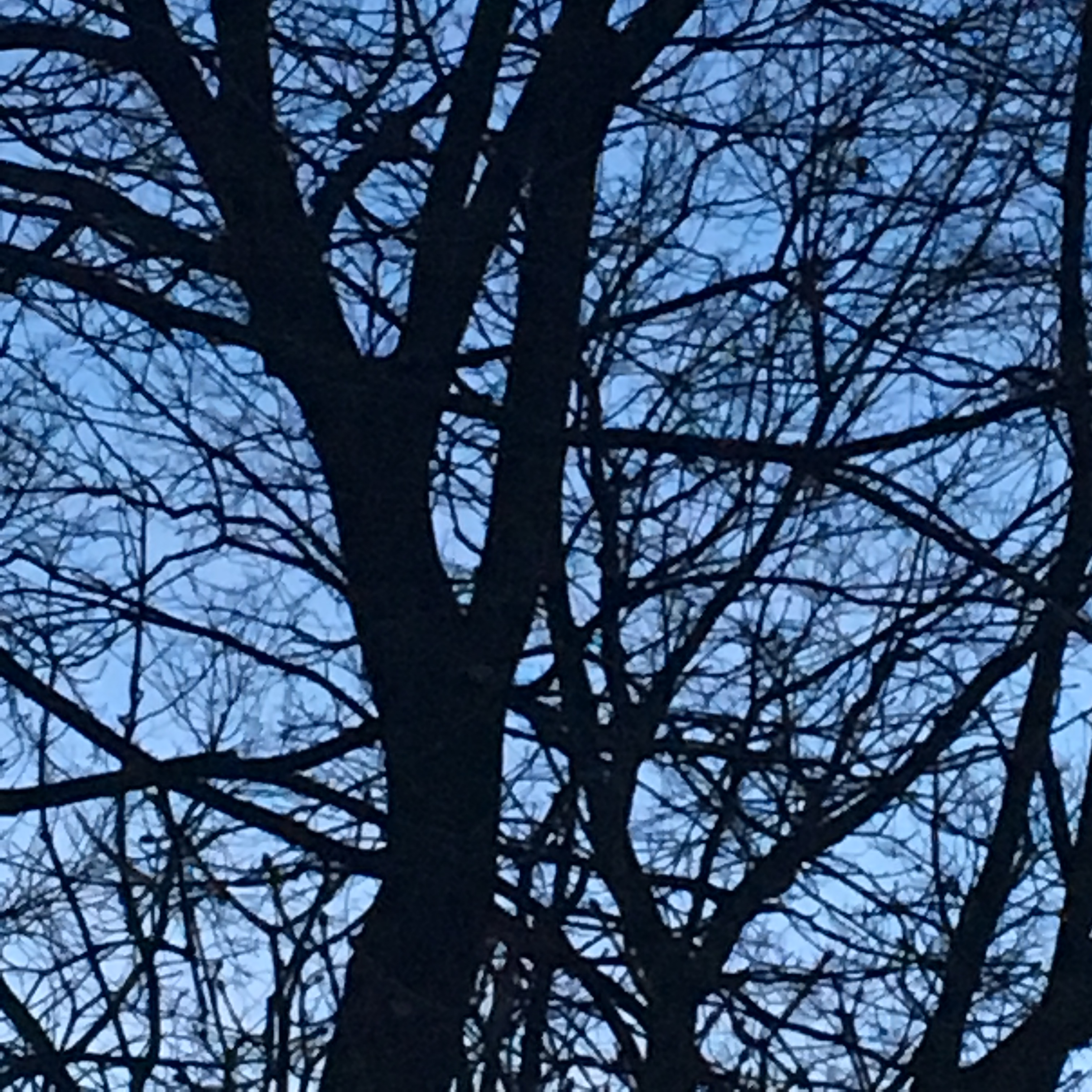
The tree in our front yard reaches toward the house. Kerri tells me that our children climbed through the branches when they were young. When the crew had to clear some branches to trench the yard, Kerri winced each time a branch snapped and fell to the ground. “I can’t look,” she said, not taking her eyes off the tree. Holding vigil. Holding her heart.

It’s easy to forget that, in all cases, no matter the eyes though which we see, the movement is always back to center. To the heart-of-the-matter. The pieces are never isolated. This tree is not separate or distinct from the sky or Kerri’s heart. The poles are always connected, whether we recognize it, see it, acknowledge it, or not. Breathe in. Breathe out. Two actions or one?

read Kerri’s blog post about THE TREE AND SKY

Kerri’s albums are available on iTunes or streaming on Pandora

Note The Beautiful [on Not So Flawed Wednesday]

There is a genius in simplicity.

Lately, one of the conversations swirling around me, a conversation I very much appreciate, is about beauty. What is a beautiful building? What makes a software beautiful? Certainly, beauty is subjective though I suspect a sunrise over the ocean is beautiful to all. A baby’s smile. A first kiss.

We are surrounded by noisy advertisements telling us what is (and what is not) beautiful. By this standard, most of us fall into the not-beautiful category. Though, deep down, we know, that the real test of beauty is not in what is concealed but in what is revealed. A warm heart is more potent than skin creme or make-up.

My niece had a birthday yesterday. She is on this earth to help people. She is creating a beautiful life. She probably doesn’t know it – and, that’s a mark of true beauty – it doesn’t need to call attention to itself.

Every collaboration I’ve had with MM was beautiful. We had fun. We explored ideas. We have nothing but respect for each other. We’ve made each other better people, better artists. When I revisit any one of the many projects we created together, I smile and feel rivers of gratitude and pride. A memory that inspires a smile is the very definition of beauty. It brings the goodness of the past into the present moment. Light travels.

20 is a master of the beautiful because he knows the power of simplicity. A heart shape torn from a piece of paper – acknowledging grief that goes beyond words. A construction paper bow. He’s not forgotten the lessons he learned in kindergarten. Laughter, he knows, is the most beautiful gift of all and we receive it from him weekly.

What makes a design beautiful? Aspen leaves shimmering in fall. I’ve stood in front of paintings by Picasso, Matisse, John Singer Sargent…and cried. They were so beautiful. I’ve held Kerri’s hand, walking on a trail, and wanted the moment to never end. Simple.

read Kerri’s blog post about THE BOW

Walk With Samuel [on DR Thursday]

“The end is in the beginning and yet you go on.” ~ Samuel Beckett, Endgame

When is something finished? Beckett wrote Waiting For Godot in 1953; characters waiting for what will never arrive. A finish. A completion. Beckett’s life spanned both wars-to-end-all-wars, Korea, Vietnam. He wrote about humanity’s dedication to nonsense. His work has been called bleak and dark. His work is shelved with the canon of The Theatre of the Absurd. And, yet, given the news of the day, these days, who doesn’t feel as if they are living in a Beckett play?

What is often missed in his absurdist plays is the beautiful human capacity to keep walking, to keep trying. Waiting and walking through tragedy, mostly of our own making, with unwavering hope. We story ourselves with nobility even when wrapping ourselves in a lie. We make rules and laws that apply to some but not to all and then we set about to justify the inequality. Money and morality are not the same thing though there’s plenty of storytelling meant to have us believe that wealth only flows to the worthy.

Art is not supposed to make sense because life doesn’t make sense. We make sense of life through the stories we concoct. Emperor’s buried with thousands of statues to keep them company in the afterlife, an artist painting the ceiling and walls of the Sistine Chapel, gods and angels and saints. How many people died building the great pyramids, tomb for a pharaoh? Who would possibly spend their life in abject poverty smearing color on canvas? Van Gogh. A legion of others not known. Are we better for it? I cried the day the Taliban blew up the Buddhas of Bamiyan, 6th century statues that I had not seen in person and was likely to never see. Were my tears more or less absurd than the Taliban’s animosity toward carved stone?

Matters of the heart. When are they finished? Where do they begin?

It was a gorgeous day, perhaps the last warm day of the season. We met our pals at the Chicago Botanical Gardens. Throughout the gardens, preparations were being made for the annual holiday light exhibit. A tree of shiny stars. Giant flowers. Faux candles floating in the waterway. Strings of colored lights were being placed along the walkways. Even during the light of day it was impressive.

In this time of transition, many of the gardens were being prepped for the winter, the pathways were packed with people cooing at the wave of the grasses, the shape of the trees in the Japanese garden. I was gobsmacked by the color of the moss on trees, the shock of red leaves against vivid green. No matter which direction I looked, someone, some special gardener and designer, had crafted beauty. They knew that their work would stop me in my tracks and allow me to whisper, “Unbelievable.”

Winding our way back to the Visitor’s Center, I told Brad that, seeing so many people out enjoying the gardens, excited to walk in beauty, filled me with hope.

To walk in beauty. Dollars and cents can’t reach the reason. Data can’t touch the impulse. There is so much light in this theatre of the absurd. Beckett knew it, writing about the stories we tell, the relationships we create, waiting for something – a beauty – that by definition, will never arrive because we are surrounded by it each and every day.

read Kerri’s blog post about RED SCULPTURE

www.davidrobinsoncreative.com

Place It In The Hollow [on DR Thursday]

For some reason, people need to leave a trace of their passage. We paint on the walls of caves. We erect monuments to ourselves and our heroes. We build cairns to mark the way for those who come behind; we build cairns so others will add stones to the marker. We put plaques on benches and engraved bricks in walkways. We graffiti bridges and walls. Banksy has made a fortune tracing his masked passage.

Growing tired as we hiked up the trail, we sat on an old log. We looked over the valley, turned our faces to the sun. And, as we stood to continue up the trail, Kerri pulled a sharpie from her bag. We left two small dots on the log. “We were here.”

Our work in the world not only can be a marker, it is a marker. Every little action is a stone on the cairn: we contribute to the whole whether we like it or not. The person who delivers packages to my door makes my life better. Easier. The score of people who created this computer, invented this software, manufactured the chip that makes it all work, have made my life better. Someone coming behind us will see the cairn we’ve constructed and add to it. Improve upon it. The first computer I touched was a toy compared to this miracle sitting on my lap.

I’m an artist and sometimes wonder if my paintings will live beyond me or will they end up in the Goodwill as so much used canvas. I hear the advice, so often offered to me: “Yours is to paint them, not decide what happens to them.” Too true. Mine is to make the offer. I have no control over the acceptance.

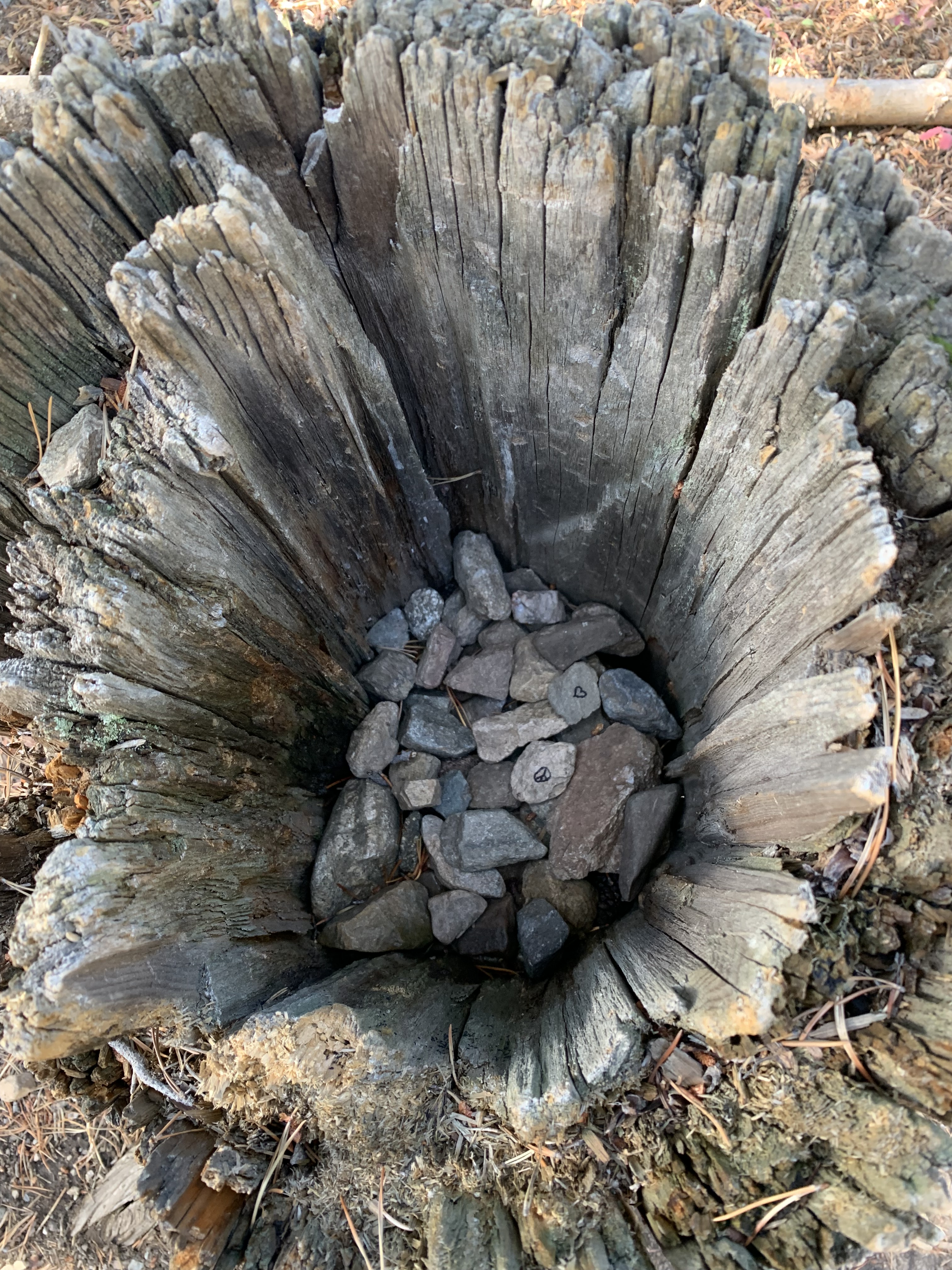
Returning down the trail, Kerri peered into the hollow of a stump. It was filled with stones! Hikers, just like us, had left a note that also served as an ancient invitation: I was here. We picked up stones, the sharpie came out of the bag, scribbled a heart and a peace sign on our rocks before placing them in the hollow. “Do you think anyone will see our stones?” Kerri asked.

An ancient question. Deeply human. Heart and Peace.

read Kerri’s blog post about THE HOLLOW

three graces © 2012 david robinson

See The Shape [on DR Thursday]

The Balinese would call this an auspicious day. They would never perform a funeral rite on a day that was not promising. This soul will come back in seven generations and requires a providential sending.

The Greeks placed coins on the eyes of their departed loved ones. Fare for safe passage over the river Styx.

Columbus’ son will give his eulogy. His son-in-law will guide the ritual. His granddaughter will sing for him. His daughter-in-law will play her compositions, prelude and postlude, and sing a special song for him. His coins are his family. They will pay his passage. Actually, that his family will perform every aspect of his service – his sending – is testament to his earth-passage, what he did during his time while walking on this planet.

Heart.

We laughed while driving across Kansas. The day was fraught with obstacles. Breakdowns and high winds. “Columbus is making this trip eventful,” I said. He was full of mischief.

“I can see that sparkle in his eye,” Kerri responded. Nothing was going to stop us from getting to his service. Nothing. Not even mischief.

I have often been asked, “What is the shape of your day?” A curious question to ask a visual artist. “Not flat nor two-dimensional,” I think but do not say. “Certainly organic. Not geometric. My days are rarely geometric.” I never know what lines-of-thought or surprise events actually close to give definition to my day until the end, when I stand back and look at the whole. That is true for all of us. No one knows the shape of their day at sunrise.

Today, the lines have closed so we gather to look at the shape of Columbus’ life.

Heart. Big heart.

read Kerri’s blog post about HEART LEAVES

Columbus circa 1998

See The Good [on KS Friday]

“…the measure on ones mental health is the ability to see the good in everything. Perception is the key.” ~ Kristine Klussman, Connection

If I kept a gratitude journal, my entry yesterday would be that Bruce was happy. I could hear it in his voice. Although it had been seven years since we last spoke, we talked like we were picking up a conversation from yesterday. Life has changed dramatically for both of us.

It seems we have both reached the revelation of simple appreciation. No longer focused on the big stuff, we talked of the sweet moments, the moments that feed our souls. He asked me to describe my days and I was happily taken aback to tell the tale of walks on trails, beginning each day writing posts with Kerri, ending each day with a glass of wine. Drawing cartoons. A dog that runs enthusiastic circles. Good friends.

I am reminded again and again that goodness is not found in the world. It is brought to the world. We don’t perceive what is already “there,” we wrap what is “there” in a story-blanket. We give it meaning. And then we feel the impact of the meaning we give it. Viktor Frankel famously wrote that “Happiness ensues.” It follows. Despair ensues, too. Anger, too, if that is what is brought.

Earlier this year a friend asked how Kerri and I were doing amidst the job losses and broken wrists. I responded that our circumstance was dire. It was. It just didn’t feel that way, so full was our sense of appreciation. In the midst of a dire circumstance, we started our days writing. Good friends called. DogDog ran enthusiastic circles and made us laugh. We sipped a glass of wine at the end of each day and enjoyed our simple meals. Today, things are less dire and, although we are still standing on shaky ground, we start each day writing together. We hold hands and take walks. We breathe deeply the smell of coffee in the morning. Our gratitude for our days has not changed a bit. Good moments are everywhere.

And today, Bruce is back in touch. He is happy and his happiness, like all happiness, comes from a hard decision that took tremendous courage: he decided to see the good. To bring light. To be light. He is doing the work of savoring the good moments that he now sees all around himself.

good moments/this part of the journey is available on iTunes and streaming on Pandora

read Kerri’s blog post about GOOD MOMENTS

good moments/this part of the journey ©️ 1998 kerri sherwood

Get To Work [on Two Artists Tuesday]

On page one of the despot’s handbook is this instruction: silence the artists. Mute the intellectuals. Authoritarians have power only when people become sheep. Silence in the face of abuse is tacit agreement. Permission to bully.

If I had a nickel for every time I’ve stood before a school board and explained that art is supposed to be powerful, that it plays a very important role in a healthy society, I’d have a lot of nickels. I was generally called to speak when a play or a painting upset the apple cart, when the art made the community confront a truth or look at a reality. Brecht’s Epic Theatre or the plays of Artaud were/are meant to shake the irrational in people, force them into discussion and revelation.

Art can be beautiful, poetry can soothe, but that is only one side of the coin. It can also shine a light and expose an ugly truth. It can give voice to what is not-being-spoken. It can work out problems on the stage instead of sending the violence into the streets. It can ask us to take a hard look at ourselves and our motives. Picasso’s large painting, Guernica, a response to horror wrought by fascists on the people of a town in Spain, is a powerful art-mirror.

The conscience of a community, like the conscience of every individual that comprises the community, lives beyond the superficial, it bubbles in the place beyond words. An artist’s job is to reach into that place, pull the veil for a moment, root or re-root the community in its values.

A despot’s job is to secure a unanimous vote, no questions asked. Sheep.

Art is not superficial. It is not the image or the words on the page. It is what the image, the words, the dance, the music, touch. Hearts. Souls. Conscience.

Without it, what remains is propaganda. Propaganda is never news, it is the opposite of art. It snuffs the question, it prevents the quest for meaning and deep-felt-truth. Without it, communities flatten, lose their center, wither, and fall apart. Silence, eyes downcast or sideways glancing. Permission to bully. Sheep.

It’s time for the artists to get to work.

read Kerri’s blog post about ARTISTS

Make It Flexible Again [on Two Artists Tuesday]

This is a tale of two quotes. They collided in my brain while I pondered this wacky year, diverging realities, repeated historical patterns, and why I have yet to rake the leaves. You might conclude that I need to relax or that I have too much stuff wafting through my noggin and, as Thom taught me to say, “you might-could” be correct on both counts. Quote #1:

“Sometimes the best way of caring for you soul is to make flexible again some of the views that harden or crystalize in your mind; for these alienate you from your own depth and beauty.” ~ John O’Donohue

Kerri is a series photographer. She has dozens of photos of heart shapes found in nature. Heart rocks, heart leaves, heart water stains. Lately she has started two new series: 1) Trains through trees, and 2) Horse poop on the trail. I rarely bring my phone on our walks or I’d inundate you with images of my artist-wife kneeling to get the best poop shot [I’ve been instructed to tell you that the horse poop series is for use in commentary and not merely aesthetic].

I am an artist and given to looking at my world, but Kerri constantly surprises me with what she sees. She opens my eyes to what I might miss: the beauty all around me. If I could give a gift to the world it would be what she gives me: to see beyond what I think I see. We see what we believe – often without question. There is no better way to atrophy the mind/heart/soul than to see only what you believe. “To make flexible again some of the views that harden or crystalize in your mind.” Can you imagine better medicine for what ails our angry, divisive nation?

Quote #2: “Creativeness is finding patterns where none exist.” ~ Thomas Disch

We stopped at IKEA for 20 to pick up some furniture. In the few moments that it took us to run in, pull the boxes, move through the register line, and run out, Kerri took a series of series photographs. IKEA is a gold mine of pattern. There are patterns within patterns. Her love of shooting photos set up for me a dichotomy, a social observation. She came alive finding patterns, capturing patterns, breaking patterns. She climbed over ropes, into shelves, crawled into tight spaces, and wriggled between stacks to get the shot she wanted. The rest of the people in the check-out line were either bored, impatient, or otherwise lost in their minds. For them, waiting-in-line was the only pattern that existed. I laughed at the contrast, the utter vitality of Kerri’s enthusiasm played against the dulled-cart-pushing of the crowd.

Sometimes there is a sea of pattern dancing right before our eyes. It exists. It surprises. It inspires and challenges. Creativeness, the vitality of living, requires nothing more than opening our eyes and engaging the world that sparkles beyond our burdened minds and worn-out belief.

read Kerri’s blog post about PATTERN

Become A Heart Symbol [on Not So Flawed Wednesday]

Almost anything can become a symbol. Almost anything can be made a symbol.

Symbols are very powerful, probably more powerful than we realize or are willing to admit. People die defending them. People die attacking them. They can serve as a moral compass. They can be a siren call and entice entire communities to crash on the rocks of devastation. Symbols can unite. They can divide. They can clarify. They can obscure. In almost every case, symbols serve as the defining line between Us and Them. They identify.

As a servant to identity, a single symbol can facilitate diametrically opposing points of view: hope and threat. It can be the taut rope in a social tug-of-war. Crazy things happen when, within a community, a symbol runs in opposite directions. We are witness to that today through the symbol of the “mask.” Some see a mask as communal responsibility. Some see it as a threat to individual freedom.

The challenge with any potent symbol is that it burns either through the heart or the guts. Only then does it run to the brain.

For instance, mask-wearers begin their symbolic journey in the heart. The symbol of “mask” is proactive. It signifies service to others and community protection. It unites in a common cause. It runs in the direction of hope. Giving. Inclusion. For them, a mask is a positive symbol. It confirms and accepts science, data, fact. It adapts to new information. It grows.

Mask resisters begin their symbolic journey in the guts. For them, the mask represents a fear of personal loss. It is a divider. It runs in the direction of threat. The symbol is reactive and signifies service to self. Exclusion. A mask, for them is a negative symbol. No amount of data or fact can assault a negative belief. A gut inception inflames the brain. It entrenches.

We’ve heard that, where mask wearing is concerned, there is a declining vigilance of the public. I wonder if that is true. I suspect the perception of declining vigilance is actually a matter of noise. Those who operate from their guts, their fear, will do anything, are capable of any and every form of cage-rattling. Theirs is a symbol of distress and is loud and enraged as is the case with most “me” focused symbols.

Those who operate from their hearts are generally quieter. They know the restraint that compassion brings. They are focused on the betterment of the entire community, including the fearful, so, as is true of most “us” focused symbols, calming the panic is an essential aspect of the action.

I doubt that vigilance is in decline. The fearful gut is screaming louder, garnering attention, daring to be made to wear a mask, cranking up the volume, loudly crying “hoax” – all the while knowingly spreading the disease.

In the meantime the quiet heart, the larger part of us, moves masked through each day. Hope need not make noise or news or announce itself. It is satisfied simply by doing the work of community, the real work of public vigilance.

read Kerri’s blog post about DECLINING VIGILANCE