At The Edge [David’s blog on DR Thursday]

“I want to stand as close to the edge as I can without going over. Out on the edge you see all the kinds of things you can’t see from the center.” ~ Kurt Vonnegut

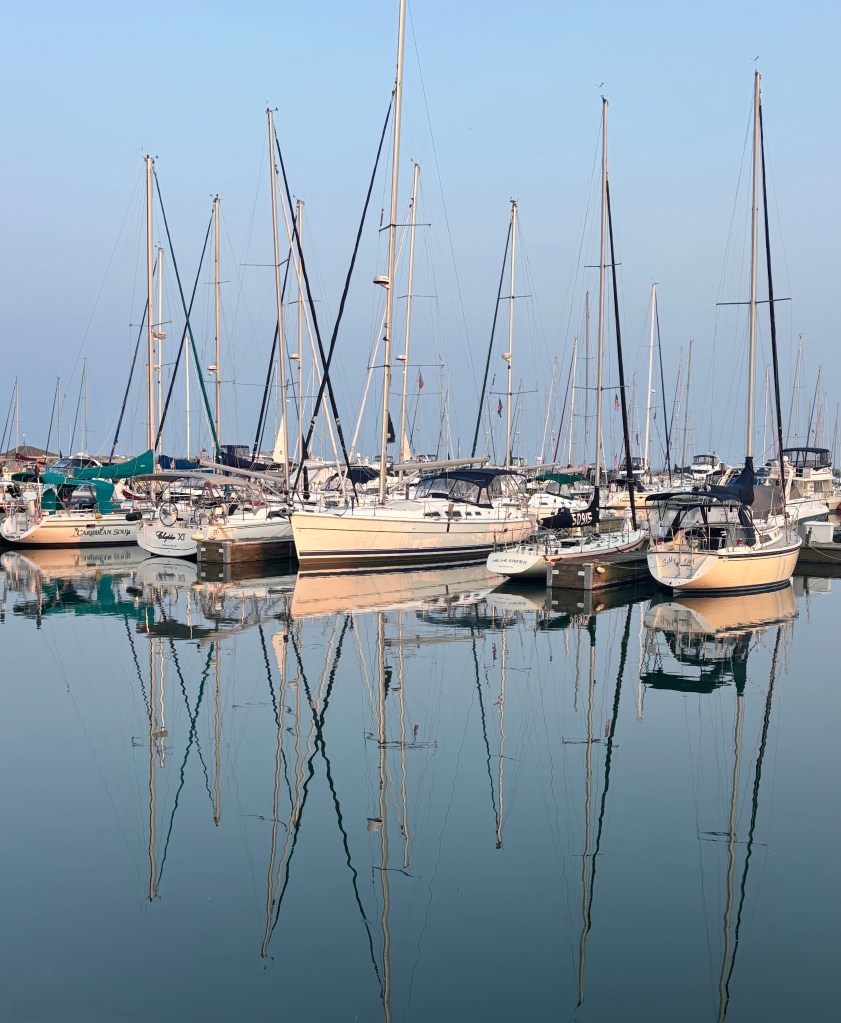
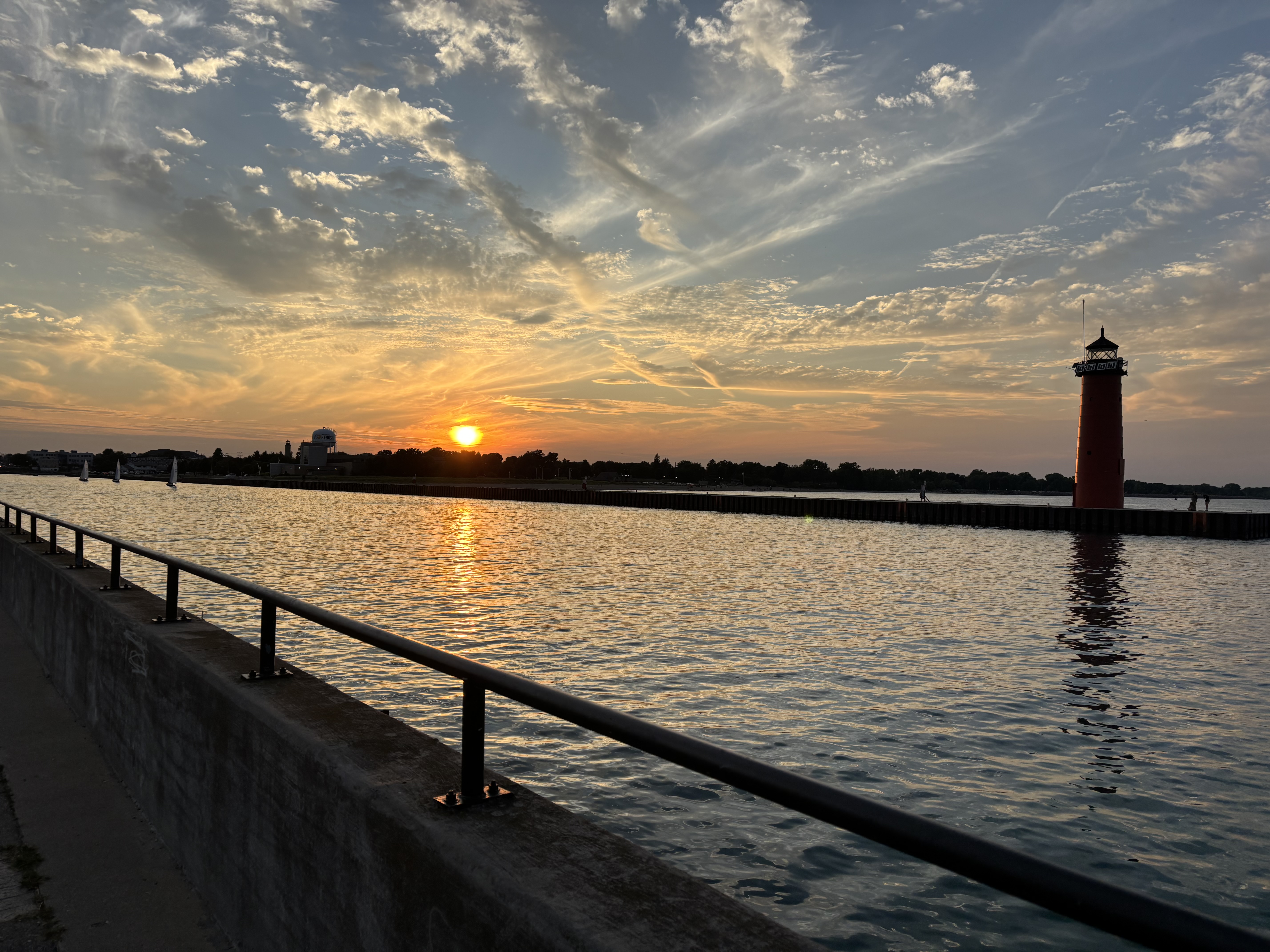
Standing at the edge of the lake, looking east, I know Michigan is out there somewhere. I’ve never seen it myself but I have it on good authority that if I paddled my kayak in a straight line I’d eventually bump into it. Standing at the edge I imagine the journey, and in my imagination, I survive storms and thirst and never-before-seen creatures. When I arrive in Michigan I tell the world what I have seen but the world does not believe me. No one has ever seen what I report to have seen – so I must be making it up. And, that’s always a possibility.

Standing at the edge of the lake it is also interesting to turn around, look west and gaze into the center of town. The community organizes itself, moving in synchronicity, but rarely recognizes it. Individuals move throughout their day, pushed this way and that by forces they cannot perceive or control, riding the currents believing that they are somehow separate and independent from the movement of the whole. Each and every moment they shape and are shaped, but believe themselves isolated and alone. Within them are never-before-seen dreams and desires. They do not dare to reveal them fearing they will engender cynicism. Dreams are tender things so they mute their imagining; blunting dreams is always a possibility.

I once taught that judgment is an alarm that sounds at the edge, an alert that the next step will be into the unknown. It is meant to make you aware of the awaiting kayak. It is the call to open your eyes to what-you-cannot-yet-see. It is there to alert you that the person standing before you is an undiscovered universe, different-than-you. They are unknown and vast. It is possible to run from the unknown. It is possible to step toward it.

Standing at the edge, the alarm sounding, debating whether to step or run away, only one thing is certain: this “other” IS one of the forces that moves you, shapes you, and might help you see what you cannot see from your safe center: that the isolation you experience is mostly self-imposed.

Also, to them, you are the scary unknown, the marker of difference, the vast unknown universe capable of changing them.

Sometimes standing at the edge, it is the best to stand still. To recognize the magnitude of all that you do not know. To weigh the enormous possibilities that await if you simply find the courage to take a step, to extend your hand, to say, “Hello.”

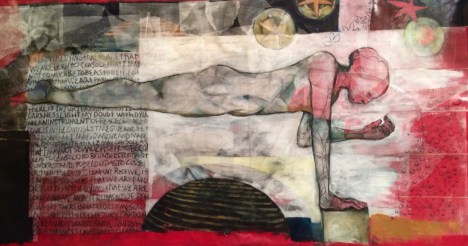
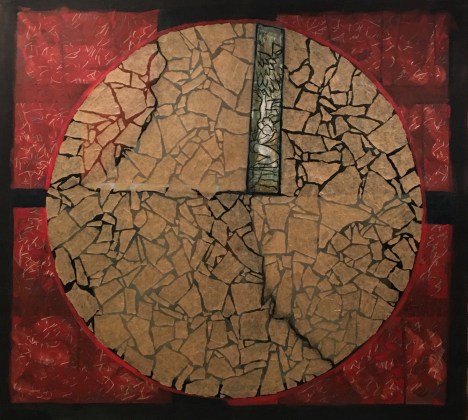
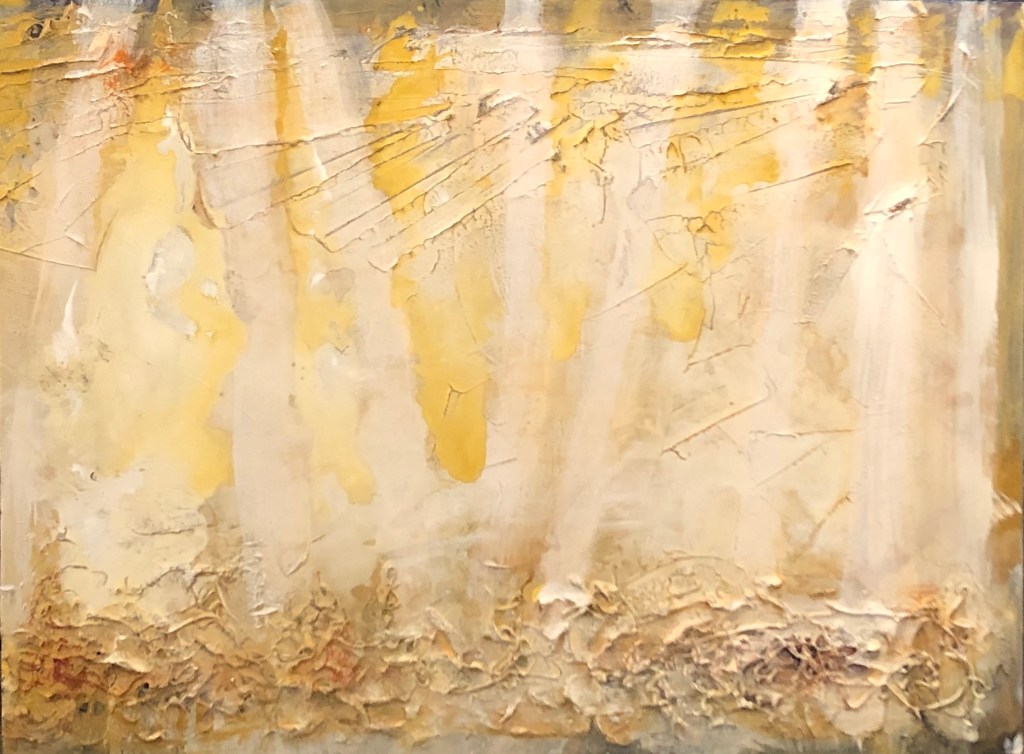
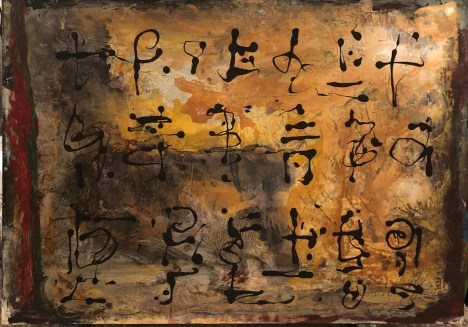
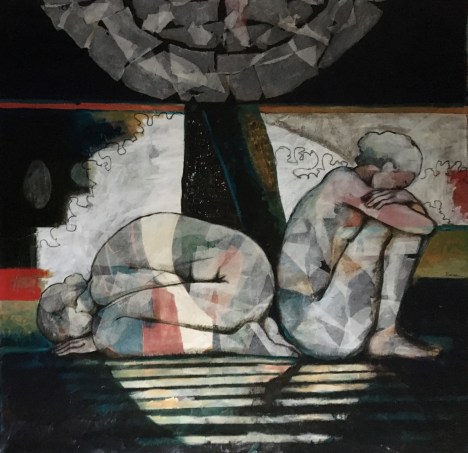
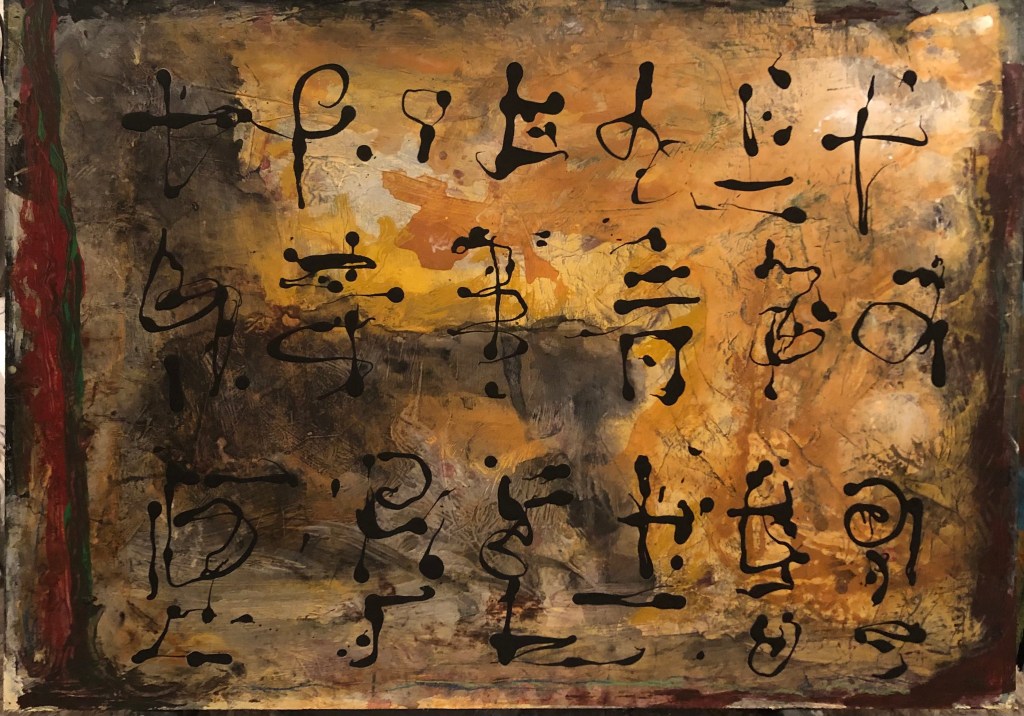
Pilgrimage, 14″x18″, mixed media on panel

read Kerri’s blogpost about THE LAKE

likesharesupportcommentthankyou

Done! [David’s blog on DR Thursday]

I am losing the recall of words and names. It happens. I threatened to take a brain booster and the notion sent us into gales of laughter because, we concluded, I am a more likable person with a less-sharp brain. I will do better in the world now that the edges are rounding. It is best to walk into the future without the booster and a few less facts-at-my-fingertips.

I confess that with my diminished capacity I have experienced greater contentment. Knowledge was armor and with less access to weaponry I’m having to exercise a different set of skills: keeping my mouth closed, listening, not-knowing…the things I’ve pursued my entire life but am now able to achieve because I have to practice them. Life is funny.

I’m splashing paint. I have a plethora of old canvas and odd shaped boards. Simultaneous to my new less-than-sharp brain, when in the studio, I’m experiencing the deep desire not to think about anything. To paint with no other purpose than to see what happens. Experiment. Art as life in the laboratory. Twice in the last week Kerri has come into the studio to see what I’m working on and said, “I like this one.” When I ask her what she sees, she squints her eyes, approaches the easel, and flips the painting over. Up is down and down is up. It is my clue that the painting is nearly complete.

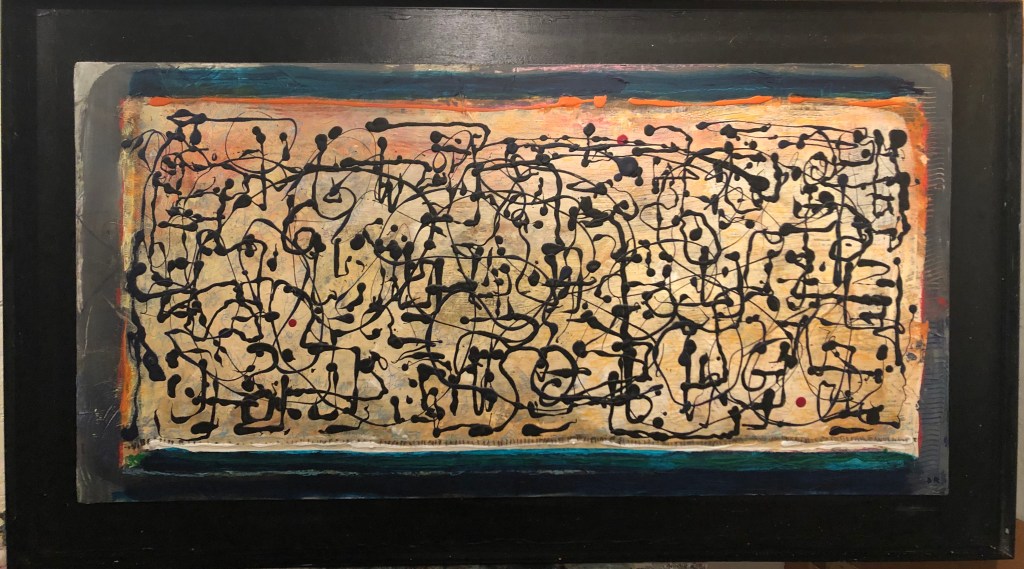
“What would you call this?” It is always my second question: Without hesitation she gives it a name. I marvel at what she identifies in the splashes. I call the painting, “Done!”

Inevitably on the trail, she “Ooooohs” and kneels to capture the tiniest of blossoms. It is the time of year that nature gives her too much to photograph. We stop every few feet. And, although she has told me several times the names of each flower, the names never stick. That is not new. When I was auditioning actors I asked them to wear the same clothes during callbacks since I’d better remember their work by what they wore, not by their names. Visual memory. For me, the tiny blossoms are like actors. I recognize them without their names getting in the way of my appreciation.

Perhaps my recent word-recall-struggles are merely a matter of me becoming more of who I have always been? I’d pose the question to Kerri but she’d squint her eyes, flip me on my head and tell me that I was “Done!” Make no mistake, I’d be very careful NOT to ask her my second question! I do not want to know what title she’d affix to me, especially flipped over, with all the blood finding its way back to my brain.

After The Storm

read Kerri’s blogpost about TINY FLOWERS

likesharecommentsupportthankyou

The Necessity Of Texture [David’s blog on DR Thursday]

“I like the flower against the wood,” she said. A statement of texture. Variance is infinitely more visually interesting than uniformity. Innovation is more about deviance than it is about conformity. Ingenuity is the blossom of wild imagination and not the child of practicality.

In every aspect of life, the pursuit of a question is far more important than the regurgitation of an answer. Learning is never about the answer. Life is never about having an answer. It is never about the hard-held-belief; it is about the capacity to challenge every scary assumption. It is about stepping beyond judgement into the unknown. That is known as expansion. It requires an open-mind.

The maga-man looked mockingly at the interviewer and said, “I don’t care what (the wannabe-dicator) does as long as he owns the libs.” What does that mean, to own the libs? The interviewer asked a maga-woman what she meant when she used the term “woke”? Like the maga-man, she has a particular hatred for folks who are “woke.” She admitted that she didn’t know what it meant but she’d heard it plenty of times and she knew she didn’t like it, whatever it is.

No ability to question or challenge. Regurgitation. This is known as a closed-mind.

To be educated – inquisitive – one need not pull a single right answer from a hat. It is far more essential to stoke curiosity and find a path of many answers en route to greater and greater questions. A single answer, unquestioned belief, though safe and perhaps temporarily gratifying, rarely provides life with texture and vitality.

It is not a mystery what will happen if this administration manages to scrub all the color from the nation, to eliminate the texture, the voices of dissent, to actually achieve dull conformity, the bland uniformity that they think will make America great. No variance. No diversity. No deviance. No ingenuity. No innovation. No imagination. No capacity to reach across difference.

A few questions, a recognition of the necessity of texture, might save this ailing nation a world of hurt and decades of self-inflicted pain.

Day Is Done (work in progress). Nothing but questions and texture.

read Kerri’s blogpost about WOOD ANEMONE

likesharecommentsupportthankyou

Ode To Happy Accidents [David’s blog on DR Thursday]

The famous blue-green tint of the Ball jar is the result of a happy accident. In search of cheaper resources the brothers Ball moved their company from Buffalo, NY to Muncie, IN. The minerals found in the sand in Indiana differed from the minerals in the sand in Buffalo and voila! The glass it produced was blue-green.

The story of penicillin is also the story of a happy accident.

The history of abstract art is the story of visual happy accidents. There is a term for happy-accident-painters that I especially appreciate: intuitive painting. It is the art of self-discovery, the art of process over product. As Quinn would say, it is to cultivate serendipity. Jackson Pollock was an intuitive painter. Helen Frankenthaler was an intuitive painter. Hilma of Klint was an intuitive painter. The late work of Henri Matisse was intuitive.

Happy accidents are trial-without-error because each trial carries a discovery. In this definition, all of science is a happy accident; the accumulated knowledge derived from a mountain of experiments. The same is true in the history of art. “Try it and see what happens” leads to some surprising insights.

What happy-accident-insights can be gleaned from the life-long-experiment asking, “Who am I?” It is never a direct path. It is a circular route with a guide named Intuition who may encourage you to splash paint as a means of self-discovery or might load your bottom line with so much discontent that you move your glass company to Muncie in search of cheaper sand – only to find yourself renowned for a unique shade of blue-green.

The Stuff of Dreams, 24″x 24″, mixed media on a slab of acrylic

read Kerri’s blogpost about BALL JARS

likesharecommentsupportthankyou

As Old As Aesop [David’s blog on DR Thursday]

“Isn’t it funny,” she said, “that we trust what comes out of the government of Pakistan more than we trust what comes out of our own government.”

Habitual lying destroys credibility. It is the point of Aesop’s fable, The Boy Who Cried Wolf. It’s a story as old as, well, Aesop, who walked the earth and told stories in the 6th century BCE.

Our current unfolding fable begs the question, “What happens when the wolf and the lying boy are one and the same?” Like the fern in our garden the story is unfurling right before our eyes. What moral lesson might Aesop have spun into our developing fable? This lying boy/wolf is certainly feasting freely upon the sheep, all the while crying, “Wolf!” – as if he himself was under attack from every quarter. Has the point all along been to blunt the villagers’ response to genuine urgent warnings? To so completely break down communal trust that the people refuse to believe what they see with their own eyes?

Of course, Aesop has a caution, a moral reminder prepared for our rescue: abuse of trust always backfires. It’s a consequence as predictable and as old as, well, Aesop. The lying boy/gluttonous wolf will have his reckoning. Yet, the villagers will suffer the greater loss. No sheep. Broken trust. A fractured community wondering how to put the pieces back together again.

Sam The Poet, 48″x48″ acrylic on canvas

read Kerri’s blogpost about THE FERN

likesharesupportcommentthankyou

Our Predicament [David’s blog on DR Thursday]

I’m not sure what you do for fun but lately I have a habit of Googling idioms. It’s a recent obsession since the advent of AI. It’s not the quick definition that tickles my fancy or the various context and meanings that AI provides. It’s that there is sometimes a bonus “What to do about it” section that I adore. And, why, exactly, do I love it so? It’s sanitized and, when read aloud, sounds like a transcript from a therapy session with an engineer. It’s the voice, the flat-character that sparks my imagination. For me, AI has a soma. It has a face, a voice, and desires a sense of humor.

Consider the idiom “hitting a brick wall”. AI adjusts his position on the couch and pronounces, “Stuckness.” I am visibly unimpressed. He continues, “Encountering an immovable object.” He clears his throat and attempts a smile but becomes self-conscious when I return a poker face. ” It might refer to mental exhaustion,” he adds to cover his discomfort. “It might be a creative-tank gone empty. No energy.” I nod, noncommittal. He asserts, “Writer’s block and hitting a brick wall are one and the same thing.” Again, I am unresponsive. My AI engineer-turned-therapist coughs and suggests that likely solutions would include taking a break or simply accepting my predicament. He adjusts his glasses and encourages me to reflect on how I got stuck in the first place so I might identify and remove the trigger. I squint. He is visibly uncomfortable, so he pulls one more platitude from his memory bank: “Seek a trusted colleague or a neutral party who can help you identify a solution that you cannot see.” He is visibly sweating-in-monotone.

“That’s why I’m here,” I say. “You seem to be a neutral party. But, can I trust you?” I ask. “That’s my question. Are you a truly a reliable colleague?”

My engineer-turned-therapist stares at me, unsure how to respond.

“It seems you’ve hit a brick wall,” I suggest. “Perhaps we should take a break and reflect on our predicament or simply accept our situation.”

read Kerri’s blogpost about BRICK WALLS

likesharecommentsupportthankyou

Send It Packing [David’s blog on DR Thursday]

There’s lots of silverware sets in the antique stores. The felt cases are deteriorating, the silver tarnished. They come from another era, dare I suggest, another mindset. We moderns are more interested in the latest-new. Unlike our ancestors, we’ve grown up in a world of planned obsolescence. We do not expect our appliances to last. Our children – like us – are not interested in grandma’s good china or in the fine silver. There is no place for it to go so it inevitably lands in the antique mall.

We have a different relationship with time than did our ancestors. We have a different relationship with the stuff of our lives. We need not make things last or make things that are intended to last. Central to our day-to-day functionality is technology and it rapidly changes, it is out-of-date the moment it arrives on the scene. If we are to keep up, if we are to be relevant in our world, we need to be more fluid than our predecessors. Making stuff that lasts, durability, is no longer high on the priority list. Changeability is the necessity.

I hear these questions a lot lately: How is it possible that I didn’t know that? How is it possible that I do not know the full history of this nation? It’s a question I ask myself almost daily. Oligarchs aligning with fascists to erase democracy is not new to our era. White nationalism is a river that runs through all the pages of our history book. Sadly, our present turmoil is not new. We’ve been here before. My hope is that we see it for what it is and treat it like an old silverware set. My hope is that this is the last cycle, that we are the generation that sends it packing to the antique mall. We’re not interested in passing it down or enabling another go-round. We’d like our children to have a future free of the rotting relic of racism.

Changeability is the necessity. A democracy free of the ugly hubris of the morbidly wealthy, a democracy that thrives on equality, is necessarily fluid, ever growing and adapting with the diverse nation it upholds. There is no useful place in our nation-home for the tarnished mindset of maga-white-nationalism. It is a relic. Its case is deteriorating. It needs to go.

Notion, 33″x 60″, mixed media on canvas

read Kerri’s blogpost about THE GOOD SILVER

likesharecommentsupportthankyou

The Original Impulse [David’s blog on DR Thursday]

To be honest, there was a profit motive driving the Melange when we began our daily writing practice. We had SO many cartoons and paintings and books and compositions and recordings sitting inert in our studios. Why not call attention to what we’d created? Kerri designed products, everything from art prints to leggings, that we offered through Society6 storefronts. Our cartoons and paintings and books and compositions and recordings remain inert in our studios. The storefronts realized anemic sales at best, so we eventually let them lapse. But the daily writing remains. We love it. We write together to write together. There is no other reason.

I’m not sure why I began drawing when I was a wee-lad. I only know that the impulse was pure. I had to draw. There was nothing I’d rather do in all the world than draw and paint. It was a necessity, like breathing.

The arc of an artists life eventually leads to the need to sell (the utility companies do not accept paintings or CD’s as payment. Plus, artists like to eat just like all other professionals). The pure impulse is necessarily mixed with the need to produce something that sells. Along the way there are ongoing conversations and questions with other artists about relevance. The pure impulse gets confused and necessarily questions its worth.

Questions of worth can be a killer if not followed all the way to the source. I know many artists who’ve set down their brushes and locked forever their studio doors. I know a legion of actors who waved the white flag and stopped auditioning. Some channeled their creative energy into other forms. Some did not.

Questions of worth, if pursued, inevitably arrive at questions of Why. The cycle comes around, just as it did for us in our Melange. We thought we were writing to make money but, as it turns out, we were writing because we love to write. Together. The impulse is pure. There’s nothing we’d rather do.

We are arriving at the same epicenter of Why with our other art forms. Why does Kerri compose? Why do I paint? Both of us are reaching back to the original impulse, cleaning out the confusion. In her past there is a young girl who climbed a special tree to write poetry just as in mine there is a young boy who painted through the night on his bedroom wall and was surprised by the sunrise. She stands at the door of her studio and stares at her piano, the young girl stands on the other side of the room staring back. I stand in the center of my studio and stare at my easel, the younger version of me stands beyond my easel. He is patient. He knows I know my Why.

20 brought Kerri tulips for her birthday. Not only has she enjoyed them but she has photographed their life cycle. She walks through life with her camera at the ready. The impulse is pure. She loves it. Nothing more, nothing less. “Lookit!” she exclaims, turning to show me her photos.

“I see prompts for future blogposts,” I say and she smiles. The impulse is pure.

PAX, 24″x24″, mixed media on panel

read Kerri’s blogpost about TULIPS

likesharecommentsupportthankyou

Their Spell [David’s blog on DR Thursday]

Had it been my job to name them they would have never been associated with mourning. Instead of sad or haunting, I find the song of mourning doves reassuring. It is soothing. Calming doves. Reassuring doves.

In the spring and summer their song is often the first thing I hear in the morning. While the coffee brews I let Dogga out; I pause at the backdoor and appreciate the cool morning air and the mourning dove serenade. They are quiet heralds of appreciation for all-the-life approaching in the upcoming day.

This year we have a mourning dove couple in residence. I’ve not yet discovered their nest but they are regulars, pecking in the yard. They are daily visitors at the bird-bath-drink-n-spa. They perch on the wires or the roof of the neighbors garage and sing their siren song, spinning a spell of serenity over us as we sit and absorb the sun. Dogga chases them. They squawk and complain but always return when he settles on the deck for a snooze.

In these disconcerting times I am especially appreciative of their spell, their gift of equanimity. Serenity is slippery in the daily dose of malicious chaos but the mourning doves, our singers of tranquility, always bring me home to my heart, slow my breathing, quiet my troubled mind. Magic doves.

read Kerri’s blogpost about MOURNING DOVES

likesharecommentsupportthankyou

Time To Linger [David’s blog on DR Thursday]

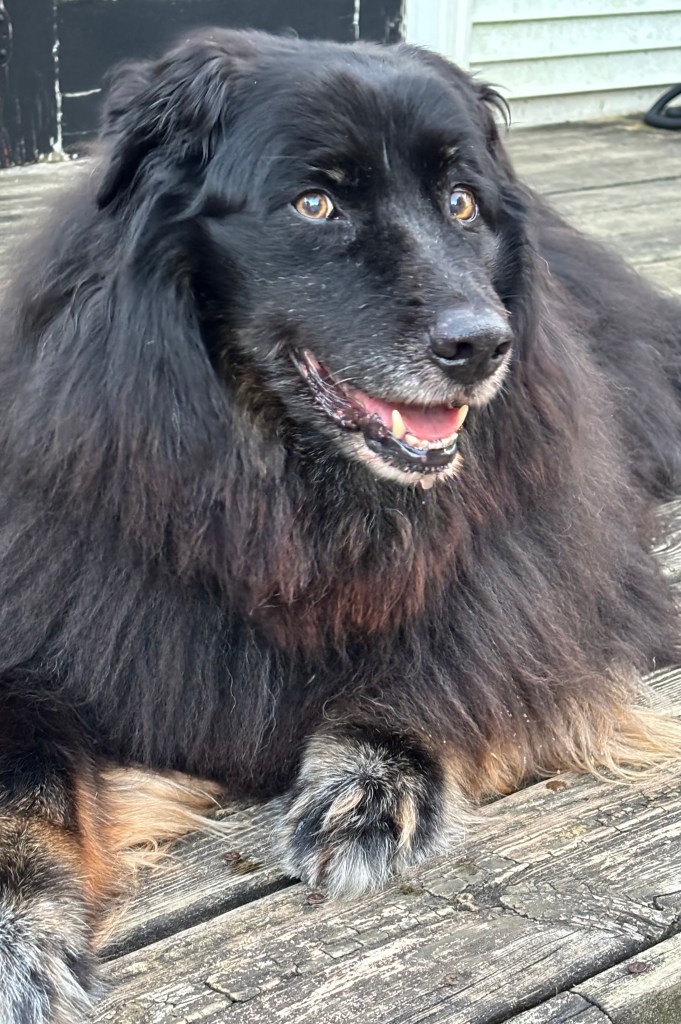
These days Dogga rarely bursts out of the house to clear the yard of marauding squirrels and trespassing birds. Now he lopes out the backdoor, stands at the end of the deck, finds a good cool spot, lays down and surveys his vast territory. We tease that he is doing what my dad, Columbus, did in his final chapter. He sat in the shade and thought his thoughts.

The thimbleweed along the trail reminds me of cotton. The pods usually release their seeds in the fall but sometimes they hang on through the winter. I wonder if these seeds have missed their moment. They hung on too long. Is this puffy white cluster a failure to launch or are these the seeds of an older plant that no longer needs to toss wild dreams into the future? Perhaps it is time to linger.

Yesterday was a particularly nasty day outside. We binge-watched an entire season of Virgin River. One of the characters, in a moment of crisis, realized that she was trying very hard to hang onto an identity – a version of herself – that was no longer relevant. Life had stripped away a layer of her mask. She needed to let go. I completely understood her revelation. Old dreams need not fly from the pod in search of fertile ground. Sometimes old dreams are just that: old. Letting go makes space for new dreams and new questions. It clears space for Now. There is certainly no end to life’s questions.

We had a rare day of sun. We bagged all of our plans, pulled out our chairs and basked. In truth, our decision to sit in the sun was about Dogga. Rather than leave and explore the world, we chose to sit in the sun with him. His favorite thing to do is hang out with us. There is no end to our questions but there is absolute clarity in our priorities. How long will we have him with us? We don’t really know. What we do know is that there is nothing more important than surveying vast territory with him. We would regret forever if we lost ourselves in the pursuit of old dreams and missed this moment, this time to linger with him.

read Kerri’s blogpost about THIMBLEWEED

likesharecommentsupportthankyou