Take A While [David’s blog on Two Artists Tuesday]

“You have traveled too fast over false ground;
Now your soul has come to take you back.

Take refuge in your senses, open up
To all the small miracles you rushed through.”

~ John O’Donohue

Even now the cardinal is singing. The early sun warms the quilt covering our feet as we write. Our morning practice of writing blogs together is never rushed. We tease that the editors are tapping their feet, unhappy with our dedication to meditative process evolution. Since we both seem to have issues with authority it is among our favorite games to torture our imaginary editors who are terminally deadline-driven and burdened with our snail’s pace, our too-generous-very-slow writing practice. The editors hate that I stare out the window and daydream. They roll their eyes when Kerri says, “This may take a while.” They desire us to be more “nose to the grindstone”. And isn’t that a happy phrase!

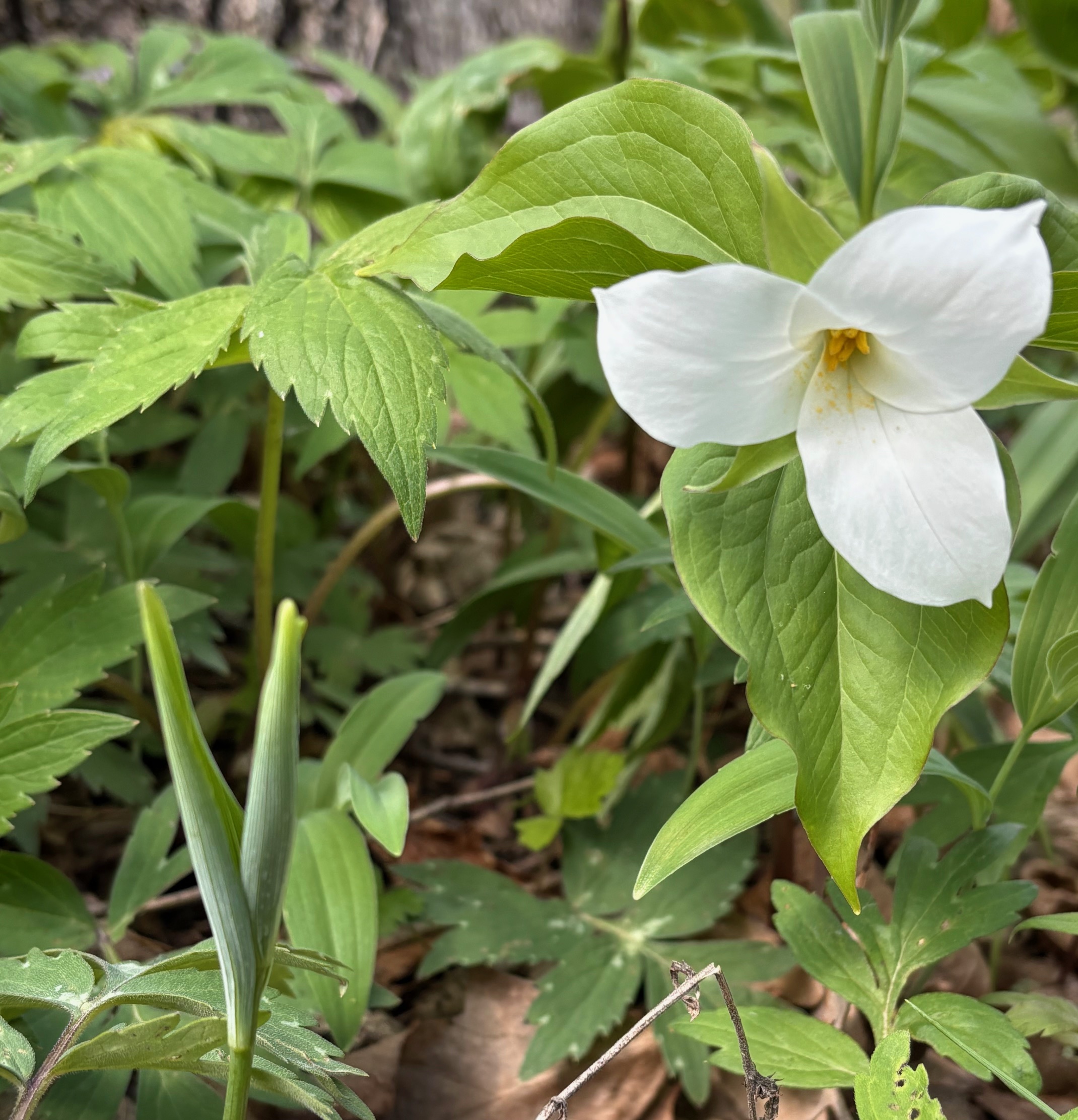
She tells me that it is impossible to get a good photograph of the white trillium unless it is in the shade or the day is cloudy. The sun bounces off the white petals and blows out the image. The day was cloudy so she was excited to find the perfect trillium. While she knelt to take her photograph I closed my eyes and stood still. It is what I do now when we stop for a photo op. Listen and feel. It is good advice to take refuge in your senses; to open up.

Though I adore his poem I imagine that John O’Donohue had it backwards. The soul does not come to take you back. I imagine it has been there all along, waiting. It knows that sooner or later we stop trying to find “it” in some distant future or some grand achievement. Soul waits for us to stop running. It waits for us to stand still enough to recognize that “it” never required a chase or proof-of-worth or acquisition. We at long last stop and take it back.

It’s hard to see anything with your nose to a grindstone – except a grindstone. The last time they were pushing me to hurry-up-and-finish I told the editors that the words “puritan” and “punitive” sounded remarkably similar. They “blew a gasket.” My soul smiled. I closed my eyes and felt the sun warming the quilt covering our feet. I asked Kerri if she was ready to read and she said, “Not yet. This may take a while.”

***

“You have traveled too fast over false ground;
Now your soul has come to take you back.

Take refuge in your senses, open up
To all the small miracles you rushed through.

Become inclined to watch the way of rain
When it falls slow and free.

Imitate the habit of twilight,
Taking time to open the well of color
That fostered the brightness of day.

Draw alongside the silence of stone
Until its calmness can claim you.”
John O’Donohue

read Kerri’s blogpost about WHITE TRILLIUM

likesharesupportcommentthankyou

Everyday, Everyday [David’s blog on Merely A Thought Monday]

Sometimes it feels as if this great big old universe pops us on the head. It wants our attention. It wants us to hear its music beyond the noisy ruckus. This is one of those times.

Many months ago, late at night while Kerri was sleeping, I came across a video called, The Life We Have. I wasn’t paying too much attention and thought it was a hiking video so I clicked on it. I was not prepared for what I saw. At the end I had to stifle my sobs so I didn’t wake Kerri. So, when last week it popped up again in our feed, I told her she had to see it: Rob Shaver, living with stage four cancer for over 20 years, squeezing every ounce of gratitude he can from the life he has. His story is raw. His telling is pure. We both sobbed.

The next day L sent us a video of a man, a friend and teacher, speaking of orienting his life toward gratitude.

The next day D told us of his dedication to live from a place of generosity: generosity in thought, in action, in spirit.

The next day, while sitting in the backyard, seven vultures dropped from the clouds – seven – riding the thermals, spiraling low, just over our heads, and then circling higher and higher until they disappeared again into the clouds. It was gorgeous. Symbolically they represent purification and transformation. “I guess we’d better start paying attention,” I said.

In this past decade, ours has been a path of fire. Layers of dross and armor have been burned away. Bags of life-garbage have been reduced to cinders. We have no illusion that we are garbage-free but we are certain that the junk no longer dominates our view. We are not nearly as invested in murky grievances as once we might have been. We’re more and more clear-eyed in appreciating the moment we’re in and less and less interested in being anywhere else. More and more we hear the music in all things.

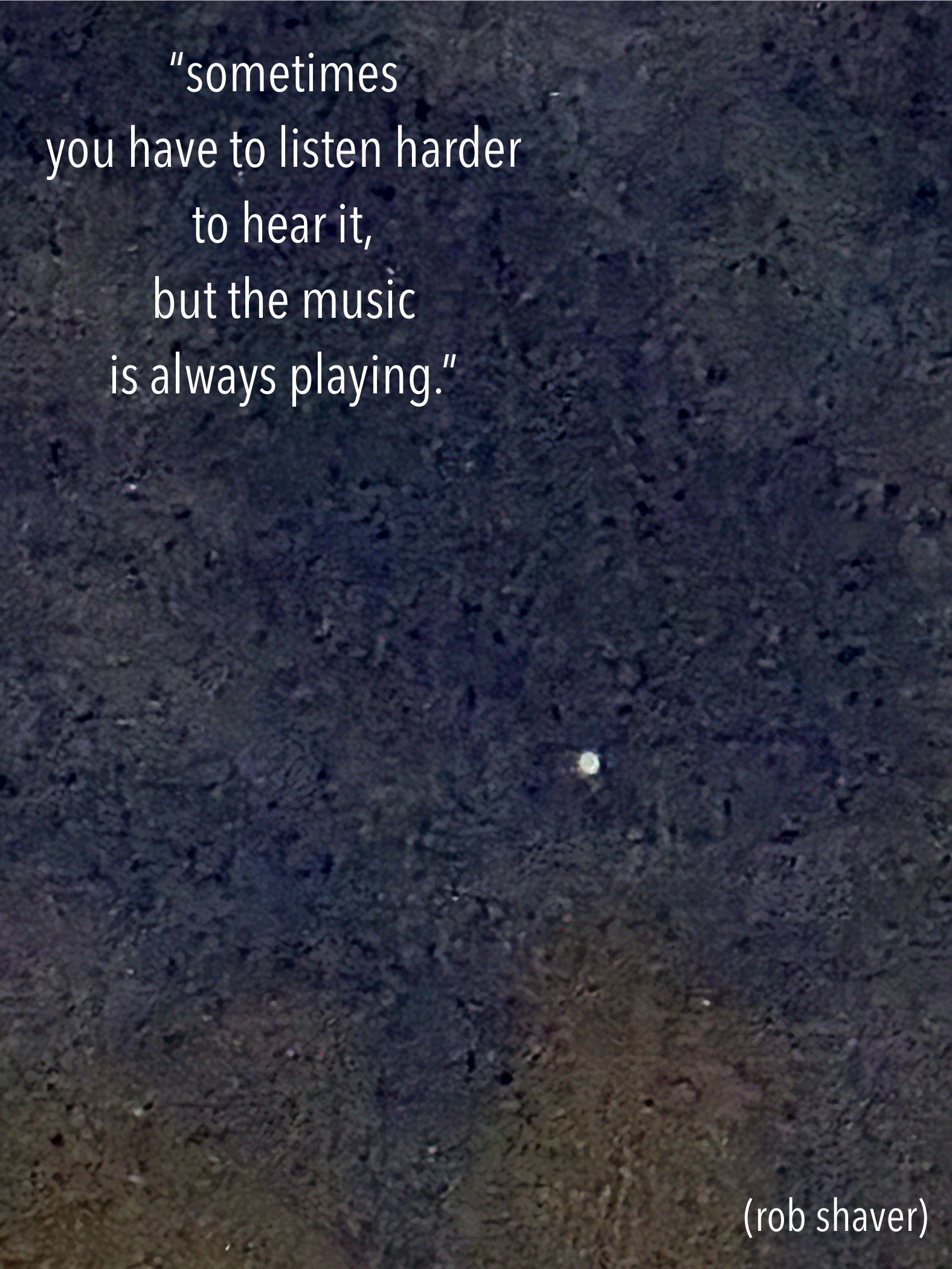
“The best thing you can do for your lungs is sing,” Rob Shaver said. This from a man who runs miles a day, a man whose lungs are filled with tumors. ‘”Everyday, everyday, everyday, everyday, everyday…be grateful for the life you have.”

read Kerri’s blogpost about THE MUSIC

likesharecommentsupportthankyou

The Simplest of Actions [David’s blog on Not So Flawed Wednesday]

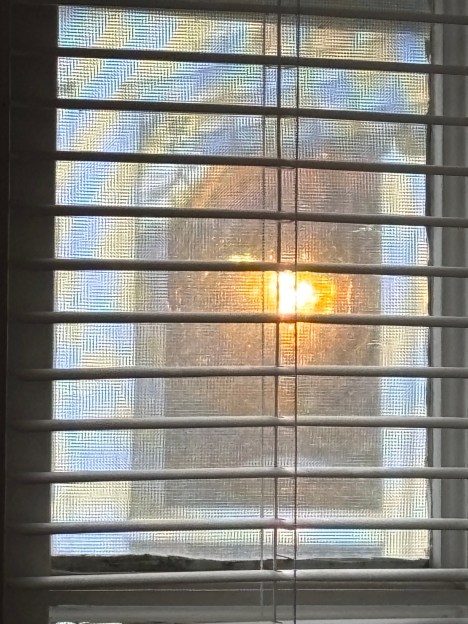
Every morning we have a ritual opening of the blinds. Each evening we have a ritual closing of the blinds. Most people would not call these routine actions “rituals” but I want to see them as such. I want to acknowledge the moment that we open our house to the light; it is the act of letting the world in. I want to appreciate the moment we decide to close out the world. The action is carried in the blinds. It’s a rhythm of life similar to the tides.

Our opening-of-the-blinds often corresponds to sunrise. Dogga is our chief priest of the coming day. He alerts us to the impending first rays of the light. We open the blinds, sip coffee, listen to the birdsong and watch the sunrise. I learned long ago that if I understand my actions as ritualistic, I would pay conscious attention. I would be less likely to reduce my moments to the ordinary. In my ritual of opening the blinds, letting in the light, I am aware that this day is unique, I have no idea what’s coming. I have never lived a day quite like this before. Open the blinds to surprise.

The same is true at the end of the day. The ritual of closing the blinds serves as a retreat to sanctuary. The darkness descends. “Are you ready?” she asks. I nod. I am ready to withdraw and retire. We close the blinds with gratitude.

Surprise and gratitude. Beginning and ending. I adore the cycles that punctuate our day. I’ve come to understand my appreciation of ritual as something that grounds me. I think this is true of all rituals; they ground us. They need not be religious yet they can’t help but elevate the ordinary to the sacred. The sacred is often nothing more-or-less than paying attention. Open the blinds. Welcome the unknown. Close the blinds. Appreciation for all that transpired.

Opening the blinds. Closing the blinds. Learning again and again that the littlest things, attention paid to even the simplest of actions, matter.

read Kerri’s blog about BLINDS

likesharecommentsupportthankyou

Time Travel [David’s blog on Not So Flawed Wednesday]

During the recent power-outage we learned the obvious: most of the activities of our life require a plug and reliable power. We learned that our access to information and connection-to-others is also plug-dependent. We learned that the car is a great-and-necessary place to warm up while also recharging devices.

We also learned how the absence of plug-driven-life greatly impacts the pace of our day. Time is a slow-moving river when the power goes out. What do you do when a screen is not available to demand your full attention? Don’t get me wrong, I appreciate my technology as much as the next person. I would not be capable of writing if I had to type my fast-thoughts on a slow typewriter. I remember with horror the days of white-out and endless retyped revisions. Also, technology makes my vocabulary seem much more expansive than it really is. Do you remember flipping through a heavy Thesaurus to find a synonym? Do you remember how long it took to research a topic when the beginning point was a card catalogue or microfiche?

The power outage tossed us back in time.

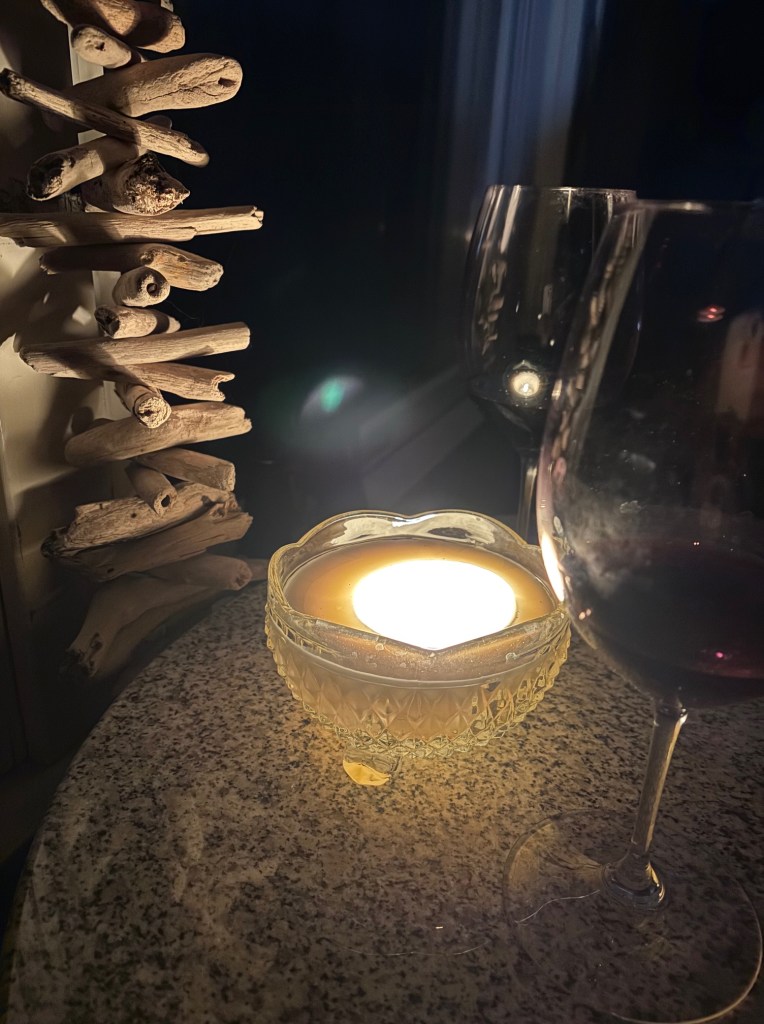
We paced so I picked up my pencils and drew pictures in my sketchbook, much as I had done as a child. We lit candles when the sun set and spoke in candlelight tones. More than once we went outside and talked with our neighbors. They were out so we went out. We made sure the elderly neighbor across the street was safe. She made sure that we were safe. We returned to a time when conversation was face-to-face. The most important news was local and immediate. We entered a era when sunset was the cue to crawl into bed, when sunset meant a drop in already cold temperatures and the only warmth in the house was beneath a pile of quilts. Time seemed more expansive and not in short supply.

We relearned the feeling of wiling away the day. We reveled in the expansion of our attention span.

In the end, we enlivened our gratitude. When the power popped on moments before the blizzard, we cheered. The furnace kicked in. The lights extended day into night. We made dinner on the stove and it was hot! Simple things that go mostly unnoticed became opportunities for thanksgiving. For a few days until trust in the plug was restored we knew that we would take nothing for granted.

And with the restoration of the power time sped up. Our screens were alight, the information inundation and rapid media stream returned. We re-inhabited the era when the question at the end of each day is inevitably. “Where did this day go?”

read Kerri’s blogpost about THE CANDLE

likesharecommentsupportthankyou

Once Again Walk [David’s blog on Two Artists Tuesday]

What is the truth of it? It is the question of our times, isn’t it?

We walked this path through our beloved Bristol woods a million times in the past. Always in the daylight. Rarely at sunset. Since they built a ropes course that cut through a significant portion of the woods, a course that draws rowdy crowds, we stopped hiking there. Too many people. Too much noise. We walk our trails to get away from the chaos. We mourned it.

A candlelight Valentine hike enticed us to return to our woods. We signed up for the latest possible slot, knowing there would be less people later at night. We almost didn’t go. We felt exhausted from the day. We ran through our list of reasons why we should stay home but rallied, tied on our boots, and drove to the woods.

The Pringle Center at the head of the trail was buzzing with activity. People who’d finished their trail walk made valentines, ate cookies and drank hot tea. We passed through long enough to check-in and then stepped into the quiet of the night.

The muscle memory was surprising. I believe we could have walked the path blindfolded. The trail was like an old friend celebrating our return with luminaria. It was as if we easily picked up a conversation after years of absence, as if no time had elapsed. Our feet knew where to go.

There was no hurry. We lingered. We stopped and gazed at the stars. We listened for deer. We had time to walk a second loop. We were the last to leave the trail.

We sorted through many of life’s trials and tribulations walking this path through Bristol Woods. We’ve made significant life decisions on this trail. We often began our walks with troubled hearts and left the woods with quiet minds, ready to live another day. On this night, the eve of my 65th birthday, walking our second loop, all alone, the last people on the trail, we talked of what we are learning as we age, what illusions we are no longer chasing, what simple abundance we find ourselves embracing, what freedoms we find as we put our lives into perspective. We talked of gratitude for each other and reveled in the opportunity to once again walk in quiet through our Bristol woods.

read Kerri’s blogpost about THE WOODS

likesharesupportcommentthankyou

For Every Little Thing [David’s blog on Two Artists Tuesday]

If you came to our house over the holidays you’d find trees, trees, trees everywhere. Trees of all shapes and sizes. Some wrapped in lights. Some adorned by a single silver ornament. Some without adornment of any kind. The outside invited inside. Until recently, when we moved it to the back deck, a large tree-sized branch wrapped in happy lights dominated our living room, 24/7, 365 days a year.

It should not then come as a surprise that last year we moved the aging wooden glider from the deck into the living room. It now sports fuzzy white pillows. Dogga knows that when we say, “Let’s go to Minturn!” it means we are headed for the glider. He meets us there.

Our most recent outside-in addition is the chiminea. It was a wedding present and over the past decade we’ve loved it and used it often. Sitting on the deck one night this past summer, Kerri was eyeing the chiminea. “What?” I asked.

“In the fall, when the weather turns cold, I think we should move it inside,” she said.

And, so, we did. The chiminea now lives in our sun room with a plant sitting atop the chimney. Happy lights pop on within the burn chamber at sunset. Each evening at snack-time we sit at our bistro table and enjoy the warmth of the light glowing from within the natural clay.

20 recently said, ‘I hope you two appreciate each other.” We laughed and reassured him, we literally recounted for him, the many ways that we, each-and-every-day, express our appreciation for each other. She thanks me for making breakfast. I thank her for washing our clothes. We have, in our past lives, taken for granted the daily kindnesses that others offered us and that we offered to others. We’d somehow allowed the myriad tiny-generosities of our past relationships to lapse into the mundane. We learned from our mistake.

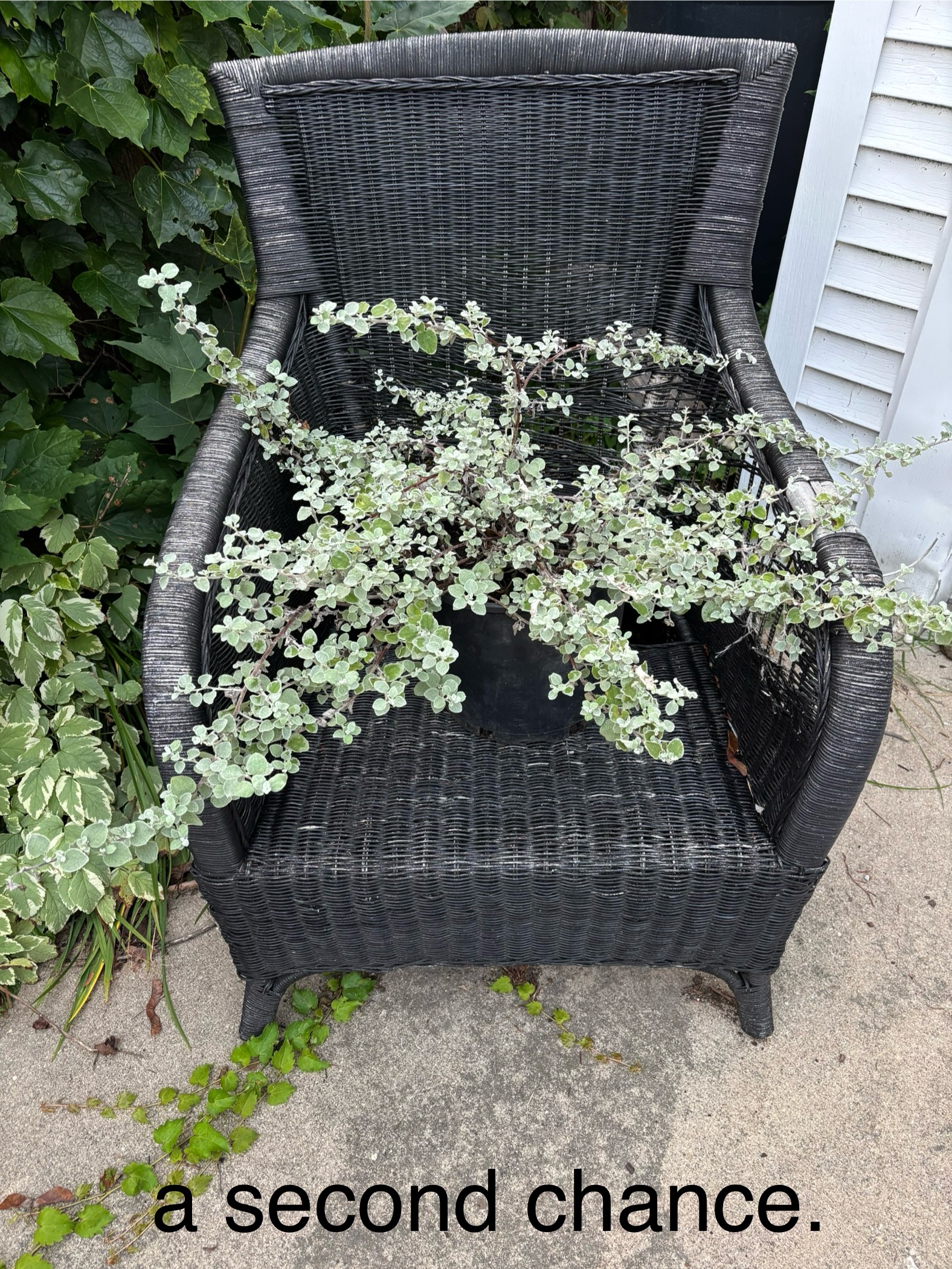
In this, life’s second chance, we take advantage of every opportunity to express our appreciation.

In fact, the idea behind our Minturn, the force that brought the chiminea inside, is the creation of opportunities for appreciation. They are spaces we create, places we stop so we can sit solidly in the moment, sharing a simple snack of bread and cheese, sipping a glass of wine, and feeling the full abundance of our lives. And, the greatest abundance of all is the conscious cultivation of appreciation for every-little-thing, especially cherishing the time we have together on this earth and the opportunity to fill each moment with appreciation for each other.

*****

about this week: there is a peril, it seems, to writing ahead these days. we had decided that this week – the first full week of a new year – we wished to use images of light as our prompts, we wished to linger on the possibility of light, of hope, of goodness. though our blogposts might stray from that as we pen them, it was without constant nod to the constant updating of current events – a mass of indefensible, unconscionable acts. we pondered what to do about these blogposts we had written and decided to keep them. we hope that – whether or not any absence of the happenings of the day, whether or not the chance these written words seem somewhat inane at this moment – you might know that those events – of corruption, illegality, immorality – do not distill or distort our intention – to bring light and hope to this new year – the first days of which bring more insanity and unnerving instability. we are still holding space for light.

read Kerri’s blogpost about THE CHIMINEA

likesharecommentsupportthankyou

Shared [David’s blog on DR Thursday]

The waning sunflower stands vigil outside of the library, towering above us, perhaps nine or ten feet tall. Only a few short months ago it was vibrant, ablaze with yellow and viridian. Just as we had done in the summer, we stopped to say hello on our way into the building to check out a book. “It’s just as beautiful in decline,” she said, “only different.”

It is the day in these un-United States that we pause and give thanks. Although our tradition is based mostly on a myth, there are a few elements of the tale that are true. A horrible winter in which many of the settlers died was followed by a successful harvest made possible with the help of a native man named Tisquantum. “It is true that both the English settlers and Wampanoag people ate together…”

A successful harvest, shared.

Annie Dillard wrote, “Buddhism notes that it is always a mistake to think your soul can go it alone.” I have made that mistake in the past which is why, on this day, I am most grateful for my capacity to learn from my mistakes. I can trace my joy to the brilliant soul at my side and all the amazing souls who walk this walk with me. With us.

We celebrated early Thanksgiving with our children. We recently had dinner with our treasured Up-North-Gang. We regularly make dinner with 20. In recent times we’ve shared a meal with Dwight, with Arnie and Shelly, Kate and Jerry, Jen and Brad, Kelly…each a meal of thanks-giving.

It is a mistake on every level to think we can go it alone. Conservatives need progressives just as progress needs to be deeply rooted in tradition. Our tradition and our progress are the product – the abundant harvest – of ineradicable diversity. We are – as we have always been – a vibrant melange; people of various traditions learning how to eat together. We live in a global economy and are re-learning the hard way that there is no such thing as going it alone.

A successful harvest not only needs to be shared but is also made possible with the help and support of others.

Perhaps on this day we can be thankful for our capacity to learn from our mistakes. Perhaps we can, once and for all, drop the myth of rugged individualism and, as we prepare and enjoy our meals together, meals made possible by farmers and ranchers and truckers and bakers and grocers and inspectors…recognize that no one goes-it-alone. Gratitude shared.

read Kerri’s blog on this THANKSGIVING


likesharesupportgivethanksthankyou

Moving Mountains [David’s blog on Merely A Thought Monday]

There are few artists that she admires more than Phil Vassar. He is one of the great singer-songwriters of his genre. Last week he played at the Genesse just down the road so we moved a few mountains to be there. He’s recovering from a heart attack and a stroke so he also moved a few mountains to be there. I’ve never witnessed more simple gratitude pour from a performer – for being alive, for being able to sing and play, for sharing his gifts.

The lyric went straight to her heart and she cried: dreams can grow wild born inside an American child. She cried for her own wild dreams.

She cried for the crumbling dream called The United States of America. This song, American Child, in a moment became the anthem for all that we are losing, all that her father, a WWII vet, a prisoner of war, who fought against fascists, who carried the deep psychological scars from his service through the rest of his life…all so that his children and grandchildren might live in a country where dreams can grow wild.

She cried.

Democracy is, itself, a wild dream careening toward a cliff. The White House is literally being torn apart by a man-who-would-be-king. The congress has all but abdicated its responsibility; it’s literally left-the-building. The Supreme Court regularly rules against the Constitution, literally elevating one man above the law.

Those who believe in the dream of democracy hit the streets on the day we saw Phil Vassar. It was the biggest protest in the history of our young nation. Thom Hartmann wrote: “The No Kings Day protests last weekend were breathtakingBut here’s the hard truth: that energy, that passion, that righteousness means very little if it doesn’t translate into structure and leadership. Movements that fail to coalesce around leaders and build institutions typically die in the glare of their own moral light or fail to produce results.

Wild dreams are the north star of action. The dreams of an artist become reality after hours and hours and years and years of practice and rehearsal. Specific action aimed at the manifestation of the dream; moving mountains.

Democracy is not defended by hashtags. It’s defended by hands, millions of them, building, voting, organizing, and refusing to quit when the cameras are gone.” ~ Thom Hartmann

Phil Vassar suffered a heart attack. And then a stroke. He is moving mountains because he nearly lost his dream. He’s not sitting at home fretting. He’s playing concerts. He’s writing new songs. He’s breathing new air into his almost-lost-dream.

Perhaps we will do the same.

read Kerri’s blogpost about WILD DREAMS

likesharesupportthankyou.

Feed The Marvels [David’s blog on Two Artists Tuesday]

Last year Carl Blanchet walked all 2650 miles of the Pacific Crest Trail in less than 90 days, a feat that would have killed most of us. This year he’s walking the PCT again, not to break his previous personal record, but to do the opposite. This time Carl is taking his time. He’s moving slowly. He’s watching sunsets. He’s smelling flowers. He’s making new friends along the way.

Carl’s gratitude is magnetic. His enthusiasm for small things is contagious. He finds magic in a tiny swimming hole. He exudes appreciation and simple kindness. He giggles at the colors of the sunset. He can’t wait to walk another mile and share it with his audience.

He has become one of our favorite bright lights in this dark time. Each night we look forward to his next installment, to spending a few moments with someone who intentionally immerses himself in the love of life.

He is a stark counterpoint to those immersing themselves in hate. He reminds me of what is possible. He reminds me of the power of the cliché: where you place your focus grows. Carl’s enthusiasm for life comes from a decision; it is an intention.

He reminds me to look for the light, to feed the positive, to not let a single sunset go by unnoticed and without celebration. It’s not so difficult to beat back the darkness when our dedication is to see – to focus on – and feed in each other – the abundant marvels readily available in this life.

read Kerri’s blogpost about THE SKY

likesharesupportthankyou

Happy Harbinger [David’s blog on KS Friday]

The space between our garage and the neighbors fence is a narrow passageway. It is out-of-sight-out-of-mind. As the original debris field of the house, there are mounds of earth that I long ago learned I’d never be able to dig out. A shovel cannot penetrate the bits of brick and wood, old cement and wire, that have long since petrified and are covered by a thin layer of dirt. Gnarly weeds grow in abundance, some taller than I am.

The passage is a neighborhood animal trail for the fox and opossum so we occasionally toss old broccoli or carrots gone rubbery for the critters to eat. Tossing critter snacks is the only time I ever visit the passageway. On a recent snack-toss-expedition I was astounded to see a mighty sunflower rising high above the weeds! A sunflower towering above the debris field. It felt auspicious. An affirmation. A positive sign of good things to come.

I looked at the sunflower in utter disbelief. It looked at me with amusement. I ran into the house to grab Kerri so she could marvel at our happy harbinger.

There are few things on this earth that human beings have so thoroughly endowed with positive symbolic meanings as the sunflower. Happiness. Health and longevity. Good luck. Abundance. Loyalty. There is no dark undertone, no shadow symbology with sunflowers. It is the Shirley Temple of symbols.

From the outside, our life together this past decade probably appears to most like a debris field. Our career implosion left bits and pieces of us scattered all over the tarmac. And yet, you would be hard pressed to find two happier people, two more intentionally grateful human beings.

Yesterday we discovered chunks of tar on the back patio. Looking up we saw that part of the roof over our sunroom had peeled back, probably from the recent wind storms. As I prepared myself to panic, Kerri smiled and said, “I am going to choose to be grateful that we found this before it really became a problem.” My panic hissed out of me like air from a balloon. No panic necessary. No need to get lost in the problem. Just gratitude with an eye toward solutions. I clamped the layers down until the roofing guy could come.

From the top of the ladder I could see the sunflower. It looked like it was watching over us. I remembered the lesson of one of Aesop’s Fables: what looks like a tragedy is often a gift. What looks like a boon sometimes brings a curse. And, in time, the curse will eventually open the way to a blessing.

“Is it a good thing or a bad thing?” I quipped with the sunflower. It simply smiled in reply.

RIVERSTONE on the album AS IT IS © 2004 Kerri Sherwood

Kerri’s music is available on iTunes and streaming on Pandora

read Kerri’s blogpost about THE SUNFLOWER

likesharesupportcommentthankyou