Embrace The Bump

photoArt stores are dangerous places. We entered the store with a short list: vine charcoal and titanium white paint. We left with a suspiciously large bag – Kerri found the pen and pencil aisle and got “that look” in her eyes. I found her sitting amidst a vast circle of pen possibilities making marks on a pad of paper. “Ooooooooooo,” she cooed, feeling the latest pen for weight and suitability for her hand. “I looooooove this one,” she said to herself. Her pile of “I love this one” selections was formidable. Art stores are like opium dens.

20 (aka John) was with us. He regularly incites us to riot and misbehavior. He was little help extracting Kerri from her pen-nest. 20 impacts us like a snout-full of laughing gas. He has a way of making the darkest day bright. 20 is, in fact, a bringer of light; he has developed this capacity because, like all bringers of light, he knows well the other side. One day in early summer, we sat on the deck drinking coffee and made our belly buttons talk, giving voice to the things we think but cannot say in polite society. We laughed so hard that I had to run inside the house; I couldn’t breathe. Twenty’s belly button had a lot to say.

After escaping the art store, Kerri hefted her bag of supplies to the car while 20 and I waited on the corner. That’s when we saw the sign. It was something Sartre might have provided had he been a traffic engineer. It was existential. 20 and I jumped at the chance to make a selfie with the sign-philosophical. It simply read, BUMP.

photo-1As we snapped our selfies, laughing all the way, I couldn’t help but recognize that life – a good life – is riddled with bumps. In my consulting days I used to work with people to embrace the bumps rather than try to remove them. There is a pervasive notion that smooth sailing makes a good life. A bump-free life is a recipe for disaster. All of life’s lessons are found within the bumps. A life without bumps is a life without challenges is a life that is boring. And, in truth, people create bumps if they don’t already exist. They’re called a hobby or gossip or a complaint or drama. In story language, bumps (called ‘conflict’) drive the story; without bumps there is no movement. Yearning is a bump. So is desire. Unrequited love is a bump. Loss is a bump. Wondering what is beyond the horizon is a great bump.

20 is a great teacher of how to address bumps: Laugh. Make a selfie. Alter the word to something even more outrageously appropriate. Look for the next opportunity. Let your belly button talk.

photo-2

Everyone Has Their Heaven

TODAY’S FEATURED PRINT FOR HUMANS

everyone has their heaven

FOR TODAY’S FEATURED PRINT FOR HUMANS, GO HERE.

Release The Edge

photo-4

Usually, there is a lake….

Hope begins in the dark, the stubborn hope that if you just show up and try to do the right thing, the dawn will come. You wait and watch and work: you dont give up. ~ Anne Lamott

Sometimes the fog hangs heavy all day along the shore of the lake. The sun tries in vain to penetrate the fog so the air glows. When, in combination with the fog, the lake is still, like it was today, it becomes invisible, inaudible; the lake disappears. Standing on the great rock barriers, staring into the void, it feels as if you have arrived at the edge of the world.

photo-5

looking the other direction

All of my life I have been fascinated by edges. What is the line between wild and tame? Most good stories require a stride beyond the boundary, a movement into territories unknown. And, at the end of the story, what was once known becomes unfamiliar. Every ending is a beginning. What is the line that distinguishes the known from the other place? A good dose of reason will assure us that most things can be understood but a walk through a spring meadow or a night spent gazing into the stars will remind us that understanding is illusive or at best illusionary. What do we understand?

Once, working with a group of teachers, we had a terrific discussion about beginnings. Where does a story or a life begin? There is always an easy answer, “Once upon a time,” a birth date, when two people meet, the day the crisis arrived on the doorstep. In fact there is always a multitude of easy answers, of possible beginnings, and none of them are definitive. Which beginning point is the beginning point? At what moment did success arrive? Or, when did failure begin? Does my life begin with my parents or their parents or…? Edges are esoteric!

There is a long tradition in the arts of Dances with Death. Paintings, dances, compositions, plays,…; Hamlet ponders life as he holds poor Yorick’s skull. It passes all too quickly. Most spiritual traditions carry the notion that life cannot be understood, valued, or fully appreciated without first grasping that this life-ride is limited. Living a good life, a fully appreciated life, demands a nod to the edge. It’s the ultimate paradox.

I’ve courted a bundle of trouble in my life because I rarely see the black-and-white of things. Where is the line between hope and hopeless? What wall delineates faith-full and faith-less? Like happiness, edges are made, not found. Ask a physicist if it is a particle or a wave and they will uniformly answer, “It depends upon where you place your focus.” Even in the era when people believed there was a hard edge to the world and finding it meant falling off, sailors supplied their ships and sailed toward the horizon to find it.

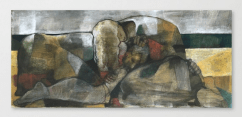
 Icarus reached for the sun.

Icarus

Step Toward Faith

My latest. An unusually small canvas.

My latest. An unusually small canvas: Will Is Belief.

I began writing this post a few weeks ago, just before the run to Florida and the launch of Beaky’s book. It was a very busy week and I’d forgotten that I started but did not finish the thought. This morning, wanting to get back into the rhythm of writing, I opened my iPad and found these words already written and awaiting my return:

I’m sitting in the choir loft watching the evening sun illuminate the stained glass window. I’m tired tonight and listening to Kerri, preparing for the Maundy evening service, rehearsing Nancy’s solo. Nancy’s voice is like a warm cello, deep and rich, and is working like a sound-massage on my tired bones. I’m giving over to it.

This cycle of services on Easter week is relatively new to me so I’m paying attention to all of the symbols and rituals of this story of rebirth. As is true of every great story cycle, the night is darkest before the dawn (thus, the cliché). This night, called Maundy Thursday in the cycle – I’m told that Maundy means mandate – is the night of the last supper and all the betrayals that followed. It is the segment of the story that is chocked full of crises of faith. If, like me, you are a lover of story you will recognize that some form of betrayal usually precedes a crisis of faith and, in turn, a crisis of faith always leads to growth and new direction; it always leads to sunrise.

Others betray us. We betray ourselves. Betrayal happens on the edges of the dark forest and forces a step into the unknown. Betrayal happens when we fall asleep (that is most often how we betray ourselves – sitting in front of the television to numb us to the richness of our lives). Things crumble: the relationship that we believed was secure, the truth into which we rooted our belief, the career that we thought would carry us to retirement. Security dissolves, identity dissipates, and then what? All the fears bob to the surface. All the dragons come out of the closet.

This was the unfinished thought I found this morning. I have no recollection of where I was going with it. Now, two weeks and a lot of life later, I read it as if someone else wrote it. However, there was one other sentence, detached from the others. It now reads like a mystery to me. When writing, I routinely float a sentence at the bottom of the page because it is the point of what I’m trying to reach. My floating sentence read:

A crisis of faith often has very little to do with faith.

And, as I try to resurrect my thought of a few weeks ago, I can only smile and write the first thing that occurred to me when I scrolled down and found the floater: Faith, like love or truth or time or anything else, is not something fixed. It moves and grows as we move and grow. A crisis of faith is really a step toward faith renewed. It enlivens. It helps us retire old dragons or let go of empty promises. It gets us out of our easy chair and helps us fully feel the day.


Capture The Essence

Dog-Dog and treasure

Dog-Dog and treasure

Tripper Dog-Dog-Dog gathers his stuff around him. He has two stinky blankets that he pulls from his crate each morning, a red Kong, a blue chew bone with a handy looped rope pull, another blue toy that once looked like a jack but has been chewed beyond recognition, a once-stuffed moose from Josh that is now an unrecognizable shredded mess though he carries it around as if it was precious cargo. There is also a muddy tennis ball, a raw hide bone and usually a sock pilfered from my sock basket. If Kerri and I shift locations within the house, move from the living room to the sun room, Dog-Dog’s worldly possessions will slowly migrate with us. He is subtle and I rarely see the migration in progress; I suddenly realize that I am sitting within a nest of Dog-Dog treasure.

My favorite section in The Lost Boy is a series of questions that Tom asked: 1) if you were given a cardboard box and it was all that was going to be allowed to provide proof that you walked on this earth, what would you put in your box? 2) Beyond proof, what would you put in the box that captured the essence of who you were, that distinguished you from all the others? 3)What are the collections, the things you gather around you that are somehow supposed to tell others who you are? These questions might seem simple but are surprisingly complex. How does your stuff tell the story of who you are? Or, a better question: does your stuff define you? Can your stuff – your car, your house, your granite counter tops, your clothes, your jewelry,…, – capture your essence?

Tom asked two other related and relevant questions: In packing your box, would you be tempted to scrub your life of its messiness? Would you try to eliminate the mundane, the everyday? Would you throw away your rough drafts? Would you ignore the relationships that didn’t work out? Would you explain away the ugliness, the ruthless choices? Would you burn your personal journals so that the future might never glimpse your doubt, your struggles, your frailty?

I would add these questions: What if your essence was only available to you once you value the messiness? What if, in throwing away the mundane, you actually eliminate what is truly special about you? I’ve often taught and touted a tenet from improvisational theatre: drop your clever and pick up your ordinary – most of us diminish/neglect our greatest gifts because we label them as ordinary. They come naturally to us so we don’t always recognize them. In trying so hard to be clever, to be right, to be flawless,…to be other, we regularly overlook the real treasure and relegate ourselves to that most shameful pile labeled ‘ordinary.’

Scrubbing life to a sterile, conflict-less blandness is a recipe for….boredom and, at the end of the day, a very uninteresting box. Of this I am certain: if Dog-Dog had to pack his box today, I would be proud to sit amidst the stinky blankets, blue bones and remnants of moose toy. Dog-Dog hides none of his messiness.


Mix Beautiful Color

photo-6This magnet-sentiment was on Jim’s refrigerator:

It’s never too late to become what you might have been.

It is particularly poignant because both Jim and I are surprised, dare I admit, disoriented, after finally producing The Lost Boy. It was over a decade in coming. I’d stopped believing that it would ever find a path to the stage and, instead, would remain a good story for dinner conversation. Now that it’s out of the box and rolling around in the world of possible-next-productions, I hear Tom’s voice ringing in my ears, “Readiness is all.” It couldn’t happen until it was ready, until I was ready.

For the past decade, coincident with the development of The Lost Boy, I have been telling stories at conferences, with symphonies, during organizational trainings, and other random stage performances. I have inadvertently learned to tell a good story (or better stated while slaughtering all grammar: to tell a story good). 5 years ago I couldn’t have performed the play as I did last week. I didn’t have the chops for it. I do now.

Years ago, after being wowed by Jim Edmondson’s performance of King Lear, I asked him what he’d learned from doing the role. He replied, “I don’t have enough colors in my paint box to do it justice. Not yet.” This giant of American theatre blew my socks off with his performance, but felt that he fell short. He couldn’t yet fulfill the demands of the role. He knew there was more to grasp and his artistic arms were not long enough. He knew he was not yet ready. No amount of accolade or sock-less fans would change what he knew: there was more to the role than he could reach. More age, more life, more skill was needed. He taught me in that moment what it meant to be an artist. The compass is internal. The capacity is ever expanding if you work at it.

I now believe that, to produce The Lost Boy, I also needed to find the right reason before readiness was available. For years I thought I had an obligation to Tom. I thought I had to finish it for him and tell his story. That was only partially true. The real obligation was to myself. I had to finish it for me – and it took a good deal of readiness for me to see that. It had to become my play. And, in becoming my play, I can now see that I have a world of color in my paint box – and a world of color that I still need to develop. That is the name of this game of mastery. There is never an end. There are just more and more beautiful colors to find and mix and share.


Jump!

photo

The set for The Lost Boy

Once, I stood on a ledge. I wanted to jump into a river several feet below but I was afraid. I’d watched kids do it all day. They told me in excited tones that it was only a 70-foot drop. I’m a bit afraid of heights – okay, I’m a lot afraid of heights – and from the ledge it looked to me more like 1000 feet. I jumped but have no memory of it. After investing in my fear for many minutes, I remember making a decision, standing and walking toward the edge. I remember bobbing to the surface and laughing aloud.

I learned a great lesson that day: if I put my focus on my fear I will be paralyzed. Before taking the big step off the ledge I sat on a rock, and told myself that I was afraid. I was stuck. I couldn’t move. My mind was atwitter with all the reasons I couldn’t do it. When, finally, I realized that, if I put the same amount of focus and energy into jumping as I was investing into being afraid, the jump would be easy. It would be inevitable. It would be a decision, a choice. And, it was easy. The jump was as intentional as the fear was irrational. It was enlivening.

The Chili Boys in rehearsal

The Chili Boys in rehearsal

Last week we performed my play, The Lost Boy and through the process I revisited my ledge of so many years ago. The opening night served as a touchstone of growth. A play is made complete with the addition of an audience. Boil a play down to its essence and there is an actor and an audience. One is exposed and vulnerable, the other is safe within a group. That’s what makes it work: the one facilitates the journey for the many.

The actor gives and the audience receives – and, if the actor is doing his or her job, the audience gives and the actor receives. It’s a loop. It is a relationship. For the actor, this dance of giving and receiving can be either a terrifying proposition or an exhilarating experience. It all depends upon where the actor places his or her focus. If the focus is on pleasing the audience, the play will be a miserable affair to perform. The audience will play the role of judge or worse, the enemy. It will be a ledge alive with irrational fear. If, instead, the focus is on the action of the play, the simplicity of doing, the experience will be alive and invigorating for everyone involved. The audience will be allies on a single journey with the actor. The actor will be present so that the audience can also experience presence.

When Kerri and I stepped onto the stage last Friday, there was no ledge; it was all jump…

[to be continued]

End And Begin

photo-2My fascination with this play grows every day. It has had a hold on me for over a decade. I’ve told the story of The Lost Boy to everyone I know. And now, as we approach opening night, the story of the production, the timing of the production, the people coming out of the woodwork for the production, Tom’s relatives appearing with additions to the narrative that Tom originally relayed to me – is equal to or exceeding the marvel of the play itself. The story around the story is, in some ways better than the story itself. Or, perhaps it is an extension to the story, the next chapter. Roger once told me that he believed the most interesting aspect of the story was not the discovery of a trunk plastered into the walls, not the story Tom felt an imperative to pass on to me, but the story of my time with Tom. “I want you to tell that story,” he said.

I have a file of recordings that I made of some of my conversations with Tom. They were in a format that made them inaccessible to me. I kept them but have been unable to listen to them for several years. A few nights ago, on a whim, I searched for conversion programs and in less than an hour, I was listening to one of the recordings. It was like opening the trunk that had been plastered into the wall. I listened to one of our conversations. I listened to our laughter. I listened to the questions I asked and his thoughtful and generous responses. I listened as I told him that I believed the real story was not Johnny’s or Isabelle’s, but his. He considered it but could not see himself as anything other than a messenger. My suggestion to him was prophetic.

On a lovely August evening in 2013 I was on a pier in Wisconsin when I received the call that Tom had passed. I sat on a bench and talked with Marcia, Tom’s widow, for over an hour. After the call I walked with Kerri and as we watched the sun set I told her stories of Tom.

My attempts to produce the play while Tom was alive (though too ill to perform the piece) hit walls of brick and stone. If I wanted disaster to strike I only needed to attempt to mount a production of The Lost Boy. I’d all but shelved it and, although I’d rewritten it so I could perform the story, the script seemed incomplete, somehow awkward. When Tom passed, the end of the play became apparent – I saw the flaw. Tom needed to join the story, not tell it. I did a final rewrite and the play was ready.

I’ve been amused because, after so many obstacles, this attempt is almost producing itself. It is as if we couldn’t stop the transmission of the story if we tried. Jim said, “I think Tom is working his magic from the other side.” The other night, in rehearsal, just as I worked the section about Isabelle (Tom’s great grandmother) reaching through time, ringing a cow bell to summon Tom, the bells from the neighboring church began to toll.

It made me laugh and I recalled a question he often asked: where does a story end? Where does it begin?

title_pageGo here to buy hard copies (and Kindle) of my latest book: The Seer: The Mind of the Entrepreneur, Artist, Visionary, Innovator, Seeker, Learner, Leader, Creator,…You.

The PoetGo here for fine art prints of my paintings.


Light The Way

A detail from my painting, An Instrument of Peace

A detail from my painting, An Instrument of Peace

Yesterday was Ann’s funeral. She died too young but by all accounts lived out loud – she packed a lot of life into her short time. One of the speakers said that she was neither a glass-half-empty nor a glass-half-full kind of person; her glass was always overflowing. I sat in the choir loft and listened to the stories, the grief and the laughter, the music that a community makes when it says good-bye. I only know her through their stories, through their eyes, and I was overwhelmed with the beauty that they saw in her. She was rooted in a community and the community was rooted in her. I was moved by the story she inspired.

Just before the service I was working on my play, The Lost Boy. We open in a few short weeks. I was memorizing the last two pages. The language of the play, the moment in the script that I worked, is about Tom’s ancestors answering his call. He worried about what to do with the ranch and the legacy that he guarded. He didn’t know what to do. There was no one to receive what he had to tell. He summoned the ancestors and, when he needed them most, they came. They didn’t answer his question. Instead, they took his hand and helped him join the story.

Jean Houston called us – the living – the burning point of the ancestral ship. Each of us carry forward the story, we add a chapter to a longer epic whether we realize it or not. Once, many years ago, John was directing one of Shakespeare’s plays for my company. While talking with the young actors about the play, he was moved to tears telling them how he realized that he was a link in a long chain that led all the way back to a first production in the 17th century. This play did not exist isolated in time. It was a burning point. Their work mattered because they were the guardians of a tradition. They were the burning point. The play was remarkable because the actors understood their root; even the smallest action mattered because if fed something bigger.

A few weeks ago we watched the film, The Descendants, with Brad and Jen’s movie group. It is a story of legacy and mattering – a story of what happens to descendants when everything looks like a commodity. The root withers. The story dissipates. As Yeats wrote, “The center cannot hold.” Joseph Campbell said that our mythology was dead and all the proof we needed was in the news. It took me years to fully understand his statement. And, the question he asked was this: once lost can a community revive its mythology? Can it reconnect with the root? Can it look beyond the immediate and see the rich soil of the greater story? As the burning point, can we light the way forward or is our dilemma the same as Tom’s: what do you do when you carry a root-story and no one is interested or capable of hearing it?

title_pageGo here to buy hard copies (and Kindle) of my latest book: The Seer: The Mind of the Entrepreneur, Artist, Visionary, Innovator, Seeker, Learner, Leader, Creator,…You.

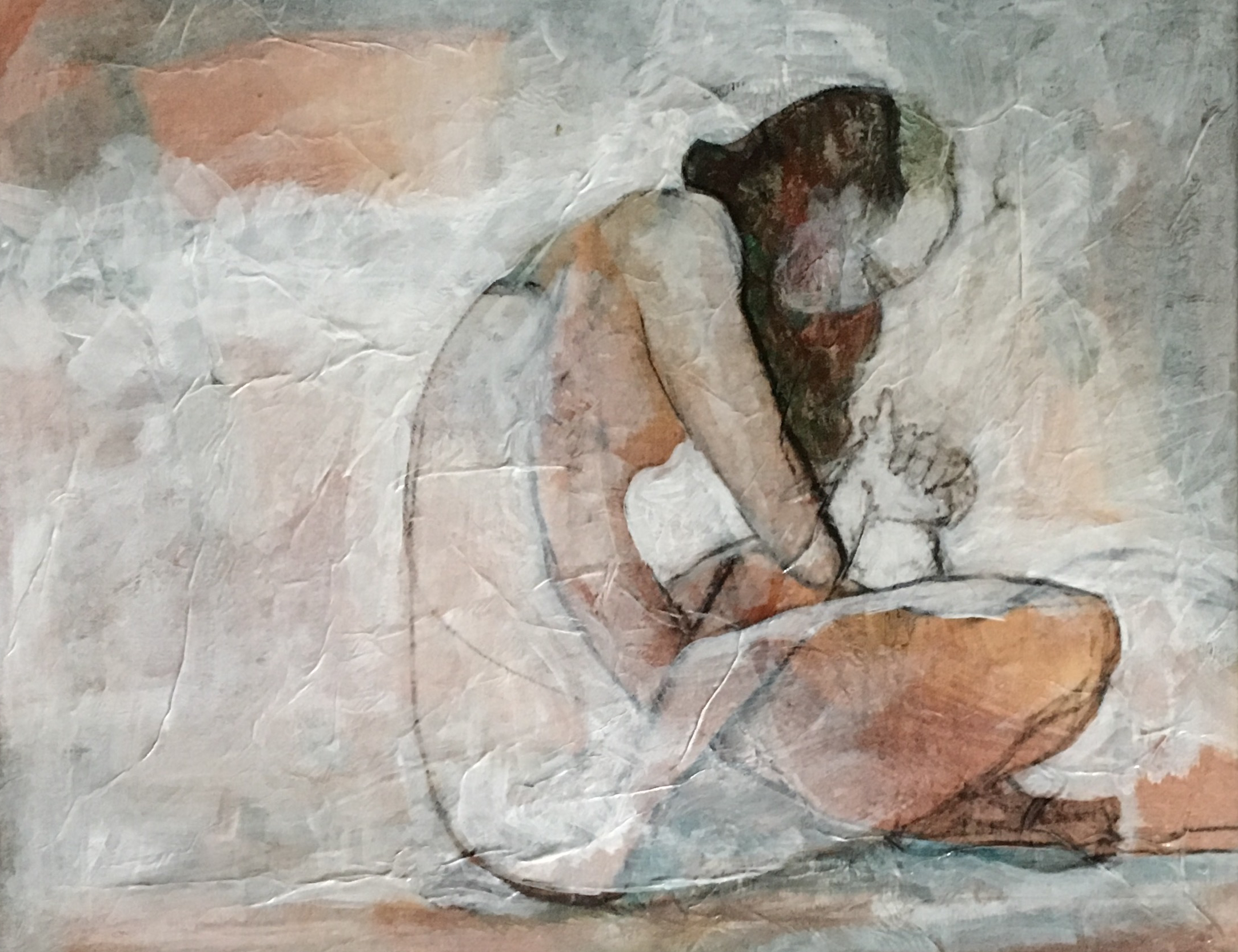
from my Yoga series

from my Yoga series

Go here to buy art prints, posters and such – of my paintings


Walk With Me

Tom and me a long time ago.

Tom and me a long time ago.

Sometimes it is the smallest thing that smacks you.

Recently I reread one of my favorite books, A Prayer For Owen Meany by John Irving. In the book, the narrator of the story suffers a loss. He tells us that we lose people in pieces, not all at once. During holidays, birth dates, passing a favorite place, and the loss happens all over again, again and again.

Today I was editing The Lost Boy script. Originally, the script was a transcript from interviews with Tom intended for Tom to perform. It was filled with quotation marks – he quoted lots of people. His story is populated with some fantastic characters. After his death I rewrote the play for two actors so that I might tell the story but I didn’t clean up the punctuation. I translated the transcription. I shaped scenes within the stories he told. As I worked on the edits today, I was suddenly struck dumb by the quotation marks. They were Tom’s. They were his exact quotes; they were no longer appropriate to the rewrites. As I erased the quotations I lost him all over again. Each erasure took a little bit more of him away.

And…it’s a paradox. The erasure also brought him closer to me. Tom used to say that the stories of his kin where more than just stories, they were alive. He could not walk the ranch land without his ancestors walking with him. He told me that he knew who he was because he knew who they were. As I removed the quotes from the script the stories were no longer Tom’s, they became mine to tell. His story and mine became one, single tale. I realized that I cannot tell this story without Tom telling it with me. Like him, I know who I am because I know who he was. I couldn’t ask for better company to walk this story with me.

title_pageGo here to buy hard copies (and Kindle) of my latest book: The Seer: The Mind of the Entrepreneur, Artist, Visionary, Innovator, Seeker, Learner, Leader, Creator,…You.

The PoetFor posters, prints, bags, stuff with images of my paintings, go here.