Hear The Voices

photo-2This is the most unusual rehearsal process I’ve ever navigated.

First, I wrote the play and in preparing to perform it, I’m discovering it anew as if someone else wrote it. There have been brilliant and funny moments when I ask myself, I wonder why he wrote that? The good news is that I remember whom to ask.

Second, the play was originally meant for Tom to perform and since the story is Tom’s family narrative, I wanted the language and syntax to be Tom’s. In development, I recorded hours of conversation with him. Much of the first draft was a transcription so that I might capture word-for-word his language choices and speech patterns. Those structures survived the several rewrites that happened after Tom’s death. In preparing to perform the play I’m wrestling with the language. I’m wrestling with his language. It is almost as if I am discovering my own speech patterns and syntax – in telling Tom’s story I’m finding it necessary to tell it my way, not his. Essentially, as is true in all good storytelling, I am finding myself, my voice, through his story.

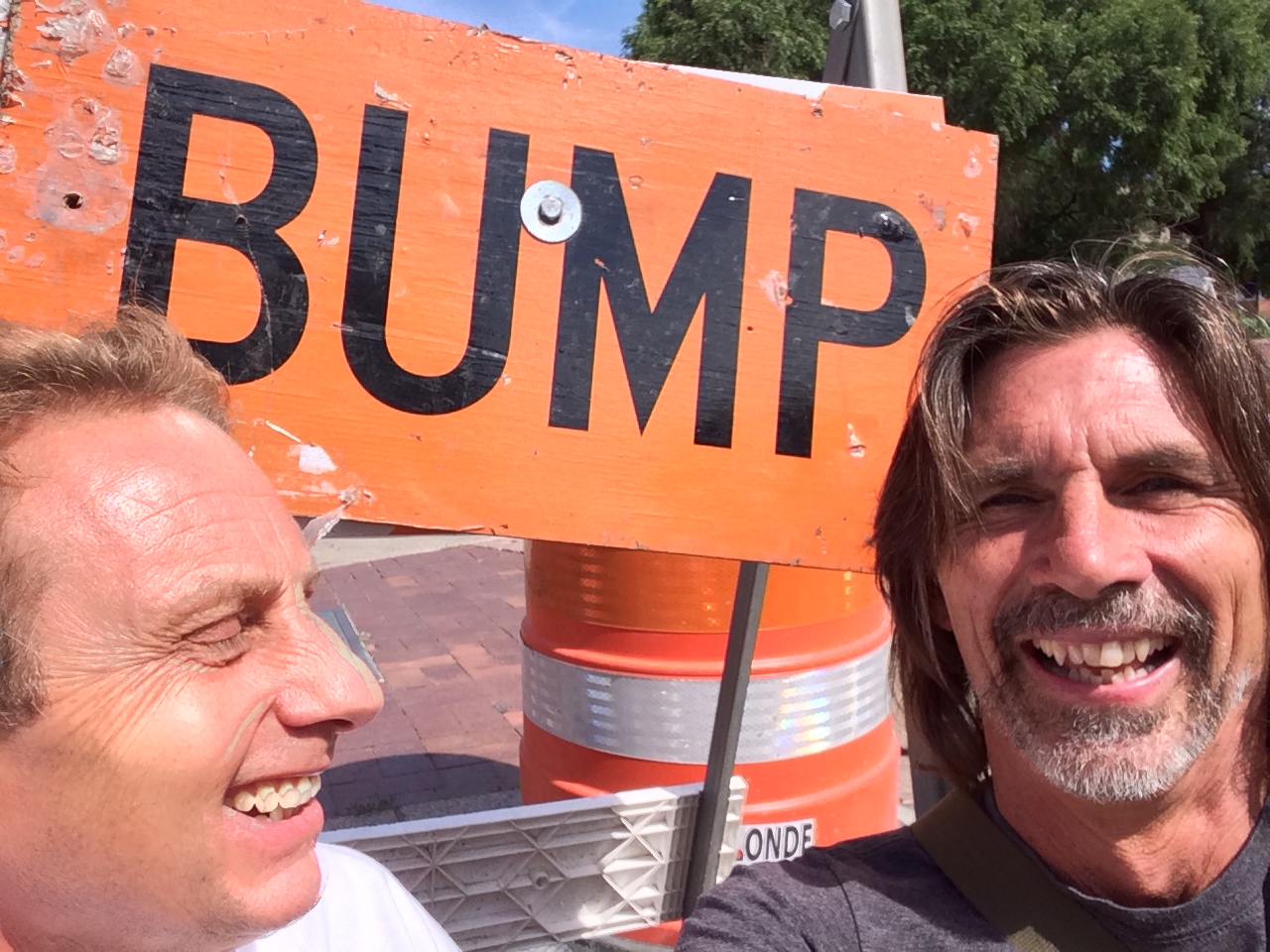
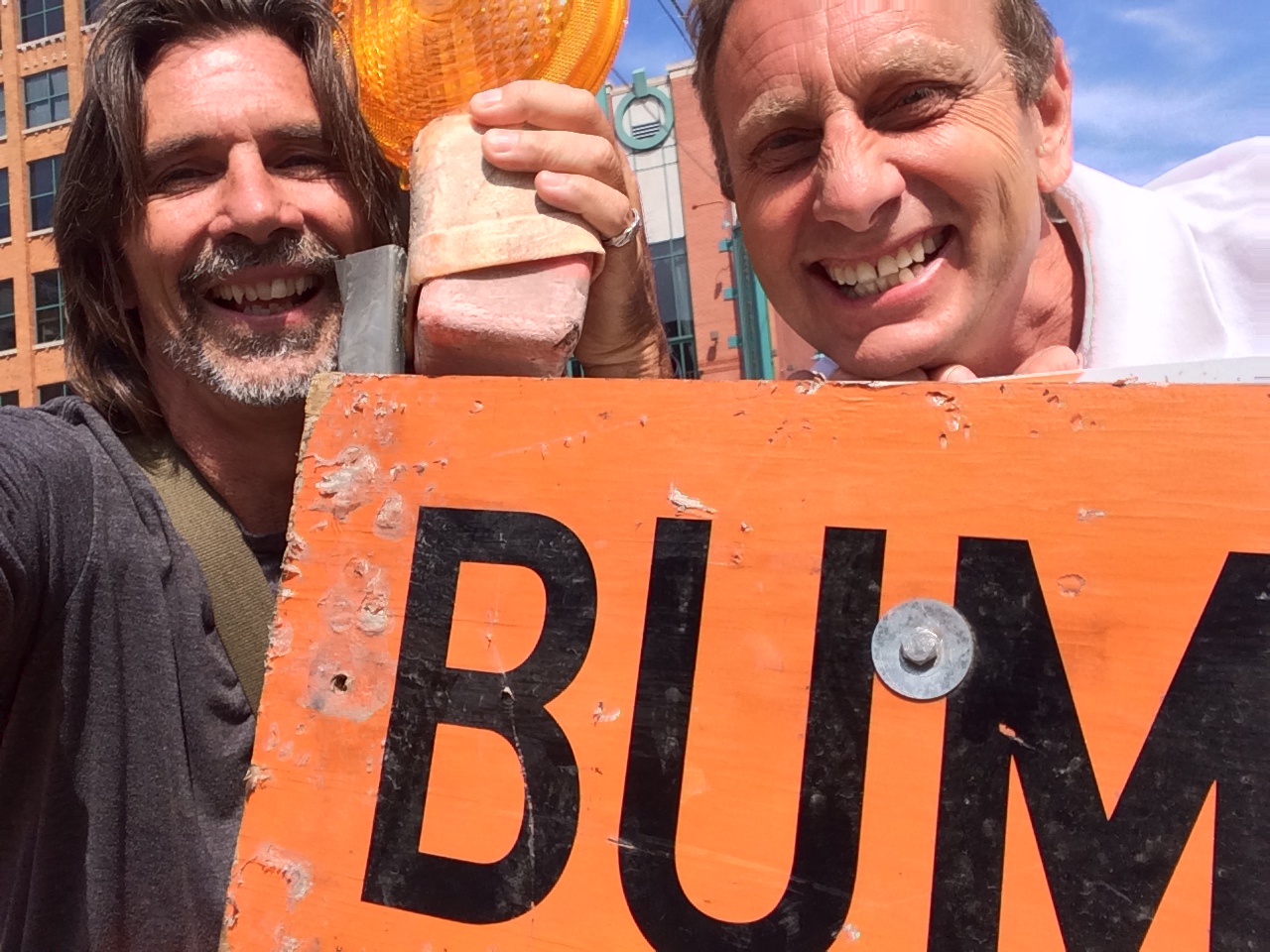
Tom and me a long time ago.

Tom and me a long time ago.

Finally, the music is a character in the play and the musicians, Mom’s Chili Boys, are madly rehearsing in California while the actors (Kerri and I) are rehearsing in Wisconsin. The internet is a beautiful thing as, each day, we pass notes, record voices, email questions; we will only be together in the same room 3 days before the first performance. We’re essentially workshopping the play from two locations. It is akin to rehearsing a symphony in parts and the parts only come together in the final day. They get to experience the whole symphony, the fullness of their music as played through all of the voices, only in the final hour. And that will be true of this play.

Each day I rehearse and I hear Tom’s voice in my head, telling me the stories that comprise the play. I am reminded that, whether artist or audience, art is a living thing. It is a relationship and ultimately that relationship is with your self.

title_pageGo here to buy hard copies (and Kindle) of my latest book: The Seer: The Mind of the Entrepreneur, Artist, Visionary, Innovator, Seeker, Learner, Leader, Creator,…You.

For all digital versions, go here (Leanpub)

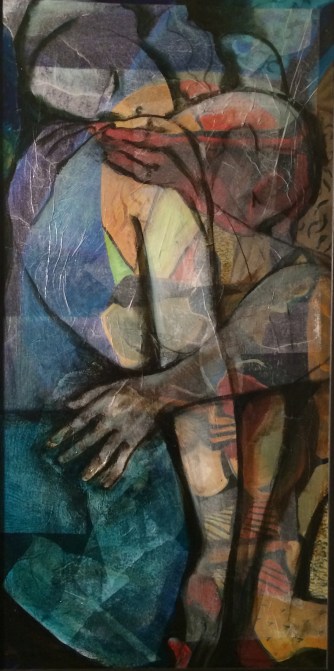
Untitled by David Robinson

Untitled by David Robinson

Go here for fine art prints of my paintings.

Visit With Your Guardian

My Threshold Guardian at the Jelly Belly store.

My Threshold Guardian at the Jelly Belly store.

In addition to being a dear friend, Arnie is my personal threshold guardian. His appearances in my life always signal that change is a’comin’. The last time that I saw Arnie I left behind everything that I knew (literally and metaphorically). I began a long pilgrimage to the church of my self. It felt as if I stepped into my big wooden sailing ship and set a course for the edge of the known world and then, with great intention, sailed over the edge.

Two years have passed since our last meeting. In the interim, I have experienced Sirens and Cyclops, I lost my metaphoric ship and crew to the great whirling Charybdis, I was held captive on an island, I paid an extraordinary visit to the underworld and, at last, returned to the light with new knowledge. And, this week, as is his custom when I am ready to pass through the next portal, Arnie came to visit.

Saul’s voice roared in my head as Arnie and I debriefed my two-year journey: address your self to the field of possibility, not to the opponent. Possibility, I learned, becomes visible when we are vulnerable and available to it. It appears when we place our focus on it, when we seek it. Pushing and protecting and fighting and resisting obscures the field of possibility because our focus is on the opponent, not on the possibility.

And, of course, the greatest opponent is our self.

In the language of story, for great personal transformation to occur, we must leave behind everything we know and go on a journey into the unknown. That includes leaving behind who we know ourselves to be. In other words, we are required to let go of all the things we believe that we can control – but in truth cannot; we are required to release our insistence on keeping things “as they are.” In the end, we are required to face and then release the things that we are trying “to make work” but cannot – and let go of all the things we want to force into existence but cannot. That is the moment the opponent in our self disappears and we are at last able to turn our eyes outward and see the field of possibility that has been available for us all along.

title_pageGo here to buy hard copies (and Kindle) of my latest book: The Seer: The Mind of the Entrepreneur, Artist, Visionary, Innovator, Seeker, Learner, Leader, Creator,…You.

Eve, by David Robinson

Eve, by David Robinson

Go here to buy fine art prints of my paintings.


Recognize The Gift

Kerri with her mom, Beaky

Kerri with her mom, Beaky

Late night thoughts from the ER.

Earlier in the day Beaky told me that she had no special talents and I protested! She is one of the best storytellers I’ve ever known. She’s a natural. She can’t help herself. Sit with Beaky and you’ll hear some great stories. Beaky is like the rest of us: she doesn’t recognize her greatest gift because she thinks it is ordinary. She overlooks her gift because she thinks everyone can do what she does easily. That is the way with gifts: it is in the ordinary that we ultimately recognize our extraordinary-ness.

Beaky fell and we spent the night with her in the emergency room. As we sat by her bed, waiting for the pain medication to kick in, she said, “Did I ever tell you about the time…?” We heard stories about stags leaping over the car and the late-in-life marriage of her brother.

Another gift, related to her gift of story or, perhaps, an extension of her story-gift: people smile when they hang out with Beaky, even under extreme circumstances. For instance, writhing in pain, she looked into the eyes of a nurse and said, “I wish I had some of what you have! You have such a lovely smile.” And a new story begins; the nurse moved into the hall to tell the night staff about the kind woman in room 28.

After a sleepless night, Kerri and I sat in the hospital café and talked about the lessons of life, the lessons in generosity of spirit, the instruction in Grace and the rich stories we are receiving. From this seat, not much else seems important.

title_pageGo here to buy hard copies (and Kindle) of my latest book: The Seer: The Mind of the Entrepreneur, Artist, Visionary, Innovator, Seeker, Learner, Leader, Creator,…You.

Johnny crop copySupport the Kickstarter campaign for my play, The Lost Boy

Touch The Past

The journal/record Isabelle kept of the fever that killed Johnny.

The journal/record Isabelle kept of the fever that killed Johnny.

I’ve been posting updates to pledgers for my play, The Lost Boy, through the Kickstarter campaign. I’ve been using images of the artifacts – Johnny Quiggle’s possessions – found in the trunk. Jim, the chief Chili Boy, has been doing archival and art shots of the artifacts. The images have served to make a vital point about the play: this story happened. This little boy died. The story that unfolded for me moved both forward and backwards in time. And, while receiving it from Tom, I realized that it was also my story, and your story. It’s universal and, therefore, worthy to tell. My latest update generated much feedback so I’m sharing it here, too:

Jim has completed shooting archive and detail photos of the contents of Johnny’s trunk. This journal was the last thing Isabelle put in the trunk before she closed it in 1885 and secretly sealed it into the walls. Tom told me that this journal told him more about Isabelle than any other object in the trunk. In her record of the fever, he could read her worry, her despair, her fears, a few days of hope, and then the devastation at losing her son. This play is more than a good story well told; it is one of the ways Isabelle reached through time, through Tom, and into me to tell a story that is relevant to all of us.

Thank you for everything you have done to bring this play to life. It is your encouragement and support (financially and otherwise) that will open the trunk to larger audience and extend Isabelle’s intention beyond the walls of the ranch, beyond the Quiggle/McKenzie families, and into the greater conversation.

Johnny crop copySupport the kickstarter campaign for The Lost Boy


title_pageGo here to buy hard copies (and Kindle) of my latest book: The Seer: The Mind of the Entrepreneur, Artist, Visionary, Innovator, Seeker, Learner, Leader, Creator,…You.


Doubt

Pidgeon Pier - acrylic on canvas

Pigeon Pier – acrylic on canvas

It’s been months since I had a good chat with the stained glass window. I hadn’t realized that the conversations had stopped. The summer was a blur of unplanned travel and I suspect during the chaos of coming and going that I simply stopped asking questions.

This morning we awoke to snow, the first of the season. Snow arrives silently and inspires inner silence. Steeped in the snow’s quiet I heard the window’s greeting. “Ah, Welcome back.” And so began our conversation about doubt.

Doubt is a double-edged sword, it has two distinct faces. The first face, unlike the snow, is noisy. Doubt does not arrive in silence. It demands to be heard. In the middle of my conversation with the window I heard P-Tom say, “Fear makes us doubt our belief and believe our doubts.” This face of doubt is a crazy maker. It makes muddy the inner waters. It makes all fears come true.

There is another face of doubt, not born of fear but arising from love. The 5th Agreement of Don Miguel Ruiz is this: doubt everything that you think. To doubt what you think makes little sense without the preceding agreements, the most powerful (to me) is this – Be impeccable to your word: speak your truth and nothing else; do not blame or accuse or make others responsible for your pain (your thoughts and actions); own your thoughts; own your actions. Or, better said, love yourself enough to express your love and nothing else. Don Miguel writes that impeccability to your word requires self-love. In this context, this other face of doubt is a step forward. Coming from love, to doubt what you think is akin to cleaning up the dirty dishes. It is to not take anything too seriously. Thought is nothing more than storytelling and to doubt the story births detachment from investment in the story. Detaching from the story-investment brings quiet, like the snow.

title_pageGo here to buy hard copies (and Kindle) of my latest book: The Seer: The Mind of the Entrepreneur, Artist, Visionary, Innovator, Seeker, Learner, Leader, Creator,…You.

Yoga Series 7Go here for fine art prints of my paintings

Change Your Mind

I used this quote by Friedrich Nietzche in The SEER:

“The snake which cannot cast its skin has to die. As well as the minds which are prevented from changing their opinions; they cease to be a mind.”

A few days ago I asked myself this question: What if I never painted another painting or wrote another word? What would happen? Who would I be?

title_pageThe first question, what would happen, is much less interesting to me than the second question: who would I be if I simply put down my brushes forever? When I was younger, I felt driven, as if I had to paint. I needed it. In asking the question I recognize that now I choose it. I don’t have to paint; I want to and consequently I am a much better artist. It’s a paradox: I am a better artist because I don’t need to be an artist. In other words, I don’t need to be, I am.

I’ve been revisiting The SEER. My initial team of wise-eyes unanimously voted the first draft to be “too much.” The book that I published is comprised of the first three chapters of the original draft. I deconstructed them and broke the steps into smaller bites. There were six more chapters outlined and, in my latest revisit, I recognize that I have a trilogy if I want it. So, book two is in process. I’m going to release the first draft in daily snippets as I write it. Everyone gets to be my wise-eyes this time around.

Here’s the launching pad section for book two from The SEER. It’s from the second cycle (story):

You can change your story. That is the sixth recognition. Doesn’t it sound simple? Say it this way: changing your story is the equivalent of changing who you know yourself to be. Changing your story often requires the loss of your illusion, a lot less armor and nothing left to lose. Who are you when you don’t know who you are or where you are going? This was the heart of Virgil’s question to me. Who are you distinct from your circumstance? Who are you when the mask comes off? More importantly, what are you capable of seeing when you are not looking through a [knight’s] visor? No one is immune to the stuff of life. Everyone lives a unique version of the story cycle. It too is a pattern, a natural process.

Go here to buy hard copies (and Kindle) of my latest book: The Seer: The Mind of the Entrepreneur, Artist, Visionary, Innovator, Seeker, Learner, Leader, Creator,…You.

Go here (to Leanpub) for all digital forms of The SEER

Canopy by David Robinson

Canopy by David Robinson

And, for fine art prints of my paintings, go here.


Enter The Castle

[continued from Tell A Good Story]

Shuttering the business, closing down my coaching practice, ending all corporate work, cleaning out the metaphoric closet – created quite a void. Standing solidly in a void of my own making I found myself once again enrapt with the Parcival tale. I’ve told this story dozens of times to audiences of all sizes, in performance and in facilitation. I wove it through The Seer as the main character’s stalking story (the story that follows you throughout your life and only opens when you are ready for it). It continues to open for me, a flower with many petal layers.

title_page

The Parcival story is woven throughout The Seer

It’s a grail quest story. Because every human being is in search of his or her personal grail (their true selves), once the metaphors are understood, it is a very useful story for navigating life. At one point in the story, after years of trying to prove himself worthy and save the world from becoming a wasteland – something that he is personally responsible for causing – believing himself to be invincible, he is defeated. A “nature warrior” knocks him off his warhorse and his magic sword shatters into a thousand pieces. Parcival strips off his armor (his role) and weeps. He lets go. He shutters his business. Despite his best efforts, despite fighting every dragon and ogre, despite defeating every dark knight, the wasteland still happened.

As is true in life, in the moment of greatest defeat, the second master appears and for Parcival it is a hermit. Parcival follows the hermit back to his cave and retreats from the world. He waits impatiently for the hermit to teach him, becomes frustrated, and finally resigned to the absence of any useful lesson, all the while, each day, chopping wood for the fire, carrying water to the cave. Over time he forgets that he was ever a knight. He forgets that he felt broken. He forgets his quest. He becomes present to the moment and is no longer invested in a role or purpose. He chops wood. He carries water. He feels the sun on his face. He appreciates his moment.

And, as is true in life, that is the moment that the grail castle appears for the second time. To re-enter the grail castle, to become the grail king (or queen), we must see ourselves as we are, beyond the role we use for armor, beyond the mission we use for meaning making, beyond the things we think we need to say, or do, or be. We have to recognize that we are enough, just as we are created, sacred and beautiful and complete. We are not broken. Nothing needs to be fixed or changed or achieved. Parcival, enters the grail castle (life) in this consciousness, speaks his truth, and the wasteland, in a single moment, disappears.

[to be continued]

Go here to buy hard copies (and Kindle) of my latest book: The Seer: The Mind of the Entrepreneur, Artist, Visionary, Innovator, Seeker, Learner, Leader, Creator,…You.

Go here (Leanpub) for all digital versions

Tell A Good Story

The Storyteller emerges from the forest. Lucy & The Waterfox

The Storyteller emerges from the forest. Lucy & The Waterfox

Over the years I’ve tried countless marginally successful ways to define for others what I do. It would seem obvious: I am a painter. I am a writer. Oh, and a theatre artist. And a consultant. And I’ve maintained a coaching practice. I’ve worked in education, the corporate world, with non-profits, and with entrepreneurs. So, in conclusion, I do too many things.

Well, that’s not exactly true. I do one thing. I deal in story.

I speak the language of story and that is confusing in any arena. What does it mean? Such a simple word, story, and yet it can mean so many different things. For instance, a truism in effective, transformational coaching is that the story doesn’t matter. By story, coaches mean the circumstance; in transformation, in the fulfillment of potential, the details of what happened – the story – are not useful. The circumstance story usually equates to blaming or endless attempts at self-fixing. The circumstance story gets in the way of growth. It is an anchor in the sea of dysfunction.

I don’t work with circumstance stories.

By story, I mean inner monologue, the-story-you-tell-yourself-about-yourself. By story, I mean the language that we use within ourselves to articulate belief. I work with the orientation story, the personal and communal mythology. Rather than get in the way, the orientation story defines the way. It defines what we see. It defines our relationship with time, with nature, with god, with community: it is the lens through which we make meaning. I help people change their lenses. Try explaining that to a CEO!

Last year, when Skip and I shuttered our business, I also shuttered my coaching practice. I ended my corporate work. Much of it came to feel like wearing an ill-fitting shirt –or a host of ill-fitting shirts – so I decided to clean out the closet. I wanted to drop all the definitions, the old forms, to make space for the new.

Last week I decided it was time to peek into the empty closet. And, as serendipity would dictate, I happened to be reading Frank Delaney’s engaging book, The Last Storyteller. On page 99 of this fictional tale, this is what I read:

“…every legend and all mythologies exist to teach us how to run our days. In kind fashion. A loving way. But there’s no story, no matter how ancient, as important as one’s own. So if we’re to live good lives, we have to tell our own story. In a good way. A way that’s decent to ourselves.”

I threw my head back and laughed. There is no story as important as one’s own. To live a good life we have to tell our own story in a good way. And then, there was this:

“…I don’t give anybody advice. All I do is release the good thinking that’s already inside of you. You’re the one who acts on your own advice, and I have the pleasure of helping you reach those thoughts about yourself. So it’s not me helping you. It’s you helping you.”

Ask me today what I do and I will say, I write. I paint. Ask me for more detail and I’ll open the book to page 99.

[to be continued]

title_pageGo here to buy hard copies (and Kindle) of my latest book: The Seer: The Mind of the Entrepreneur, Artist, Visionary, Innovator, Seeker, Learner, Leader, Creator,…You.

All digital forms of The Seer can be found here

Live Your Sequence

Michelangelo's 'Awakening Slave.' photo from academia.org

Michelangelo’s ‘Awakening Slave.’ photo from academia.org

Metaphors abound and are all around us. Since all language is referential, all language is metaphor. Every experience we relate, every story we tell, every thought we think, is metaphoric. It is a pointer to something experienced, sensed, felt.

Just as letters are sequenced to make words, metaphor is sequenced to create story. It is in the naming and the stacking of metaphor that we make meaning of our lives.

Today, hanging out in the choir loft as Kerri played a service, I heard these metaphors that, linked together like cars on a train, make a universal story; if you are human you’ll live this sequence: Slavery. Wilderness. Promised Land. This is both the ancient story of a people and it is a story common to the human experience. The first, the ancient story is biblical. It’s big! It is the scaled up version of the personal, more human scale variation.

We hold ourselves captive. I’ve yet to meet anyone, myself included, that doesn’t place limits on their capabilities. Michelangelo sculpted a brilliant series of human figures trying to escape the marble from which they were created. Figures struggling to emerge, he called them the Prisoners. I think of the Prisoners every time someone tells me that “they can’t.”

Once we take the scary step out of captivity, once we say, “I can,” a necessary lost-ness ensues. “I can’t” is an orientation. Leaving it behind is akin to leaving the known world and striking out into the wilderness in search of a new orientation. “I can” requires a host of new experiences, a new trail blazed to the point of normalcy. Orienting to possibility is more than a choice; it is a practice.

The Promised Land is a place of mastery. It comes when we forget, for just a while, that we are on a journey. It comes when the painter forgets that they once did not know what happens when red meets green. It comes when the sculptor no longer needs to impress but can play with the stone and delight when the stone plays in return. It is comfortable and safe and known.

And, every Promised Land comes with a gift: one day it will become a prison, a place of captivity. And the cycle will begin anew. The struggle of “I can’t,” the scary step into the wilderness, and the arrival “home” with mastery, deeper knowledge, and new eyes.

title_pageGo here to buy hard copies (and Kindle) of my latest book: The Seer: The Mind of the Entrepreneur, Artist, Visionary, Innovator, Seeker, Learner, Leader, Creator,…You.

“As both an artist and an entrepreneur, who adores the works of The Artist’s Way, I am liking where this book is taking me.” Tom Ellis


DSC_1196 copy


Go here to support the kickstarter of my play, The Lost Boy

Make An Appeal

Tom and me a long time ago.

Tom and me a long time ago.

Horatio wrote and said he hoped my kickstarter campaign picked up steam soon. Me, too. It looks like a long hill to climb with less than 10 days to go and less than a third of the way to our goal.

In his email, Horatio asked a great question and also gave me some good advice:

The question: why should anyone care?

The advice: make a direct appeal.

The question (why should anyone care?): To be honest, I’m not sure why anyone cares or does not care about anything. I have lots of cerebral reasons why I think this play should matter but to expound the list feels somewhat like one of the many times I’ve stood in front of a school board telling them why the arts matter. What I know in my bones will bounce off because it is not yet personal to my audience. I know it has to be personally relevant for people to engage or invest in any thing, not just the arts. For instance, the people raising money for breast cancer research and awareness are the same people who’ve had breast cancer or know someone who has. It’s personal. It matters.

This is personal for me. I spent hundreds of hours over several years listening to Tom’s stories, taking notes, recording him. We walked through graveyards. We drove through the fields and stopped at places where his ancestors lived and played out their lives. It’s where he played out his life. He took me those places and told me those stories because he feared they would die with him. He wanted to keep alive the family story and, at the time, no one in his family was present to listen. I was present. I wanted to listen. I wanted to spend time with my friend and mentor and that time was a great gift to me. Tom is chief among the patriarchs of my artistic family. I am his artistic descendent.

Last week as I travelled back to the San Joaquin Valley to work with The Chili Boys to integrate the new music into the play, it occurred to me that I’ve poured more energy and time into this play than any other artistic project in my life. It’s been a decade of development and attempts to get it to production. We let it sit fallow for a spell after Tom’s health collapsed. Oddly, it was Tom’s passing that made it ready, necessary.

One mistake I made in setting up the campaign: I thought people would join the kickstarter because of Tom. It has been somewhat of a mystery to me but also a great delight that the majority of people supporting the play never knew Tom. I thought the legion of Tom’s students, peers, and friends would be the primary donors. Instead, the folks throwing in their support are my peers, students, and friends. They know me. They are supporting me. So, the only answer I can come up with that may make this relevant for you: because I care, because I need to bring this play across the finish line. Because I am now on the front line of an artistic legacy: I carry the stories, the teaching, the value-set, the vision as I inherited it. Making art (performing this play) is the way I serve as conduit to the next generation. It’s how I (like all artists) pass it on. Kerri continues to remind me that there is more to it than that. It’s not just the passing of the legacy to me. It is the reminder we all need in this busy world – the reminder that family story needs to be told and needs to be heard. And everyone has a family story to pass on. Period.

As for Horatio’s advice: make a direct appeal. Here it is: I have 10 days and need your help. Pass on the link. Give $10.00..or $1,000.00. Mostly, I appreciate your correcting my mistake. Thank you for supporting me.

DSC_1196 copyGo here for The Lost Boy Kickstarter campaign

Go here to buy hard copies (and Kindle) of my latest book: The Seer: The Mind of the Entrepreneur, Artist, Visionary, Innovator, Seeker, Learner, Leader, Creator,…You.title_page