Stay Fully Alive

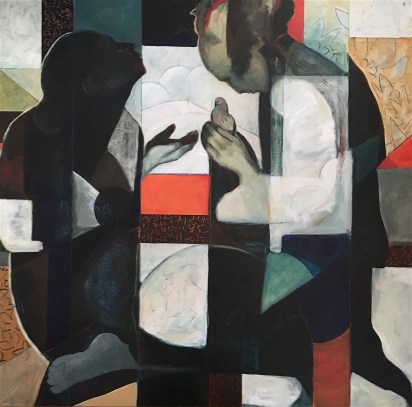
a more recent smaller painting: In Quiet Prayer

Horatio issued me this challenge: do something new, something you’ve never done before. Paint something different, something that boggles you.

I love this challenge. In other words, step out of your comfort zone. Dare to not know where you are going. Make a mess with great gusto and intention. Court chaos and wrestle it into something that resembles order for you and no one else.

Horatio might have said, “Dare to see again, purely, with no filters, knowledge, or preconceptions.” He might have added, “What might you see, who might you be, if you stepped beyond the safety of your ideals, your beliefs, and great mass of weighty and important knowledge?”

The child in me, the one not yet accustomed to sitting in a desk or raising my hand or waiting my turn would loudly sing the answer: You’d be fully alive! I’d be fully alive.

from a few years ago, a larger piece: Meditation

I’ve always appreciated how similar are an artist’s path and that of a spiritual seeker. The aim of the exercise is the same. A meditation practice to still a busy mind is identical to an actor’s training to be fully present on the stage or a painter’s pursuit to see purely (to see without the disruption of interpretation). On both paths, truth is a fluid thing. Truth is what is happening right now. What happened yesterday or may happen tomorrow are distractions at best. They are stories that get in the way. They are of no consequence to this moment of living, this moment of aliveness. It is, an actor learns, a fool’s errand to attempt to repeat yesterday’s performance.

Horatio’s challenge is relevant for every human being wrestling with the big questions or trying to stave off or make sense of the chaos. Dare to dance with what’s right in front of you. Dare to drop the questions.

Picasso famously said that every child is an artist. The problem is to remain an artist once he or she grows up. He might well have said that every child is fully alive. The problem is to remain fully alive once he or she grows up.

playing around with simplicity. This one is hot off the easel and not yet named.

this is how she looks in a frame. Magic!

Save

Save

Save

Save

Save

Save

Row

may-you-be-small-crop-jpegSometimes the way forward is akin to rowing a boat: facing backward is the only way to get proper leverage. Today, to stir my pot, to get some leverage and new energy, I revisited three books that I wrote but never published (or limply offered to a tiny audience). It was a revelation. It’s as if the man who wrote those books in the past meant for me to read them today. The man who wrote them was not ready or clear enough to birth them. The man who read them today knows just what to do (including rewrite some odd bits). Here is the introduction to the first of the three books:

I’ve generally stepped in every pothole, tripped over every opportunity, broken the family dishes, and made every mistake a person can make. I feel fortunate to be alive. I used to try and hide the mess behind a veneer of “knowing.” Eventually I realized that in order to find what I was seeking I had to stop pretending that I knew what I was doing. I didn’t. I now recognize that the more I learn, the less I know. Life is not about knowing stuff. Life is vibrant when engaging with the un-known. Seeking is messy business. Being human is messy business. To pretend otherwise is…well, to pretend.

One day, while exhausting myself pretending, I realized that I was telling myself a story of fear. I realized that I was the only person invested in my fear story. I realized that I’d cast all the other people in my story as dangerous characters. I believed that if they really knew me they’d shame me. I realized that I was the only person in my story feeling pain, frustration and exhaustion. So, why was I telling myself this story? This was not the story that I wanted my life to tell. That day I began changing my story.

At some point, each of us comes face-to-face with the story of our lives. When we do, we have the choice to retreat further into hiding or to take off the mask, turn around, and walk toward the thing we fear the most. This is to seek the bear.

Every human being who has walked the face of the earth has come to the same crossroad; those that faced their bear left behind clues about how to do it. They left us messages about how best to stop hiding, how to turn and walk toward fear, what to do when it is time to stand in front of the bear’s cave and how to welcome the encounter. The clues and messages are found in the stories they left for us. The stories are maps for navigating our inner geography.

Our ancestors understood that stories are a participation sport. Our lives are mirrored in the tale of adventure. We know what to do in our personal story because we identify with the heroine/hero in the story. Their journey of transformation is a guide to our journey of transformation. Their follies and foibles give coherence and direction to our messy passage. Their death and rebirth is a map for our death and rebirth. Their story is a call for us to step more fully into our adventure-story.

As is true in all life-lessons, it’s a perfect loop. I’m back where I started (apparently) only with new eyes and a few more years of experience. Order from chaos, chaos from order, I suspect we are all, one way or another, rowing in a perfect circle.circle-peace-earth-jpeg

Save

Protect Our Diversity

Many years ago, sitting in a Starbucks, my brother told me that I should be careful because not everyone wanted the diversity I was promoting. His warning struck me as odd. At the time I was partners in a business that facilitated diversity training and change dynamics. I was traveling to many places in this nation, north, south, east, west, and places in the middle, to work with people in corporations and schools and communities who’d come up against the startling reality that all people do not share the same reality, that equality is an ideal not yet realized, that we are a nation defined by our other-ness.

When I was in school I was taught that the USA was a melting pot, a hot crucible into which people of many backgrounds, creeds, and colors were transformed into something stronger. I was taught that we were a nation of immigrants. It is printed on our currency: e pluribus unum. Out of the many, one. Why, then, would I need to be careful? Diversity was not something I was promoting, it was (and is) our circumstance. It was an identity I was helping people navigate in their workplaces and communities.

I read somewhere that the real challenge of the American Experiment is that we have to reinvent ourselves everyday. Because we are not (and never have been) able to share a common ethnic-religious-origin story, we must strive everyday to create a shared story. We create our story. We were, at our inception, an experiment in other-ness. To insist that we were meant to be singular – white and Christian – is a concoction. Our shared story begins with the single common thread that runs through most of our ancestral paths: we came from some other place seeking freedom in one form or another: religious freedom, freedom from persecution, the freedom to pursue opportunities. What binds us, the single story-blanket under which we can all crawl, is our diversity. Out of the many, one.

There is and always has been a tension in our story creation. Each new wave of others is resisted and often persecuted by the previous wave. When, in a nation of diverse backgrounds, in a country made strong by its multiplicity, does one actually become an American? And, what does an American look like? And, how far are we from living the ideal of all being created equally? With liberty and justice for all? It’s a moving target at best. It is a worthy ideal and worth the struggle.

The Experiment, like all experiments, has had some miserable failures. It has taken some giant strides forward. It is riddled with paradoxes and often runs into a hard wall of hypocrisy. We’ve torn ourselves in half and pasted ourselves back together. We’ve had our share of hate-mongers and xenophobes. We have one now. And, we always transcend them because we do not run on fear or anger but on promise and opportunity. The conservative impulse is always at odds with the progressive desire. It provides the heat for the crucible. It provides the tension for creativity and growth.

The greatest centers of innovation and entrepreneurship in the history of humankind have all been crossroads, places where many cultures cross paths and come together. Difference is a great opener of eyes and minds. We are an intentional crossroads, a meeting place by design. Our make-up of differences might be the single reason why we have grown as a nation of invention, advancement, and possibility.

In one aspect my brother was right: I should be careful, we should be careful to protect and keep the ideal in the center. It is worth marching for, it is worth challenging the fear-mongering and stepping in the way of a leader who plays on anger to create division. We should be careful to honor and steward The Experiment forward to the next generation of diverse Americans.


Use Joy Language

joy-croppedTripper Dog-Dog-Dog has moved through several names in his 3 years on earth. He has a cornucopia of names. For a while I dropped the “Tripper” part of his name and simply called him Dog-Dog. Now, much as a mother might use their child’s middle name, we only call him Tripper when he’s in trouble.

Lately I call him Dog-a-Dog (or doggadogga). He answers to Wag-A-Wag. He is an Australian Shepherd and has a bobbed tail that never stops wagging. He is a happy, happy boy. When I let him out in the morning I call him Fuss Bucket. When he comes back in I call him Poop Sack (for obvious reasons) or Bark Monster or Fur Ball. He sheds like a champion. When he circles through the rooms of our house looking for a safe place to deposit his bone, I (cleverly) call him Bone.

All the variations and derivatives are terms of endearment. Dog-Dog knows and responds in kind. Love is like that. Once, sitting on a train, I watched a grandfather lovingly toss his toddler grandson in the air saying, “You’re just Rubbish! That’s what you are! Rubbish!” The boy squealed with delight. The grandfather chuckled with pleasure and repeated the toss, “You’re just Rubbish!”

Language is a beautiful paradox. It is reductive even as it points to the unfathomable universe and the infinity of love. It is referential; we sometimes forget that the word “tree” is not the tree itself. It is merely an invented-phonetic-pointer toward something too complex to comprehend.

Language is powerful beyond comprehension. We use it to narrate our worlds, both inner and outer. The words we choose create the world we see. The words we choose define the world we inhabit. In my consulting/coaching days I used to love playing with exercises that revealed how easily we come to the language of gossip and blame. It requires almost no effort. Like sugar, hate-speak is addictive. It is the mark of a lazy mind.

The language of love takes some intention and consciousness. It demands conscious effort. It requires paying attention. It requires focusing the energy of the mind and, like any focus (or muscle) it demands exercise to be healthy. And, when exercised, it becomes easy. With great love, the word “Rubbish” can generate squeals of pleasure. The name “Fuss Bucket” will engender a full body joy-wag. And, a full body joy-wag will bring the love full circle. Love is like that. Joy is like that.

In his many books, Martin Prechtel writes beautifully about the power and necessity of speaking beautifully. Speaking beautifully creates a beautiful thinker and a beautiful thinker creates – narrates – a beautiful story, a beautiful world.

Prints/Mugs/Pillows/Cards/Totes

kerrisherwood.com   itunes:  kerri sherwood


Save

Sit In The First Seat


a detail from my latest painting

a detail from my latest painting

I am living this story, as are we all. I am a lover of story so I count myself fortunate enough to know that I am living it. It’s one of the grail stories. Here’s the section of the story that I am now living:

The knight who cannot be beaten (he has a magic sword) is knocked from his warhorse. A warrior, a man with no armor or shield, no protection, emerges from the woods, challenges the knight, and in a single blow, unseats him. That’s not the worst of it: the knight’s magic sword shatters. And, that’s not the worst of it. His armor, his trusty protection through the many wars in the wasteland, pins him down. Like a turtle on its back, he is defenseless. His magic sword, his trusted armor, all that he has relied on, all that he’s built his identity and purpose upon, betray him. He is stunned. He is lost. He closes his eyes and awaits his death.

Death does not come. Well…

another detail

another detail

The warrior, the man with no armor, does not finish the job. He disappears without a trace leaving the knight stranded but alive. The knight opens his eyes and somehow manages to sit up. He weeps because his endless efforts to save the world have come to naught. In fact, fighting ogres seemed to produce more ogres! He removes his armor. He is no longer a knight. He is no longer capable of saving the world. He is, for the first time since his childhood, unprotected. He is, at last, purpose-free.

Nothing is more frightening – or useful – than to drop the armor of purpose and take a good hard look at what lives beneath all that forged metal.

...and another

…and another

At first his lack of identity drives him crazy. He has no answer to the cocktail party question, “So, what do you do?” He feels naked and exposed. Fortunately, a teacher, a hermit, emerges from the woods to help him navigate the crazies. Namely, the hermit helps him by not answering his endless questions. The hermit helps him understand that the world never really needed him because the world was never really broken. The hermit helps him relax and see beyond all of his thinking. He realizes that the wasteland came, not because the world was broken, but because he believed himself to be broken, somehow lacking.

In a life of chopping wood and carrying water he sees that his purpose has nothing at all to do with doing – or roles or achievements. He sees that the road to the grail castle is blocked so long as he believes he is defined by a role or a bank account or lost in a made-up purpose. When he drops his need for importance the grail castle appears.

...and another

…and another

Satori, in all the stories, knocks seekers from their ponies. It stops all pursuits. It pops the illusion of a purpose-driven life. It necessarily strips the seeker naked.

We are all seekers at some point.

When you are required in the workshop to write your epitaph or are somehow forced to articulate what was most important in this life, the doing, the list of achievements, the purpose-drive will always take second seat. HOW you did what you did, the relationships you tended or ignored, the moments you appreciated or missed, will sit squarely in the first spot.


as yet unnamed

as yet unnamed


Save

Save

Start Walking

photoTell Me. How can I be a learner?

My mind went absolutely blank, and I heard myself saying, Its simple. To be a learner youve got to be willing to be a fool. ~George Leonard, Mastery

I used to do a lot of work in education. My career in the theatre took a sharp left-hand turn when I started consulting with schools. The puzzles that plagued educators seemed to me easy to address. To be human is to be curious. Tickle the curiosity, begin the story and get out of the way.

Tom once told me that teaching is about relationship (not control). He also told me that the best teaching/learning needed to be directly applicable; it had to be immediate. It had to be real. It had to matter – to both the teacher and the learner. The trick is to extend the mattering into greater and deeper levels of abstraction.

An emphasis on testing is an emphasis on knowing. Great learning places the emphasis on not-knowing. It reinforces the pursuit and dispels the notion that knowledge is something achievable. Worthy questions always open more worthy questions. To be human is to be curious. To be alive is to wonder what is on the other side of the hill and then take a step toward it.

The fool George Leonard references isn’t “ the unthinking person,” it is “the carefree fool in the tarot deck who bears the awesome number zero, signifying the fertile void from which all creation springs, the state of emptiness that allows new things to come into being.”

Emptiness. Not knowing. Relationship. Mattering.

Step Into Unknown with SigThe question, “How do we/I do it?” is a great step-stopper. It is the leading edge of every personal and organizational stagnation excuse. We don’t know how. I’ve come to believe that it isn’t a natural question but is learned behavior. It is an emergency brake installed by a system that values right answers over great questions.

My wife and I have a short-hand phrase, Beaky’s Wheelchair, to remind us when we stall, that “how?” is something that can only be known after the fact. No one knows “How?” at the beginning. Beaky needed an electric wheelchair to be mobile and the world of insurance/medicare was standing still. After months of waiting, with no clue which direction to begin, we started making calls. We met every “no” with a “why not?.” We asked a multitude of foolish questions. We learned. And learned some more. Within a matter of weeks, Beaky had her wheelchair.

How do you play the guitar? Paint a picture? Bridge a conflict? Transcend a limit? Know one knows. Tickle the curiosity, let go of any notion that you need to know how, and start walking.

text from Krishnamurti as it appears in my painting

the text from Krishnamurti as it appears in my painting


Save

Save

Save

Save

Cut A New Path

ComfortNow

The latest in my Held In Grace series. This is Comfort Now

It seems to me that most of our days on this earth are spent moving through patterns, conscious or unconscious. These patterns are the rituals of our lives. Some of the rituals are easy to see. For instance, what is the sequence of actions you perform before going to bed each night? What about your ritual of rising each day? The care and feeding of Tripper Dog-Dog-Dog and Babycat are central to my rising and retreating rituals each day. We move through the same actions every morning and evening and I delight in the warmth of the ritual.

Some of the rituals are not so easy to see. Researchers tell us that most of the thoughts we think every day are the same thoughts we had yesterday. We mostly think in patterns (it makes sense once you recognize that language is constructed of category and pattern). We talk to ourselves, cutting paths through the forest of our minds and, once we’ve established a trail, we like to stay on it. Easy is often unconscious. There’s nothing wrong with staying on the easy trail if the path you’ve cut, your repetitious thought-ritual, is self-loving. The rub: ritual paths of self-loathing and self-limitation are also easy, well-worn paths and that makes them both unconscious and hard to leave.

Cutting a new path through the mind forest begins with recognizing that new paths are always available. They just aren’t easy to establish. They require new practices. They require surrender and the first bit of surrender necessary for cutting a new path is the ritual giving-over of needing-to-know-anything; new paths, by definition are unknown.

New paths are not comfortable precisely because they require attention, consciousness.

My teachers taught me that all stories worth telling are stories of transformation. The main character or characters will know something at the end of the story that they did not know at the beginning and the new knowledge will be hard-won. That’s what makes the story worth engaging. Hamlet is a much different character in Act 5 than he was in Act 1. His peace was difficult to come by. He had to learn to surrender. To cut a new path he had to make a practice of peace.

The same ideal applies to the stories we live off the stage.


Stand In It

photo

a detail from a recent painting

A surprise package came in the mail. It was a gift from David, my artist’s artist. He sends me things to feed my artist soul, to stir my pot or help me sort out my dilemmas. This gift is more timely than most; it is especially relevant for me now. It is a book of photographs and essays by Walter Kaufmann called Time Is An Artist. I’ve barely cracked the cover and already know it carries the wind that will fill my becalmed life-ship.

This is a quote from the first essay: We always live at the limits, but we are rarely aware of it.

I woke up this morning awash with gratitude for a man who stood in line behind me at an airport ticket counter over 30 years ago. I was returning from Europe. I had a hundred dollars and some lose change in my pocket. I was exhausted. I’d flown from London and landed in a blizzard. My connecting flight from D.C. to Denver was cancelled. Because I was traveling on a cheap open-ended student ticket, the cancelled flight meant I was stuck with no way home. I didn’t know what to do and was too tired to sort it out. I was desperate and lost in my desperation. That’s when the man tapped me on the shoulder. He was a guy in a rumpled business suit. That’s all I remember about him. He was also trying to get home. He’d just heard someone mention an airline offering a cheap flight to Denver. It was $89.00 ($100 with tax). I ran for the ticket counter and snagged one of the few remaining tickets.

That’s it. That’s what I remember about this man who tapped me on the shoulder. To him it was probably a little thing. To me it was enormous. I needed hope beyond desperation. I was investing in a story of limitless problems and was met with a moment of generosity.

It seems that I am in a life course, a graduate school for detachment. Last night P-Tom shared a quote that was important to him when he was doing his chaplaincy in a hospital: Don’t’ just do something, stand there (a reversal of the known quote). Stand there. Amidst the grief and the loss and the mess, sometimes it is essential to do nothing but offer presence. The man at the airport gave me his presence. Beyond his situation he was listening to my struggle.

Detach from your story and the gift will be gratitude. What rolls through our minds is nothing more or less than a story. Eckhart Tolle tells us the story is a force that pulls us out of the Now. Carlos Castaneda writes that Don Juan taught him 3 steps on the warrior’s path: Detach. Make a choice. Own the choice. One of the primary reasons people meditate is to quiet the mind. In the quiet it is possible to see the story as just that, a story. Detachment, in this sense, is not disengagement from life or cold aloofness from reality. It is the doorway to life. Stand in it and not the story of it.

Gratitude lives in the Now. Where else?

photo-2

another detail from another painting. kerri says this one looks like gratitude

The man at the airport was on my mind because I have learned in this life-course that gratitude is best served in thimbles: the taste of the pear, the sun on your face. The man tapping your shoulder, “Hey, I just heard….” I thanked him before running but the real gratitude came later. Gratitude came again this morning because I was telling stories of the good angels who’ve populated my path.

Real gratitude for this life lived perpetually on the edge is often lost when the expectation-bar is set too high. To be grateful for your life – your whole life – is… an abstraction. It requires a story that pulls you away from this bite. It is a bucket too big. Savoring is a slow affair, available in the smallest taste, right now.


Unroll The Generosity Perspective

from the archives: EmbraceI’m eavesdropping. Kerri and Pastor Tom are in the next room having a planning session. I just heard P-Tom say, “The generosity perspective fell down. Woody rolled it up and put it under the table.” I laughed out loud. They are talking about a banner but, taken out of context, it is a terrific and ominous phrase!

If you take a gander at the daily news, follow the political circus, count the people trampled in the crush to buy stuff the day after Thanksgiving, you would be hard-pressed to find a better phrase for our times. The generosity perspective fell down. And, to add icing on the metaphoric cake: Woody easily rolled it up. He put under a table.

This land is your land. This land is my land. This land was made for you and me.

I’m convinced that there is another side of the coin. There is no denying that meanness exists in our world. Humiliation is a game played everyday through social media and beyond. Yet, I still believe that there is a disconnection between the rhetoric and the lived experience. I see and experience terrific acts of generosity every day. Some are small acts, some are vast – unfathomable, some are spontaneous, some are planned but all are generous. In fact, when I really pay attention, I find that the incidences of generosity far outpace the acts of cruelty.

Cruelty makes for good gossip and good gossip is cruel. And so, meanness sells. It is good for advertisers so those are the stories we broadcast. Generosity, on the other hand, erases victim stories and so is rarely yummy-fun to talk about. Acts of generosity are less potent as a selling tool.

Cruelty is easy to see. Generosity requires an intentional focus.

This morning I bumbled into a TED talk by Patti Dobrowolski. I learned that the odds are 9-to-1 against making change even if the change needed is life saving. Her message is great: draw the story you want to tell. Literally, draw it. And then tell it. If we want a different story we have to imagine a different story. If we want a different story we need to tell a different story. If we want a different story we need to act a different story.

If Woody easily rolled up and stashed the generosity perspective under the table it should be equally as easy for Woody to reach under the table, unroll the generosity perspective and hang it for all to see.


Open Your Eyes

a detail from the painting on the chopping block. It's called "The Stillness Must Be Immense."

a detail from the painting on the chopping block. It’s called “The Stillness Must Be Immense.”

There is a debate raging in my house. Yesterday I was about to wipe a painting off my canvas and begin anew when Kerri intervened. “I love it!” she declared. “I hate it,” I replied. “Truly,” she said, “I love it.” When I wrinkled my brow she restated, “I love it.”

Many years ago I was stepping toward a canvas to wipe it clean. The painting wasn’t working for me and I’d given up. I wanted to start anew. My landlady, Kathleen, came into the studio at just that moment and hurled herself in front of the canvas. “You can’t erase it!” she declared! “This is one of my favorites!” She had the look of a desperate woman begging for the life of her child. I relented. I couldn’t wipe it clean. She confessed to coming into the studio the previous evening and admiring the painting. “I spent a long time with it!” I made a deal with her. I promised to show the painting – to include it in one show – and let the public decide. If it was roundly reviled, as I KNEW it would be (as I was actively roundly reviling it), I’d paint over it without drama or interference. If it was appreciated by anyone, by a single person, Kathleen could say, “I told you so,” and I’d never paint over it.

the painting Kathleen saved

the painting Kathleen saved.

A few months later I hung the painting in my solo show at Rock/Dement studio gallery in

Seattle. At the opening a woman came into the gallery, stood before the painting, and burst into tears. She looked at me with tears rolling down her face and said, “I love it.” Kathleen waited a few days before allowing words to break through her smug smile, “Well,” she sighed, “I told you so.”

That painting is the reason I made the same deal with Kerri yesterday. I will let it remain long enough to show one time. If it is roundly reviled and ignored, then I will paint over the canvas without protest. If a single person likes it or expresses appreciation for it, she can bury me in a mountain of, “I told you so,” and the painting will live on long after I’m gone.

The Stillness Must Be Immense.

The Stillness Must Be Immense.

This morning I posted an image, a print that reads, “CROSS THE BOUNDARY OF ELEMENTS.” In the short blurb associated with the image I wrote that sometimes we have to stand in other people’s shoes. We have to see what they see. I am an artist and am convinced that artistry is all about opening new visions for others. It is about helping people see what is there, not what they think is there – and I’m certain that I fall into a thought eddy while painting. It is, perhaps impossible for me to see what others see in my paintings. What I judge to be worthless has often proven to be magnetic to others. And so, I am willing to make this bet, I delight in the moments when my understanding of life turns back on me, flings itself in front of me and screams, “Open your eyes!”

another detail of the painting.

another detail of the painting.