Imagine The Possibilities! [on Two Artists Tuesday]

Mastering others is strength. Mastering yourself is true power.” ~ Lao Tzu

I’ve had this quote sitting on my desktop for months. I’ve been on a Lao Tzu kick, a Kurt Vonnegut kick, a Rainier Maria Rilke kick…all at the same time. They are, not surprisingly, in alignment on many topics, among them self-mastery. “The secret?” they whisper. “Stop trying to control what other people think or see or feel and, instead, take care of what you think and see and feel.” Their metaphoric trains may approach the self-mastery station from different directions but the arrival platform is the same.

It’s a universal recognition: take the log out of your own eye.

Sometimes a penny drops more than once and so it is with Saul’s advice to me. “Look beyond the opponent to the field of possibilities.” “And, just what does that mean?” you may shout at your screen. It sounds like new-age hoo-haw.

Ghandi said, “Nonviolence is the weapon of the strong.” It is the height of self-mastery to bring ideas to the table rather than a gun. It is the height of self-mastery to bring to the commons good intention and an honest desire to work with others to make life better for all. Power is never self-generated but is something created between people. Power is distinctly different than control. Power endures since it does not reside within a single individual. Power lives, as Saul reminded me again and again, not in throwing an opponent but in helping the opponent throw themself. “Focus on the possibilities,” he said again and again. Throw yourself to the ground often enough and, one day, it occurs that there may be another way.

Work with and not against. It seems so simple. The bulb hovering over my cartoon head lights-up. Work with yourself, too, and not against. Place your eyes in the field of all possibilities. Obstacles are great makers of resistance, energy eddies and division. Possibilities are expansive, dissolvers of divisiveness.

I am writing this on the Sunday that Christians celebrate their resurrection. The day that “every man/woman for him/herself” might possibly and-at-last-transform into “I am my brothers/sisters keeper.” All that is required for this rebirth is a simple change of focus; a decision to master one’s self instead of the never ending violent attempt to exercise control over others.

It’s the single message, the popcorn trail left for us by all the great teachers. Instead of fighting with others, master yourself. Imagine the possibilities!

read Kerri’s blogpost about THE CEILING LIGHT

Reseed [on Merely A Thought Monday]

We pulled everything off the walls of the office. The photographs and posters of plays I’ve directed, Kerri’s first album, framed, a gift. Our poster announcing Beaky’s Books. “I don’t think the office should be about the past,” she said. “It’s time to make this space about our current work and the future.”

She chose a painting, Nap On The Beach, one of many created from our experiences together. She’s making a poster of Smack-Dab, our cartoon. Turning our eyes from what we’ve done, where we’ve been, who we were. We’ve changed. We want different things now. We work in different ways now.

She’s slowly cleaning out the house. I can’t help. This is something she must do by herself. Purging closets, the laundry room, the storage and work rooms. The year of water upended our house. Several times. It continues in the front yard, all the way to the street. When the ground settles, we’ll reseed the lawn. How’s that for a metaphor? When the ground settles, we will reseed.

It takes time for the ground to settle. It can’t be rushed. It should not be rushed. The same is true for cleaning out. We have new piles forming: what goes, what stays. I climb the stairs to the office each morning. When I come down again, she shows me the new space that she’s created from the day’s purge. It’s true on many levels. She’s creating space. Old baggage and burdens are going out with the old clothes and broken appliances. I can see it in her eyes. Space. Light. Like the house, she is beginning to breathe again.

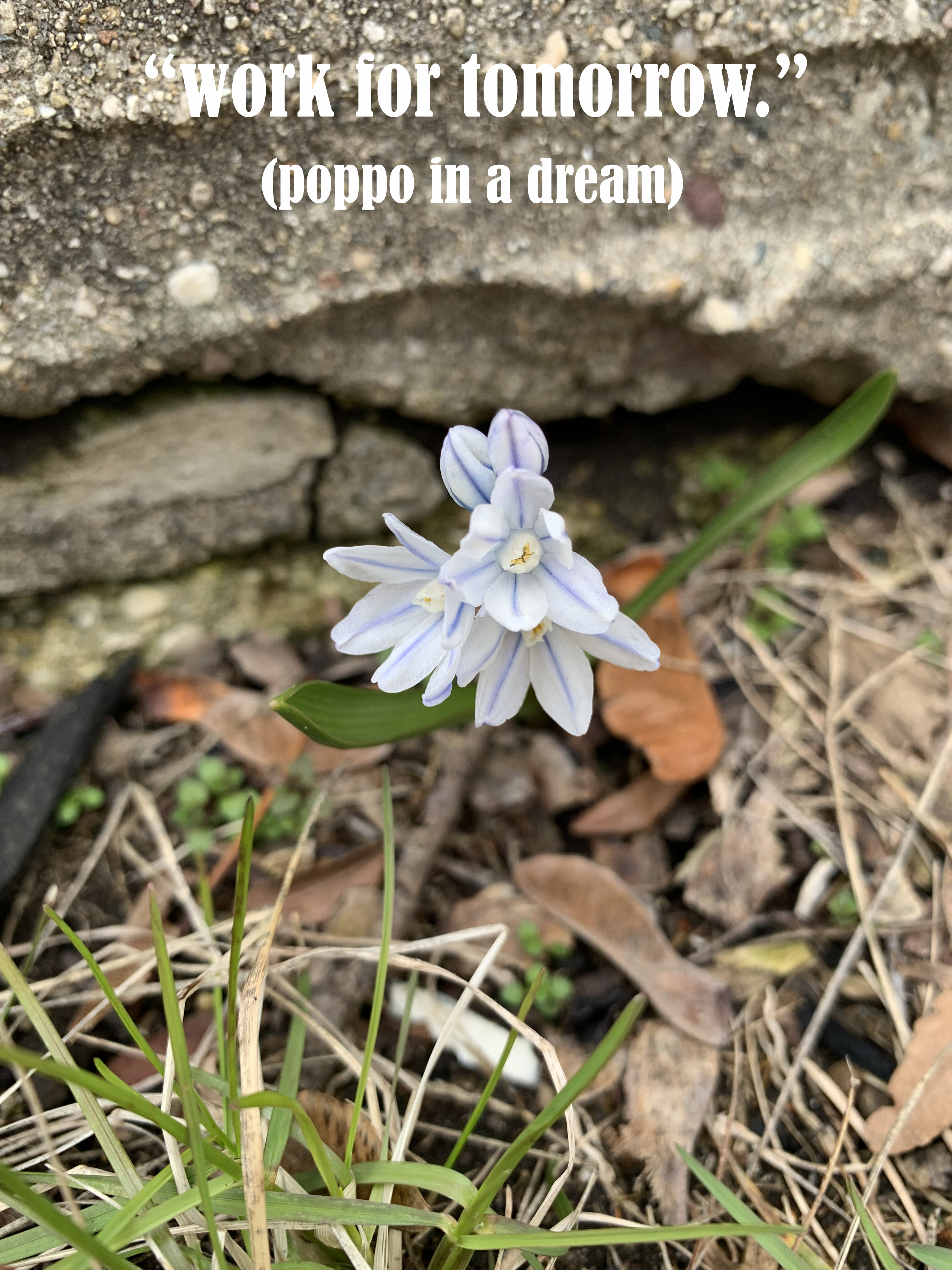
She told me about the dream, her father was setting up microphones. “What are you doing?” she asked.

“Working for tomorrow,” he said.

I had to work hard not to weep. She’s had a rough few years. “Your daddy’s talking to you,” I said. “Sage advice.”

She nodded. Her eyes turning from the pain and constraints of the injuries. Letting go of the past. “Work for tomorrow,” she smiled.

read Kerri’s blog post about WORK FOR TOMORROW

Stack The Impossible [on Merely A Thought Monday]

We watched the video of Jaxon climbing the ladder of the red plastic slide. His momma said, “Is that your big boy slide?” Jaxon said, “Big boy slide.” Pandemonium. “He said it!” his father exclaimed, “I think he said it!”

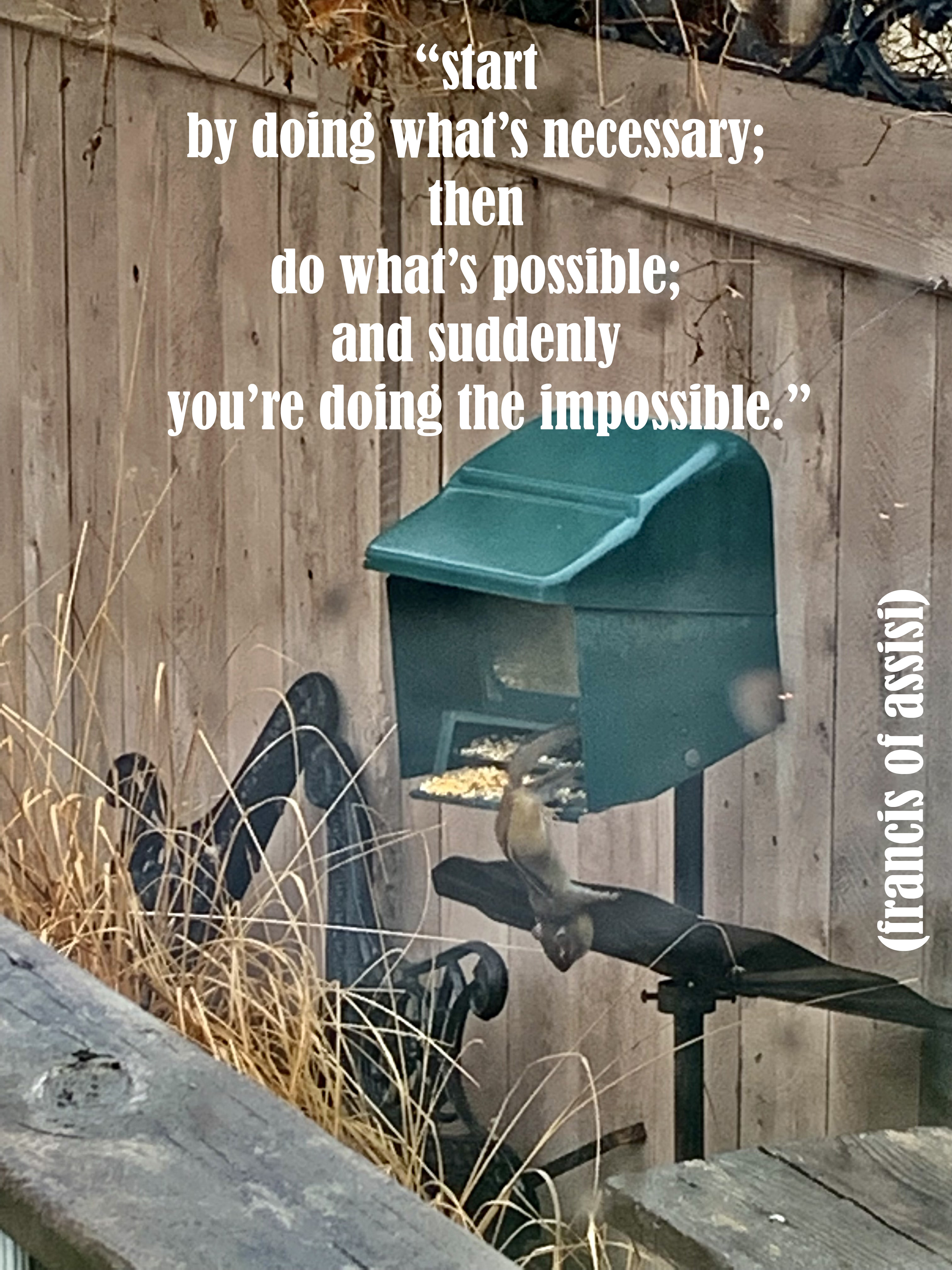
Big boy slide. A first phrase. The moment when what’s necessary becomes what’s possible. It’s something we take for granted every day. The utter impossibility of spoken language. Sounds uttered in sequence that somehow make sense. Of course, we’re also quite capable of stringing together sounds that make nonsense, too. Soon, Jaxon will ask his parents for the keys to the car and a wholly different kind of pandemonium will let loose. From climbing a ladder to driving the Volvo. The impossibilities stack one upon the other.

My mother is adjusting to life without my dad. She says often, “I don’t think I can take it, this loneliness.” She is doing what is necessary. In our last chat, she spoke of playing pickleball, of taking a walk, of meeting a friend for tea. Moving with intention out of the apartment to meet other people. The moment when the necessary becomes what’s possible. She will, I am confident, live her way into the impossible.

The impossible rarely happens in a snap. We live our way into it. Jaxon’s pronouncement and subsequent trip down the big boy slide was a long time coming, a step in the process worthy of celebration. And then, the miracles will keep coming. Full sentences. He’ll learn to write. Someday he’ll write love letters and drive the car to pick up his date. He’ll ask someone to marry him. The art of the impossible. This life.

And, the most amazing of the impossibilities, as we stack our lives with the formerly inconceivable, we grow less and less capable of seeing it. Perhaps that is necessary? How would we exist if we saw each other as keepers of the impossible? Experiencers of the unimaginable?

read Kerri’s blogpost about THE IMPOSSIBLE

Seed The Pocket [on Flawed Wednesday]

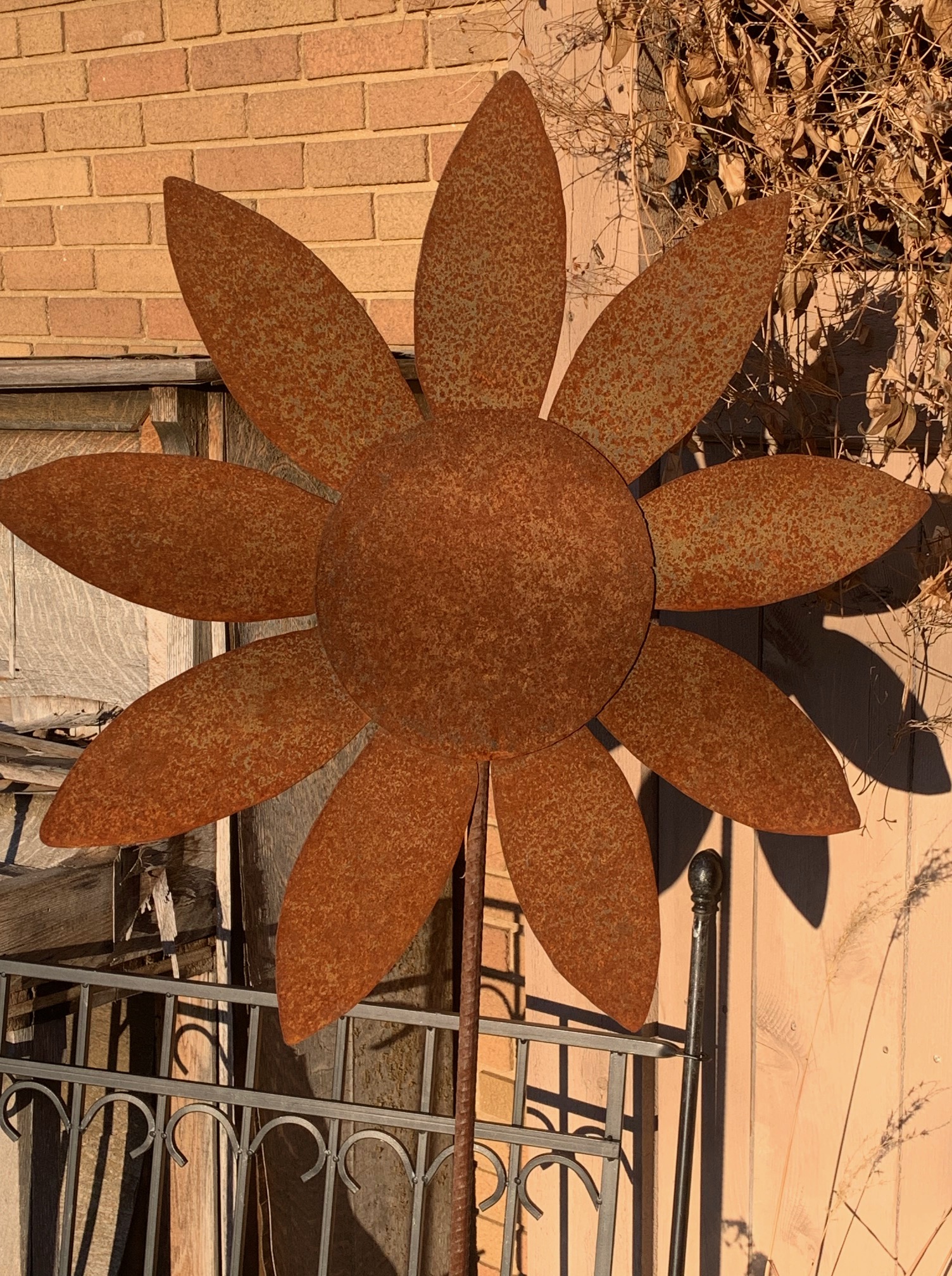
I’ve appreciated this sunflower for many years and until a month ago it never made me think of Ukraine. Now, that’s all I see. Thus, the power of a symbol. Sunflower seeds placed into the pockets of Russian soldiers by brave Ukrainian elders. “So, some good may come from your death.”

Walking through the antique mall, Brad spotted an ugly homemade sculpture. Golf balls with multiple screws protruding, spray painted and supported by wire rods. “Look, the coronavirus!” he exclaimed. Three years ago spheres with spiky knobs would have made me wrinkle my brow but never associate the shape with a virus. Now?

And masks? Will we ever see a surgical mask without feeling the divide in our nation? A confederate flag paraded through the Capitol? Members of the Capitol Police beaten with the stars and stripes; symbols matter.

Every year more and more our written communication is reimagined with emojis. Visual symbols. The new Ideogram. A thumbs up. A heart. Laughing face. Saying more with less or at the very least opening up our communication to broader interpretation. I find that I’m symbolically rolling my eyes more and more. Exclamation point. HAHA! Know what I mean? Winky face.

Leonard Shlain wrote some remarkable books about how our brains are wired by how we communicate; he posits that linear language, the introduction of writing drove us into our left brains and away from our holistic right. Perhaps in our movement back toward the ideogram we are rebalancing? A course correction or returning to center? It takes more than a few years for brains to rewire. Our descendants will, no doubt, either write books about it or communicate their thoughts through a combo platter of alphabet and pictograph.

Either way, we can only hope they grasp the meaning of the peace symbol. Or, at the very least, learn how to give it more preference than the dollar sign. Or, better yet, figure out how to make peace profitable. Can you imagine? Certainly there will be a symbol for that.

Until then, sunflowers in the killing fields. Sad face. Broken heart.

read Kerri’s blog post about THE SUNFLOWER

Let Fly [on Two Artists Tuesday]

“We have to continually be jumping off cliffs and developing our wings on the way down.” ~ Kurt Vonnegut, If This Isn’t Nice, What Is?: Advice For The Young

It is now my opinion, based on life’s experience, that it you don’t find the cliff, the cliff will find you. Wing development is the name of this game. Hide in the closet, bury your head in the sand, drink yourself to oblivion, pretend the monster is not at the door, and you’ll discover in your last moments that looking the other way was, in fact, your cliff.

Master Marsh once asked me why I had the need to run and jump off every cliff. At the time I said, “I don’t know!” My latent response comes straight from Vonnegut: wing development. Apparently my wings took their sweet time developing and needed some extra cliff-age. And, as we all know but are too polite or arrogant to admit, wing development never ceases. There’s always another cliff until there’s not.

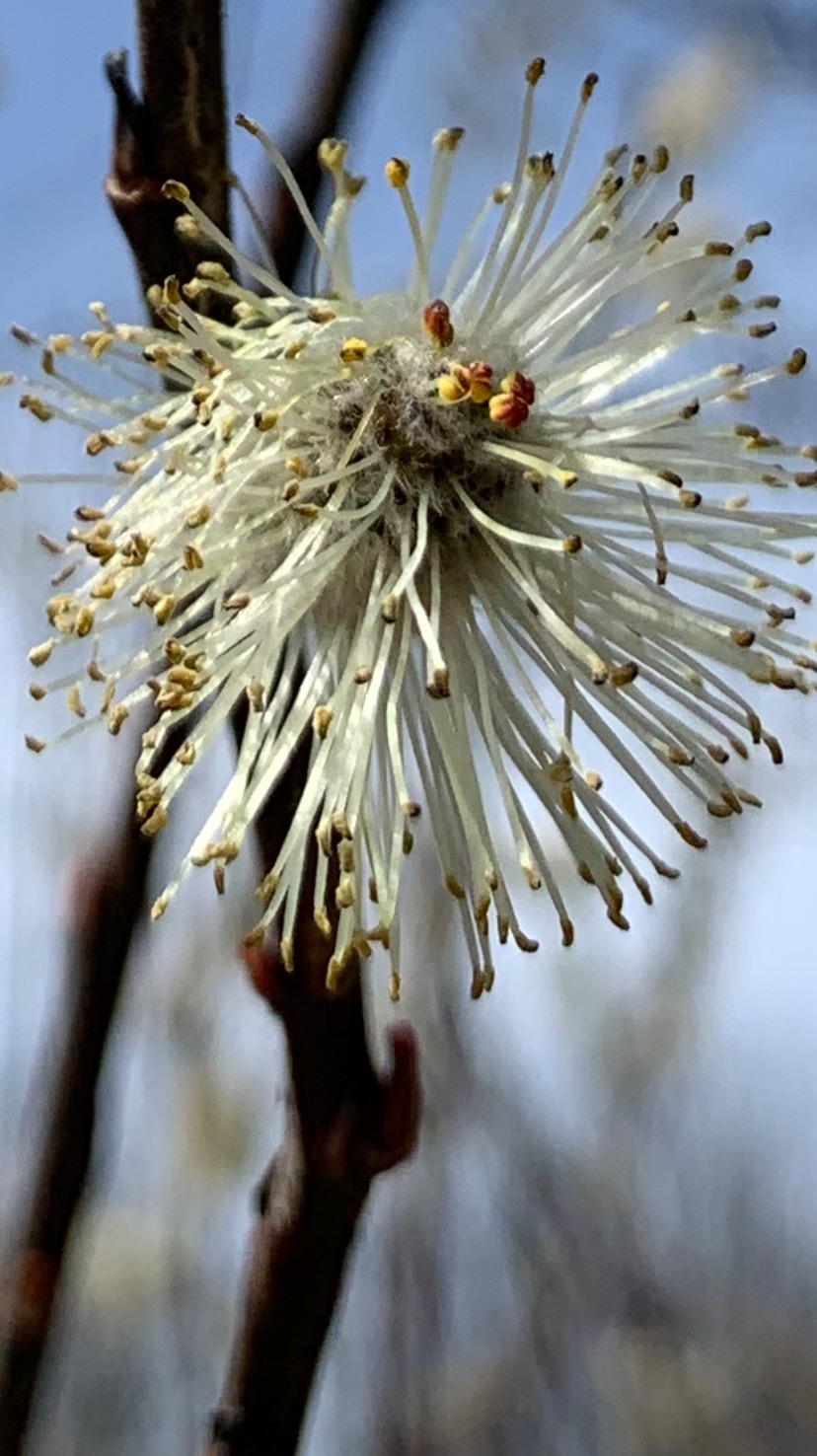
We had a rare warm day so took a walk on our favorite trail. The brilliant raw sienna of the empty pod caught Kerri’s eye. While she took photos of the pod I thought about the thousands of seeds it once held that took flight on the wind. A few certainly found fertile soil. Most did not. That’s the idea behind Kurt Vonnegut’s advice. Don’t hoard your idea seeds. Put them out. Audition for the play. Submit your story. Offer your idea. There’s great truth to the advice: your job is to put it out there, not to decide whether or not it is good enough. Explode the pod rather than protect the seed.

Greg recently told me said, “it doesn’t have meaning until it’s published.” He wasn’t speaking about publishing in a newspaper or by Random House. Sending an email is an act of publishing. To text is to publish. Greg was referring to sharing. It has no meaning until it is shared. And, sharing your creations can be -and often is – vulnerable and scary. Giving a speech is terrifying to most people. Dancing, painting, composing a song, playing a solo, offering your idea in a meeting…all are acts of publishing. All are potential cliffs to jump off.

Explode the pod. Let the seeds fly. The wind will carry them. Some will find fertile soil. Most will not. Wing development is easier when you realize that you are a pod of ideas and not a judge of worth or value.

read Kerri’s blog post about THE POD

Shape The Vessel [on Two Artists Tuesday]

George Ohr was one of the great ceramic artists of the late 19th and early 20th century. Like Van Gogh, he died unknown, never experiencing the success of his work. Robert reminded me of George Ohr’s story and I reminded Robert that Ohr would be a terrific story for him to tell through a one-man play.

What is it to follow your art-call with heart and dedication with nary a hint of financial reward or success on the horizon? Vincent Van Gogh would have been called an amateur during his life since the making-of-money is the flag we plant in the sand marking the line between being a professional and a dilettante. Those lines do not exist for artists with a deeper call. The money does not the artist make.

The Ohr-O’Keefe Museum of Art was designed by renowned architect Frank Gehry, quite a journey for the unseen work of George Ohr’s life to find so much vibrant admiration after his passing. Had he known it would have changed nothing. He’d have spent his days at the potter’s wheel either way.

“Shape clay into a vessel; It is the space within that makes it useful. Cut out doors and windows from a room; It is the holes that make it useful. Therefore, profit comes from what is there; Usefulness from what is not there.” ~Lao-tzu

Profit and usefulness. Shape and space. Mary Oliver asked the question: What will you do with your one wild and precious life? It hits the nail squarely on the head. It was not the pots that George Ohr made or the paintings that Van Gogh painted, it was the space they entered while throwing pots and painting paintings. It was the world they entered through their artistry, more expansive than financial success, more necessary than renown. A wild and precious life lived wildly and with avid appreciation.

Standing amidst the brilliant orchids, some of the flowers were in their last days. Their beauty fading, they cared not a wit. It is not in their nature to stretch their faces and pretend that the cycle of life is more valuable in the early bloom than it is in the late retreat. All is treasured, beguiling. Every last moment, not to be stalled or held onto. The root as necessary as the bloom, the winter as indispensable as the spring.

read Kerri’s blogpost about FIREWORKS

Look At You Look At Me [on Merely A Thought Monday]

It’s taken me this long to discover the source of all cartoon characters: orchids. I’m not kidding. At a recent field trip to the Chicago Botanical Garden’s Orchid Exhibit, I was surrounded by brightly colored fantastic faces, playful and chuckling. “Look at this one!” Kerri exclaimed. “It’s the Imperial Margarine guy!” I thought it was a whacky Pope or funny Cardinal, but the idea was the same.

“The earth laughs in flowers.” Emerson’s quote was stenciled on the wall as we exited the exhibit. And the laughing flowers made me laugh. Truly. I felt like a little kid at Christmas. Surrounded by color and delight and whimsy, I found myself more than once pointing, “Look at this one! Oh My God!” And, I felt like the colorful faces were staring back at me, thrilled to tears by the odd looking human standing before them. I-look-at-you-look-at-me. “Look at that face!” they snickered.

The thought stopped me in my tracks and filled me with wonder. We personify everything, projecting our humanness into everything. The art of animation, the world of Disney, is rooted in our desire to project ourselves onto and into the world. Talking mice. Dancing candlesticks. Humpty Dumpty. Wise old trees. Wouldn’t it be lovely, and isn’t it hopeful, to think the world projects itself into us? I want the orchids to fill me with color and awe. To project themselves into me. I know the forests I walk through infuse me with quiet. I know Dogga pulls love from my deepest soul.

Participants. Relationship, rather than controllers. Dancers rather than dominators. Would we be so invested in killing each other for imagined supremacy if we allowed ourselves to laugh the laugh of the flowers? If we actually understood that nothing is forever, that our warmongering was at best delusional? That the single trait that makes us human is to turn and help someone in need? The very capacity that allows us to project ourselves into the orchids is the same capacity that makes it possible to stand in the shoes of the other. Empathy is a two-way street.

If the earth laughs in flowers, these days it certainly cries in humans. Yet, standing amidst the orchids, I looked at all the human faces, hundreds of people wide-eyed with wonder and alive with astonishment. The laughing orchids looking back at the astonished faces, open and vulnerable, and they were evoking those qualities from the crowd. Earth’s tears. So hopeful, these faces, drinking in each other’s beauty.

read Kerri’s blog post about FACES

Care For Your Space [on Not So Flawed Wednesday]

It seems like such a simple concept. Tom taught it. So did Paul. And, since I was one of their students, I taught it, too. How you treat your space is a reflection of what you think of your art. The concept is universal. Replace the word “art” with “work” or “life.” You and your space are not separate. We worked hard at the theatre to become better artists and produce better plays and a significant part of that work was bettering and maintaining our artistic “home.” We were proud of our work and it showed -everywhere. Our “space” included our community and our art was meant to make it better.

Yesterday it was warm so we took a walk on a favorite loop. As we returned to the car we watched a man clean out his truck. He’d come to the park, not to walk or appreciate the quiet. His purpose was to dump his trash onto the paved lot. In an earlier time, pre-gun-gun-everywhere, we might have said something. Instead, we stared in disbelief. His space,I thought, does not extend beyond his truck. Neither does his community.

Yesterday, after the walk I received a text from Mike. He was a big part of my long-ago theatre. He’s realizing a dream and opening his own theatre. He’s led a company for a few decades but they didn’t have their own space. Now, they do. He – the artistic director – was mopping the floor and paused to send me a text. It’s the other part of the lesson from Tom and Paul. And Demarcus. And Quinn. There’s no hierarchy. There’s no above and below. Loving the space, loving the art that happens in the space: no separation. One and the same for everyone involved and everyone needs to be involved.

You and your space are not separate. The care you take of your outer space is equal to the care you give to your inner space. And, vice-versa.

[visit Justin’s to see how a company can make a better world]

read Kerri’s blogpost about NEAT EARTH

With Fresh Eyes, See [on Merely A Thought Monday]

In retrospect, many of the experiences I used to facilitate were meant to pop people – even for a moment – out of the fog of their life story. It’s a curious intention for a guy whose career was/is centered around the telling of stories.

I loved working with masks, especially with people in corporate settings or lofty educational towers. They feared the exposure that a mask might bring so they approached it with eye rolling and whatever-ego resistance. Yet, in every case, they put the mask on with reverence. There is a sequence, after donning the mask, that the wearer “wakes up” and looks at the world for the first time through fresh eyes. Everything is new. Everything. Their hands. The movement of their arms. The color and feel of the carpet. Jaded people, blunted with puffy assumption, through the eyes of the mask, are astonished by the miracle of their fingers. And then, imagine the moment that they discover each other. Their discussion during the debrief would make you weep. It was quiet. Respectful to the point of sacred. In every case the people, newly out of the mask, had to tell of their astonishment and discovery. Their eyes wide with the utter beauty of the world in and around them. And, their new eyes never carried further than the next day. The old mask, the one worn daily, the one full of fear and inflated self-importance, is powerful, too. As they say, masks reveal and masks conceal.

Masks reveal and masks conceal. The phrase refers to the wearer but it also applies to the world seen or not seen through the mask. New eyes are astonished with the ubiquitous beauty of the world newly revealed. Eyes fogged through been-there-done-that stories are dulled to the point of inattention. The magical world is concealed from their sight.

I am working on a script for a piece that I’ll perform in the fall. I realized in my latest draft that it is really about masks. The astonishment of seeing – and seeing is nothing more than or less than the revelation of connectivity. Paying attention is a step toward the eyes that see crackling vibrant color, ears that hear the birdsong. When the dull eyes open, even for a moment, the next impulse is to reach, to “call attention” to the connectivity. “Do you see that?” “Listen, isn’t it gorgeous!”

read Kerri’s blog post about PAYING ATTENTION

Trip And Trip Again [on KS Friday]

One of the advantages of having stepped in every pothole, tripped on every cobble, and made every mistake at least twice, is that I’ve learned about potholes, cobbles, mistakes, tripping and stepping where I ought not step. If I could boil down to the essence the single thing I’m beginning to grok it is this: life is not elsewhere.

I laughed aloud when I at last I realized the absurdity of “practicing mindfulness” as if it was something to achieve. Mindfulness arrives when the practice stops. Of course. Meditating for self-improvement, I’ve read, is a uniquely Western oddity. “Trying” to be present is ridiculous if you think about it. You are present. What else? Because your mind is running amok does not actually magically transport you to the past or the future. You are present with a mind that is running amok. Minds are like puppies: chase them and they run away. Stand still and they will eventually come to you.

Is any of this pothole wisdom helpful? Absolutely not. Like mindfulness, wisdom arrives when the obsession with knowledge-for-betterment ceases. I’ll let you know what that looks like when I stop trying to attain it. There’s no end to the tripping stones. I’ve learned that, too. Again and again. And again.

The best things in life are not achievements. They are relationships. Me to you. Me to me. Me to the world I am passing through, one moment at a time. With you. Stand still in the moment – you might as well since it is where you are – and you’re libel to experience all manner of beauty.

read Kerri’s blog post about SNOWFLAKES

Kerri’s albums are available on iTunes and streaming on Pandora

kindred spirits…away/released from the heart © 1995 kerri sherwood