Ask A Peony Question [on KS Friday]

The peony in our yard is sandwiched between tall grasses. We’re careful to cut back the grasses so the peony has space and air to breathe. Kerri watches it. She checks on it daily. She calls me to “Comesee!” when the buds appear. She pulls my arm, “It’s happening!” on the day the buds open into full bloom. In our house peony-bloom is cause for celebration.

The blossoms do not last long, a week, perhaps a few days more if we’re lucky. And then they are gone.

The blooms are passing but the plant is sturdy. Sometimes I feel that the peony is a good artist. It works all year drinking in sun and water and life so it might produce a few moments of lovely. Every single day, through the dog days of August, the harsh cold of winter, the wet and muddy spring, is necessary for the peony to bring its fragile and passing burst of pink beauty – its expression – into plain sight.

Late at night, the tornado sirens sent us to the basement. We sat in rocking chairs and listened to the roar of the storm, the flash and house-rattling thunder. I looked at my easel. Currently, my studio is filled with boxes. Kerri eyes her studio; it’s next up for a good cleaning-out. Revamp and refresh.

In the basement, sirens blaring and storms howling, we talked about whether or not she would ever play again. Whether or not I would ever again pick up a brush. It’s an open question. It’s a deep-in-the-night question.

It’s a peony question. I wonder if, in the dead of winter, roots reaching deeper than the frozen ground, if the peony knows that it will, with certainty, bloom?

In A Split Second from As Sure As The Sun

Kerri’s albums are available on iTunes and streaming on Pandora

read Kerri’s blogpost about THE PEONY

in a split second/as sure as the sun © 2002 kerri sherwood

Embody The Symbol [on DR Thursday]

Everything in the Japanese Garden is symbolic, intentional. Pine trees represent longevity. Rocks, I’ve learned, represent the bones of the earth. They are as necessary in the design as are the “ephemeral blooms of the iris, rhododendron, and plum.” The symbol is not complete without both.

“The ephemeral existence of human life and the timelessness of nature.” Balance.

Entering the small yard of the Shoin House at the Chicago Botanical Garden is instantly calming for me. The small house is designed to “merge the outdoors with the indoors.” It is closed to the public but always beckons. I want to sit in the alcoves and write. Or do nothing at all. In the garden, I am instantly “connected.”

“Connectivity” is a word that has moved to the center of the work that I am currently doing. Amidst our ubiquitous capacity to share (Facebook, Instagram, Tiktok…email, chat, tweet, slack, text…) we are less and less connected. As Neil Postman wrote, we have made the irrelevant relevant and the relevant irrelevant. We share but do not connect. Shared information is not – and never will be – shared meaning.

Symbols empty of meaning when a community ceases to understand, honor, tend or acknowledge the significance of the symbol. And, symbols are the glue of a community. They are the physical, tangible location of an ideal. Disconnect from the symbol and the house falls apart.

I think that is why I am drawn to the Japanese Garden. There, beauty is intentional. The symbols are so well tended, so intentional, that one need not know the specific meanings to enter the symbol.

And, that’s the point. Connectivity happens when people, together, embody their symbols. They enter them. They become embodiments of their symbol(s).

It is the artist’s job to bring people into a shared moment. To give them access to a unified experience. To help them transcend the splinter symbols that divide – and see them for what they are. To help people step back and take a good look at what they, together, are creating. A garden? A desert? Balance? Imbalance?

read Kerri’s blogpost about THE ROCKWAY

prayer of opposites © 2006 david robinson

Stroll [on Two Artists Tuesday]

Yesterday, for some reason, I revisited days of early childhood. I played four-square in the driveway. I threw dirt clods at the site of new home construction. I raced my cars off the side of the abandoned building above Del and Dorothy’s house in the mountains; the cars tumbled and I ran to retrieve them so I might send them flying again and again. I ran home in a panic the day I learned that Nancy’s little sister had drowned in utility hole that was filled with water. It was on the route I walked to school and passing the hole filled me with trepidation, it was a dark portal, my first experience of death. I didn’t really understand it.

Late at night, Kerri and I sometimes talk about everything that has happened in the short time of our relationship. We’ve lost parents and lost careers, spiraled in a free fall of uncertainty, had surgeries and broken bones. We’ve also climbed mountains, watched sunrises and meteor showers, we hold hands when we walk, we write together every day. We dance in the kitchen. I am the sous chef to her cooking artistry.

I’m not sure if we practice paying attention to our moments or it’s something that has come naturally to us. She is rarely without her camera, noticing the smallest flower, capturing the angry sky. I hold the space and hope someday she stops apologizing for stopping again to take a photo; I love watching her discover the shapes and colors of this world. Besides, I get to see what she captures in her lens with an excited, ‘Lookit!”

Today the plumber comes. Yesterday we appealed to the company that destroyed our yard replacing the waterline to come back and strip off the top layer of soil, now filled with hardware and concrete and asphalt. Slowly, we are digging out, repairing and replacing all that was destroyed or delayed in our free fall. Our lessons seem to be about stress – or, rather – not stressing. We are having experiences, rich and varied. Some things we can control. Most, we cannot. The best we can do is hold hands and stand together in each experience. Appreciate them no matter whether they look like tragedy or comedy. We’ll make meaning of them later down the road.

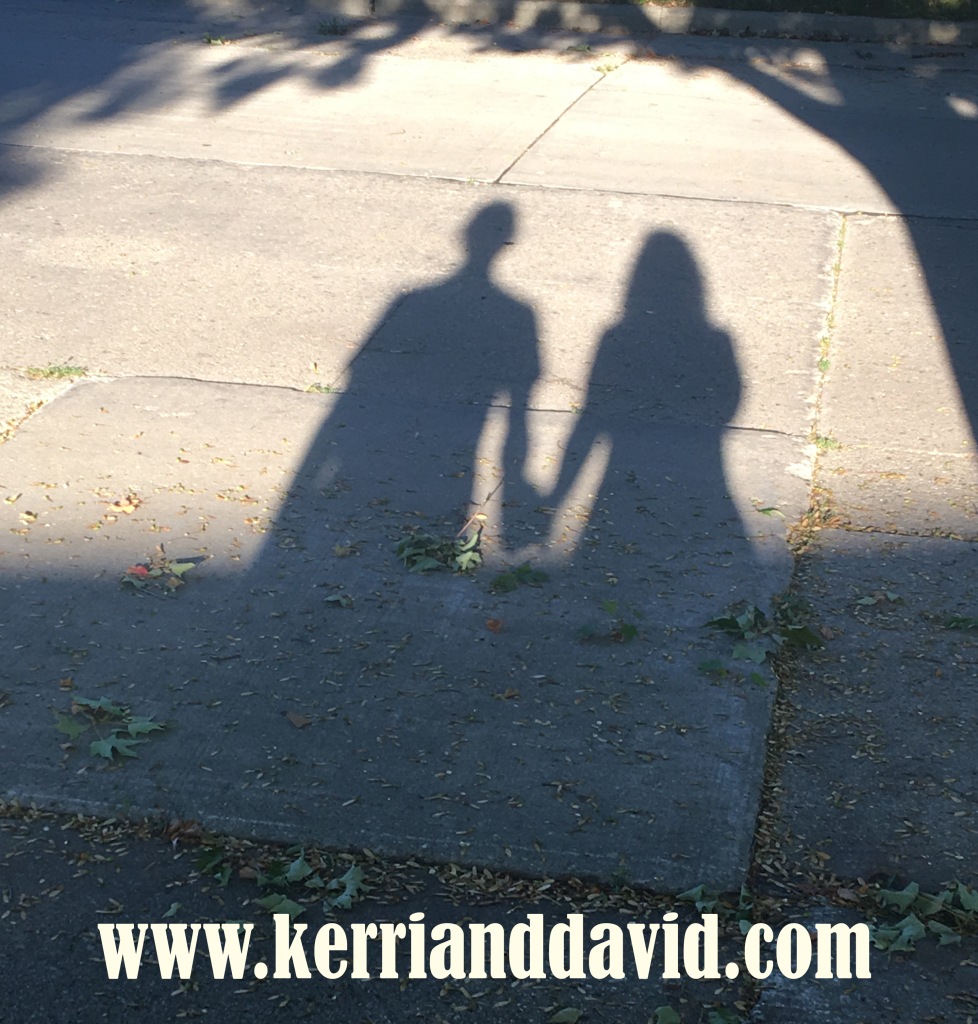
The artist dances with death. The appreciation of the fragility of life. Each day I walk by that metaphoric utility hole, only now it does not fill me with trepidation. It makes me squeeze her hand and fills me with gratitude for this life, this moment, this shadow we cast together as we take our time strolling through the garden.

read Kerri’s blogpost about THE SHADOW

Sit On The Horizon [on KS Friday]

We are the first wave of humans to experience a pace of change so fast that the media of our memories becomes irrelevant – and sometimes inaccessible – even before the paint on the memory is dry. A crank driven film camera caught a toddler version of me running down the hall in my footie pajamas on Christmas morning. Images rare and, at the time, expensive to develop, our technology makes those films seem prehistoric. Kerri and I work on computers that are separated by over a decade. Mine works lightning fast and hers…is teaching her patience.

I’ve recently been pondering a quote attributed to many: “We shape our tools, and thereafter our tools shape us.” Facebook is a tool. Twitter, too. This screen that opens entire universes for me is a tool. These screens that pull us into them are tools. Our stories, our expectations, our experience of time and space and each other, shaped by our tool. This river runs so fast that front page news is less than an afterthought tomorrow. We take so many photos and movies that we can’t remember taking them. It’s a million miles from the days of precious and rare footage in footie pajamas.

Kerri found the bin. It holds many treasures. Movies that her dad recorded of her first album release concert. Early performances. Recording of movies complete with commercial breaks (before tevo was a glimmer in its inventor’s eye). Luckily, we have a VHS player. And it works! Some night, very soon, we’ll plug in the player and I will get to see her, at the very beginning of her career, long before we met, play.

Reaching back. Racing forward. Little miracles of remembrance rendered obsolete by faster and smaller miracles of moment-capture.

We sit squarely upon the event horizon, our memories both a bin found in the basement and an intentional composition – Instagram stories, Facebook memories, a story shaped by our tools, tools shaping us, a creative act.

read Kerri’s blogpost about THE BIN

Kerri’s albums are available on iTunes & streaming on Pandora

let me take you back/as it is © 2004 kerri sherwood

Unearth Your Modtro [on Merely A Thought Monday]

Our latest late-night binge is Bad Hikers. An adorable young couple hiking the John Muir Trail. Never have two people hiked the JMT in such modtro style. Goth meets urban chic. They are at home in their style, comfortable in their bodies, so they are both unaffected and affected at the same time. Glimmers of Mad Max on the JMT. I love it. Their spirit inspires us.

William Blake is another in the canon of artists unrecognized during his lifetime but now considered a creative titan, one of the great artists of the Romantic era. His contemporaries thought he was crazy because he was not like them. He stood out and no amount of hammering would make him fit the mold.

In the dance between the conservative and the creative impulses, the conservative will always claim the safe ground, plant their flag in “normal.” Tradition. “We’ve always done it this way.” The creative will swim to the margins, climb to the tops of the mountains where they can see more clearly. “What’s over the next horizon?” All people are a mix of both impulses, conservative and creative. We dance between the poles.

One of the first lessons I learned in art school is that, in the western tradition, every era reacts against the previous standard (I laughed when it occurred to me that our tradition is to react against our tradition – no wonder we are always at war with ourselves!) Realists rise in response to the Romantics. Impressionism reacts to Realism. And on and on. The other side of that equation is that the artists are generally tuned into societal and technological advances. Picasso’s cubism and Einstein’s theory of relativity hit the world within a few months of each other. Reactivity holds hands with innovation.

And so it goes with clothes, too. To dress as is expected. To dress as a statement. To dress as is comfortable. To find your style. To define yourself within your era. Clothes are how we publicly locate ourselves relative to the two poles. “This is me!” We shop at the same stores, we buy the same brands, all to express our individuality relative to the expectation-of-the-day. Sometimes you find your style and sometimes it finds you. And, mostly, your style changes as you do. Tie-dye puts on a suit and tie.

And so, this long and winding road brings me to a caution: do not, when you unearth the box of sponge curlers in your basement, exclaim as I did, “Oh my god! Who on earth ever used these things! Why do we have these in our house?” My laughter fizzled the moment I realized that the obvious answer was standing right next to me.

read Kerri’s blogpost about SPONGE CURLERS

Sit In The Quiet [on DR Thursday]

Years ago I directed a production of Into The Woods and I wanted a set design alive with David Hockney colors. The production was gorgeous. The set the designer created was a vibrant fantasyland with the dark undertones wrought by dinosaur-size-too-big foliage. Tiny people in an oversized children’s pop-up book.

If I were going to direct the musical again today, I’d approach it through a different lens. I wouldn’t place it in the vivid palette of fantasyland; this world we journey through is fantastic just as it is. When Kerri and I walk, I am sometimes stunned to silence by the shapes and patterns and pops of color. Ominous and serene. Alive.

For reasons that have nothing to do with reason, I started using imagined leaf shapes, plant-symbols in my paintings. I know when I someday return to my easel, the plant shapes will be present – perhaps even dominant. There is no end to the eye-popping variations. Our walks in nature have me “seeing” again.

A few years ago, Brad and I talked about the deep backstory of why an artist creates. Of course, there’s not a single driving reason – it changes over time as we change over time. I know many artists who’ve set down their brushes, singers who stopped singing. They satisfied their backstory. They channel their creative juices into other forms. Based on the evidence, these days I am a writer. Lately, I spend more time drawing cartoons than painting paintings. And yet, I still think of myself as a painter.

In the past, a step away from the easel was acknowledging a fallow season, letting my batteries recharge. This time, the step away is different. My reasons are spinning, changing. The younger me-artist was finding a place to transform pain into presence. The middle-age-artist-me entered the studio because it was the only place on earth that made sense. It was a sanctuary. A quiet place.

Each day I walk down the stairs and stand for a few moments with the canvas on my easel. It’s a stranger. I hear my easel whisper, “Not yet. Soon.” I am content with soon. I feel as if I am in an extended meditation, borrowing a tradition from Japanese masters, sitting in the quiet until there is no space between me and the brush, no space between me and the motion. No space between me and the shape, the pop of color, the infinite variance of pattern. No space between me and the surprise-of-what-will-happen. No space between me and the story.

read Kerri’s blogpost about TRILLIUM

joy © 2014 david robinson

See Down The Pike [on Flawed Wednesday]

“Age and stage,” 20 says, to explain the behavior of people. Age and stage.

I pulled up Shakespeare’s Seven Ages of Man soliloquy. Jaques from As You Like It. “All the world’s a stage…” We perform the role of ourselves in this drama of life. In a funny coincidence, I’m spending some time inside Pirandello’s play, Six Characters In Search of An Author. David is updating the script and preparing for a production. I’m fortunate enough to play witness to his journey. ‘All the world’s a stage’ meets ‘who will tell our story?’

In the final lap of his career, Tom was an assistant superintendent at a school district. He’d shake is head and say, “Parents forget that they were once children and expect their kids to do things that they themselves could not do as children.” Each age grows blind to the previous stage. We forget the great learning-power of making a mistake.

My favorite of Tiago Forte’s 10 Principles of a Second Brain is to make it easier for your future self. It’s a great idea and I wish the bevy of my past selves had been kind enough to consider me at this age and stage. When I turn and look at the rough wake of my passage I know that, with some better choices, I might have scribed a more direct path. Or not. My past selves caution me to fully appreciate the messes and the mistakes that they made. My life is better today because of the rampant foolishness of those former-me’s.

The Balinese believe that we come back every seventh generation. They are an ancestor returned. As such, they are less likely to foul their nest believing they will themselves be the future inhabitants of the nest. Looking down the long-road, they see themselves dealing with the world they currently create. And so cooperation, sustainability, and peace are much higher on their priority list than guns and every-man-for-himself. To care for another is to care for their future self. They find a society like ours, that allows anyone in the community to be homeless, to be broken. Diseased. Or simply adolescent.

I can’t help but think they are mature while we are mewling toddlers. Considering the impact of your actions seven generations into the future is surely a sign of maturity. Thinking of others, understanding betterment as a shared responsibility, is an adult perspective. Currently, we allow our children to be slaughtered and protect the gun that killed them. Surely there’s some growing-up to be done.

I wish I had a penny for every recent conversation I’ve heard that began with the phrase, “I don’t understand what’s going on in this nation.” 20’s voice pops into my head, “Age and stage,” he says in my mind. “Age and stage.” Let us hope that there’s some maturity coming down the pike, that we survive this stick-your-finger-in-the-socket stage.

Perhaps we will someday look back and appreciate the mess, the rampant foolishness, the mishmash we are making.

read Kerri’s blogpost about AGE AND STAGE

Stand Still [on Merely A Thought Monday]

“The understanding of what you actually are is far more important than the pursuit of what you should be.” ~ Krishnamurti, Think On These Things

I wrinkled my brow the first time I heard Kerri say it: “We don’t change. We just become more of who we already are.” I didn’t like it. I wanted to pop the notion with pithy ideas of transformation. Something made me hold my tongue. “Consider it,” I said to myself.

Now, a full decade into the latest phase of my life-long-onion-peel, I see the wisdom in her words. The layers of protection, the suits of armor, the wall of respect, the race from shame, the measuring sticks and self-inflicted-social-expectations stripping away. Trying-to-be falls to the floor like a robe. The story-husks and fear-shells and false skins, false faces, false labels and roles and masks falling to the forest floor.

And, there you are. Just as you are. Naked and vulnerable and oh, so passingly human. Standing still. No ghosts to chase. No monsters chasing you.

And, there you are.

No distance between you and what you desire to create or experience. Finger painting. A child with a crayon and an empty wall for scribbles.

Kerri looks for hearts. She finds rocks shaped like hearts and leaves, heart-impressions in walls and heart-shaped clouds. Each one is a first-and-only and evokes delight. Last week on the trail, it occurred to me that she finds them everywhere, not because she looks for them, but because she expects to see them.

Seeing old friends. There you are.

read Kerri’s blog post about the HEART LEAF

Know Secret Things [on DR Thursday]

I wanted to begin this post with a quote from Rainier Maria Rilke’s Letters To A Young Poet. As I always do, I opened his book this morning and fell into it. I couldn’t decide which quote to use – there are so many! Finally, I put it down because I concluded that I’d have to place the entire book into this post. So, I begin this day both quote-full and quote-free. Nothing to share and everything to share.

Showing me her photo, Kerri asked, “What do you think of this still life?” I don’t think I’ve ever heard her use the phrase, “still life.” It’s a painter’s phrase, much like the word “garment” belongs to costumers. “I love this,” I said, knowing why she used the painter-phrase. “It looks like a painting.”

My very first art teacher was a jolly older woman named Jackie Fry. She offered oil painting classes at the recreation center. I carried my paint box and canvas boards to Saturday morning classes. I was the odd ball in the class because I didn’t want to paint trees. I wanted to paint people. Not portraits. People. I felt badly about being the odd ball and she gave me the tidbit of advice that has informed my choices for decades: “Tree painters are a dime a dozen,” she said. “Follow your star and not theirs.”

Great advice. She made me paint still life set-ups. “You have to learn to see basic shape and color,” she said when she saw my frown. “People are shapes.”

People are shapes. Learn to see. Follow your star and not theirs. Advice worthy of Rilke, which brings a quote to mind:

“I want to be with those who know secret things or else alone.”

Phew. Now you don’t have to read the entirety of his very wise book just because I couldn’t decide which beautiful phrase to use.

read Kerri’s blogpost about THE GOURD

john’s secret (pray now) © 2010 david robinson

Find Your Way [on Two Artists Tuesday]

I will never forget the day I followed the stream, watching the life-ending struggle of the salmon as they fought the current the final mile to return to their place of origin, their spawning ground. To the local people, the people who tended the hatchery, the salmon were gods. Gods or not, watching their struggle to return was sacred. The utter necessity to continue life through the next generation – as the final act of life. Cathedral building.

We brought home a Selenite crystal. It is raw, translucent, gorgeous. A Google search of its properties reveals that it promotes calm and provides clarity. I’ve never actually been invested in the debate about whether or not a crystal has powers. I’ve made the association so, when I look at it or hold it, I have in my mind that we brought this beautiful crystal home to elevate our spirits. And, so it does.

I live in the golden age of marketing. I’m told that a new truck will make me sexy, the latest medication will make my life a snap, that a pizza delivery will bring my family together like never before. Status and power are available through the purchase of machines and clothes. One year, no interest. We buy these messages, filling our closets with passing satisfaction. Is the fulfillment of a new pair of shoes imagined, less-than-genuine? We are consumers so doesn’t it make sense that contentment lasts no more than a spin through the washing cycle? Momentarily satisfied. What’s next?

I suppose the question is whether or not the crystal brings peace to me or do I bring more calm to my day because I’ve surrounded myself with messages – and, therefore, intentions – of serenity?

I know without doubt that a new truck will not imbue me with sex appeal. Yet, I have a pair of jeans that I save for the days that I want “to look good.”

Skip drove two days to find the sun so that he might stand in it and rejuvenate. I go to the basement and stand amidst the boxes that currently fill my studio and stare at a large blank canvas. Like the sun, it rejuvenates me. Yesterday, the nurse at the community health clinic said she loved her job because she felt that she was really helping the people who need her the most, “There are better rewards than money,” she said. Imagine the necessity – the hope – she brings to her life and work. Rejuvenation.

I do not know whether we are gods or not, but our struggle to find our way home is no less beautiful or fraught than the salmon. It is breathtaking, this swim upstream. Confusing. Sacred.

read Kerri’s blogpost about CRYSTALS