We call it his wag-a-wag. Dogga came to us with his tail docked, and as an exceptionally happy pooch, his stumpy little tail is often in full expression. He leaves no doubt about his anticipation and enthusiasm. Walk into a room and the wag-a-wag of the supposedly sleeping Dogga will start to flutter. “It would be so good for you to love on me!” And, the wag-a-wag is always right.
Sometimes it seems so simple, this art of living. If I had ten Academy Awards and a Pulitzer Prize or two that would be great, but I wouldn’t trade a single sweet moment with the wag-a-wag for a plaque to hang on my wall or a statue to put on my shelf. Don’t get me wrong, I’d delight in a degree of success, but I know at the end of the day, in my last few moments, I will treasure my life with the wag-a-wag, the mornings on the raft with the sun streaming in the window, drinking coffee, talking about the day, and Dogga rolling over just-within-reach (he’s an Aussie and has a spatial quirk) for his morning belly-belly.
It’s the rule of the wag-a-wag. Walk into the room and signal simple enthusiasm, an expectation of mutual generosity. Not only is it so good for me to love on you but it is so good for you to love on me. One-and-the-same-action.
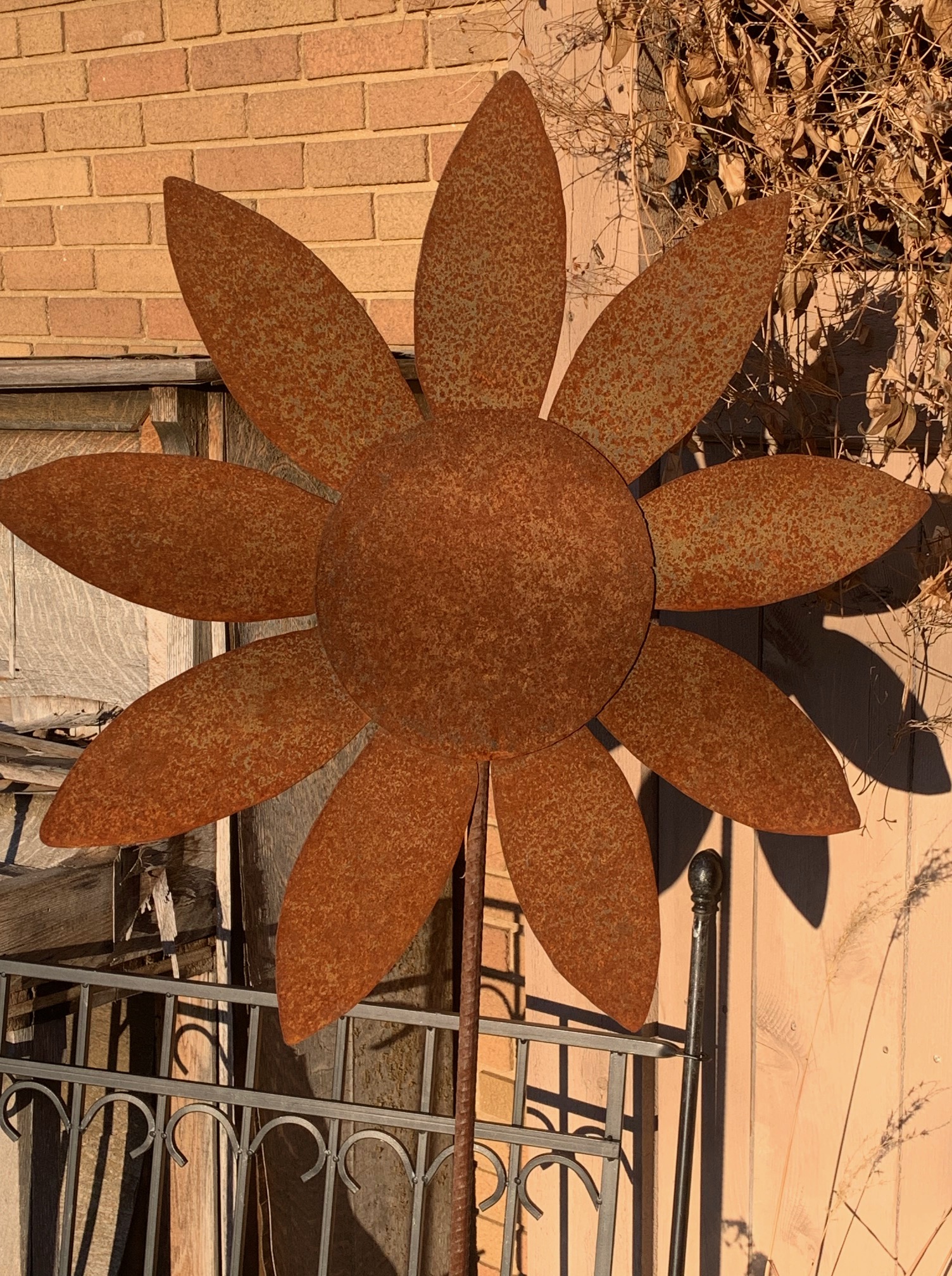
I’ve appreciated this sunflower for many years and until a month ago it never made me think of Ukraine. Now, that’s all I see. Thus, the power of a symbol. Sunflower seeds placed into the pockets of Russian soldiers by brave Ukrainian elders. “So, some good may come from your death.”
Walking through the antique mall, Brad spotted an ugly homemade sculpture. Golf balls with multiple screws protruding, spray painted and supported by wire rods. “Look, the coronavirus!” he exclaimed. Three years ago spheres with spiky knobs would have made me wrinkle my brow but never associate the shape with a virus. Now?
And masks? Will we ever see a surgical mask without feeling the divide in our nation? A confederate flag paraded through the Capitol? Members of the Capitol Police beaten with the stars and stripes; symbols matter.
Every year more and more our written communication is reimagined with emojis. Visual symbols. The new Ideogram. A thumbs up. A heart. Laughing face. Saying more with less or at the very least opening up our communication to broader interpretation. I find that I’m symbolically rolling my eyes more and more. Exclamation point. HAHA! Know what I mean? Winky face.
Leonard Shlain wrote some remarkable books about how our brains are wired by how we communicate; he posits that linear language, the introduction of writing drove us into our left brains and away from our holistic right. Perhaps in our movement back toward the ideogram we are rebalancing? A course correction or returning to center? It takes more than a few years for brains to rewire. Our descendants will, no doubt, either write books about it or communicate their thoughts through a combo platter of alphabet and pictograph.
Either way, we can only hope they grasp the meaning of the peace symbol. Or, at the very least, learn how to give it more preference than the dollar sign. Or, better yet, figure out how to make peace profitable. Can you imagine? Certainly there will be a symbol for that.
Until then, sunflowers in the killing fields. Sad face. Broken heart.
It is now my opinion, based on life’s experience, that it you don’t find the cliff, the cliff will find you. Wing development is the name of this game. Hide in the closet, bury your head in the sand, drink yourself to oblivion, pretend the monster is not at the door, and you’ll discover in your last moments that looking the other way was, in fact, your cliff.
Master Marsh once asked me why I had the need to run and jump off every cliff. At the time I said, “I don’t know!” My latent response comes straight from Vonnegut: wing development. Apparently my wings took their sweet time developing and needed some extra cliff-age. And, as we all know but are too polite or arrogant to admit, wing development never ceases. There’s always another cliff until there’s not.
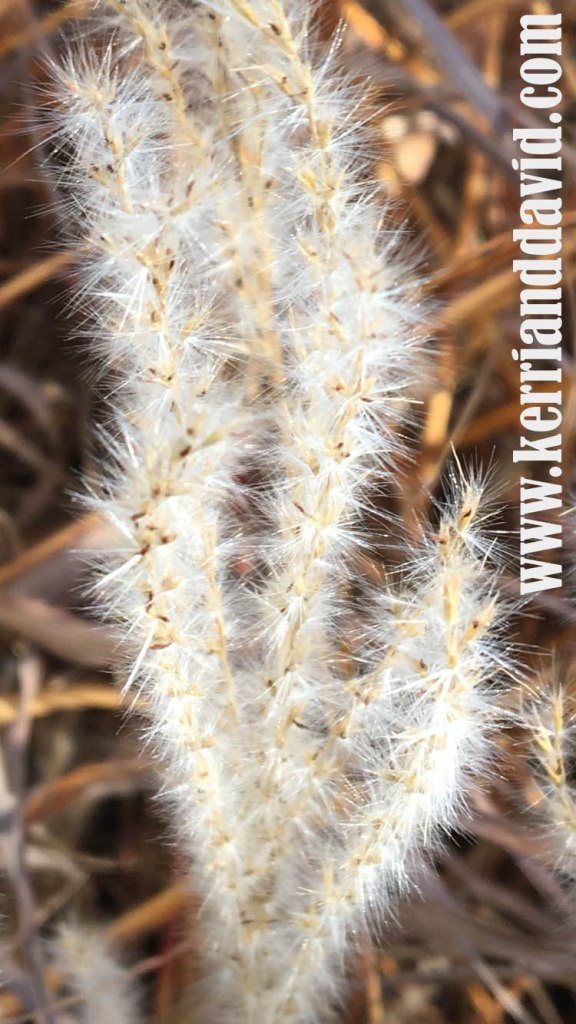
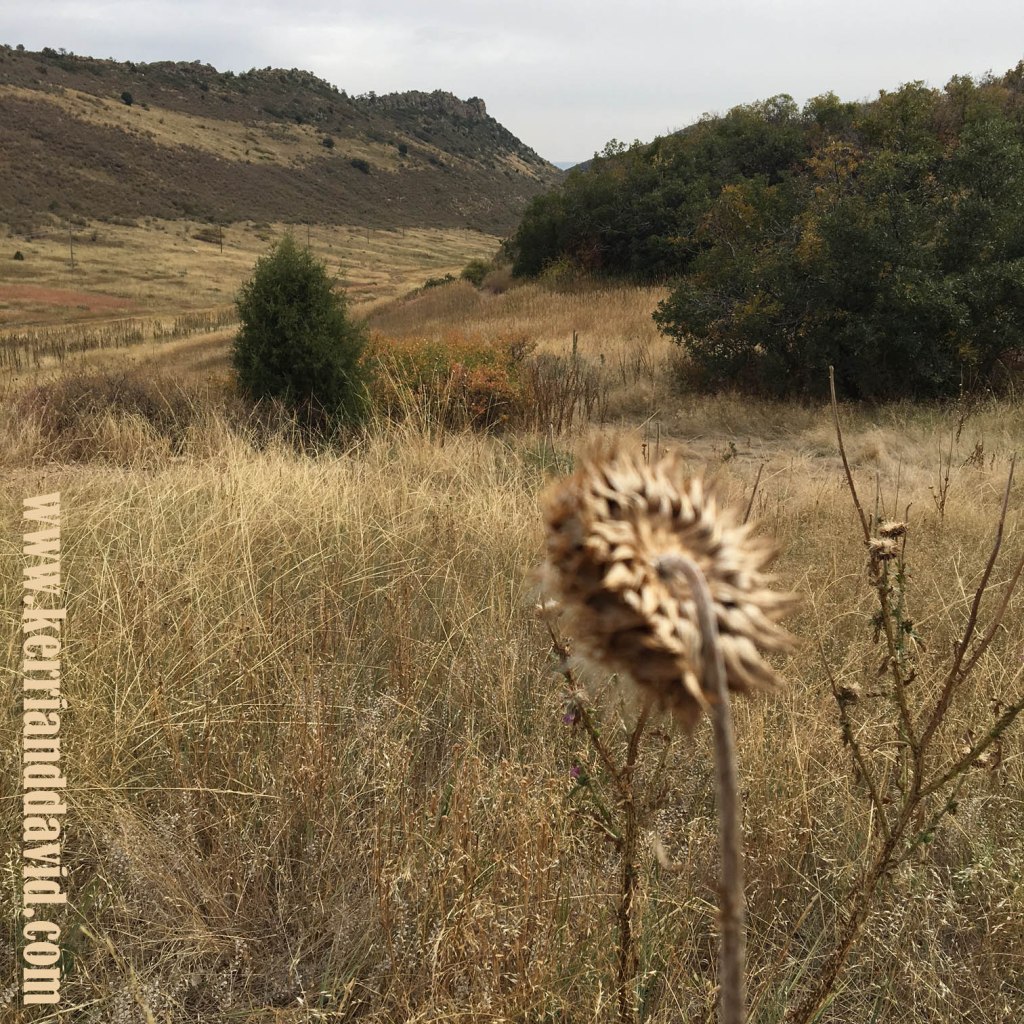
We had a rare warm day so took a walk on our favorite trail. The brilliant raw sienna of the empty pod caught Kerri’s eye. While she took photos of the pod I thought about the thousands of seeds it once held that took flight on the wind. A few certainly found fertile soil. Most did not. That’s the idea behind Kurt Vonnegut’s advice. Don’t hoard your idea seeds. Put them out. Audition for the play. Submit your story. Offer your idea. There’s great truth to the advice: your job is to put it out there, not to decide whether or not it is good enough. Explode the pod rather than protect the seed.
Greg recently told me said, “it doesn’t have meaning until it’s published.” He wasn’t speaking about publishing in a newspaper or by Random House. Sending an email is an act of publishing. To text is to publish. Greg was referring to sharing. It has no meaning until it is shared. And, sharing your creations can be -and often is – vulnerable and scary. Giving a speech is terrifying to most people. Dancing, painting, composing a song, playing a solo, offering your idea in a meeting…all are acts of publishing. All are potential cliffs to jump off.
Explode the pod. Let the seeds fly. The wind will carry them. Some will find fertile soil. Most will not. Wing development is easier when you realize that you are a pod of ideas and not a judge of worth or value.
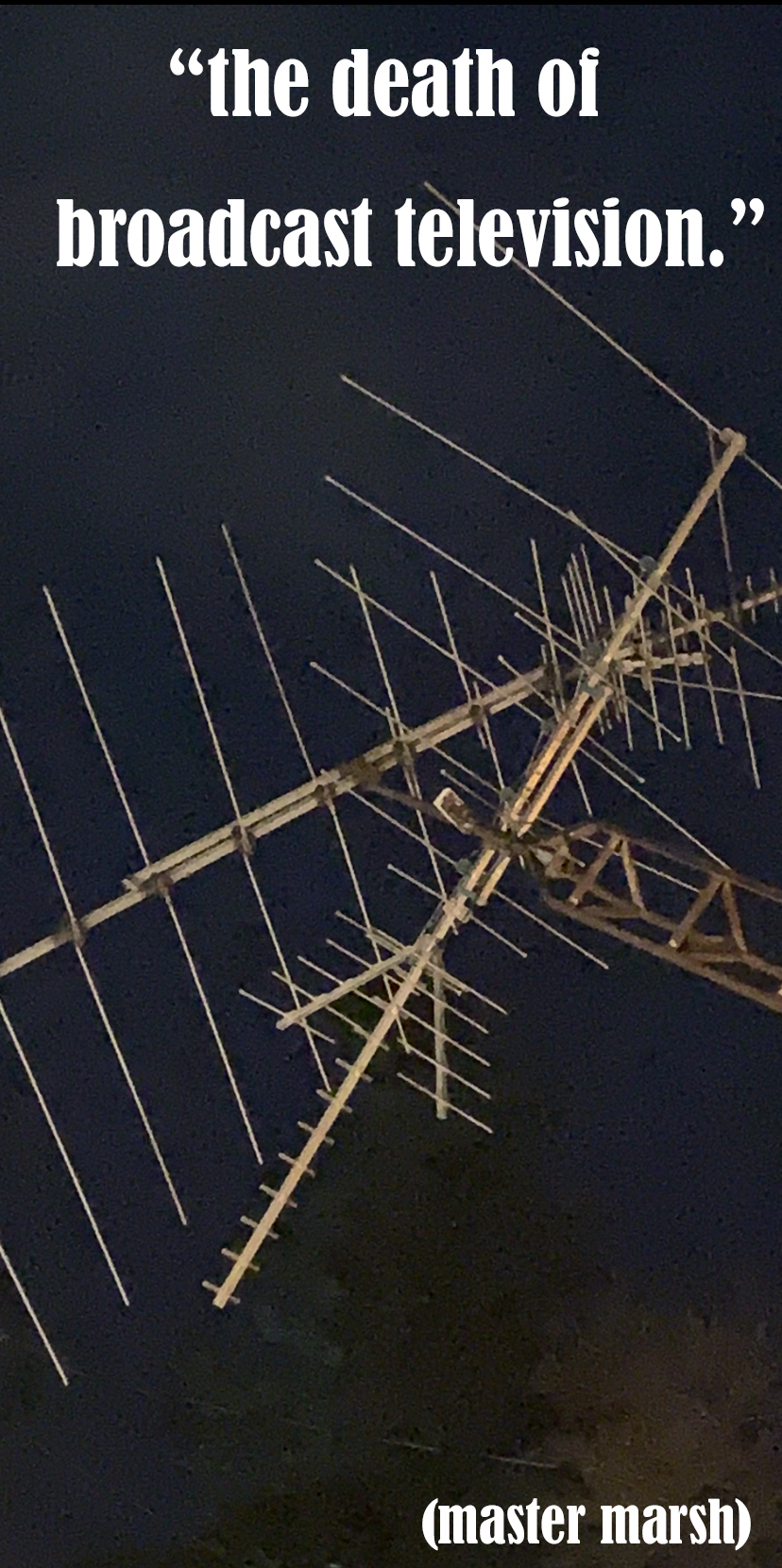
When the ancient television antenna tower fell in the windstorm, it snagged on the neighbor’s fence and tilted precariously above their garage. We did not know what to do – so we did what we always do in similar circumstances: we texted our tribe with a rousing, “HELP!!! And then we asked, “What do we do?”
No one had a clue. This was a first. The insurance company was certainly clueless. Their advice was to (I’m paraphrasing and scrubbing for courtesy) let it fall. The fire department didn’t know. We called a contractor friend who recommended finding a crane. We called tow trucks. We called antenna companies who told us that this problem was out of their league.
A single, sensible, and fantastic piece of advice came as it always does, from Master Marsh. “Just leave it and tell the neighbors it’s an art piece: The Death of Broadcast Television.” Had it not been dangerous, I’d have taken his sage advice. I’d have gone so far as to make a plaque for the base. I’d have sent out a press release. Our art piece might have one day been moved to the permanent collection at The Chicago Art Institute or been featured at Biennale Arte 2022. It would be necessary to compensate the neighbors for a piece of their fence – since it is a crucial element of the statement – but that is a minor detail and certainly worth sorting out for such a prestigious end to our dilemma.
It did make me wonder how many of my life’s tribulations would have been better solved with a bit of rebranding? Call it an art piece and make it all better with plaques emblazoned with clever titles. I laughed when I imagined moving through my life’s calamities as a gallery show. Children asking their grandparents, “What is broadcast?” The raging waterfall through the ceiling would be fantastic!
In the end, rather than art, we opted for a tree service. These amazing guys came, sawed up and carted away our precarious antenna in less than 30 minutes. An entire era of technology disappeared in less than half an hour.
As they say, in our times, the only constant is change and, if you keep asking the right question, “What do we do?” a proper answer is certain to find you. And, if not, there’s always the art route.
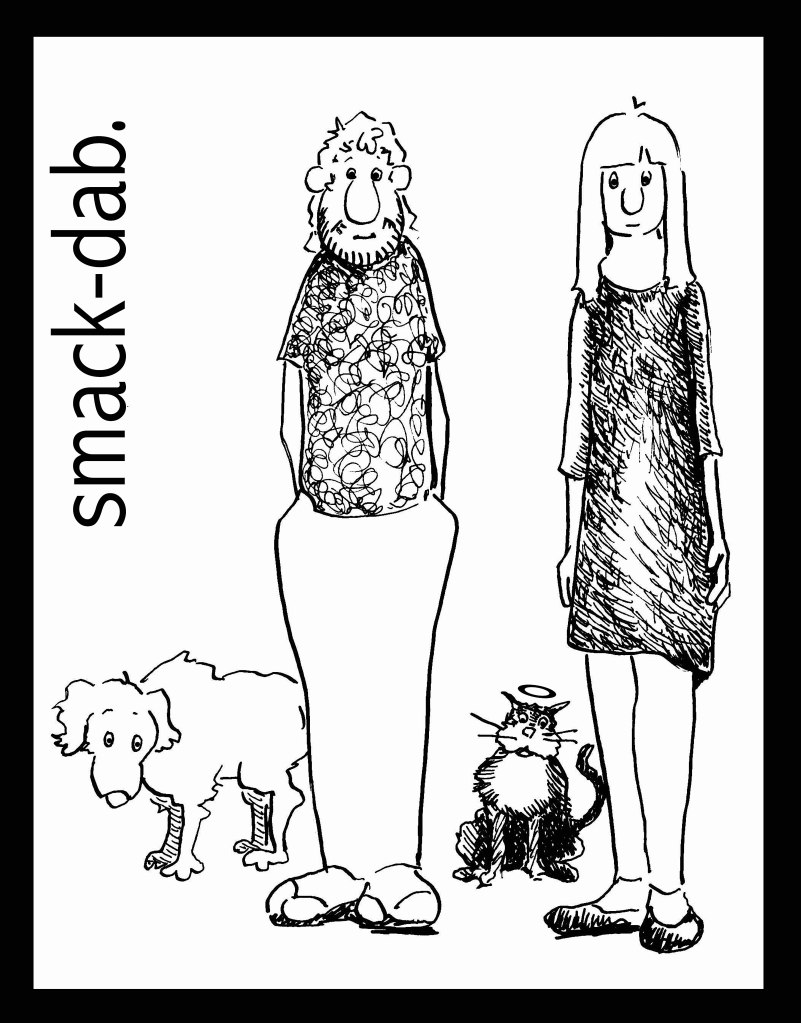
Although we may have led you to believe otherwise, these characters are fictitious. Especially the man. He’s a product of imagination and has no bearing on reality. Any resemblance is purely coincidental and, since I never snore, there’s no chance of coincidental resemblance. None. Nope.
This is what he wrote. “The irony I feel is that the world is lost on the artistic temperament of these students. They don’t seem awake to all that’s going on.” He’s directing teenage students in a play. He was my student thirty five years ago and reached out to me. We compared notes of the production I directed when he was a teenager, and the production he’s directing now. The world has changed mightily. His production will be viewed through a wholly different lens.
I flipped his phrase over in my mind. Artistry is to be awake to all that’s going on. And, awake is not a steady state. It’s not an arrival platform. It’s a relationship between the inner and the outer. What I know about that relationship is that sometimes you need to look away. His students have drilled for active shooters in the hall since they were in kindergarten. Mine couldn’t have imagined it. His students are navigating a pandemic, they’ve never known a world pre 9/11, they live in a country that is eating itself alive. My actors had easier access to what was going on. What was going on was closer in, more immediate and less abstract. They were not looking at a world-wide horror story or lost in the morass of social media. Cell phones were science fiction to my cast. My actors looked at each other and not at their screens.
Stories are about something. We just watched Erin Burnett’s interview with a Ukrainian husband who lost his wife and children to a Russian mortar attack. A month ago, violent death was nowhere on their radar. They were making dinner, going to school, doing homework, late for work. Erin Burnett began to cry and thank goodness. Humanity breaks through and we awake to what’s going on – really going on. We should all be weeping with Erin Burnett and this man.
Sometimes I feel as if I am looking for the small beautiful moments. I am trying to root my day in the explosion of color, the pastel sky, Dogga in the sun. Holding hands. Cooking dinner together. I am trying to be awake to what is going on, the anger and division and warmongering and carelessness as we soil our nest – without it frying my insides. Holding hands is just as real. Reaching toward our neighbors is also what’s going on.
Stories have to be about something and most often stories are about transcendence. Waking up to what is going on is less about waking up – we already know – and more about fully acknowledging it, facing the full picture and turning toward it rather than running away. But, before that final act, that moment of deciding enough-is-enough, before we are willing to blink open our eyes, we pretend the problem is non-existent or small. We ignore the obvious. 500 year storms every year. A family killed by a mortar shell. We bury our faces in our phones, we ban critical race theory, and toss our attention in a Twitter reality or a Tik-Tok diversion.
I wanted to write back and suggest that the world is not lost on the artistic temperament of his students, it’s simply too hard to look at the world so they are choosing to look away. That’s what their play will ultimately be about.
My sketchbooks are punctuated by weird landscapes. It was a practice. When I felt the need to draw regularly, to exercise my artistry, I worked on compositions for future paintings. And, when I had no idea what to draw, no composition in my head, I sketched my weird landscapes. They were fun and I got lost in them.
There was a blowback effect. I’ve never been a landscape artist. I considered my weird landscapes as not-serious exercises. Yet, they were made of scribbles and patterns and it became a game to collect patterns from nature. My not-serious exercises required me to look around. To get close. To look at the edges and splashes and etchings available in nature. To see. My weird landscapes became eye-opening meditations.
There are miracle-patterns in bark. Orchids, I recently learned, are a master-class of pattern, shape, and color. It is impossible to find a hand painted brush and ink painting as perfect or as spontaneous and lively as the strokes on the rattlesnake plant. Go to the garden if color combinations are in question.
I will never invent anything as imaginable, as impossibly beautiful, as what already exists in this world. I will never produce any painting as glorious as the paintings in nature. The best I can do is play. Look and marvel. And isn’t that a great relief?
I’ve tried to keep notes on my computer. I know that typing my notes into the digital world will make them searchable. Easier to find. It just doesn’t work for me. If I write with a pen on paper, I remember. Marking an important page with a Post-it note makes finding my notes faster than a search engine. It’s not that I am old school. I’m kinesthetic.
I’ve always kept notebooks. At this moment there are two within my reach. The Melange notes. On the desk in my office a is a notebook and three yellow pads. The yellow pads are a task-capture strategy. The notebook is idea capture. Quote capture. Thoughts-in-progress. The notebooks are like my sketchbooks, a place to work out my thought-compositions. They are the history, the breadcrumb trail of a project. For me, the riches are never in the outcome. The real treasures are alive in the notebook process paths.
I’d rather look at an artist’s sketchbook than the finished painting. I have a book of Picasso’s sketches that I treasure. Spend a few moments in Leonardo’s sketches or Michelangelo’s scribbles and you’ll forever toss away the notion of a mistake. Look behind the scenes at the process. A dancer will spend hours in repetition to incorporate a move into their body. The playwright will write hundreds of pages to arrive at a few, yet, those hundreds of pages are nothing less than reduction to essence. Refinement on the path of saying more with less.
Look behind to see the structure. Turn it over to see the pattern. I am, to this day, in awe of the Wayan Kulit master. I looked behind the shadow puppet screen to see the artist at work and, what appears in simple two-dimensions in front of the curtain, is a symphony of structure and improvisation. The man wore an oil lamp on his head to cast the light for the puppets, held a rock between his toes to tap, keeping time for the musicians seated behind him, all the while manipulating and voicing multiple characters, telling with simple clarity an epic tale. A lifetime of trial and error, complexity made simple, like a dancer, the story was deeply choreographed in his body. I wished I could have seen this elder storyteller-priest when he was young and developing his mastery. I’d love to see his notebooks.
I’ve recently had cause to return to my old notebooks. I marvel at the thought cycles coming back around. I’m taken again and again by the questions that still linger, and by those that seem antiquated. “How could I have not seen it!” I smile, knowing in just a few more drafts, a notebook or two down the road, the clarity would arrive.
A peek behind the scenes. It is for me, where the real beauty shines.
George Ohr was one of the great ceramic artists of the late 19th and early 20th century. Like Van Gogh, he died unknown, never experiencing the success of his work. Robert reminded me of George Ohr’s story and I reminded Robert that Ohr would be a terrific story for him to tell through a one-man play.
What is it to follow your art-call with heart and dedication with nary a hint of financial reward or success on the horizon? Vincent Van Gogh would have been called an amateur during his life since the making-of-money is the flag we plant in the sand marking the line between being a professional and a dilettante. Those lines do not exist for artists with a deeper call. The money does not the artist make.
The Ohr-O’Keefe Museum of Art was designed by renowned architect Frank Gehry, quite a journey for the unseen work of George Ohr’s life to find so much vibrant admiration after his passing. Had he known it would have changed nothing. He’d have spent his days at the potter’s wheel either way.
“Shape clay into a vessel; It is the space within that makes it useful. Cut out doors and windows from a room; It is the holes that make it useful. Therefore, profit comes from what is there; Usefulness from what is not there.” ~Lao-tzu
Profit and usefulness. Shape and space. Mary Oliver asked the question: What will you do with your one wild and precious life? It hits the nail squarely on the head. It was not the pots that George Ohr made or the paintings that Van Gogh painted, it was the space they entered while throwing pots and painting paintings. It was the world they entered through their artistry, more expansive than financial success, more necessary than renown. A wild and precious life lived wildly and with avid appreciation.
Standing amidst the brilliant orchids, some of the flowers were in their last days. Their beauty fading, they cared not a wit. It is not in their nature to stretch their faces and pretend that the cycle of life is more valuable in the early bloom than it is in the late retreat. All is treasured, beguiling. Every last moment, not to be stalled or held onto. The root as necessary as the bloom, the winter as indispensable as the spring.
It’s taken me this long to discover the source of all cartoon characters: orchids. I’m not kidding. At a recent field trip to the Chicago Botanical Garden’s Orchid Exhibit, I was surrounded by brightly colored fantastic faces, playful and chuckling. “Look at this one!” Kerri exclaimed. “It’s the Imperial Margarine guy!” I thought it was a whacky Pope or funny Cardinal, but the idea was the same.
“The earth laughs in flowers.” Emerson’s quote was stenciled on the wall as we exited the exhibit. And the laughing flowers made me laugh. Truly. I felt like a little kid at Christmas. Surrounded by color and delight and whimsy, I found myself more than once pointing, “Look at this one! Oh My God!” And, I felt like the colorful faces were staring back at me, thrilled to tears by the odd looking human standing before them. I-look-at-you-look-at-me. “Look at that face!” they snickered.
The thought stopped me in my tracks and filled me with wonder. We personify everything, projecting our humanness into everything. The art of animation, the world of Disney, is rooted in our desire to project ourselves onto and into the world. Talking mice. Dancing candlesticks. Humpty Dumpty. Wise old trees. Wouldn’t it be lovely, and isn’t it hopeful, to think the world projects itself into us? I want the orchids to fill me with color and awe. To project themselves into me. I know the forests I walk through infuse me with quiet. I know Dogga pulls love from my deepest soul.
Participants. Relationship, rather than controllers. Dancers rather than dominators. Would we be so invested in killing each other for imagined supremacy if we allowed ourselves to laugh the laugh of the flowers? If we actually understood that nothing is forever, that our warmongering was at best delusional? That the single trait that makes us human is to turn and help someone in need? The very capacity that allows us to project ourselves into the orchids is the same capacity that makes it possible to stand in the shoes of the other. Empathy is a two-way street.
If the earth laughs in flowers, these days it certainly cries in humans. Yet, standing amidst the orchids, I looked at all the human faces, hundreds of people wide-eyed with wonder and alive with astonishment. The laughing orchids looking back at the astonished faces, open and vulnerable, and they were evoking those qualities from the crowd. Earth’s tears. So hopeful, these faces, drinking in each other’s beauty.













 The Direction of Intention