Think “And”

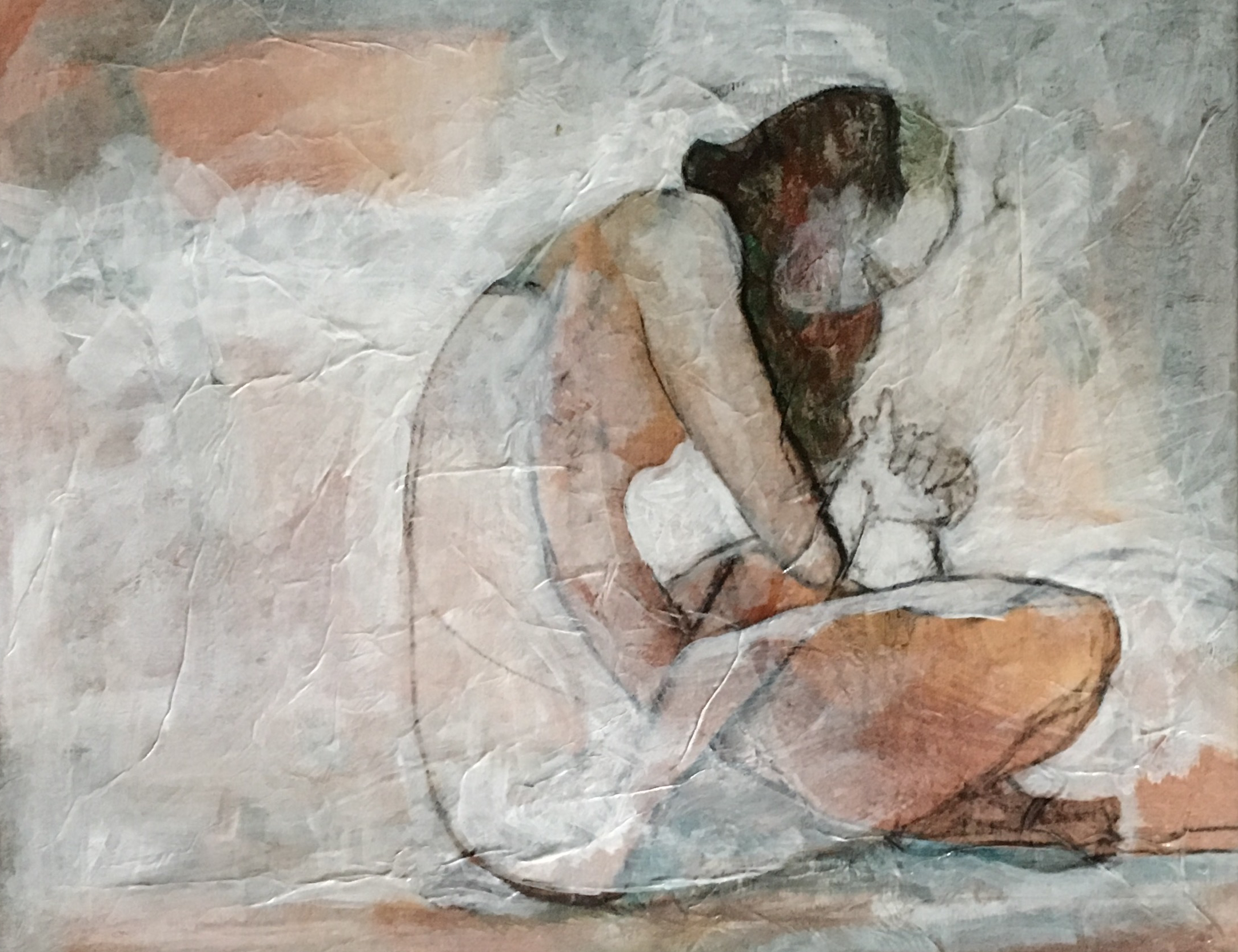
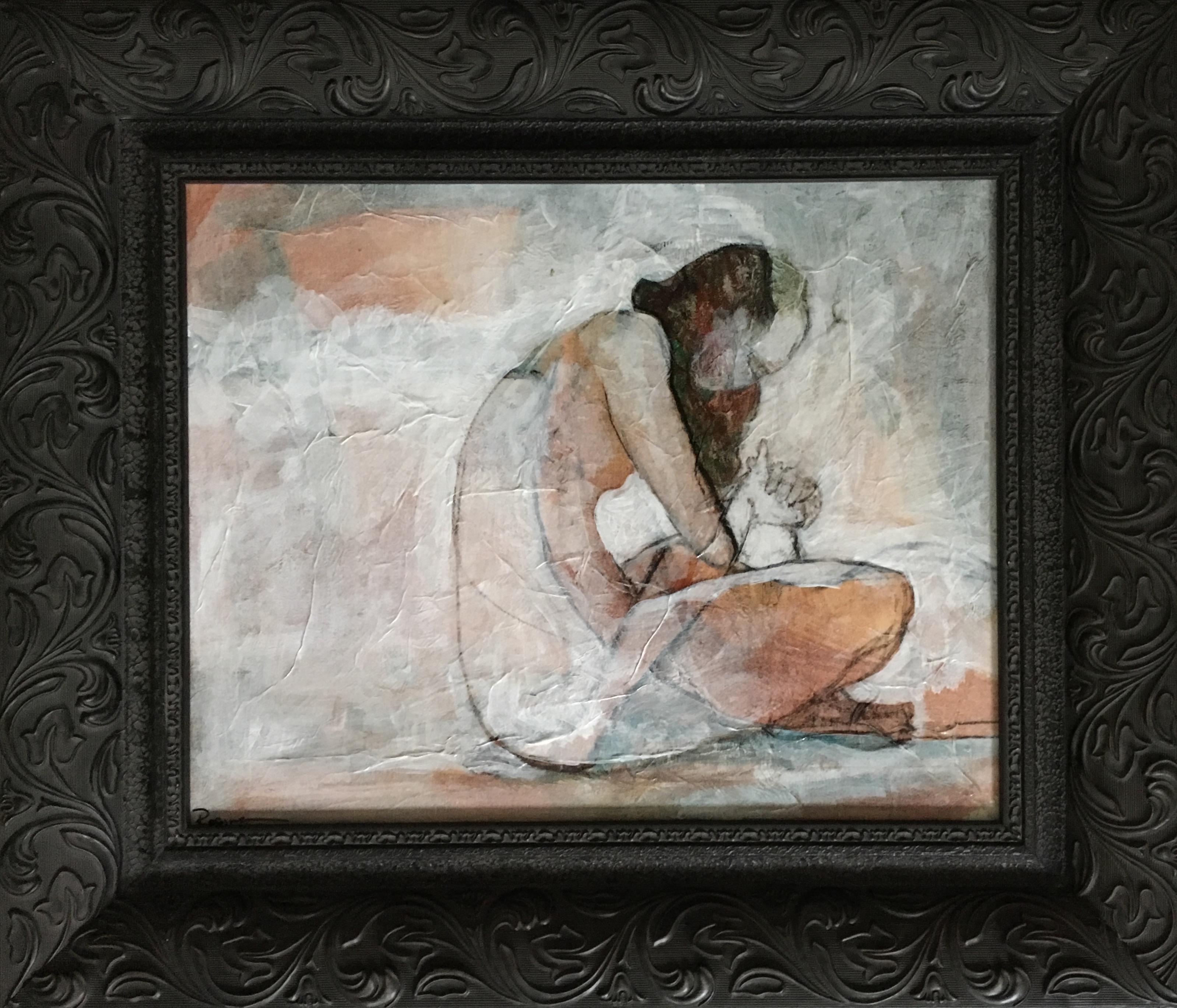
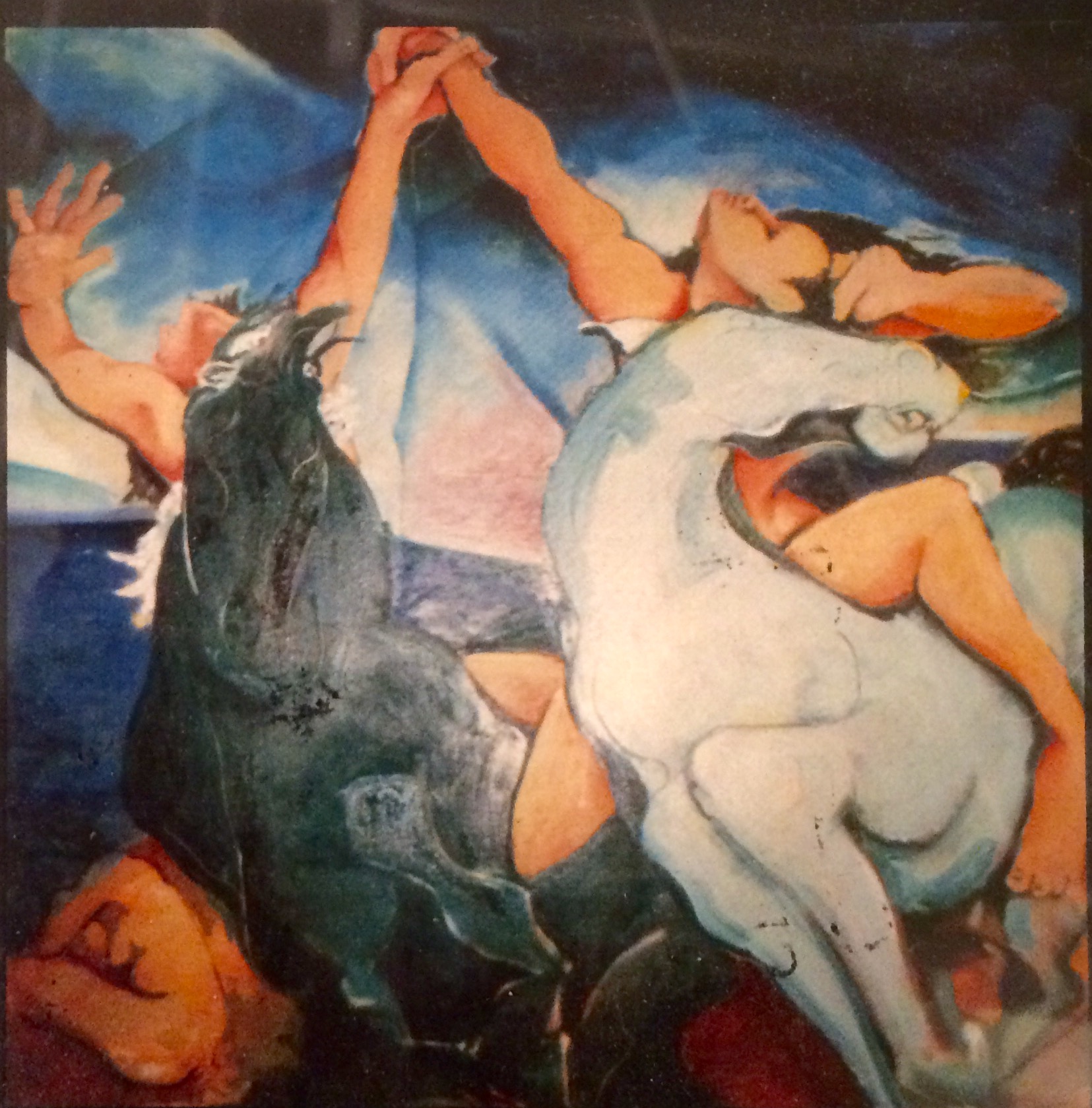
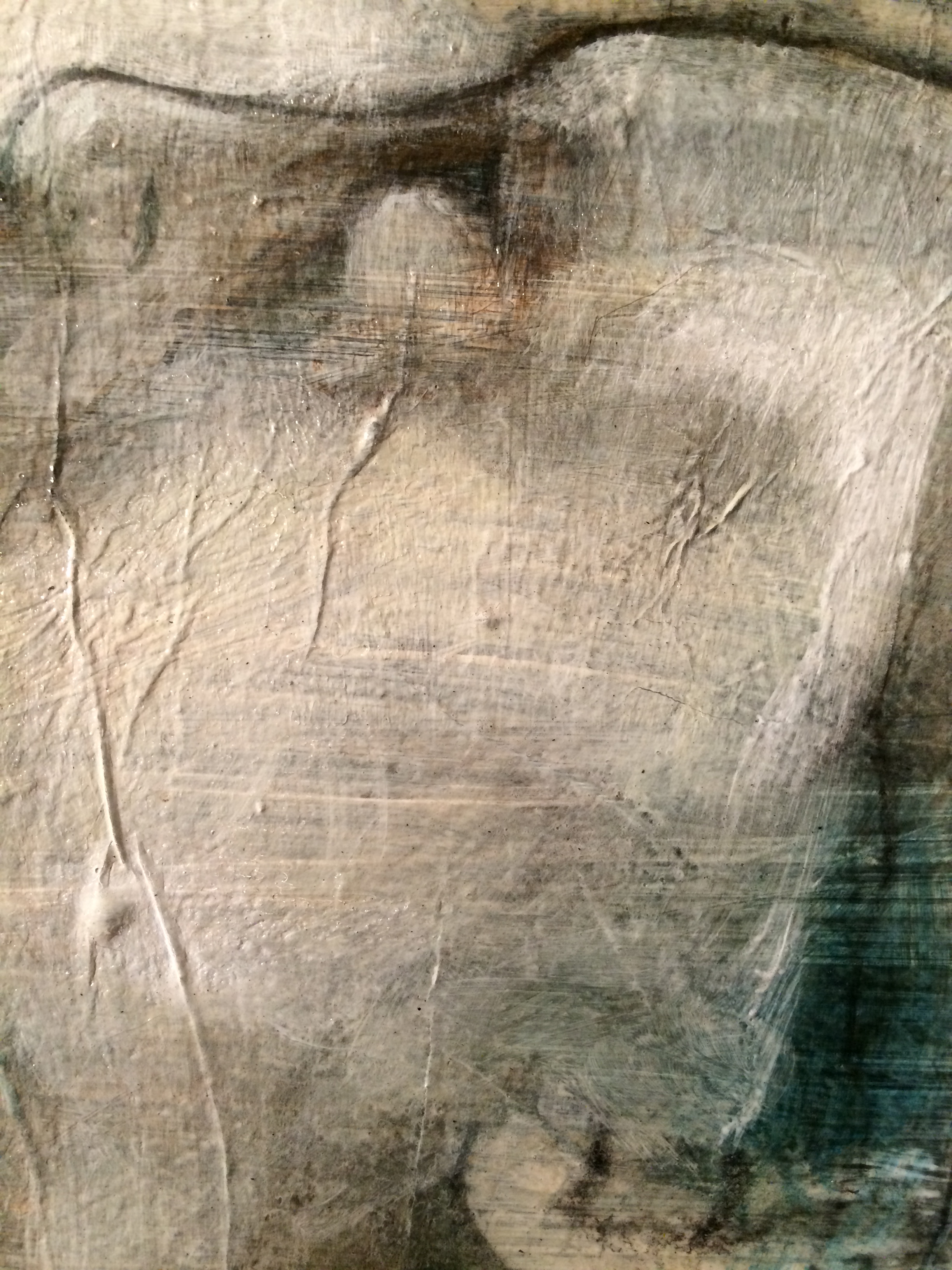
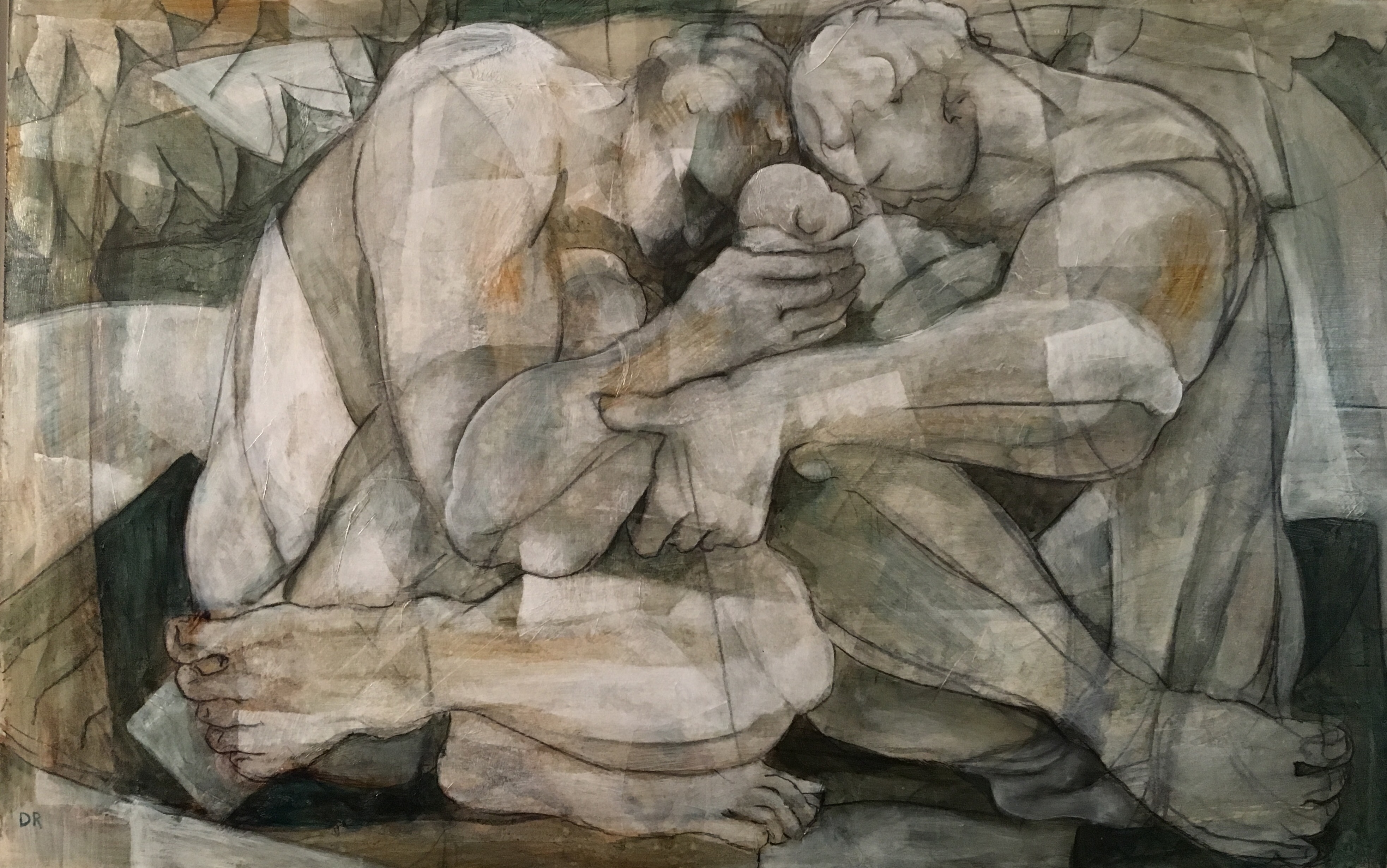
a second version, a second point of view of my painting Shared Fatherhood

I suppose it is the great trap in human nature to define life through oppositions. Was your experience good or bad? Are you liberal or conservative? Are you your brother’s keeper or is it every man for himself? Oppositions provide the illusion that there is a right way or a wrong way, that any issue can be reduced to a simplicity, a singular path. One way. Oppositions are great language devices for dictators and the righteous. They remove the grey tones and blunt the grey matter. With an opposition, us or them, “god” can be exclusively on your side (a small god, indeed) which self-grants permission for all manner of abuses enacted by “us” on “them.” The problematic word when employing oppositions is “or.”

“And” is a much more useful (and honest) term to employ when dancing with oppositions. Can you be your brother’s keeper AND take care of yourself? Certainly. Can you survive entirely by yourself without the participation of your brothers and sisters? Certainly not. No one lives in a vacuum; “or” is the great creator of illusory vacuums. “And” guarantees a conversation and perhaps a host of useful, challenging and robust perspectives. Both/And is always more functional than Either/Or.

AND the first version of Shared Fatherhood

The snag in “Or” is that there is very little truth in any reduction that ultimately lands on just One. This or that. All life is movement and all movement stops in One. Creative tension requires at least two points and a desire for someplace place to go. There is no single arrival station in real life. There is no achievement that stops all the presses. Every answer inspires new questions. Each question opens doors to multiple possibilities. Agreement is a fluid target at best and must be nurtured. Compromise is never an end state; it is a relationship imperative. Life is never found in the static “or.”

Do an experiment: go to the grocery store, choose any item and ask yourself how many people it took to bring your chosen item to the shelf at that moment. If you are not astounded by the complexity of participation, how dependent we are on actions of others, your imagination has most certainly failed you. Skip, entrepreneur extraordinaire and mentor to entrepreneurs taught me that a business cannot succeed until it serves its customer’s customer. Note the word “serves.” Businesses serve. Not simply a customer but the complexity of a customer’s customer. Entrepreneurism is a service to the creative genius of a community and multitudes of communities beyond.

Entrepreneurism, like artistry, ….even, yes, like governance…like all things vital, moving, complex and growing, live in service according to the good graces of AND. Anything else is a mirage.


Think “Isn’t It Weird…?”

my new tree;-)

Wide awake in the middle of the night, we snacked on handfuls of Chex cereal and indulged in my favorite kind of conversation: “Isn’t it weird that…?” Little did we understand that our late-night conversation would set the theme for the week.

The next night high winds toppled our neighbor’s ENORMOUS aging maple tree into our backyard. The insurance company called it “an act of God.” It is a phrase implying no fault, no responsibility. It just happened. I laughed aloud when, immediately following the “act of God” designation, the insurance adjuster heaped on us a load of legal cautions, new responsibilities (the tree now ‘belonged’ to us), property line designations, and small print reminders meant to minimize financial risk and responsibility to the insurance company. The layers of irony are too many to count though I suppose if wacky preachers can assign responsibility for hurricanes and other natural disasters to the wrath of God, then it is no less ridiculous for insurance companies to invoke the fickleness of God to absolve themselves of liability.

Isn’t it weird that…?

P-Tom reminded us that the “act of God” was that no one was hurt in the tree fall. For P-Tom the act of God was a kind of intervention. A few degrees to the right, a slightly different wind direction, and the tree would have landed on our bedroom. Life does seem fragile by the slightest of degrees. We told people that we were lucky. Intervention? Fortunate? Fate? Design?

Isn’t it weird that…?

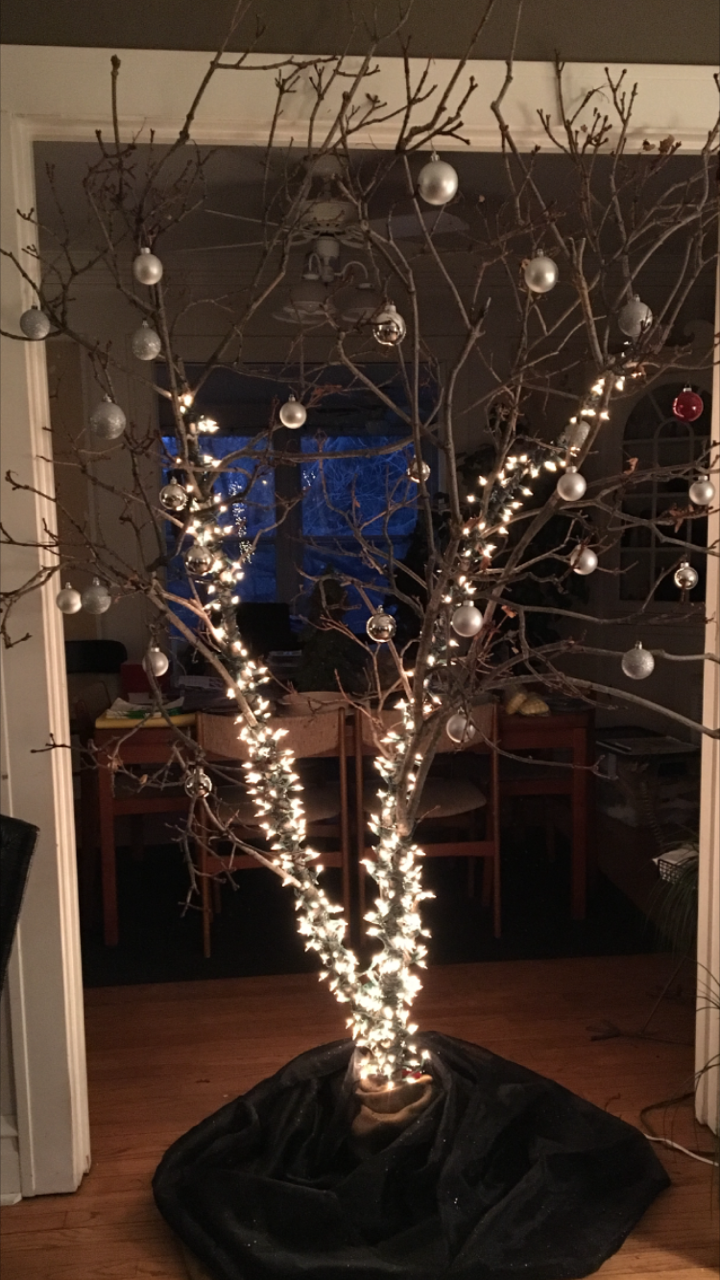
We cut a branch from the fallen tree and brought it in the house. It is now our Christmas tree.

Had you asked that branch a week ago if it would ever become a Christmas tree it might have laughed at you.

As a maple branch it had no aspirations or intentions of being wrapped in lights or decorated with silver baubles. In truth, it probably cares little if it makes us laugh or invokes a smile each time we enter the room. But it does. Or, better, we make sense of it that way. Sense making? Story telling? Either way.

Isn’t life weird?

Our work-in-progress


Look For The Two Points Of View

My latest. As yet untitled. It’s about dreams and angels.

It is the time of thanks giving in these United States and this week when I say my quiet thanks I will include Horatio in my list. Our conversations are life-giving and art-inspiring. And, best of all, tracking Horatio’s thought path is an utter delight. He is an expansive thinker! Here’s an example from our recent call:

“I’m the last person to really see my work,” I said. “Kerri routinely stops me from ruining paintings. She forces me to leave them alone until I can actually see what I’ve painted.”

Horatio said, “You have a parallax problem.”

I thought to myself (who else would I think to?): Parallax is a great word! The last time he flung that word at me I looked it up. In essence, divergent perspectives when looking at the same thing from two different points of view. You might say our political parties have a parallax problem.

Horatio continued, “All religions say, ‘Love your neighbor.’ All religions say it. Love your neighbor.”

What!? I thought. How did we get to neighbor-love from parallax? Grab the reins and hold on!

“The fundamental human problem is to know yourself.” Horatio said. “And artists confront that problem every moment that they stand in front of the canvas or sit down at the piano. Every moment is an exploration of the self, what you see, what you believe.”

From parallax to loving your neighbor to knowing yourself.

“Self. Other. That’s it!” Horatio continued: “That’s all there is! Isaac Bashevis Singer said that the purpose of literature [he was a writer but you can insert any art form] is to 1) entertain and 2) to educate. IN THAT ORDER! You cannot educate first! Playing matters! Fun matters! You must engage the heart first. It opens the path to the other thing.” [take note all ye test makers and proponents of head-driven education].

Parallax: differing points of view. Love your neighbor: a universal aspiration amidst the raging parallax. Know yourself: the fundamental human problem and the singular pursuit necessary to approach the universal aspiration. Heart first: the only route to all of the above.

“An artist has to play. Experiment. Step across the knowns into the unknowns. Question all of those assumptions. Doubt what they see,” he said.

It’s a beautiful paradox, isn’t it? The route to knowing yourself, the route to loving your neighbor, is to doubt what you think. In fact, it is to realize that the river of nonsense incessantly running through your mind is nothing more than a deflection from actually coming to know your self. It is not to be believed. It is the ultimate fake news. It is a great day when you recognize that your inner monologue is entertainment and not education! It’s a great day when you recognize that you need another person’s perspective in order to know your self. You need it precisely because it differs from what you see. Clear vision requires two points of view. It’s called perspective.  Having two points of view opens the door to questioning. It makes probable the birth of a possibility.

“It’s all about relationship.” Horatio concluded, “Now, the only real question surrounding the artist is, in the midst of all of this navel gazing, in the thick of all of this dedicated pursuit of the self, boundary-crossing-questioning, will your neighbors want anything to do with you? Will they want to have you around at all?!”

Oh, yes. Parallax.

Stay Fully Alive

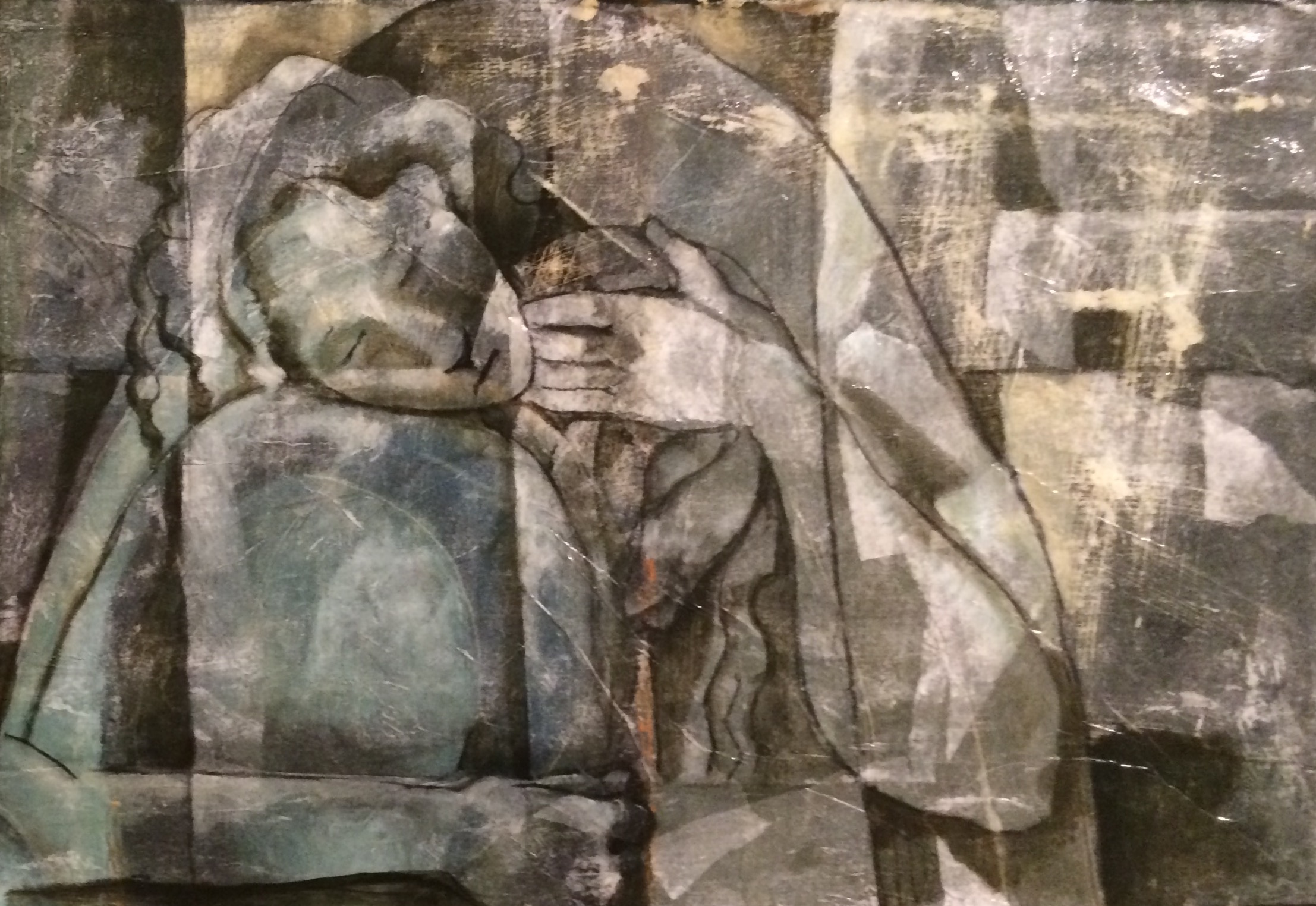
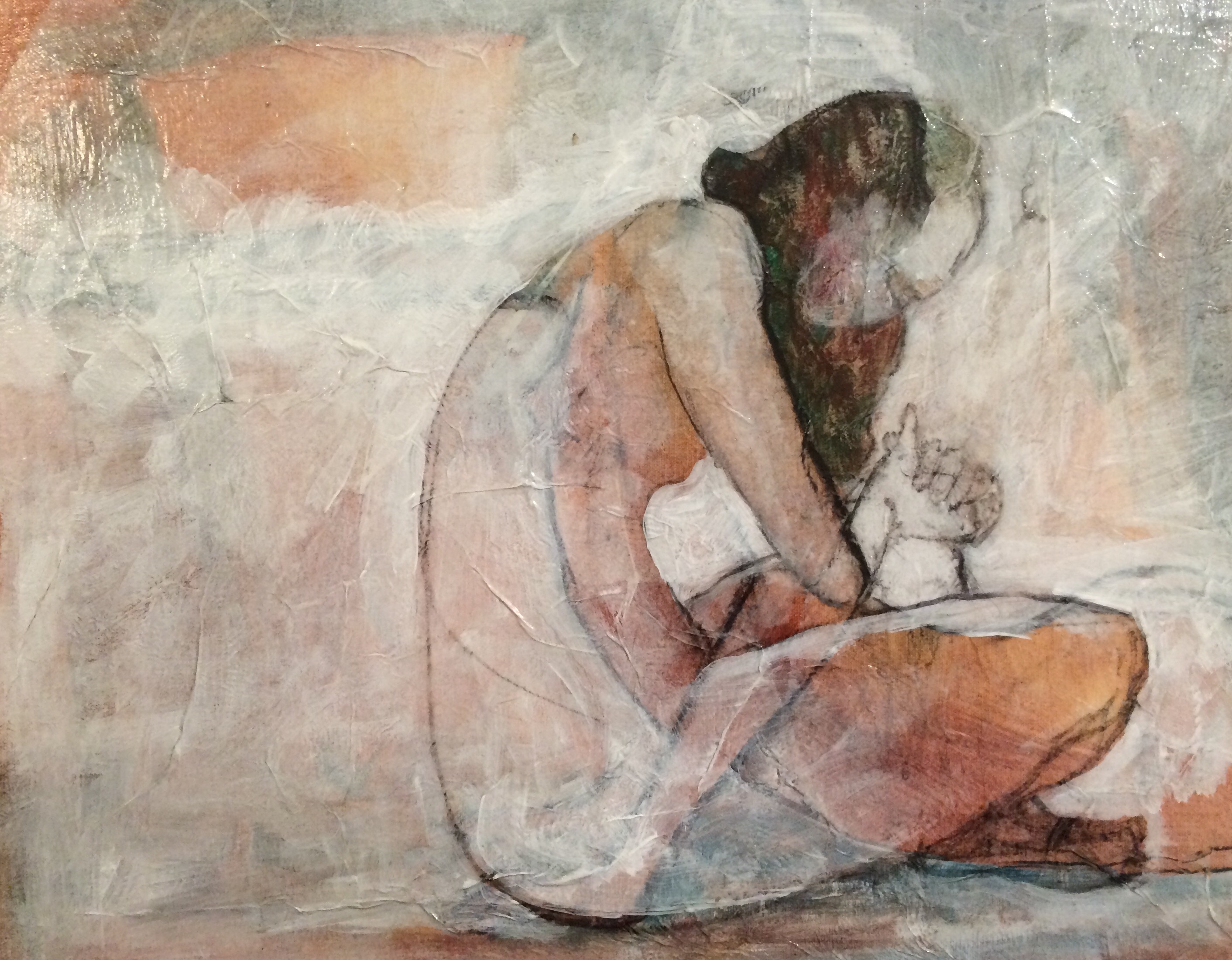
a more recent smaller painting: In Quiet Prayer

Horatio issued me this challenge: do something new, something you’ve never done before. Paint something different, something that boggles you.

I love this challenge. In other words, step out of your comfort zone. Dare to not know where you are going. Make a mess with great gusto and intention. Court chaos and wrestle it into something that resembles order for you and no one else.

Horatio might have said, “Dare to see again, purely, with no filters, knowledge, or preconceptions.” He might have added, “What might you see, who might you be, if you stepped beyond the safety of your ideals, your beliefs, and great mass of weighty and important knowledge?”

The child in me, the one not yet accustomed to sitting in a desk or raising my hand or waiting my turn would loudly sing the answer: You’d be fully alive! I’d be fully alive.

from a few years ago, a larger piece: Meditation

I’ve always appreciated how similar are an artist’s path and that of a spiritual seeker. The aim of the exercise is the same. A meditation practice to still a busy mind is identical to an actor’s training to be fully present on the stage or a painter’s pursuit to see purely (to see without the disruption of interpretation). On both paths, truth is a fluid thing. Truth is what is happening right now. What happened yesterday or may happen tomorrow are distractions at best. They are stories that get in the way. They are of no consequence to this moment of living, this moment of aliveness. It is, an actor learns, a fool’s errand to attempt to repeat yesterday’s performance.

Horatio’s challenge is relevant for every human being wrestling with the big questions or trying to stave off or make sense of the chaos. Dare to dance with what’s right in front of you. Dare to drop the questions.

Picasso famously said that every child is an artist. The problem is to remain an artist once he or she grows up. He might well have said that every child is fully alive. The problem is to remain fully alive once he or she grows up.

playing around with simplicity. This one is hot off the easel and not yet named.

this is how she looks in a frame. Magic!

Save

Save

Save

Save

Save

Save

Change Nothing

a detail from In Peace I Pray.

Thoughts from the mountain.

I grew up with these mountains so it should come as no surprise that I get quiet the moment I step into them. Like a too-tight coat the chaos I wear in my day-to-day life simply drops off; stepping into the mountain is to step out of the noise. Literally and figuratively.

Tom once told me that people change when they are ready. Rich once told me that people change when the pain of staying the same grows greater than the pain of making the change. Change when you are ready, change when you are in pain. Skip taught me that a business intending to change people was destined to fail. It is a fool’s errand. Business is about business not change. I loved this bit of advice from Skip because he is a natural-born change agent, a mentor of mentors (and, poetically, entrepreneurs). In a moment of frustration Kerri told me that people don’t change, they simply become more of who they really are. The masks drop off and we unwittingly reveal ourselves. Change as revelation.

As I hike through the snow toward the summit I wonder if change, at least the human notion of change, is as made-up as the rest of the stories we tell. It is in the forest, which is a festival of the cycles of life, that ideas of different ways of Being seem…superficial. Disconnected. Within seasons there are plenty of changes that roll around and around and around again. Perhaps this thing we call ‘change’ is nothing more than a recognition of the cycle, a readiness to release our dedicated resistance to life? A readiness to release our stories of limitation and division.

Kerri caught me staring at the mountain

Toward the end of his life, Joseph Campbell said that he suspected that all life (energy) was consciousness. There is 1) energy and 2) the forms that energy takes. Although seemingly disparate, seemingly separate, all forms fall back into energy. He said, “The universe throws forms up, then takes them down again.”He might have said that change is nothing more than the cyclical movement between energy and the forms it expresses.

Jim taught me that the art of acting was the art of being present. I know that when I stand in front of a canvas and begin to work, all notions of time disappear. Another day on the mountain, sitting in an adirondack chair midway up the slope, basking in the sun on warm day, we watched Kirsten snowboard. She flew by us several times. When she rides, it is clear, there is no other place, there is no past or future. There is now. She is vital, alive. In that place, riding the present moment (the only place that actually exists), the noise drops off. I know, and Jim knew, when fully in this moment there is no need to pester yourself with misplaced notions of being somewhere else, being anyone else.


a blast from the waaay past: August Ride. I lost track of this one and if you know where this painting is, let me know.

Look To The Living Thing

my latest, as yet un-named, painting

Kerri looked at this painting and told me it captures how she feels when our daughter is hurting and calls home. “Describe that feeling to me?” I asked. She pointed to the painting, and said, “Just like that.”

Some things are universal and understood regardless of political affiliation or religious belief. What does a mother need to know to support her child? The political investments and religious doctrines are abstractions, separations. Motherhood is direct; it lives beyond the capacity of language to capture and articulate. It is the impulse to unity. It transcends all divisions. It knows nothing of conceptions like the rational and irrational.

Jim and I just had one of our famous phone calls. Our discussion romped through many fields but we returned again and again to the notion that the important things in life cannot be rushed. For instance, relationship takes time. Relationship takes attention and tending. It is fluid and dynamic so it is nearly impossible to slap a single word-label on it. It changes. It grows. In a single day it can pass through many descriptors. Dog-Dog can drive me crazy in one moment and melt my heart the next. The important stuff, like relationship, is not static or containable. It is not a concept. It is a living thing.

So What?

The best language can do is point to the living. Language can describe experience but can never be experience. Language, of necessity, reduces while the important stuff – like relationship – like love – expands. Language, as a tool of abstraction, can never be true. It can only point toward truth. Language separates. Truth is like relationship. Truth is a living thing, dynamic and changing. To be known, it must, like motherhood, be experienced directly.

Again, so what?

Direct experience is always (obviously) personal. Truth is not so easily captured. Is it exclusively liberal or conservative? Is it Christian? Buddhist? Is it unique to Islam, Judaism, or the Tao? Leave the city lights some night, take a good long look at the stars, and realize what you are staring into.

Last week we rushed 20 to the hospital. He couldn’t breathe. He walked to the edge of the abyss and looked into it. We watched him teeter on the edge. As we watched, all other concerns, pursuits, bills, frustrations, news,…, dropped away. The stuff of separations and abstractions went to dust in the face of the actual. Ask me what I experienced watching 20 grasp for life? There are no words. Ask him what he experienced in those long hours and he will shrug his shoulders. There are no words – but it is clear in his eyes.

The important stuff, the stuff beyond words, leaps the boundaries of separation and abstraction; all else falls away. The important stuff always leads to a universal place, a common ground. It is a beautiful paradox.  As a test, try this: if language can reach it, ask this very important and often absent question: Is it really true or merely another entrenched point of view?

a detail

Stand At The Intersection

2mayyoubepeace-jpegI find myself once again standing at an intersection of seemingly unrelated conversations and experiences and am in awe of the common thread.

Yesterday was Ash Wednesday. The imposition of the ashes is a reminder of mortality: we came from dust and to dust we will return. Last night I watched the ritual from the choir loft. It is new to me and beautiful – a lifelong fascination of mine – to witness the power of people gathering to participate in their rites of transformation. Life made vibrant through the realization of its limits.

After a long hiatus, this week I picked up my art discussions with Horatio. He is wise and I have sorely missed my conversations with him. During my Seattle years we often met downtown for coffee and talked about all things artistic. We’d compare notes, challenge assumptions, share inspirations, complain about obstacles, wax poetic, and laugh at the fears and foibles of life on an artist’s path. A few days ago we scheduled a call and picked up our chat as if no time had elapsed. He is an accomplished visual artist and filmmaker and told me that finishing a drawing (or film) always feels insignificant, anti-climactic. “There is no such thing as completion,” he said. “The product always feels empty. Doing the work is vibrant and alive. The life is in the process!” Horatio told me that he disappears when he goes into the studio. I know that feeling well. It is not an experience of losing your self, it is the experience of transcending your self. It is a ritual of transformation

This morning I read in our local newspaper that the University of Wisconsin, Parkside (the campus in our town) launched an initiative to inspire peace through the arts called “PeaceWorks.” They were inspired by this quote from Eleanor Roosevelt: “It isn’t enough to talk about peace. One must believe in it. And, it isn’t enough to believe in it, one must work at it.” I read that there will be over 20 artistic events from all disciplines that deal in one way or another with peace – or the absence of peace. Peace is likely to be found when a community gathers to participate (not just witness) in the transcendence of self. There are few things like the arts that can facilitate that.

One of the latest paintings from The Yoga Series

One of the latest paintings from my Yoga Series

The ride is limited. The achievements of this life are of little importance if the process (the moment) is missed. Peace, inner or outer, like all high ideals, begins with an intention and is usually possible when, looping back to the beginning, we realize that this ride of life is finite and precious.


Save

Save

See Your Angels

angelsallaroundyou-jpeg

Products with this and other images available at society6.com

One of my favorite rituals is the reading-of-the-calendar on the last day of the year. It is no ordinary peruse through an ordinary calendar. Kerri, every day, writes in her calendar the events, the important calls, the amazing sightings, the simple and the profound moments. The day we first spotted the owl, the ice circles in the harbor, the generosity of the clerk at the store; they find a spot in the calendar. The tough stuff is in there, too. It is a habit she picked up from her mother. Calendar-as-diary. With a hot cup of coffee and nothing but time, we read through and talk about the days of our life.

It is probably not surprising that our most common exclamation is, “I’d forgotten about that!” I’m always amazed at how many of the years happenings are lost in the stream of time. The review not only helps me remember but also refreshes my appreciation for all that we navigated, discovered, survived and created in a mere 365 days.

At our gathering that night I laughed when Mary Kay told us that she dislikes New Year’s Eve because it always makes her feel as if she hasn’t done enough. I recognized Mary Kay’s disdain because earlier in the day I’d levied the same judgment against myself. The ritual reading of the calendar put my self-judgment to rest. After reviewing all that we’d done in a year, Kerri looked at me (tired of hearing my endless self-criticism) and asked, “Now, doesn’t that give you a greater respect for what we’ve done?” Yes. It did.

Although we didn’t say it this way, we told Mary Kay and Russ, Linda and Jim, John and Michele that they had made it into the calendar. This year was tough for us and when I was ill, when things were going badly, they brought us food, they offered to carry some of our load, they showed up to shovel our walks. So, rather than thinking of the year as bad, in our ritual we read about year of generosities extended to us.

Mary Kay said, “But that was nothing.” Kerri responded, “That was everything! It changed our world.” We were reminded in our ritual that the world is changed for the better everyday, not by the grand gesture, but by the small things, the passing kindnesses. From the point of view of the doer, they are often too tiny to remember. From the standpoint of the receiver, they are monumental. Opening a door can change someone’s day. And who knows how far a kindness-ripple will travel?

From the archive: 'Angels At The Well.'

From the archive: ‘Angels At The Well.’ This painting is available at zatista.com

Fun products featuring details of my artwork are available at society6.com.


Save

Save

Save

Save

Save

See The Sacred

First Anniversary Sunrise

First Anniversary Sunrise

“…it seems to me absurd to consider problems about other beings while I am still in ignorance about my own nature. Phaedrus by Plato

I’m sitting alone in a sanctuary and thinking about sacred spaces. Here’s the thing I’ve come to understand about sacred spaces: slower motion is required to experience the power of the place. People in a hurry to get somewhere have little or no access to the sacred. Race through a meadow and you will miss it. Sacred spaces do not lose their power; people lose their access to the power of the space.

Once, many years ago in Bali, I made it a practice to walk the same pace as my Balinese hosts. To me, they moved at an impossibly slow pace. As an American, patterned to be forever in a hurry, I walk quickly “to get” somewhere else. There must always be a goal to achieve, a destination to reach. The Balinese were not patterned for transit but for presence. Over time, as I picked up their rhythm of movement I also picked up their pattern: it is possible to walk in presence. It is possible to be where you are with no imperative to get somewhere else – even while walking. It is possible to be in your life instead of racing through it.

A most amazing thing happens when “being here” becomes primary to “getting there”: everything becomes sacred space. Slow down enough and it is possible that you will recognize yourself as a sacred space.

After returning home from Bali I was able to sustain my capacity to move slowly for only a few months. It is easy to move slowly and be present when the culture you are in is patterned for presence. It is an entirely different challenge to move slowly and be present in a fast moving river. In the months after returning home I was either trampled or the cause of others (trying to navigate my slow movement) being trampled. We are not nearly as separate as we think we are. As I resumed my American pace I also dropped my capacity for presence and lost my lens on the sacred.

A recent surgery has necessitated slower moving. I have, in these past few weeks, found myself walking once again like a Balinese. I’ve stepped out of the fast moving river. Yesterday, standing on the back deck, I watched Dog-Dog delight in chasing squirrels. I listened to Kerri talk on the phone with a friend. I felt the sun on my face. There was no other place on earth I would rather be. There was nothing necessary to achieve.

Sit In The First Seat


a detail from my latest painting

a detail from my latest painting

I am living this story, as are we all. I am a lover of story so I count myself fortunate enough to know that I am living it. It’s one of the grail stories. Here’s the section of the story that I am now living:

The knight who cannot be beaten (he has a magic sword) is knocked from his warhorse. A warrior, a man with no armor or shield, no protection, emerges from the woods, challenges the knight, and in a single blow, unseats him. That’s not the worst of it: the knight’s magic sword shatters. And, that’s not the worst of it. His armor, his trusty protection through the many wars in the wasteland, pins him down. Like a turtle on its back, he is defenseless. His magic sword, his trusted armor, all that he has relied on, all that he’s built his identity and purpose upon, betray him. He is stunned. He is lost. He closes his eyes and awaits his death.

Death does not come. Well…

another detail

another detail

The warrior, the man with no armor, does not finish the job. He disappears without a trace leaving the knight stranded but alive. The knight opens his eyes and somehow manages to sit up. He weeps because his endless efforts to save the world have come to naught. In fact, fighting ogres seemed to produce more ogres! He removes his armor. He is no longer a knight. He is no longer capable of saving the world. He is, for the first time since his childhood, unprotected. He is, at last, purpose-free.

Nothing is more frightening – or useful – than to drop the armor of purpose and take a good hard look at what lives beneath all that forged metal.

...and another

…and another

At first his lack of identity drives him crazy. He has no answer to the cocktail party question, “So, what do you do?” He feels naked and exposed. Fortunately, a teacher, a hermit, emerges from the woods to help him navigate the crazies. Namely, the hermit helps him by not answering his endless questions. The hermit helps him understand that the world never really needed him because the world was never really broken. The hermit helps him relax and see beyond all of his thinking. He realizes that the wasteland came, not because the world was broken, but because he believed himself to be broken, somehow lacking.

In a life of chopping wood and carrying water he sees that his purpose has nothing at all to do with doing – or roles or achievements. He sees that the road to the grail castle is blocked so long as he believes he is defined by a role or a bank account or lost in a made-up purpose. When he drops his need for importance the grail castle appears.

...and another

…and another

Satori, in all the stories, knocks seekers from their ponies. It stops all pursuits. It pops the illusion of a purpose-driven life. It necessarily strips the seeker naked.

We are all seekers at some point.

When you are required in the workshop to write your epitaph or are somehow forced to articulate what was most important in this life, the doing, the list of achievements, the purpose-drive will always take second seat. HOW you did what you did, the relationships you tended or ignored, the moments you appreciated or missed, will sit squarely in the first spot.


as yet unnamed

as yet unnamed


Save

Save