Cosmos Questions [David’s blog on DR Thursday]

“Named after the Greek word kosmos (meaning “harmony” or “ordered universe”), cosmos flowers symbolize peace, balance, tranquility, and the harmonious arrangement of the world.” The Everpresent A-EYE

I am having an existential moment. That means that I am swimming around in the notion that there is no meaning or order in the universe and it is up to me to make it for myself. That’s a lot of responsibility! What if I am responsible for my own happiness and I screw it up!

I was not having an existential moment until I looked into the symbolism of the Cosmos – the flower – and bumped into the etymology and meaning of the word “cosmos” which is “the universe viewed as an orderly, complex, and harmonious system.” There’s plenty of science to support the orderly, complex yet harmonious system we know as the universe. I appreciate actual science that begins with a hypothesis, experimentation, observation, test upon test, verification, and drawing conclusions…and knows with each evidence-based conclusion, with each answer, bigger and bigger questions open.

I’m convinced that, unlike the spiritual traditions of the east, the three great western religions fear the absence of meaning (what happens after I die?) so they’ve constructed a very simple answer (I go to heaven if I’m good and hell if I’m bad). They’ve learned that people are more malleable and easily controlled if their cosmos is organized around fear, particularly the fear of breaking a rule and falling out of favor with an angry old father. Fear is an organizing principle that produces conflict. It is possibly why we have, as Joseph Campbell said, “3 names for the same god so we can’t get along.” This god is a colonist for sure: the shepherds of his flock control by pitting one group against the other. In this vast unknowable universe the shepherds claim the cranky old father chooses favorites. His is an autocracy made complex by his fickle love, contradictory rules and penchant for punishment. Sound familiar?

But that’s not what threw me into my existential crisis.

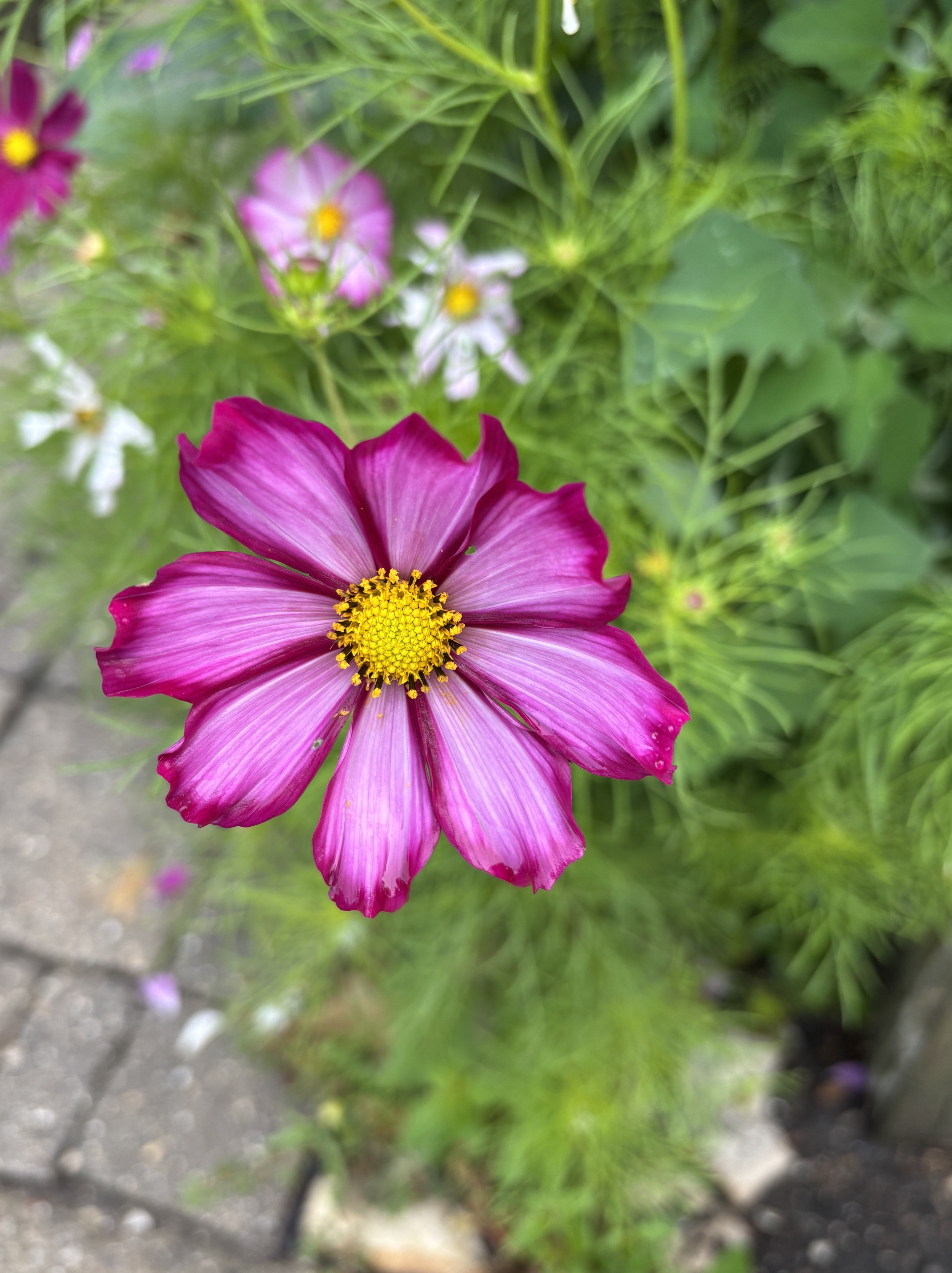
On our walk through the neighborhood we passed a house with brilliant cosmos. “I love those!” I said. I do. Cosmos may be among my favorite flowers. Kerri took a picture. I was not surprised when I investigated the symbolism of the simple cosmos-flower and found harmony, peace and tranquility. I was surprised to find, at the bottom of my screen, a box with this siren-call: Ask Me Anything.

Anything? A little cocky A-EYE box that promises an answer for anything?

I am suspicious of a little box that promises easy answers just as I am of religions that promise heavenly solutions – just as I have rolled my eyes for a decade at a bloated man in a blue suit who daily trumpets, “Only I can fix it!”

Ask me anything. Only I can fix it.

What if there isn’t an answer? What if it isn’t broken?

I find that it is more meaningful – and helpful – when my gods are silent, like a good parent, who, rather than dosing me with easy answers, helps me to find a better question. It may be frustrating at times but working and searching for my answers helps me grow.

Just so, the best leaders do not elevate themselves with boastful guarantees that they alone have all the answers. The best leaders elevate others. They seek answers with their constituents, answers that open doors to better questions. They welcome debate. They unify and facilitate. They focus energy into a common direction, making life better for all.

I stared at the box: Ask Me Anything?

“Okay,” I thought and smiled. “Two can play this game.” Into the A-EYE box I typed, “What’s your question?”
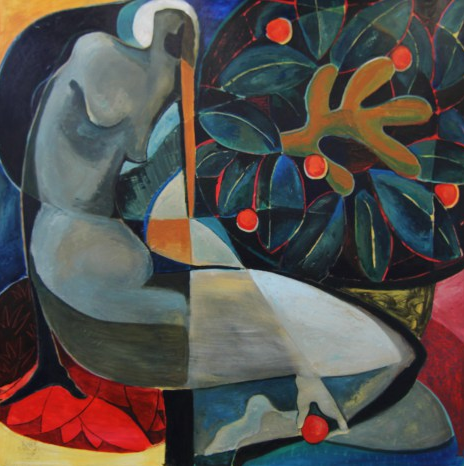
Eve, 48″x 48″, acrylic on panel

read Kerri’s blogpost about COSMOS

likesharecommentsupportthankyou!

Love Is. [David’s blog on Not So Flawed Wednesday]

I’ve decided love is like the Heisenberg Uncertainty Principle. The more we try to nail it down, the less we actually know about it. We know it when we feel it yet it is impossible to describe. If we know its location we cannot fathom its momentum. And vice versa. Poets and priests have been trying to wrap their fingers around it for centuries to no avail:

“All we need is love,” ~ The Beatles

“Love is patient and kind. Love is not jealous or boastful or proud or rude…” ~ 1 Corinthians 13: 4-7

If you want to jump down an bottomless rabbit hole, consider the religious views on love as articulated by the world’s many, many, many religions. As a boy I read and reread a thick book on comparative religions. It was my dad’s from a course he took in college. It left me with the impression that the more the religious try to lay claim to love the further away from it they travel. Carl Jung famously wrote, “One of the main functions of organized religion is to protect people against a direct experience of God.”

It does seem to me – especially now – that people not only seek protection against a direct experience of love but actively erect fortresses against it. The word “love” is often used to justify its opposite. For instance, the “love” of country is currently the go-to rationalization for the brutal rejection of others. Hurting others has nothing to do with love of country or love in any sense of the word.

The more we try to nail it down, the less we actually know about it. The more rules and laws passed to define it, the more “moral authority” is proclaimed to own it, the more the bible – or any religious text – is used to parse it…the less love is actually understood.

The message painted on the window read, “Love is. Love.” It’s not so complicated. Not really. Love is. It has no opposite. That’s what makes it so hard to grasp. There is no separation, no capacity for comparison, no black-and-white, no division from love that is not manufactured. Love is all inclusive. No law can slice it. No poet can contain it. No priest can claim it.

Love is. The rest – what we do with it – is of our own making.

read Kerri’s blogpost about LOVE

likesharesupportcommentsubscribe…thankyou.

A Place Called “Home” [David’s blog on KS Friday]

“We need, in love, to practice only this: letting each other go. For holding on comes easily; we do not need to learn it.” ~ Rainier Maria Rilke

I’ve never been a big fan of the holidays. Most of my life I’ve lived far away from family. Most of my life I’ve been a wanderer, detached from any meaningful feeling of “home”. I’ve never been a believer in any religious tradition though I understand to my bones the deeply human necessity of celebrating the solstice, observing with ritual the return of the light. It’s mythic, this annual journey through the darkness and back into the light.

It’s an experience common to all people on earth. No matter the story wrapped around it – birth or rebirth or journey or emergence – the commemoration of light’s return springs from a shared human experience. Literally and in metaphor, our lives parallel the movement of our planet around the life-giving sun. Would that we could recognize our sameness instead of fight over our perceived differences!

As I’ve previously written, the moment I stepped into this house was the first moment in my life that I felt “home”. In my imagination I saw the word “home” written on the wall. As a dedicated wanderer it frightened me. Now, more than a decade later, I am grateful for the intense struggle the wanderer-in-me fought and lost to finally – finally – arrive home.

We decorate our house for the holiday over many days. It is a work in progress that is both intentional, improvisational and responsive. We discover as we go. This season, in a nation filling itself with darkness, we have more reason than ever to create a space in our home that celebrates the return of the light.

We are also learning, in the midst of this looming shadow, how to fill ourselves with light. How to let go. We are learning how to stand in a center of intentional light in the midst of the swirling darkness. We are more than ever understanding the necessary delineation between solid-center and fluid-circumstance, how to root in the center without grappling with the passing state of affairs.

As we clean out, as we practice letting go of our stuff, both literal and metaphoric, we also decorate. We create a beautiful space, simple and warm, a place called home, safe and solid, where we turn to the sky and witness the return of the light.

The Lights on the album of the same name © 1996 Kerri Sherwood

Kerri’s albums are available on iTunes and streaming on Pandora

read Kerri’s blog post about DECORATING

likesharesupportsubscribecomment…thank you.

The Necessity of Intolerance [David’s blog on Flawed Wednesday]

Life has a way of flipping you on your head. As a former facilitator of DEI workshops I have had innumerable conversations about intolerance and the necessity for standing in “the other’s shoes.” Tolerance is a step on the path to an open mind. Throughout the course of this election I have discovered within myself the necessity of intolerance. The absolute necessity.

There has to be a line. I cannot stand in the shoes of intentional indecency. I cannot afford an ounce of grace to the ugly racist, misogynistic, xenophobic, violent ambitions of maga or its dictator-wanna-be. In a democracy, there is no validity, nothing remotely defensible about their fascist aims. I cannot listen – even for a moment – to the rabid justification of a thought-less-babble-tower built of lies and grievance. It is less than sandy soil. It is a disaster in the making. A foul permission structure of deception and nonsense.

I have found my hard intolerance and I couldn’t be more proud to declare it. At first I feared it made me a hypocrite but lately I know better. There is a place for intolerance and it is this: Intolerance of injustice, intolerance of hatred, intolerance of fear-mongering, intolerance of misogyny… is the vanguard of an open-heart, the guardian of an open-mind.

There has to be a line.

I am learning that within my intolerance of this maga-hatred is the living-seed of common decency and respect of others. My intolerance of whipped-up division constructed by a pathological liar gives bright energy to my belief in truth and goodness. It points the way to the virtues I was taught, to the ethics that are my inheritance.

Our parents and grandparents fought against fascism. My imperfect and messy nation strives to fulfill the ideal that all people are created equal. As the stewards of democracy it is now our imperative – my imperative – to claim my utter intolerance of the authoritarian bilge poisoning our nation.

Every religion, spirituality and belief-system I’ve ever studied (and I’ve studied more than I can count) instructs that I am my brothers’ and sisters’ keeper – as they are also mine, to help others – especially those who are downtrodden. As Kerri says, “If it’s not about kindness then it’s not about anything.”

That seems pretty straight forward and absolutely unequivocal to me. Especially now.

read Kerri’s blogpost about TATTERS

like. share. comment. subscribe. support…thank you.

How To Harmonize [David’s blog on Not So Flawed Wednesday]

“Nature, in the intimate and in the vast, is not designed. It is designing. Our own nature confirms it.” ~ N.J. Berrill, You and the Universe (via The Marginalian)

 In one of our famous conversations, Horatio suggested I read Ernest Becker’s Pulitzer Prize winning book, The Denial of Death. So, I did. Horatio has never led me astray. Boiled down to an essence, as a unifying principle for religion and science, it unpacks the human dilemma of being a finite animal with an unlimited imagination. We are unique among creatures because we know we will die yet we have the capacity to imagine ourselves infinite. And so, to live beyond the veil, we think we must leave a mark, to serve a greater purpose. We must seek or give meaning to our limited time. No other animal carries so great a burden, this split-dance of separation and unity.

It is an understatement to suggest that it has set me to thinking. It is the ultimate in creative tension.

For ages, artists have painted the Danse Macabre. Some are a painting a warning: it’s coming so be ready! Some are painting an appeal: it’s precious so live every moment of it!

And this is what Horatio’s recommendation has me thinking: It’s a cycle of movement, like the tides or the cycle of the seasons, the movement of the earth, spinning around the sun…It is movement. Life is movement.

I was hired at the software start-up, not because I know anything about technology or coding, but because I see movement. Dynamic whole systems. In my brief foray into the start-up, I learned that, in order to be successful, software has no end. It is never finished. It must constantly iterate. It must never assume a completion. It is, in that way, like a human being, constantly becoming, cycling through periods of stability and periods of chaos, through lostness and found-ness, each generation supporting the cycle of the next generation.

We confuse ourselves by seeking an answer to our end, as if the design is finished. As if we are complete. That is a statement of our denial. We are movement. Relationship. Cycle. Never complete.

She knelt to take a photograph of the daisies, each at various points in their life cycle. A perfect visual for the single question-with-no-answer at the core of our short season on earth:

“…how to harmonize our cosmic smallness with the immensity of our creaturely experience…” ~ N.J. Berrill

read Kerri’s blogpost about DAISIES

like. support. share. subscribe. comment…thank you.

Beyond Words [David’s blog on Not So Flawed Wednesday]

Sometimes the obvious is hard to write about. A heart path. A heart on the path. My mind jumped to the easiest association: a heart path is a metaphor for a spiritual life. Despite the countless tomes written across cultures and through the ages, including the current river of memes flowing across our screens, a spiritual life is impossible to wrap in words. Yet we have a long and complex history of trying.

I have friends who are Buddhist, friends who are Christian, friends who are Jewish, friends who are Muslim. I’ve spent time with Hindu priests and I’ve been introduced to the Tao. As they say, many paths, one destination. Heart paths, all. It is worth remembering that no single path is better or worse than any other. As Joseph Campbell suggested, religions are vehicles. A ride share.

A spiritual path need not require a deity or a book of rules. As Kerri says, “If it’s not about kindness it’s not about anything.” Kindness is an expression of the heart. Kind-heartedness. Warm-heartedness. Tender-heartedness. A heart path invokes this quality: selflessness. Deities and rulebooks can be twisted, human-made as they are, to serve un-kind, selfish intentions. Stoke divisions. Division is the opposite of a heart path. Kindness is an expression of unity.

A heart is a good symbol for the path because we all have one – every single one of us. Skin color, cultural orientation, systems of belief, sexual identity…do not alter the simple fact: we have hearts in common. Many hearts (plural) reaching for the single shared heart. One heart (singular).

Transcendent.

read Kerri’s blogpost about HEART ON THE PATH

like. comment. support. share. subscribe. many thanks.

Share The Symbols [David’s blog on KS Friday]

When I was a wee-turnip I found a textbook on the shelf from a course my dad took in college. Comparative religions. It’s a big-big book full of many-many comparisons. It now resides on my shelf. This book sparked a life-long fascination for me. The universal nature of myth and story across individual cultures and how these stories and symbols are, over time, pulled and twisted like taffy, co-opted, integrated and sometimes claimed as the private property of religion x or y.

Today, as I write this, we sit squarely on the solstice. I thought a few tidbits of story-symbol might be fun to visit so, together, we might taste the taffy.

In Italian tradition, La Befana is the goddess of the solstice. She rides a broom through the skies leaving candy and presents to the good little boys and girls. As a broom-riding pagan goddess, she predates Saint Nick by more than a few centuries. The Christian tradition snagged her and after a bit of twisting, she became a character in the Magi story. On a cold, cold night she gave shelter to those three wise-men but declined to join them on their quest because she had unfinished chores. After they left she had a change of heart but couldn’t find the manger on her own so she gave the gifts she had in tow to the nice children she met during her manger-search.

On the solstice, the goddess Isis gave birth to her son Horus, the sun god. Leta gave birth to Apollo on the solstice. The Persian god of light, Mithra, was born on the solstice. These births were technically virgin births since the conception in every case was immaculate. Egyptian. Greek. Persian. These stories predate the Christian story by centuries. It’s a ripple across time and culture of the same human impulse: after a long dark season to celebrate the return of the light.

We lose more than we know when we – to borrow a great term from Joseph Campbell – concretize a symbol. The stories and myths are meant to open us to greater unity with each other and the world we share. They are not meant to be taken or understood literally. Holding them literally slams the door on their greater meaning and unifying power. It renders them a possession, a plot point on a map.

On this winter solstice I can imagine no greater gift to this divided world than to recognize we are, through our unique symbols and characters, telling the same story, yearning for the same possibilities, sharing the same ideals whether they soar through the air on a broomstick or in a sleigh, both rides brimming with toys for good girls and boys. We borrow each others best ideas and ideals, rewriting them to fit our unique audience. From Isis and Horus to Mary and Jesus, it’s time once again to celebrate the rich warm return of the light through our myriad forms and cultural traditions, to feel the push and pull of something ancient and deeply human. Together.

this season/this season © 1998 kerri sherwood

Kerri’s albums are available on iTunes and streaming on Pandora and iHeart Radio

read Kerri’s blogpost about THE HOME IN THE TREE

like. share. support. comment.

buymeacoffee is a surgically implanted intention, a medicinal tradition stretching back eons to a time when beauty and analytics held hands and shared meals. together.

Can You Imagine? [David’s blog on Not So Flawed Wednesday]

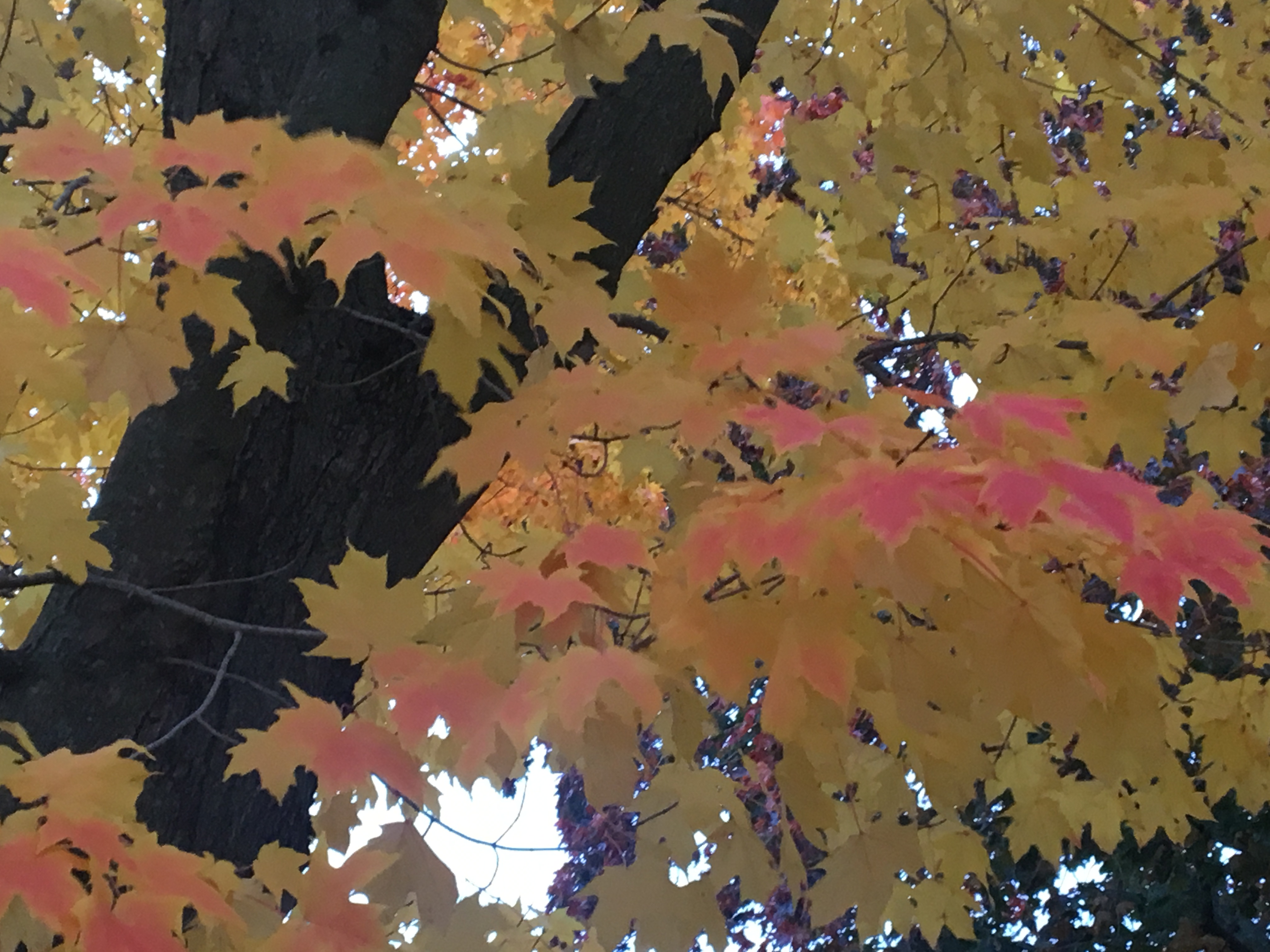
Like the leaves on a tree. We bud, grow green, vibrant and strong. We are not disconnected from the seasons. Colors change. We shine and become translucent. Brittle. And then, the strong wind blows.

I am not religious but I’ve had a life-long love of story so I’ve spent too much time walking among religious metaphor. Stories that are meant to guide us through the changing terrain of life somehow get lost-and-confused in a literal translation. A universal life-map is reduced to a territorial marker, us-and-them.

Spend enough time in many traditions – as Joseph Campbell did – and it becomes apparent that the characters in the stories might be different, but across cultures and systems of belief, “…all paths lead to the same destination.” [Bhagavad Gita…and others]

In the Christian tradition, today is All Saints Day. Tomorrow is All Souls Day. Though, the hinge word is “all.” They do not celebrate all; they celebrate only the saints and souls within the faith.

Standing beneath the luminous tree, the leaves lightly shaking in the cold autumn breeze, I wonder if it is possible for humanity to wake up – or progress – and celebrate the All. I’m an idealist so it’s not hard to suss out where I stand. Wouldn’t it be grand if for a day we could pause our many wars, put down made-up divisions, and celebrate all souls? Can you imagine? “Let’s fight again tomorrow, but, for today, I celebrate you, soul-to-soul-as-one-soul.”

All souls sacred. Like leaves on a tree.

read Kerri’s blogpost about THE LEAVES

like. support. share. comment. soul-to-soul appreciation

buymeacoffee is a “tip jar” where you can support the continued creativity of the artists that spin stories that keep you grounded and full of curiosity.

Check Your Reaction [David’s blog on KS Friday]

I confess to being disconcerted. At lunch, Kerri asked me a question about my blog so I typed “the direction of intention” into Google. The top slots were a prayer, rather, a type of prayer originated by Saint Francis de Sales. “Oh, No!” I thought. I don’t want my blog to be associated in any way with any church or any religion. “I hope people know that I am not that,” I said, surprising myself with the vehemence of my sentiment.

We’d just finished reading and discussing a Washington Post opinion piece, I Left The Church And Now Long For ‘A Church For The Nones.’ “… I couldn’t ignore how the word Christian was becoming a synonym for rabidly pro-Trump White people who argued that his and their meanness and intolerance were somehow justified and in some ways required to defend our faith.” So Perry Bacon, Jr.’s very interesting opinion piece was fresh in my mind.

So, too, was a passage I’d read earlier in the day from Vāclav Havel‘s book, Disturbing The Peace. The interviewer asked him to define “absurd theatre” (Havel wrote absurdist plays). He responded that absurdist theatre “demonstrates humanity in a ‘state of crisis’…it shows man having lost his fundamental metaphysical certainty, the experience of the absolute, his relationship to eternity…, in other words, having lost the ground under his feet.” In my mind, he could not have written a more prophetic or accurate description of our times. We are untethered without a functioning moral compass. We are awash in a flood of content mostly bereft of shared context.

I attended a Catholic college. I am not Catholic. I have never identified as Christian or Buddhist or Hindu…Yet, I am not an atheist. One of my favorite memories of my college years are the many conversations I had with Father Lauren sitting on the stoop of the barracks, sipping tea, discussing his faith and my belief. We explored ideas. We compared and contrasted philosophies. We laughed. We asked questions. We considered and expanded each other’s point of view. We respected each other’s differences because we were both driven by a desire to do good for other people. We shared a common intention. A common direction of intention. We both believed in “something bigger” but did not share the same idea of what “something bigger” might be.

Suddenly, I yearned for that time of openness of thought and generosity of sharing opposing points of view. I imagined sitting again with Father Lauren. Eschewing any black-or-white opinion, attempting to practice what I preach – to practice what I believe – I clicked on a few of the links of Saint Francis de Sales. I read. I wanted to know rather than to judge.

I read that Saint Francis de Sales was noted for “…his deep faith and gentle approach to the religious divisions in his land…” We could use some gentle approaches to division in these rabidly discordant times…This also caught my attention: the direction of intention, the heart of Salesian spirituality, is a practice of prayer consciously directing to god what you are about to do… In other words, intending goodness of action.

My definition of the direction of intention: it’s not about what you get, it’s about what you bring. Saint Francis de Sales and I are not so far apart in our direction of intention. Other-focused. Purposive goodness. We both encourage consciousness of action in the world and awareness of the impact of our actions on others.

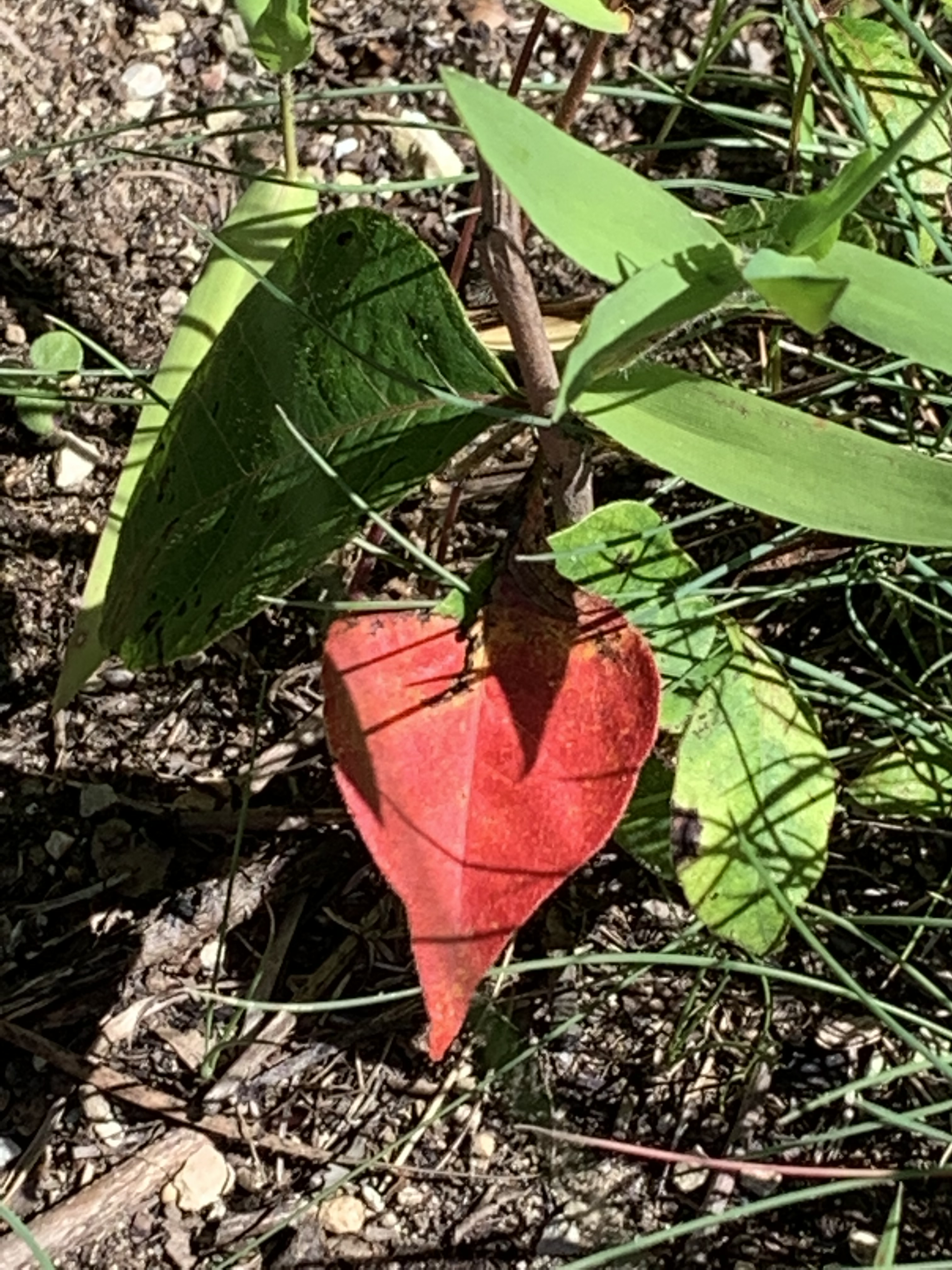
So, I amend my initial thought: I do not want to be associated with any church or religion, but there’s plenty of common ground to share when we’re driven – and united – by a conscious desire to do good for other people. 

grace/right now © 2010 kerri sherwood

Kerri’s albums are available on iTunes and streaming on Pandora and iHeart Radio

read Kerri’s blogpost about HEART LEAF

like. support. share. comment. thank you.

Put It On The Wall [on DR Thursday]

“What you think, you become. What you feel, you attract. What you imagine, you create.” ~ Buddha

I sometimes wonder what the Buddha might think about how words, attributed to him, are now available on Wayfair.com as posters or large decals for every living room wall. Does the ease and ubiquity of the message make it less meaningful? A decoration rather than a wisdom? Or, that we are capable of immersing ourselves in inspiration, a reminder-to-live-well in every room, are we meditating on the messages? Are we incorporating them into our actions and choices?

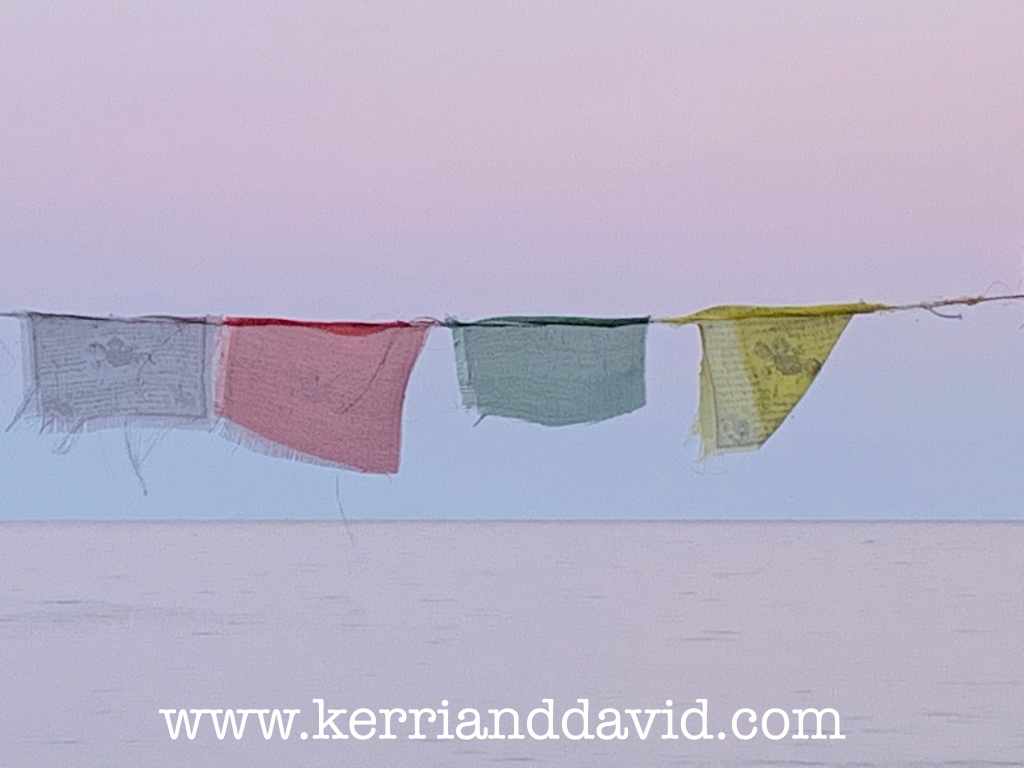
I’ve read that the only requirement when hanging prayer flags is to hold positive thoughts and intentions in the mind. Intend goodness and goodness will spread. That is, after all, the point of the flag. To spread on the wind goodness, peace, kindness,…

Kerri’s philosophy – her religion – is much the same as Dolly Parton: “You just try to be nice to everybody ’cause you know everybody’s got a dream.” Kerri’s version: “If it’s not about kindness it’s not about anything.” It’s simple.

Minds are powerful things. It’s why stories are so impactful; stories are the stuff that fills-the-minds. What you feel. What you think. What you imagine. It’s not passive. Although a trick of the English language, your thoughts, your feelings, your imaginings, are not really separate from “you.” They are you. The story you tell yourself about yourself in the world.

I suppose that’s why we rub the sentiment onto the living room wall. A desire to be better in the world. To tell a better story. Better about each other. Better for each other. What else?

read Kerri’s blogpost about PRAYER FLAGS

in serenity © 2018 david robinson