See And Speak [on Not So Flawed Wednesday]

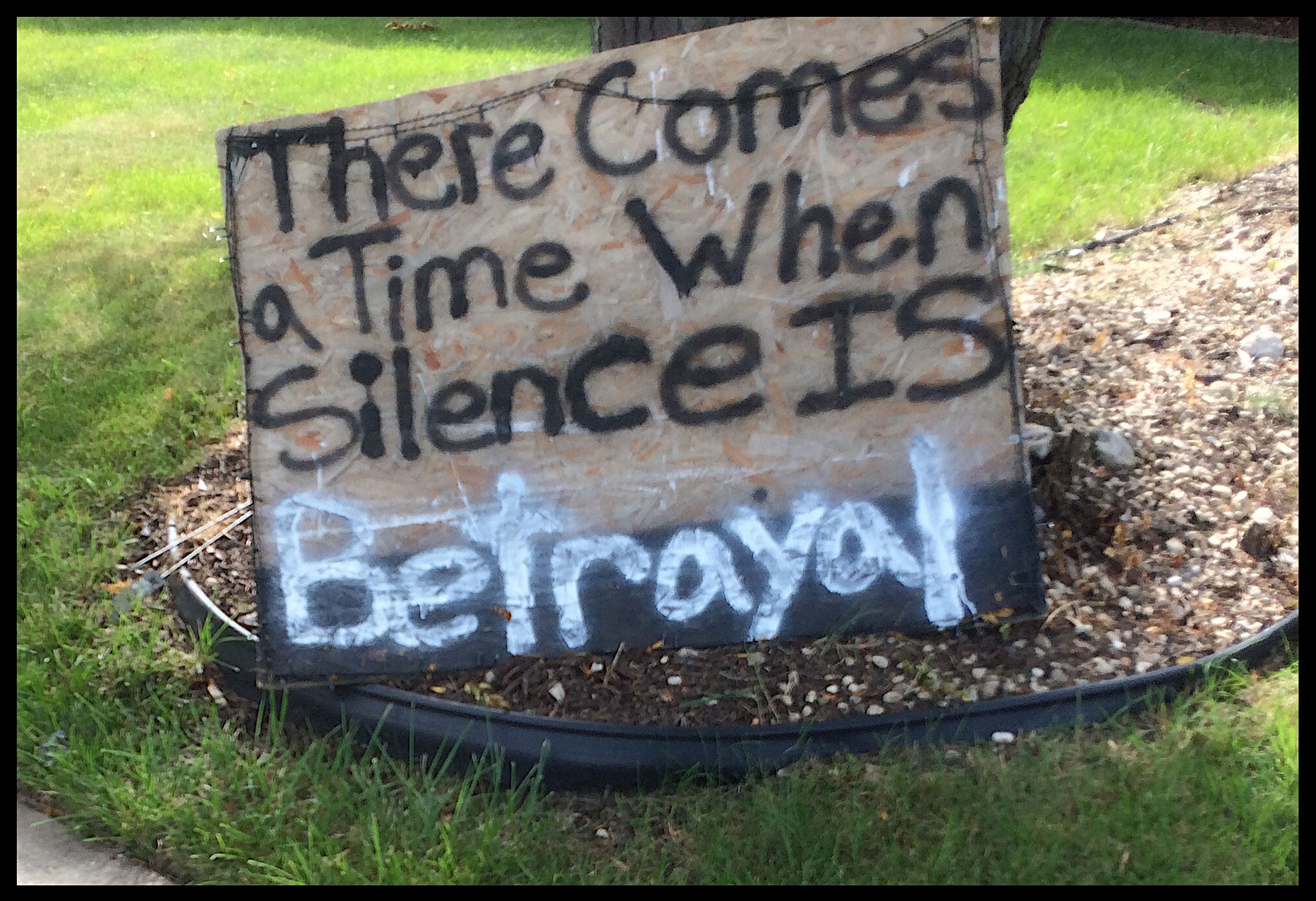
there comes a time when silence copy

We were sitting on a concrete wall, taking a break, when he asked the question. I’ve been asked this very question more times than I care to count and I did what I always do: I took a breath. When you facilitate conversations on diversity and culture change, this question is always lurking somewhere in the room, waiting for a break, a side conversation, so it can be given voice without ramification. Truth often steps forward at the water cooler. It was the question that illuminated for me the real problem with race in America and the mountain we need to move. “Don’t you think black people cause their own problems?” he suggested.

Breathe.

No. I don’t. I believe privilege is blind to itself. And, isn’t this the very conversation we need to have happen in the middle of the room and not at the margins? The mark of institutional racism is that it is utterly invisible to the privileged class.

In the United States we hear a lot these days about tribes and information bubbles as if they were a new phenomenon.  They are not new. Our bubbles, like all bubbled history, is meant to cleanse the narrative to justify the indefensible, to hide the ugly behind a noble mask. Here’s a phrase from our history: The ruling class responded [to Bacon’s Rebellion] by hardening the racial caste of slavery in an attempt to divide the two races from subsequent united uprisings with the passage of The Virginia Slave Codes of 1705.

If you are white in America this might not yet have pierced your bubble. Note these phrases relative to the history you learned in school. It might help to understand the system at play in our current historical attempt to change systemic racism: Ruling class. Harden the racial caste of slavery [yes, a created caste system. The system of slavery was erected and black Americans were legally defined as lesser beings]. Divide the two races [black & white]. The point of the black/white division was and is to prevent subsequent uprisings against the ruling class. Ruling class.  The division we wrestle with was intentional, crafted for a specific purpose, and systematized. It serves the same institutional purpose to this day.

Another tidbit worth gnawing on: According to the Oxford English Dictionary, the first appearance in print of the adjective white in reference to “a white man, a person of a race distinguished by a light complexion” was in 1671. Colonial charters and other official documents written in the 1600s and early 1700s rarely refer to European colonists as white.

If we are learning anything in these days of fox propaganda and pandemic tales it is the power of people to entrench in their narrative despite data, fact, and personal experience that disputes the narrative. Systematize a narrative and it is nearly impossible to challenge. No see, no hear, no speak. Systems, as I learned in school, are living things – not mechanical – and will fight to the death to keep themselves alive. We are currently watching the fight of a systemic challenge.

The question at the water cooler, “Don’t you think black people create their own problems?” was always asked in earnest. It revealed the successful hardening of racial caste, the power of the mechanism preventing the uniting of the races so as to ensure no possible subsequent uprisings. Us. Them. Bubbles. A vicious cycle.

It’s hard to see a mountain when you are sitting on it. We The People. Ruling class. These two phrases are incompatible but co-exist through the successful creation of division. It’s black and white.

We have a long history and have worked very hard not to see what is right before our eyes. The second rule of systems change: if you know where you are going then it is not change but repetition. Rearranging the deck chairs on the Titanic.

The opportunity for change is, once again, upon us. The conversation needs to move to the center of the communal square and we need to muster the courage to step into unknown territory. Silence and denial are not now nor ever have been valid excuses for perpetuating an ugly system. We betray ourselves.

“When you see something that is not right, not fair, not just, you have to speak up. You have to say something. You have to do something.” ~ John Lewis


read Kerri’s blog post about SILENCE


sunrisewebsite copy

Shift [on Merely A Thought Monday]

shift key framed copy

Shift is not an insignificant key. In a nanosecond it can take you from lower case to upper. It can throw your backslash into question. The simple finality of a period can be pitched into a statement of worth: greater or lesser.

Doesn’t it feel like a malevolent pinky just hit the universal shift key in our world? Of this we can be sure: it’s a new sentence and there’s no going back to what we once knew as “normal.”

In spiritual circles, shift is what happens when our otherwise cloudy consciousness becomes crystal clear. In circles of learning and growth, shift is what happens to our perspective when what was previously unknown becomes readily apparent. The penny drops and we can never again not-know what we now comprehend.

Perhaps the omnipotent pinky pushing our shift key is not malevolent. Perhaps it was long past time that we took stock of the gap between our rhetoric and our actions, our professed history and the full accounting? Perhaps we needed a boost from our lower case value-set to actually approach our upper case potentials.

In the great stories, as in life, there is a paradox associated with profound shifts. They come, not through pursuit or seeking, they come when the protagonist stops looking, surrenders and stands still. The shift always comes with the realization that what is sought has been readily available all along. The belief in separation creates the necessity to seek. The commitment to division creates the necessity to fight for dominance.

Shift words like “unity” or “common” or “harmony” or “accord” or “wholeness” or “integrity” arise when the seeking and fighting and pursuing cease. They show up when we stand still, when we stop looking for them. They become options when we realize that they have been available all along.


read Kerri’s blog post about SHIFT

Kerri is still in the Facebook penalty box so if you enjoy reading her thoughts please consider subscribing to her blog. I do – even though I get to read what she writes before she publishes. As her greatest fan it is always a pleasure to read the before-publish AND after-publish versions.


prayerflags pastel website box copy


color & contemplation copy

an oldie but goodie: contemplation


contemplation ©️ 2004 david robinson

Draw The Symbol [on DR Thursday]

sketch image copy

Sometimes drawing is like free writing. I capture the lines and images as they arise without edit or evaluation. It is more akin to following than leading. It’s a meditation. I draw for the surprise of what shows up. Often, in my free flow, symbols arise and I only see them after I put down my pencil. The symbols that floated to the surface in this drawing are Heart and Strawberry.

When symbols pop up for me I make it a practice to investigate, even if they appear obvious or I think I already know. I assume that I do not know anything. It’s a way of continuing the conversation. These two, heart and strawberry, are intertwined symbols. Venus, the goddess of love. Purity and perfection. Sensuality. Eros. Happiness. Good fortune. Compassion. Joy. Charity. There are cultural lenses and religious interpretations but across all cultural variance, both symbols are rivers that lead to love in one or all of its expression.

Yaki asked me to rewrite THE CREATURES OF PROMETHEUS – a storytelling to accompany Beethoven’s symphony – so that it might speak directly to the realities of our day. He wants it to be more obviously relevant. I have been sitting on it, watching and waiting, since we seem to be living in a swirl of chaos. My grasp of relevance in the morning is obsolete by sundown. The only consistency that cuts through the mayhem is that the circles in our communal Venn Diagram no longer intersect. Not only is there no crossover, the circles no longer share the same page. We define ourselves according to our differences rather that reach toward our similarities. Romeo and Juliet is an example, a cautionary tale of what happens when the communal circles stubbornly refuse to find crossover. The children easily transcend the division. The society crushes them for daring to love. And then the adults realize they’ve sacrificed the greater for the lesser and in their grief they reach to grasp hands.

There are hearts and strawberries in every tragic tale. The tragedy arises because the characters refuse to see it. Maybe that is the theme of my rewrite? Maybe hearts and strawberries are the tender sprouts that will emerge in our nation once the fire ceases to rage?


read Kerri’s blog post about HEARTS AND STRAWBERRIES

We are still in the Facebook penalty box. It is possible that Kerri’s posts may never reappear so, if you enjoy reading Kerri’s word, consider subscribing to her blog. I know we publish waaay too much but, with the minor exception of us, ALMOST no one reads everything that we write – except for Lydia and Horatio and Malta-Alex and for their dedicated perseverance, we are most grateful.


dogdog babycat paws touchingwebsite box copy


*Shared Fatherhood evolved from a sketch about Polynices & Eteocles, brothers that killed each other in combat over control of the throne. Somehow I traveled from senseless war to shared fatherhood.


shared fatherhood 2 ©️ 2017 david robinson

Love Your Words [on Not So Flawed Wednesday]

kawaii raccoons copy

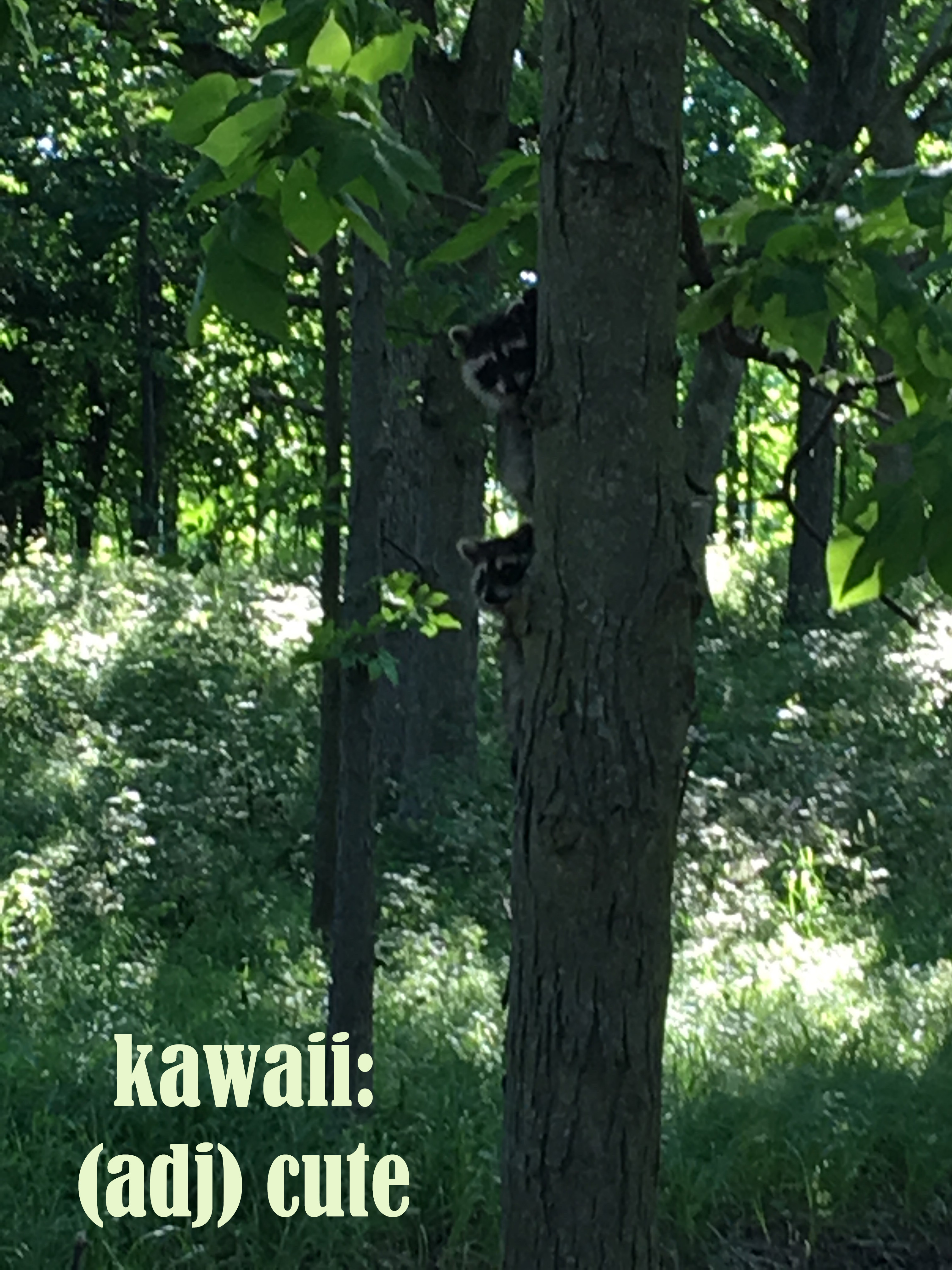
I have grown fond of words. No one is more surprised by this statement than me.

A decade ago I did not consider myself a writer. Nowhere in my limited identity structure did I harbor thoughts of writing. This is an admission of my utter unconsciousness since I was writing and performing stories at conferences, with symphonies, and during facilitation. Tell a good story and even the most disparate-and-divided group will inhabit a common metaphor. Tell a good story in cliffhanger segments and even the most resistant conference-goer will greedily return to the general assembly to gobble up the next bit of story.  Stories are powerful magic and I loved telling them. At the time, it never occurred to me that I first had to write them.

The Buddha said, “The mind is everything. What you think is what you become.” I’ve also found the quote modified to read, “What you think is what you are.”  We think in words. We think in stories. Mostly, we are unconscious to the stories we tell ourselves and, more to the point, we rarely recognize that the river of words running through our mind is not truth. It is not fact. It is interpretation. It is story. We are storytellers all and the stories we tell define the moments we live. The stories we tell determine what we see or do not see, how we see or do not see.

That recognition brought me to my love of words. I started paying attention to the stories that I tell myself. I have a Hall-of-Grievances. I have a Complete-Book-Of-Rules for how I ought to live. I have a Jukebox-Of-Greatest-Hits, a entire collection of  stories and conversations that I replay again and again and again. I’m fond of the debate records I play because I win every time! There’s even a special long play set of recordings of things I SHOULD have said and, guess what? In my mind I say the SHOULD-HAVE-SAID words every time! I especially enjoy being witty and quick (in my mind).  It is a wonder that I have any space for new thought given the story-grooves I play over and over ad infinitum.

Words matter. The words I choose matter. I learned in school that William Shakespeare had a working vocabulary of approximately 26,000 words. If we are average, you and I top out at around 1,800 words. William either made up or was the first to put on paper roughly 10,000 of his 26,000 word vocabulary. We tell shorter, less articulate stories. Less poetry and more “get-to-the-point!” He didn’t have commercial breaks shaping his attention span.

I story other people as much or more than I story myself. The annoying little secret about the-story-I-tell-myself-about-others is this: it is not a story about them at all. It’s my story about them which makes the story I tell not about them, but about myself. “Words, words, words,” Hamlet replies to Polonius.

My world can be beautiful. My world can be ugly. My world can be safe. My world can be violent. My world can be kawaii. My world can be fugly. My world can be fearful. My world can be love-full. My world can be. I can be my brother’s/sister’s keeper. I can be concerned only for myself. Yes. No. Just words. Not just words.


read Kerri’s blog post about KAWAII

We are still in the Facebook annihilation zone. It is possible that Kerri’s posts may never reappear so, if you enjoy reading Kerri’s blog, consider subscribing to her blog. I know we publish waaay too much but, with the minor exception of us, no one reads everything that we write – except Horatio and for his dedicated perseverance, we are grateful.


chicken and perseverance website box copy*look at this website box on Kerri’s post. She added pupils to the eyes. Originally, I drew Chicken Marsala without pupils and that creeps Kerri out. She always adds pupils to Chicken!


Look For It [on Two Artists Tuesday]

des plaines copy

“Consider yourself blessed. These stones that break your bones will build the altar of your love.” ~ Lynn Park

20 has a collection of images. Faces found in objects. A light socket that seems to be eyes and a nose and a mouth. A teapot face. A widget-face at the hardware store. He sees them everywhere because he looks for them.

Looking for it. It’s the key to a positive attitude: you see what you look for. Look for generosity and kindness and you’ll see it everywhere. It’s also true of a darker view on life: there’s plenty of horror story to be found if you spend your days looking for it.

As a rule, both kindness and cruelty are available in abundance. Both are on display at any given moment of the day.

People seem to be more attracted to cruelty – especially for pleasure. We build coliseums so we can watch gladiators do combat. We thrill when the car crashes on the track. The bloodier the video game the better the sales. We love to yammer on and on about our bad experiences but will tell far fewer people about the good moments. We’ve managed to turn something as benign as Facebook into yet another bloody coliseum for e-battle. People negating people. Dedicated division. “Shouting into the canyon,” as Rob called it.

And, as a rule, we will either go through life seeking meaning for our experiences or we will go through life giving meaning to our experiences. We focus on what we have or we focus on what we lack. Opportunity or obstacle. Us or Them. Either way, it’s a story and we are the storytellers.

People are patterned so they generally see what they expect to see. It’s the lesson that’s all the rage these days in the USA. Lesson #2: once patterned, people are resistant to seeing anything other than what they believe. We have the unique capacity, in the face of overwhelming evidence to the contrary, to argue to the death to maintain our point of view. The anti-mask crowd are providing generations of psychologists with a heyday of research: people literally arguing to death to maintain their point of view despite a veritable mountain of evidence that contradicts their belief.

It seems impossible, yet there it is. There we are.

Like 20, I have decided to train my eyes to see. Only, instead of faces found in inanimate objects, I’ve decided to look for the little miracles. Intrepid life. The magnificent force that expresses in small affirmations. An unlikely plant growing from a crack in the wood. A snake stretched out on the path to catch the sun. The single-day proliferation of crabgrass taking over our yard! A meteor flying by.  People more invested in the sunset than the Facebook. The fox at midnight. The turkey on the roof. The friends who love each other enough to keep their distance.


read Kerri’s blog post about INTREPID LIFE


squarecat website box copy


underpainting copy

untitled


Learn to Look [on KS Friday]

part of the wind dandelion fluff copy

“At the heart of beauty must be a huge care and affection for creation, for nowhere is beauty an accidental presence.” John O’Dononue, Beauty, The Invisible Embrace

I read yesterday in my Brain Pickings that Georgia O’Keeffe believed her close-up paintings were “a magnifying lens for paying attention.” I read and appreciated this phrase: Painting these close-ups was a way of learning to look, a way of removing the blinders with which we gallop through the world, slowing down, shedding our notions and concepts of things, and taking things in as they really are.

It is the astonishing miracle of a human being: we can choose to see or choose to not see. Also, we can choose what we see or we can choose to deny what is right in front of us. In any case, seeing is predicated on slowing down, on taking the time to “shed our notions and concepts of things.”

Seeing is an intentional act or perhaps it is a creation-in-the-moment – which implies it is an intentional relationship. In this way, as I understand it, seeing the beauty of this life is a decision, it is a lens. It is a dance.

I’ve never been in a hot-air balloon. Kerri had the experience once, it is the source of this composition. Hovering in a basket above the earth, moving with the wind, very few controls. It was, I imagine, an exercise of giving over, of letting go. I think seeing is like the experience she describes of hanging in the basket of a hot-air balloon. All concepts of hurry-up or getting-things-done drop away. Hard time dissolves. There is nowhere else to be. And, in that space, beauty makes known her presence. She opens your eyes.


PART OF THE WIND is on the album BLUEPRINT FOR MY SOUL


read Kerri’s blog post about PART OF THE WIND


HH coffee cups website box copy


part of the wind/blueprint for my soul ©️ 1996 kerri sherwood

  blanket of blue sky ©️ 2004 david robinson

Search [on Flawed Wednesday]

explicitly divisive copy

I’m a broken record: words matter. They are rarely accidental. For instance, the division between “black” and “white” was created. Our racial legacy is not happenstance. It is by design.

Power does not like to be challenged or threatened and strategies of division are great mechanisms of control. Taking pride-in-ignorance is another – it is a terrific support strategy if discord is the goal. An ignorant people are easily misled.

We enact and reenact Bacon’s rebellion again and again. It is a vicious cycle, a whirlpool that is hard to escape without a clear view of the full story. History, like language, is never passive, it comes with a dedicated point of view – and so we are witness once again to the great narrative tug-of-war.  We could drop the rope if we decided to look at our history, ask a few questions, and perhaps see the narrative slop that the fox and friends are force feeding to white fear as just the latest iteration of an old, old scare tactic.

Misinformation is nothing new. Propaganda is as old as human history. It is the downfall of a critter unique in its need for an identifying narrative to believe almost anything if it provides a sense of belonging. People who refuse to take a step back and ask, “Is this true?” will buy almost any line. Fear is a narrative with an agenda so what-on-earth prevents otherwise thinking people from considering that the daily dose of fear they are being fed might be cooked up intentionally? Trading brains for belonging never works out well in the end.

Black and white. Red and blue. We have a pattern, not a problem.

A people united are an unstoppable force and the worst nightmare of identity politicians.  People unite when their ideals – things like freedom and truth and justice and equality – transcend their small identity bubbles.  Ideals are unattainable – that is what gives them their special uniting capacity. We strive. It’s an active verb with an inclusive pronoun.

Hate and fear – all things divisive – are easily attained. That’s what makes them so useful to despots and control-mongers. Keep the thinking small and encapsulated within the tiny bubble. It will keep the people warring among themselves with no questions asked.

How do we move beyond this pattern and rise above the incessant division that plagues us? Well, we must first desire to see the pattern. We must choose to see. Then, we might be capable of revisiting the words we placed as central to our national ideal and choose to live them. Our words matter. That might require a few challenging questions.

It will definitely require a good deal of soul searching and that’s not such a bad thing. Nations, like people, grow and become better when they grow weary of their dysfunction and go looking for their soul.


read Kerri’s blog post about Explicitly Divisive


? website box copy


surrender now ©️ 2016 david robinson

Sing [on KS Friday]

sing

The story is famous in these parts. It goes like this: when I met Kerri I told her that she needed to know two things about me: 1) I don’t sing. 2) I don’t pray. She gave me a sideways knowing look and said, “Oh, that’s too bad.”

I had some very-traumatic-early-in-my-life-singing-experiences. Lots of shame and humiliation led me to an adamant preemptive proclamation with my musician-soon-to-be wife: I do not sing. No way. Don’t even ask. I’ll watch from the sidelines.

Of course, within a few months, she had me in a ukulele band, a choir, and a band. It turns out I like to sing. The problem, she taught me, was not in my capacity to sing, it was in how I hear sound. I hear an octave up. She taught me how to hear. I am now a confident parasitic singer (i.e. I sing just fine with others, just don’t ask me to sing alone).

I’ve spent my life teaching people to see. How beautifully ironic (or perfect) that I needed to learn to hear.

Early in the saga of Beowulf, he is caught in a swarm and blinded by bees. Because he was blinded, he had to develop other senses; his heightened senses were critical in combating and defeating the monster Grendel. Late in his life, he retired as a beekeeper. He not only made peace with bees, they become his allies. At the very end, his bees are his greatest strength. They defeat a dragon plaguing his kingdom.

The great stories are with us for a reason. They can help us navigate and craft our own life stories. For instance, the greatest wounds can be limits or they can lead to new and vital gifts. I’ve learned from Beowulf that the path you take – limit or liberation –  depends on the story you argue for, the focus you choose. When I met Kerri I was arguing for my limitation. I do not sing. Period.

Another recurring theme in the great stories goes like this: when you are ready, the right teacher appears.


read Kerri’s blog post about SING


ks website header copy


picnic table website box copy


shaman ©️ 1993 david robinson

Expect Nothing [on Not So Flawed Wednesday]

happy copy

The man was about to begin hiking the Appalachian Trail. The interviewer asked, “What do you expect it will be like? What do you expect will happen?” The man replied, “I try not to have any expectations. I want to be open to what comes along, whatever that might be.”

It’s a spiritual practice. Make no assumptions. Release all preconceived notions. Open to what is and not what you think should be. Have the experience first, make meaning second. All good advice for attempting presence: that place we fully occupy but rarely visit.

Making meaning. It’s what people do. Wrap an experience in a story. Wrap it in a blanket of belief. Often we muffle the experience in a heavy cloak  before we’ve had it.”It’s going to be hard.” “I don’t think they will like me.” Or, “This will be the best!” “I’m going to crush it!”

Joe used to call this high-dream/low-dream. Imagine the best. Imagine the worst. Like a magical invocation. Either way, an expectation is set. The story has begun and imposes a slick layer over the happenings. The story bleaches the experience-space, that full range of color available between the high and low.

It’s no wonder we can’t find compromise in our current nation-story.

I watch DogDog in the morning. He can’t wait to race outside. He barks for no other reason than it feels good. He sits in the sun. He chases birds with no hope or expectation that he will catch one [he wouldn’t have the vaguest idea what to do if he actually caught one]. DogDog does not know there is a pandemic. He does not care about people politicizing mask wearing. He holds no expectation for the direction of the day. His to-do list is blank. He is happy going on errands. He is happy sleeping on the cool tiles.  He holds no grudges. He makes no judgments. He holds his story lightly. He is happy both before and after he eats. Sometimes he even tastes his food. Above all, he is happiest when we are happy.

Open to experience, DogDog has much to teach me. He has much to teach the world.


read Kerri’s blog post about HAPPY DOING


shadow des plaines river trailwebsite box copy


The quote “happy doing something, happy doing nothing” comes from an article about Augie the dog.

Treat The Origin [on KS Friday]

it's a long story copy

Yaki called. He wants to dust off our Prometheus project and give it another whirl. The Creatures Of Prometheus is one of Beethoven’s early works, a ballet that is nigh-on impossible for a contemporary ballet company to afford. Besides a symphony, it requires  scores of dancers. Twelve years ago, Yaki asked if I would write and perform a narrative – a storytelling- that would weave together the movements. It lives among my all-time favorite collaborations. Yesterday he asked, “Can we update it? Can we make it relevant with what’s happening in the world today?’

My first thought: it’s already relevant! It is a creation story. Prometheus is given the task of creating human beings, a man and a woman. Although he is instructed to make them dull and crude, he creates them to be beautiful, to see and appreciate their connection to the earth from which they were made. Angered by his disobedience, Zeus punishes Prometheus by corrupting the new creatures; he fills them with fear and division. He twists their fear into a lust for war. He makes them dull and crude. Now, Prometheus waits for them to remember and recover their original sight, to remember their capacity for pure seeing, fearless living. To drop their madness and return to their senses.

My second thought: people are notoriously incapable of grasping metaphor. It’s the Zeus thing in practice. The update has to be a direct statement. It must leave no doubt and puncture the commitment to dullness. “Gear down!” as Kerri constantly reminds me.

“How can Prometheus speak to Black Lives Matter?” he asked. We are both artists in the later stage of our career.  Yaki added, “I want my work – my art to really speak to what’s happening today. I want it to help.”

I’ve been sitting in his questions since we talked yesterday. We are standing again at a moment in time when change is possible. We are also standing at the moment when the system, a living thing, a wizard of recreation, will fight to maintain itself. Consider: we had this moment with the abolition of slavery and the system responded with Jim Crow. Segregation. Institutional racism. We had the moment again with the civil rights movement in the 1960’s and the system responded with a draconian judicial/policing/incarceration apparatus, disproportionate tax structures…segregation by legislation (again and again and again).

In our current moment, in this latest moment, how can we make the necessary changes that are not merely the existing system putting a new face on a 400 year old mechanism? Real change requires steps in unknown directions [the rule: if you know where you are going you are merely re-creating what already exists]. How can Prometheus speak to that?

We focus on behavior when we need to stare at the underlying structures. Behavior, as Robert Fritz reminds us, always follows the path of least resistance – the sub-structure determines the path of behavior.

In the story, Prometheus is in it for the long haul. He knows his creatures are made for beauty and will inevitably see beyond their made-up fear and return to their source. They will one day stop listening to the fear mongers and race baiters. They will wake up and recognize that they are not made to be dull and crude and divisive. In fact, quite the opposite. They were made to appreciate and participate in the creation of beauty and betterment. Nature.

Prometheus is in no hurry. He waits for his creatures to remember. He plays the long story. What will that look like?


IT’S A LONG STORY is on the album THIS PART OF THE JOURNEY


read Kerri’s blog post about IT’S A LONG STORY


treehole website box copy


it’s a long story/this part of the journey ©️ 1997/2000 kerri sherwood

joy ©️ 2014 david robinson