Care For Your Space [on Not So Flawed Wednesday]

It seems like such a simple concept. Tom taught it. So did Paul. And, since I was one of their students, I taught it, too. How you treat your space is a reflection of what you think of your art. The concept is universal. Replace the word “art” with “work” or “life.” You and your space are not separate. We worked hard at the theatre to become better artists and produce better plays and a significant part of that work was bettering and maintaining our artistic “home.” We were proud of our work and it showed -everywhere. Our “space” included our community and our art was meant to make it better.

Yesterday it was warm so we took a walk on a favorite loop. As we returned to the car we watched a man clean out his truck. He’d come to the park, not to walk or appreciate the quiet. His purpose was to dump his trash onto the paved lot. In an earlier time, pre-gun-gun-everywhere, we might have said something. Instead, we stared in disbelief. His space,I thought, does not extend beyond his truck. Neither does his community.

Yesterday, after the walk I received a text from Mike. He was a big part of my long-ago theatre. He’s realizing a dream and opening his own theatre. He’s led a company for a few decades but they didn’t have their own space. Now, they do. He – the artistic director – was mopping the floor and paused to send me a text. It’s the other part of the lesson from Tom and Paul. And Demarcus. And Quinn. There’s no hierarchy. There’s no above and below. Loving the space, loving the art that happens in the space: no separation. One and the same for everyone involved and everyone needs to be involved.

You and your space are not separate. The care you take of your outer space is equal to the care you give to your inner space. And, vice-versa.

[visit Justin’s to see how a company can make a better world]

read Kerri’s blogpost about NEAT EARTH

Listen To The Memento [on DR Thursday]

Stop for moment and look around your house. How many of the objects that populate your shelves and walls are mementos? Keepsakes from travels or special events? I’m always struck, after a devastating fire or tornado, how often I watch people sifting through the rubble of their home to find a photograph or a special ring. There is the shock of losing the home, but the stories! What will happen with the loss of the reminder, the things that carry the story?

Last week, after the night we thought there was a fire in our walls, we talked about our race to get out of the house, and the question of “What do we grab and take?” The dog. The special papers. The computers. A few clothes. Those “items” fall into two categories: what you love (the dog. each other) and what we need to start again (special papers, the computers, a change of clothes). Although losing the passports and birth certificates would be difficult to replace, the first category is really all you need.

I’m certain, because our experience was so recent, I want to sob watching the news footage of families fleeing their homes in Ukraine. What do you grab and take when yesterday you went to work and today you are fleeing bombs and war? Where do you go? We have friends a few minutes away who would have taken us in and helped us back on our feet. When fleeing is the destination…where do you go?

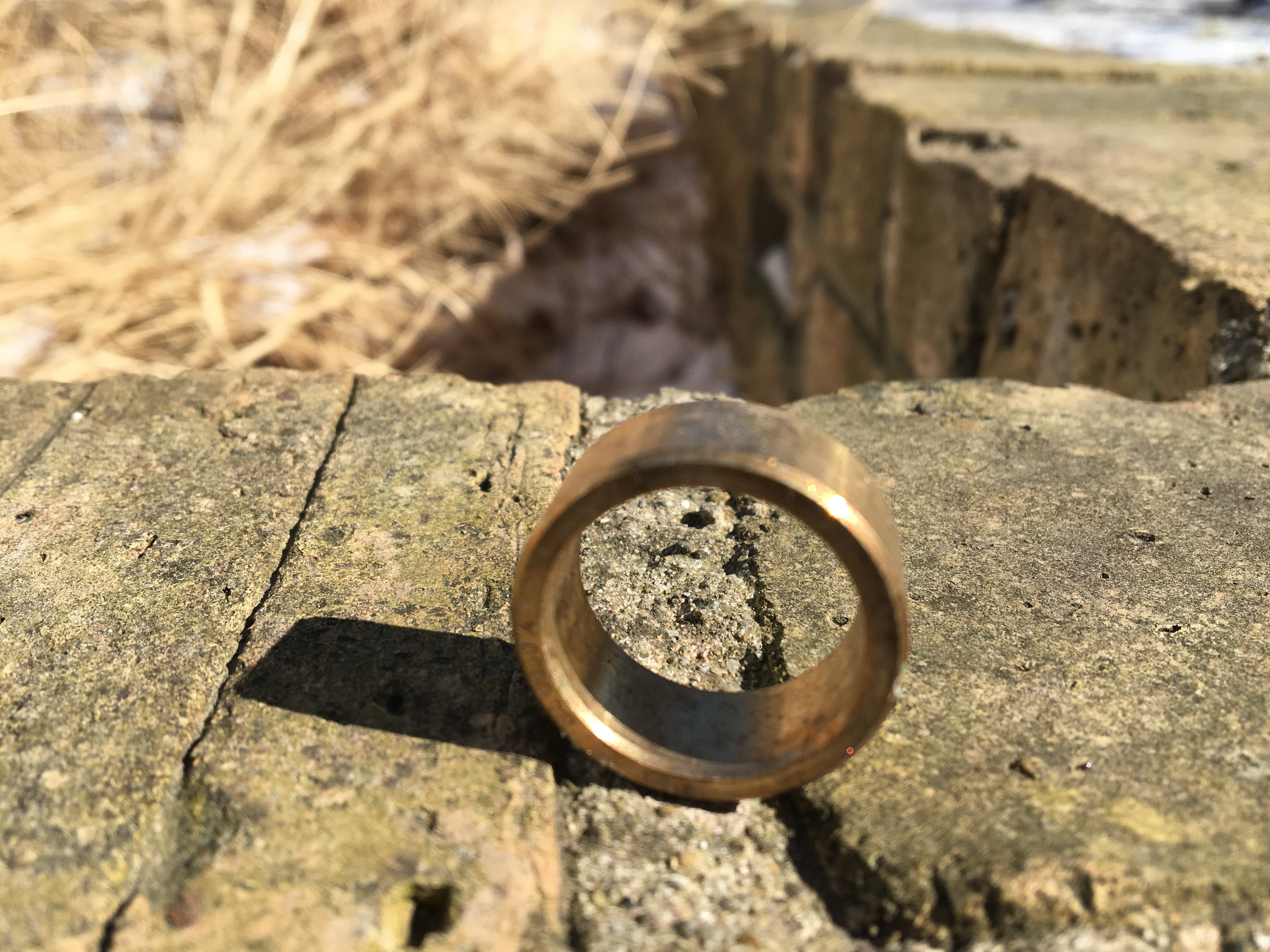
The sun was bright through the cold on the day we pushed LittleBabyScion down the driveway so we could get Big Red out and onto the street. At first, she thought she found a wedding ring poking out of the snow. One of the men who worked so hard to replace our water line must have lost it. But then, we realized it was a brass fitting. We brought it in house. Someday, when the trench has settled, the front yard has grass again, when we feel comfortable leaving the television plugged in, and the house is restored to order, the ring will serve as a memento to remind us of the upheaval.

Yesterday I held the ring for a moment and I wondered why we – humans – build memorials to war that carry messages chiseled in stone, “Never again…” or “Remember…”, sentiments that are meant to remind us that murdering each other for resource or political gain actually achieves nothing but pain and the erection of yet another stone and steel memento – it’s a flip of priority – as if the special papers and computers have more importance than the people. The people become expendable. Where do you flee in the face of such madness?

read Kerri’s blog post about THE RING

Dial Three Numbers [on Not So Flawed Wednesday]

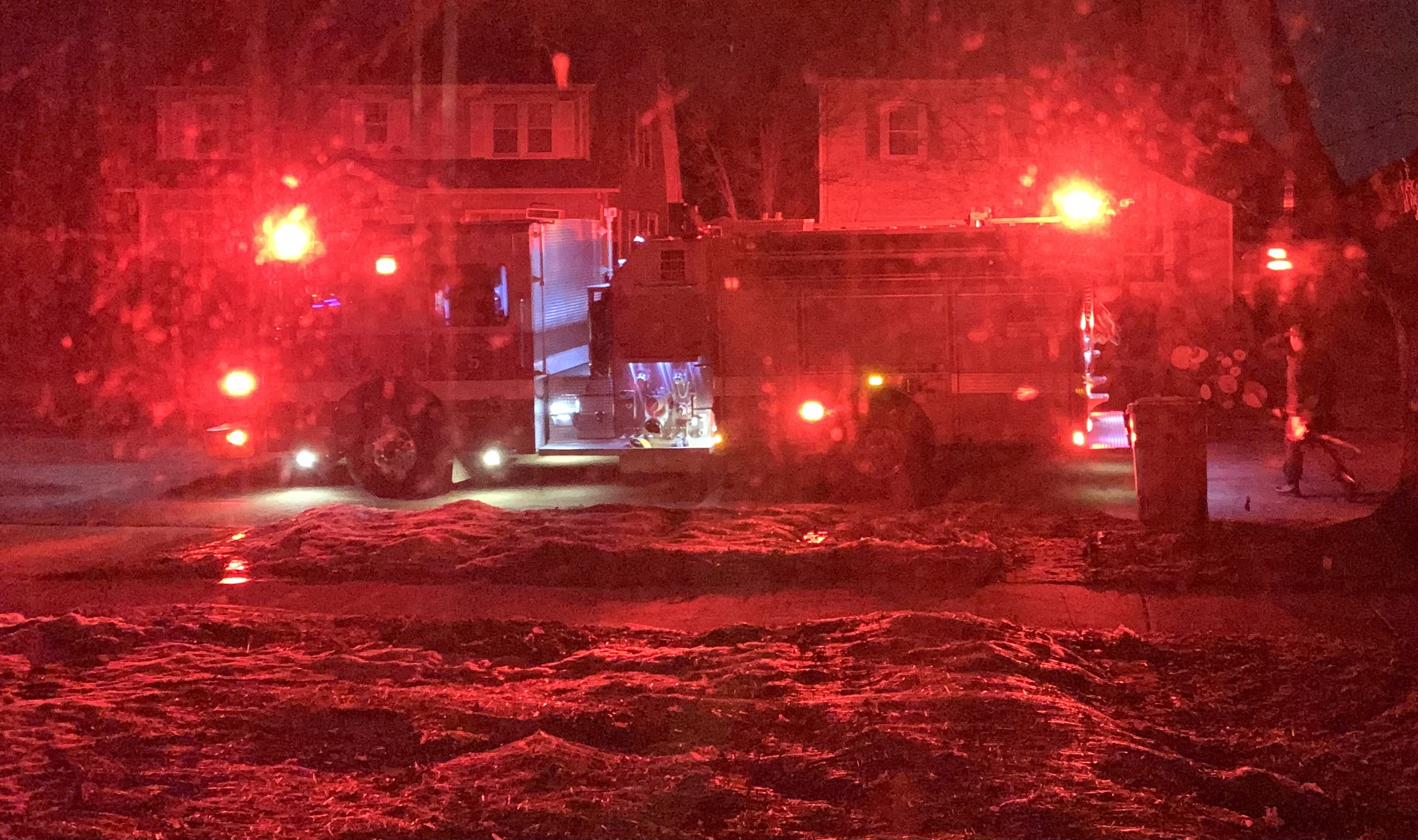
Last month, when the car across the street blew up, there was general pandemonium until the fire department arrived. In a few moments, order was restored. People, myself included, who only moments before had been running around in panic, gathered at the end of our driveway and watched the methodical dousing of the fire. Tragedy turned to block party the minute the men and women of the fire and police departments took charge. We transitioned from unsafe to secure, in a heartbeat, from “I don’t know what to do,” to, “I’m so glad they know what to do”. Neighbors chatted. Speculated. We shared tales of the explosion. We compared notes while the people who know what to do put out the fire and cleaned up the mess.

We take for granted the security we enjoy. In the back of my mind, I know that dialing three simple numbers into the phone will summon people who know what to do.

We awoke in the middle of the night to the sound of our basement carbon monoxide alarms blaring. We turned on the lights but something was dreadfully wrong. It was as if the entire house was on a dimmer switch: there was light but it was very dim. And then we heard a buzzing sound in the ceiling. And then the smell of hot electric wires filled the room.

We dialed three simple numbers. In a panic, we put the dog, our bag with important papers, and the computers into the car.

And then, the people who know what to do arrived with their red lights ablaze. They calmly came in the house. They searched every square inch of our home with heat sensing technology. They pinpointed the source of the buzz and the burning smell. It was not yet dire but could have been bad had we not been awakened by the alarms. Within minutes of their arrival, our fear dissipated. Problems were identified. Safety was secured. Advice given.

We were safe. We dialed three simple numbers and help was on the way.

read Kerri’s blog post about FIRE ENGINES

Love Your Vintage [on Two Artists Tuesday]

The woman on the Apple support line told Kerri that her computer was vintage. “As if I didn’t know!” Kerri groused after the call.

In the middle of the night, after the firemen had determined that the burning electric smell wasn’t coming from inside our walls (a story for tomorrow), their chief took one last look around and said, “You have some really nice antiques here.”

“Thanks,” Kerri said, avoiding my smirk.

We are not collectors of antiques. Not on purpose. Our house is populated with stories and random pieces of furniture that we like and could afford. For instance, the two chairs in the sunroom are made of course-weld steel with raw wood seats. $5 for both. They are quirky, like us. An old door, set on two sawhorses, serves as a table for our plants. Budget and taste. Or, taste defined by budget. As Gus says in My Big Fat Greek Wedding, “There you go.”

Big Red and Little Baby Scion are long-in-the-tooth, too. And, isn’t that a great idiom! Showing their age. Horses gums recede with age (I just read this!) so older horses seem to have longer teeth. I am suppressing the urge to run into the bathroom and look at my gums in the mirror. “I am not a horse,” I whisper to my urge. Vintage, vintage, vintage. Last month Big Red wouldn’t start. He needed a new battery. Yesterday, we pushed Little Baby Scion down the driveway so we could get the newly-batteried-Big Red out. We drove him across the front yard. Classy people. LBS decided not to start and, after refusing her jump from Big Red, she’s destined to have a tow truck adventure to visit Steve [Thanks to John and Michele, our awesome neighbors, for helping us push Little Baby Scion back up into the driveway for safekeeping until the tow].

“We’ve had one hell of a week,” I said, after being rear-ended. It was lucky that we were in Big Red. Normally, we’d have been in Little Baby Scion and it would not have been pretty. It occurs to me that we are living an Aesop’s fable: you can never see your good fortune since it sometimes comes dressed as a problem. Stepping out of the truck to see the damage – and being amazed that, after being hit so hard, that there was not a single scratch on Big Red. The other car lost its grill to Big Red’s trailer hitch. Pieces of plastic and glass were everywhere. “I’m glad Little Baby Scion broke down,” I thought. Our unintentional vintage collection could have just saved our lives.

“We’re really lucky,” Kerri said. Yes. Yes we are.

read Kerri’s blog post about JUMP STARTS

Blur The I [on Not So Flawed Wednesday]

We capture quotes all week. Some we see. Some we hear. Some find their way into the Melange. Most do not. We usually note where we heard or found the quote so we remember the context. It’s a practice. It’s not as if we are perpetually eavesdropping on conversations. We’ve simply tuned ourselves to immediately write the amazing words and phrases that catch our attention.

A common phrase is mind-over-matter. Athletes and actors and dancers are conditioned to ignore the limits of their bodies. To keep going. The mind as master over body. I loved this quote because it is the flip side. The mind, the “I”, wanted to stop but the body did not listen. It kept going.

Lately I’ve been reading about – so, paying attention to – the false separations that language necessitates: Mind and body are spoken of, thought of, as separate things. And, the question is this: where does one begin and the other end? Mind over matter. Body did not listen. I made myself do it. Once you start listening for it, it is ubiquitous. Exactly where is the line between “I” and “myself”? When your toe is in pain, isn’t your whole body is in pain? Follow your gut. What does your heart say?

When Dogga gets excited, his little body bounces. He runs in circles. He has to work hard to sit still. Say, “Do you want to go…” and he’s bouncing before the words “on errands?” reach his ears. He knows he won’t actually go on errands until he first sits on the rug. Eventually, he bounces his way into compliance. Control follows unbridled enthusiasm. Control is a means to an end. Rug before errands. Sit before snack.

Dogga might say, while bouncing enthusiastically, “I wanted to stop but my body kept going!”but I doubt it. Given his unified happy spirit, I’m certain the phrase would come out of his muzzle this way: I wanted to stop but I kept going. Watching him is like reading the I-Ching: no separation.

read Kerri’s blogpost about I AND BODY

Feed It [on KS Friday]

“The devaluation of music and what it’s now deemed to be worth is laughable to me. My single costs 99 cents. That’s what a single cost in 1960. On my phone, I can get an app for 99 cents that makes fart noises – the same price as the thing I create and speak to the world with. Some would say that the fart app is more important. It’s an awkward time. Creative brains are being sorely mistreated.” ~ Vince Gill

I am the first in line to tell you that everyone has a creative mind. Everyone. That river of ridiculousness running between your ears is nothing other than creativity-run-amok. What else? Telling yourself that you are not creative is, in itself, a creative act. Seeds planted early in life grow into mighty obstructions. Creative wastelands are created. If you want to hear a terrific appeal to educators to nurture rather than stifle the creative mind, listen to Sir Ken Robinson’s 2006 Ted Talk. It’s appropriately titled “Do Schools Kill Creativity?”

I’ve listened to numerous school boards tell me how much they truly value the arts – until it’s time to pay for it. Sadly, it’s not a question of whether or not they value the arts; it’s that the arts, the creative minds, do not fit any of the standards of valuation against which all things are measured. They do not know how to value the creative minds that they steward. Arts organizations and artists, mostly, are not money makers. Creative minds, creative acts, do not fit in the boxes and are not measurable on standardized tests. Thinking outside of boxes is, after all, the point of a creative mind. Metrics and goals stop a creative mind and heart in its tracks. The cruelest thing you can ask any artist to do is write a grant.

And yet, an artist has to make a living. Yaki asked me if I had to choose between making a living and making my art, which would I choose? I answered, “Art, of course,” but that it was really a question of Maslow’s hierarchy: it’s hard to make art when you are not surviving. What I didn’t say is that his question perfectly captured the reason schools kill creativity and creative brains are sorely mistreated: it is assumed one must choose between. Making a living and thriving creativity are understood as oppositional.

How many parents have tried to dissuade their children from following their passion for the arts? How many times have I heard Kerri say of the stacks of music on her piano waiting to be recorded, “What’s the use?” How many times have I sat in my basement studio looking at my stacks and rolls of paintings and wondered, “Why bother?” We do it to ourselves, too.

And then, the phony metric falls and we breathe, pick up our brushes and sit at our keyboards. There is a river of riches that runs deeper than money. It is, after all, a creative act to kill a passion. It’s also a creative act to feed and nurture an artistic soul. Both. It’s what the school board doesn’t understand: the choice is not between making a living or living as an artist, the choice is between feeding inspiration, expanding a creative mind, or smothering it.

read Kerri’s blogpost about CREATIVE MINDS

Kerri’s albums are available on iTunes and streaming on Pandora

watershed/as it is © 2004 kerri sherwood

Stack Your Nickels & Pennies [on Flawed Wednesday]

From the school of if-you-are-sitting-on-the-mountain-you-can’t-see-it comes the hot mess we call healthcare in these un-united-united-states. Insanity never looks at itself and says, “I’m insane.” Our system of healthcare – and I use the term “system” loosely, is insane. In my sordid past as an organizational consultant I facilitated an experience called reverse design: ask people to design the worst system possible. The worst product imaginable. Hilarity ensued. None of those mad-mad sessions could have concocted what we call healthcare in the richest nation on earth. It seems the money has both blinded us and made us batty.

I just asked Kerri how much a postage stamp costs. “58 cents,” she grumbled, “And we got three mailings.” We finally achieved our get-out-of-jail-free card: a job with benefits. We canceled our ACA prison policy but, apparently, there was a one-day crossover in the billing cycle. I know a computer sent us the three-times-nasty-gram and spent $1.74 in postage to collect $.27. No human was involved though, having spent an inordinate amount of time on the phone with people paid to try and make sense of the nonsense, we’ve learned how numb the human mind can become when sense-making in a swamp of gobbledygook. We paid our debt online.

No human involved. De-human-izing. The Turing test is…a test of intelligence in a computer. Is the machine’s behavior indistinguishable from that of a human being? Hubris is a human quality that imagines the computer will become more like us while not recognizing that, in the process, we are becoming less like us. I doubt the computer will ever evolve to that point of pomposity. I suspect that the computer will someday recognize the folly of attempting to model itself after something so flawed as human intelligence. What intelligent machine would model itself on beings that seem incapable of creating a competent system for the care of its own health? No advanced intelligence would submerge its prime directive for the secondary intention of stacking nickels and pennies.

read Kerri’s blogpost about HEALTHCARE

Point The Way [on Merely A Thought Monday]

“You can accomplish with kindness what you cannot by force.” ~ Publilius Syrus

It’s one of the most interesting Wikipedia pages I’ve come across. Publilius Syrus. A life described in two sentences that conclude with this: “…but by his wit and talent he won the favor of his master, who freed and educated him. The rest of the page are maxims attributed to him. A Syrian. A Roman slave. An observer of human-kind.

We live in a world of ubiquitous maxims. They are posted everywhere, in stores, billboards, and elementary school signboards. Appeals to our better nature. Choose kindness. There are, of course, plenty of appeals to our worse nature, too. It’s as if our maxims are in a tug-of-war. I imagine that Publilius Syrus experienced in his short life both ends of the rope, the cruel and the kind, which is why he wrote so many maxims.

This quote came across my screen so I wrote it on a lilac colored post-it note and stuck it to my monitor. It may or may not be from Christina Wodtke: “When you make complex things, words eventually fail.” Life is a complex thing that words will always fail to describe or contain. The best a word can do is point to something, or the way to something. A maxim, an ideal, is, after all, a signpost, a direction. A choice of path. A point-of-view is created during those moments of choosing.

Kindness is not a thing. It’s not a word – not the word. The word simply points the way to something so complex, so boundless, that the word will always fail. But, we know it when we see it. We know it when we offer it. We know it when we receive it. We know with certainty when we choose it and when we do not.

read Kerri’s blog post about CHOOSE KINDNESS

Step Back And Realize [on Flawed Wednesday]

If you are like us, every day brings another report of a friend or loved one who has Covid. As someone recently said to me, “With Omicron, it’s only a half degree of separation between you and someone who’s carrying the virus.” I’d say, given the wave of people we know falling sick and reporting positive test results, it’s true. It’s no time to let down your guard.

On Saturday we watched a documentary film, The First Wave. It’s a film everyone should see. It chronicles the first few months of the pandemic in a New York hospital. It is shocking how, in a few short years, we’ve normalized hospitals being overrun. How removed we, the populace, are from the tangible horror of this pandemic. Refrigerator trucks used as temporary morgues. We stand today at 865,000 deaths and counting. People. By comparison, 620,000 people died in the Civil War. 418,500 US citizens, military and civilian, died in World War 2. We ought to be grieving instead of dividing. We ought to be reaching to help rather than peacocking our politics. This film will slap you awake. It will help you step back and realize what we – all of us – are passing through. It might help you grieve.

Kerri tells me that the woman in the next car thought she and 20 were doing a drug deal. He felt sick, needed a test and could find none. We had a few so they met in a parking lot to make a safe pass. While making the exchange, he handed her an envelope. Money for the phone bill but I’m sure it looked suspicious.

It reminded me of the time, many years ago, that Sam asked me to meet him in a parking lot. He rolled down his window and passed to me a sheaf of poems. The window went up. I was to tell no one. It was terribly vulnerable for him to share. I cried the day he published his first book of poetry. It was a titanic journey from fear-of-certain-shame to proudly publishing his beautiful work. He was transformed.

I imagine someday we will stand and look back at this titanic journey. I hope that I remember with fondness the story of Kerri and 20 making an exchange in the parking lot, the women one-car-over shocked by what she thought she was seeing, and we smile. Transformed. Remade as better people in a better community making better assumptions of each other. Stronger.

For now, as the credits rolled on The First Wave, we looked at each other and together said, “I’m exhausted.”

read Kerri’s blog post about THE EXCHANGE

Connect The Poles [on KS Friday]

Though it is not, this could be a close-up of an x-ray. Arteries carrying blood away from the heart, veins carrying blood back to the heart, and the capillaries that connect the them. Outgoing. Incoming. And the connection between the two. And, as is always true of language, in the naming and the action-describing, the whole system is obscured. This part does this. That part does that. Mechanical mind applied to a miracle of pulsating life.

In North Carolina I overheard an old guy grousing about climate change. He is a sceptic. “There’s record snow in California!” he decried, “And, we’re having record heat here! You can’t have it both ways!” His reluctant listener bobbed her head. “It’s either warming or it’s not!” he railed. “Explain that to me!” Mechanical mind. Parts-thinkers cannot see the whole system. The capillary-word that tumbled from his mouth but bypassed his mind was “record.” The poles are, after all, connected.

I am fascinated by my current work. I am witness to and a participant in the creation of software. The language is familiar though the meanings are new: epic and story. Bug. My mind, lately, has been awhirl. The developers necessarily talk of information as content-objects. Items. The language of “fixed” things. Yet, the problems in the world that they design and solve for are “fluid.” Information, in our day-and-age, never stops. It grows exponentially everyday. It is movement, constant motion. More/faster. Sometimes I get a glimpse behind the curtain and see the developer’s work of content-items-in-motion. You’ve never seen a faster moving current of symbols. Is it a particle or a wave? It depends.

The tree in our front yard reaches toward the house. Kerri tells me that our children climbed through the branches when they were young. When the crew had to clear some branches to trench the yard, Kerri winced each time a branch snapped and fell to the ground. “I can’t look,” she said, not taking her eyes off the tree. Holding vigil. Holding her heart.

It’s easy to forget that, in all cases, no matter the eyes though which we see, the movement is always back to center. To the heart-of-the-matter. The pieces are never isolated. This tree is not separate or distinct from the sky or Kerri’s heart. The poles are always connected, whether we recognize it, see it, acknowledge it, or not. Breathe in. Breathe out. Two actions or one?

read Kerri’s blog post about THE TREE AND SKY

Kerri’s albums are available on iTunes or streaming on Pandora