Recognize The Greater [on DR Thursday]

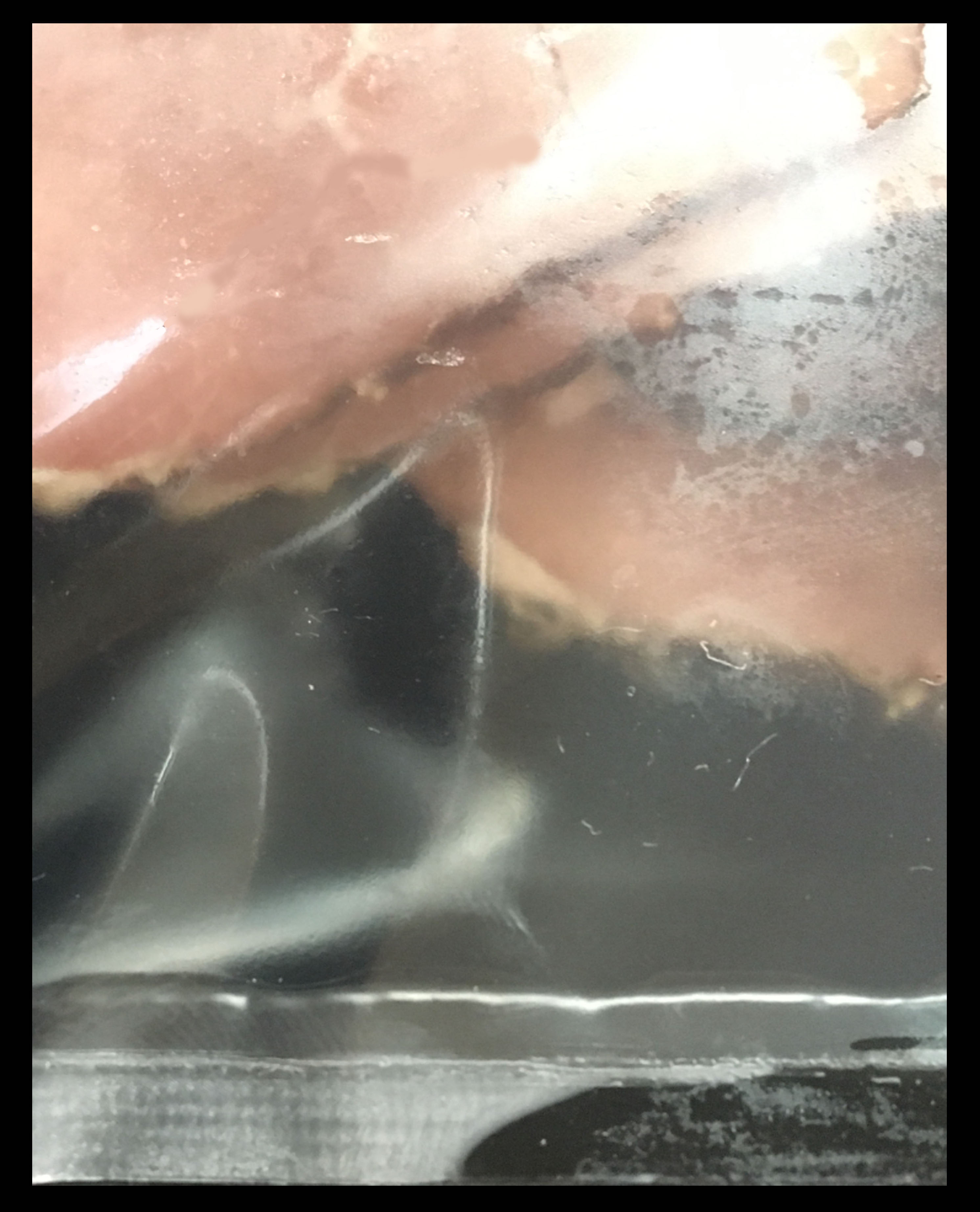
strange sky

“Can a shallow mind appreciate beauty?…When the mind is merely concerned with itself and its own activities, it is not beautiful; whatever it does, it remains ugly, limited, therefore it is incapable of knowing what beauty is.” ~Krishnamurti, Think On These Things

What accounts for the strange color of the sky? Smoke from the fires? A coming storm?

The quote above is only half of the thought. It is the set up for the real point to be made. A shallow mind is concerned only for itself. And, while consumed with the lesser, it misses the greater. It is the unintentional theme that emerged for me this week: losing the greater for the lesser. The baby goes out with the bathwater.

It is a matter of perception, of focus placement.

Yesterday I wrote about the judge questioning the potential juror about his capacity to experience hardship in order to keep the system going and growing. The juror entered the exchange with a self-focus and exited, admonished, with perhaps the possibility of seeing something beyond his own agenda. Perhaps.

I read that Rome fell when the luxuries became more important than the essentials. Societies fall when they can no longer discern between what is important and what is not, when the lesser is protected at the expense of the greater.

Years ago, during a facilitation, a young woman pulled herself from and exercise. She sat on the sidelines and brooded. After the exercise, during the debrief, she claimed that she was discriminated against because her team did not listen to her ideas. Initially, her team scrambled to apologize – one does not want to be accused of discrimination. We asked the team to explore the situation a bit further. Because the young woman’s idea was rejected, was she truly a victim of discrimination? It was an illuminating conversation. The problem – the real problem – arises when we can no longer discern between what is discrimination and what is not? There is terrible discrimination in our world and needs to be addressed. It can’t be seriously confronted if we are incapable of distinguishing between the rejection of an idea and laws that prevent citizens of color from voting.

In a pandemic, a mask is not a breach of personal freedom. It is not the state ripping away control of your body. It is a minor inconvenience to ensure the mitigation of a virus that is killing scores of fellow citizens. Despite the rhetoric otherwise, the fearmongering and tribe-building, wearing a mask is something done for the health of the whole. It is not unlike jury duty.

It is a matter of perception. Of focus placement. Self or other? Lesser or greater?

The rest of the quote: “Whereas, a mind that is not concerned with itself, that is free of ambition, a mind that is not caught up in its own desires or driven by pursuit of its own success – such a mind is not shallow, and it flowers in goodness. Do you understand? It is this inward goodness that gives beauty, even to a so-called ugly face.”

Pay attention to the verb. Beauty is given. Concern for the well-being of the other is a sentiment expressed and championed in every corner of the world, by all the figures we quote, elevate, and sometimes emulate. Martin Luther King, Ghandi, Abraham Lincoln, Mother Teresa,…it’s a very, very long list.

Communities thrive when they are capable of enduring hardship for each other, for the benefit of the whole. They also thrive when they hold boundaries and protect the rights of the individuals. Those two seemingly different actions are, in fact, one and the same.

Societies fall when shallow minds prevail, when they can no longer discern between essentials and luxuries, privileges and responsibilities. When personal comfort takes precedence over enduring ideals.

It’s a matter of perception. Of focus placement, and make no mistake, focus is easily led. Just like a package of pastrami mistaken for a strange colored sky.

read Kerri’s blog post about PASTRAMI SKY

shared fatherhood ©️ 2017 david robinson

See The Spaces [on DR Thursday]

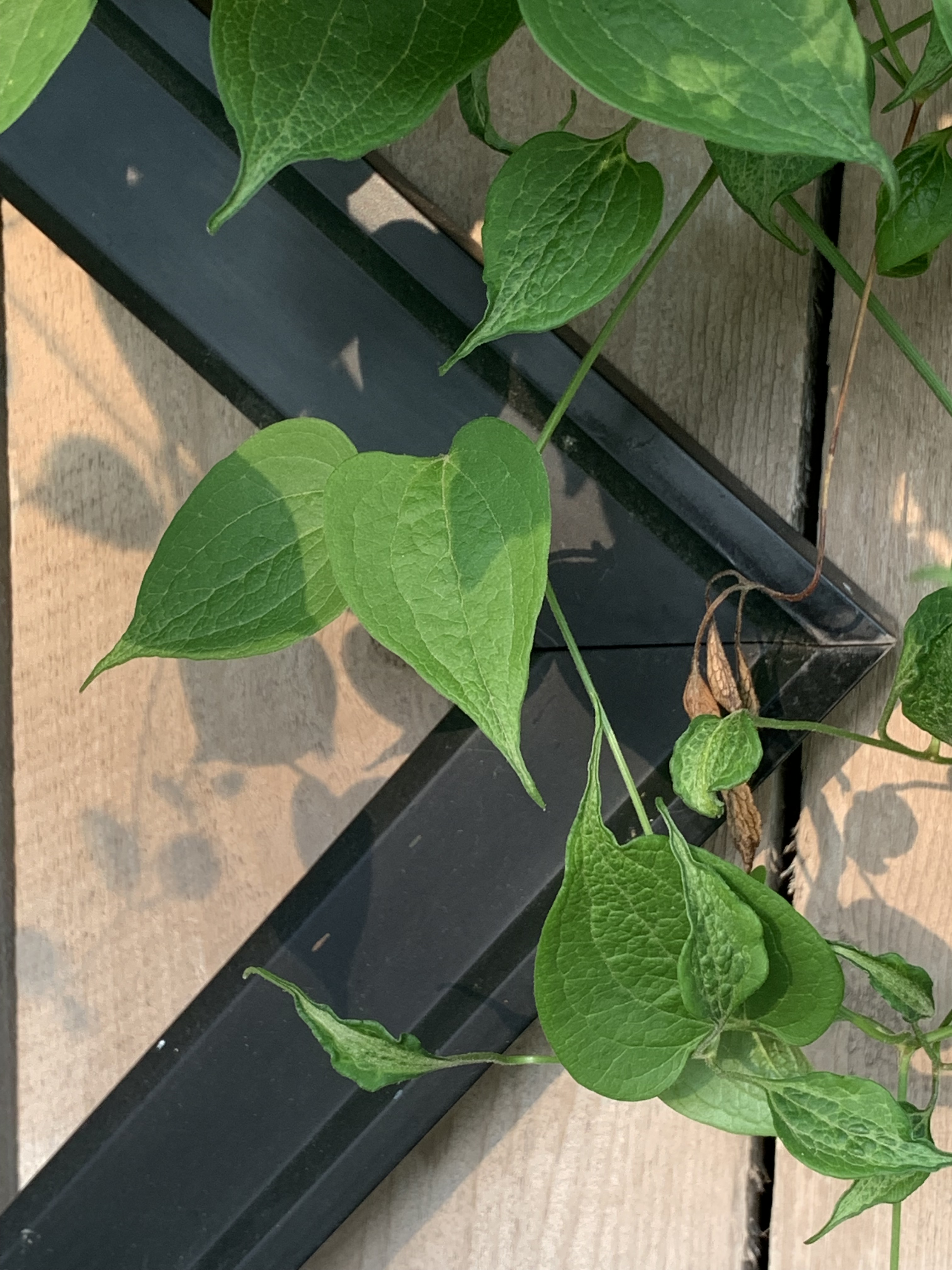
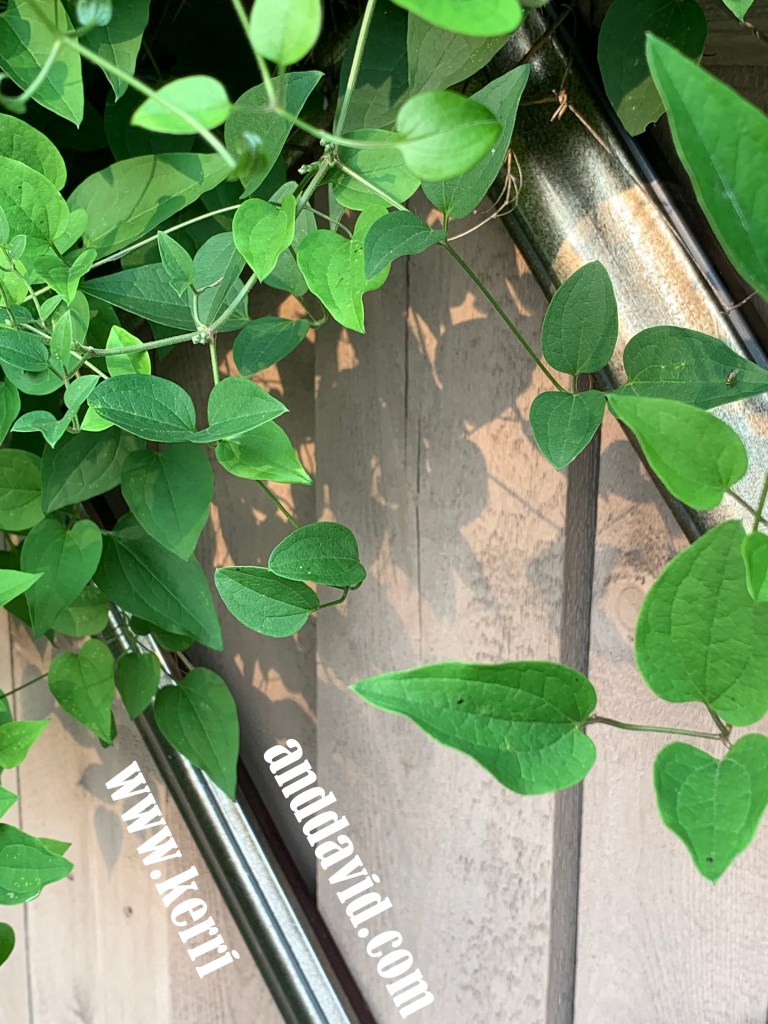
The space around and between. Shapes that share edges. Emptiness that provides definition. In art it is called negative space. Not-the-object. In art classes, students draw the negative spaces in order to see or to learn a new way of seeing. Try it. See the holes and the space around the leaves as primary. It’s not as easy as it sounds.

Some folks use the term “air space” because they get snagged on the word “negative.” It’s a term of opposition when set next to “positive.” Yet, just as there is an electric field that flows between negative and positive ions, electrons and protons, there is a field that flows between negative and positive space. Yin and Yang. A dynamic polarity. A creative field of movement and energy. The air space is alive because of the perceived opposition. The positive space is not visible without the negative.

When I was a consultant, I used the phrase “the space between” to imply relationship. There are people. There is the space between people. Relationship is invisible but it defines the people. Relationship illuminates the otherwise unknowable individual. They are impossible to separate. In a community obsessed with nouns, bottom lines, test scores and individual rights, the verbs and the relationships often go unnoticed and unappreciated. As if the negative space didn’t matter. The space between is where the movement lives and the problems are solved. It is where new seeing is possible. It is created and creative. The word “community” lives in the space between.

Try it. Take a day and focus on the space between. See relationship as primary. You may experience a whole new way of seeing.

20 sent this image,a memorial. It makes the point.

read Kerri’s blog post about NEGATIVE SPACE

iconic ©️ 2010 david robinson

Sit On The Curb [on DR Thursday]

As much as our wily-ole brains would like us to believe otherwise, we can be nowhere else but in the present. Everything else is imagination.

Years ago I belonged to a support group of independent consultants. We met once a month to discuss our business challenges, insights, and to give and receive some advice. One of the members of the group was a Byron Cady coach. I have no memory of the discussion that prompted her to offer this Byron-thought-metaphor: “If your house burns down, rather than race around in panic, the best thing you can do is sit on the curb and appreciate the moment.”

To the consumer-mind, wisdom often sounds like bad advice. That you are alive, that you have this moment, means that no real possession was lost. The question is, in the face of calamity, what will you make of the moment?

Brother Joseph told the story of holding a woman wearing expensive furs, each finger was diamond encrusted, as she died on the street. He was, in the moment, overwhelmed by the worthlessness of her stuff. The illusion of value once life has gone.

Life. This moment. Calamity is certain to come. Sit on the curb and see what is there, beyond what you think is there.

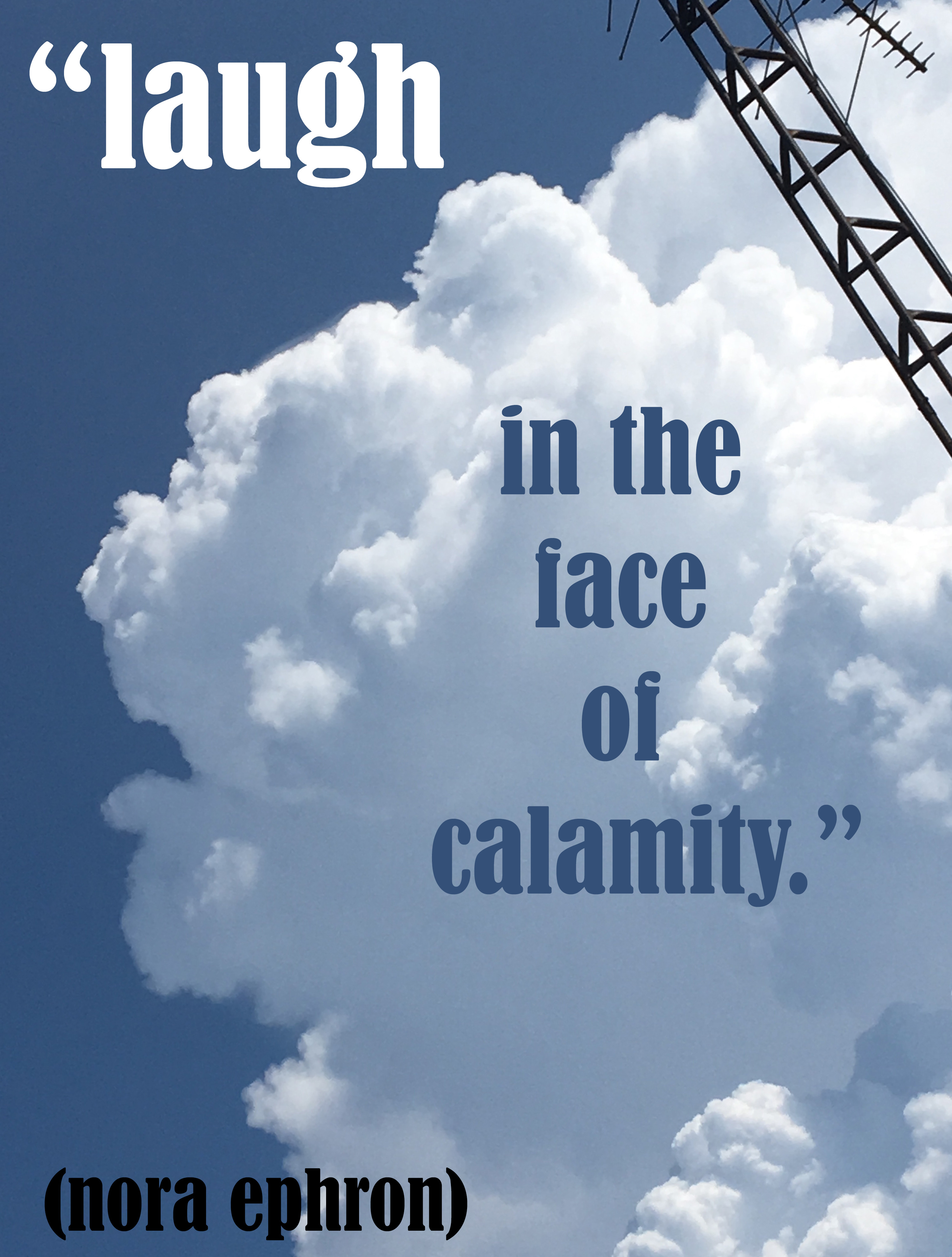
We’ve had our share of adversity these past few years. I would like to report that we laughed heartily in the face of lost jobs and broken wrists and pandemic madness and civil unrest. We did not. We shook our fists at the sky. We made up words and ran loops like Chicken Little. We invested in all manner of fear-of-the-future and ran from monsters-of-the-past. None of our racing around or fist-shaking brought comfort or change.

But, the moments that we took a breath, walked a trail or sat on the back deck and listened to the cardinals and crows, sipped hot coffee on cold mornings, held hands – sat on the curb and appreciated the undeniable truth of our moment: we have everything. We have this moment – the only moment of life that we’ll ever inhabit. We have each other. The rest, the fear of future, demons of the past, are pure imagination. In those moments, wrapped in a circumstance of calamity, we laughed at the beauty of it all.

read Kerri’s blog post about LAUGH IN THE FACE OF CALAMITY

Choose [on Two Artists Tuesday]

“It’s a serious thing just to be alive on this fresh morning in this broken world.” ~ Mary Oliver

Were I to have been born in an earlier century I would not be alive today. Twice on my life-path doctors have declared that, “You are now a miracle of modern medicine.” Leeches and blood-letting would not have cured what ailed me.

This thing called ‘science’ is what gave me more days of life. It is the same science that developed vaccines for a pandemic but also made possible the technology that makes mass-media-misinformation possible. Here is the medicine. Here is the disease. It is exactly as Sophocles wrote: Nothing vast enters the life of mortals without a curse.

One morning, deeply tired, I arose to go do a job that I did not like. It was a means to an end and I dreaded the day ahead of me. Stepping out the door, the cold morning air stopped me in my tracks. It slapped me awake. The air was crisp and clean, the neighborhood was quiet. The light in the sky was brilliant. I drank it in. I vowed never again to dread a day of my life. In truth, I had no idea what the day held for me. Why then, would I story my day with a frame of dread? Why tell myself a tale of just-getting-through-it? Why not open to the possibilities of surprise and miracle? Why not embrace the already-stated-obvious-thing: I had no idea what the day held. That simple fact would be true every single day of my life. Dread was a choice, not an inevitability.

To be alive on this fresh morning. It is a serious thing. In this world, broken by the little story of us-and-them, the tiny tale of power-over. Choices. The miracle of the new day is present whether it is seen or not. We can cloak it in dread or gratitude, in support or division. It doesn’t care either way. The miracle of the new day, the gift of being alive on this fresh morning in a world that is broken or healed, whole or fragmented – it all depends upon the story-frame we wrap around it. The story we tell is a choice, not an inevitability.

read Kerri’s blog post about JUST TO BE ALIVE

Pull The Weeds [on KS Friday]

My very first painting teacher offered me some sage advice. I was painting figures while the rest of the class worked on landscapes. Being the odd-child-out I assumed something was wrong with me. She said, “Tree painters are a dime a dozen. Someday, being the only one will seem like a gift so ignore what they are interested in and paint what is interesting to you.” Jospeh Campbell said, “Follow your bliss.” It’s the same advice that Jackie Fry gave to the boy-version of me.

I never imagined myself with a back yard. And, now that I have one, I find it a place of rest and peace. This is a confession that I’ll never admit to in the future: weeding is meditative. Each day I find myself taking a few moments to go out and yank the invaders out by the roots. No thought. No other thing to do. I simply tend the garden, knowing I am accomplishing nothing since weeds are good at growing and more will appear tomorrow. We are strange allies, they provide me with a daily meditation.

If I was as an art teacher, I’d send my students into my back yard. Nature is a masterful teacher of color. Orange and green. Highlights of yellow. Barney provides subtle blues, purples, and pinks. The orange and green of the lily pop against the purple and blue of the aging piano. Warm colors come forward. Cool colors recede. It’s all there.

I read somewhere that, as an artist, “to discover” is more potent than “to invent.” See what is there, beyond what you think is there. Everything is fluid so the discoveries are endless. While I weed the sun passes beneath a cloud. Everything changes. The sun reappears and the colors change again. Not the same. Different. I’ll never be able to capture it and that is the best held secret of an artist. Another wisdom from Jackie Fry: you will never succeed. Art is a relationship, not a transaction. So, no pressure. It is a relationship, complex and dynamic. It is not about capturing an image. It is about freeing your sight and possibly freeing the sight of others. Facilitate discovery. Play to play, to become a better player. Open a small door to peek into the vast inner universe.

It’s a paradox. It’s impossible to eradicate the weeds. That is not why I pull them. It’s impossible to capture life in an image. ‘Capturing’ is not why I paint. Relating is why I paint. I do it because I’ll never create anything more beautiful than the Tiger Lily dancing with Barney. I paint so that I might see and share in the dance.

ALWAYS WITH US on the album AS IT IS by KERRI SHERWOOD

Kerri’s albums are available on iTunes and streaming on Pandora

read Kerri’s blog post about the TIGER LILY

always with us/as it is ©️ 2004 kerri sherwood

Meet The Frame [on DR Thursday]

“There are people who prefer to say ‘yes’ and there are people who prefer to say ‘no’. Those who say ‘yes’ are rewarded by the adventures they have. Those who say ‘no’ are rewarded by the safety they attain.” ~ Keith Johnstone

A violent storm blew through so we spent the night hunkered down in the basement. We had very little sleep. Sleeplessness always leads me to moralize and for that, I apologize.

A frame of reference is a powerful thing. Experiences are interpreted through a frame of assumptions. We are witness to a time in which verifiable reality is denied because it doesn’t jive with the tribal frame.

Master Marsh passed along this quote from E.O. Wilson’s Sociobiology: “(Humankind) would rather believe than know.”

Knowledge often challenges the frame. That is the point of knowledge. Growth. And growth is always a challenge to what was formerly believed possible.

It is somehow easier to lapse into a conspiracy theory, demonize an other, deny what is indisputable, than it is to allow that the frame is just that, a frame. It’s not a truth. It’s a context. It’s a binding agent. Culture is a frame of reference. Religion is a frame of reference. What we believe of ourselves is not a fact. Identity is a frame of reference. Democracy is a frame of reference. Autocracy is a frame of reference. Supremacy is a frame. Equality is a frame. Every-man-for-himself is a frame. Brother-and-Sister’s-keeper is a frame.

None are truth. Frames are creations. Agreements. Aspirations.

Frames that allow for challenges, for growth, are sustainable. Those that do not, those that deny insight, fact, data, new knowledge, those that are threatened by opposing-point-of-view, inevitably collapse in their denial.

The fire burns. A garden hose is not an effective defense, regardless of belief. Temperatures rise relative to emissions. Rain forests disappear. A lie undermines the foundations of democracy. Believe it or not. Harry Truman sat in his cabin nestled into the mountain called St Helens. Despite repeated appeals from fleeing neighbors, repeated rumbles and tremors, warnings from scientists and safety personnel, he believed he would be safe, that his mountain would never erupt. Traces of Harry have never been found.

So it goes with the denial of believers. Frames held too tightly blind rather than reveal.

Every artist knows the transformative power of a frame. A frame can make almost any scribble look substantial. A cheap frame can diminish the greatest masterpiece.

New knowledge meets an old frame. Growth or entrenchment? Blind acceptance or emerging possibility? Yes? No? Both?

read Kerri’s blog post about FRAMES

held in grace: surrender now ©️ 2016 david robinson

In-Tolerate [on Not So Flawed Wednesday]

In theatre school, I was taught that the action of the play was driven by conflict. I’ve never been comfortable with that word. Something did not ring true with the concept of conflict. A dividing line. Battle. Fight. Kerri just suggested that conflict is not simply a line, it is bandwidth. A full spectrum of color in our human struggle.

I recently read that, through resistance, all things become visible. We see color because some light rays are absorbed and others are reflected. The light ray is filtered, separated into color bands. We see the color that was resisted. Rejected by the surface. Split off. Separated. Is it any wonder that the epicenter of most faith traditions, the driver of most origin stories, is the journey through separation back to unity?

We become visible in our birth. Separate. We become invisible in our death and are given to imagining a comforting story of reunion. Re-union. In between those two points, separation and unity, there is life made visible and wildly colorful by the separation. The filters. What is absorbed and rejected. Reflected. Learned. Ignored. Appreciated. Vilified. Visible. Invisible.

This time of pandemic has been, for us, an exercise in separation. In the distancing, we’ve nurtured, intentionally and unintentionally, an appreciation of quiet. Over these many months we’ve grown a garden of simplicity. We read together. We walk our paths slowly. We’ve found that we do not need to be entertained or distracted. We have a low tolerance for crowds and run the opposite direction when there’s too much noise ahead.

We’ve fostered an appreciation for those who walk through life considerate of the needs of others. Our circle of friends has come into focus. We’ve dropped off the plate of many and many have dropped off of our plate. The connective tissue is felt, established and hearty. In some cases, even though our actual conversations are rare, the focus is sharp. Deeply rooted. Arnie. Judy. Jim. Mike. David. In other cases, we communicate almost every day. 20. Brad and Jen. Heart-y.

Our play has become visible through resistance. What we absorb and what we reject has come into stark contrast, clear focus, through the separation. Layers of shallow tolerance have been peeled away revealing a much deeper understanding of what we desire to create in this life, how we desire to live. It is necessary to understand the boundaries set and the colors illuminated by intolerance. Said another way, it is important to be able to thoroughly sort substance from noise. Both inner and outer. I have learned that I have limited tolerance for thoughtless acceptance, for unthinking noise. My resistance. I surround myself with questioners, those curious enough to dig, dedicated to building their thought-castles on bedrock instead of shifting sands. Those few who are capable of releasing their grips on the comfortable known and step willingly into the uncomfortable question. I absorb them. Take them in.

We – all of us – walk the same path, visible in our birth. Separate. Invisible in our death. Re-union. In this we are equal. What we do, how we choose to support each other, or choose not to, in the passage between those two universal points, is all. These choices define the story we live.

The pandemic, the separation, has helped me to a deeper understanding and appreciation of this word: Intolerant. A word that used to inspire egg-shell walking for what it implied. A word held with shallow roots. Now, it is a word rich in complexity, useful in paradox, a resistance that has made so much come visible. Tolerance, ironically, is at the same time intolerance. What, in your play, is acceptable? What, in your play, will you tolerate? What, in your play, will you not tolerate? Your play is not separate from mine.

read Kerri’s blog post about TOLERANCE LEVELS

Step Beyond Words [on Two Artists Tuesday]

“Truth is a pathless land.” ~ Jiddu Krishnamurti

I have done my share of seeking and, also, my share of not finding.

I believe that I began painting because, while doing it, while lost in the discovery of an image, I experienced truth – or something close to it. Always in quiet studios. Always beyond the place of mind chatter. Something “bigger” washed through. Something beyond words.

That must be why I associate truth with silence.

All around I hear people proclaiming transparency. No hidden agendas. Everything up-front! As Quinn used to say, “If they have to tell you that they are being transparent, it’s a good bet that they are not.” Words, words, words.

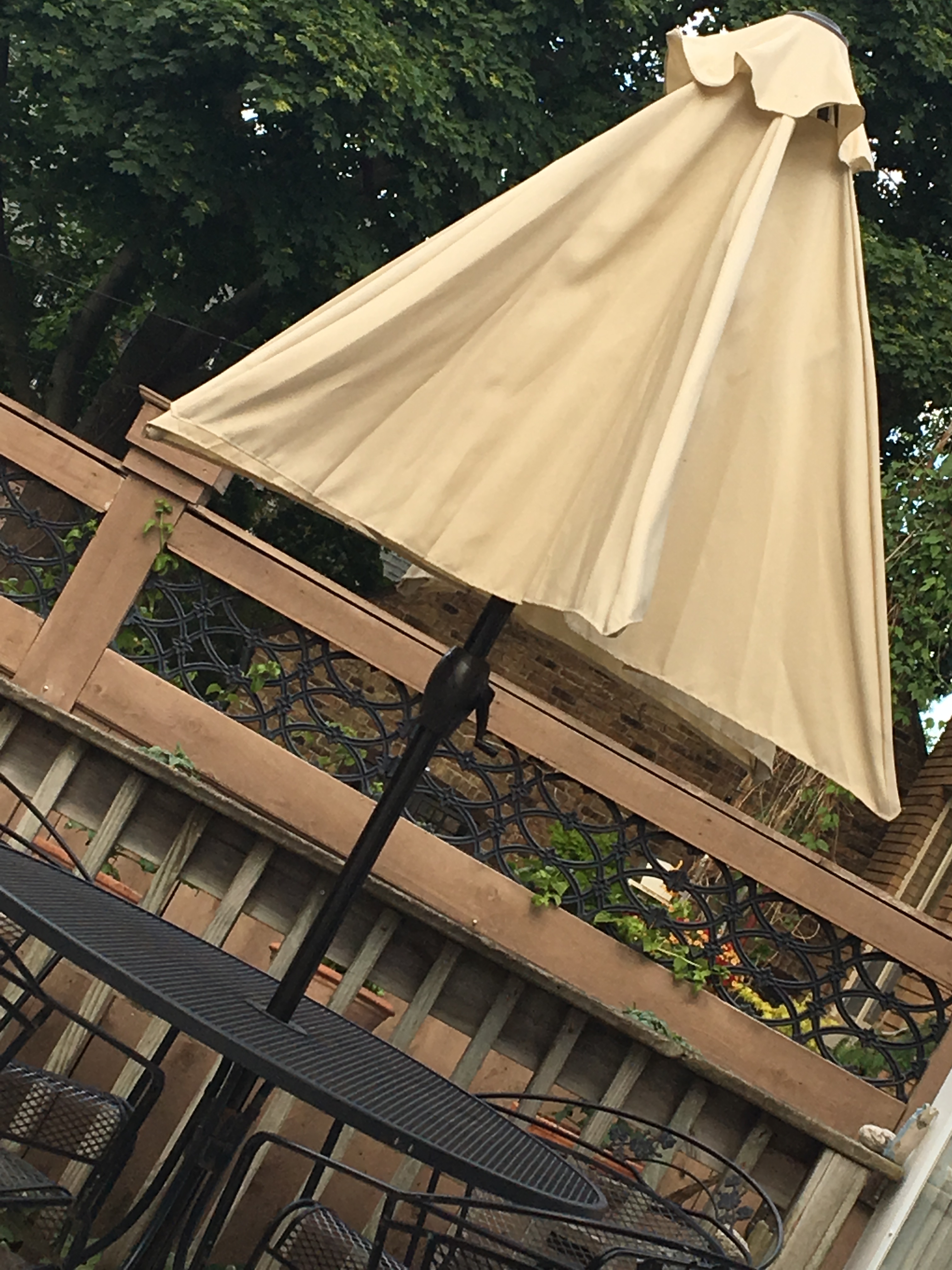
Many evenings we sit on our back deck. The umbrella shields us from the heat. We watch Dogga run circles, dig holes, and bark at squirrels. The birds perch at the feeder or drink from the pond. A chipmunk dashes across Barney’s keys. The crows call from the treetops. The sun drops behind the trees. The mosquitoes come out; our cue to go in.

So much life! And not a single word required though, clearly, it is more than tempting to try and describe it. Try is the best I can do.

I often remind myself that I have never lived this day and will never again live this day. No trail to follow even when I think I know what will happen next. I don’t. That’s the truth.

read Kerri’s blog post about THE UMBRELLA

Gather And Share [on DR Thursday]

Back in my Don Quixote days, with the onset of a camera in every phone, one of my favorite exercises to give to groups was to send them out in search of textures. Gather texture. Gather pattern. It was quite literally eye-opening. It was also, quite literally, presence-enabling and life-invigorating.

There is enormous power in the simple phrase, “Stop and look.” See.

In “gather” there is no judgment. Consequently, the photos that came back, rich in texture and collision of texture, patterns revealing themselves everywhere, were gorgeous. Dynamic. But, mostly, they were revealing. Otherwise serious adults, who believed that there was nothing new, that life was less-than-exceptional, came back from their texture-gather with open eyes. Some giggled. These people, claiming that they did not possess an ounce of artistry, would show their photos to the group and say, “I pulled that in so we could see it better.” Or, “Don’t you just love how those two things come together?” Or, my favorite, “You didn’t give us enough time! I couldn’t gather it all!”

Ah. Not enough time to see it all. Not enough time to take it in. Now, isn’t that a statement of the-love-of-life? Isn’t that the epicenter of an artist’s life. Isn’t that a more interesting path than, “Same-old-same-old”?

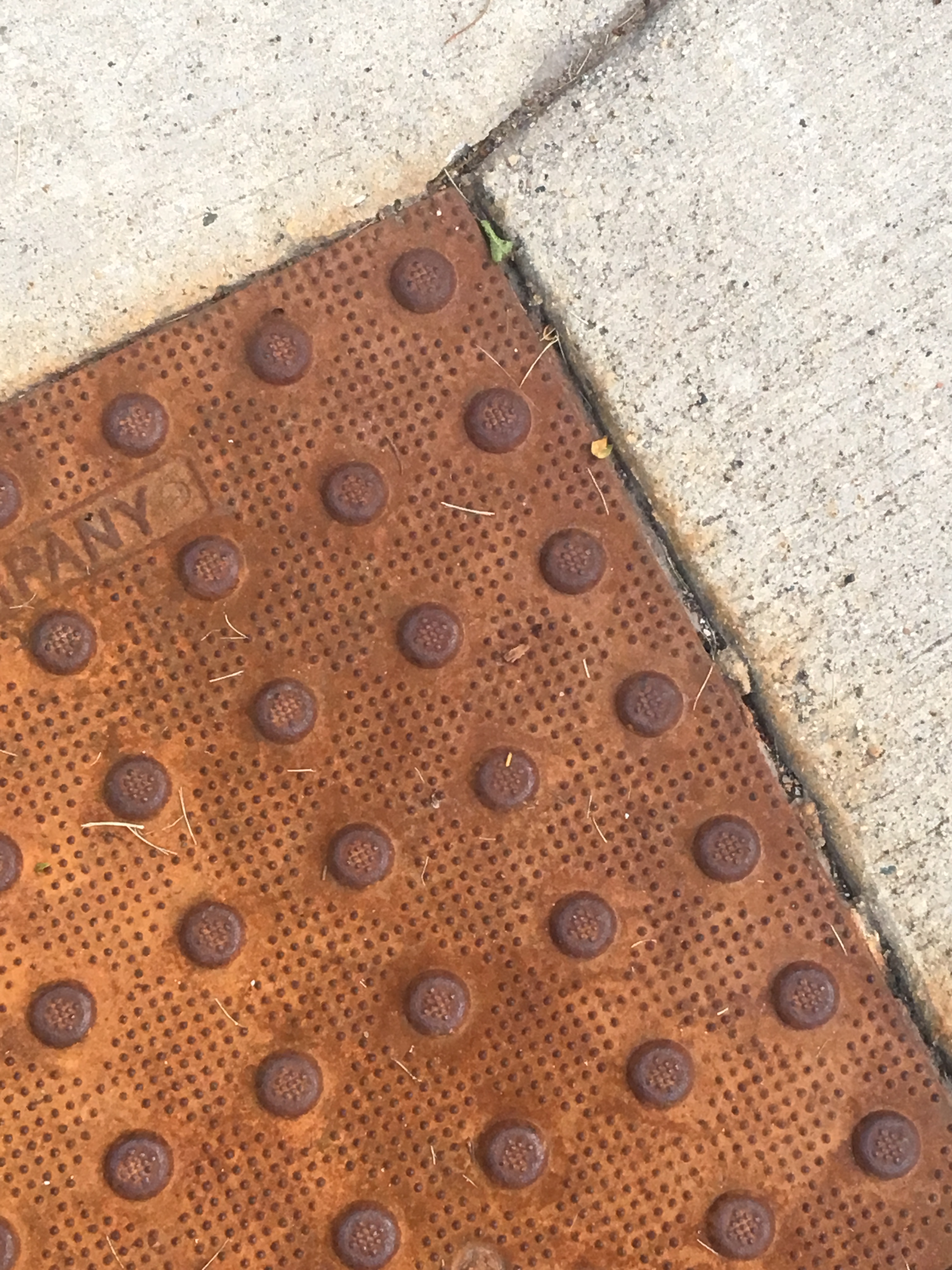
Dots. Diamonds of dots. Lines. Pattern. Texture. Too much to see. Too much to experience. And the best, most simple way to step into vibrancy is to stop and look.

But, there is one more step, the part that made the exercise powerful. The essential part was and is almost always overlooked. Stopping and looking and gathering is great but only has meaning – only becomes artistry – when it is shared. Without fear or judgment. Stop. Look. Gather. Come back to the center and share what you see.

read Kerri’s blog post about TEXTURE

yoga series: meditation ©️ 2012 david robinson

See The Good [on KS Friday]

“…the measure on ones mental health is the ability to see the good in everything. Perception is the key.” ~ Kristine Klussman, Connection

If I kept a gratitude journal, my entry yesterday would be that Bruce was happy. I could hear it in his voice. Although it had been seven years since we last spoke, we talked like we were picking up a conversation from yesterday. Life has changed dramatically for both of us.

It seems we have both reached the revelation of simple appreciation. No longer focused on the big stuff, we talked of the sweet moments, the moments that feed our souls. He asked me to describe my days and I was happily taken aback to tell the tale of walks on trails, beginning each day writing posts with Kerri, ending each day with a glass of wine. Drawing cartoons. A dog that runs enthusiastic circles. Good friends.

I am reminded again and again that goodness is not found in the world. It is brought to the world. We don’t perceive what is already “there,” we wrap what is “there” in a story-blanket. We give it meaning. And then we feel the impact of the meaning we give it. Viktor Frankel famously wrote that “Happiness ensues.” It follows. Despair ensues, too. Anger, too, if that is what is brought.

Earlier this year a friend asked how Kerri and I were doing amidst the job losses and broken wrists. I responded that our circumstance was dire. It was. It just didn’t feel that way, so full was our sense of appreciation. In the midst of a dire circumstance, we started our days writing. Good friends called. DogDog ran enthusiastic circles and made us laugh. We sipped a glass of wine at the end of each day and enjoyed our simple meals. Today, things are less dire and, although we are still standing on shaky ground, we start each day writing together. We hold hands and take walks. We breathe deeply the smell of coffee in the morning. Our gratitude for our days has not changed a bit. Good moments are everywhere.

And today, Bruce is back in touch. He is happy and his happiness, like all happiness, comes from a hard decision that took tremendous courage: he decided to see the good. To bring light. To be light. He is doing the work of savoring the good moments that he now sees all around himself.

good moments/this part of the journey is available on iTunes and streaming on Pandora

read Kerri’s blog post about GOOD MOMENTS

good moments/this part of the journey ©️ 1998 kerri sherwood