Imagine The Possibilities! [on Two Artists Tuesday]

Mastering others is strength. Mastering yourself is true power.” ~ Lao Tzu

I’ve had this quote sitting on my desktop for months. I’ve been on a Lao Tzu kick, a Kurt Vonnegut kick, a Rainier Maria Rilke kick…all at the same time. They are, not surprisingly, in alignment on many topics, among them self-mastery. “The secret?” they whisper. “Stop trying to control what other people think or see or feel and, instead, take care of what you think and see and feel.” Their metaphoric trains may approach the self-mastery station from different directions but the arrival platform is the same.

It’s a universal recognition: take the log out of your own eye.

Sometimes a penny drops more than once and so it is with Saul’s advice to me. “Look beyond the opponent to the field of possibilities.” “And, just what does that mean?” you may shout at your screen. It sounds like new-age hoo-haw.

Ghandi said, “Nonviolence is the weapon of the strong.” It is the height of self-mastery to bring ideas to the table rather than a gun. It is the height of self-mastery to bring to the commons good intention and an honest desire to work with others to make life better for all. Power is never self-generated but is something created between people. Power is distinctly different than control. Power endures since it does not reside within a single individual. Power lives, as Saul reminded me again and again, not in throwing an opponent but in helping the opponent throw themself. “Focus on the possibilities,” he said again and again. Throw yourself to the ground often enough and, one day, it occurs that there may be another way.

Work with and not against. It seems so simple. The bulb hovering over my cartoon head lights-up. Work with yourself, too, and not against. Place your eyes in the field of all possibilities. Obstacles are great makers of resistance, energy eddies and division. Possibilities are expansive, dissolvers of divisiveness.

I am writing this on the Sunday that Christians celebrate their resurrection. The day that “every man/woman for him/herself” might possibly and-at-last-transform into “I am my brothers/sisters keeper.” All that is required for this rebirth is a simple change of focus; a decision to master one’s self instead of the never ending violent attempt to exercise control over others.

It’s the single message, the popcorn trail left for us by all the great teachers. Instead of fighting with others, master yourself. Imagine the possibilities!

read Kerri’s blogpost about THE CEILING LIGHT

Stack The Impossible [on Merely A Thought Monday]

We watched the video of Jaxon climbing the ladder of the red plastic slide. His momma said, “Is that your big boy slide?” Jaxon said, “Big boy slide.” Pandemonium. “He said it!” his father exclaimed, “I think he said it!”

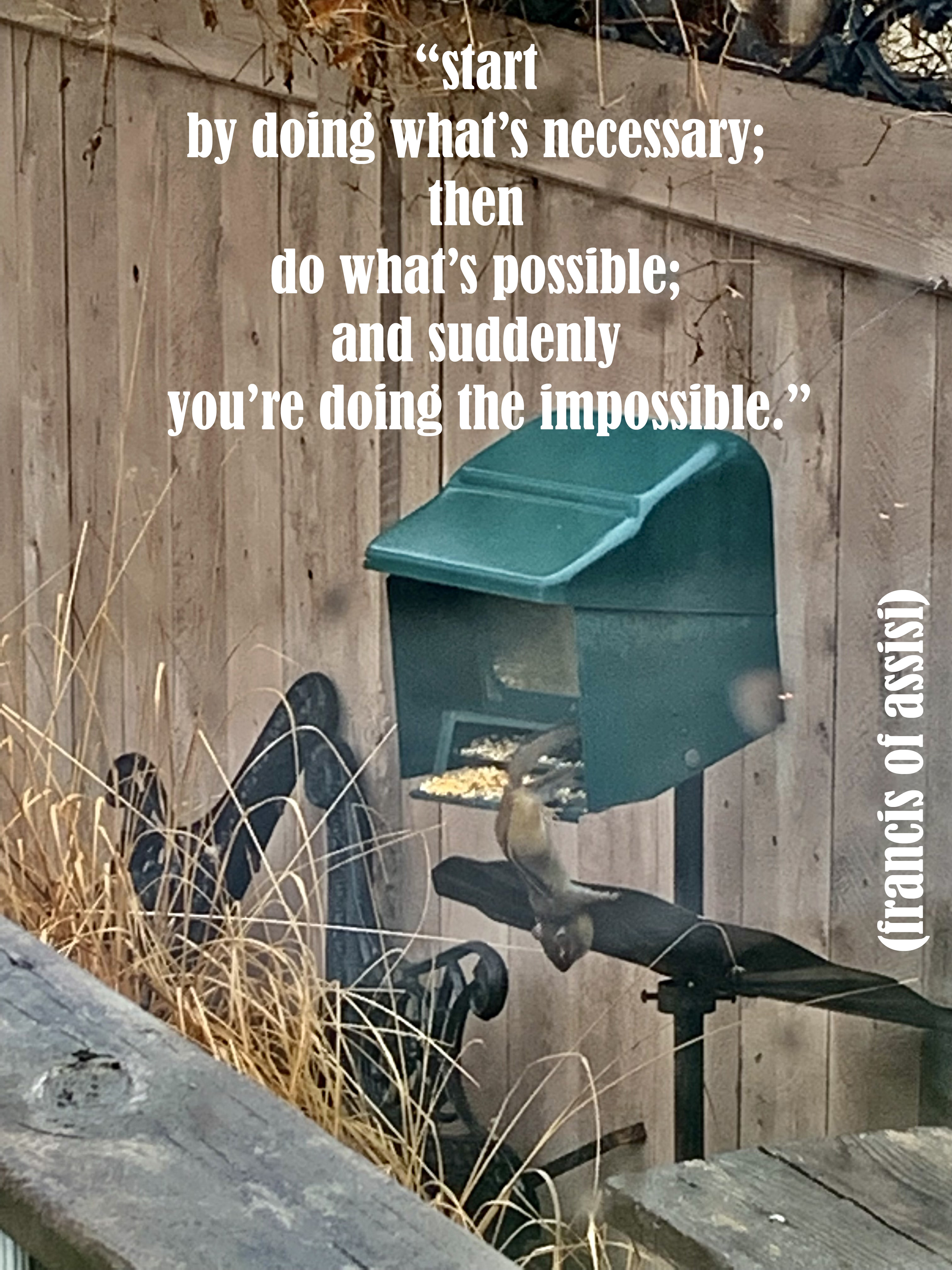
Big boy slide. A first phrase. The moment when what’s necessary becomes what’s possible. It’s something we take for granted every day. The utter impossibility of spoken language. Sounds uttered in sequence that somehow make sense. Of course, we’re also quite capable of stringing together sounds that make nonsense, too. Soon, Jaxon will ask his parents for the keys to the car and a wholly different kind of pandemonium will let loose. From climbing a ladder to driving the Volvo. The impossibilities stack one upon the other.

My mother is adjusting to life without my dad. She says often, “I don’t think I can take it, this loneliness.” She is doing what is necessary. In our last chat, she spoke of playing pickleball, of taking a walk, of meeting a friend for tea. Moving with intention out of the apartment to meet other people. The moment when the necessary becomes what’s possible. She will, I am confident, live her way into the impossible.

The impossible rarely happens in a snap. We live our way into it. Jaxon’s pronouncement and subsequent trip down the big boy slide was a long time coming, a step in the process worthy of celebration. And then, the miracles will keep coming. Full sentences. He’ll learn to write. Someday he’ll write love letters and drive the car to pick up his date. He’ll ask someone to marry him. The art of the impossible. This life.

And, the most amazing of the impossibilities, as we stack our lives with the formerly inconceivable, we grow less and less capable of seeing it. Perhaps that is necessary? How would we exist if we saw each other as keepers of the impossible? Experiencers of the unimaginable?

read Kerri’s blogpost about THE IMPOSSIBLE

Gaze At The Seam (on KS Friday)

Some things are hard to grasp. When that’s the case, it’s a good time to look at the sky. You’ll not find many explanations up there but gazing at the seam between us and the infinite-universe can, in moments of clenched fists, bring some perspective. As Kerri says, “It just keeps rolling.” No problem can remain large when measured against the seam, that fragile ozone layer that makes breathing and every current dilemma possible.

Sometimes when I look at the sky I wonder how many people across the ages have engaged in seam-gazing.

I imagine, one day in Kansas, 1932, as his fields turned to dust, a farmer looked to the sky. All his appeals for rain exhausted.

I can’t imagine how many women looked to the sky over the 100 years of protests and parades before being afforded the right to vote.

Can you imagine how many African-Americans looked to the sky as slaves in a nation that boasted to the world about its freedom and equality?

I look to the sky every time another state in the union passes legislation prohibiting discussions about our history, so fearful are we of critical race theory and the equality that we profess.

I find nothing in the seam that explains anything, but the clouds remind me that it just keeps rolling and, since I believe we tend toward wholeness, I catch a whiff of hope in all the blue and moving puffy white.

Someday, somewhere down the historic road, someone will look to the sky, in a post-nonsense era, and will, perhaps, imagine me staring back. To them, from their perspective, my unanswerable questions will have found resolve. They will have questions of their own, no doubt, but won’t it be nice to have a new set of questions to thrust at the seam?

read Kerri’s blogpost about THE SKY

Little By Little (©2022 Kerri Sherwood featuring Dogga)

Seed The Pocket [on Flawed Wednesday]

I’ve appreciated this sunflower for many years and until a month ago it never made me think of Ukraine. Now, that’s all I see. Thus, the power of a symbol. Sunflower seeds placed into the pockets of Russian soldiers by brave Ukrainian elders. “So, some good may come from your death.”

Walking through the antique mall, Brad spotted an ugly homemade sculpture. Golf balls with multiple screws protruding, spray painted and supported by wire rods. “Look, the coronavirus!” he exclaimed. Three years ago spheres with spiky knobs would have made me wrinkle my brow but never associate the shape with a virus. Now?

And masks? Will we ever see a surgical mask without feeling the divide in our nation? A confederate flag paraded through the Capitol? Members of the Capitol Police beaten with the stars and stripes; symbols matter.

Every year more and more our written communication is reimagined with emojis. Visual symbols. The new Ideogram. A thumbs up. A heart. Laughing face. Saying more with less or at the very least opening up our communication to broader interpretation. I find that I’m symbolically rolling my eyes more and more. Exclamation point. HAHA! Know what I mean? Winky face.

Leonard Shlain wrote some remarkable books about how our brains are wired by how we communicate; he posits that linear language, the introduction of writing drove us into our left brains and away from our holistic right. Perhaps in our movement back toward the ideogram we are rebalancing? A course correction or returning to center? It takes more than a few years for brains to rewire. Our descendants will, no doubt, either write books about it or communicate their thoughts through a combo platter of alphabet and pictograph.

Either way, we can only hope they grasp the meaning of the peace symbol. Or, at the very least, learn how to give it more preference than the dollar sign. Or, better yet, figure out how to make peace profitable. Can you imagine? Certainly there will be a symbol for that.

Until then, sunflowers in the killing fields. Sad face. Broken heart.

read Kerri’s blog post about THE SUNFLOWER

Turn Toward It [on KS Friday]

This is what he wrote. “The irony I feel is that the world is lost on the artistic temperament of these students.  They don’t seem awake to all that’s going on.” He’s directing teenage students in a play. He was my student thirty five years ago and reached out to me. We compared notes of the production I directed when he was a teenager, and the production he’s directing now. The world has changed mightily. His production will be viewed through a wholly different lens.

I flipped his phrase over in my mind. Artistry is to be awake to all that’s going on. And, awake is not a steady state. It’s not an arrival platform. It’s a relationship between the inner and the outer. What I know about that relationship is that sometimes you need to look away. His students have drilled for active shooters in the hall since they were in kindergarten. Mine couldn’t have imagined it. His students are navigating a pandemic, they’ve never known a world pre 9/11, they live in a country that is eating itself alive. My actors had easier access to what was going on. What was going on was closer in, more immediate and less abstract. They were not looking at a world-wide horror story or lost in the morass of social media. Cell phones were science fiction to my cast. My actors looked at each other and not at their screens.

Stories are about something. We just watched Erin Burnett’s interview with a Ukrainian husband who lost his wife and children to a Russian mortar attack. A month ago, violent death was nowhere on their radar. They were making dinner, going to school, doing homework, late for work. Erin Burnett began to cry and thank goodness. Humanity breaks through and we awake to what’s going on – really going on. We should all be weeping with Erin Burnett and this man.

Sometimes I feel as if I am looking for the small beautiful moments. I am trying to root my day in the explosion of color, the pastel sky, Dogga in the sun. Holding hands. Cooking dinner together. I am trying to be awake to what is going on, the anger and division and warmongering and carelessness as we soil our nest – without it frying my insides. Holding hands is just as real. Reaching toward our neighbors is also what’s going on.

Stories have to be about something and most often stories are about transcendence. Waking up to what is going on is less about waking up – we already know – and more about fully acknowledging it, facing the full picture and turning toward it rather than running away. But, before that final act, that moment of deciding enough-is-enough, before we are willing to blink open our eyes, we pretend the problem is non-existent or small. We ignore the obvious. 500 year storms every year. A family killed by a mortar shell. We bury our faces in our phones, we ban critical race theory, and toss our attention in a Twitter reality or a Tik-Tok diversion.

I wanted to write back and suggest that the world is not lost on the artistic temperament of his students, it’s simply too hard to look at the world so they are choosing to look away. That’s what their play will ultimately be about.

read Kerri’s blogpost about COLOR!!

Kerri’s albums are available on iTunes & streaming on Pandora

the way home/this part of the journey © 1998 kerri sherwood

Ready The Wings [on KS Friday]

“Yes, I’m being followed by a moonshadow/Moonshadow, moonshadow/Leaping and hopping on a moonshadow/Moonshadow, moonshadow” ~ Cat Stevens, Moonshadow

An appreciation of life, no matter what comes. It is the meaning of this lyric, this song – or so I’ve read. It seems obvious. I’m having many, many conversations about loss these days. This has been an era of loss and, so the cliche’ goes, with loss new opportunity arrives. It’s true though one must move through the loss in order to arrive at the new. On the way, there is weeping and fear and anger and disorientation. Chrysalis. The trick, we are told, is about focus placement. One day we shift our eyes and see what we have instead of what we no longer possess. We move toward rather than look back.

Kerri has, for years, surrounded herself with symbols of peace. They are on our walls, on rings that she wears, on chains draped on the corner of our bathroom mirror. She draws them in the sand on the trail. A prayer for the world she desires to create. Inside and out. Since she fell, my solo-piano-playing wife has lost more than mobility in her wrists. Strange stuff is happening. Fingers that sometimes refuse to respond. Pain that shoots, seemingly from nowhere. After a photograph – a wish for the world, a peace sign in shadow – she said, “Come look at this. Look how much my finger is bending!” Strange stuff.

What is most remarkable about this shadow is, a year ago, it would have been cause for frustration. A reminder of loss. Full of fear. Today, it was a curiosity. She looks back, she looks forward. Each day she writes lyrics and poetry and wisdoms. She hums the music running through her mind and heart and, sometimes, she dances. Standing at the crossroads of what was and what is to become. Peace replaces pain. All in good time. Good time. Wings readying to unfurl.

[peace. this is one of my favorite pieces of Kerri’s]

Kerri’s albums are available on iTunes and streaming on Pandora

read Kerri’s blogpost about PEACE

peace/as it is © 2004 kerri sherwood

Care For Your Space [on Not So Flawed Wednesday]

It seems like such a simple concept. Tom taught it. So did Paul. And, since I was one of their students, I taught it, too. How you treat your space is a reflection of what you think of your art. The concept is universal. Replace the word “art” with “work” or “life.” You and your space are not separate. We worked hard at the theatre to become better artists and produce better plays and a significant part of that work was bettering and maintaining our artistic “home.” We were proud of our work and it showed -everywhere. Our “space” included our community and our art was meant to make it better.

Yesterday it was warm so we took a walk on a favorite loop. As we returned to the car we watched a man clean out his truck. He’d come to the park, not to walk or appreciate the quiet. His purpose was to dump his trash onto the paved lot. In an earlier time, pre-gun-gun-everywhere, we might have said something. Instead, we stared in disbelief. His space,I thought, does not extend beyond his truck. Neither does his community.

Yesterday, after the walk I received a text from Mike. He was a big part of my long-ago theatre. He’s realizing a dream and opening his own theatre. He’s led a company for a few decades but they didn’t have their own space. Now, they do. He – the artistic director – was mopping the floor and paused to send me a text. It’s the other part of the lesson from Tom and Paul. And Demarcus. And Quinn. There’s no hierarchy. There’s no above and below. Loving the space, loving the art that happens in the space: no separation. One and the same for everyone involved and everyone needs to be involved.

You and your space are not separate. The care you take of your outer space is equal to the care you give to your inner space. And, vice-versa.

[visit Justin’s to see how a company can make a better world]

read Kerri’s blogpost about NEAT EARTH

Listen To The Memento [on DR Thursday]

Stop for moment and look around your house. How many of the objects that populate your shelves and walls are mementos? Keepsakes from travels or special events? I’m always struck, after a devastating fire or tornado, how often I watch people sifting through the rubble of their home to find a photograph or a special ring. There is the shock of losing the home, but the stories! What will happen with the loss of the reminder, the things that carry the story?

Last week, after the night we thought there was a fire in our walls, we talked about our race to get out of the house, and the question of “What do we grab and take?” The dog. The special papers. The computers. A few clothes. Those “items” fall into two categories: what you love (the dog. each other) and what we need to start again (special papers, the computers, a change of clothes). Although losing the passports and birth certificates would be difficult to replace, the first category is really all you need.

I’m certain, because our experience was so recent, I want to sob watching the news footage of families fleeing their homes in Ukraine. What do you grab and take when yesterday you went to work and today you are fleeing bombs and war? Where do you go? We have friends a few minutes away who would have taken us in and helped us back on our feet. When fleeing is the destination…where do you go?

The sun was bright through the cold on the day we pushed LittleBabyScion down the driveway so we could get Big Red out and onto the street. At first, she thought she found a wedding ring poking out of the snow. One of the men who worked so hard to replace our water line must have lost it. But then, we realized it was a brass fitting. We brought it in house. Someday, when the trench has settled, the front yard has grass again, when we feel comfortable leaving the television plugged in, and the house is restored to order, the ring will serve as a memento to remind us of the upheaval.

Yesterday I held the ring for a moment and I wondered why we – humans – build memorials to war that carry messages chiseled in stone, “Never again…” or “Remember…”, sentiments that are meant to remind us that murdering each other for resource or political gain actually achieves nothing but pain and the erection of yet another stone and steel memento – it’s a flip of priority – as if the special papers and computers have more importance than the people. The people become expendable. Where do you flee in the face of such madness?

read Kerri’s blog post about THE RING

Dial Three Numbers [on Not So Flawed Wednesday]

Last month, when the car across the street blew up, there was general pandemonium until the fire department arrived. In a few moments, order was restored. People, myself included, who only moments before had been running around in panic, gathered at the end of our driveway and watched the methodical dousing of the fire. Tragedy turned to block party the minute the men and women of the fire and police departments took charge. We transitioned from unsafe to secure, in a heartbeat, from “I don’t know what to do,” to, “I’m so glad they know what to do”. Neighbors chatted. Speculated. We shared tales of the explosion. We compared notes while the people who know what to do put out the fire and cleaned up the mess.

We take for granted the security we enjoy. In the back of my mind, I know that dialing three simple numbers into the phone will summon people who know what to do.

We awoke in the middle of the night to the sound of our basement carbon monoxide alarms blaring. We turned on the lights but something was dreadfully wrong. It was as if the entire house was on a dimmer switch: there was light but it was very dim. And then we heard a buzzing sound in the ceiling. And then the smell of hot electric wires filled the room.

We dialed three simple numbers. In a panic, we put the dog, our bag with important papers, and the computers into the car.

And then, the people who know what to do arrived with their red lights ablaze. They calmly came in the house. They searched every square inch of our home with heat sensing technology. They pinpointed the source of the buzz and the burning smell. It was not yet dire but could have been bad had we not been awakened by the alarms. Within minutes of their arrival, our fear dissipated. Problems were identified. Safety was secured. Advice given.

We were safe. We dialed three simple numbers and help was on the way.

read Kerri’s blog post about FIRE ENGINES

Love Your Vintage [on Two Artists Tuesday]

The woman on the Apple support line told Kerri that her computer was vintage. “As if I didn’t know!” Kerri groused after the call.

In the middle of the night, after the firemen had determined that the burning electric smell wasn’t coming from inside our walls (a story for tomorrow), their chief took one last look around and said, “You have some really nice antiques here.”

“Thanks,” Kerri said, avoiding my smirk.

We are not collectors of antiques. Not on purpose. Our house is populated with stories and random pieces of furniture that we like and could afford. For instance, the two chairs in the sunroom are made of course-weld steel with raw wood seats. $5 for both. They are quirky, like us. An old door, set on two sawhorses, serves as a table for our plants. Budget and taste. Or, taste defined by budget. As Gus says in My Big Fat Greek Wedding, “There you go.”

Big Red and Little Baby Scion are long-in-the-tooth, too. And, isn’t that a great idiom! Showing their age. Horses gums recede with age (I just read this!) so older horses seem to have longer teeth. I am suppressing the urge to run into the bathroom and look at my gums in the mirror. “I am not a horse,” I whisper to my urge. Vintage, vintage, vintage. Last month Big Red wouldn’t start. He needed a new battery. Yesterday, we pushed Little Baby Scion down the driveway so we could get the newly-batteried-Big Red out. We drove him across the front yard. Classy people. LBS decided not to start and, after refusing her jump from Big Red, she’s destined to have a tow truck adventure to visit Steve [Thanks to John and Michele, our awesome neighbors, for helping us push Little Baby Scion back up into the driveway for safekeeping until the tow].

“We’ve had one hell of a week,” I said, after being rear-ended. It was lucky that we were in Big Red. Normally, we’d have been in Little Baby Scion and it would not have been pretty. It occurs to me that we are living an Aesop’s fable: you can never see your good fortune since it sometimes comes dressed as a problem. Stepping out of the truck to see the damage – and being amazed that, after being hit so hard, that there was not a single scratch on Big Red. The other car lost its grill to Big Red’s trailer hitch. Pieces of plastic and glass were everywhere. “I’m glad Little Baby Scion broke down,” I thought. Our unintentional vintage collection could have just saved our lives.

“We’re really lucky,” Kerri said. Yes. Yes we are.

read Kerri’s blog post about JUMP STARTS