Call It Realism [on Not So Flawed Wednesday]

This garlic could have been painted by Jan Vermeer. To my eye it looks like the work of a Dutch master, an artist more concerned with realism than the ideal.

Art that reveals the beauty in the ordinary. For a few weeks in my surly youth I studied with a realist painter. I was wowed by his technique but could not yet grasp his dedication to capturing the everyday. Only later did I come to understand that his art was not about the technique but about bringing attention to the experience of the everyday. He rejected the aloof and desired to pull art down from the pedestal so it might reflect the lives of the “common people.” He believed that people needed to literally see themselves in the paintings to have access to the painting. They needed to see their hardship and toil as well as the objects that surrounded them.

Bertolt Brecht believed the opposite. In order for people to have access to the deeper messages of a play, they needed to be removed from their circumstance. So, in his way of thinking, people are more capable of seeing themselves in a piece of science fiction than in a reality-mirror.

David is working on a re-imagining of Pirandello’s play, Six Characters In Search of an Author. One of the questions of the play is, “Who is telling your story?” And, how are they telling it. I reread the play and was struck by how relevant it is to our times.

The beauty in the ordinary. The turmoils and struggles of the everyday. Ours is a time of tumultuous story tug-of-war. I wonder, in a hundred years, what historians will write about our time. I wonder what aspect of artistry – if any – will be considered “realism.” As defined by Vermeer and Pirandello, it’s to reach across a social line, from the privileged to the working class. For Brecht it is spatial: step out to look in.

One thing is constant, while reaching across time and artificial boundary, it is always the role of the artist to help their community ask the questions: Who is telling my story? Whose story am I telling? What is the story that we are telling?

I imagine those someday-historians will write tomes on our messy struggle to sort out what is “real” and what is not.

read Kerri’s blogpost about GARLIC

Ode The Basement Floor [on Not So Flawed Wednesday]

Ode to the basement floor.

Though little acknowledged and less appreciated, you carry without comment the brunt of the load. When water runs where it ought not run, you, master of the Tao, let it flow, knowing the drains in your design will surely win the day. Or not. No matter. What happens will happen and we will make stories with either result, never once mentioning your stalwart participation, unseen support in every storm.

The washer jumps, the dryer rolls, the boxes stack, the shelves stand guard, you accommodate and hold space for all.

Sometimes I stand on you, toes a-wriggling, lost in thought, or wrinkle-brow-perplexed, all the while missing the wise message of patience you proffer. “Stand long enough,” you suggest but do not say, “and everything will look different. Or the same.” Were I to ask – and you to answer – you might imply that my paint and carpet solutions are surface remedies merely. Perhaps I should consider lasting and deeper alternatives?

We rearrange. We are cleaning out. We see more of you than before! Yet increasingly exposed and in full reveal you do not attempt to hide your age as we might. As we do. Your pocks and chips and scratches galore the proud chronicle of your era.

“Tread on me” your flag must wave, as we step and stride and dance and tramp and plod and stomp, fulfilling your purpose with our every footfall. I wonder, as I carry a load to the stairs, do you mind or even note that I am lost in the cause of singing your praises?

[this post comes to you without the assistance of mind altering drugs of any kind. Just sayin’]

Say Uff Da [on Not So Flawed Wednesday]

I never met Kerri’s dad. He passed before I came into the picture. I feel as though I know him. When a nasty bit of home repair is staring me down, I often ask his advice. “What should I do with this one, Pa?” I ask. Generally, he crosses his arms in quiet consideration and mutters, “Uff da.” And soon a solution comes to mind.

Hanging beside our back door is a bamboo wind chime. It was Pa’s. Sometimes when we open the back door it voices and I respond with a hearty, “Good morning, Pa.”

His nickname for Kerri was “brat.” I know exactly why Pa gave her that nickname. Let’s just say she earned it and, to be clear, has never outgrown it. 20 often looks at me in desperation and says, “She’s torturing me!” He wants me to intervene, to come to his rescue. I know better. Kerri laughs. So does Pa. We love the brat even if we are the recipients of her mischief.

Earlier this year I lost my dad. Yesterday while on the trail, I confessed that I was overwhelmed with a wave of missing him. “Cycles of grief,” as the Wander Women say. Growing older is filled with cycles of grief and I had cycled in. I sighed. Kerri squeezed my hand. “I’m sorry,” she said.

“This sucks,” I thought.

“Uff da,” Pa said.

read Kerri’s blogpost about UFF DA

Dream [on Not So Flawed Wednesday]

When does a dream turn into a goal?

Lately, I’m having conversations that confuse me. Business thinking, engineer minds, make models for creation. Creativity plans as action templates and guides.

Screen writers make plans, too. Step outlines. The difference is in the process. A creative mind makes models and plans with full intent to throw them away. To discover the best story, their plan involves making space for the better idea. Open up by tossing the model. Clear the deck by shuffling the plan. Sketches and rough drafts. It’s a conversation with the muse. Muses are notoriously structure resistant until the story makes an audience sit forward. Movement first. Then, the structure begins.

The engineer mind works in the opposite direction. The dream must wear the mask of a goal or it is considered invalid. Too squishy. Construction begins immediately with targets and tasks. Order. It is, in fact, the same process as the creative mind, only it is less forgiving of space. It forces the muse to move. Time is of the essence. Structure first. Then movement. Efficiency is a tree with shallow roots.

It confuses me. Dreams do not wear ties or leather shoes, yet, scrape the blueprint and you’ll find a dream every time. Perspective requires stepping away from the canvas. Standing too close for too long and loss of vision is the result. Every time. It’s not a mystery or voodoo. It’s physics. Great ideas and idea-break-throughs happen in the shower or walking on the trail. A clear mind. A different focus creates space. Too tight thinking, too close in for too long, sucks energy.

Once upon a time I worked with organizations and educators. They also confused me. Squeezing the air out of their space they’d gasp, “We can’t breathe.” A little bit of space, some play, a refocus on the relationships was good medicine. Fresh air. Step back and see the painting. The point of perspective is to see. The secret: permission to remove the status games and need to be an authority and, for a moment, reconnect the players to their dream.

At the nucleus of every goal beats the wild heart of a dream.

read Kerri’s blog post about DREAM

See The Signs [on Not So Flawed Wednesday]

Religions around the world and across time have personified this moment. The return of the green. From one day to the next buds appear on trees. The signs of life’s vibrant enthusiasm returning (again) from long winter, barren earth, metaphoric death. Persephone’s homecoming from the underworld and Demeter, her mother, goddess of the earth, allows the return of life.

It’s a very, very old story told in many, many different ways. Human beings, storytellers all, making sense of death and life, generalized across the real experience of cycles and seasons, all pressed through the lens of this-causes-that. Reduce us to an essential oil and we are makers of metaphor and seers of pattern.

I told Kerri that I got out of the wrong side of the bed this morning. An idiom. Imagine the power in brains that utilize idioms! The meaning cannot possibly be carried by a literal interpretation of the individual words. We pull the meaning out of or inject it into the collection of words. We know what it means because the meaning has a long history. The Romans, I’ve read, believed there was a correct side of the bed. Arising on the correct side of the bed would ensure good luck. The right side of the bed was positive, the left side was dubious. Jump out of bed on the left side and the day was ruined!

Superstition: making sense of the happenings of a day or a life, pressed through the lens of this-causes-that.

Mostly, I am restless. It snowed all day yesterday. I yearn for the moment when I can, for the first time of the returning (pattern) spring, lean against the wall and feel the warm sun on my face. I will, like I did last spring, enjoy the moment to the point of non-thinking. I will drink it in with no need to wrap a story around it or make sense of what I am feeling. I will appreciate it to my bones and revel in the return of warmth, new growth, and light.

read Kerri’s blog post on GREEN

Make ’em Laugh [on Not So Flawed Wednesday]

“I know what I want!” she exclaimed. “I just saw it.” Little-Baby-Scion whipped a sudden u-turn and we drove back into the park. We’d just finished a hike around our favorite loop and were discussing the choices for this week’s Melange. We had a problem day, a prompt that could only go one way: a rant. It would evoke a topic we’ve already beaten to death.

The car screeched to a halt in front of the stop sign. “It’s not possible!” she said. “You can’t stop and go one way all at the same time!” She jumped out to take a photo of the sign. I smiled at the irony. We were about to replace a problematic blog-prompt, an image/topic that could only go one direction, with a stop-one-way combo sign. Our new replacement prompt would be the universe’s message to us.

I’ve received – we’ve received – this message more than once and at times far more weighty than an upcoming blog prompt. Stop. This can only go one way. Or, the more hopeful variety: Stop. There is only one way to go.

As Kerri likes to say, “We have good angels.” Our good angels employ a special hammer on our heads when we need to stop. It is a full abrupt stop. Those whacky angels have great senses of humor. They giggle to see us mistake the wall for a door. I’ve quietly suggested to our angels that they consider using airbags with us but so far they are sticking to the hard-stop-no-cushion strategy.

And, the door that opens is never subtle. We sit in the hallway for a long time. No doors to be found. We lose all hope of doors, resigning ourselves to life in the hallway. Suddenly, out of nowhere, a door pops open. It’s a definitive, “Take this door or continue to sit where you are.”

Those whacky angels. All of those Renaissance painters led us astray, portraying gentle, harp playing, soft robe wearing winged guides. I suppose some people might have that variety. Not us. Our good angels are pranksters. Billiard-playing-Harley-riding-pastrami-eating-blue-jeans-wearing-tricksters who let us run blind toward the cliff and hit us with a stop sign at the last possible minute. “Hold on there, artists-types,” they snicker. “Stop. This can only go one way.”

An angel in the back row whispers, “That looked like it hurt.” The entire chorus of angels guffaws.

read Kerri’s less random blogpost about STOP!

Seed The Pocket [on Flawed Wednesday]

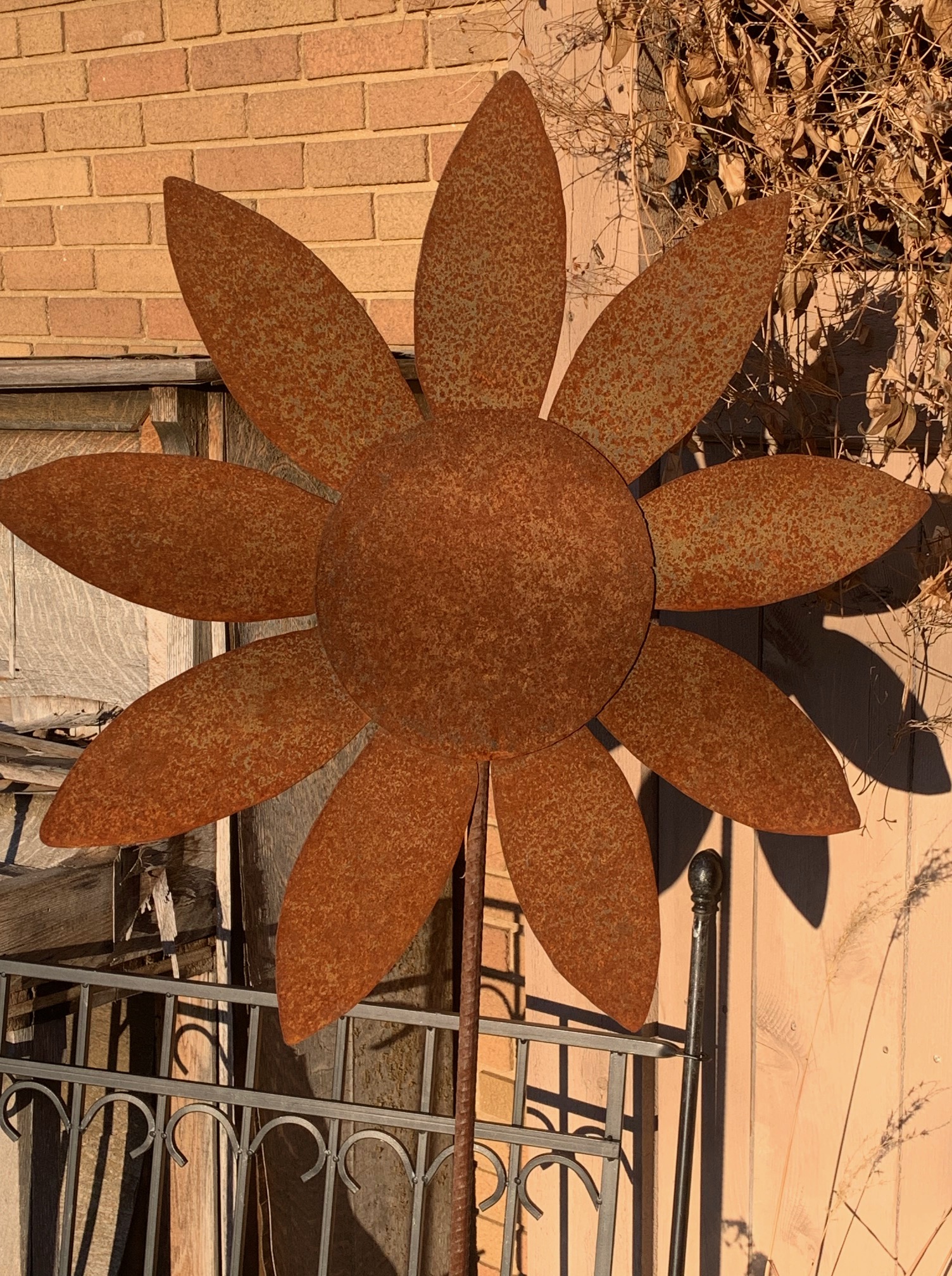
I’ve appreciated this sunflower for many years and until a month ago it never made me think of Ukraine. Now, that’s all I see. Thus, the power of a symbol. Sunflower seeds placed into the pockets of Russian soldiers by brave Ukrainian elders. “So, some good may come from your death.”

Walking through the antique mall, Brad spotted an ugly homemade sculpture. Golf balls with multiple screws protruding, spray painted and supported by wire rods. “Look, the coronavirus!” he exclaimed. Three years ago spheres with spiky knobs would have made me wrinkle my brow but never associate the shape with a virus. Now?

And masks? Will we ever see a surgical mask without feeling the divide in our nation? A confederate flag paraded through the Capitol? Members of the Capitol Police beaten with the stars and stripes; symbols matter.

Every year more and more our written communication is reimagined with emojis. Visual symbols. The new Ideogram. A thumbs up. A heart. Laughing face. Saying more with less or at the very least opening up our communication to broader interpretation. I find that I’m symbolically rolling my eyes more and more. Exclamation point. HAHA! Know what I mean? Winky face.

Leonard Shlain wrote some remarkable books about how our brains are wired by how we communicate; he posits that linear language, the introduction of writing drove us into our left brains and away from our holistic right. Perhaps in our movement back toward the ideogram we are rebalancing? A course correction or returning to center? It takes more than a few years for brains to rewire. Our descendants will, no doubt, either write books about it or communicate their thoughts through a combo platter of alphabet and pictograph.

Either way, we can only hope they grasp the meaning of the peace symbol. Or, at the very least, learn how to give it more preference than the dollar sign. Or, better yet, figure out how to make peace profitable. Can you imagine? Certainly there will be a symbol for that.

Until then, sunflowers in the killing fields. Sad face. Broken heart.

read Kerri’s blog post about THE SUNFLOWER

Peek Behind The Scenes [on Not So Flawed Wednesday]

I’ve tried to keep notes on my computer. I know that typing my notes into the digital world will make them searchable. Easier to find. It just doesn’t work for me. If I write with a pen on paper, I remember. Marking an important page with a Post-it note makes finding my notes faster than a search engine. It’s not that I am old school. I’m kinesthetic.

I’ve always kept notebooks. At this moment there are two within my reach. The Melange notes. On the desk in my office a is a notebook and three yellow pads. The yellow pads are a task-capture strategy. The notebook is idea capture. Quote capture. Thoughts-in-progress. The notebooks are like my sketchbooks, a place to work out my thought-compositions. They are the history, the breadcrumb trail of a project. For me, the riches are never in the outcome. The real treasures are alive in the notebook process paths.

I’d rather look at an artist’s sketchbook than the finished painting. I have a book of Picasso’s sketches that I treasure. Spend a few moments in Leonardo’s sketches or Michelangelo’s scribbles and you’ll forever toss away the notion of a mistake. Look behind the scenes at the process. A dancer will spend hours in repetition to incorporate a move into their body. The playwright will write hundreds of pages to arrive at a few, yet, those hundreds of pages are nothing less than reduction to essence. Refinement on the path of saying more with less.

Look behind to see the structure. Turn it over to see the pattern. I am, to this day, in awe of the Wayan Kulit master. I looked behind the shadow puppet screen to see the artist at work and, what appears in simple two-dimensions in front of the curtain, is a symphony of structure and improvisation. The man wore an oil lamp on his head to cast the light for the puppets, held a rock between his toes to tap, keeping time for the musicians seated behind him, all the while manipulating and voicing multiple characters, telling with simple clarity an epic tale. A lifetime of trial and error, complexity made simple, like a dancer, the story was deeply choreographed in his body. I wished I could have seen this elder storyteller-priest when he was young and developing his mastery. I’d love to see his notebooks.

I’ve recently had cause to return to my old notebooks. I marvel at the thought cycles coming back around. I’m taken again and again by the questions that still linger, and by those that seem antiquated. “How could I have not seen it!” I smile, knowing in just a few more drafts, a notebook or two down the road, the clarity would arrive.

A peek behind the scenes. It is for me, where the real beauty shines.

read Kerri’s blogpost about THE FLIP SIDE

Care For Your Space [on Not So Flawed Wednesday]

It seems like such a simple concept. Tom taught it. So did Paul. And, since I was one of their students, I taught it, too. How you treat your space is a reflection of what you think of your art. The concept is universal. Replace the word “art” with “work” or “life.” You and your space are not separate. We worked hard at the theatre to become better artists and produce better plays and a significant part of that work was bettering and maintaining our artistic “home.” We were proud of our work and it showed -everywhere. Our “space” included our community and our art was meant to make it better.

Yesterday it was warm so we took a walk on a favorite loop. As we returned to the car we watched a man clean out his truck. He’d come to the park, not to walk or appreciate the quiet. His purpose was to dump his trash onto the paved lot. In an earlier time, pre-gun-gun-everywhere, we might have said something. Instead, we stared in disbelief. His space,I thought, does not extend beyond his truck. Neither does his community.

Yesterday, after the walk I received a text from Mike. He was a big part of my long-ago theatre. He’s realizing a dream and opening his own theatre. He’s led a company for a few decades but they didn’t have their own space. Now, they do. He – the artistic director – was mopping the floor and paused to send me a text. It’s the other part of the lesson from Tom and Paul. And Demarcus. And Quinn. There’s no hierarchy. There’s no above and below. Loving the space, loving the art that happens in the space: no separation. One and the same for everyone involved and everyone needs to be involved.

You and your space are not separate. The care you take of your outer space is equal to the care you give to your inner space. And, vice-versa.

[visit Justin’s to see how a company can make a better world]

read Kerri’s blogpost about NEAT EARTH

Look Back [on Not So Flawed Wednesday]

Our 3am conversation was about the horrible clothes we once wore. We both lived through the 70’s and 80’s so there was plenty of fodder for shudders and laughter. I couldn’t be more delighted that cameras in that era used film that was expensive to process, and were not ubiquitous, so there’s limited visual proof of the alarming garments of my past.

Looking back. My favorite aspect of our horrible-clothes-conversation is how much we loved the offending items when we wore them. I had a Huckapoo shirt that was only worn on special occasions. I’d scream and run from that shirt if I opened my closet and found it there today. Kerri described a favorite periwinkle blue dress with black polka dots that had me crying with laughter. The woman I know would faint in fright if she awoke wearing that dress. “Get it off! Get it off,” she’d scream, as if it was a spider.

For two people who spend most of their lives wearing black thermal shirts and blue jeans, it was delicious to trace our past lives through the costumes we’ve worn. The people we were. The investments we made. The colors we donned.

What was sacred is now profoundly silly. What was serious is now grin-worthy. What seemed so important turned out to be so-much-powder.

“Time just rolls. It just keeps rolling,” she said. The hard times and the good times. Hang on long enough and what-is will become what-was and a new-thing will have replaced the previous thing. “It just rolls on through.” At 3am, what matters in life could not be more clear. It’s the conversation. The laughter at our foibles, the sweet, “Shall we try and get some sleep?” It’s what we will see of this age when time rolls on and, late one sleepless night, we look back.

read Kerri’s blogpost about LOOKING BACK