Peek Behind The Scenes [on Not So Flawed Wednesday]

I’ve tried to keep notes on my computer. I know that typing my notes into the digital world will make them searchable. Easier to find. It just doesn’t work for me. If I write with a pen on paper, I remember. Marking an important page with a Post-it note makes finding my notes faster than a search engine. It’s not that I am old school. I’m kinesthetic.

I’ve always kept notebooks. At this moment there are two within my reach. The Melange notes. On the desk in my office a is a notebook and three yellow pads. The yellow pads are a task-capture strategy. The notebook is idea capture. Quote capture. Thoughts-in-progress. The notebooks are like my sketchbooks, a place to work out my thought-compositions. They are the history, the breadcrumb trail of a project. For me, the riches are never in the outcome. The real treasures are alive in the notebook process paths.

I’d rather look at an artist’s sketchbook than the finished painting. I have a book of Picasso’s sketches that I treasure. Spend a few moments in Leonardo’s sketches or Michelangelo’s scribbles and you’ll forever toss away the notion of a mistake. Look behind the scenes at the process. A dancer will spend hours in repetition to incorporate a move into their body. The playwright will write hundreds of pages to arrive at a few, yet, those hundreds of pages are nothing less than reduction to essence. Refinement on the path of saying more with less.

Look behind to see the structure. Turn it over to see the pattern. I am, to this day, in awe of the Wayan Kulit master. I looked behind the shadow puppet screen to see the artist at work and, what appears in simple two-dimensions in front of the curtain, is a symphony of structure and improvisation. The man wore an oil lamp on his head to cast the light for the puppets, held a rock between his toes to tap, keeping time for the musicians seated behind him, all the while manipulating and voicing multiple characters, telling with simple clarity an epic tale. A lifetime of trial and error, complexity made simple, like a dancer, the story was deeply choreographed in his body. I wished I could have seen this elder storyteller-priest when he was young and developing his mastery. I’d love to see his notebooks.

I’ve recently had cause to return to my old notebooks. I marvel at the thought cycles coming back around. I’m taken again and again by the questions that still linger, and by those that seem antiquated. “How could I have not seen it!” I smile, knowing in just a few more drafts, a notebook or two down the road, the clarity would arrive.

A peek behind the scenes. It is for me, where the real beauty shines.

read Kerri’s blogpost about THE FLIP SIDE

Care For Your Space [on Not So Flawed Wednesday]

It seems like such a simple concept. Tom taught it. So did Paul. And, since I was one of their students, I taught it, too. How you treat your space is a reflection of what you think of your art. The concept is universal. Replace the word “art” with “work” or “life.” You and your space are not separate. We worked hard at the theatre to become better artists and produce better plays and a significant part of that work was bettering and maintaining our artistic “home.” We were proud of our work and it showed -everywhere. Our “space” included our community and our art was meant to make it better.

Yesterday it was warm so we took a walk on a favorite loop. As we returned to the car we watched a man clean out his truck. He’d come to the park, not to walk or appreciate the quiet. His purpose was to dump his trash onto the paved lot. In an earlier time, pre-gun-gun-everywhere, we might have said something. Instead, we stared in disbelief. His space,I thought, does not extend beyond his truck. Neither does his community.

Yesterday, after the walk I received a text from Mike. He was a big part of my long-ago theatre. He’s realizing a dream and opening his own theatre. He’s led a company for a few decades but they didn’t have their own space. Now, they do. He – the artistic director – was mopping the floor and paused to send me a text. It’s the other part of the lesson from Tom and Paul. And Demarcus. And Quinn. There’s no hierarchy. There’s no above and below. Loving the space, loving the art that happens in the space: no separation. One and the same for everyone involved and everyone needs to be involved.

You and your space are not separate. The care you take of your outer space is equal to the care you give to your inner space. And, vice-versa.

[visit Justin’s to see how a company can make a better world]

read Kerri’s blogpost about NEAT EARTH

Look Back [on Not So Flawed Wednesday]

Our 3am conversation was about the horrible clothes we once wore. We both lived through the 70’s and 80’s so there was plenty of fodder for shudders and laughter. I couldn’t be more delighted that cameras in that era used film that was expensive to process, and were not ubiquitous, so there’s limited visual proof of the alarming garments of my past.

Looking back. My favorite aspect of our horrible-clothes-conversation is how much we loved the offending items when we wore them. I had a Huckapoo shirt that was only worn on special occasions. I’d scream and run from that shirt if I opened my closet and found it there today. Kerri described a favorite periwinkle blue dress with black polka dots that had me crying with laughter. The woman I know would faint in fright if she awoke wearing that dress. “Get it off! Get it off,” she’d scream, as if it was a spider.

For two people who spend most of their lives wearing black thermal shirts and blue jeans, it was delicious to trace our past lives through the costumes we’ve worn. The people we were. The investments we made. The colors we donned.

What was sacred is now profoundly silly. What was serious is now grin-worthy. What seemed so important turned out to be so-much-powder.

“Time just rolls. It just keeps rolling,” she said. The hard times and the good times. Hang on long enough and what-is will become what-was and a new-thing will have replaced the previous thing. “It just rolls on through.” At 3am, what matters in life could not be more clear. It’s the conversation. The laughter at our foibles, the sweet, “Shall we try and get some sleep?” It’s what we will see of this age when time rolls on and, late one sleepless night, we look back.

read Kerri’s blogpost about LOOKING BACK

Dial Three Numbers [on Not So Flawed Wednesday]

Last month, when the car across the street blew up, there was general pandemonium until the fire department arrived. In a few moments, order was restored. People, myself included, who only moments before had been running around in panic, gathered at the end of our driveway and watched the methodical dousing of the fire. Tragedy turned to block party the minute the men and women of the fire and police departments took charge. We transitioned from unsafe to secure, in a heartbeat, from “I don’t know what to do,” to, “I’m so glad they know what to do”. Neighbors chatted. Speculated. We shared tales of the explosion. We compared notes while the people who know what to do put out the fire and cleaned up the mess.

We take for granted the security we enjoy. In the back of my mind, I know that dialing three simple numbers into the phone will summon people who know what to do.

We awoke in the middle of the night to the sound of our basement carbon monoxide alarms blaring. We turned on the lights but something was dreadfully wrong. It was as if the entire house was on a dimmer switch: there was light but it was very dim. And then we heard a buzzing sound in the ceiling. And then the smell of hot electric wires filled the room.

We dialed three simple numbers. In a panic, we put the dog, our bag with important papers, and the computers into the car.

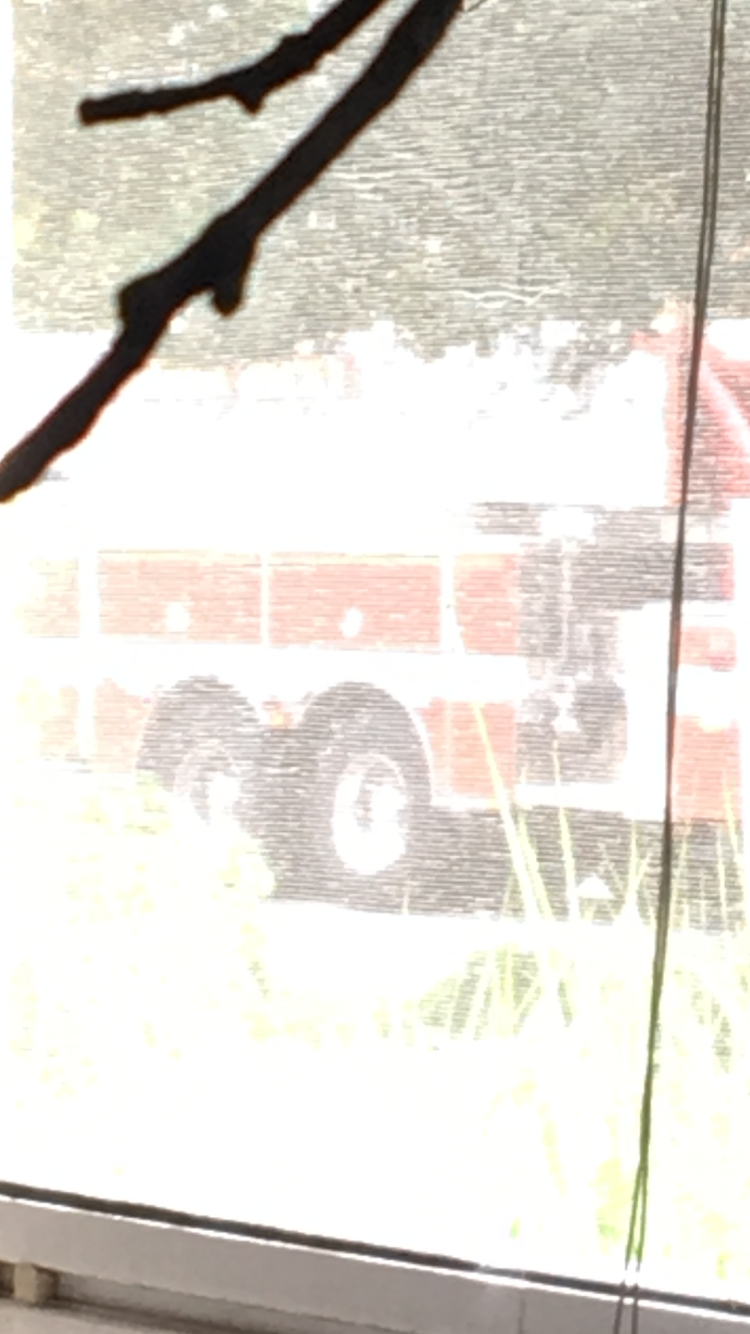
And then, the people who know what to do arrived with their red lights ablaze. They calmly came in the house. They searched every square inch of our home with heat sensing technology. They pinpointed the source of the buzz and the burning smell. It was not yet dire but could have been bad had we not been awakened by the alarms. Within minutes of their arrival, our fear dissipated. Problems were identified. Safety was secured. Advice given.

We were safe. We dialed three simple numbers and help was on the way.

read Kerri’s blog post about FIRE ENGINES

Blur The I [on Not So Flawed Wednesday]

We capture quotes all week. Some we see. Some we hear. Some find their way into the Melange. Most do not. We usually note where we heard or found the quote so we remember the context. It’s a practice. It’s not as if we are perpetually eavesdropping on conversations. We’ve simply tuned ourselves to immediately write the amazing words and phrases that catch our attention.

A common phrase is mind-over-matter. Athletes and actors and dancers are conditioned to ignore the limits of their bodies. To keep going. The mind as master over body. I loved this quote because it is the flip side. The mind, the “I”, wanted to stop but the body did not listen. It kept going.

Lately I’ve been reading about – so, paying attention to – the false separations that language necessitates: Mind and body are spoken of, thought of, as separate things. And, the question is this: where does one begin and the other end? Mind over matter. Body did not listen. I made myself do it. Once you start listening for it, it is ubiquitous. Exactly where is the line between “I” and “myself”? When your toe is in pain, isn’t your whole body is in pain? Follow your gut. What does your heart say?

When Dogga gets excited, his little body bounces. He runs in circles. He has to work hard to sit still. Say, “Do you want to go…” and he’s bouncing before the words “on errands?” reach his ears. He knows he won’t actually go on errands until he first sits on the rug. Eventually, he bounces his way into compliance. Control follows unbridled enthusiasm. Control is a means to an end. Rug before errands. Sit before snack.

Dogga might say, while bouncing enthusiastically, “I wanted to stop but my body kept going!”but I doubt it. Given his unified happy spirit, I’m certain the phrase would come out of his muzzle this way: I wanted to stop but I kept going. Watching him is like reading the I-Ching: no separation.

read Kerri’s blogpost about I AND BODY

Help Them Smile [on Not So Flawed Wednesday]

I howled with laughter when she said it. “You can buy anything that looks like something.” She was referring to the sweet Italian sausage that was not sausage at all but made of plants. I thought she was making a political statement. We are solidly in the age of things-are-not-what-they-seem. Photos can be manipulated. Words that come out of mouths can be placed there, not by the speaker. Propaganda is called news and American cowboy culture does not see its full-lemming transformation. Sausage-not-sausage is everywhere!

“What are you laughing at?” she asked, placing the sausage look-alike in our basket. Linda made us a yummy vegetable hash that included the not-sausage and we enjoyed it so much that we left with the recipe. “The age of enlightenment is officially over,” I thought but did not say. Had I answered honestly she would have told me to “gear down.” The grocery store is no place for philosophical hoo-haw.

“Nothing,” I said, giggling.

Standing in front of the cold not-sausage-section, looking down the aisle at people masked and not masked, some wearing masks on their chins, I felt thrust out of all reality and into the tragi-comedy that is our times. Peter Barnes wrote a terrific play, a comedy called Red Noses about the plague that swept Europe in the 14th century. A priest and his band of fools traveling through the villages offering humor as the only relief for the fear and pain. They wore red noses.

“When people in the future look back at us, I hope they laugh,” I said.

“What?” she asked, furrowing her brow.

“We need a band of fools.”

If we could laugh at ourselves, we’d probably have a better time of life during the pandemic, I thought, as an unmasked woman sneered at my fully masked face. I wonder how we’d have fared had there been a red nose mandate? Protect your neighbor by helping them smile.

Kerri stared at me and smiled. “Don’t make me tell you to gear down.”

“Yes, ma’am,” I said. “I think we need Dogga food.”

read Kerri’s blogpost about ANYTHING AND SOMETHING

Stack Your Nickels & Pennies [on Flawed Wednesday]

From the school of if-you-are-sitting-on-the-mountain-you-can’t-see-it comes the hot mess we call healthcare in these un-united-united-states. Insanity never looks at itself and says, “I’m insane.” Our system of healthcare – and I use the term “system” loosely, is insane. In my sordid past as an organizational consultant I facilitated an experience called reverse design: ask people to design the worst system possible. The worst product imaginable. Hilarity ensued. None of those mad-mad sessions could have concocted what we call healthcare in the richest nation on earth. It seems the money has both blinded us and made us batty.

I just asked Kerri how much a postage stamp costs. “58 cents,” she grumbled, “And we got three mailings.” We finally achieved our get-out-of-jail-free card: a job with benefits. We canceled our ACA prison policy but, apparently, there was a one-day crossover in the billing cycle. I know a computer sent us the three-times-nasty-gram and spent $1.74 in postage to collect $.27. No human was involved though, having spent an inordinate amount of time on the phone with people paid to try and make sense of the nonsense, we’ve learned how numb the human mind can become when sense-making in a swamp of gobbledygook. We paid our debt online.

No human involved. De-human-izing. The Turing test is…a test of intelligence in a computer. Is the machine’s behavior indistinguishable from that of a human being? Hubris is a human quality that imagines the computer will become more like us while not recognizing that, in the process, we are becoming less like us. I doubt the computer will ever evolve to that point of pomposity. I suspect that the computer will someday recognize the folly of attempting to model itself after something so flawed as human intelligence. What intelligent machine would model itself on beings that seem incapable of creating a competent system for the care of its own health? No advanced intelligence would submerge its prime directive for the secondary intention of stacking nickels and pennies.

read Kerri’s blogpost about HEALTHCARE

Step Back And Realize [on Flawed Wednesday]

If you are like us, every day brings another report of a friend or loved one who has Covid. As someone recently said to me, “With Omicron, it’s only a half degree of separation between you and someone who’s carrying the virus.” I’d say, given the wave of people we know falling sick and reporting positive test results, it’s true. It’s no time to let down your guard.

On Saturday we watched a documentary film, The First Wave. It’s a film everyone should see. It chronicles the first few months of the pandemic in a New York hospital. It is shocking how, in a few short years, we’ve normalized hospitals being overrun. How removed we, the populace, are from the tangible horror of this pandemic. Refrigerator trucks used as temporary morgues. We stand today at 865,000 deaths and counting. People. By comparison, 620,000 people died in the Civil War. 418,500 US citizens, military and civilian, died in World War 2. We ought to be grieving instead of dividing. We ought to be reaching to help rather than peacocking our politics. This film will slap you awake. It will help you step back and realize what we – all of us – are passing through. It might help you grieve.

Kerri tells me that the woman in the next car thought she and 20 were doing a drug deal. He felt sick, needed a test and could find none. We had a few so they met in a parking lot to make a safe pass. While making the exchange, he handed her an envelope. Money for the phone bill but I’m sure it looked suspicious.

It reminded me of the time, many years ago, that Sam asked me to meet him in a parking lot. He rolled down his window and passed to me a sheaf of poems. The window went up. I was to tell no one. It was terribly vulnerable for him to share. I cried the day he published his first book of poetry. It was a titanic journey from fear-of-certain-shame to proudly publishing his beautiful work. He was transformed.

I imagine someday we will stand and look back at this titanic journey. I hope that I remember with fondness the story of Kerri and 20 making an exchange in the parking lot, the women one-car-over shocked by what she thought she was seeing, and we smile. Transformed. Remade as better people in a better community making better assumptions of each other. Stronger.

For now, as the credits rolled on The First Wave, we looked at each other and together said, “I’m exhausted.”

read Kerri’s blog post about THE EXCHANGE

Watch The Dance [on Not So Flawed Wednesday]

It was once a guilty pleasure. After a snowfall, through newly plowed streets, I’d tie on my red Nike shoes and go for a long, long run. In Colorado, the sun and the cold air play well together. Atmospheric sweet and sour. Run toward the sun in the snow quiet. Sensual pleasure. I’ve never felt more alive than during those treasured runs.

Our yard is a miracle of shadow-play after the snowfall. Between the trees and the tall grasses that grow along the property line, the cool blue sways and dances across the ice-white canvas, a visual conversation between limb and wind. It can be mesmerizing. Sometimes it reminds me of Wayan Kulit, the shadow puppets of the Balinese. An epic tale told on the screen of our front yard. The lesson of Wayan Kulit: we are not substance, not really. Rather, we are passing shadows projecting our story onto the canvas of our minds.

The mailwoman told me that she adored bringing our mail during the winter afternoons. “The light on the grasses,” she said, “they knock me out.” We wait until spring to cut back the grasses for exactly that reason. The pink, orange and purple light of a late winter afternoon makes the grasses luminous. And the shadows they cast! A gentle blue waving, aloha! Greeting or parting? Longing or fulfillment? I’m never sure.

Sylvia Plath wrote in The Bell Jar, “I thought the most beautiful thing in the world must be shadow.” Staring out our front window watching the dance, the frigid air and sun at play together, I think she was right. What could possibly be more heartbreakingly beautiful?

Share Appreciation [on Not So Flawed Wednesday]

“I’ve got an old mule and her name is Sal
Fifteen miles on the Erie Canal”

~Low Bridge, Everybody Down, music and lyrics by Thomas Allen, 1913

She’s a donkey, not a mule, yet I couldn’t help but appreciate the collision of power sources present in this photograph. From donkey to solar.

I’ve read that the innovations of the industrial age were meant to spare humans of muscle-toil. If an engine could power it, a human didn’t have to. The innovations of the information age are meant to spare us mental and sense toil: why stress to parallel park your car if the car can do it all by itself? Why add the numbers if the spreadsheet does it for you? Why look up information if Siri or Alexa can bring it to you? What does it now mean to stay in touch? Text and facebook and tweet and email and zoom and facetime and slack and chat and…call.

Oil, coal and gas are the energy systems of the past. They are donkeys and mules standing next to renewable energy sources like wind and power. It takes time for an infrastructure to be built. It takes time for people to wrap their imaginations around a different way. Do you remember the loud resistance in the early days of the credit card proclaiming that plastic would never replace paper money? That was not so long ago. There were similar angry voices declaring the auto-mobile was a flash-in-the-pan. “Nothing will replace the horse!” Our local supermarket just installed banks of electric car charging stations. Energy systems are slowly moving away from grids: the power source and the property will (mostly) be one and the same.

Industries, like people, either adapt or die. Most retail chains that came late to online shopping are going or already gone. Many have said that they didn’t see the change coming. Or that they couldn’t imagine a world in which people bought stuff without first touching it. Cars are in vending machines. Isaac Asimov would have loved it!

Did I mention that the solar panel in the photograph senses and moves with the sun? As it turns out, the donkey does, too. Much for the same reason. Only, for the donkey, the heat of the sun feels good and I doubt the solar panel cares or feels anything. Sensing and feeling are still on opposite sides of the change-line. At least so far. There may come a day in the not-so-distant-future that the donkey and the solar panel share appreciation for the heat of the sun. The donkey will wag its tail. The solar panel will stretch and sigh. The stuff of children’s books or sci-fi. At least for now.

read Kerri’s blog post about DONKEY & SOLAR PANEL