Turn Toward It [on KS Friday]

This is what he wrote. “The irony I feel is that the world is lost on the artistic temperament of these students.  They don’t seem awake to all that’s going on.” He’s directing teenage students in a play. He was my student thirty five years ago and reached out to me. We compared notes of the production I directed when he was a teenager, and the production he’s directing now. The world has changed mightily. His production will be viewed through a wholly different lens.

I flipped his phrase over in my mind. Artistry is to be awake to all that’s going on. And, awake is not a steady state. It’s not an arrival platform. It’s a relationship between the inner and the outer. What I know about that relationship is that sometimes you need to look away. His students have drilled for active shooters in the hall since they were in kindergarten. Mine couldn’t have imagined it. His students are navigating a pandemic, they’ve never known a world pre 9/11, they live in a country that is eating itself alive. My actors had easier access to what was going on. What was going on was closer in, more immediate and less abstract. They were not looking at a world-wide horror story or lost in the morass of social media. Cell phones were science fiction to my cast. My actors looked at each other and not at their screens.

Stories are about something. We just watched Erin Burnett’s interview with a Ukrainian husband who lost his wife and children to a Russian mortar attack. A month ago, violent death was nowhere on their radar. They were making dinner, going to school, doing homework, late for work. Erin Burnett began to cry and thank goodness. Humanity breaks through and we awake to what’s going on – really going on. We should all be weeping with Erin Burnett and this man.

Sometimes I feel as if I am looking for the small beautiful moments. I am trying to root my day in the explosion of color, the pastel sky, Dogga in the sun. Holding hands. Cooking dinner together. I am trying to be awake to what is going on, the anger and division and warmongering and carelessness as we soil our nest – without it frying my insides. Holding hands is just as real. Reaching toward our neighbors is also what’s going on.

Stories have to be about something and most often stories are about transcendence. Waking up to what is going on is less about waking up – we already know – and more about fully acknowledging it, facing the full picture and turning toward it rather than running away. But, before that final act, that moment of deciding enough-is-enough, before we are willing to blink open our eyes, we pretend the problem is non-existent or small. We ignore the obvious. 500 year storms every year. A family killed by a mortar shell. We bury our faces in our phones, we ban critical race theory, and toss our attention in a Twitter reality or a Tik-Tok diversion.

I wanted to write back and suggest that the world is not lost on the artistic temperament of his students, it’s simply too hard to look at the world so they are choosing to look away. That’s what their play will ultimately be about.

read Kerri’s blogpost about COLOR!!

Kerri’s albums are available on iTunes & streaming on Pandora

the way home/this part of the journey © 1998 kerri sherwood

Constellate [on KS Friday]

Our 3am banana conversation was about cleaning out. The past few years have, as Skip is fond of saying, tipped the apple cart. Our life-apples are akimbo. So, as we pick them up, we are also sorting. It’s not just the stuff in our closets or the post-water-line-mess-explosion in the basement, it’s also the psychological/mental/spiritual/emotional debris. What bag of trash can we finally toss in the bin? What small treasure was unearthed that surprised us? What will we carry forward into the next chapter that informs who we’re now becoming?

I sat in the basement for a few minutes yesterday, staring at the canvas on my easel. Each day I see a little more of the painting that I will someday paint. I do not now have the time or energy to make it visible. This canvas is becoming a marker in time. It calls. My creative energy is dedicated to other projects and I am careful not to over-tap it. That is new. Knowing my limits. Honoring the creative well is part of who I am becoming. I am in no rush. That’s new, too.

“I’m certain these were my momma’s,” Kerri said, showing me the tic-tacs. She was cleaning out the pantry and found them in the way-back. Beaky was a fan of tic-tacs. Treasure. And, how did they get lost in the recesses of our pantry? No matter, they inspired some good stories, reminiscing. “It makes no sense, but I’m keeping these,” she said. Treasures do not need to make sense.

I learned a big lesson during the decade that it took me to complete and produce The Lost Boy: I started it as a project for Tom to perform and it became a project I had to perform for Tom. His passing was the final piece necessary to complete the story he wanted to tell. His passing made the play possible to perform. The lesson: we cannot see it all. We think we understand “why” but mostly our reasoning is constellation. Dots connected in the vast open sky.

The tipping of the apple cart. 3am bananas. Next chapter imagined and arriving. A tic-tac kiss from the past. Making space for constellation. We are in awe and not in a hurry.

Kerri’s albums are available on iTunes and streaming on Pandora

read Kerri’s blogpost about TICTACS

connected/released from the heart © 1995 kerri sherwood

Gurgle On! [on DR Thursday]

I’m certain the first time I tried to walk I was not successful. A few stumble-steps and a return to the floor. My first attempts at speaking the English language did not receive a passing grade. As I recall (and I don’t recall), I made some gurgling sounds into which the adults surrounding me projected meaning. I’m certain they cheered and encouraged me to gurgle-on.

Learning is not a terribly difficult thing to do when 1) there’s a reason to do it, and 2) judgment, including words like “success” or “failure” are absent from the experience. Thank goodness my first art teacher treated me like an infant and, rather than critique my mess, she encouraged me to gurgle-on. Consequently, I associate my artistic impulses with fun and exploration instead of the thousand shades of rignt-and-wrong that most people are subjected to.

Recently Skip wrote and asked, “What’s the second rule?” Suspend your judgment and learn.

We just bought a mandoline. It slices and dices and chops and cuts. “The first thing we’re going to make is potato chips!” Kerri proclaimed. And, then, her brow furrowed. “What if we do it wrong?”

“We’ll learn something and make another batch.” Trial and error. Both “trial” and “error” are essential ingredients in the learning process and, since all of life is a learning process, you’d think someday we’d learn to value the “error” portion of the experience. We do ourselves a great disservice placing so much emphasis on passing the test and having the “right” answer. The essential ingredients of trial and error can’t breathe in brains fogged by so much right-and-wrong-ness.

Our first batch, like our first baby step, was a stumble. But more delicious. We stood over the pan eating our result and discussed second steps. What should we do differently next time? Less heat or more? Thinner slices or thicker? This is all I know. I love to learn, especially when food is involved and judgment is not.

read Kerri’s blogpost about POTATO CHIPS!

flawed cartoon © 2016 david robinson

Point The Way [on Merely A Thought Monday]

“You can accomplish with kindness what you cannot by force.” ~ Publilius Syrus

It’s one of the most interesting Wikipedia pages I’ve come across. Publilius Syrus. A life described in two sentences that conclude with this: “…but by his wit and talent he won the favor of his master, who freed and educated him. The rest of the page are maxims attributed to him. A Syrian. A Roman slave. An observer of human-kind.

We live in a world of ubiquitous maxims. They are posted everywhere, in stores, billboards, and elementary school signboards. Appeals to our better nature. Choose kindness. There are, of course, plenty of appeals to our worse nature, too. It’s as if our maxims are in a tug-of-war. I imagine that Publilius Syrus experienced in his short life both ends of the rope, the cruel and the kind, which is why he wrote so many maxims.

This quote came across my screen so I wrote it on a lilac colored post-it note and stuck it to my monitor. It may or may not be from Christina Wodtke: “When you make complex things, words eventually fail.” Life is a complex thing that words will always fail to describe or contain. The best a word can do is point to something, or the way to something. A maxim, an ideal, is, after all, a signpost, a direction. A choice of path. A point-of-view is created during those moments of choosing.

Kindness is not a thing. It’s not a word – not the word. The word simply points the way to something so complex, so boundless, that the word will always fail. But, we know it when we see it. We know it when we offer it. We know it when we receive it. We know with certainty when we choose it and when we do not.

read Kerri’s blog post about CHOOSE KINDNESS

Hold A Greater Space [on Merely A Thought Monday]

The sun was setting as we drove away from the memorial service. A celebration of life. We were quiet, lost in our thoughts. “I don’t know if I’ve ever before been to a celebration of life where I LEARNED something about life,” Kerri said. I was thinking the exact same thing. I’d just received a master class on how to live a good life. I just learned about the untenable nature of love.

It was Nancy’s service. Her husband of many years spoke. Her daughters spoke. Her stepchildren sang and read poetry. She was a longtime member of the church so the pastor told stories about her. The service was alive with laughter and with tears. Both. People applauded at the end of the slideshow, a photographic journey of a life that began in 1933.

We are inundated with notions that ‘the good life” should have no pain. It should be above hardship. Nancy’s life did not support that half-narrative. She experienced canyons of loss. As her daughter said, “She could have become hardened and bitter.” But, she didn’t. She didn’t ignore her pain or deny it, she allowed it. It was part of the color of her life. She did as the Buddhists recommend: joyfully participated in the sorrows of the world. She participated. She chose. She decided. She created.

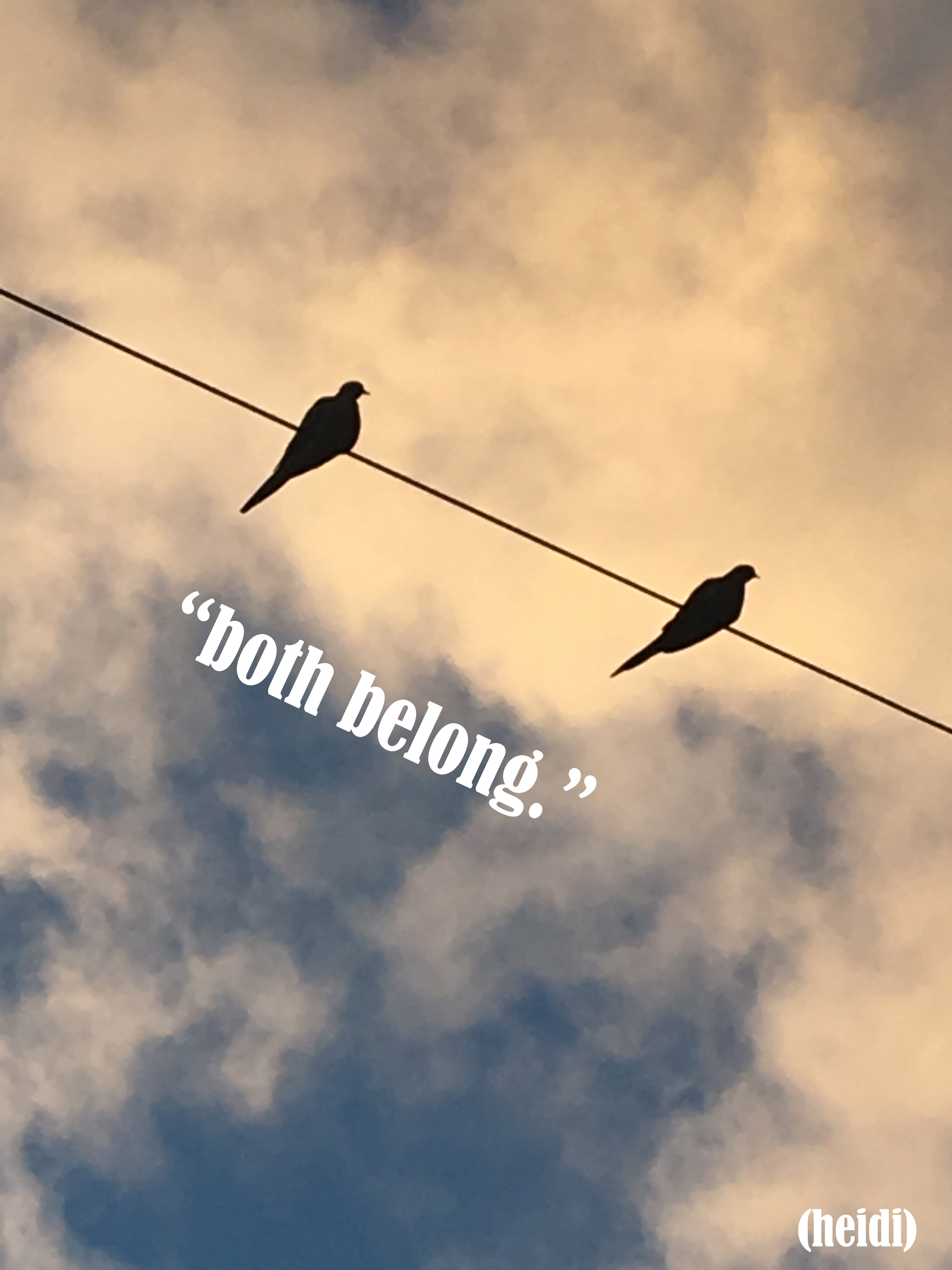
She surrounded herself with flowers and loved her garden. She made her table a magnet for family and friends. She did not sit and complain, she had no time for woe-is-me. She found opportunities to give and engage. Story after story of a woman, even in the heat of cancer, while awaiting the results of the latest scans that would determine the number of days she would have on earth, turned trips to the doctor into opportunities to shop with her daughters. Lunches. Expeditions to a beloved bakery. Create the extraordinary in the simple moment, regardless of the circumstance. We heard again and again these companion phrases, “She chose love.” The pain and the love, “Both belong,” Heidi said.

In an intentional life, one does not negate the other. Tragedy and triumph. Devastation and joy. It’s a decision. Where we focus will determine our experience of life. Nancy stood in her pain and uncertainty; she had every opportunity to become bitter. Instead, she focused on love. She created it. Nurtured it. Grew it. Offered it. She didn’t deny her pain. She held space for it in a greater container.

It was apparent in the laughter evoked in the stories told, it was apparent in the generosity of the service we experienced. This was not a Hallmark movie. It was a celebration of a life of texture, of impossible mountains to climb and of enormous blessings. It was the lesson Nancy lived because it was woven through every story told about her. “It’s what she taught me,” Heidi said, “Both belong.”

read Kerri’s blog post about BOTH BELONG

Look After [on Merely A Thought Monday]

Mike and I exchanged text messages. His mother recently passed and his clan interred her ashes a few days ago. We held services for my dad last week. Columbus’ ashes will find their final resting place in the spring.

Mike is heading for the ocean. Before leaving Colorado, I had to stand in the mountains. Both are places of infinity. Stand in our smallness. Realize the ‘bigness’ of life.

What do we do after…After.

John Irving wrote that we lose people, not all at once, but in pieces. I think we find them in pieces, too. There is so much to discover in the After. Stories are told. Quiet is necessary. An anchor goes missing and then, bit by bit, is rediscovered. Inside.

After. Bit by bit.

read Kerri’s blog post about AFTER

Compose [on DR Thursday]

Many years ago I attended a workshop facilitated by Sam, a brilliant landscape painter. I was delighted and amused when he demonstrated his technique. Rather than paint what he observed, he took great pleasure in rearranging the elements. He moved the trees, altered the hills, relocated the barn. He laughed while mixing up his elements. His eyes sparkled with mischief. Rather than a workshop on painting, the day became an exercise in joy-in-art. Seeing and playing with what we see.

This morning I read that the word ‘composition’ means “putting together.” Definers-of-art-terms associate composition with freedom. “The artist has freedom when choosing the composition of their artwork.” It is a mistake to believe that compositional freedom is the sole province of an artist. If the mind is a canvas then thought is a composition. It is patterned and composed. Arranged and rearranged. We choose where we place our focus. Point-of-view is cultivated, it is not a default setting. We design the story-we-tell-ourselves-about-ourselves. And, then we project it onto the world.

The trick in both art and thought composition is not to wear ruts in the road. Sam was joyful in his art because he was constantly challenging and engaging with what he saw. Art was fun, not morbid tradition. Art was delight-full, not rule-bound or laden with the pressure to capture. Recall that stepping out of the rut was the first lesson in Julia Cameron’s The Artist’s Way. Morning pages and artist’s dates are meant to both see the ruts and open new paths. The same process applies to the thought-canvas. See the rut. Step out of it.

As Sam taught me so many years ago, seeing and playing with what we see begins with letting go of what we think we see. It begins with a blank canvas, an unfettered mind, and the freedom to choose the composition.

read Kerri’s blog post about COMPOSITION

Unfettered ©️ 2018 david robinson

Offer The Chair [on Flawed Wednesday]

“Indeed, the effect of the forum is all the more powerful if it is made clear to the audience that if they don’t change the world, no one will change it for them.” ~ Augusto Boal, Games For Actors And Non-Actors

Many of my pals in the theatre turned their noses up at me when I began doing work in corporations. They thought I was yet another theatre artist doing improvisation-games with the terminally neck-tied. I was not. My work was more in the tradition of Augusto Boal than Keith Johnstone. Some of the best plays I’ve ever facilitated, some of the most profound pieces of theatre I’ve directed and witnessed, happened in board rooms, classrooms or conference spaces. Here’s how I know: the actors and audience were one-and-the-same. Their play was personal. When they left “the theatre” they did not leave the nice story behind and end the evening with a cocktail. They were disrupted. They had seen something that could no longer be ignored or deflected. The hard work was about to begin.

People yearn. People entrench. People plant their flags and claim the most ridiculous territory. I’ve seen teachers come to blows over an overhead projector. I’ve seen lawyers undermine colleagues to gain dominion over a swiveling chair. And, the chair or the projector are never really the issue. The issue is usually an abstraction. Pecking order. Boundaries. Alliances. People have killed each other over a pair of shoes. It’s not the shoes but the status the shoes represent. Abstraction and illusion.

People are generally unconscious about the reasons beneath their passions. I’ve met a score of dedicated meditation practitioners who meditate to control their thoughts rather than realize them. Once I led a group of teachers through the ritual they enact each morning before the arrival of their students. The question was, “What are you preparing to do in your day?” Their answer was unnerving and revolutionary: they were preparing to control the kids. Teaching and learning were secondary.

We are witness to a country-wide communal piece of theatre, an unconscious play. The issue is not the mask. The issue has never been the mask. The issue is, I suppose, people feeling out of control, imposed upon. Fearful. They are, with their bare faces, making a stand. Drawing a line in the sand. That “no one can tell me what to do” might as well be “I am losing control over my life.”

And, as is always the case, as with the office chair and the overhead projector, refusing to don the mask does not really address the real issue, it merely deflects it. The energy and action is focused on non-sense. And when non-sense rules the day, the action taken actually brings about the thing-most-feared. Loss of control. The pandemic continues, the children are being taken, the economy suffers, the community fractures. It’s a lengthy list.

The lesson in the office chair wars and the overhead projector games is always the same. No one wins. Everyone loses in a toxic tug-of-war. The chair might be yours today but it will be theirs tomorrow. The game only ends when one of the players offers the chair to the other or the projector becomes a reason to share. The same will be true of the mask wars. People will die, the pandemic will continue until the mask becomes a generosity. Then, low-and-behold, the virus will abate and real control over our destiny will be within our grasp.

I hope that, like the lawyers or teachers who were brave enough to walk into the real story, to stand face-to-face with a dysfunction, that we meet our story and ask, “Why would so many sacrifice so much over a little piece of cloth?” An overhead projector. A pair of shoes. A chair that swivels…

read Kerri’s blog post about MASKS

Choose [on Two Artists Tuesday]

“It’s a serious thing just to be alive on this fresh morning in this broken world.” ~ Mary Oliver

Were I to have been born in an earlier century I would not be alive today. Twice on my life-path doctors have declared that, “You are now a miracle of modern medicine.” Leeches and blood-letting would not have cured what ailed me.

This thing called ‘science’ is what gave me more days of life. It is the same science that developed vaccines for a pandemic but also made possible the technology that makes mass-media-misinformation possible. Here is the medicine. Here is the disease. It is exactly as Sophocles wrote: Nothing vast enters the life of mortals without a curse.

One morning, deeply tired, I arose to go do a job that I did not like. It was a means to an end and I dreaded the day ahead of me. Stepping out the door, the cold morning air stopped me in my tracks. It slapped me awake. The air was crisp and clean, the neighborhood was quiet. The light in the sky was brilliant. I drank it in. I vowed never again to dread a day of my life. In truth, I had no idea what the day held for me. Why then, would I story my day with a frame of dread? Why tell myself a tale of just-getting-through-it? Why not open to the possibilities of surprise and miracle? Why not embrace the already-stated-obvious-thing: I had no idea what the day held. That simple fact would be true every single day of my life. Dread was a choice, not an inevitability.

To be alive on this fresh morning. It is a serious thing. In this world, broken by the little story of us-and-them, the tiny tale of power-over. Choices. The miracle of the new day is present whether it is seen or not. We can cloak it in dread or gratitude, in support or division. It doesn’t care either way. The miracle of the new day, the gift of being alive on this fresh morning in a world that is broken or healed, whole or fragmented – it all depends upon the story-frame we wrap around it. The story we tell is a choice, not an inevitability.

read Kerri’s blog post about JUST TO BE ALIVE

Meet The Frame [on DR Thursday]

“There are people who prefer to say ‘yes’ and there are people who prefer to say ‘no’. Those who say ‘yes’ are rewarded by the adventures they have. Those who say ‘no’ are rewarded by the safety they attain.” ~ Keith Johnstone

A violent storm blew through so we spent the night hunkered down in the basement. We had very little sleep. Sleeplessness always leads me to moralize and for that, I apologize.

A frame of reference is a powerful thing. Experiences are interpreted through a frame of assumptions. We are witness to a time in which verifiable reality is denied because it doesn’t jive with the tribal frame.

Master Marsh passed along this quote from E.O. Wilson’s Sociobiology: “(Humankind) would rather believe than know.”

Knowledge often challenges the frame. That is the point of knowledge. Growth. And growth is always a challenge to what was formerly believed possible.

It is somehow easier to lapse into a conspiracy theory, demonize an other, deny what is indisputable, than it is to allow that the frame is just that, a frame. It’s not a truth. It’s a context. It’s a binding agent. Culture is a frame of reference. Religion is a frame of reference. What we believe of ourselves is not a fact. Identity is a frame of reference. Democracy is a frame of reference. Autocracy is a frame of reference. Supremacy is a frame. Equality is a frame. Every-man-for-himself is a frame. Brother-and-Sister’s-keeper is a frame.

None are truth. Frames are creations. Agreements. Aspirations.

Frames that allow for challenges, for growth, are sustainable. Those that do not, those that deny insight, fact, data, new knowledge, those that are threatened by opposing-point-of-view, inevitably collapse in their denial.

The fire burns. A garden hose is not an effective defense, regardless of belief. Temperatures rise relative to emissions. Rain forests disappear. A lie undermines the foundations of democracy. Believe it or not. Harry Truman sat in his cabin nestled into the mountain called St Helens. Despite repeated appeals from fleeing neighbors, repeated rumbles and tremors, warnings from scientists and safety personnel, he believed he would be safe, that his mountain would never erupt. Traces of Harry have never been found.

So it goes with the denial of believers. Frames held too tightly blind rather than reveal.

Every artist knows the transformative power of a frame. A frame can make almost any scribble look substantial. A cheap frame can diminish the greatest masterpiece.

New knowledge meets an old frame. Growth or entrenchment? Blind acceptance or emerging possibility? Yes? No? Both?

read Kerri’s blog post about FRAMES

held in grace: surrender now ©️ 2016 david robinson