Ask A Better Question [on Merely A Thought Monday]

This may be the height of cynicism but I don’t think so. Suddenly, as if dinged by a magic wand, we’ve entered that time of year when people remember to be kind. “After you,” the woman said, when I gestured for her to go first. The check out line was long so I had ample opportunity to witness the instantaneous return of the “After you!” It was ubiquitous. People were thinking of the needs of other people!

Later, we came to a four-way stop and everyone at the intersection waved for the other drivers to go first “Wow!” I exclaimed, “Just like the old days.” In my one-day anecdotal sample set, we’d just experienced more public generosity in an afternoon than we’d experienced in a very long time – twelve months to be exact.

It is possible, for the people in a nation newly-priding-itself on the depths of its divisions, to be considerate, one-to-the-other. If we are capable of a ritual-compassion-practice every year when Santa is looking, I have to believe that we can muster up some kindness and generosity of spirit in the eleven month gap between holiday seasons.

It was the day after Thanksgiving so it’s possible that the crowds were high on tryptophan, that the good mood and kindness I witnessed was turkey-induced. But, I don’t think so. I suspect the turkey consumption simply demarcates the time when we turn from our aggression-fantasy and consider our better nature. It simply feels better to lend a hand, to help another than it does to drive on top of someone’s bumper.

I appreciated the turn-of-question Kerri found in an article in Inc. magazine: instead of asking yourself, “What am I thankful for,?” a better question is, “What will I do to make others thankful?” The first question is a me-me-me question. The second turns the eye out, it first considers the needs of other people. It requires action, doing. What we experienced in the store, what we experienced at the four-way-stop, was steeped in asking the better question.

Sometimes the change we seek need not be legislated or debated or strategized; sometimes it is no more or less difficult than asking – and then practicing – a better question.

[Even though we’d hidden the store on our website, we’ve lately had a small run on Be Kind buttons. That, too, gives me hope that others out there feel as I do: a better world is not so far away. It’s as close as an act of kindness]

read Kerri’s blog post about A BETTER QUESTION

Dump The Suit [on DR Thursday]

“When you are content to be simply yourself and don’t compare or compete, everybody will respect you.” ~ Lao Tzu

Lately, I’m on a Lao Tzu quote kick. Have you noticed? An advocate for a simple life, his words – or those attributed to him – appeal to me at this moment in my walk.

The outstanding characteristic of my working life is that I have mostly been a sore thumb, the person in the collective who doesn’t belong to the collective. That’s been my value: I am the consummate outsider. I do not sit on the mountain so I can more clearly see the mountain. The alternative perspective. I’ve not always found that to be a comfortable role. For instance, alternative perspectives are invited into conversations but the alternative perspective, when voiced, is rarely welcome. The first response to the alternative perspective is almost always an emphatic whisper, “Conform!”

I have, my entire life as the sore thumb, been told that, “Our people will never do that!” or “They don’t think that way, therefore you must conform-modify-edit…” The emphasis is placed squarely on the limit, the notion that “They can’t…” or “They won’t…”

And, I’ve never found that to be true. In fact, that’s precisely the perception that a sore thumb is hired to challenge. “They” can. “They” will. The job of the alternative perspective is to emphasize the possible, to open paths to the not-yet-imagined, to the revelation of, “We didn’t know we could do that.” Or see that. Or feel that.

In order to walk in an alien world, the sore thumb necessarily steps into the unknown. The first step is to listen and learn: to open to the possible within themselves, to challenge the inner-limiter. The alternative perspective lives on a two-way-discomfort-street with their client.

It is never comfortable to “not know.” It’s never comfortable to say, “I have no idea what that means.” However, it’s a great exercise, a necessary practice. And, it’s actually what the alternative perspective is paid to do and to model. “We didn’t know we could do that,” are words that come after a step into discomfort, a step beyond the known limits. “We step together because we both know how this feels.”

The alternative perspective is never right or wrong, it is simply an alternative. “These are the patterns I see. They may be useful or not.” Conformity bristles when the unknown beckons. Conformity is safe, and the emphatic whisper, while meant to maintain comfort for all, is the line that a sore thumb is hired to help the whisperer cross, “The possibilities we seek live beyond this line.”

The first day I put out my consultant shingle, I bought a suit. It’s what I thought I was supposed to wear. I bought my suit because I’d snagged a client, a financial advisor who wanted me to work with his staff. He’d seen my work – he’d seen me work – in another context. After the job, he asked me, “What’s up with the suit?” I’d always been told by well-meaning teachers that I should “dress for the job I wanted,” so I told my client that I’d dressed for the job. He gave me some great advice: dump the suit. “I want you to show up as you are, not as the person you think we want to see.”

His words became my mantra.

Truth: I hated that suit. I felt like an imposter wearing it. My client gave me a great gift. Be content to be yourself. Challenge the inner-limiter. Inner-limiters are very loud, and like outer-limiters, are generally not worth listening to; they will always advise you to conform, say nothing, and put on an ill-fitting suit.

[Happy Thanksgiving]

read Kerri’s blog post about GOURDS

tango with me © 2018 david robinson

Throw Some Light [on KS Friday]

“The principles of true art is not to portray, but to evoke.” ~Jerzi Kosinski

Out of seeming chaos, pattern is found. And, from pattern, chaos is born. It’s a creative cycle. I spent some time this week swimming up the river of systems theory, synthesis instead of analysis. The means of production in an agrarian economy; the means of production in an industrial economy; the means of production in an information economy. The relationship between the methods and materials, the behaviors and the purpose, systems take on a life and energy of their own. The toil to feed more people led to toil to automate to relieve manual toil, led to automation to relieve intellectual toil, will lead to… we can only imagine. And, we do imagine: imagination is the relationship between the present and the future. Stand back and you’ll see, amidst the mess and chaos, we attempt to evoke a better world.

It is not a coincidence that a banana taped to the wall is considered art in an age in which Tucker Carlson is considered a source of truth. Ironically, in the golden age of information, we are befuddled by vapid minds and empty suits. Bananas and duct tape. Shock without substance can only evoke anger and will illuminate nothing. Anger for anger’s sake can only destroy. There’s no nourishment in all of this anger candy but it is certain to lead to national-diabetes and rot our teeth.

Marcel Duchamp, at the beginning of the last century, entered a toilet as sculpture in an art exhibit. He lived and worked in the age of industry at the threshold of mass production. His gesture had purpose and aesthetic framing. What was formerly craft and individual creation was now stamped into being on an assembly line. That’s old news to us but, in his time, it was a shocking revelation. A world war was raging. The collision of old practices meeting new technology was playing out on the battlefield. His exhibit entry evoked questions about loss and gain in the dawn of a new world order.

Sometimes it seems that we are spiraling into chaos. Polynices and Eteocles, brothers who will not compromise, kill each other in a battle for dominance. All lose. A father’s curse fulfilled. In our great art, the work that evokes truth and throws light to our hearts and minds, we have all the guidance we need – if we choose to pay attention. Yesterday I wrote to Mike that it seems we will need to walk the path of Romeo & Juliet: “Two households, both alike in dignity…”will lose their children to violence rather than sit down at a table and earnestly talk. And, when it is too late, when the primary is lost, the formerly indignant will sit and mourn together.

Chaos. Pattern. Sometimes the pattern is chaos. The children die. The mother takes her son across state lines with a big gun and pretends, after he murders people with his big gun, that his crime was self-defense. Bananas taped to a wall. A judge who broadcast to all that a guilty verdict might trigger his decision for a mistrial. He’ll just wait and see if he agrees with the jury. So, here we are. Lady Justice takes off her blindfold and takes sides. Is there a more profound statement of ethical collapse? In the age of information, misinformation gets equal billing; anger-candy.

What might Duchamp put on his pedestal today? What might evoke an honest conversation, throw some light and love, on what is lost and what is gained?

read Kerri’s blog post about FIRE AND SMOKE

Kerri’s music is available on iTunes and streaming on Pandora

Decide To Learn [Flawed Wednesday]

[No image today. My technology is having a rough morning]

I spent my day yesterday thinking about lines of perception. I’ve known for a long time that where a focus is placed will largely determine the dynamic reality, the movement, that is created. For instance, a focus on opposition will always produce a chaotic, explosive pattern. The moving energy locks up, tension builds, explosion. Repeat again and again. Focus on the relationships, the spaces between, and the movement, the energy, will harmonize around a common center. The behavior of a system is visible if you know where to look.

Points. Spaces between. Analytics or Synthesis? Break it into parts or look at the whole. Is it a particle or a wave? Both/And.

Tom used to say, “Teaching is a relationship.” It’s not about the material-to-be-covered. It’s never about the test. It’s always about the spaces between. Learning, at its best, is not about coverage. It’s about incorporation. It’s about meaning made from relevant experience. Experiences made relevant.

Every action has an intention, even if the intention is to stir the pot, to see what happens.

A few blocks from our home, outside the courthouse, protestors face each other across a perceptual dividing line. The energy is locking up. Tension is building. Last year a boy, too young to legally order a beer in a bar, legally brought a big gun to a protest. His mom brought him to the protest, big gun and all. He killed two people and maimed a third just a block or two from where he now stands trial. In the year since, he has been made a symbol, a well-financed icon of those who desire a dividing line. The pressure builds, just as the system demands. We await the explosion. It will be here, a few blocks away, or elsewhere, but it is coming just as the system requires.

There’s a less understood truism when the focus is placed on the points & oppositions: the tension builds and the explosion happens again and again because no one ever learns. It’s a repetitive pattern that perhaps feels like progress but is actually an eddy. Empty movement.

The only way out of the eddy is to attend to the relationships, to turn the focus to the spaces between.

read Kerri’s blog post about DIVIDING LINES

Stand In Time [on DR Thursday]

Stephen Hawking asked why we remember the past but not the future. Yesterday, in the middle of a meeting, I received a slack message with a sentiment from Russ Ackoff: entrepreneurs stand in the future and look at the present. I was fascinated by an article by Wade Davis, writing about a culture that experiences time as movement backwards; we row our way into the future.

Declan Donnellan writes that it is impossible to try and be present because we already are present. We live in it. We have to try very hard not to be present. In fact, we have to split ourselves in two halves. One looking backward. The other looking forward. We are, each and every one, Janus.

It is the time of year that time changes. It’s an odd ritual to “fall back” in time. What was 5 o’clock will soon be 4 o’clock, not because of a strange universal movement between planets and stars, but because we say so. A few states in the union don’t participate in the ritual so their time stays the same.

Time on a line. So many different realities, even in the most basic experience. Constructs of time.

I’ve read that old age is a return to childhood. Many, many great thinkers and writers from many disparate cultures tell us that we will journey through life and arrive where we began. The destination is ourself. Have you ever tried to describe your self and found the task impossible? Words simply cannot reach that level of complexity. There is a notion popular in the self-help world to define your life mission, your single life purpose. It’s meant to give you focus-of-action and certain-location on your line of time. It is also nearly impossible to articulate and becomes an exercise in metaphor selection. I’ve smiled knowingly as people in my past have asked, “Is this my mission or am I making it up?” The answer to both is, of course, yes. In a more universal peek, the exercise is meant to take you one more step around the circle that will bring you back to your self.

When I was doubting myself, judgmental because I “didn’t know” what I was doing, Quinn pointed to the tallest building and said, “The person on the top floor is just making it up, too.” He was standing in my future, looking back.

It’s just a matter of time.

Just.

read Kerri’s post about TEA LIGHTS

Greet The World © 2011 david robinson

Place It In The Hollow [on DR Thursday]

For some reason, people need to leave a trace of their passage. We paint on the walls of caves. We erect monuments to ourselves and our heroes. We build cairns to mark the way for those who come behind; we build cairns so others will add stones to the marker. We put plaques on benches and engraved bricks in walkways. We graffiti bridges and walls. Banksy has made a fortune tracing his masked passage.

Growing tired as we hiked up the trail, we sat on an old log. We looked over the valley, turned our faces to the sun. And, as we stood to continue up the trail, Kerri pulled a sharpie from her bag. We left two small dots on the log. “We were here.”

Our work in the world not only can be a marker, it is a marker. Every little action is a stone on the cairn: we contribute to the whole whether we like it or not. The person who delivers packages to my door makes my life better. Easier. The score of people who created this computer, invented this software, manufactured the chip that makes it all work, have made my life better. Someone coming behind us will see the cairn we’ve constructed and add to it. Improve upon it. The first computer I touched was a toy compared to this miracle sitting on my lap.

I’m an artist and sometimes wonder if my paintings will live beyond me or will they end up in the Goodwill as so much used canvas. I hear the advice, so often offered to me: “Yours is to paint them, not decide what happens to them.” Too true. Mine is to make the offer. I have no control over the acceptance.

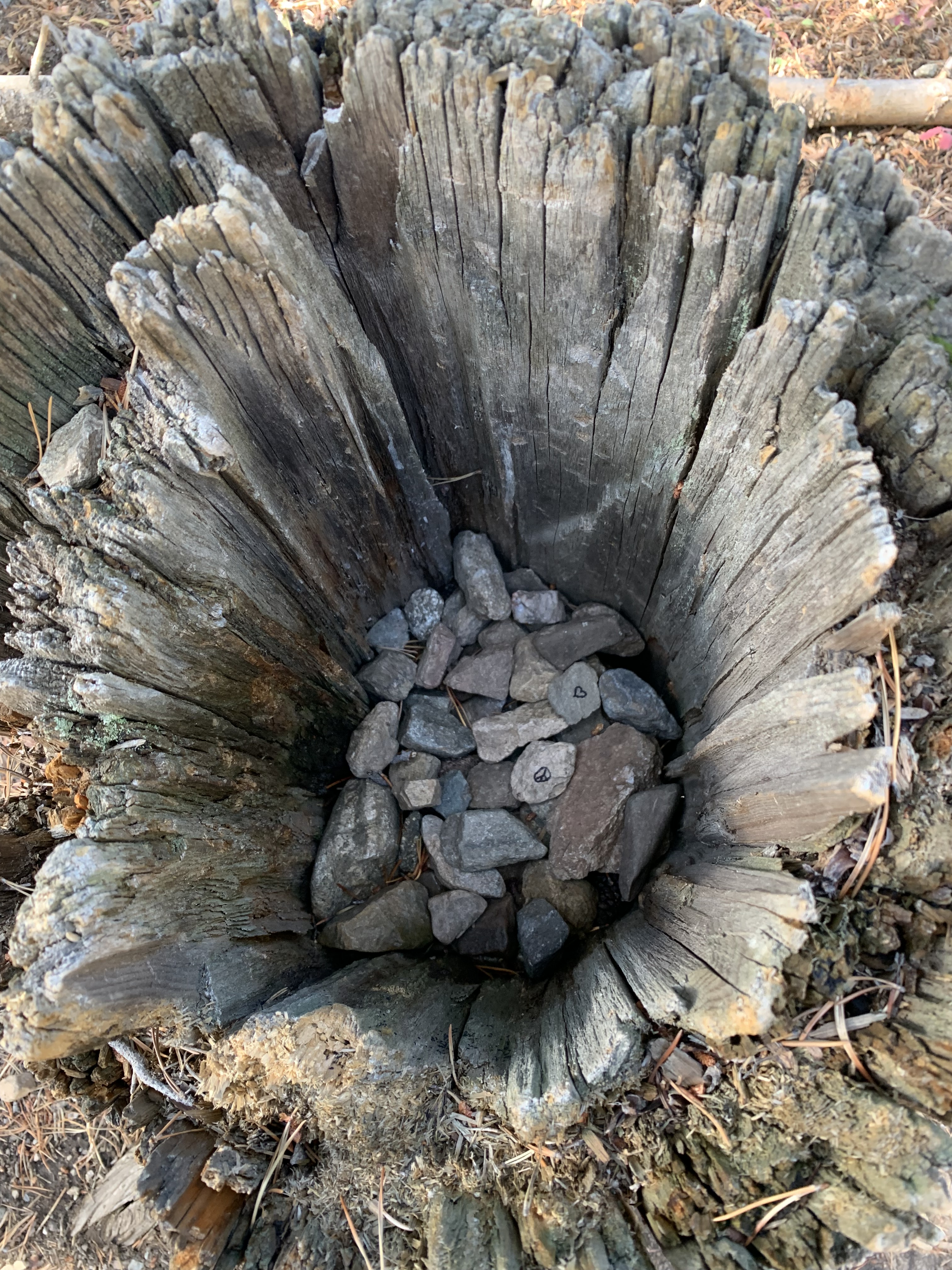
Returning down the trail, Kerri peered into the hollow of a stump. It was filled with stones! Hikers, just like us, had left a note that also served as an ancient invitation: I was here. We picked up stones, the sharpie came out of the bag, scribbled a heart and a peace sign on our rocks before placing them in the hollow. “Do you think anyone will see our stones?” Kerri asked.

An ancient question. Deeply human. Heart and Peace.

read Kerri’s blog post about THE HOLLOW

three graces © 2012 david robinson

See Through It [on Flawed or Not-So-Flawed Wednesday]

Light passes through. Transparent. Trans; across or beyond. A prefix of movement.

Last night we had snacks with some pals. Our conversation turned to politics and how resistant we are as a nation to tell our full story. Opaque. The opposite of transparent. Impenetrability of light. “It’s just history,” someone said. “History is history.”

Narrative. With a point of view. The winners of wars tell one story. The opposite side has another tale to tell. History is never just history. A country as deeply divided as ours is warring over its history. What happens if we actually tell our full story? Who are we if we acknowledge our shadow? Shine the light or snuff it?

Boiling our times down to the essence, we’d arrive at these two words. Transparent. Opaque. Isn’t it always the way that people who have something to hide proclaim transparency? Isn’t it always the case that people who lie claim to be holders of the truth? Opacity is a tricky business.

I recently watched again Simon Sinek’s first TED talk. He said, “There are leaders and there are those who actually lead.” We could call it a simple truth: we know those who actually lead because they boldly shine-the-light. They are not afraid of being seen or seen through. They are, however, a threat to those who call themselves “leaders,” those that fear the revelations of light. Reveal-ations. Those leaders will fight to-the-death to maintain their opacity. They will sacrifice the greater for the lesser if necessary to remain opaque.

We are watching – and participating in – history being written. Our question – as has been true from the beginning: will we shine the light without fear of transparency or hide behind the wall of opacity? It’s just history.

read Kerri’s blog post about TRANSPARENCY

Surface The Pattern [on DR Thursday]

Steve read my book and said he didn’t really understand the thing about pattern. His comment at first surprised me but then I realized he was actually reinforcing the point: we are unconscious to our patterning. We think in patterns. We see in patterns. Culture is pattern. Pattern is invisible and making it visible is a necessary first step in change processes.

The people who surface pattern are often seen by the mainstream as deviant or rebellious. Women demanding equal pay are attempting to make a pattern visible. The BLM movement is attempting to make a cultural pattern visible. Shining a light on longstanding oppression is never welcome in the halls of power.

The people who work to repress the visibility of cultural pattern, conserve the norms, generally claim a righteous superiority. They are keepers of the culture and feel threatened, even victimized, by the sudden visibility of cultural pattern. Exposure is always a threat to the existing pattern and no one relinquishes power or privilege without a fight. The current raft of voter suppression laws – made possible by the fantasy of a stolen election – is a great example. The Big Lie is a textbook example of how far people in power will go to hide a privilege-norm. It is, for us in these un-united states, not a new phenomenon; it is a longstanding well-guarded pattern.

Change happens when the patterns are surfaced. There will always be a tide that rises to extinguish the light of exposure. In the long run, those hardy voices that were, at first, branded as deviant or dangerous, we come to honor and respect. They refused to be silenced. We claim them as our heroes. MLK. Gandhi. Rosa Parks. Cesar Chavez. Susan B. Anthony. There are so many. It is no easy task to surface the patterns. The path of a light-shiner is dangerous and difficult.

John Lewis gave great advice for those dedicated to surfacing unconscious patterns: “Get in good trouble, necessary trouble, and help redeem the soul of America.” He also said that, “…transformation will not happen right away. Change takes time.”

Opening eyes to unconscious pattern, to what is obvious yet unseen, is an artist’s path. Seeing beyond what you think you see…seeing beyond your field-of-dedicated-belief, being curious enough to question what you are being told – can you imagine anything more necessary – more vital – in our age of rabid-misinformation and desperate-pattern-suppression?

read Kerri’s blog post about PATTERN

in dreams I wrestle with angels ©️ 2018 david robinson

Compose [on DR Thursday]

Many years ago I attended a workshop facilitated by Sam, a brilliant landscape painter. I was delighted and amused when he demonstrated his technique. Rather than paint what he observed, he took great pleasure in rearranging the elements. He moved the trees, altered the hills, relocated the barn. He laughed while mixing up his elements. His eyes sparkled with mischief. Rather than a workshop on painting, the day became an exercise in joy-in-art. Seeing and playing with what we see.

This morning I read that the word ‘composition’ means “putting together.” Definers-of-art-terms associate composition with freedom. “The artist has freedom when choosing the composition of their artwork.” It is a mistake to believe that compositional freedom is the sole province of an artist. If the mind is a canvas then thought is a composition. It is patterned and composed. Arranged and rearranged. We choose where we place our focus. Point-of-view is cultivated, it is not a default setting. We design the story-we-tell-ourselves-about-ourselves. And, then we project it onto the world.

The trick in both art and thought composition is not to wear ruts in the road. Sam was joyful in his art because he was constantly challenging and engaging with what he saw. Art was fun, not morbid tradition. Art was delight-full, not rule-bound or laden with the pressure to capture. Recall that stepping out of the rut was the first lesson in Julia Cameron’s The Artist’s Way. Morning pages and artist’s dates are meant to both see the ruts and open new paths. The same process applies to the thought-canvas. See the rut. Step out of it.

As Sam taught me so many years ago, seeing and playing with what we see begins with letting go of what we think we see. It begins with a blank canvas, an unfettered mind, and the freedom to choose the composition.

read Kerri’s blog post about COMPOSITION

Unfettered ©️ 2018 david robinson

Be Indeterminate [on Two Artists Tuesday]

Through the good graces of our tomato plants, I’ve learned a few new concepts this summer. Determinate and indeterminate. Bush and vine. Determinate tomato plants (bushes) are bred to stop growing. Indeterminate tomato plants (vines) will grow indefinitely or until the weather conditions “are no longer favorable.”

Our plants are indeterminate. Each morning, Kerri visits our planting bench and checks her tomatoes. 20 taught her a few simple tending-rules and now, each morning, there are more and more little indeterminate miracles moving backward along the color spectrum, finally arriving at a brilliant red.

Life is indeterminate.

My new tomato-terms come just in time. My current project has me revisiting my past life as a teacher and facilitator. If I apply my new terminology to people I can’t help but think it is the lucky few who survive so much dedicated energy to stop the learning-mind in the name of education. The natural output of a system designed on manufacturing principles is to truncate the questioning mind by patterning the notion that there is a predetermined answer. It becomes a game of finding the answer that teacher wants – a closed loop – instead of an incitement of curiosity. Children are excellent game players and translate the gaming pattern into their now-dulled-adulthood.

There is a cycle apparent in all genuine learning processes. It begins with discontent. Curiosity is a movement born from some form of discontent. It leads to questioning. Questioning always leads to disturbance (the interruption of the known). And, just like that, out of the disturbance something new is seen, call it a breakthrough, call it an insight, call it new learning…Many classrooms – certainly the systems – are designed and organized to keep disturbances to a minimum. The mantra is ‘control’ rather than ‘inspire curiosity.’ Business has the same dedication.

We’re taught that disturbance is the sign of something wrong rather than the crusty earth breaking to reveal new verdant life.

Discontent leads to questioning, leads to disturbance, which leads to breakthrough. And, an insight will always lead to discontent. It’s a story cycle, where yearning meets obstacle. Learning is by definition uncomfortable and at its best when it is uncontrollable.

Last week I attended a meeting. My two companions and I brought our homework back to the team. One was content. The other two of us were filled with discontent. The leader of the session, at first, was angry. He did not get the result he’d anticipated from his exercise. “So, you two are telling me this process was worthless!” he raged. We’d spent our week questioning instead of answering. Discontent. Questioning.

“No! It was great!” we chimed in chorus. “Look at all the good information we uncovered!” It was a mess. Big disturbance. We cycled through our misalignment a few times, wrangling over perception and usefulness. More rage. And then…an insight. The breakthrough. All of the rage, all of the appeasing, began to flow in a single direction. A possibility took shape. A target materialized that was much better than the prescribed pursuit. Energy filled our zoom-osphere. Laughter. Excitement.

Learning. Indeterminate. Open questions. Hot pursuits.

I am drawn to and surrounded by the dedicated indeterminates; those who refuse to stop learning: David, Mike, Horatio, MM, Bruce, 20, Judy, and yes, Kerri…I am a very fortunate man to be surrounded by so many tomatoes moving their way backward along the color spectrum, not afraid to walk through their discontent toward bigger and bigger questions.

read Kerri’s blog post about TOMATOES