Posted on November 8, 2022 by davidrobinsoncreative
“Things are not always what they seem; the first appearance deceives many; the intelligence of a few perceives what has been carefully hidden.” – Phaedrus
My first question: is this the Phaedrus from Plato’s book or a quote from the guy who hung out with Socrates? Historically, they are one and the same person but one is a character and the other the person upon which the character is based. I suppose it doesn’t really matter since either way the words are sifted through time and translation.
And, either way, they are as relevant today as when they were spoken/written. They are especially relevant on this day since today we vote.
Phaedrus, the character-in-Plato’s-book, offers an analogy of the soul as a charioteer holding the reins of two horses. One horse is good and pulls toward the sacred. The other horse is bad and pulls toward material gain. The charioteer steers them to a common center. The middle way.
Things are not always what they seem. A wild teasel. A strawberry in a skeleton costume. It was my first thought when she showed me this photo. It’s appropriate to the Halloween season-just-passed and the election-day-present.
One thing is as it seems: this nation’s soul has lost the reins of the chariot, if it ever had them. The wild teasels are run amok, their pundits loudly claiming to be strawberries. Many are deceived and deceiving. Conspiracies. Angry thorns in their mouths.
The horses pull this way and that. They are quite capable of ripping the chariot in half.
Today we vote. Perhaps it is possible to see through the seeming. Perhaps we can recover the reins and bring our divided team toward a common center? A middle way?
Posted on September 29, 2022 by davidrobinsoncreative
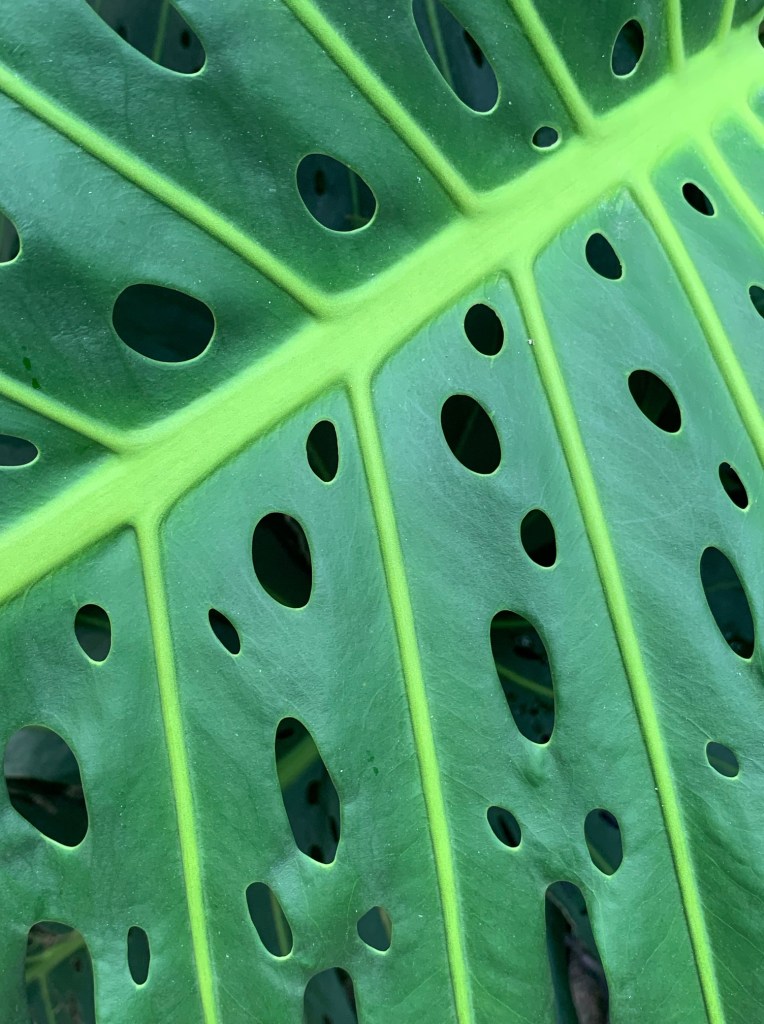
I am amazed by nature. We learned in our visit to the botanical gardens that plants in tropical climates are a study in waterproofing. Waxy leaves prevent excess water from accumulating. Holes allow water and sunlight to pass through. It’s a masterclass in protection from algae. Adaptation, not resistance. Working with rather than fighting against.
My adult life has been a meditation on whole systems – which is quite simply a study of perception. It takes a human mind to separate the leaf from the branch from the trunk from the root. Separation and categorization is how we make sense of things. Analysis requires breaking-it-down. It’s easy to forget that those distinctions are in our minds and not in the world we observe. There is no separation of leaf from rain, not really. There is movement. Concert. Equilibrium.
Understanding requires reassembly.
To live creatively is to discover rather than invent. Thank goodness for the scientists teasing apart, deconstructing, uncovering, analyzing. I would not be alive today without their passionate pursuit.
And, while the scientist dissects, the artist reassembles. The reach for wholeness, the pull toward universal experience that cuts across division…I thank goodness each day for eyes that see beyond the separations, the capacity for utter delight and awe – standing in a garden – staring at a leaf made colander over eons of time.
Breaking space with a line changes the dynamic of the entire composition. I played with those dynamics for years. Vertical breaks. Horizontal lines that read like confused measure bars, segments of inconsistent time. Sometimes the lines tilted and pulled to the past. Sometimes they leaned into the future, urging the image forward. All of those interpretations were, of course, in my mind; I have no idea how others interpreted the lines on my canvases.
We are in the season of fog. Sometimes it’s so dense that we stand on the rocks and cannot see the water. Lake Michigan is hard to hide! The fog is a worthy magician.
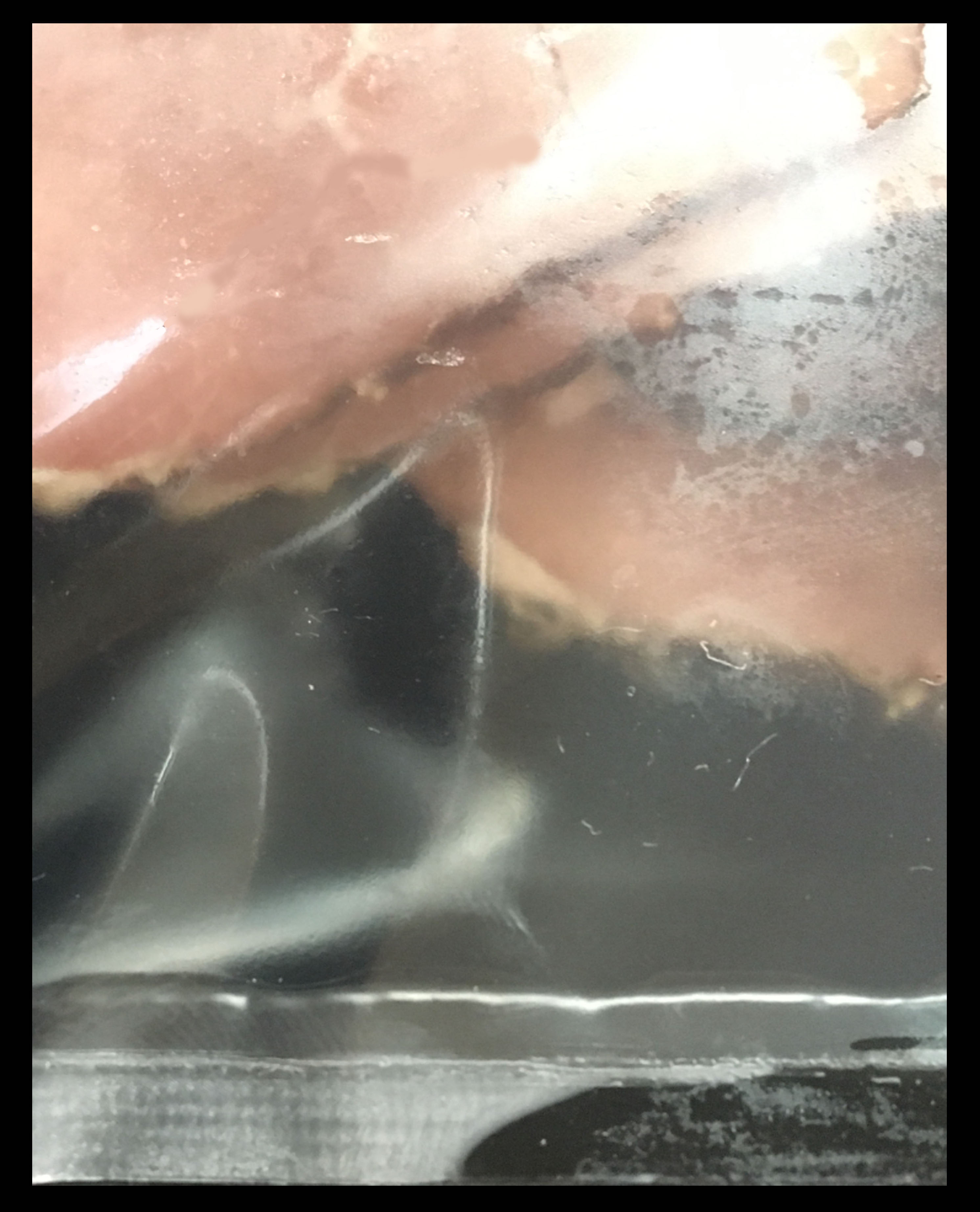
The fog-magician also has the capacity of pressing three dimensional objects into seeming flat two dimensional images. The sudden silhouetting of the world pulls Kerri out onto the deck every time. “Can you believe it?” she asks, grabbing her camera and stepping through the door and into the fog. Dogga and I watch. We are happy in three dimensions and resist the call of stepping into flatland.
When she returns to our dimension, she shows us her photographs. “I love this one because the wire made a line,” she says. “It breaks the image.”
I smile. Vertical breaks in the composition. I say, “It reads like an abstract painting.” Three dimensions becoming two, a line breaking space, capping or pulling or simply interrupting.
Jackson Pollock believed his paintings were recordings of movement. Paint dancing. Who really knows how others interpret his paintings. Beyond the curator or art historian, who cares, really? The relationship between art and audience is meant to be direct, pure. No third party interpretation necessary.
“What do you think?” she asks.
“I love it,” I say. “It makes me want to paint.”
kerri’s albums are available on iTunes & streaming on Pandora
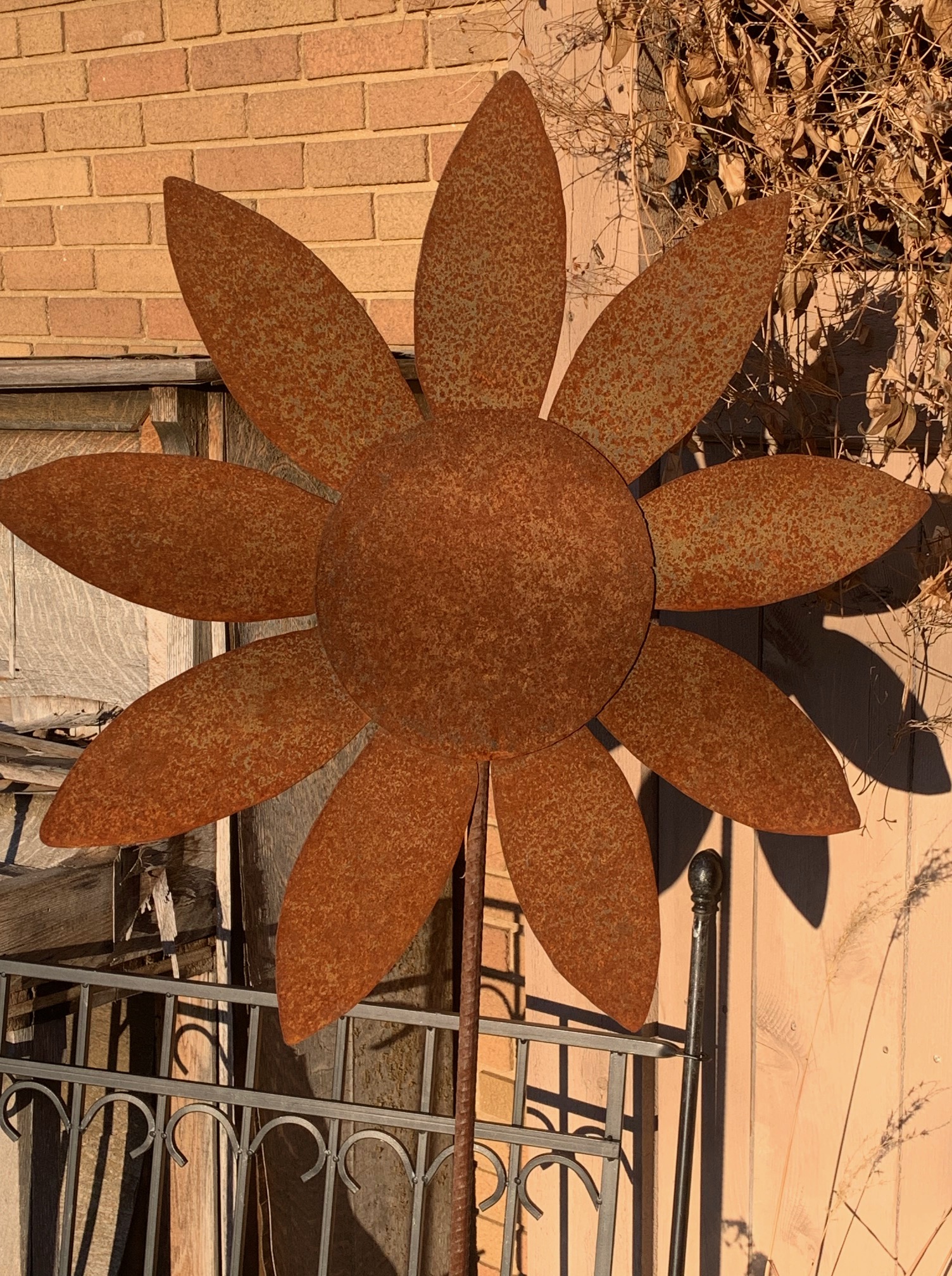
I’ve appreciated this sunflower for many years and until a month ago it never made me think of Ukraine. Now, that’s all I see. Thus, the power of a symbol. Sunflower seeds placed into the pockets of Russian soldiers by brave Ukrainian elders. “So, some good may come from your death.”
Walking through the antique mall, Brad spotted an ugly homemade sculpture. Golf balls with multiple screws protruding, spray painted and supported by wire rods. “Look, the coronavirus!” he exclaimed. Three years ago spheres with spiky knobs would have made me wrinkle my brow but never associate the shape with a virus. Now?
And masks? Will we ever see a surgical mask without feeling the divide in our nation? A confederate flag paraded through the Capitol? Members of the Capitol Police beaten with the stars and stripes; symbols matter.
Every year more and more our written communication is reimagined with emojis. Visual symbols. The new Ideogram. A thumbs up. A heart. Laughing face. Saying more with less or at the very least opening up our communication to broader interpretation. I find that I’m symbolically rolling my eyes more and more. Exclamation point. HAHA! Know what I mean? Winky face.
Leonard Shlain wrote some remarkable books about how our brains are wired by how we communicate; he posits that linear language, the introduction of writing drove us into our left brains and away from our holistic right. Perhaps in our movement back toward the ideogram we are rebalancing? A course correction or returning to center? It takes more than a few years for brains to rewire. Our descendants will, no doubt, either write books about it or communicate their thoughts through a combo platter of alphabet and pictograph.
Either way, we can only hope they grasp the meaning of the peace symbol. Or, at the very least, learn how to give it more preference than the dollar sign. Or, better yet, figure out how to make peace profitable. Can you imagine? Certainly there will be a symbol for that.
Until then, sunflowers in the killing fields. Sad face. Broken heart.
Posted on February 1, 2022 by davidrobinsoncreative
I’ve re-read his email several times. Skip’s explanation of the development of the computer. Subject/Object. Noun/Verb. Items/Action. It’s a story of cause and effect. This causes that. I’ve learned more from this single email than from my very expensive graduate degree. And, it’s sent me down the rabbit hole and I am currently in a world easily as miraculous as Alice’s Wonderland.
Does the moon cause the tides? It does if you are an English-speaker. Causation is the foundation structure of the English language. An action needs an initiator. The noun is king. He kicked. The sea rocked the boat. The moon causes tides. If you speak Mandarin, the moon and the tides are inseparable, not perceived or described as separate events but as interconnected. The same dance, differentiated forms.
Where does an action begin? A consequence end? I warned you. A rabbit hole.
Our perception of the world has everything to do with the language we use to describe it. Our creating of the world has everything to do with the language we use to imagine it. In a world where actions are separate from items, verbs from nouns, this causes that, it’s easy to believe that order is separate from disorder, cosmos is separate from earth, humans are separate from nature. Death is separate from life. Is it?
Each year that passes I’ve noticed the world of written communication includes more emojis and fewer words. Attention spans are shorter – mine, too. Tweet and text. Images carries the bulk of the message. If you could see the analytics on my blog you’d note that if I use more than 600 words, you are less likely to read what I write. We are slowly moving toward ideograms and slowly away from alphabets. Whatever will we do, what might we see, when nouns and verbs blend into image? When the eyes of dedicated separation begin to see through the eyes of interconnectivity – or, as Skip says, “When actions become central.”
It’s called a Wolf Moon, I read, because wolves are particularly loud and vocal during the first months of the year. One questioner asked if the moon causes the wolves to howl. Noun/Verb. Subject/Object.
Posted on November 25, 2021 by davidrobinsoncreative
“When you are content to be simply yourself and don’t compare or compete, everybody will respectyou.” ~ Lao Tzu
Lately, I’m on a Lao Tzu quote kick. Have you noticed? An advocate for a simple life, his words – or those attributed to him – appeal to me at this moment in my walk.
The outstanding characteristic of my working life is that I have mostly been a sore thumb, the person in the collective who doesn’t belong to the collective. That’s been my value: I am the consummate outsider. I do not sit on the mountain so I can more clearly see the mountain. The alternative perspective. I’ve not always found that to be a comfortable role. For instance, alternative perspectives are invited into conversations but the alternative perspective, when voiced, is rarely welcome. The first response to the alternative perspective is almost always an emphatic whisper, “Conform!”
I have, my entire life as the sore thumb, been told that, “Our people will never do that!” or “They don’t think that way, therefore you must conform-modify-edit…” The emphasis is placed squarely on the limit, the notion that “They can’t…” or “They won’t…”
And, I’ve never found that to be true. In fact, that’s precisely the perception that a sore thumb is hired to challenge. “They” can. “They” will. The job of the alternative perspective is to emphasize the possible, to open paths to the not-yet-imagined, to the revelation of, “We didn’t know we could do that.” Or see that. Or feel that.
In order to walk in an alien world, the sore thumb necessarily steps into the unknown. The first step is to listen and learn: to open to the possible within themselves, to challenge the inner-limiter. The alternative perspective lives on a two-way-discomfort-street with their client.
It is never comfortable to “not know.” It’s never comfortable to say, “I have no idea what that means.” However, it’s a great exercise, a necessary practice. And, it’s actually what the alternative perspective is paid to do and to model. “We didn’t know we could do that,” are words that come after a step into discomfort, a step beyond the known limits. “We step together because we both know how this feels.”
The alternative perspective is never right or wrong, it is simply an alternative. “These are the patterns I see. They may be useful or not.” Conformity bristles when the unknown beckons. Conformity is safe, and the emphatic whisper, while meant to maintain comfort for all, is the line that a sore thumb is hired to help the whisperer cross, “The possibilities we seek live beyond this line.”
The first day I put out my consultant shingle, I bought a suit. It’s what I thought I was supposed to wear. I bought my suit because I’d snagged a client, a financial advisor who wanted me to work with his staff. He’d seen my work – he’d seen me work – in another context. After the job, he asked me, “What’s up with the suit?” I’d always been told by well-meaning teachers that I should “dress for the job I wanted,” so I told my client that I’d dressed for the job. He gave me some great advice: dump the suit. “I want you to show up as you are, not as the person you think we want to see.”
His words became my mantra.
Truth: I hated that suit. I felt like an imposter wearing it. My client gave me a great gift. Be content to be yourself. Challenge the inner-limiter. Inner-limiters are very loud, and like outer-limiters, are generally not worth listening to; they will always advise you to conform, say nothing, and put on an ill-fitting suit.
Posted on November 17, 2021 by davidrobinsoncreative
[No image today. My technology is having a rough morning]
I spent my day yesterday thinking about lines of perception. I’ve known for a long time that where a focus is placed will largely determine the dynamic reality, the movement, that is created. For instance, a focus on opposition will always produce a chaotic, explosive pattern. The moving energy locks up, tension builds, explosion. Repeat again and again. Focus on the relationships, the spaces between, and the movement, the energy, will harmonize around a common center. The behavior of a system is visible if you know where to look.
Points. Spaces between. Analytics or Synthesis? Break it into parts or look at the whole. Is it a particle or a wave? Both/And.
Tom used to say, “Teaching is a relationship.” It’s not about the material-to-be-covered. It’s never about the test. It’s always about the spaces between. Learning, at its best, is not about coverage. It’s about incorporation. It’s about meaning made from relevant experience. Experiences made relevant.
Every action has an intention, even if the intention is to stir the pot, to see what happens.
A few blocks from our home, outside the courthouse, protestors face each other across a perceptual dividing line. The energy is locking up. Tension is building. Last year a boy, too young to legally order a beer in a bar, legally brought a big gun to a protest. His mom brought him to the protest, big gun and all. He killed two people and maimed a third just a block or two from where he now stands trial. In the year since, he has been made a symbol, a well-financed icon of those who desire a dividing line. The pressure builds, just as the system demands. We await the explosion. It will be here, a few blocks away, or elsewhere, but it is coming just as the system requires.
There’s a less understood truism when the focus is placed on the points & oppositions: the tension builds and the explosion happens again and again because no one ever learns. It’s a repetitive pattern that perhaps feels like progress but is actually an eddy. Empty movement.
The only way out of the eddy is to attend to the relationships, to turn the focus to the spaces between.
Posted on August 19, 2021 by davidrobinsoncreative
strange sky
“Can a shallow mind appreciate beauty?…When the mind is merely concerned with itself and its own activities, it is not beautiful; whatever it does, it remains ugly, limited, therefore it is incapable of knowing what beauty is.” ~Krishnamurti,Think On These Things
What accounts for the strange color of the sky? Smoke from the fires? A coming storm?
The quote above is only half of the thought. It is the set up for the real point to be made. A shallow mind is concerned only for itself. And, while consumed with the lesser, it misses the greater. It is the unintentional theme that emerged for me this week: losing the greater for the lesser. The baby goes out with the bathwater.
It is a matter of perception, of focus placement.
Yesterday I wrote about the judge questioning the potential juror about his capacity to experience hardship in order to keep the system going and growing. The juror entered the exchange with a self-focus and exited, admonished, with perhaps the possibility of seeing something beyond his own agenda. Perhaps.
I read that Rome fell when the luxuries became more important than the essentials. Societies fall when they can no longer discern between what is important and what is not, when the lesser is protected at the expense of the greater.
Years ago, during a facilitation, a young woman pulled herself from and exercise. She sat on the sidelines and brooded. After the exercise, during the debrief, she claimed that she was discriminated against because her team did not listen to her ideas. Initially, her team scrambled to apologize – one does not want to be accused of discrimination. We asked the team to explore the situation a bit further. Because the young woman’s idea was rejected, was she truly a victim of discrimination? It was an illuminating conversation. The problem – the real problem – arises when we can no longer discern between what is discrimination and what is not? There is terrible discrimination in our world and needs to be addressed. It can’t be seriously confronted if we are incapable of distinguishing between the rejection of an idea and laws that prevent citizens of color from voting.
In a pandemic, a mask is not a breach of personal freedom. It is not the state ripping away control of your body. It is a minor inconvenience to ensure the mitigation of a virus that is killing scores of fellow citizens. Despite the rhetoric otherwise, the fearmongering and tribe-building, wearing a mask is something done for the health of the whole. It is not unlike jury duty.
It is a matter of perception. Of focus placement. Self or other? Lesser or greater?
The rest of the quote: “Whereas, a mind that is not concerned with itself, that is free of ambition, a mind that is not caught up in its own desires or driven by pursuit of its own success – such a mind is not shallow, and it flowers in goodness. Do you understand? It is this inward goodness that gives beauty, even to a so-called ugly face.”
Pay attention to the verb. Beauty is given. Concern for the well-being of the other is a sentiment expressed and championed in every corner of the world, by all the figures we quote, elevate, and sometimes emulate. Martin Luther King, Ghandi, Abraham Lincoln, Mother Teresa,…it’s a very, very long list.
Communities thrive when they are capable of enduring hardship for each other, for the benefit of the whole. They also thrive when they hold boundaries and protect the rights of the individuals. Those two seemingly different actions are, in fact, one and the same.
Societies fall when shallow minds prevail, when they can no longer discern between essentials and luxuries, privileges and responsibilities. When personal comfort takes precedence over enduring ideals.
It’s a matter of perception. Of focus placement, and make no mistake, focus is easily led. Just like a package of pastrami mistaken for a strange colored sky.
Posted on August 12, 2021 by davidrobinsoncreative
The space around and between. Shapes that share edges. Emptiness that provides definition. In art it is called negative space. Not-the-object. In art classes, students draw the negative spaces in order to see or to learn a new way of seeing. Try it. See the holes and the space around the leaves as primary. It’s not as easy as it sounds.
Some folks use the term “air space” because they get snagged on the word “negative.” It’s a term of opposition when set next to “positive.” Yet, just as there is an electric field that flows between negative and positive ions, electrons and protons, there is a field that flows between negative and positive space. Yin and Yang. A dynamic polarity. A creative field of movement and energy. The air space is alive because of the perceived opposition. The positive space is not visible without the negative.
When I was a consultant, I used the phrase “the space between” to imply relationship. There are people. There is the space between people. Relationship is invisible but it defines the people. Relationship illuminates the otherwise unknowable individual. They are impossible to separate. In a community obsessed with nouns, bottom lines, test scores and individual rights, the verbs and the relationships often go unnoticed and unappreciated. As if the negative space didn’t matter. The space between is where the movement lives and the problems are solved. It is where new seeing is possible. It is created and creative. The word “community” lives in the space between.
Try it. Take a day and focus on the space between. See relationship as primary. You may experience a whole new way of seeing.
20 sent this image,a memorial. It makes the point.
“…the measure on ones mental health is the ability to see the good in everything. Perception is the key.” ~ Kristine Klussman, Connection
If I kept a gratitude journal, my entry yesterday would be that Bruce was happy. I could hear it in his voice. Although it had been seven years since we last spoke, we talked like we were picking up a conversation from yesterday. Life has changed dramatically for both of us.
It seems we have both reached the revelation of simple appreciation. No longer focused on the big stuff, we talked of the sweet moments, the moments that feed our souls. He asked me to describe my days and I was happily taken aback to tell the tale of walks on trails, beginning each day writing posts with Kerri, ending each day with a glass of wine. Drawing cartoons. A dog that runs enthusiastic circles. Good friends.
I am reminded again and again that goodness is not found in the world. It is brought to the world. We don’t perceive what is already “there,” we wrap what is “there” in a story-blanket. We give it meaning. And then we feel the impact of the meaning we give it. Viktor Frankel famously wrote that “Happiness ensues.” It follows. Despair ensues, too. Anger, too, if that is what is brought.
Earlier this year a friend asked how Kerri and I were doing amidst the job losses and broken wrists. I responded that our circumstance was dire. It was. It just didn’t feel that way, so full was our sense of appreciation. In the midst of a dire circumstance, we started our days writing. Good friends called. DogDog ran enthusiastic circles and made us laugh. We sipped a glass of wine at the end of each day and enjoyed our simple meals. Today, things are less dire and, although we are still standing on shaky ground, we start each day writing together. We hold hands and take walks. We breathe deeply the smell of coffee in the morning. Our gratitude for our days has not changed a bit. Good moments are everywhere.
And today, Bruce is back in touch. He is happy and his happiness, like all happiness, comes from a hard decision that took tremendous courage: he decided to see the good. To bring light. To be light. He is doing the work of savoring the good moments that he now sees all around himself.
good moments/this part of the journey is available on iTunes and streaming on Pandora

















 The Direction of Intention