Choose [on Two Artists Tuesday]

“It’s a serious thing just to be alive on this fresh morning in this broken world.” ~ Mary Oliver

Were I to have been born in an earlier century I would not be alive today. Twice on my life-path doctors have declared that, “You are now a miracle of modern medicine.” Leeches and blood-letting would not have cured what ailed me.

This thing called ‘science’ is what gave me more days of life. It is the same science that developed vaccines for a pandemic but also made possible the technology that makes mass-media-misinformation possible. Here is the medicine. Here is the disease. It is exactly as Sophocles wrote: Nothing vast enters the life of mortals without a curse.

One morning, deeply tired, I arose to go do a job that I did not like. It was a means to an end and I dreaded the day ahead of me. Stepping out the door, the cold morning air stopped me in my tracks. It slapped me awake. The air was crisp and clean, the neighborhood was quiet. The light in the sky was brilliant. I drank it in. I vowed never again to dread a day of my life. In truth, I had no idea what the day held for me. Why then, would I story my day with a frame of dread? Why tell myself a tale of just-getting-through-it? Why not open to the possibilities of surprise and miracle? Why not embrace the already-stated-obvious-thing: I had no idea what the day held. That simple fact would be true every single day of my life. Dread was a choice, not an inevitability.

To be alive on this fresh morning. It is a serious thing. In this world, broken by the little story of us-and-them, the tiny tale of power-over. Choices. The miracle of the new day is present whether it is seen or not. We can cloak it in dread or gratitude, in support or division. It doesn’t care either way. The miracle of the new day, the gift of being alive on this fresh morning in a world that is broken or healed, whole or fragmented – it all depends upon the story-frame we wrap around it. The story we tell is a choice, not an inevitability.

read Kerri’s blog post about JUST TO BE ALIVE
Meet The Frame [on DR Thursday]

“There are people who prefer to say ‘yes’ and there are people who prefer to say ‘no’. Those who say ‘yes’ are rewarded by the adventures they have. Those who say ‘no’ are rewarded by the safety they attain.” ~ Keith Johnstone

A violent storm blew through so we spent the night hunkered down in the basement. We had very little sleep. Sleeplessness always leads me to moralize and for that, I apologize.

A frame of reference is a powerful thing. Experiences are interpreted through a frame of assumptions. We are witness to a time in which verifiable reality is denied because it doesn’t jive with the tribal frame.

Master Marsh passed along this quote from E.O. Wilson’s Sociobiology: “(Humankind) would rather believe than know.”

Knowledge often challenges the frame. That is the point of knowledge. Growth. And growth is always a challenge to what was formerly believed possible.

It is somehow easier to lapse into a conspiracy theory, demonize an other, deny what is indisputable, than it is to allow that the frame is just that, a frame. It’s not a truth. It’s a context. It’s a binding agent. Culture is a frame of reference. Religion is a frame of reference. What we believe of ourselves is not a fact. Identity is a frame of reference. Democracy is a frame of reference. Autocracy is a frame of reference. Supremacy is a frame. Equality is a frame. Every-man-for-himself is a frame. Brother-and-Sister’s-keeper is a frame.

None are truth. Frames are creations. Agreements. Aspirations.

Frames that allow for challenges, for growth, are sustainable. Those that do not, those that deny insight, fact, data, new knowledge, those that are threatened by opposing-point-of-view, inevitably collapse in their denial.

The fire burns. A garden hose is not an effective defense, regardless of belief. Temperatures rise relative to emissions. Rain forests disappear. A lie undermines the foundations of democracy. Believe it or not. Harry Truman sat in his cabin nestled into the mountain called St Helens. Despite repeated appeals from fleeing neighbors, repeated rumbles and tremors, warnings from scientists and safety personnel, he believed he would be safe, that his mountain would never erupt. Traces of Harry have never been found.

So it goes with the denial of believers. Frames held too tightly blind rather than reveal.

Every artist knows the transformative power of a frame. A frame can make almost any scribble look substantial. A cheap frame can diminish the greatest masterpiece.

New knowledge meets an old frame. Growth or entrenchment? Blind acceptance or emerging possibility? Yes? No? Both?

read Kerri’s blog post about FRAMES

held in grace: surrender now ©️ 2016 david robinson

In-Tolerate [on Not So Flawed Wednesday]

In theatre school, I was taught that the action of the play was driven by conflict. I’ve never been comfortable with that word. Something did not ring true with the concept of conflict. A dividing line. Battle. Fight. Kerri just suggested that conflict is not simply a line, it is bandwidth. A full spectrum of color in our human struggle.

I recently read that, through resistance, all things become visible. We see color because some light rays are absorbed and others are reflected. The light ray is filtered, separated into color bands. We see the color that was resisted. Rejected by the surface. Split off. Separated. Is it any wonder that the epicenter of most faith traditions, the driver of most origin stories, is the journey through separation back to unity?

We become visible in our birth. Separate. We become invisible in our death and are given to imagining a comforting story of reunion. Re-union. In between those two points, separation and unity, there is life made visible and wildly colorful by the separation. The filters. What is absorbed and rejected. Reflected. Learned. Ignored. Appreciated. Vilified. Visible. Invisible.

This time of pandemic has been, for us, an exercise in separation. In the distancing, we’ve nurtured, intentionally and unintentionally, an appreciation of quiet. Over these many months we’ve grown a garden of simplicity. We read together. We walk our paths slowly. We’ve found that we do not need to be entertained or distracted. We have a low tolerance for crowds and run the opposite direction when there’s too much noise ahead.

We’ve fostered an appreciation for those who walk through life considerate of the needs of others. Our circle of friends has come into focus. We’ve dropped off the plate of many and many have dropped off of our plate. The connective tissue is felt, established and hearty. In some cases, even though our actual conversations are rare, the focus is sharp. Deeply rooted. Arnie. Judy. Jim. Mike. David. In other cases, we communicate almost every day. 20. Brad and Jen. Heart-y.

Our play has become visible through resistance. What we absorb and what we reject has come into stark contrast, clear focus, through the separation. Layers of shallow tolerance have been peeled away revealing a much deeper understanding of what we desire to create in this life, how we desire to live. It is necessary to understand the boundaries set and the colors illuminated by intolerance. Said another way, it is important to be able to thoroughly sort substance from noise. Both inner and outer. I have learned that I have limited tolerance for thoughtless acceptance, for unthinking noise. My resistance. I surround myself with questioners, those curious enough to dig, dedicated to building their thought-castles on bedrock instead of shifting sands. Those few who are capable of releasing their grips on the comfortable known and step willingly into the uncomfortable question. I absorb them. Take them in.

We – all of us – walk the same path, visible in our birth. Separate. Invisible in our death. Re-union. In this we are equal. What we do, how we choose to support each other, or choose not to, in the passage between those two universal points, is all. These choices define the story we live.

The pandemic, the separation, has helped me to a deeper understanding and appreciation of this word: Intolerant. A word that used to inspire egg-shell walking for what it implied. A word held with shallow roots. Now, it is a word rich in complexity, useful in paradox, a resistance that has made so much come visible. Tolerance, ironically, is at the same time intolerance. What, in your play, is acceptable? What, in your play, will you tolerate? What, in your play, will you not tolerate? Your play is not separate from mine.

read Kerri’s blog post about TOLERANCE LEVELS

Answer The Call [on Merely A Thought Monday]

I have an old iPhone. Sometimes it doesn’t ring when people try to call. The sound of the message coming into my inbox is the first clue that someone is trying to reach me. Yesterday, when I heard the alert, I was unloading stone from the car so I didn’t check it right away. I wish I had. It was my dad.

His message was 12 seconds long and most of it was confusion and labored breathing. He is famous for removing his oxygen when no one is around and, in his advancing dementia, he will sometimes accidentally dial my number when he is lost in the story-in-his-mind. I treasure these brief touches, these calls, when I hear the phone and answer. We talk. He’ll stay on the phone and, even when he is panicked, he shares his story. My goal always is to convince him to go to the door and tell someone that he needs help with his oxygen. No one can help him with his story.

I tried twice to return his call but he did not pick up.

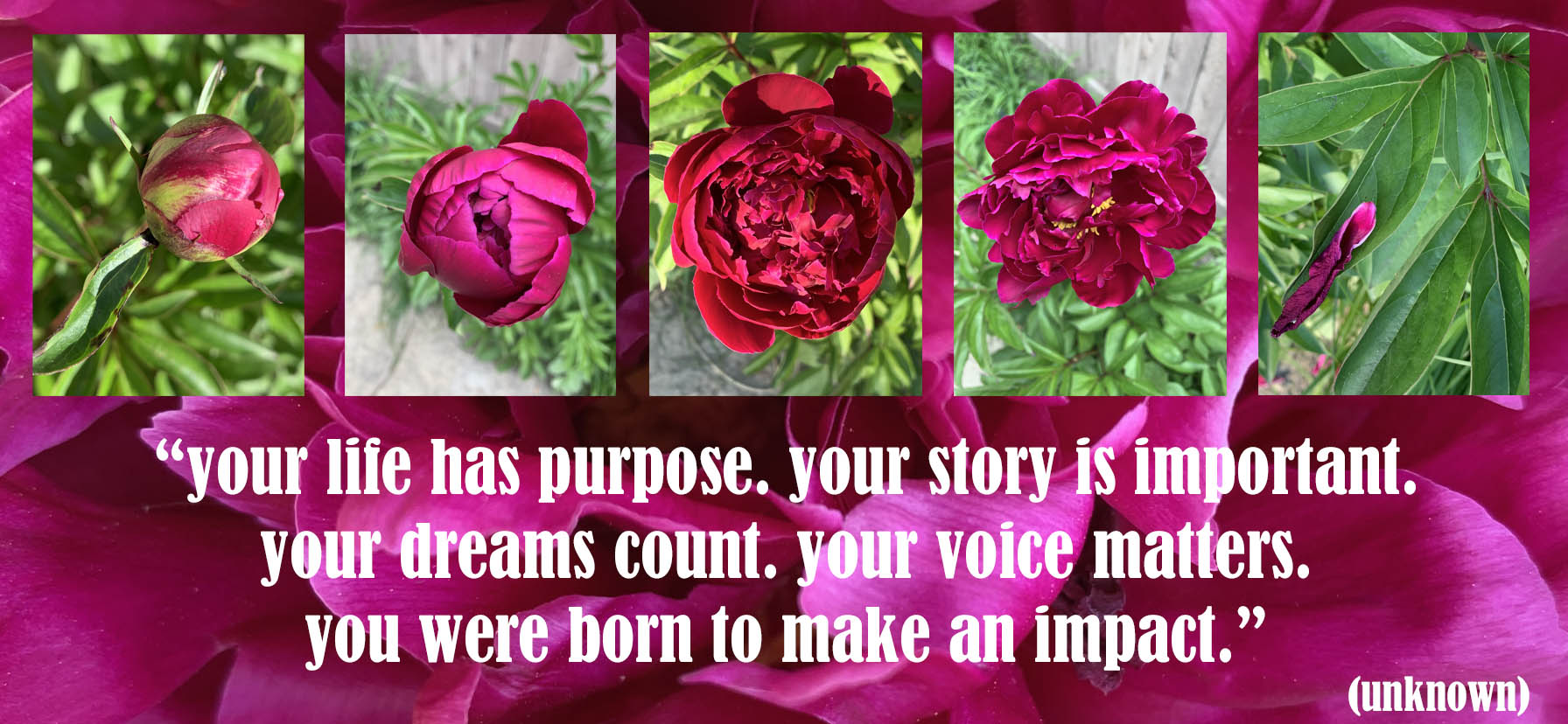
The theme of this season is life-cycle. We’ve enjoyed the peonies bud-to-blossom-to-fade. Each step of the process has been gorgeous. In the lingering season of pandemic we are, like many people in the nation, paying attention to our backyard. We’re making it our sanctuary and have already spent many an evening sitting on the deck, the mourning dove singing to us from the trees.

We had the opportunity to visit a local college. It is a new campus. It’s the old newspaper building, transformed. This quote is stenciled on the wall: Your life has purpose. Your story is important. Your dreams count. Your voice matters. You were born to make an impact. It’s a good message for anyone but particularly students trying to find their way into the world. People at the beginning of their story.

It’s also a good message for people at the end of their story, making their way out of the world, though it is not the same as a statement of reflection as one of aspiration. It has more punch.

Were I a teacher at this college, I would tell my students, new buds on the peony, not to worry so much about mattering. Assume it to be true.

I would teach them that they might spend their whole lives trying to make a mark and none of it will matter so much as answering the phone. Your voice will matter. You will have an impact.

No story that you tell will be more important than the story you concoct to get Columbus out of his chair, to shuffle to the door of his room, so he can say to someone, anyone, “Will you help me to breathe.”

read Kerri’s blog post about LIFE PURPOSE

See The Good [on KS Friday]

“…the measure on ones mental health is the ability to see the good in everything. Perception is the key.” ~ Kristine Klussman, Connection

If I kept a gratitude journal, my entry yesterday would be that Bruce was happy. I could hear it in his voice. Although it had been seven years since we last spoke, we talked like we were picking up a conversation from yesterday. Life has changed dramatically for both of us.

It seems we have both reached the revelation of simple appreciation. No longer focused on the big stuff, we talked of the sweet moments, the moments that feed our souls. He asked me to describe my days and I was happily taken aback to tell the tale of walks on trails, beginning each day writing posts with Kerri, ending each day with a glass of wine. Drawing cartoons. A dog that runs enthusiastic circles. Good friends.

I am reminded again and again that goodness is not found in the world. It is brought to the world. We don’t perceive what is already “there,” we wrap what is “there” in a story-blanket. We give it meaning. And then we feel the impact of the meaning we give it. Viktor Frankel famously wrote that “Happiness ensues.” It follows. Despair ensues, too. Anger, too, if that is what is brought.

Earlier this year a friend asked how Kerri and I were doing amidst the job losses and broken wrists. I responded that our circumstance was dire. It was. It just didn’t feel that way, so full was our sense of appreciation. In the midst of a dire circumstance, we started our days writing. Good friends called. DogDog ran enthusiastic circles and made us laugh. We sipped a glass of wine at the end of each day and enjoyed our simple meals. Today, things are less dire and, although we are still standing on shaky ground, we start each day writing together. We hold hands and take walks. We breathe deeply the smell of coffee in the morning. Our gratitude for our days has not changed a bit. Good moments are everywhere.

And today, Bruce is back in touch. He is happy and his happiness, like all happiness, comes from a hard decision that took tremendous courage: he decided to see the good. To bring light. To be light. He is doing the work of savoring the good moments that he now sees all around himself.

good moments/this part of the journey is available on iTunes and streaming on Pandora

read Kerri’s blog post about GOOD MOMENTS

good moments/this part of the journey ©️ 1998 kerri sherwood

Use Your Chalk [on Two Artists Tuesday]

There are two words floating around in my universe these days: structured and unstructured. Structured data. Unstructured data. Structured time. Unstructured time.

The world as seen through the Puritan lens gives great preference to structure. Unstructured anything is suspect. “Idle hands,” we are taught, “are the devil’s workshop.” Yikes. Apparently it’s dangerous to take a stroll, to sit and ponder, to clear the day and do nothing.

I suspect it explains why our notion of business is hyper-focused on the bottom line and often misses the value of relationships. Bottom lines are easy structure. Relationships, not so much. It is the same with test scores in education. Easy structure. However, stepping into the unknown – the very definition of learning – is largely eschewed because it begins in an unstructured pursuit. Creating the structure, making the meaning, discovering the connectivity is what our hearts and brains like to do. When learning isn’t merely a factory, when business is more than a bottom line, people prosper. They come alive.

Unstructured time. There was a time when time had no structure. Monks attempted to “keep” time by monitoring water through a bucket or sift sand through an “hour” glass. Sometimes the water froze in the bucket so the structure of evening prayer was disrupted. The sand clumped in the hour glass and the measure of time clumped with it.

There are moment on the stage when the actor forgets their lines. It’s called “going up” or “drying.” It is always, in the re-telling, the moment when everything becomes real, alive. It is the moment when the structure becomes unstructured. Hearts race. Eyes widen. The stakes are suddenly palpable. The actor breathes, stands in the vast unstructured universe, and the words return like a swinging bar to a high-flying aerialist. The play is infused with aliveness. Presence is mostly unstructured.

As is common in the structured and unstructured use of the English language, oppositions are easily constructed. Unstructured simply means the meaning has yet to be made. Structured data, structured time, are the tip of a largely unknown iceberg. Love, joy, despair, awe…the full spectrum of experiences, bubble in the unstructured spaces. Numbers can describe a moment in time, can orient for a moment, but will never “explain” yearning or desire or our fundamental need to tell stories (put structure on unfathomable experiences). Structure & Unstructure: they are dancing partners, not combatants.

Where do we come from? What are we here to do? I am going to die, what then? It takes a good deal of unstructured time to sit in these unanswerable questions. There are, of course, plenty of people who will gladly provide structure to your unanswerable – and therefore uncomfortable – questions. Perhaps that is why we adore our structure and demonize the empty spaces? Comfort. Ease.

Kerri cannot pass a hopscotch template chalked on the street. It’s almost automatic. Step, hop, hop, step, hop. The little girl in her connects to the child who chalked the squares on the sidewalk. A simple game. Play. It’s one of the things people do with unstructured time. Set challenges. Make up obstacles. Seek puzzles. Invent. Dream. Connect to the deeper places. Where’s the structured bottom line watching the little-girl-in-my-wife hop and skip and turn in the game-chalked-on-the-sidewalk? The laughter of remembering? The giggle and freedom of the woman hopping the scotch, just because she can?

read Kerri’s blog post about HOPSCOTCH

Look Closer [on Two Artists Tuesday]

Arnie recently sent me a book, Connection by Kristine Klussman. As is my practice these days, I’m reading it slowly, a few pages at a time. I recognize much of what she’s writing about: focus placement, meaning making, cutting through the ‘should’s’…all in the process of re-connecting to what is really important in this life. The book offers specific exercises and process steps to help readers take a closer look at their lives. To identify the gaps between espoused and lived values in order to make different choices and close the gap. Alignment.

In art school, the most valuable lesson (for me) was to learn to see beyond what I ‘think.’ I’ve written about the professor who asked us to look at our yellow #2 pencils and tell him what color were the pencils. A riot of eye rolling ensued but, in the end, he helped us to see that the simple yellow pencil was alive with green and purple and red. Our minds generalize. It requires a bit of slowing down and, dare I write, a bit of presence, to see and experience how rich and alive even the simplest things, a yellow pencil, really are. The dictum applies to each and every day of life, especially the days we generalize into boredom or “same-old-same-old.” Slow down. Look again. There’s more to the yellow pencil than you think.

When Kerri and I arrived home from our trip to move my mother into an independent living community, we poured a glass of wine and opened the box my parents had kept with the artifacts of my life. Old newspaper clippings of play reviews, playbills, gallery opening announcements, elementary school report cards, photographs that reached back through proms and school portraits to blurry black and white infant prints with “David, 4 months” scribbled on the back. It was a poignant exercise of pulling the life-camera in for a closer view. Life-fragments in a box are like the yellow pencil. They require a closer look.

I’ve always appreciated Kerri’s tendency to pull the camera in closer. She is forever taking photographs and then pulling the image this way and that, like so much taffy, looking for the most interesting slice, the most dynamic composition. In her photographic-push-me-pull-you, there is often a discovery. “Look at this color!” she’ll exclaim. Or, “Did you see this! Look at the spines on this plant!” She cultivates surprise. She understands that a closer look will always reveal tiny not-yet-seen-miracles.

Expecting surprise. Taking the time to look beyond yellow-pencil-expectations. Closing the gap between lived and espoused values. Slowing down just enough to realize that there is no such thing as “same-old-same-old.” These are age-old sage suggestions for living a rich and meaningful life. All of it, born of a tender, quiet suggestion to take a deep breath and have a closer look.

read Kerri’s blog post about A CLOSER LOOK

Count What Is Right [on KS Friday]

As I came up through the garbage layer of sleep, that half-awake state where all the gunk of being human floats like detritus on the ocean awaiting consciousness’ return, I thought, “I want to have a full day in which I make no diagnosis. In other words, solve no problems, make no judgements, resolve no issues…A mindful day.

Mindfulness is only mindfulness when there is no judgment or discernment or necessity involved. Have the experience, make no meaning. Try it. It’s hard to do. Minds like to story things. I know that, later today, I will sit at the drafting table, script and draw the next batch of images for my latest project – try doing that without judgment or discernment!

Somewhere in my dark and sordid past I realized that I never had a problem or a stress that I didn’t create. The Greek tragedy, the absolute imperative, the all-too-important-agendas were not happening outside of me. I was making the agendas and lists, storying myself into rushing around or fighting back against ogres of my own making. Minds like to story things and conflict is the driver of story. Yearning meets obstacle. Desire meets impediment.

Why not make up a better story? Be careful! There’s an all-important caveat, a prerequisite in telling a better, stress free, story: it only becomes possible when the teller of the story relinquishes their oh-so-important-self-importance. Better stories are lived off the pedestal. Better stories, stress free, are available to tell when the teller realizes that their season on this earth is a passing thing and the notion of leaving a lasting mark just might be hubris.

I’ve been enjoying the reemergence of the hosta plants this spring. They are intrepid. They spread easily. Not so long ago their spiky heads jabbed up through the earth. They looked like little spearheads. DogDog had to dance between them. Overnight, the soldiers-beneath-the-soil transformed as their spears unfurled into tiny variegated leaves. A day later, or so it seemed, the tiny leaves swelled into thick dense clusters. Every year the hostas claim a bit more of the yard. People in these parts dig them up and give them away to their neighbors and friends when they realize that the hostas are taking over and will soon be spreading into the house.

I confessed to Kerri yesterday that I was, very intentionally, counting what is right in the world. It will come as no surprise to you that the list of what is right in the world greatly outstrips what is wrong. The hostas of my mind are the generosities and kindnesses. I want to be overrun by them. The little things. It will also not come as a surprise to you that, if you start counting what is right in your world, you’ll discover that the vast majority of what you find are the simple, the ordinary. The everyday. Kerri and I make dinner together. DogDog leads me to the gate when I’m taking out the trash. Feeling the breeze on my face as I open the door first thing in the morning. The first sip of coffee.

What is right in this world includes Kerri’s music. There is nothing I love so much as when she plays. She didn’t pick this composition for today’s melange. I wanted to hear it. That’s all. That’s enough. Right Now. It’s another name for mindfulness. It’s on the list, like hostas.

right now is available on iTunes

read Kerri’s blog post about HOSTAS

right now ©️ 2010 kerri sherwood

Exercise Choice [on Not So Flawed Wednesday]

I know what it is to be kind. I see acts of kindness everyday. Humans helping humans. Humans helping animals. Humans mindful of and taking care of their planet. Synonyms include friendly, generous, considerate. All of these are other-focused. To be kind is to consider the needs and lives of others. Beaky used to say in parting, “Be kind to each other.” Kindness was her wish for this world.

I’m not sure that I know with the same clarity what it is to be human. Philosophers have answers that generally trace back to our capacity to reason, to make meaning from our senses. To think consciously. To question. To be aware.

My quick pass through the news of the day betrays how non-human we humans can be. What is the sense of perpetuating a lie? What is gained by lobbing bombs at neighbors? Cyber attacks? We read that there were, from sea to shining sea, 9 mass shootings over the weekend. I’m having a hard time making meaning of it all. I can rationalize it, explain it away, assign blame…but, at the end of the day, I know my rationalizations are nonsensical. Non-sense. No sense. Which, according to the battalion of philosophers scribbling across the ages, attempting to define what it is to be human, we are, because of our non-sense, not human.

There are so many questions and thoughts bursting from this simple bumper sticker!

Arriving home at 10pm, after two consecutive days of 13 hour drives, 20 had a hot meal waiting for us. I called for help and my neighbor John came running. Jen prepared a travel bag of snacks for us and left it on our doorstep. The family that lived next door to my parents made sure, after every snowfall, that the walks and driveways of their elder neighbors were shoveled and safe. Kind.

Somewhere in Kansas it occurred to me that to be human was a choice. Kindness is a choice. Yes, we make meaning from our senses and experiences and the line that defines us as human is our capacity to choose the sense, the meaning that we make. We witness and then we choose. The choice makes all the difference.

The angry man weaving in and out of traffic in his truck, flying the confederate flag, was making a choice. The man who shoveled my parent’s driveway, never having met them, was making a choice. To focus on division is a choice. To reach across the aisle is a choice. To wear a mask to protect others is a choice. To point a gun is a choice. To lie is a choice. To stand firm in your conviction is a choice. To open a door for others is a choice.

To be human is not just to exercise choice but to choose actions that support others. And, among the greatest available choices, the choice that most advances humankind, as Beaky knew, is kindness. To think of others, choose, and act accordingly.

read Kerri’s blog post about HUMANKIND

Start Here [on Flawed Wednesday]

Let’s start here: a strange attractor. “Chaos has its own pattern, a peculiar kind of order.” This magical definition pairing chaos and order is from the good folks at Merriam-Webster. They provide definitions of words. Words are a collection of symbols, called “letters,” assigned to specific sounds which, when placed in a sequence, carry meaning. For instance, D-O-G points to something unique and different than, say C-A-T. A collection of words placed in a sequence carries even more complex meaning. Dogs chase cats.

Thought. Expression. It’s nothing short of miraculous if you think about it. And, if you are thinking about it, you, too, are a carrier of meaning. The symbols and their sequence are useless without me and you, reaching to each other, agreeing on the general meaning of the sequence of sounds. And, more to the point, we not only carry but we create meaning. With our magical sounds-in-sequence we are capable of generating the high art of story, the supreme gift of understanding each other. We can reach each other, touch each other, move each other. We can find each other with our words. We shape each other with our words.

From the chaos of all-possible-sound, to the pattern of word and alphabet, to the order of sentence, to the power of story. Anyone who tells you that they are not creative is missing the point of their existence.

I suspect the power of story is infinitely more powerful than we might realize. We take it for granted, this extraordinary capacity, this glorious gift. You’d think we’d have more appreciation for our high art of language, our transcendent ability of speech. You’d think we might honor and protect truth and fact. They are the compass, the map through the forest of all possible tales. You’d think we might use our most powerful accomplishment to find, or better yet, to create shared ground. Common good is an intention, a creation.

You’d think.

There’s a vast difference between disagreement, conflicting points of view, and lie.

The point of a disagreement is to find agreement. After all, single-point-perspective begins from two disparate points of view. It is a “coming together.”

The point of a lie is to mislead. To deceive. To create false impression. False ideals. To foster disagreement. It is a tool for exploitation. It is meant to render apart.

Because we so easily sequence our words, pattern our thoughts, we are capable of using our magic, our ordered language to create…order. We are also capable of using it to create chaos. Disorder.

To help. To hurt. To accomplish. To disrupt. It’s a matter of intention. The direction of intention. How do you intend to use your precious gift?

The real power comes when we learn to think beyond our belief. To question. To ask.

The first rule of education, an essential rule in shaping precious words into thoughts, into actions, is simple: check your sources. Make sure the story you’re embracing, the piper you are following, arises from a well spring of good intention. That it has an ethical center. Check that it seeks to clarify and reach rather than obscure and demonize. Check that your thought-house is not built on a lie.

Check your sources. Of information. You, too, are a source of information, so…check your sources.

With our most powerful capacity to pattern, to create, to think in words and sentences and stories, we can be a carrier of the lie-virus or we can be part of the cure. Reach or reject. It is our choice, through how we use our miracle words and language, what we agree to create together.

Let’s start here.

read Kerri’s blog post on AGREE