Just That [David’s blog on DR Thursday]

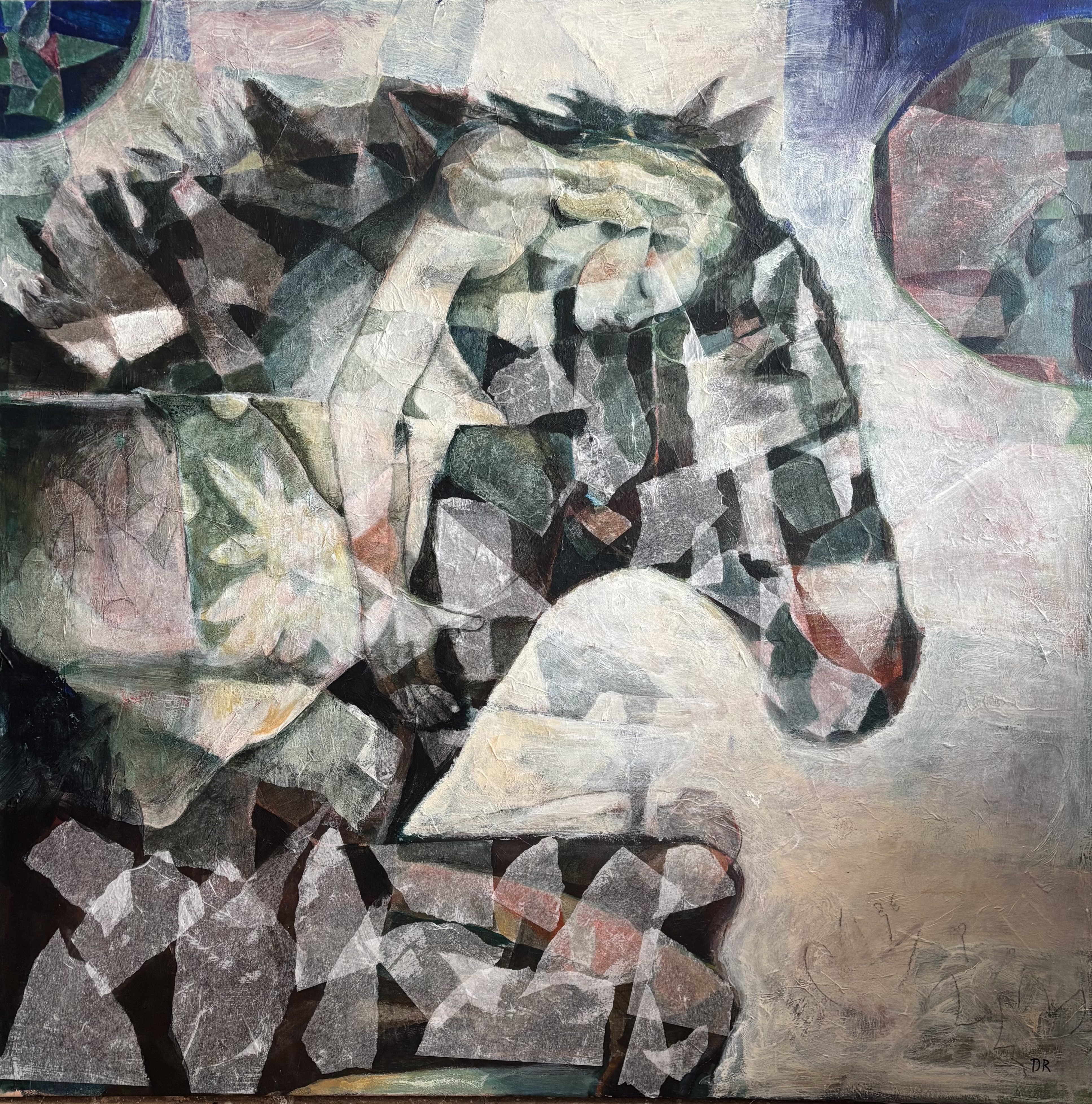
My favorite email of the week comes from Horatio. In last week’s post I included a new painting, an experiment. Horatio wrote, “Wow! Keep digging into that.” Later he added, “Dive in, amigo. That is the earth and the sun and moon all talking to you.” My painting is resonate of runes. Joking, Horatio asked, “Can’t you read runic code?”

“What a great idea!” I exclaimed to myself. I Googled runic code and found several runic translators. For kicks, I typed into the translator, “To be or not to be, that is the question.” This is what Shakespeare looks like in runic symbol:

ᛏᛟ ᛒᛖ ᛟᚱ ᚾᛟᛏ ᛏᛟ ᛒᛖ, ᛏᚺᚨᛏ ᛁᛋ ᛏᚺᛖ ᛩᚢᛖᛋᛏᛁᛟᚾ

Every written language is sound translated into line so we might translate the line back into sound. Musical notes also represent sound in a visual symbol. It is so fundamental, so ubiquitous, that we forget the miracle of it all. We scratch lines on paper to capture ideas, to remember dreams, to record symphonies. We’ve created a code, an alphabet, a limited yet specific number of symbols, developed a set of rules that make our scratches uniform, common and understandable. We created a “dictionary” so the sequencing of the symbols would not be individualized but uniform, shared.

In our nation we insist that we are divided, irreconcilable in our differences, but need a shared language, the most common of common grounds, to do so.

And now we text. The symbols newly created and used, emojis, are pictorial abbreviations, short cuts in a medium servicing the reduction of the message. I❤️U. WTF! 😂 Pictographs and phonetics. In the name of progress we revisit the ancients and now write like Egyptians. We communicate in hieroglyphs.

In these times, difference of language, difference of alphabet, is less of a barrier than difference of opinion. Language translators populate our devices. They are not perfect since culture is non-translatable, but we at least approach the ballpark of understanding. Yet, we are learning, even when our language is shared, that no amount of translating can build a bridge of understanding between maga and the rest of us. A shared language is most useful when facts are also shared.

I am a fan of Wade Davis, an ethnobotanist, a studier of culture and language. He tells a story of indigenous people in the Amazon rainforest, mixing rare plants, grown in different regions, for medicines. He asked them, “How do you know what plants to use?” Incredulous at his question, they laughed and replied, “The plants tell us.”

The plants tell us. “There are more things in heaven and earth, Horatio, Than are dreamt of in your philosophy.” – Hamlet (1.5.167-8)

The lines we draw that carry the sounds that give shape to words are ultimately all drawn from our conversation with nature. Where else? The earth and the sun and moon all talk to us. When we engage with lines meant to carry meaning, like a runic code, we ask, “What does it mean?” When you look at my painting of lines that seems to carry a message, it is natural to ask, “What does it say?” And that – just that impulse – to know, to understand; it is the hope of humanity, the thing we all share, the desire that brings us together, the yearning to understand IS the desire, the most basic of desires, to join, to reach, to connect.
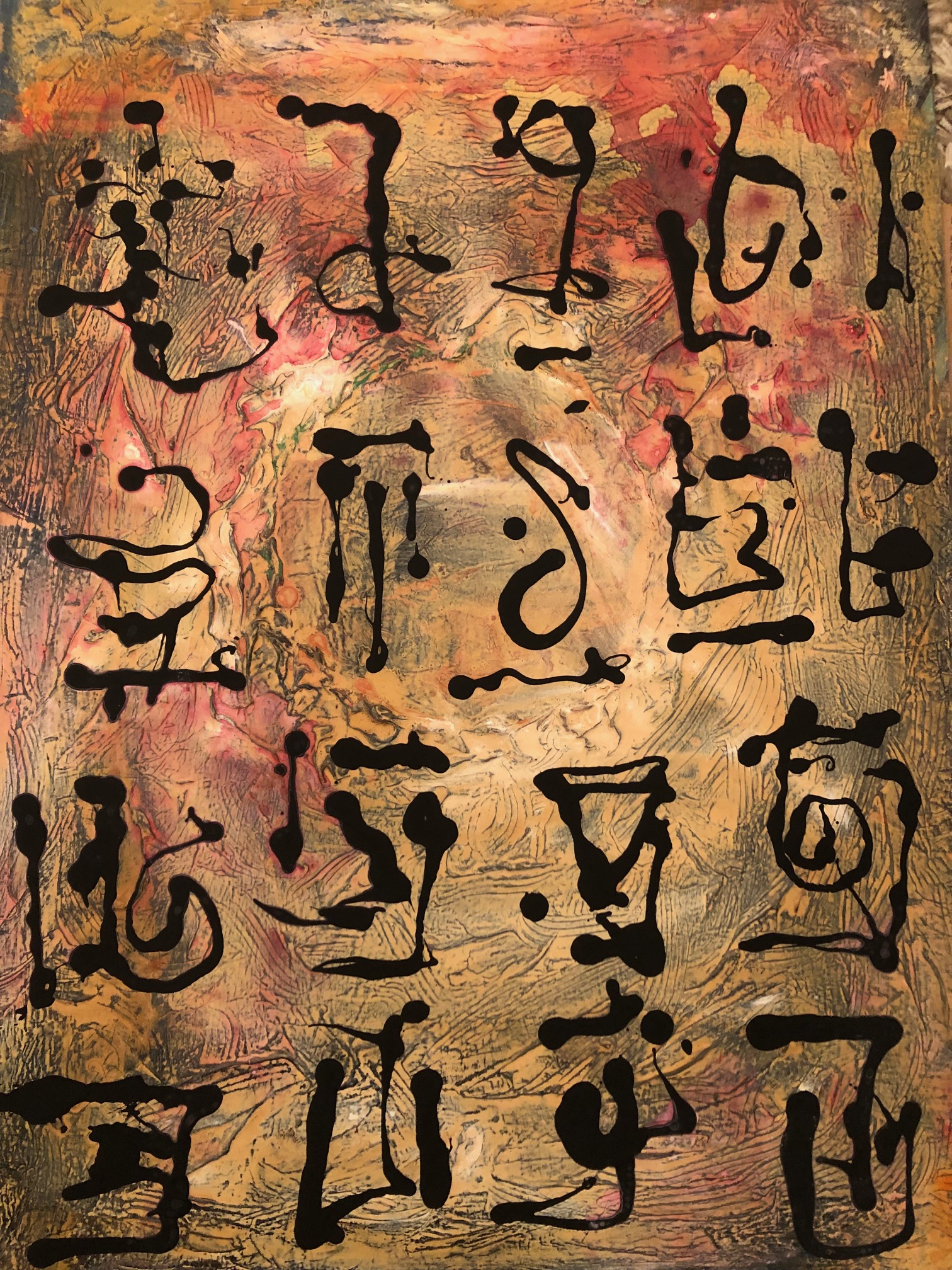
Untitled, acrylic on board

read Kerri’s blogpost about CHIVES AND SUN

likesharecommentsupportthankyou!

The Pizza Thing [David’s blog on DR Thursday]

My latest painting I did for Kerri. It is a painting of invocation. I did not paint it from knowledge or plan. I felt my way through it.

On the day I thought I’d completed the painting I asked her if she wanted me to make any changes. After staring at the image for a few minutes she said, “I love it,” and then asked, “But what’s up with the pizza thing?”

In the many art openings I’ve had in my life I’ve learned that what I paint is rarely the whole of what a viewer sees. I used to be surprised by what others saw in my paintings but now I expect it.

“Pizza thing?” I asked.

“You know, the thing they use to put pizzas in the oven. A paddle.”

“Where is it?”

She pointed to a series of connected shapes on the canvas.

Once someone sees something in an abstract image – like a dragon in a cloud – they can never again not see it. I knew the painting was not-yet-done. She would always see a pizza paddle in the painting if I didn’t alter the shapes. “Do you want me to change it?” I asked. She nodded, afraid I was offended.

It is the great challenge of perception: people rarely look in the same direction and see the same thing. We do not share experiences until we…share them, talk about them, compare notes, come to a common perceptual ground.

A younger me would have defended the painting as I saw it. This older version of me feels no need to defend what I see since I don’t expect others to see what I see. I want to learn what they see. I want to step into a common ground, a space of collaboration. That doesn’t mean that I necessarily must change the painting. It does, however, afford me the opportunity to make it better if I so choose, if my question, “What do you see?” actually opens my perspective.

It’s why I feel the need to shout into the winds of our current political and national circus. It is unimportant whether or not we see eye to eye. It is most important that we share notes, ask questions, discuss discrepancies…discern what is fact from what is fiction. We have to want to step into common ground.

When we walk she often stops and aims her camera at the ground. “What do you see?” I ask.

She snaps the photo and shows me the screen. “A heart,” she smiles. “Do you see it?”

“Now, I do.” I say. I would have stepped over the stone and never seen the heart. And aren’t I fortunate to walk through life with someone who is surrounded by hearts and takes the time to show me what I do not see?

In Dreams She Rides Wild Horses (finished, without the pizza thing)

read Kerri’s blogpost about HEARTS

likesharecommentsupportsubscribe…thankyou.

Right Before Our Eyes [David’s blog on Two Artists Tuesday]

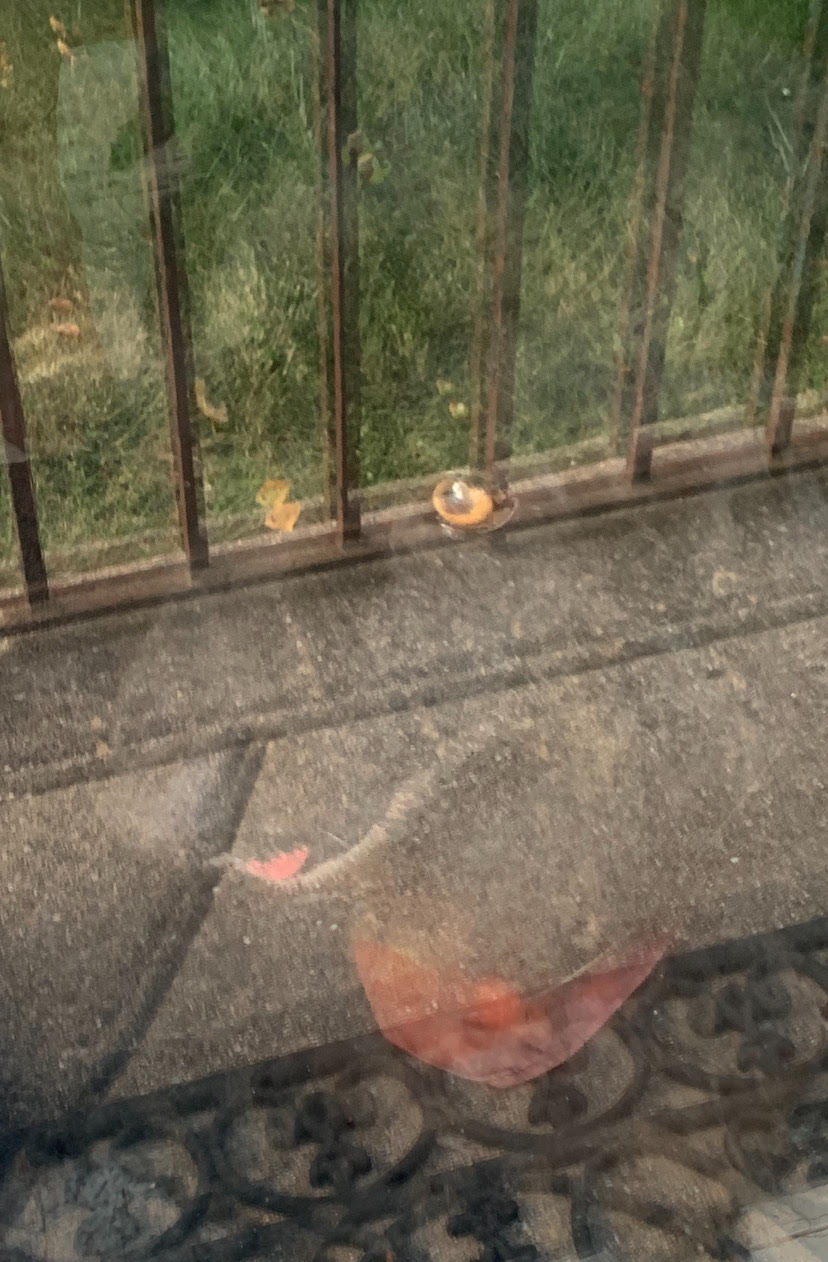
If you are like me, this image took a moment to grok. All the elements are apparent yet, at first, my brain couldn’t pull the pieces together. Kerri, standing outside the front door, took the photo of Dogga on the inside staring out. What is reflection? What is image-through-the glass? It reminds me of those famous drawings that can be seen in completely different ways, the old crone and the young woman. One drawing, two possible images. An optical illusion.

After the image of Dogga-in-the-glass came into focus for me, Kerri exclaimed, “I can’t believe it took you so long to see it!”

MC Escher made a career of creating optical illusions. Stairways to nowhere. Hands drawing hands. The mathematics of art and design. We are rarely aware that our brains assign rather than discover meaning, selecting and assembling pieces in order to sense-make. Like well-worn paths through the woods, our sense-making carves default channels: we see what we expect to see. We see it because we believe it, not the other way around. That is to say, we rarely see beyond what we think. Thinking paths-of-least-resistance render us blind.

The pursuit of truth is to see beyond our well-worn paths. Escher knew that. His images play with our expectations. His images, for a moment, shock us into seeing beyond our expectation.

Factors like age or cultural orientation create biases in the making of meaning, in the assembly of the illusion. For instance, in the drawing of the old/young woman, older people will more often see the old woman while younger people will almost always see the young woman. If you happen to come from a culture that is not inundated with images (there are a few remaining on the planet), it is likely that you would only see scribbles on a page. You would see neither the old or the young woman.

Your normal is not my normal. Your well-worn thought-paths are different than mine.

Given identical experiences, your sense-making will differ from mine. It is the genius behind our system of governance. That two opposing points of view might come together, discuss what they think-they-see and compromise on a best path forward, is the foundation-stone of our democratic system. The genius begins when allowing that one party sees an old woman while the other sees a woman who is young. Both can be valid. Both can exist on the same page.

Allowing for and valuing differences of perspective leads to common ground, shared action.

On the other hand, the same system collapses when what is immediately apparent to both parties is summarily denied by one side of the aisle. It’s another type of illusion altogether: the negation of the obvious. For instance, our last presidential election endured 65 challenges in court and all were summarily thrown out for lack of evidence. Both sides knew – and know – without doubt that the election was valid, free and fair yet the red-hat team continues to fearmonger, pounding the drum of corruption, wearing another kind of thought-path in the minds of their constituents, rendering them blind.

There is a clear distinction between sorting out differences and creating them to exploit fear.

Coming together, in an attempt to see beyond expectations, respecting differing perspectives, valuing the multiple perceptions of a diverse nation in order to stand on common ground is democracy at its best. Creating division, whipping up disunity, negating and devaluing the perspectives and values of others spells the end of democracy. It intentionally pulls the nation apart.

Democracies pursue truth. Autocracies thrive on falsehoods. The choice we face is abundantly clear and right before our eyes. As a nation, all we need do is step off our well-worn thought-paths and open our eyes.

read Kerri’s blog about ILLUSIONS

like. share. comment. subscribe. support…thank you.

Check Your Reaction [David’s blog on KS Friday]

I confess to being disconcerted. At lunch, Kerri asked me a question about my blog so I typed “the direction of intention” into Google. The top slots were a prayer, rather, a type of prayer originated by Saint Francis de Sales. “Oh, No!” I thought. I don’t want my blog to be associated in any way with any church or any religion. “I hope people know that I am not that,” I said, surprising myself with the vehemence of my sentiment.

We’d just finished reading and discussing a Washington Post opinion piece, I Left The Church And Now Long For ‘A Church For The Nones.’ “… I couldn’t ignore how the word Christian was becoming a synonym for rabidly pro-Trump White people who argued that his and their meanness and intolerance were somehow justified and in some ways required to defend our faith.” So Perry Bacon, Jr.’s very interesting opinion piece was fresh in my mind.

So, too, was a passage I’d read earlier in the day from Vāclav Havel‘s book, Disturbing The Peace. The interviewer asked him to define “absurd theatre” (Havel wrote absurdist plays). He responded that absurdist theatre “demonstrates humanity in a ‘state of crisis’…it shows man having lost his fundamental metaphysical certainty, the experience of the absolute, his relationship to eternity…, in other words, having lost the ground under his feet.” In my mind, he could not have written a more prophetic or accurate description of our times. We are untethered without a functioning moral compass. We are awash in a flood of content mostly bereft of shared context.

I attended a Catholic college. I am not Catholic. I have never identified as Christian or Buddhist or Hindu…Yet, I am not an atheist. One of my favorite memories of my college years are the many conversations I had with Father Lauren sitting on the stoop of the barracks, sipping tea, discussing his faith and my belief. We explored ideas. We compared and contrasted philosophies. We laughed. We asked questions. We considered and expanded each other’s point of view. We respected each other’s differences because we were both driven by a desire to do good for other people. We shared a common intention. A common direction of intention. We both believed in “something bigger” but did not share the same idea of what “something bigger” might be.

Suddenly, I yearned for that time of openness of thought and generosity of sharing opposing points of view. I imagined sitting again with Father Lauren. Eschewing any black-or-white opinion, attempting to practice what I preach – to practice what I believe – I clicked on a few of the links of Saint Francis de Sales. I read. I wanted to know rather than to judge.

I read that Saint Francis de Sales was noted for “…his deep faith and gentle approach to the religious divisions in his land…” We could use some gentle approaches to division in these rabidly discordant times…This also caught my attention: the direction of intention, the heart of Salesian spirituality, is a practice of prayer consciously directing to god what you are about to do… In other words, intending goodness of action.

My definition of the direction of intention: it’s not about what you get, it’s about what you bring. Saint Francis de Sales and I are not so far apart in our direction of intention. Other-focused. Purposive goodness. We both encourage consciousness of action in the world and awareness of the impact of our actions on others.

So, I amend my initial thought: I do not want to be associated with any church or religion, but there’s plenty of common ground to share when we’re driven – and united – by a conscious desire to do good for other people. 

grace/right now © 2010 kerri sherwood

Kerri’s albums are available on iTunes and streaming on Pandora and iHeart Radio

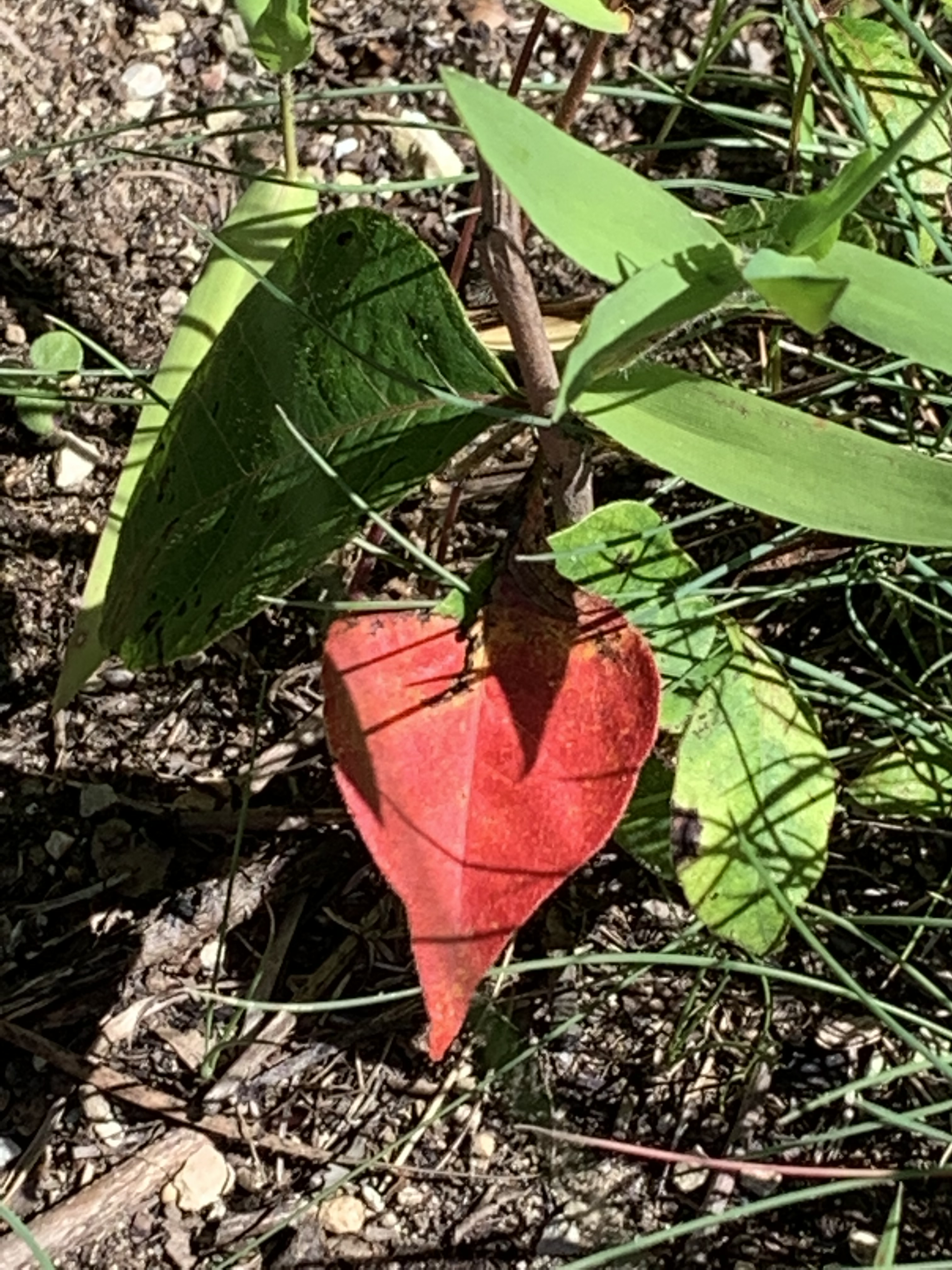
read Kerri’s blogpost about HEART LEAF

like. support. share. comment. thank you.

Start Here [on Flawed Wednesday]

Let’s start here: a strange attractor. “Chaos has its own pattern, a peculiar kind of order.” This magical definition pairing chaos and order is from the good folks at Merriam-Webster. They provide definitions of words. Words are a collection of symbols, called “letters,” assigned to specific sounds which, when placed in a sequence, carry meaning. For instance, D-O-G points to something unique and different than, say C-A-T. A collection of words placed in a sequence carries even more complex meaning. Dogs chase cats.

Thought. Expression. It’s nothing short of miraculous if you think about it. And, if you are thinking about it, you, too, are a carrier of meaning. The symbols and their sequence are useless without me and you, reaching to each other, agreeing on the general meaning of the sequence of sounds. And, more to the point, we not only carry but we create meaning. With our magical sounds-in-sequence we are capable of generating the high art of story, the supreme gift of understanding each other. We can reach each other, touch each other, move each other. We can find each other with our words. We shape each other with our words.

From the chaos of all-possible-sound, to the pattern of word and alphabet, to the order of sentence, to the power of story. Anyone who tells you that they are not creative is missing the point of their existence.

I suspect the power of story is infinitely more powerful than we might realize. We take it for granted, this extraordinary capacity, this glorious gift. You’d think we’d have more appreciation for our high art of language, our transcendent ability of speech. You’d think we might honor and protect truth and fact. They are the compass, the map through the forest of all possible tales. You’d think we might use our most powerful accomplishment to find, or better yet, to create shared ground. Common good is an intention, a creation.

You’d think.

There’s a vast difference between disagreement, conflicting points of view, and lie.

The point of a disagreement is to find agreement. After all, single-point-perspective begins from two disparate points of view. It is a “coming together.”

The point of a lie is to mislead. To deceive. To create false impression. False ideals. To foster disagreement. It is a tool for exploitation. It is meant to render apart.

Because we so easily sequence our words, pattern our thoughts, we are capable of using our magic, our ordered language to create…order. We are also capable of using it to create chaos. Disorder.

To help. To hurt. To accomplish. To disrupt. It’s a matter of intention. The direction of intention. How do you intend to use your precious gift?

The real power comes when we learn to think beyond our belief. To question. To ask.

The first rule of education, an essential rule in shaping precious words into thoughts, into actions, is simple: check your sources. Make sure the story you’re embracing, the piper you are following, arises from a well spring of good intention. That it has an ethical center. Check that it seeks to clarify and reach rather than obscure and demonize. Check that your thought-house is not built on a lie.

Check your sources. Of information. You, too, are a source of information, so…check your sources.

With our most powerful capacity to pattern, to create, to think in words and sentences and stories, we can be a carrier of the lie-virus or we can be part of the cure. Reach or reject. It is our choice, through how we use our miracle words and language, what we agree to create together.

Let’s start here.

read Kerri’s blog post on AGREE

Accept What You See [on Flawed Wednesday]

I had the privilege to watch the work of the great Kichom Hayashi. He was a master of the middle way, helping polarized groups find middle ground and shared purpose. I have more than once wondered what Kichom would say about our great national divide.

For someone whose life work has been steeped in the art of “seeing” and perspective flips, I find myself utterly incapable of seeing the perspective of those on the other side. In truth, it’s not that I am incapable, it’s that I believe I already see it and what I see is ugly to the bone.

I remember a heated conversation in 2016 with my dear friend who stands on the opposite side of the divide. Too emphatically I said, “You wouldn’t leave your daughter alone in the same room with this man! How could you vote for him?” To date, 26 women have accused the outgoing president of sexual assault or misconduct. I can’t NOT see that nor can I pretend that it isn’t relevant. Although I couldn’t articulate it at the time, my emphatic question to my friend unearthed the crux of the matter. This man has no moral compass. This man is capable of anything.

Standing on my side of the divide, the conversation that pops up again and again is a dilemma that goes something like this: “I want to find common ground but I can’t NOT see what my family, friends, neighbors have embraced.” The list of lies is extensive and pervasive. The corruption is life-long. A scam called Trump University. Bilking donors through his foundation. A businessman, famous for stiffing the working men and women who built his projects, who has been bankrupt six times, is not the biz-wizard he pretends. The emoluments violations are breathtaking. The art of his deal is the art of the swindle and I am utterly mystified at what my loved ones standing on the other side of the crevasse do not see.

And, actually, that sheds light on my fear. I am afraid that they DO see it. That they see it and either don’t care or that they embrace what this man represents. Misogyny. White supremacy. Authoritarianism. Conspiracy theories a-go-go. Fear mongering. Hatred of others. Rob. Rape. Pillage. I can’t NOT see what I know they MUST see.

I’ve provided an excuse for myself, something to make me feel better: they don’t see because they have their heads so firmly thrust into the fox hole. The story that they are being told blinds them. They are filled with info-goop that has all the truth-merit of the National Inquirer. But, in my quiet moments, I have to admit to myself that they must want to eat that bile. Who would choke down so much hatred unless, to them, it tastes good.

I rolled my eyes when my sister repeated the inanity, “There are more COVID cases because they are doing more testing!” I hung up the phone and shouted to the sky, “She can’t be that stupid!” She’s not stupid. She’s caring and loving and works hard in her community to make a better world. So what is it that she doesn’t see? Or doesn’t want to see?

On the other side of the crevasse I hear fear cries of “SOCIALISM” and, again, I roll my eyes. In a nation in which the top 1% holds and controls more of the wealth than the entire middle class, you’ll have to forgive my loud guffaw. “They can’t be that stupid!” I shout from the back deck. They either do not know what socialism is or they cannot SEE what is right in front of them. Or, they don’t care to see it. The slop that they are being fed must taste good. It must feed something inside of them. It certainly profits those who are feeding it to them.

Them. They. It is too easy to fact check what we are being fed. It only takes a moment to investigate media bias. What is it that THEY do not want to SEE?

And, most alarming to me, this is what I SEE: it is not just a difference of opinion that divides us. A difference of opinion orbits a common center of ethical understanding, of moral agreement. Kichom Hayashi could bring seemingly irreconcilable differences to a middle way because he knew the center, the moral compass, was shared.

To my friends and loved-ones, to those that have lined up behind a pathological lie, a gaping virtue-void, I can’t UNSEE it. I can’t justify or pretend there is any merit to the empty center, the grotesque morass of what you embrace. I would never leave my daughter alone in a room with a rapist. I wonder why you would.

read Kerri’s blog post about UNSEEING IT

Bring It [on DR Thursday]

InstrumentofPeace copy 2

This painting, or snippets of this painting, has found its way into more Melange posts than any other. An Instrument of Peace. It’s a big canvas. It’s an even bigger meditation.

The words are a mish-mash of the Prayer of St. Francis which was not at all written by St. Francis. Its author is anonymous. The Franciscan Order notes that the prayer is too “me” focused to be something that Francis would have written. Let me bring love. Let me bring pardon. Let me bring union, truth, faith, hope, light, joy. Let me be an instrument of your peace. Let me bring.

It’s a prayer of intention. Let me not be reactive.

It’s an appeal that speaks directly to our current climate. Let me respond to fiery times and dedicated division from my better nature. Where there is discord, let me bring union.

Ideals and idealists are often written off as being so much pie-in-the-sky. Idealists, like Gandhi or Martin Luther King, understood that union is not an elimination of differing points of view. It is not utopian or singular. It is wildly diverse and collaborative. Compromise is a meeting ground of unlike minds in service to a common cause.

More than once I have walked into a room populated with dedicated diametrically opposed points of view. Wood cutters and tree huggers.  There is always common ground to be found. Trees are a vulnerable livelihood. Trees as vulnerable heritage.  The conversation begins in vulnerability. More than once I left a room populated with people who found a place to begin, a shared middle ground. The most amazing moment happens when everyone in the room realizes that the middle ground was always present, it was there all along. It becomes crystal clear in shared vulnerability.

It’s possible, regardless of dedicated belief, to bring the middle ground. Yes, bring it. Too often we shout across it so it remains invisible. Too often we plant our flags and defend our territory and justify our position before we check a fact; we listen through a lens of righteousness. Bringing middle ground requires nothing more than a desire to leave behind our dedicated reactivity, our stalwart indignation, and enter the conversation with an intention. Let me bring union. Let me be an instrument of peace. Peace is, after all, nothing more or nothing less than an intention.


read Kerri’s blog post about PEACE


seagull in fog website box copy


ddot studio copy


instrument of peace ©️ 2015 david robinson

Give It [on Not So Flawed Wednesday]

half and half copy

Janus is a Roman god with two faces. He looks to the future and peers into the past. He is the god of beginnings and endings, transitions, doorways, and passages. He is the god of gateways, the liminal spaces, the between.

Janus must certainly be the god that we dance with on this island, a community defined by divisions, married to its conflicts but also, at least rhetorically, desiring peace.

Kerri and I are the stewards of a performing arts center that is, as Julian Dawson said, punching above its weight. It is the symbol of division in the community, the epicenter of discord, the rope in a very ugly tug-of-war. All of the fault lines run through it. Yet, as Janus would remind us, it then must also hold the path to unity, the potential for common ground.

All in the community want the doors to be wide open; none want the responsibility that comes with access. They want the center, the art, to serve them. They do not yet comprehend that any alive and vital art space is, in fact, the opposite: a place of service to others. Arts spaces and the artists the enliven them are keepers of the commons, the stewards of the stories that unite.

In another life I ran an educational theatre company. It boomed into life the day that the artists, the students, grocked that art was in fact a gift given to others, something they brought to people, not something (like attention or fame or a spotlight) that they got from people.

This island, this center, will someday boom into life. They will discover that the rope in the tug of war goes slack when they walk toward each other. Pulling in opposition exhausts everyone. They will come alive when they cease asking, “What do we get?” and start asking, “What do we bring?”


read Kerri’s blog post about EDGES


handshadowstones website box copy


UpLift [on Merely A Thought Monday]

cohesion copy

And, what is the opposite of cohesion? Incoherence. The lack of clarity or unity. Fracture.

For a period of time my work on this earth was essentially a meditation on power. Power with. Power over. After a while I understood that power-over was not really power at all; it was control. Control and power are two very different things. They are often confused.

Power is something created with others. Control is something done to others. The equation is simple: the more controlling a person is, the less powerful they actually are. A person who understands his/herself as powerful has no need to assert control over others.

A leader invested in control has only one sure route to controlling: to fracture. To divide. It is the way of the truly powerless. Incoherence and chaos are great tools if control is the aim. Destroy the unity. Play to the disgruntled. Feed the fire of those who are feeling powerless. Promise them control. Pushing others down to elevate the self can only end badly. Everyone drowns.

People secure in their power create cohesion. They unite. They uplift. Power is a force that grows between people. It cannot be owned by one. It is always the province of the community. A person secure in her/his power generates unity. What else? The power they feel within is an expression of the power they experience with.

Community is a word that implies cohesion. To commune. Common. And, what could be more common than a central focus, the intention to support and bring out the best in all.

What is the opposite of a powerful person?


read kerri’s blog post about COHESION


alice's restaurant, california websitebox copy


Turn The Phrase [on Merely A Thought Monday]

them apples 1 copy

I just read this phrase and laughed aloud: Conversation in English is often full of phrases not to be taken literally.

It’s the word ‘often’ that got me chuckling. I’d have been more sober if ‘always’ had been the adverb. Conversation in English is always full of phrases not to be taken literally.

My head exploded! She turned the tables on me! You don’t say! I’ll be dogged. It’s nothing to sneeze at! It’s more than you can shake a stick at! I’d rather stick needles in my eyes!

Isn’t it the best of paradoxes? Language, at it’s best, is inexact. It is referential. It can only point toward experience.  It’s why we have legal opinions, religious debates and news pundits that scream at each other.  It’s why we have differing points of view.

“I didn’t say that!”

“That’s not what I meant.”

“Just what are you implying?”

Nothing. No thing. The absence of a thing. The absence of a thought (in English, a thought, however fleeting, is a noun, a thing).

Of course, in it’s inexactness, there is also an infinity of space. There is as much reason to reach, to ask, to discover as there is to push, negate, or differ. To put down your end of the rope. To shake hands not make fists. A common ground.

Word for word. Line for line. To the letter. It’s never black and white. In a toxic time, a poisoned well. Find the middle way. Heart felt. We need not stab each other in the back. Kill two birds with one stone. Pull your head out of the sand. It’s a piece of cake. It literally blew me away. They put down their swords. They reached across the aisle.

Well I’ll be! How ’bout them apples?


read Kerri’s blog post BOUT THEM APPLES


laughing website box copy