Take Note [on DR Thursday]

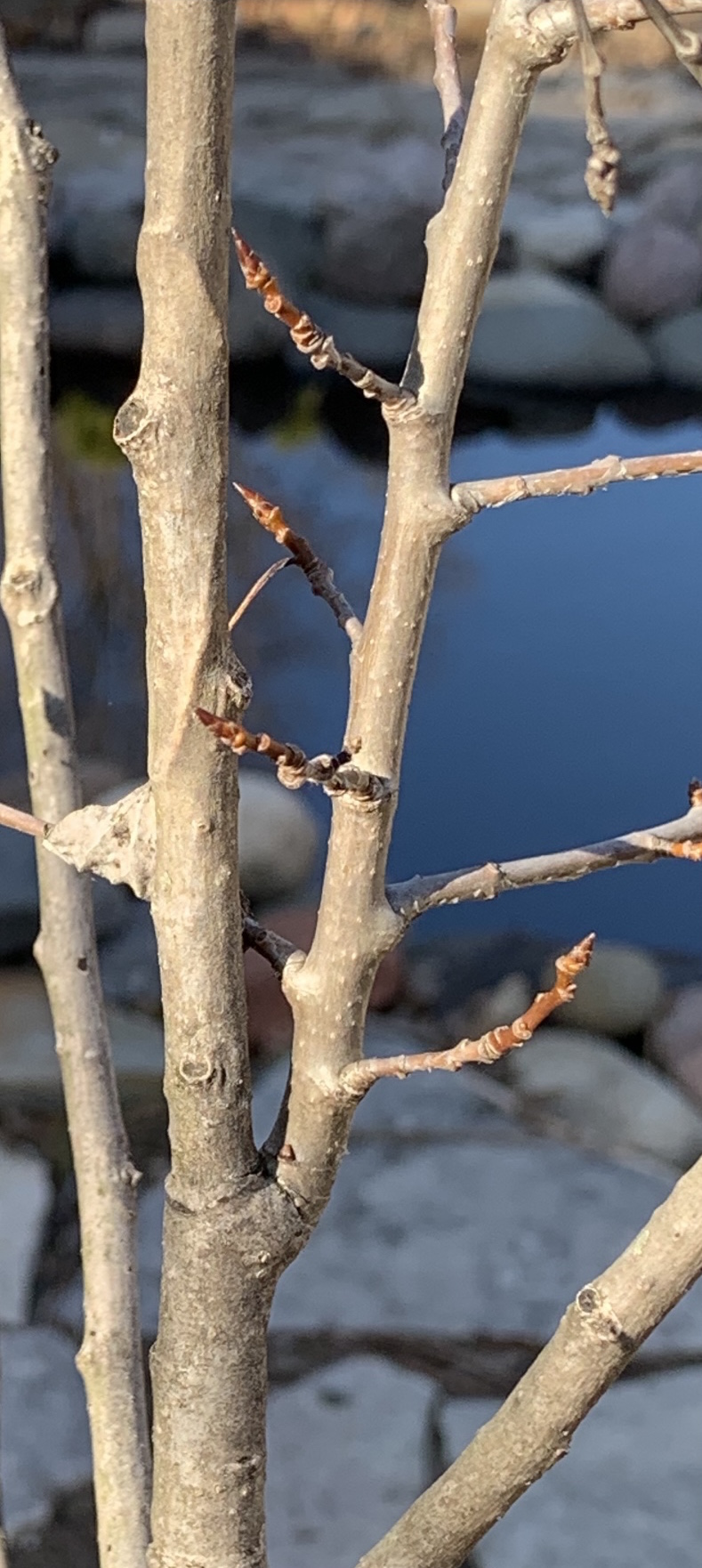
Although it may not be at first apparent, this is a map for product development. A single stout stalk that supports shoots of replication that explode in support features. One clear central intention. Multiple expressions that return nutrient to the stalk.

Although it may not be at first apparent, this is a map for healthy community. A single stout story stalk that supports shoots of replication, diverse paths that explode in seeming individual expression. One clear central narrative. Multiple expressions sending sunlight back to the root.

Who hasn’t seen the time-lapse films of plants growing, forms expressing and then retreating, the accelerated motion of people commuting on a city street, what seems like chaos is, at speed, cooperation. Those people on the street in real time, walking to work, a to-do list on their mind, are mostly unaware of their symphony of togetherness.

It’s easy to forget the stout stalk when standing at the individual expression point. I have been witness to the demise of many organizations who turn against the stalk in favor of the feature. For instance, the fastest way to kill a non-profit organization is to attempt make it run like a for-profit business. It will forget its story-stalk and lose its heart and mind in a spreadsheet.

The quickest way to destroy a community is for its branches to forget that they are individual expressions of a single stout story. They are not separate as much as extensions. To focus on the multiple tiny expressions as if each small branch is a stand-alone truth is absurdity-creation. Chaos masked as convention. Inverted, the plant dies.

In our literature we are riddled with advice to turn toward nature. Existential crisis? Lost? Go to the meadow, find the woods, take a hike. Get quiet. We go there because…we are there. Alan Watts wrote,”We don’t come into the world, we come out of it.” We are not separate from the stalk; we are expressions of it. Occasionally, the map to sanity that we seek is hiding in plain sight dressed as a platitude. Go to nature. You cannot do otherwise. Realize it.

When I’m running abstract questions of design in my dreams, I know it’s time to take a walk. It’s time to stop, look around, take note of nature’s design, the perfection of a plant. A perfect yoga, branch-fingers reaching for the sun, root-fingers reaching deep into soil.

read Kerri’s blogpost about PARSNIPS

sam the poet, 48×48 (painted and sold a long time ago)

sam the poet © 2004 david robinson

Ode The Basement Floor [on Not So Flawed Wednesday]

Ode to the basement floor.

Though little acknowledged and less appreciated, you carry without comment the brunt of the load. When water runs where it ought not run, you, master of the Tao, let it flow, knowing the drains in your design will surely win the day. Or not. No matter. What happens will happen and we will make stories with either result, never once mentioning your stalwart participation, unseen support in every storm.

The washer jumps, the dryer rolls, the boxes stack, the shelves stand guard, you accommodate and hold space for all.

Sometimes I stand on you, toes a-wriggling, lost in thought, or wrinkle-brow-perplexed, all the while missing the wise message of patience you proffer. “Stand long enough,” you suggest but do not say, “and everything will look different. Or the same.” Were I to ask – and you to answer – you might imply that my paint and carpet solutions are surface remedies merely. Perhaps I should consider lasting and deeper alternatives?

We rearrange. We are cleaning out. We see more of you than before! Yet increasingly exposed and in full reveal you do not attempt to hide your age as we might. As we do. Your pocks and chips and scratches galore the proud chronicle of your era.

“Tread on me” your flag must wave, as we step and stride and dance and tramp and plod and stomp, fulfilling your purpose with our every footfall. I wonder, as I carry a load to the stairs, do you mind or even note that I am lost in the cause of singing your praises?

[this post comes to you without the assistance of mind altering drugs of any kind. Just sayin’]

See The Exact Center [on Two Artists Tuesday]

Kerri took this photograph a week ago. We’d set up our pop-up table in the middle of the woods. We had a small cooler with cheese and crackers, tabouli and chips and wine. It was cold. We needed to take off our gloves to eat a bit of our snack and then put them on again, fingertips stinging. Since she is a photography maven, I knew to stand back after setting up so she might take shots of our snack-laden table. She finished, sat, and then pointed her camera to the sky.

Despite what you see in the photo, the trees did not reach to a common center. That is an illusion. Perspective as taught in art school. The point of view of a lens. “Lookit!” she said, red fingertips holding the camera so I could see the image. “We must have found the exact center of the forest,” I thought and smiled.

I often feel like that these days. We must have found the center.

Last night, on an all-too-rare warm evening, we sat with friends on their deck. The Up North Gang. We ate dinner. We laughed. I had my first ever sip of salted caramel whiskey. Dessert as a drink. Time stood still for me and I studied the moment. I wondered if anyone on earth was as fortunate as Kerri and me.

Perspective as taught in art school. Points converge creating the illusion of distance. At one time in history, a crossroads of art and mathematics, this simple recognition was a revolution. Linear perspective. A unique point of view. The accurate portrayal of three dimensions on a two-dimensional surface was powerful – the creation of illusion, shape and distance, produced new intentions and mathematical rules.

It also changed forever the viewer. To see the illusion one must occupy the illusion of a unique center. A new psychology. It’s possible to draw a direct line of descendancy from the hard perspective of the Renaissance to our abstract expressionism. The artist’s point of view, unconscious expression without limit or rule, is all that matters. Two ends of the same pole.

I told Horatio that I am, at long last, learning to keep quiet. To share what I see when asked, and not before (he says as he writes a blogpost about what he sees). I have made a career out of too adamantly trying to get people to see what I see. My adamancy might be traced to the Renaissance and the notion that I occupy a unique center, a specific point of view that makes my illusion of shape and distance somehow privileged and necessary.

Age is helping me challenge and release my investments. It is also a grand teacher of movement and moments. Nothing stands still, especially time. The best we can do is savor the spaces between, always shifting and moving. Children become parents become grandparents. A warm night. A cold day on the trail. It matters less and less what I see and sense-make with my unique hard lines and more and more that I taste the tastes and see the colors, my lens aimed at a common center, sharing the passing moments with others.

read Kerri’s blogpost about THE WOODS

Tell The Full Story [on Merely A Thought Monday]

If you Google Harriet Beecher Stowe you’ll come across a confounding question: Did Harriet Beecher Stowe cause the Civil War?

Think about it. Tease it apart. If the question doesn’t make you shudder ever so slightly, you’re not paying attention to the happenings in our day.

A woman in 1851, a full seventy years before women in our nation had the right to vote, wrote a book depicting “the harsh conditions experienced by enslaved African Americans.” She did not write a fantasy. She wasn’t concocting a circumstance. She wrote a book “which highlighted the evils of slavery.” She called attention to a moral horror story.

The question jumps the long and legislated history of slavery in the land of all-men-are-created-equal. It ignores the economic engine that made enslavement of human beings an institution in our nation. It suggests that shining the light, calling attention to the immorality, not the immorality itself, caused the war. The slavery wasn’t the cause, the industry and economics and political drivers had nothing to do with the war. Looking at slavery, calling attention to it, was.

If we close our eyes it doesn’t exist. If we ban the books it will not be part of our history. It’s a game we play with infants. It’s the puerile mentality of Fox news.

“Since January of 2021, 42 states have introduced bills or taken other steps that would restrict teaching critical race theory or limit how teachers can discuss racism or sexism, according to an Education Weekly analysis.”

To be clear: “Critical race theory is an academic concept that is more than 40 years old. The core idea is that race is a social construct, and that racism is not merely the product of individual bias or prejudice, but also something embedded in legal systems and policies.”

Why do we work so hard to cover our eyes and plug our ears? The path to health begins with admitting and taking a good hard look at the disease. Slavery is a part of our history. As is Jim Crow. The Civil Rights Movement. Red lining,…Black Lives Matter. A clear narrative path.

Isn’t the frenzy to introduce bills restricting discussion about our history yet another example of racial bias embedded into our policies? We are watching critical race theory in action.

Talking about what ails us isn’t the cause of our division. Our inability to fully look ourselves in the mirror and acknowledge all aspects of our story – perpetuates our dis-ease. We would do well to revisit the Serenity Prayer and muster our courage.

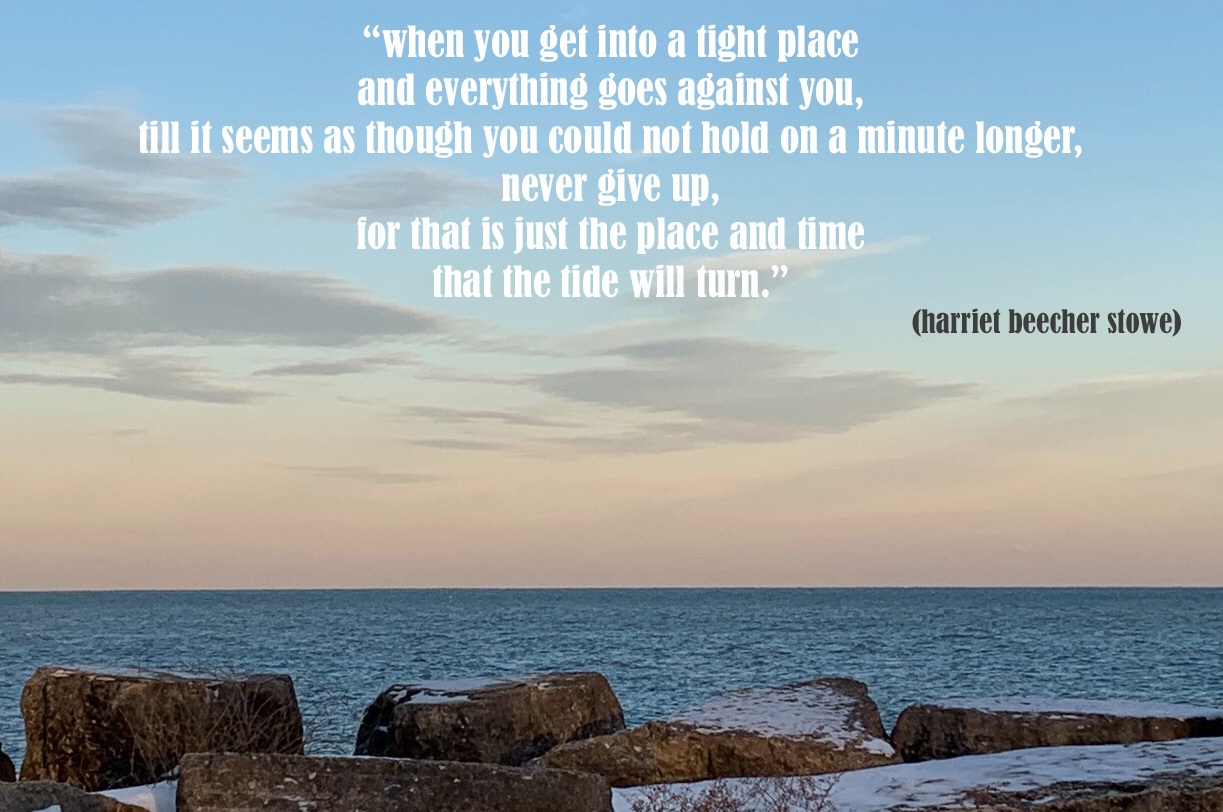
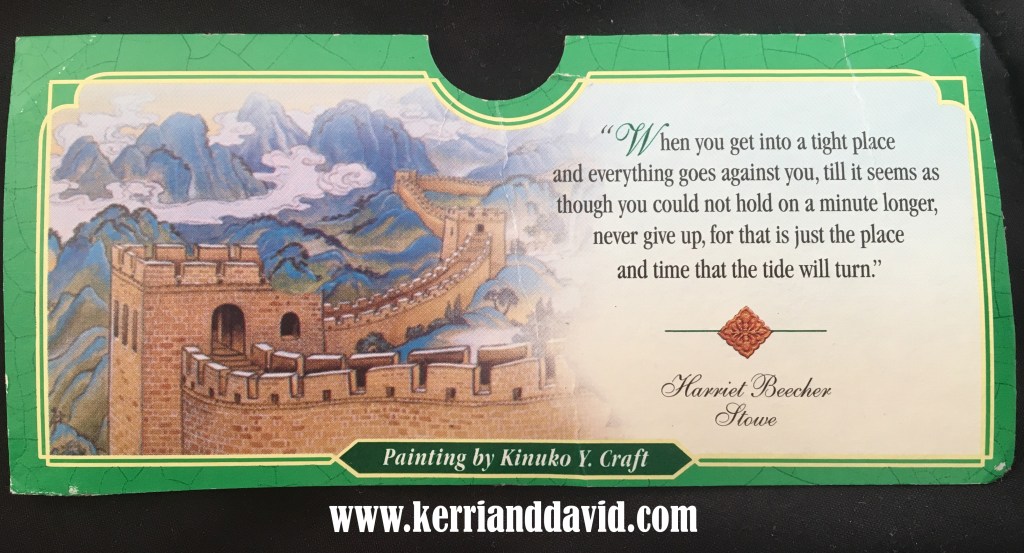
According to Harriet, there is hope. There will someday come a place and time that our tide turns, a time when we can without fear or shame or legislation, look at each other and tell our full story.

read Kerri’s blogpost about THE TIDE TURNING

Drop And Roll [on saturday morning smack-dab.]

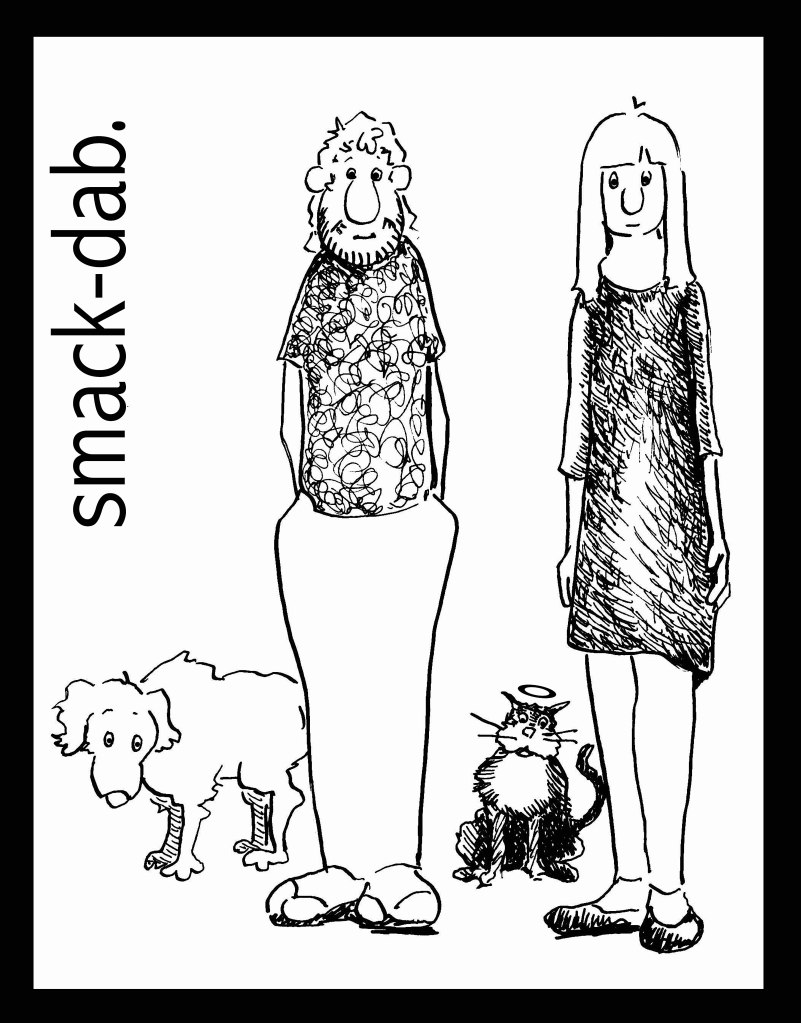
If you want to see me go primal, all you need do is hang out with me when there’s lightning. One hot flash of light ripping across the sky and I wince, drop, and roll. I enjoy thunder. Lightning, not so much.

The first time Kerri saw my lightning-behavior, we were on a walk when a storm blew in. There was no time between the violent white flash and cannon-style-boom. “It’s just lightning,” she said as I attempted to make myself a smaller target. We ran home. Well, in truth, I grabbed her arm and pulled so hard she had no choice but to fly along (giggling) with her manly-man bobbing and weaving to avoid imminent electrocution.

Even within the safety of the house, I will wax poetic about the beauty and wonders of thunder but add a dash of lightning and I lose all artistry. I dip into my animal brain. I’m happy to admit that, when there’s lightning and you want to find pants in our family, go find Kerri. You’ll find me under the bed with Dogga.

read Kerri’s blogpost about LIGHTNING

smack-dab. © 2022 kerrianddavid.com

Breathe At Human Pace [on KS Friday]

We live in a time in which cars are capable of parking and braking themselves. I am able to type a message into a little box that I carry in my pocket and my message, through space and time to anywhere in the world, is delivered immediately. I write my thoughts in this device and then publish all over the world. I’ve learned of a software that is able to write my thoughts without me – faster and with fewer grammatical errors at the outset. I think and write in a pattern capable of being recognized. I am, therefore, capable of being approximated. What is amazing today is common tomorrow. So it goes with the pace of change.

I read in The Dream Society, written two decades ago, that the aim of the industrial era was to spare humanity physical toil and the aim of the information age is to relieve us from the exertion of thought. We’re producing data at a staggering rate and, ironically, the explosion is both serving the intention and overwhelming our capacity to keep up. We can’t possibly process the tsunami of information that washes over us everyday. We are human. We have a tough time sussing out truth from belief-fantasy even when not washed down the roaring information streams.

It is why I hang out with Desi. Desi is the little tree sprout that we rescued from the Des Plaines river trail over two years ago. When Desi came home with us, her tiny trunk was needle thin. She is thriving in her pot and has more than doubled in size, yet, by the standards of data, her growth is glacial. And that is precisely why I visit her each day. She is in no rush. Efficiency for Desi has nothing to do with speed. Health is about good soil and light. Like all plants, she could be pushed artificially, but why? Pushing might get her to adulthood faster but would also damage her systems. Efficiency and health, for Desi, are all about natural pace. Slow, slow, slow to human eyes.

Desi reminds me that the pace of my life is artificial. A choice. The pace, the incessant noise vying for my attention, are human-made, unnatural. Don’t get me wrong. I delight that Google maps gets me where I want to go. I appreciate having a phone available while walking a backwoods trail. One of the great joys of my life is watching Kerri photograph – with her phone – the world she sees. I love to write and push a button to share. I am, despite my advertising, not a luddite. I’m also aware that the media – the medium – is the message. We are – we become – what we consume and how we consume it. It is a necessity in our age of rolling miracles to keep both eyes open.

I think it is healthy (although virtually impossible) to occasionally crawl out of the stream and breathe at human pace. To think without the expectation of assistance. Each day, for a few minutes, I hang out with Desi, a reminder that an inch of growth every year is sometimes fast enough.

Kerri’s albums are available on iTunes and streaming on Pandora

read Kerri’s blogpost about DESI

taking stock/right now © 2010 kerri sherwood

Pass The Cheer [on DR Thursday]

We do some quirky things. Driving an aspen tree halfway across America in the back of our car is certainly on the list of quirky.

It’s from a place special to us. We honeymooned at Linda and Bill’s condo in Breckenridge, Colorado. I am from Colorado and our honeymoon trip felt like coming home – for both of us. We return to that special place when we can, though not often enough. There is a trail we like to hike. It’s become an old friend that we need to visit when in the area. If we do nothing else, we strap on our boots and begin the climb. It follows a brook up the side of the mountain. We’ve never made it to the top but one day…

On our mantel is a piece of driftwood from Long Island, Kerri’s home. In our dining room is a log – literally a log – we carried from our trail in Breckenridge. Elemental. We have stones from our respective birthplaces, too. Our house is filled with confused cairns, pointing both east and west.

We named the little aspen tree Breck. It traveled in a pot with its tippy top branches bent against the car ceiling for the ride. It survived the journey. For the first few years it lived in a pot on the deck in the warm months and was wrapped and protected in the winter. Breck’s quaking leaves make us smile and instantly transport us to the special town in the high mountains.

Breck did not like its first spot where we planted it in the yard. The top branches died. When we moved it last fall, we were afraid that Breck would not make it through the winter. We talked to it. We cheered for it. “You can do it!” we chirped. Imagine our relief and celebration a few weeks ago when we went out back and found Breck budding. Lots of buds. More sun. Better soil. New Growth!

A reminder of a special place. A symbol of resilience and a hearty can-do. This spring it feels as if Breck is speaking to us, too. More sun! Better soil! You can do it. New growth. Art-life budding.

read Kerri’s blogpost about BRECK

Say Uff Da [on Not So Flawed Wednesday]

I never met Kerri’s dad. He passed before I came into the picture. I feel as though I know him. When a nasty bit of home repair is staring me down, I often ask his advice. “What should I do with this one, Pa?” I ask. Generally, he crosses his arms in quiet consideration and mutters, “Uff da.” And soon a solution comes to mind.

Hanging beside our back door is a bamboo wind chime. It was Pa’s. Sometimes when we open the back door it voices and I respond with a hearty, “Good morning, Pa.”

His nickname for Kerri was “brat.” I know exactly why Pa gave her that nickname. Let’s just say she earned it and, to be clear, has never outgrown it. 20 often looks at me in desperation and says, “She’s torturing me!” He wants me to intervene, to come to his rescue. I know better. Kerri laughs. So does Pa. We love the brat even if we are the recipients of her mischief.

Earlier this year I lost my dad. Yesterday while on the trail, I confessed that I was overwhelmed with a wave of missing him. “Cycles of grief,” as the Wander Women say. Growing older is filled with cycles of grief and I had cycled in. I sighed. Kerri squeezed my hand. “I’m sorry,” she said.

“This sucks,” I thought.

“Uff da,” Pa said.

read Kerri’s blogpost about UFF DA

Imagine The Possibilities! [on Two Artists Tuesday]

Mastering others is strength. Mastering yourself is true power.” ~ Lao Tzu

I’ve had this quote sitting on my desktop for months. I’ve been on a Lao Tzu kick, a Kurt Vonnegut kick, a Rainier Maria Rilke kick…all at the same time. They are, not surprisingly, in alignment on many topics, among them self-mastery. “The secret?” they whisper. “Stop trying to control what other people think or see or feel and, instead, take care of what you think and see and feel.” Their metaphoric trains may approach the self-mastery station from different directions but the arrival platform is the same.

It’s a universal recognition: take the log out of your own eye.

Sometimes a penny drops more than once and so it is with Saul’s advice to me. “Look beyond the opponent to the field of possibilities.” “And, just what does that mean?” you may shout at your screen. It sounds like new-age hoo-haw.

Ghandi said, “Nonviolence is the weapon of the strong.” It is the height of self-mastery to bring ideas to the table rather than a gun. It is the height of self-mastery to bring to the commons good intention and an honest desire to work with others to make life better for all. Power is never self-generated but is something created between people. Power is distinctly different than control. Power endures since it does not reside within a single individual. Power lives, as Saul reminded me again and again, not in throwing an opponent but in helping the opponent throw themself. “Focus on the possibilities,” he said again and again. Throw yourself to the ground often enough and, one day, it occurs that there may be another way.

Work with and not against. It seems so simple. The bulb hovering over my cartoon head lights-up. Work with yourself, too, and not against. Place your eyes in the field of all possibilities. Obstacles are great makers of resistance, energy eddies and division. Possibilities are expansive, dissolvers of divisiveness.

I am writing this on the Sunday that Christians celebrate their resurrection. The day that “every man/woman for him/herself” might possibly and-at-last-transform into “I am my brothers/sisters keeper.” All that is required for this rebirth is a simple change of focus; a decision to master one’s self instead of the never ending violent attempt to exercise control over others.

It’s the single message, the popcorn trail left for us by all the great teachers. Instead of fighting with others, master yourself. Imagine the possibilities!

read Kerri’s blogpost about THE CEILING LIGHT

Collapse And Decide [on Merely A Thought Monday]

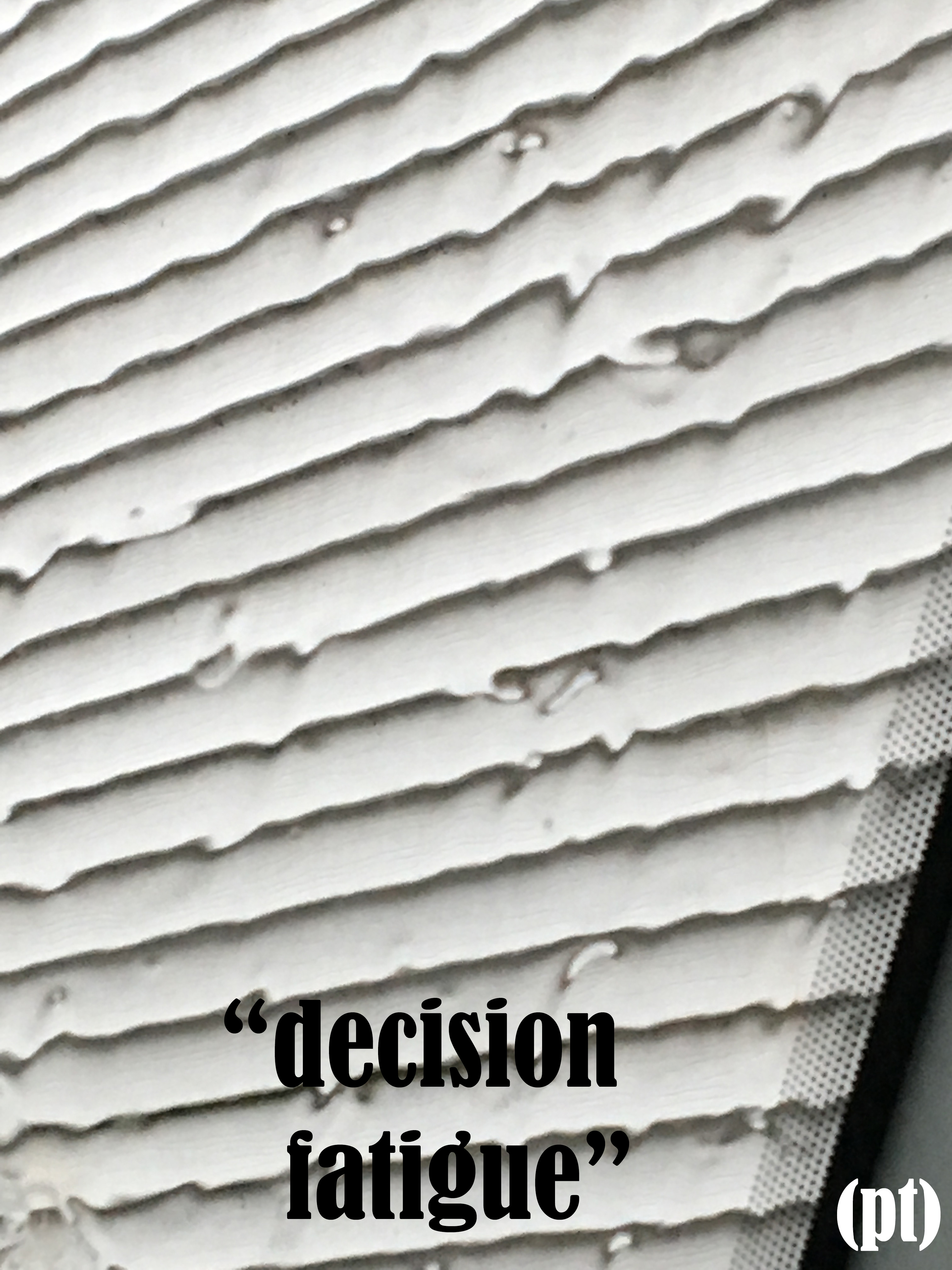
Brad calls it “paralysis by analysis”. Over thinking. Over researching. Reading every label. Considering every color combination relative to every other possible color combination. If you do some quick math, you’ll note that there are an infinite number of color combinations so arrival at a choice is a process of exhaustion. Waving the white flag. Conclusion via collapse. Decision by despair.

Neither Brad nor I suffer from this debilitating condition but both of our partners in life do.

It’s hard to watch. I learned at the very beginning to detach from the process. If I wait for the research and comparison phase to pass, if I say nothing until the desperation arrives, then I can tip the turmoil into a choice. And then I return to detachment because the paralysis has only reached its midpoint..

They say that summiting a high peak is not the dangerous part. Most climbers die on the return trip, the descent from the mountain. The same is true for analysis-paralysis-style-decision-makers. Once the decision is made, a river of decision-doubt and choice-remorse rushes in. The real paralysis happens after the decision is finally made. And revoked. And made again. And revoked. More spouses have collapsed on the way down from Mount Decision than on the initial ascent.

There’s a terrific scene in the movie About Time. The wife wants help from her husband in deciding which dress to wear to an important dinner meeting. She models dozens of dresses. He finds goodness in every option. She finds flaws in every dress. He becomes increasingly desperate, no matter what he says or enthusiastic support he offers, he finds himself swirling into the quagmire of no-good-answer.

I love that movie. Every time I watch that scene, I both howl with laughter and close my eyes. I know his desperation. I feel his fatigue. The minute she circles back and decides on the very first dress she modeled, with his wave of relief I whisper to the screen, “Now you’re really in trouble.”

read Kerri’s blogpost about DECISION FATIGUE