See The Pattern [on Not So Flawed Wednesday]

napkin copy

Virgil: From what you wrote, I see that you think you have a problem. The first recognition is simple: you do not have a problem. You have a pattern. ~ David Robinson, The Seer

I’ve stared at this napkin for a long time wondering what to write. It’s not that I have nothing to say, it’s that I have too much to say. I’ve killed more than one dinner party going on and on and on about patterns.

In 2014 I published a book, The Seer. The first three chapters are about patterns of seeing, patterns of thinking. Patterns of self-story. So, rather than rewrite something that I have already written, here’s a small slice, an email conversation, from the first chapter of The Seer:

 ***

Me: I realized that I think in patterns. I think the same stuff over and over. This is a puzzle: the act of looking for patterns opened my eyes. So, patterns reveal. And yet, later, when I became aware of the patterns of my thinking, I recognized that those patterns were like ruts or grooves. It’s as if I am playing the same song over and over again so no other music can come in. My thinking pattern, my rut, prevents me from seeing. So patterns also obscure. Make sense?

Virgil: Yes. It must seem like a paradox to you. Think of the song or rut as a story that you tell yourself. Your thoughts, literally, are a story that you tell yourself about yourself and the world; the more you tell this story the deeper the rut you create. So, a good question to ask is: what is the story that you want to tell? Are you creating the pattern that you desire to create? We will return to this many times. This is important: the story is not happening to you; you are telling it. The story can only control you if you are not aware that you are telling it.

 Me: Can you say more?

 Virgil: We literally ‘story’ ourselves. We are hard-wired for story. What we think is a narrative; this pattern (song) that rolls through your mind everyday is a story that you tell. You tell it. It defines what you see and what you do not see. What you think is literally what you see.

 There was a pause. That was a lot for me to take in. When I didn’t respond, he continued:

Virgil: So, what you think is nothing more than a story; it’s an interpretation. You move through your day seeing what you think – instead of what is there. You are not seeing the world, you are seeing your interpretation of the world. You are seeing from your rut and your rut is a pattern. So, your patterns of thinking, your rut, can obscure what you see. Make sense?

 Me: Yes. I guess 😉 So, when I started looking for patterns outside of me, I…stopped seeing from within my rut? I stopped assuming that I knew what I was seeing. So, I was capable of discovering new patterns and connections?

 Virgil: Yes, something like that. You said that when you looked for patterns you slowed down and felt that you could see. I would say it this way: you stopped moving through your world and for a brief period you were actually in your world. For a brief period you were no longer lost in thought but present with what was right in front of you. You suspended what you think you know so you started to see again. You were curious. To be curious is synonymous with “not knowing.”

 Me: Okay….

 Virgil: Humor me and entertain this notion: your thought, your story, is not passive. It is a creative act. What you think IS what you see. Most of the time people create what they see based on their rut. They see what they expect to see. To practice curiosity is to suspend the assumption of knowing. To practice curiosity requires us to step out of the rut. Stop assuming that you know and you gain the capacity to see beyond what you think.

 A glimmer of light pierced the dark recesses of my mind. Suddenly I was back in front of the Sphinx and I could see the answer to the riddle. It was so clear! I typed:

Me: Wait! Is this why I need to distinguish between problems and patterns? If I tell myself that I have a problem to solve, I am telling a certain kind of story. If I tell myself that I have a pattern to change, I am telling an entirely different kind of story. Is that true?

Virgil: Yes. It sounds too simple, doesn’t it? A problem is a story. It is a lens that filters your sight. A problem does not exist unless you insist that it is there. You say that you are an entrepreneur. How many great products and services were the results of an accident in the lab? How many innovations were missed because the ‘solution’ did not fit the ‘problem’ as identified? A problem is a rut that separates you from possibilities. On the other hand, a pattern connects you to possibilities. See the pattern not the problem.


[go here for a fun Escher-activity about pattern to use during this time of social distancing]


read Kerri’s blog post about THE NAPKIN
 

tpacwebsitebox copy


the seer ©️ 2014 david robinson

Visit [on Two Artists Tuesday]

birch in winter copy

All this week I’ve been lost in memories of childhood. Nothing indoors, my remembering is outside. Running through fields. Aspen trees. The sound of snow. The smells of coming spring in Colorado. The intense blue sky. Standing against a brick wall, face to the sun to drink in the warmth on cold day. These memories are more sensual than story. It’s as if, this week, I need to remember the feeling of being a child.

I’ve always loved to draw and paint. I’d spend hours drawing eyes and faces. I drew portraits of Colonel Sanders from the empty chicken bucket. I spent hours inside of National Geographic magazine drawing the figures I found there. I drew again and again and again a cabin in the woods that lived only in my imagination. I knew the place the first time I scribbled it on paper. There was a period of time in my mid-life that I thought I might someday happen across the cabin-of-my-imagination.  I forgot the feeling of being happily lost inside the world of my imagination. This week, I remember.

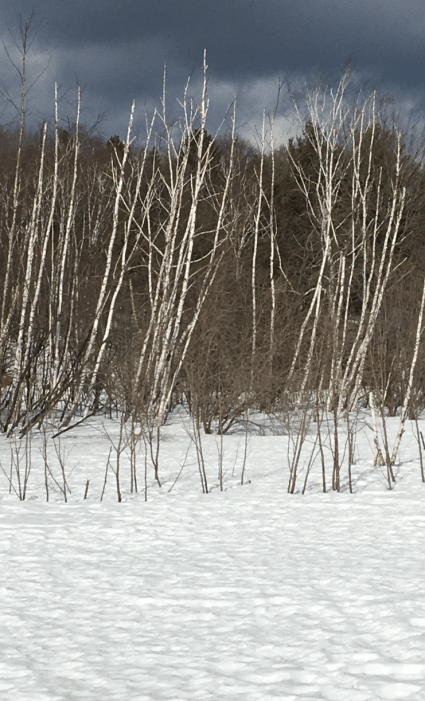
Up north, walking on a frozen lake to see the eagle’s nest, we passed this stand of birch trees. Andy Goldsworthy could not have placed them better. White and fragile against the forest, they glowed in the afternoon sun. They shocked me into presence. I was surrounded with people I love, the sun was warm on my face, the creaking of the ice, the smell of pine, Kerri’s delight. “Remember this feeling,” I told myself. Remember this moment. Someday, after you’ve long forgotten this day, you will reach back and be thankful to have this place in memory, this feeling, to visit again.


read Kerri’s blog post about BIRCH TREES


footprints in sunlit snow website box copy

Touch The Chair [on Merely A Thought Monday]

healing copy

I am reading books slowly these days. Meditating on words. Sometimes it takes me months to read what I used to blow through in a few days. I am often pleasantly surprised and taken aback by how the words I read on this morning – words written months or years ago – line up exactly with the events of my day. All the time I catch myself thinking, “How did they know I needed to hear that today?”

“There was an altar upon which we could place a photo of someone who had died. Kim chose to put a picture of his “old” self; I found one of him rowing his peapod looking so happy, so strong. Beautiful. We both grieve the loss of that Kim while getting to know and love this new one.” ~ Judy Friesem, Summoned By A Stroke.

Grieve the loss. This is the fourth time in my life that world circumstance/events have drawn a hard line between ‘what was’ and ‘who-knows-what-will-become.’ What was normal and true last week will never again be the same. Social distancing. Pandemic. Disruption is scary and confusing.

I’ve many times heard the story of immigrants, preparing to leave their homes forever for some distant and unknown shore, just before leaving, circle the rooms, touching walls, running their fingers along the arm of a well-loved chair. One last look. This is who I was. Who will I become? It is necessary to mourn what is known before making space for the unknown.

In the midst of spinning change, hanging on too long to the way things-ought-to-be or used-to-be is destructive. More than once I’ve stood with a group in full denial of their new circumstance insisting that “This is the way we’ve always done it!”  Perhaps. What is comfortable today was at one time new and uncomfortable. Someday, what is now new and uncomfortable will be a well worn path. The first step: one last look. This is who we were.

“No person is a finished thing, regardless of how frozen or paralysed their self image might be. Each one of us is in a state of perennial formation. Carried within the flow of time, you are coming to be who you are in every new emergent moment.” ~John O’Donohue, Beauty

Imagination lives in the midst of “It happened to me.” One of our greatest super-powers is the capacity to imagine ourselves different, more expansive. It is what we call dreaming. We “see” ourselves” writing the book or scaling the mountain or being a better parent or working at the soup kitchen or losing the weight or…becoming the more perfect union.

Imagination requires leaving. Leaving requires imagination.

“Fate has a way of handing us what we need in order to become whole…” ~ Judy Friesem, Summoned By A Stroke


read Kerri’s blog post about HEALING


moon website box copy


See The Series [on Two Artists Tuesday]

life series quote copy

The closing moment of the film Love Actually is a wonderful montage of greetings at the arrival gate at Heathrow airport. The Beach Boys sing God Only Knows to images of children greeting grandparents, husbands rushing to their wives, friends opening their arms to friends. Hugh Grant’s voice over: “Love actually is, all around us.”

For reasons I’ve never quite understood, we human beings have an uncanny ability to focus on the negative stuff while completely missing the love all around us. We famously study ourselves and the data is overwhelming: we yammer on and on to all who will listen about the “bad” thing that happened in our day. We share the “good” stuff less and with far fewer listeners. There’s something about a fight that draws our eyes while a kiss will make us look away.

Stand on any street corner and  watch the world go by and one thing becomes immediately clear. There are far more acts of generosity than there are acts of violence. The kind hearts outstrip the mean spirits by far so why do believe the opposite?

Krishnamurti famously said that “Life is a relationship. Living is a relationship. We cannot live if you and I have built a wall around ourselves and just peep over that wall occasionally.”

Violence and division make for better ratings because it’s profitable [and easy] to focus the feed on all things negative. Low hanging fruit. It’s profitable to keep the eye off the thousand tiny miracles. But that doesn’t mean they aren’t happening all around us, every minute of every day.

What might it take to pull down the wall so we might more than periodically peep over it? So that we might see that love actually is all around us? To borrow a phrase from The Beach Boys, “god only knows.”


read Kerri’s blog post about A THOUSAND TINY MIRACLES


feet on dashboard website box copy

Eat The Cold [on Merely A Thought Monday]

every storm runs out copy

“Eat the cold!” the Buddhist monk said to the shivering novice. “Eat the cold.” It is” monk-speak for embracing rather than resisting the circumstances of your life.

Non-resistance. Detachment. Hold your self lightly. Presence. Make no assumptions. Be here now. Every spiritual tradition has language for the lesson. Eat the cold. Have the experience. Suspend your judgment. See what is there, not what you think is there. Feel it without condemnation or praise.

When I was a teenager I went on a trip with a school group. The bus broke down in the mountains. We sat on the side of the road bemoaning the state of our affair. The teacher laughed at us. “We’re on an adventure and this is part of it!” he exclaimed. “Rather than fool ourselves into thinking we are stuck, maybe we should fool ourselves into thinking this is exactly where we should be! What’s here? What can we do and create here?” I remember nothing about the rest of that trip but I do remember how much fun we had on the side of the road.

Kerri’s wrists are broken. We find ourselves on a metaphoric roadside. Our patterns are completely disrupted so we are experiencing the gift of mindfulness. Putting on a coat requires complete attention. Lifting a fork. Combing out her gorgeous naturally curly hair. Buckling a seat belt. We have abandoned all notion of rushing. It happens when it happens. When she plays the piano, she does it with full attention; nothing is taken for granted.

What’s here in this storm? Maybe this is exactly where we should be. Amazed at our friendships, our first walk since the accident with Jen and Brad, the sun and wind, laughter with 20, cooing at the meal Joan made for us, flowers, brownies and wine, crawling under the healing quilt that Janet sewed.


read Kerri’s blog post about EVERY STORM 


halfmoonbay CA website box copy

Bother to Ask A Question [on Flawed Wednesday]

think before you share copy

All of us know this tale: A farmer loses his ax. He saw the neighbor boy playing in his field so he suspects the boy took his ax. He tells his wife the neighbor boy is a thief. The wife goes to town shopping and tells everyone she meets the story of the neighbor boy stealing her husband’s ax. People share the story and the story magnifies. An ax is now the least of the boy’s crimes! They tell other people and when things go missing or worse, the boy is their suspect. If he could steal an ax he could also steal a shirt off the line. He’ll take your horse when you’re not looking! He’s a chronic thief! The boy is shunned. His family is ostracized. The farmer feels satisfaction until the day he finds his ax resting on the tree – right where he’d left it.

Narratives are very, very powerful.

Yesterday I listened to a speaker from SelahFreedom present on the growing “industry” of sex trafficking. It was horrifying. One of the slides on the speaker’s Powerpoint was from a pimp’s notebook, instructions about how to keep his women under his control. Drugs help but the narrative weave is all. It could have been notes taken from the commandant at a concentration camp or a cult leader’s handbook. Paranoia tactics. Isolationist, us-versus-them strategies. Lies and distortions repeated to the point that it is impossible, once inside the narrative, once hooked in the story, to distinguish between reality and the distortion.

We live in the age of information and misinformation. We now inhabit the era of hyper-magnified distortion. A single post, a tweet, can reach millions in an instant. The boy stole the ax! They are trying to make us all socialists! The judge was biased! Don’t believe what you see! Witch hunt! Hoax! Believe what I say not what I do.

When was the last time you checked the veracity of your news sources? When was the last time you bothered to fact check or research something that alarmed you in your stream?

Fear is a great brain scrambler. Robert Sapolsky, researcher of stress in animals, has shown that zebras are capable of shaking off their stress after the lion gives up the chase. People, on the other hand, whip up and maintain their stress by repeating the story over and over to all who will listen. And, more to the point, there need not be a real lion chasing us, just someone who knows how to manufacture a lion and get us to spread the terror, to share without question.

It’s the pimp’s strategy. Stoke fear. Discourage thinking.  Threaten. Sow doubt. Play on insecurity. Keep them hooked. Encourage thoughtless sharing of an empty narrative. It validates the perspective of the pimp and the farmer who couldn’t possibly have lost his ax all by himself.

Despite what they tell you, the pimp is never protecting your interests. The pimp is only concerned with his own interests and needs a deep state of delusion running rampant through his stable, to control the narrative.

Imagine what might have been possible if anyone in the ax chain had thought to ask a question, had stepped back to think about what they were hearing before they hit the easy button to share.


read Kerri’s blog post about THINK BEFORE YOU SHARE


shadow bristol woods website copy


Snap Your Fingers [on Merely A Thought Monday]

we should be wide awake billboard copy

When I was roaming the world working with corporate types, tilting at windmills, I would tell my be-suited crowd that words matter. I’d relay a story I heard from Don Miguel Ruiz. He told his audience that people in the United States completely misunderstood the word, “spell.” He said, “You think to put a spell on someone is magic, like hocus-pocus. But, that is not it at all. Tell a little girl that she is fat and you will have spelled her forever.”

She will hate her body. That is a powerful spell.

Words matter. Tell the nation that the “Democrats are vicious” or that the news is “the enemy of the people” and the enchantment is undeniable, angry.  Push the spell through a propaganda machine and it magnifies in intensity. Like a ritual drum, the thump-thump whips the glassy eyed adherents into a red frenzy. Insist that long debunked conspiracies are real or that the deep state is out to get us all and the spellbound will see demons threatening everywhere.

The nation body splits and just like the little girl looks with hatred at the other part of itself. A powerful spell.

‘Hoax’ thump-thumped in the face of undeniable fact and the mesmerized fall into line, repeating what they are told to repeat. “Cluck like a chicken!” the hypnotist suggests and the sleepers dutifully cluck. Common sense surrenders to the spell.

Teachers of consciousness use different techniques but are in general agreement about how to awake from a nasty spell. Step back. Doubt what you think. See what is there and not what you think is there. Detach from your attachment to what you want to believe, to what you are being told. The salesman always wants you to buy the car. He is not your friend. He does not have your best interest in mind. He will use his words tell you anything. Despite what you are told, this car will not make you happy, it will not solve all of your problems. It will not make you sexy or powerful or complete. Uncouple from the words, the spell being woven, and see.

If she is lucky, the little girl one day wakes up and realizes that the hatred she experiences is not her own; it was planted in her with a word. The hatred she wields against herself and turns on to others is not of her creation. She learns that she must snap her own fingers and call herself awake. The hypnotist, she understands, only has authority if she continues to cluck and sleep.


read Kerri’s blog post about WAKING UP


luminaria website box copy


Ride The Lion [on KS Friday]

watershed the songbox copy

Let’s just say that 2020 is off to a rough start. If I was to get out my old-school label maker and slap a sticky tape descriptor on last year, on 2019, it would be the year of contention. 2020 is shaping up to be the watershed. Ka-chunk, ka-chunk, ka-chunk.

Broken contracts [literal and metaphoric]. Broken wrists. Broken dreams. All of our presses have stopped. We are moving very, very slowly through our days. We are having long conversations about where we’ve been, our successes and failures, dreams realized and those that went to ashes in our mouths, and where we want to go from here.

Unless you are being chased by a real lion, fear is mostly a function of imagination. In the real-lion scenario, fear is a life-saver that makes world-class sprinters of us all. In every other case, sans lion, it is a made-up monster that chases.  Running does no good. This chasing monster requires the opposite of the real lion: stopping, turning, and looking squarely into the eyes of your own dark imagination. The only relevant question is, “What’s wearing the mask of this monster?” Shame? Failure? What should have been? What will never be?

It is a turning point. Stopping. Breathing. Turning and staring back at your wild-eyed scare-fantasy and realizing that it’s merely a mechanism to prevent you from being where you are.  Standing in this exact moment is the only place from which you can enact change. It is the single location in which you can fully, unequivocally appreciate your life. Self-made monsters always dissipate when scrutinized.

Running away casts you as both runner and lion, chaser and chased. Fear the imagined-lion, be the runner. It splits you in half. The sky is falling! The sky is falling! And what if it is not falling? What if the lion-monster chases precisely to prevent you from standing still?

It’s a vicious circle, an energy eddy, this hyper-active dark imagination. It is true, if you think about it, that an imagination that is capable of so much doom is equally capable of fixating on the light side. Ride the lion. Better yet, give it wings so the ride is uncanny and wondrous. The ultimate human choice is where we decide to place our focus.

The story we decide to tell follows the focus-choice. Standing still, the only place from which we can see the array of choices and available stories, we are once again learning, seems to be the gift of the Watershed.


WATERSHED on the album AS IT IS is available on iTunes& CDBaby


read Kerri’s blog post about WATERSHED


skylake website box copy


watershed/as it is ©️ 2004 kerri sherwood

Do Like Duchamp [on Two Artists Tuesday]

doorknobs copy

Roger used to say that Picasso’s paintings determine the shape of our cars. He meant that “seeing” is not passive. Just as audiences in a play wiggle in their seats at seven minutes into the play, the usual time for a commercial break on television, our visual sensibility is also patterned and mostly culturally uniform. Beauty is in the eye of the beholder and that eye has been conditioned.

One of the great moments of visual conditioning came in 1917 when Marcel Duchamp entered his “readymade” sculpture, FOUNTAIN, in an art exhibit. FOUNTAIN is a urinal. He signed his readymade scultpture R. Mutt. It is possible to spend many days of your life reading about FOUNTAIN, the symbolic meaning of a toilet, the then-new art term “readymade” and the challenges readymade-as-art posed to the art world, how Duchamp came to enter a urinal in an art exhibit. In that moment of time, a whole new genre was born: conceptual art. The idea behind the work is more important than the finished piece.

You can draw a straight line from Duchamp’s toilet to the recent banana duct taped to the wall by Maurizzio Cattelan. And, you might ask, just what was the idea behind the banana?

You can draw a straight line from Duchamp’s FOUNTAIN to Kerri’s out-door-voice-exclamations in a gallery, “ARE YOU KIDDING ME?” The idea behind the conceptual work generally needs a curator’s explanation. “I WANT TO EXPERIENCE IT, NOT HAVE IT EXPLAINED!” she gestures wildly, sending other patrons fleeing. In that moment, my wife becomes exquisite performance art.

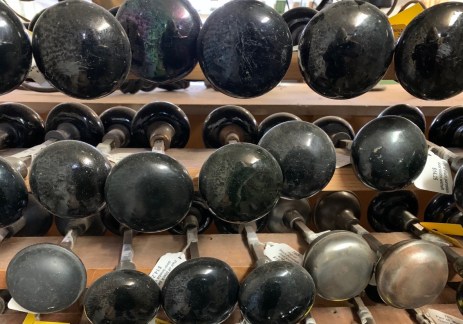
You can draw a straight line from Duchamp’s urinal to my inability to walk through an antique store and not see elegant design worthy of Louise Nevelson. Racks of door knobs. Stacks of suitcases. A wall of bric-a-brac, the wall composition more meaningful and beautiful than any of the individual pieces displayed.

A statement from Captain Obvious: artists live in a time and the art they produce is an expression of that time. Duchamp put his toilet on a pedestal in 1917, the year the world was nearing the end of the first war to end all wars. It was a horror story. The manufacture of stuff was hitting its stride.  The Royal Academy had a lock on determining what was considered art and what was not. The rules of polite society felt dangerous and suppressive. Duchamp, like all change agents, pushed against the norm.

There is composition and design in the everyday. There is human-created beauty all around us. We learn in school that form follows function and form is design. We learn in school that one of the purposes of art is to create beauty. Another purpose is to shock people out of complacency, to see what is in front of them and not what they think is there. Beauty usually lives beyond what we think.

We live in very confusing times. We are asking fundamental questions about truth, about social norms and what is acceptable. We are asking questions about who we are and what we believe. You can draw a straight line from Duchamp’s FOUNTAIN to our current confusion. Is it art? Is it not? If the idea is more important than the final expression then what happens when all that is left to see and touch is absent of the idea? What happens when the curator is gone and only the urinal remains? Sense breaks down.

What happens to  the eye and ear that is shocked open but refuses to see what is right in front of them and, instead, retreat behind the fortress of what they think?  What happens when form no longer follows function but things flip the other way around? What happens when form IS function? Propaganda, mostly. A naked emperor and plenty of people passionately swearing that they see clothes. Readymade thought.

We live in those times. Sense breaks down. We tape bananas to walls and issue a certificate of authenticity.


read Kerri’s much-less random blog post about DOOR KNOBS


frontdoorknob website box copy


Know They Are Watching [on Two Artists Tuesday]

deer tracks converge copy

We go to Bristol wood to return to center. It is a place of peace. It somehow breathes serenity into our overactive minds.

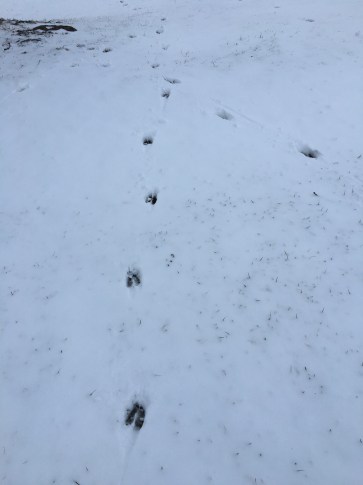
Sign of deer are everywhere in the woods. We rarely see them but we know they are there. I imagine they watch us. I imagine they silently encourage us to walk slower, to catch our breath. To listen to tree song. We delight when we walk a path where they recently tread.

Deer are a symbol of gentleness and intuition. Balance and peace. This summer, on the Island, we saw deer everyday. We would retreat from the contentious community back to the littlehouse, pour some wine, and take a walk. A deer would inevitably appear and we’d stop talking. We’d breathe. We’d watch. It would watch us, too. After a few moments it would leap and disappear and, with it, our day’s concerns would also disappear. The deer would shift our conversation, from a lengthy list of disgruntlement to the beauty immediately surrounding us.

I’ve decided that, in our broken-wrists-time-out, our goal should be to make the whole world Bristol Wood. That we shouldn’t retreat to find peace but should invite peace and balance and serenity into the rest of the day, no matter where we happen to be living it.

Things I used to know. Things I once practiced.

Know that they are there, everywhere. Watching. Silently encouraging us to walk slower, the breathe, to focus on the beauty immediately surrounding us and not on the other stuff. It turns out that balance and serenity are practices, not pursuits. They are choices. Peace-of-heart-and-mind do not exist in the woods exclusively. Peace comes to the place where I decide to allow it. To practice it. To make it a priority.


read Kerri’s blog post on DEER SIGN


deer in woods copy


tpacwebsitebox copy