Do Like Duchamp [on Two Artists Tuesday]

doorknobs copy

Roger used to say that Picasso’s paintings determine the shape of our cars. He meant that “seeing” is not passive. Just as audiences in a play wiggle in their seats at seven minutes into the play, the usual time for a commercial break on television, our visual sensibility is also patterned and mostly culturally uniform. Beauty is in the eye of the beholder and that eye has been conditioned.

One of the great moments of visual conditioning came in 1917 when Marcel Duchamp entered his “readymade” sculpture, FOUNTAIN, in an art exhibit. FOUNTAIN is a urinal. He signed his readymade scultpture R. Mutt. It is possible to spend many days of your life reading about FOUNTAIN, the symbolic meaning of a toilet, the then-new art term “readymade” and the challenges readymade-as-art posed to the art world, how Duchamp came to enter a urinal in an art exhibit. In that moment of time, a whole new genre was born: conceptual art. The idea behind the work is more important than the finished piece.

You can draw a straight line from Duchamp’s toilet to the recent banana duct taped to the wall by Maurizzio Cattelan. And, you might ask, just what was the idea behind the banana?

You can draw a straight line from Duchamp’s FOUNTAIN to Kerri’s out-door-voice-exclamations in a gallery, “ARE YOU KIDDING ME?” The idea behind the conceptual work generally needs a curator’s explanation. “I WANT TO EXPERIENCE IT, NOT HAVE IT EXPLAINED!” she gestures wildly, sending other patrons fleeing. In that moment, my wife becomes exquisite performance art.

You can draw a straight line from Duchamp’s urinal to my inability to walk through an antique store and not see elegant design worthy of Louise Nevelson. Racks of door knobs. Stacks of suitcases. A wall of bric-a-brac, the wall composition more meaningful and beautiful than any of the individual pieces displayed.

A statement from Captain Obvious: artists live in a time and the art they produce is an expression of that time. Duchamp put his toilet on a pedestal in 1917, the year the world was nearing the end of the first war to end all wars. It was a horror story. The manufacture of stuff was hitting its stride.  The Royal Academy had a lock on determining what was considered art and what was not. The rules of polite society felt dangerous and suppressive. Duchamp, like all change agents, pushed against the norm.

There is composition and design in the everyday. There is human-created beauty all around us. We learn in school that form follows function and form is design. We learn in school that one of the purposes of art is to create beauty. Another purpose is to shock people out of complacency, to see what is in front of them and not what they think is there. Beauty usually lives beyond what we think.

We live in very confusing times. We are asking fundamental questions about truth, about social norms and what is acceptable. We are asking questions about who we are and what we believe. You can draw a straight line from Duchamp’s FOUNTAIN to our current confusion. Is it art? Is it not? If the idea is more important than the final expression then what happens when all that is left to see and touch is absent of the idea? What happens when the curator is gone and only the urinal remains? Sense breaks down.

What happens to  the eye and ear that is shocked open but refuses to see what is right in front of them and, instead, retreat behind the fortress of what they think?  What happens when form no longer follows function but things flip the other way around? What happens when form IS function? Propaganda, mostly. A naked emperor and plenty of people passionately swearing that they see clothes. Readymade thought.

We live in those times. Sense breaks down. We tape bananas to walls and issue a certificate of authenticity.


read Kerri’s much-less random blog post about DOOR KNOBS


frontdoorknob website box copy


Know They Are Watching [on Two Artists Tuesday]

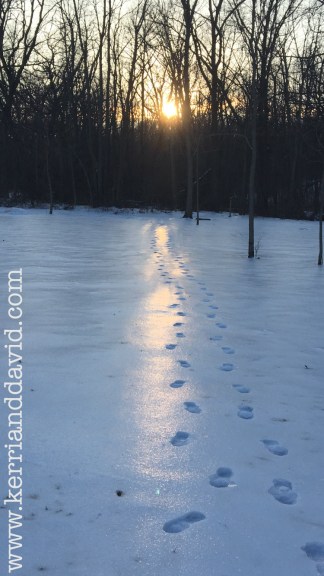
deer tracks converge copy

We go to Bristol wood to return to center. It is a place of peace. It somehow breathes serenity into our overactive minds.

Sign of deer are everywhere in the woods. We rarely see them but we know they are there. I imagine they watch us. I imagine they silently encourage us to walk slower, to catch our breath. To listen to tree song. We delight when we walk a path where they recently tread.

Deer are a symbol of gentleness and intuition. Balance and peace. This summer, on the Island, we saw deer everyday. We would retreat from the contentious community back to the littlehouse, pour some wine, and take a walk. A deer would inevitably appear and we’d stop talking. We’d breathe. We’d watch. It would watch us, too. After a few moments it would leap and disappear and, with it, our day’s concerns would also disappear. The deer would shift our conversation, from a lengthy list of disgruntlement to the beauty immediately surrounding us.

I’ve decided that, in our broken-wrists-time-out, our goal should be to make the whole world Bristol Wood. That we shouldn’t retreat to find peace but should invite peace and balance and serenity into the rest of the day, no matter where we happen to be living it.

Things I used to know. Things I once practiced.

Know that they are there, everywhere. Watching. Silently encouraging us to walk slower, the breathe, to focus on the beauty immediately surrounding us and not on the other stuff. It turns out that balance and serenity are practices, not pursuits. They are choices. Peace-of-heart-and-mind do not exist in the woods exclusively. Peace comes to the place where I decide to allow it. To practice it. To make it a priority.


read Kerri’s blog post on DEER SIGN


deer in woods copy


tpacwebsitebox copy


Get Serious [on Merely A Thought Monday]

er or uc copy

Looking back on the experience, I see a map of choices.

Kerri fell. Both wrists were painful. We knew it was bad. In the ski patrol hut, the medic’s advice was to go get x-rays. Choice #1: To get x-rays or to not get x-rays? We had a conversation in all seriousness with the medics, that, given the nature of healthcare in America, it might be a valid option to skip it. To go home. To ignore it and let it heal as it will. The problem with ignoring it: the loss of motion that comes with ignoring what might be broken or torn in her wrists.

So the choice was not actually to get x-rays or to not get x-rays. The choice, the real choice, was financial ruin or loss of motion. Kerri is a pianist. It is her livelihood and her life. So, choice made: financial ruin.

We pulled into the medical center and saw a sign. To the right was the emergency room. To the left was the urgent care center. We sat in the truck and debated the option. While Kerri writhed in pain, in all seriousness, we sat in an idling truck and discussed the merits [or lack thereof] of our insurance policy. If we chose the right hand path, we would meet the vast, gaping deductible. Like Evel Knieval attempting to jump his motorcycle over the Grand Canyon, we’d have to gun our engine and run at the edge. No parachute. So, we chose the left hand path. We went to the desk of the urgent care and asked if they did x-rays.

Choice #2 was not, in truth, the emergency room versus the urgent care. The choice was which canyon did we have the best chance of surviving?

A few days later. An appointment with a great orthopedic doctor. She, in all seriousness, told us that she ignores the part of the patient file that speaks to their health insurance. She explained that there is dilemma that doctors face: do I advise my patient to do what is best for their health or do I advise them to do the thing that might keep them out of bankruptcy? She ignores the file because she wants her patients to hear what is best for them. She told us that she needs to keep herself blind to the financial reality that her best advice might necessitate. “Yet another untenable choice,” I thought.

Our choices reminded me of an experience we had a few years ago. We were shopping for a new washing machine. The salesman, an older man, was embarrassed by the products he was selling. He, in all seriousness, took us down the aisle of appliances and told us what was wrong with each machine. He was convincing us NOT to buy his appliances. Mostly, he told us, they were designed to fail. He said, “We used to know how to make things in this country. Now we make crap on purpose.”

The healthcare in the richest country on earth is just like the appliances sold in the richest country on earth: Designed to fail. Making crap on purpose. The way I am certain that I see clearly? Sit with your wife, a world-class pianist, who has just broken both wrists, and listen to the choices you are considering. Clarity, in all seriousness, comes when the crisis hits.

As we shake our increasingly obese and unhealthy bellies, wave our angry signs and shout about making America great again, it seems we are falling further and further behind. We saw it this week in our senate, did we not? At least our capacity for denial of the truth [in our post-fact, low-information frenzy] is running in front of the rest of the world. I can only hope, as a nation, we break our collective wrists sooner rather than later. In our pain, perhaps we will look at the sign and have a real conversation, in all seriousness, about our choices, about what we can and cannot survive.


Read Kerri’s blog post [written with a cast and a splint!] on CHOICES


snowsteps website box copy

Look Beneath [on DR Thursday]

underpainting copy

What’s beneath? It’s a question all artists learn to ask. It’s the same question good coaches ask of their clients. Seeing is not a superficial affair.

What’s beneath? What alchemy of color was brewed to make this image or that painting? What alchemy of experience was brewed to make this belief or that perception?

Sometimes “what’s beneath” supports and enlivens the surface layers. It’s magnetic and makes you stare – even if you don’t know why. Sometimes it dulls the painting, pulling the life from it. The same holds true for how a life is storied. Sense-making is as dynamic as color.

Color is a miracle. It is never passive. It is only understood by what it is relative to. That is, color, like a relationship, is fluid, moving, spirited.

What’s beneath all those layers and layers of color?


read Kerri’s blog post about UNDER PAINTING


pumpkinfarm website box copy


under painting, like captain underpants, is under copyright. ©️ 2020 robinson david

Look Beyond [on Not So Flawed Wednesday]

cameras copy

“Technology is anything that wasn’t around when you were born.” ~ Alan Kay

On the one hand, this could be a display of old technology. Shelf after shelf of what was once understood as a camera. Not so long ago a camera was a device that employed a once-revolutionary-invention, a light sensitive plastic strip called “film,” to capture images. These film devices, the miracles that populated my youth, are now antiques.

On the other hand, this could be an art piece, a commentary on the contemporary world. Many, many, many cameras, all with their lenses pointed back at us. There are cameras in phones, each a trafficker of the relatively new obsession known as the “selfie.” There are cameras at almost every major intersection of my town. Traffic selfies that come with tickets. In stores I am told to smile because I am on camera. There are cameras in doorbells. Many medical procedures employ teeny tiny cameras capable of fantastic voyages, inner selfies. The cameras shot into outer space transmit back to us images of a tiny speck in this vast universe, a dot called Earth.  Our art piece reveals to us that we are the central object of our study.

Standing in front of the shelf, looking at the myriad lenses looking back at me, I understood with some sadness that the cameras on the shelf used to be understood as arbiters of truth. There is a now an antiquated term, you may have heard it: photographic proof. Proof. It is not so much that the camera – film – is antiquated – but it’s purpose is most certainly passe’. Truth is out of date. Proof has no reliable root. We have replaced ‘photographic proof’ with a new concept, a ‘post-fact’ world.

Buckminster Fuller once said that, “Humanity is acquiring all the right technology for all the wrong reasons.” Were this beautiful unintentional-art-piece-found-in-an-antique-mall one of my creations, you can bet that I’d scribble Fuller’s quote someplace on the shelf, though, you’d have to look beyond the cameras to find it.


read Kerri’s blog post about CAMERAS


savannah selfie WEBSITE BOX copy

Follow The Intention [on DR Thursday]

2mayyouBEpeace jpeg copy 2

It occurred to me, last night, when writing about the heart symbol, that the mistake we too often make is to hold fluid aspirations as ‘fixed’ states. Heart as a frozen symbol. An achievement. An arrival station on the train of life.

Nothing in this vast universe is still. Every molecule, every cell, is in constant movement. Constant transformation. Peace, hope, heart, love,…are not end-games. They are not winnable sports. They are dynamic, fluid, ever moving. Try to wrap your fingers around them and they will slip through, fog in a butterfly net. They are unattainable.

What, then, does it mean to dwell in your heart? To be at peace?

None of us are ‘fixed’ states. We, too, are in constant movement. Constant transformation. Constant relationship. Constant choice.

Last week I told the choir that their voices would go where their eyes go. Look up. Look to the back of the hall. In that way all are included in the song. It is also true that our actions will go where our thoughts go. Meditate (think about) division and opposition and that’s where we go. That’s what we see. That’s what we create. It’s a choice.

The words on this painting come from the Buddhist prayer of loving kindness. It is a prayer that ripples out, ripples back. Constantly moving. Peace as a motion, hope as a practice. Love as a dynamic action that follows the intention of a fluid mind.


read Kerri’s blog post about BE PEACE


2mayyouBEpeace jpeg copy 2

this image is available here. Scroll down for options.


prayerflagsinsnow website box copy


yoga series: may you/morsel: may you be peace ©️ 2015/2017 david robinson


Go Tiny And Skip! [on DR Thursday]

PeaceOnEarth copy

Kerri called them ‘morsels,’ little snippets of my paintings. She’d isolate a spot, crop it, perhaps add some words or simply let the cropped image become a new, stand-alone design. We offered her morsels through society6.com [prints, cards, coffee cups, pillows, etc.]. This morsel is from the corner of a large painting, An Instrument of Peace.

The morsels had a profound impact on how I see my paintings. In many cases, I liked the morsels better than the paintings they came from. The morsels said more with less. They took me by the hand and led me back to the forgotten lands of shape, form, and color in their purity.

The morsels helped me comprehend and then dance back and forth across the crevasse between design and painting. Painting [for me] is a deep dive, personal spelunking. It is a meditation. Design is visual play. It’s skipping in the sunshine, looking for shells on the beach. Carefree [Kerri is the designer in our family so it is especially easy for me. I’m like the supervisor on a road crew; she does all the work and I stand there, pat my belly, look important, and get all the accolades].

Originally, Kerri made this morsel as a wish for peace. It is among her many morsels that celebrate this season, the return of the light. Peace seems in short supply in our divided nation, our angry world. She asked that we use this morsel today so I pulled it from the archive. She knows that art carries great power and can inspire people to see anew, to dance back and forth across their personal crevasses, and lead the way back to forgotten lands of community and shared vision. Shape, form, color. Beauty generated and shared inside as well as out. Reaching rather than rejecting as a first action.

All of this possibility, hope, an enormous wish, carried in one little tiny morsel.


read Kerri’s blog post about PEACE ON EARTH


PeaceOnEarth copy

for a print or wall art of this image, go here


oversizedjoy copley place website box copy


an instrument of piece ©️ 2015 david robinson

morsel: peace on earth ©️ 2018 david robinson & kerri sherwood

Know The Value [on Two Artists Tuesday]

paint by number copy

“What’s it worth?” This seems to be the least answerable question of our times. Its cousin question, “Is it real?” is under assault and so qualities like ‘value’ or ‘worth’ are less and less discernible.

For instance, I laughed heartily recently when I listened to a podcast Horatio sent my way. It was about the billions of dollars spent on our educational system of testing that has produced minimal results. It doesn’t work. Data, brain science, and common sense have known this for years. I can hear Tom now (and see his famous sigh-with-eye-roll), “It has to be real. It’s about relationship. It needs direct application.” Do the tests make for better education? No. Of course not. The opposite. And, we knew that before implementing the system of testing. So, what is real? What was it worth? The system consumes itself.

A few years ago, Kerri and I went to the Chicago Art Expo. We came upon a gallery installation, a single piece. It was priced at $40,000.00. A line of twine stretched across the booth. Clipped to the twine was a single household sponge. It had been dipped in paint. Kerri, using her outside voice, said to all who could hear, “ARE YOU KIDDING ME?” It was purchased. What was it worth? Was it real? It was the precursor to artist Maurizio Cattelan’s recent piece. He duct taped a banana to a wall. He’s now sold three versions for $120,000 apiece.  What is it worth? What is real? Art commenting on art. The system consumes itself.

Politics in America. It’s all about crowd size regardless of what the photograph reveals. [sorry, I couldn’t help myself]. There are so many that we actually keep a running tally of the presidential lies. We are slack-jawed at those who nod their heads and bellow their agreement with the demonstrably untrue. What is real? What’s it worth? The country hungrily consumes itself.

We haunt antiques stores. We rarely buy anything but enjoy the exploration. At School Days Mall, one of our favorite adventure antique grounds, Kerri turned and gasped. A paint-by-number landscape wearing a Minnie Pearl tag. “I recognize this painting!” she said, wide eyed. Her mom, Beaky, liked to paint and had a paint-by-number phase. The painting evoked a good story. It evoked a momentary possibility that this might be THE ONE Beaky painted. Kerri sent a text to her sister. They shared a memory. They reached through time and had a moment with their mother. Priceless.

Watching Kerri, so excited, text with her sister, it occurred to me that one reason we go to antiques stores is to touch stuff that comes from a time when value and worth were better understood. We go to the throwaways to find some substance. What is real is not in question.

Banana taped to the wall or paint-by-number landscape? What’s real? What’s it worth?


read Kerri’s blog post about PAINT-BY-NUMBER


tpacwebsitebox copy

Decide To See [on Two Artists Tuesday]

heart leaf copy

When you come to our house, pay attention to the small things. You will find many, many, many hearts. Heart shaped rocks, heart shaped leaves, shells that are the shape of a heart. This is not an accident. It’s also not a collection of “things” – like a collection of shot glasses or figurines. No, it is altogether different.

Kerri looks for hearts. Often on our walks she will gasp, pull out her camera and take a picture. I know that she has seen another heart. Usually, she engages with it and walks on. Sometimes she picks up the heart and it comes home with us.

To be clear: she doesn’t buy hearts from the store. She is not a collector of heart shapes. Kerri looks for hearts. When we are out in public she will gasp and move toward someone, striking up a conversation. Soon there is laughter; always there is a story. Usually, she engages with the heart and walks on. Sometimes she picks up the heart and  it is in our life forever.

Since seeing the recent Mr. Rogers movie, we’ve been talking a lot about intentional thinking, about focus placement. We’ve been talking about what we look for when we go out into the world – what we decide to see. Everyone decides what they see but very few people know that they have that decision. Everyone decides what they think but very few people know that they have that decision. It’s what made Mr. Rogers so special. He knew he  had decisions and he talked about it with children. Children are capable of listening.

It’s very easy to see the gunk. The dark is an easy choice; fear makes it so. It takes some intention to see the light.  Hearts are always present but they require some attention and resolve to see. They ask that we look beyond the superficial gunk to see the heart-substance. That’s why Kerri picks them up and plants them around our home. It’s a practice. She’s built a practice of seeing the hearts. She goes into each day looking for the hearts.

It turns out that hearts are everywhere. You can see them, too, if you decide to see them.


read Kerri’s blog post about HEARTS


heart rock website box copy

Learn The Lesson [on Merely A Thought Monday]

the world will treat you royally copy

The exercise is simple: be an angel to someone for at least 3 hours.

There is only one rule: you can’t tell them what you are doing or why you are doing it.

When assigning the exercise, there is always one panic-question masked as two questions: What does it mean to be an angel/How do I do it? [pull the mask and the real question is: what will they think of me?]

There is only one answer to the question: What does it mean to you to be an angel? Do that.

After the exercise, there is always one post-angel observation: “It was scary at first and then it was really fun!”

After the exercise, there is always one post-angel revelation: “I received waaaay more than I gave.”

Receiving abundantly as the consequence of giving abundantly is the point of the exercise [in this case, define ‘exercise’ any way you want to].

This message is everywhere. It’s a Hermetic Principle. It’s cause and effect. It’s what we learned in kindergarten. It’s the message from grandmothers on every continent. It’s blow-back. It’s a Beatles lyric: the love you take is equal to the love you make. It’s an advertisement to sell Canadian Whiskey.

Because it’s ubiquitous, you’d think we’d have learned it by now. Perhaps we know it already but get hung up on the courage it takes to be an angel. Mean is easy. Division is as easy as falling off a log. Kindness takes a bit of pluck.

After the exercise, there is always one post-angel lesson: there are no sissy angels.


read Kerri’s blog post about LIVING GENEROUSLY


juiceglassesonHH website box copy