Know The Moment [on KS Friday]

“A work needs to relax toward finality. It cannot be pushed, it cannot be worried, it cannot be analyzed to completion. Pushing against the natural rhythms of creation will just churn up the waters. Clarity comes only when the waters settle and the air clears.” ~Kent Nerburn, Dancing With The Gods

Because I tend to speak in metaphors in a world enamored with goals, what I say often, at first, goes unheard. Skip is stewarding an amazing creation and has, from my perspective, just passed a significant milestone. I told him that, in working with many playwrights and painters and actors, there is an initial phase in every creative process in which the creator works for form. It’s like the tide going out, dumping everything down on the page to gather and find the story-form. Then, in a beautifully mysterious moment, the tide turns and finding form is no longer the intention. Clarity becomes the aim. Skip is a listener. Metaphors tossed into an analytic frame generally seem out of place or perhaps arrive too early to the party. But I’ve learned they are seeds that, when planted, begin to work their way up through the crusty soil.

John Guare said that a writer has to write ten bad pages to arrive at a single good page. The ten bad pages are the search for form. Reducing ten into an essence of one is the work of clarity. The phases, the exhale for form and the inhale of clarity, are two different yet interrelated energies.

When I am working on a canvas I might evolve the image for days. Sketching, painting, wiping, adjusting, wiping, sketching, painting. The search for form. Adding and subtracting. Moving the composition, tilting the symmetry. And then, something clicks and I know. The painting is formed and now the pursuit is to hold its hand and bring it into the light. Inhale.

Because my father recently passed, followed hard upon by my dear Ruby, I have been reviewing much of my life. Roger used to say that the first 30 years of life were about trying to become something and then, one day, you realize that you are that thing you were trying to become. The rest is learning how to be it. Searching for form. And then, clarifying. I think Roger was half-right. Becoming and being are cycles, not arrivals.

The cycles of my life are explicit. I enter into worlds that I know nothing about – either by accident or invitation. That I know nothing about the world is precisely why I’m invited in – or bumble in. I see it. I bring it metaphors. It is uncomfortable to not-know so I learn about the world as an outsider. It helps me see more clearly. I know the moment when form turns toward clarity. I see when the process roils into an eddy. I understand how to free stuck energy. I’m a midwife to creative process, a guide across unseen bridges.

We stood in the November sun admiring the giant flowers against the blue sky. I loved the idea that I was experiencing an ant’s view. These past many years I have been looking for the new form. Pushing. What was I? What am I now? And, in a beautifully mysterious moment, I realized that the tide was at long last coming in.

read Kerri’s blog post about GIANT FLOWERS

find Kerri’s music on iTunes or streaming on Pandora

Walk With Samuel [on DR Thursday]

“The end is in the beginning and yet you go on.” ~ Samuel Beckett, Endgame

When is something finished? Beckett wrote Waiting For Godot in 1953; characters waiting for what will never arrive. A finish. A completion. Beckett’s life spanned both wars-to-end-all-wars, Korea, Vietnam. He wrote about humanity’s dedication to nonsense. His work has been called bleak and dark. His work is shelved with the canon of The Theatre of the Absurd. And, yet, given the news of the day, these days, who doesn’t feel as if they are living in a Beckett play?

What is often missed in his absurdist plays is the beautiful human capacity to keep walking, to keep trying. Waiting and walking through tragedy, mostly of our own making, with unwavering hope. We story ourselves with nobility even when wrapping ourselves in a lie. We make rules and laws that apply to some but not to all and then we set about to justify the inequality. Money and morality are not the same thing though there’s plenty of storytelling meant to have us believe that wealth only flows to the worthy.

Art is not supposed to make sense because life doesn’t make sense. We make sense of life through the stories we concoct. Emperor’s buried with thousands of statues to keep them company in the afterlife, an artist painting the ceiling and walls of the Sistine Chapel, gods and angels and saints. How many people died building the great pyramids, tomb for a pharaoh? Who would possibly spend their life in abject poverty smearing color on canvas? Van Gogh. A legion of others not known. Are we better for it? I cried the day the Taliban blew up the Buddhas of Bamiyan, 6th century statues that I had not seen in person and was likely to never see. Were my tears more or less absurd than the Taliban’s animosity toward carved stone?

Matters of the heart. When are they finished? Where do they begin?

It was a gorgeous day, perhaps the last warm day of the season. We met our pals at the Chicago Botanical Gardens. Throughout the gardens, preparations were being made for the annual holiday light exhibit. A tree of shiny stars. Giant flowers. Faux candles floating in the waterway. Strings of colored lights were being placed along the walkways. Even during the light of day it was impressive.

In this time of transition, many of the gardens were being prepped for the winter, the pathways were packed with people cooing at the wave of the grasses, the shape of the trees in the Japanese garden. I was gobsmacked by the color of the moss on trees, the shock of red leaves against vivid green. No matter which direction I looked, someone, some special gardener and designer, had crafted beauty. They knew that their work would stop me in my tracks and allow me to whisper, “Unbelievable.”

Winding our way back to the Visitor’s Center, I told Brad that, seeing so many people out enjoying the gardens, excited to walk in beauty, filled me with hope.

To walk in beauty. Dollars and cents can’t reach the reason. Data can’t touch the impulse. There is so much light in this theatre of the absurd. Beckett knew it, writing about the stories we tell, the relationships we create, waiting for something – a beauty – that by definition, will never arrive because we are surrounded by it each and every day.

read Kerri’s blog post about RED SCULPTURE

www.davidrobinsoncreative.com

Reboot [on Flawed Wednesday]

I’m not going to lie. Yesterday was textured and difficult. Because our internet connection was spotty – and because our work depends upon a reliable connection – we called our provider to upgrade our service. And, rather than an easy upgrade, we lost our service altogether. And, as I write, almost a full day later, in a world brimming with messages of fast-and-easy, we are still in the internet no-fly zone. After eleven hours, a full five hours on the phone, a trip to the store to get new equipment, ethernet tests on everything but my heart, after a series of pleasant but not-very-helpful service representatives, after the fifteenth (not a joke) suggestion that we “reboot one more time just to see,”we gave up for the night. 

Giving up looked like this: “The problem is on our end,” a pleasant tech offered when there was still light in the sky. “There’s a ticket and our engineers are working on it.” Later, much later, after being passed to two of the engineers-that-were-working-on-it, we heard that they had no idea what the problem was. “We could try to reboot one more time,” he said. “Just to see.”

Kerri looked at me, exhausted, and said, “I can’t do it. Not again.” A battle to be waged another day.

Surrender. I’ve learned this lesson again and again in my life. Sometimes it is best to give over. It is best to stop pushing. Sometimes, there is no solution. Time and a bit of sleep, a new day, will bring another point of view. What was impossible yesterday will resolve today.

In surrender, we sat in the quiet night and talked of our day. The quiet. Nothing dinging or binging or pulling at our attention, nothing notifying us of another message. Nothing trying to keep us hooked for the sake of being hooked. The static was gone. The incessant, “Look at me,” of news apps and Facebook and Instagram and… Life as perpetual “Breaking News.” Within the constant pull, the only thing breaking is our focus. We sat and enjoyed a moment when nothing was breaking.

For a moment during the madness, I looked out the window of my office. The day before yesterday the leaves on our tree were still green. It’s late in the season. Yesterday, in a seeming flash, they were vibrant color. They changed overnight. I was taken, as I always am, by the recognition that the best way to learn color is to go outside, take a walk in nature. See. If there is ever a question about, “Does this color work with that color?” – go outside. Look around. The answer is right there. Crimson and dusty grey. A bit of sage green. Charcoal. Polka dots are not a human invention. The patterns are there, too. Texture. See it.

This morning, while we await the visit from our tech who-will-fix-everything, we’ll go outside. We might play in the leaves. We’ll certainly enjoy the moment without the bings and pings and tech-sounds of made-up-importance. We’ll kneel and coo over the polka dots and salmon pink, the electric yellow and revel in the rare simple moments that a good surrender brings.

[*a hefty thank you to Matt the technician who just spent hours sorting out and fixing what ailed our internet. This post is proof positive that we are, at long last, out of the internet-no-fly zone]

read Kerri’s blogpost about POLKA DOTS

Find Your Motley [on KS Friday]

“Mix a little foolishness with your serious plans. It is lovely to be silly at the right moment.” ~ Horace

There is a famous photo of a gathering of the world’s religious leaders. Readying for the photographer, poised with their serious, “I’m-a-religious-leader” faces, the Dalai Lama turned trickster, and the group burst into laughter. Instead of a wall of stony import, the photographer caught the humanity, the real people hiding behind the official masks. The silly revealed the real.

We are not well represented by our walls of respect, our certificates and degrees and resumes. The letters after our names are often layers of obfuscation.

Although I am not a religious person, I went to a Catholic college. Some of my fondest memories are the moments sitting on the barracks steps with Father Lauren talking about life and personal belief. I knew the road to a rowdy conversation was to bring up the topic of reincarnation. Father Lauren, a Franciscan, always took my bait. He could only maintain his official-priest-role for a few moments and then the real guy, the man full of laughter and curiosity, came out to play. Inevitably, we’d talk into the evening of choices and dreams and plans and roads-not-taken.

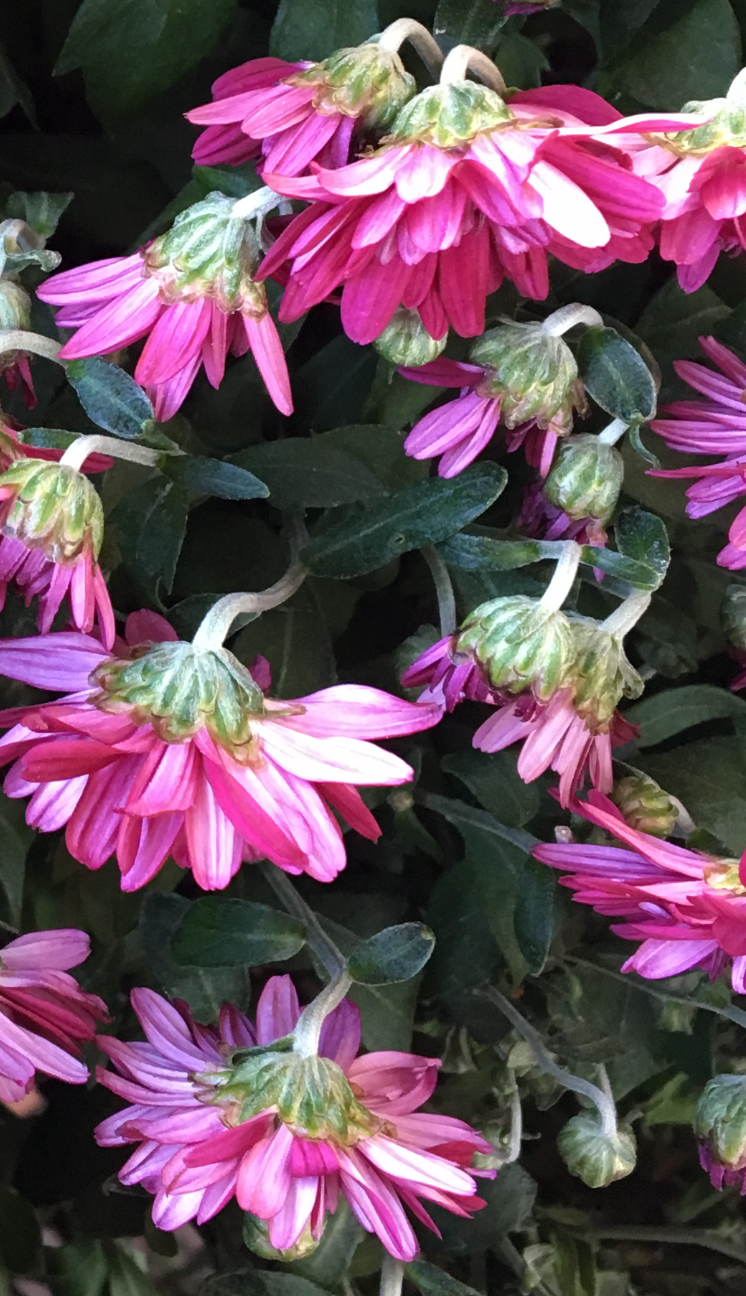
Sometimes I think of fall color as a jester’s motley. The world explodes into vivid fuchsia and gold set against the green. Nature’s play, a silly dance meant to make us gape and coo and laugh. I’ve read that the only person in the court that dared speak truth to the king was the court jester. Truth is available if it arrives in foolish clothes. Thus, Stephen Colbert.

Quinn was full to the brim with laughter. He was a master of tossing the silly into the serious so the truth might be heard. Skip initially hired me to draw cartoons. A serious product that speaks to a serious problem. It’s very possible that the only way it will be heard is though a silly message, a quirky stick poking the bear. The overriding lesson I am learning at this stage of my life is to not-take-it (I am “it”) so seriously. And, so, each week, I lob silly bombs into serious camps – my own camp and others.

I’ve taken special delight this fall. Kerri’s photographic eye is on high alert. We walk and every third step she says, “I’m sorry,” and stops to take a picture. I’ve stopped asking, “What are you apologizing for?” Now, I simply watch and wait for the moment she looks at the screen, scrutinizing what she’s just captured, turns to me with silly glee, saying, “Lookit!”

Kerri’s albums are available on iTunes and streaming on Pandora

read Kerri’s blog post about FUCHSIA

every breath/as it is © 2004 kerri sherwood

Get Lost [on DR Thursday]

We delight in taking Sunday drives. Sometimes we have a destination but most of the time we have no idea where we are going. We head “out into the county,” the farm land, and with great intention, we get lost. “Left or right?” Kerri asks when we come to a crossroads. “Left.”

The goal is to “not know.” Drive down roads we’ve never experienced. There is a direct correlation between “not knowing” and “clear seeing.” When lost, we open our eyes. It’s something that every artist understands, “always-knowing-where-you’re-going” is a killer of the magic. It is the dividing line between art and craft.

I’m currently working with a team of analytical minds. “Lostness” is often interpreted as failure. It’s not welcome. But, to my great delight, even in the most analytic of creative processes, the engineers and entrepreneurs, shaking their fists at the sky when adrift, find their greatest magic arrives only after time spent wandering the wilderness.

After many twists and turns, rolling country roads and, “Which direction are we headed?”, we pop out of lostness and know exactly where we are. “Hey!” we laugh, “How did we get here?”

The art of getting lost. The art of exploration. The art of having an experience without a predetermined outcome. The art of having an outcome and letting it go, making space for something better. It is the art of cultivating surprise, allowing for the bigger idea to come through. “Left or right?”

It’s a practice. Learning-to-see and letting-go-of-needing “to know.” It’s the same thing. And, a great way to practice, is taking a nice Sunday drive.

read Kerri’s blog post about THE ROAD

pax © 2015 david robinson

Hold A Greater Space [on Merely A Thought Monday]

The sun was setting as we drove away from the memorial service. A celebration of life. We were quiet, lost in our thoughts. “I don’t know if I’ve ever before been to a celebration of life where I LEARNED something about life,” Kerri said. I was thinking the exact same thing. I’d just received a master class on how to live a good life. I just learned about the untenable nature of love.

It was Nancy’s service. Her husband of many years spoke. Her daughters spoke. Her stepchildren sang and read poetry. She was a longtime member of the church so the pastor told stories about her. The service was alive with laughter and with tears. Both. People applauded at the end of the slideshow, a photographic journey of a life that began in 1933.

We are inundated with notions that ‘the good life” should have no pain. It should be above hardship. Nancy’s life did not support that half-narrative. She experienced canyons of loss. As her daughter said, “She could have become hardened and bitter.” But, she didn’t. She didn’t ignore her pain or deny it, she allowed it. It was part of the color of her life. She did as the Buddhists recommend: joyfully participated in the sorrows of the world. She participated. She chose. She decided. She created.

She surrounded herself with flowers and loved her garden. She made her table a magnet for family and friends. She did not sit and complain, she had no time for woe-is-me. She found opportunities to give and engage. Story after story of a woman, even in the heat of cancer, while awaiting the results of the latest scans that would determine the number of days she would have on earth, turned trips to the doctor into opportunities to shop with her daughters. Lunches. Expeditions to a beloved bakery. Create the extraordinary in the simple moment, regardless of the circumstance. We heard again and again these companion phrases, “She chose love.” The pain and the love, “Both belong,” Heidi said.

In an intentional life, one does not negate the other. Tragedy and triumph. Devastation and joy. It’s a decision. Where we focus will determine our experience of life. Nancy stood in her pain and uncertainty; she had every opportunity to become bitter. Instead, she focused on love. She created it. Nurtured it. Grew it. Offered it. She didn’t deny her pain. She held space for it in a greater container.

It was apparent in the laughter evoked in the stories told, it was apparent in the generosity of the service we experienced. This was not a Hallmark movie. It was a celebration of a life of texture, of impossible mountains to climb and of enormous blessings. It was the lesson Nancy lived because it was woven through every story told about her. “It’s what she taught me,” Heidi said, “Both belong.”

read Kerri’s blog post about BOTH BELONG

Stand In Time [on DR Thursday]

Stephen Hawking asked why we remember the past but not the future. Yesterday, in the middle of a meeting, I received a slack message with a sentiment from Russ Ackoff: entrepreneurs stand in the future and look at the present. I was fascinated by an article by Wade Davis, writing about a culture that experiences time as movement backwards; we row our way into the future.

Declan Donnellan writes that it is impossible to try and be present because we already are present. We live in it. We have to try very hard not to be present. In fact, we have to split ourselves in two halves. One looking backward. The other looking forward. We are, each and every one, Janus.

It is the time of year that time changes. It’s an odd ritual to “fall back” in time. What was 5 o’clock will soon be 4 o’clock, not because of a strange universal movement between planets and stars, but because we say so. A few states in the union don’t participate in the ritual so their time stays the same.

Time on a line. So many different realities, even in the most basic experience. Constructs of time.

I’ve read that old age is a return to childhood. Many, many great thinkers and writers from many disparate cultures tell us that we will journey through life and arrive where we began. The destination is ourself. Have you ever tried to describe your self and found the task impossible? Words simply cannot reach that level of complexity. There is a notion popular in the self-help world to define your life mission, your single life purpose. It’s meant to give you focus-of-action and certain-location on your line of time. It is also nearly impossible to articulate and becomes an exercise in metaphor selection. I’ve smiled knowingly as people in my past have asked, “Is this my mission or am I making it up?” The answer to both is, of course, yes. In a more universal peek, the exercise is meant to take you one more step around the circle that will bring you back to your self.

When I was doubting myself, judgmental because I “didn’t know” what I was doing, Quinn pointed to the tallest building and said, “The person on the top floor is just making it up, too.” He was standing in my future, looking back.

It’s just a matter of time.

Just.

read Kerri’s post about TEA LIGHTS

Greet The World © 2011 david robinson

See The Dance [on Two Artists Tuesday]

“You can only push the truth down for so long, and then it bubbles back up.” ~ Cassandra Clare

“Oh, for the wonder that bubbles into my soul.” ~ D.H. Lawrence

Last night we made a fire in the fire pit. We decided to have a pop-up dinner by the fire so we set up our table, lit candles, poured some wine, and brought our dinner out under the stars on a chilly October night. There wasn’t a cloud in the sky so we looked at the stars. We wondered if the brightest lights were planets.

There are many, many works of art from a genre in the Middle Ages known as the Dance Macabre. Dance with death. The scary images were meant to remind people of life’s fragility, its passing nature. They were also meant to point out the obvious: we are all united in our final destination. No one is better or worse than any other in the grand scheme of things, in the Dance Macabre. In the Middle Ages, the allegory was meant to suggest it was best to aim your focus at the afterlife. Do good works as an investment in your future or go to the fiery place below.

Were I to paint a series of Dance Macabre images today, my intent would be the exact opposite: aim your eyes at this moment. There is nothing more precious or wonder-full than this moment. If there is a heaven, it is now. And, it will go unnoticed if the dance is not acknowledged. There is no sadder phrase on earth than, “Same-old-same-old.”

According to some cultures, I am now in sacred space. I’m seeing all things relative to my dad’s recent passing. Sitting by the fire, our dinner complete, we talked about his death and my inability lately to invest too much emotional energy in anything. Things that would have upset me a few months ago barely register. I’m watching the usual list of anxieties and worries drop off. Why would I give an ounce of my wonder to something so…small? Perspective is the gift of the dance macabre. Clarity of sight and intention comes with this kind of perspective.

We clinked our glasses, the cold night and the heat from the fire colliding around us under the stars. DogDog slept on the deck, a few feet away. We realized our moment. Fully. Magic was alive, bubbling everywhere.

read Kerri’s blog post about BUBBLES

Lookit [on KS Friday]

“It was not that he had nothing to say, he just hadn’t realized that what he had to say was enough.” ~ Kent Nerburn, Dancing With The Gods

Kerri practices what Kent Nerburn calls “the art of close inspection.” When we are on the trail or in the backyard or in the kitchen, she’ll suddenly jump, grab her camera, and take a shot of some gorgeous detail. A reflection. A flower. A texture. I would have walked by without ever noticing. She sees detail. And, she is never off duty; she is always looking. Seeing.

I know her images are authentic – meaning that she is not trying to “make art” or make grand statements or be clever – because she is tickled by what she captures. “Lookit!” she exclaims as she shows me the image. Her delight is as pure as her eye-for-composition.

When I moved to Wisconsin and put my studio in the basement, she’d take photos of my paintings. Never the full painting, always a detail. It unnerved me a bit because the composition of her detail-image was always much better than my composition of the full painting. “Lookit!” she’d say, showing me the image. We called them “morsels.” I started studying her morsel-shots. My musician-wife was a secret master of visual composition and I had much to learn. She encouraged me to take photos of my works-in-progress as a way of standing back from the painting, as a way of seeing what my eyes could no longer see.

I’ve been drawing cartoons for months. This series is special because it is simple, pared down. How much expression can I capture in a simple line – in fact, in the fewest lines possible? The art of close inspection is having an impact on me. I’m getting paid to draw this series and am fully aware that they might never see the light of day. And, it simply does not matter. I love them. I know they are pure because, with each new cartoon, I race down the stairs (my drafting table is upstairs) and say, “Lookit!” as I hand them over to Kerri to finish them with her photoshop magic. After she performs her magic, she brings the computer to me and says, “Lookit!” and I smile. “Doyoulikeit?’ she asks.

“Ilikeit.”

read Kerri’s blog post about FALL FLOWERS

Kerri’s albums are available on iTunes or streaming on Pandora

you come to realize/this part of the journey © 1998 kerri sherwood

Listen To Claude [on Two Artists Tuesday]

In his 60’s, the famous Impressionist painter Claude Monet went blind. Cataracts were removed, restored his sight, but also changed his capacity to see color. He painted in blues because he couldn’t perceive red and yellow. He was not fond of the paintings that he produced. He painted what he could see. Historians, on the other hand, credit his blue paintings as an important link to abstract painting.

We never really know the impact of our actions or our work.

The path paralleled a stream. As we walked up the mountain, she stopped often and took photographs. The sun on the water was enticing so she aimed her camera at the stream. “Look!” she said, showing me. “These look like abstract paintings!”

“They look like Monet,” I said. “Gorgeous.”

Whether they know it or not, artists are always having conversations with their artistic ancestors. I was amused at the idea that Kerri and Claude were having a chat. The world of a master painter, living before ubiquitous photography, meets they eyes of one who sees and quickly captures.

I was also amused that, through Kerri’s picture, Claude and I were having an exchange. “I love your blues,” I say. Claude responds, “Ah, but it’s the reds and yellows that make the blue so vibrant. Contrast principle,” he winks.

Excited, she returned to the stream to take more photos.

I turned my face to the sun. I breathed in the mountain air, the aspen leaves fluttering. I have not finished a painting since the pandemic began. “I feel empty,” I say to Claude.

“We paint what we see, ” Claude whispered. “Sometimes we simply cannot see.”

“Yes,” I said, “I am blind. But my cataracts are not in my eyes.”

“No,” Claude replied. “You are not blind, you see well enough. You’ve closed your eyes.”

“Lookit!” Kerri smiled, “These are so cool!” She shows me more water close-ups, a symphony in orange, blue and gold.

“Don’t worry,” Claude smiled. “When you are ready, you’ll open your eyes again. You’ll see a whole new world. New colors and shapes. More than blue.”

“You think so?” I ask.

“Isn’t it beautiful!” Kerri glowed.

“Do you see?” he smiled and faded into the photograph.

“Yes,” I laughed and nodded, “It’s really beautiful.”

read Kerri’s blog post about MONET WATER

images of water © 2021 kerri sherwood