Take Note [on DR Thursday]

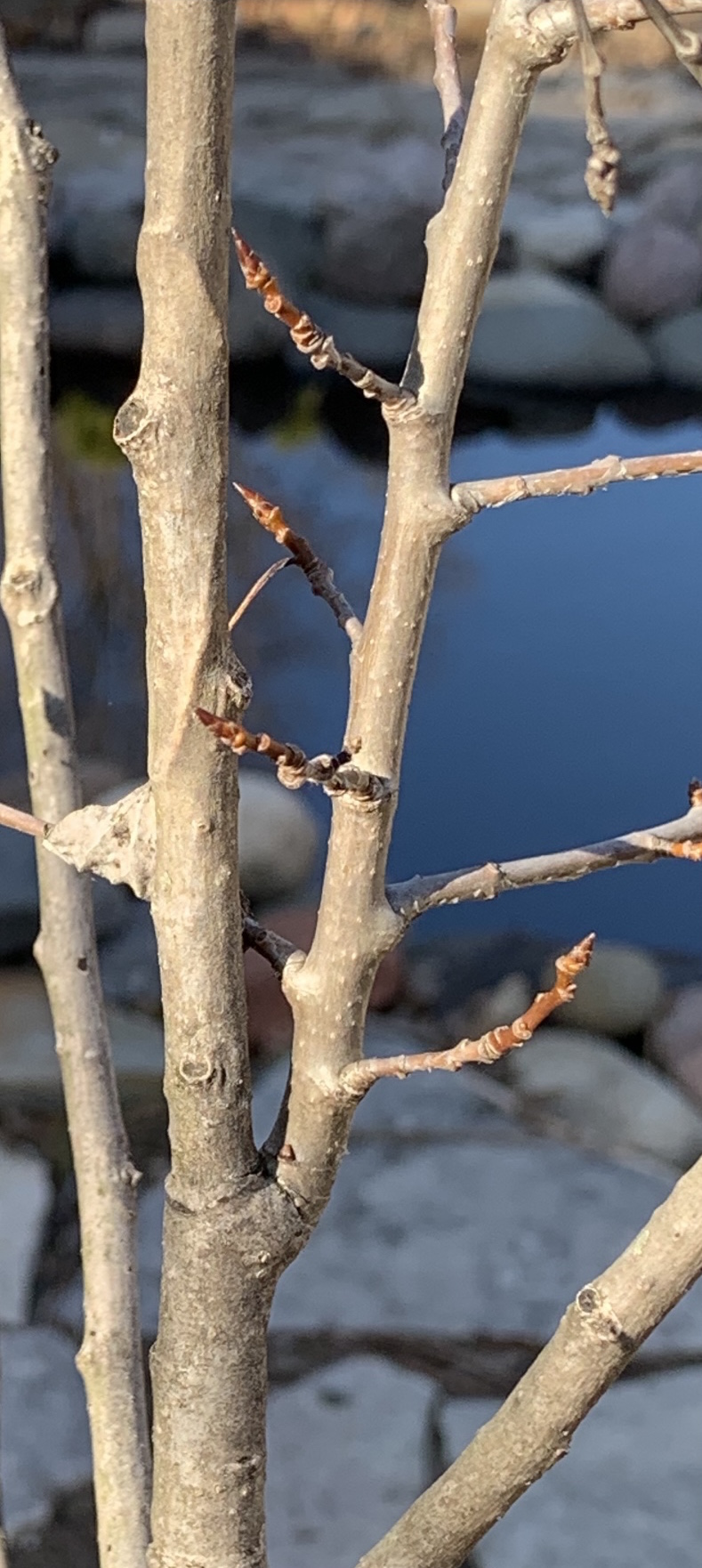
Although it may not be at first apparent, this is a map for product development. A single stout stalk that supports shoots of replication that explode in support features. One clear central intention. Multiple expressions that return nutrient to the stalk.

Although it may not be at first apparent, this is a map for healthy community. A single stout story stalk that supports shoots of replication, diverse paths that explode in seeming individual expression. One clear central narrative. Multiple expressions sending sunlight back to the root.

Who hasn’t seen the time-lapse films of plants growing, forms expressing and then retreating, the accelerated motion of people commuting on a city street, what seems like chaos is, at speed, cooperation. Those people on the street in real time, walking to work, a to-do list on their mind, are mostly unaware of their symphony of togetherness.

It’s easy to forget the stout stalk when standing at the individual expression point. I have been witness to the demise of many organizations who turn against the stalk in favor of the feature. For instance, the fastest way to kill a non-profit organization is to attempt make it run like a for-profit business. It will forget its story-stalk and lose its heart and mind in a spreadsheet.

The quickest way to destroy a community is for its branches to forget that they are individual expressions of a single stout story. They are not separate as much as extensions. To focus on the multiple tiny expressions as if each small branch is a stand-alone truth is absurdity-creation. Chaos masked as convention. Inverted, the plant dies.

In our literature we are riddled with advice to turn toward nature. Existential crisis? Lost? Go to the meadow, find the woods, take a hike. Get quiet. We go there because…we are there. Alan Watts wrote,”We don’t come into the world, we come out of it.” We are not separate from the stalk; we are expressions of it. Occasionally, the map to sanity that we seek is hiding in plain sight dressed as a platitude. Go to nature. You cannot do otherwise. Realize it.

When I’m running abstract questions of design in my dreams, I know it’s time to take a walk. It’s time to stop, look around, take note of nature’s design, the perfection of a plant. A perfect yoga, branch-fingers reaching for the sun, root-fingers reaching deep into soil.

read Kerri’s blogpost about PARSNIPS

sam the poet, 48×48 (painted and sold a long time ago)

sam the poet © 2004 david robinson

Breathe At Human Pace [on KS Friday]

We live in a time in which cars are capable of parking and braking themselves. I am able to type a message into a little box that I carry in my pocket and my message, through space and time to anywhere in the world, is delivered immediately. I write my thoughts in this device and then publish all over the world. I’ve learned of a software that is able to write my thoughts without me – faster and with fewer grammatical errors at the outset. I think and write in a pattern capable of being recognized. I am, therefore, capable of being approximated. What is amazing today is common tomorrow. So it goes with the pace of change.

I read in The Dream Society, written two decades ago, that the aim of the industrial era was to spare humanity physical toil and the aim of the information age is to relieve us from the exertion of thought. We’re producing data at a staggering rate and, ironically, the explosion is both serving the intention and overwhelming our capacity to keep up. We can’t possibly process the tsunami of information that washes over us everyday. We are human. We have a tough time sussing out truth from belief-fantasy even when not washed down the roaring information streams.

It is why I hang out with Desi. Desi is the little tree sprout that we rescued from the Des Plaines river trail over two years ago. When Desi came home with us, her tiny trunk was needle thin. She is thriving in her pot and has more than doubled in size, yet, by the standards of data, her growth is glacial. And that is precisely why I visit her each day. She is in no rush. Efficiency for Desi has nothing to do with speed. Health is about good soil and light. Like all plants, she could be pushed artificially, but why? Pushing might get her to adulthood faster but would also damage her systems. Efficiency and health, for Desi, are all about natural pace. Slow, slow, slow to human eyes.

Desi reminds me that the pace of my life is artificial. A choice. The pace, the incessant noise vying for my attention, are human-made, unnatural. Don’t get me wrong. I delight that Google maps gets me where I want to go. I appreciate having a phone available while walking a backwoods trail. One of the great joys of my life is watching Kerri photograph – with her phone – the world she sees. I love to write and push a button to share. I am, despite my advertising, not a luddite. I’m also aware that the media – the medium – is the message. We are – we become – what we consume and how we consume it. It is a necessity in our age of rolling miracles to keep both eyes open.

I think it is healthy (although virtually impossible) to occasionally crawl out of the stream and breathe at human pace. To think without the expectation of assistance. Each day, for a few minutes, I hang out with Desi, a reminder that an inch of growth every year is sometimes fast enough.

Kerri’s albums are available on iTunes and streaming on Pandora

read Kerri’s blogpost about DESI

taking stock/right now © 2010 kerri sherwood

Pass The Cheer [on DR Thursday]

We do some quirky things. Driving an aspen tree halfway across America in the back of our car is certainly on the list of quirky.

It’s from a place special to us. We honeymooned at Linda and Bill’s condo in Breckenridge, Colorado. I am from Colorado and our honeymoon trip felt like coming home – for both of us. We return to that special place when we can, though not often enough. There is a trail we like to hike. It’s become an old friend that we need to visit when in the area. If we do nothing else, we strap on our boots and begin the climb. It follows a brook up the side of the mountain. We’ve never made it to the top but one day…

On our mantel is a piece of driftwood from Long Island, Kerri’s home. In our dining room is a log – literally a log – we carried from our trail in Breckenridge. Elemental. We have stones from our respective birthplaces, too. Our house is filled with confused cairns, pointing both east and west.

We named the little aspen tree Breck. It traveled in a pot with its tippy top branches bent against the car ceiling for the ride. It survived the journey. For the first few years it lived in a pot on the deck in the warm months and was wrapped and protected in the winter. Breck’s quaking leaves make us smile and instantly transport us to the special town in the high mountains.

Breck did not like its first spot where we planted it in the yard. The top branches died. When we moved it last fall, we were afraid that Breck would not make it through the winter. We talked to it. We cheered for it. “You can do it!” we chirped. Imagine our relief and celebration a few weeks ago when we went out back and found Breck budding. Lots of buds. More sun. Better soil. New Growth!

A reminder of a special place. A symbol of resilience and a hearty can-do. This spring it feels as if Breck is speaking to us, too. More sun! Better soil! You can do it. New growth. Art-life budding.

read Kerri’s blogpost about BRECK

Imagine The Possibilities! [on Two Artists Tuesday]

Mastering others is strength. Mastering yourself is true power.” ~ Lao Tzu

I’ve had this quote sitting on my desktop for months. I’ve been on a Lao Tzu kick, a Kurt Vonnegut kick, a Rainier Maria Rilke kick…all at the same time. They are, not surprisingly, in alignment on many topics, among them self-mastery. “The secret?” they whisper. “Stop trying to control what other people think or see or feel and, instead, take care of what you think and see and feel.” Their metaphoric trains may approach the self-mastery station from different directions but the arrival platform is the same.

It’s a universal recognition: take the log out of your own eye.

Sometimes a penny drops more than once and so it is with Saul’s advice to me. “Look beyond the opponent to the field of possibilities.” “And, just what does that mean?” you may shout at your screen. It sounds like new-age hoo-haw.

Ghandi said, “Nonviolence is the weapon of the strong.” It is the height of self-mastery to bring ideas to the table rather than a gun. It is the height of self-mastery to bring to the commons good intention and an honest desire to work with others to make life better for all. Power is never self-generated but is something created between people. Power is distinctly different than control. Power endures since it does not reside within a single individual. Power lives, as Saul reminded me again and again, not in throwing an opponent but in helping the opponent throw themself. “Focus on the possibilities,” he said again and again. Throw yourself to the ground often enough and, one day, it occurs that there may be another way.

Work with and not against. It seems so simple. The bulb hovering over my cartoon head lights-up. Work with yourself, too, and not against. Place your eyes in the field of all possibilities. Obstacles are great makers of resistance, energy eddies and division. Possibilities are expansive, dissolvers of divisiveness.

I am writing this on the Sunday that Christians celebrate their resurrection. The day that “every man/woman for him/herself” might possibly and-at-last-transform into “I am my brothers/sisters keeper.” All that is required for this rebirth is a simple change of focus; a decision to master one’s self instead of the never ending violent attempt to exercise control over others.

It’s the single message, the popcorn trail left for us by all the great teachers. Instead of fighting with others, master yourself. Imagine the possibilities!

read Kerri’s blogpost about THE CEILING LIGHT

Know The Poem [on KS Friday]

“Spring has returned. The Earth is like a child that knows poems.” ~Rainier Maria Rilke

“First robin!” she said.

“What?”

“First robin. That means spring is here!” she looked at me with “duh” eyes. I was new to Wisconsin so the rituals were not yet known to me. I did not yet understand that in this strange land a water cooler is called a “bubbler” and that cheese curds are sacred food. Before the week was out, I’d heard it three times from strangers. “First robin!”

Years ago, during my first winter in Seattle, after months of gray, the sun came out for an hour and all the people working downtown poured out of the tall buildings and stood facing the sun. They moaned with satisfaction. “What’s this!” I exclaimed. Weird behavior. The next year, after months of dreary gray, the moment the sun peeked from behind the drab curtain, I ran out of my apartment to revel in the return. Leaning against a brick wall, eyes closed, feeling the warmth on my face and the heat reaching my bones, I knew this was my passage to becoming a “local”. I moaned with satisfaction.

Poetry is visceral. It has it roots in the moans of sun drinkers and robin-seers. The green pushing up from dark soil. The smell of spring or the first hint of warmth on the winter wind. Words cannot capture feelings but isn’t it glorious that we try?

We were walking the neighborhood on a cold afternoon. She squeezed my hand and pointed. “First robin,” I said and she smiled. “Spring.”

Now, doesn’t “First robin. Spring!” sound like a grand start to a poem of renewal? Ahhhhhh, yes. A hint of warmth on the wind, harbinger of green shoots reaching. Someday soon, sun will call me out of hiding and color my pale face.

read Kerri’s blogpost about FIRST ROBIN

Kerri’s albums are available on iTunes and streaming on Pandora

baby steps/right now © 2010 kerri sherwood

View The World [on DR Thursday]

Dogga is a wrecker of backyards. He’s a destroyer of pristine spaces. His joyful enthusiasm propels him in rapid circles and his circles have become etchings in our smallish yard. Initially, we tried to cover his etching path in stone. Were you to visit you’d find flat stones covering a wide spiral around the pond, his first velodrome. To no avail. He is a living Spirograph, a dervish of delightful circles. Viewed from the air, I’m certain our backyard smacks of alien visitation, mysterious crop circles.

We’ve learned. Rather than resist nature, attempt to control it or cover it up, it’s a much better plan to work with it. I knew we’d crossed a thought-bridge the day Kerri suggested we install a round-about sign. We had to be direction-correct so we bought one for right-sided drivers. The details matter. If Dogga was to suddenly switch and run in the opposite direction we’d have to issue a citation or get a new sign.

If there is a devil in the details there must also be an angel. As I’ve previously noted, I am not naturally a detail-guy; my head is at home in the clouds. I’m conceptual and can see great distances. It’s why metaphors are my currency, movement and pattern my friends. Please do not ask me to write a grant or make sense of the world through a spreadsheet. I can. I have, mostly out of necessity. But the cost to my soul is mighty. Luckily, as this great world spins, and the draw to a comfortable center is the force-at-play, I’m currently surrounded by teachers-of-detail, Kerri and Dogga are my favorite two but there are many in my circle. Angels, all.

Kerri runs to show me the photo she’s just taken. A close-in shot. A texture. A bud. An entire world in minutiae. See the beauty in the detail. For me, that’s the passage to the center. There’s entire universes to be found in the smallest detail. The up-in-the-clouds and close-in are relative terms. There’s a whole other worldview available from the grasses.

Lay on the ground and the Dogga will run circles of joy around you, his center point. There’s nothing better and that’s the kind of detail that’s not to be missed.

read Kerri’s blogpost about FROM THE GROUND UP

face the rain © 2019 david robinson

Look Out [on Two Artists Tuesday]

Perhaps the most useful and profound lesson I’ve learned happened under the water. I was doing my first night dive. I was scared. I was not yet a confident diver. As we descended the world became inky black. All I could see was where I pointed my light.

It was that simple. I can see where I point my light. That’s it. And, more to the point, I choose where I point my light. I have the capacity to choose what I see. I can…and have…chosen to focus on hardship and lack. I can…and have…chosen to focus on what I love. On any given day my focus bounces full spectrum between complaint and appreciation. And then I remember: it’s my light, where do I want to aim it?

There’s a second aspect of the lesson. My focus is a beam. My light is not all encompassing. Each of us looks at life through a soda straw. None of us has the big picture. That’s why the commons is so important. In order to know what to do, we need to bring our many perspectives together to approximate something close to a full picture. Rather than fight about disparate points of view – who is right – it’s more useful to try and assemble all of those differing views, like the pieces of a jigsaw puzzle, into a bigger picture. No one wins when the pieces refuse to interlink.

With two broken wrists the cello became impossible to play. It has sat in her studio, the case unopened, since her fall over two years ago. I remember the day we bought it. We were early in our relationship, not yet married. I knew she was having cello dreams. We went to the music store for some other purpose, I can’t remember. The cello was sitting in the corner. She sat. She began to play. It was a perfect fit. And, although we could not afford it, we also could not leave it behind. It was a perfect fit.

Our lives these past two years have been a descent into dark water. We’ve worked hard to shine our light at our good fortune in a dark and inky landscape. As we make our way back to the surface, we are cleaning out. Taking stock. “The cello needs to be played,” she said, deciding to sell it. “I’ll never be able to play it, now.” She took photographs of her cello. Sent out a message through the network.

At the end of the day she showed me the photo. Edges. The view from inside the empty cello case, looking out. A slice of the world visible outside the case.

What’s “out there” is rarely clear. We see a small slice. It tickles our curiosity. The cello dream moves on making space for…? Who knows? We can’t see that far. In the meantime, we keep our eyes and hearts uplifted as we slowly kick our way back to the surface.

read Kerri’s blogpost about EDGES

Reseed [on Merely A Thought Monday]

We pulled everything off the walls of the office. The photographs and posters of plays I’ve directed, Kerri’s first album, framed, a gift. Our poster announcing Beaky’s Books. “I don’t think the office should be about the past,” she said. “It’s time to make this space about our current work and the future.”

She chose a painting, Nap On The Beach, one of many created from our experiences together. She’s making a poster of Smack-Dab, our cartoon. Turning our eyes from what we’ve done, where we’ve been, who we were. We’ve changed. We want different things now. We work in different ways now.

She’s slowly cleaning out the house. I can’t help. This is something she must do by herself. Purging closets, the laundry room, the storage and work rooms. The year of water upended our house. Several times. It continues in the front yard, all the way to the street. When the ground settles, we’ll reseed the lawn. How’s that for a metaphor? When the ground settles, we will reseed.

It takes time for the ground to settle. It can’t be rushed. It should not be rushed. The same is true for cleaning out. We have new piles forming: what goes, what stays. I climb the stairs to the office each morning. When I come down again, she shows me the new space that she’s created from the day’s purge. It’s true on many levels. She’s creating space. Old baggage and burdens are going out with the old clothes and broken appliances. I can see it in her eyes. Space. Light. Like the house, she is beginning to breathe again.

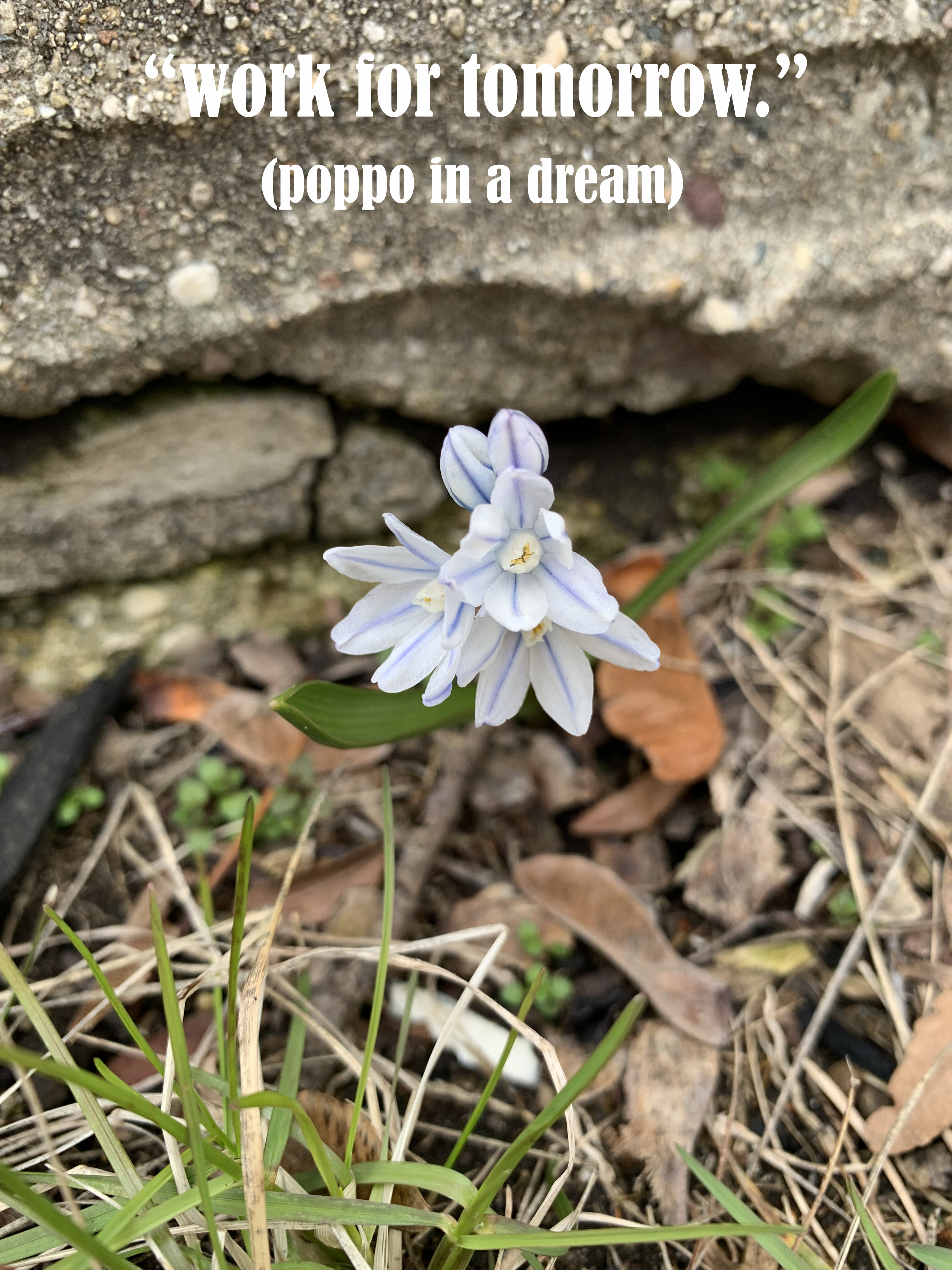
She told me about the dream, her father was setting up microphones. “What are you doing?” she asked.

“Working for tomorrow,” he said.

I had to work hard not to weep. She’s had a rough few years. “Your daddy’s talking to you,” I said. “Sage advice.”

She nodded. Her eyes turning from the pain and constraints of the injuries. Letting go of the past. “Work for tomorrow,” she smiled.

read Kerri’s blog post about WORK FOR TOMORROW

See The Signs [on Not So Flawed Wednesday]

Religions around the world and across time have personified this moment. The return of the green. From one day to the next buds appear on trees. The signs of life’s vibrant enthusiasm returning (again) from long winter, barren earth, metaphoric death. Persephone’s homecoming from the underworld and Demeter, her mother, goddess of the earth, allows the return of life.

It’s a very, very old story told in many, many different ways. Human beings, storytellers all, making sense of death and life, generalized across the real experience of cycles and seasons, all pressed through the lens of this-causes-that. Reduce us to an essential oil and we are makers of metaphor and seers of pattern.

I told Kerri that I got out of the wrong side of the bed this morning. An idiom. Imagine the power in brains that utilize idioms! The meaning cannot possibly be carried by a literal interpretation of the individual words. We pull the meaning out of or inject it into the collection of words. We know what it means because the meaning has a long history. The Romans, I’ve read, believed there was a correct side of the bed. Arising on the correct side of the bed would ensure good luck. The right side of the bed was positive, the left side was dubious. Jump out of bed on the left side and the day was ruined!

Superstition: making sense of the happenings of a day or a life, pressed through the lens of this-causes-that.

Mostly, I am restless. It snowed all day yesterday. I yearn for the moment when I can, for the first time of the returning (pattern) spring, lean against the wall and feel the warm sun on my face. I will, like I did last spring, enjoy the moment to the point of non-thinking. I will drink it in with no need to wrap a story around it or make sense of what I am feeling. I will appreciate it to my bones and revel in the return of warmth, new growth, and light.

read Kerri’s blog post on GREEN

See The Signs [on KS Friday]

Although it is not quite here, I know spring is coming. How do I know? The blinds are open on one side of the room. They are closed on the other side.

During the winter, the blinds are closed on both sides of the room. During the winter, we turn in. We close out the world. All of the energy goes to the root, beneath the soil, to recharge our lives. Hibernation. And then, one day, though it is still cold, the birds return, we wake to their song, the sun plays hide-and-seek. In the morning, well rested, we open the blinds to the east.

We’re watching the squirrels. They gather the fallen leaves in their mouths and adeptly climb the maples and oaks to high notches, deposit their load, and return to the ground to gather more. Up and down. Over and over. Preparing their nests. The birds are courting. It looks like a hearty game of chase but we know the females are dodging the insistent pesky males.

Life is returning from the deep. Preparation for Persephone’s homecoming. Restless buds appear on branches. It’s close, but not quite yet.

Not quite yet. The third covid springtime. We are not yet past it and are fidgety.

We sat in the car staring at the door to the store. “I’m so goddamn tired of putting on this mask, ” I said as I put it on. We know we’ll be among the few wearing masks as we shop. No matter. It’s not over yet, this long winter of pandemic. As much as we want it to be spring, as much as we can see the signs, it’s not here yet. Not yet. Blinds open on one side of the room. Blinds closed on the other side.

kerri’s albums are available on iTunes and streaming on Pandora

read Kerri’s blog post about BLINDS

that morning someday/blueprint for my soul © 1997 kerri sherwood