Although we may have led you to believe otherwise, these characters are fictitious. Especially the man. He’s a product of imagination and has no bearing on reality. Any resemblance is purely coincidental and, since I never snore, there’s no chance of coincidental resemblance. None. Nope.
This is what he wrote. “The irony I feel is that the world is lost on the artistic temperament of these students. They don’t seem awake to all that’s going on.” He’s directing teenage students in a play. He was my student thirty five years ago and reached out to me. We compared notes of the production I directed when he was a teenager, and the production he’s directing now. The world has changed mightily. His production will be viewed through a wholly different lens.
I flipped his phrase over in my mind. Artistry is to be awake to all that’s going on. And, awake is not a steady state. It’s not an arrival platform. It’s a relationship between the inner and the outer. What I know about that relationship is that sometimes you need to look away. His students have drilled for active shooters in the hall since they were in kindergarten. Mine couldn’t have imagined it. His students are navigating a pandemic, they’ve never known a world pre 9/11, they live in a country that is eating itself alive. My actors had easier access to what was going on. What was going on was closer in, more immediate and less abstract. They were not looking at a world-wide horror story or lost in the morass of social media. Cell phones were science fiction to my cast. My actors looked at each other and not at their screens.
Stories are about something. We just watched Erin Burnett’s interview with a Ukrainian husband who lost his wife and children to a Russian mortar attack. A month ago, violent death was nowhere on their radar. They were making dinner, going to school, doing homework, late for work. Erin Burnett began to cry and thank goodness. Humanity breaks through and we awake to what’s going on – really going on. We should all be weeping with Erin Burnett and this man.
Sometimes I feel as if I am looking for the small beautiful moments. I am trying to root my day in the explosion of color, the pastel sky, Dogga in the sun. Holding hands. Cooking dinner together. I am trying to be awake to what is going on, the anger and division and warmongering and carelessness as we soil our nest – without it frying my insides. Holding hands is just as real. Reaching toward our neighbors is also what’s going on.
Stories have to be about something and most often stories are about transcendence. Waking up to what is going on is less about waking up – we already know – and more about fully acknowledging it, facing the full picture and turning toward it rather than running away. But, before that final act, that moment of deciding enough-is-enough, before we are willing to blink open our eyes, we pretend the problem is non-existent or small. We ignore the obvious. 500 year storms every year. A family killed by a mortar shell. We bury our faces in our phones, we ban critical race theory, and toss our attention in a Twitter reality or a Tik-Tok diversion.
I wanted to write back and suggest that the world is not lost on the artistic temperament of his students, it’s simply too hard to look at the world so they are choosing to look away. That’s what their play will ultimately be about.
My sketchbooks are punctuated by weird landscapes. It was a practice. When I felt the need to draw regularly, to exercise my artistry, I worked on compositions for future paintings. And, when I had no idea what to draw, no composition in my head, I sketched my weird landscapes. They were fun and I got lost in them.
There was a blowback effect. I’ve never been a landscape artist. I considered my weird landscapes as not-serious exercises. Yet, they were made of scribbles and patterns and it became a game to collect patterns from nature. My not-serious exercises required me to look around. To get close. To look at the edges and splashes and etchings available in nature. To see. My weird landscapes became eye-opening meditations.
There are miracle-patterns in bark. Orchids, I recently learned, are a master-class of pattern, shape, and color. It is impossible to find a hand painted brush and ink painting as perfect or as spontaneous and lively as the strokes on the rattlesnake plant. Go to the garden if color combinations are in question.
I will never invent anything as imaginable, as impossibly beautiful, as what already exists in this world. I will never produce any painting as glorious as the paintings in nature. The best I can do is play. Look and marvel. And isn’t that a great relief?
I’ve tried to keep notes on my computer. I know that typing my notes into the digital world will make them searchable. Easier to find. It just doesn’t work for me. If I write with a pen on paper, I remember. Marking an important page with a Post-it note makes finding my notes faster than a search engine. It’s not that I am old school. I’m kinesthetic.
I’ve always kept notebooks. At this moment there are two within my reach. The Melange notes. On the desk in my office a is a notebook and three yellow pads. The yellow pads are a task-capture strategy. The notebook is idea capture. Quote capture. Thoughts-in-progress. The notebooks are like my sketchbooks, a place to work out my thought-compositions. They are the history, the breadcrumb trail of a project. For me, the riches are never in the outcome. The real treasures are alive in the notebook process paths.
I’d rather look at an artist’s sketchbook than the finished painting. I have a book of Picasso’s sketches that I treasure. Spend a few moments in Leonardo’s sketches or Michelangelo’s scribbles and you’ll forever toss away the notion of a mistake. Look behind the scenes at the process. A dancer will spend hours in repetition to incorporate a move into their body. The playwright will write hundreds of pages to arrive at a few, yet, those hundreds of pages are nothing less than reduction to essence. Refinement on the path of saying more with less.
Look behind to see the structure. Turn it over to see the pattern. I am, to this day, in awe of the Wayan Kulit master. I looked behind the shadow puppet screen to see the artist at work and, what appears in simple two-dimensions in front of the curtain, is a symphony of structure and improvisation. The man wore an oil lamp on his head to cast the light for the puppets, held a rock between his toes to tap, keeping time for the musicians seated behind him, all the while manipulating and voicing multiple characters, telling with simple clarity an epic tale. A lifetime of trial and error, complexity made simple, like a dancer, the story was deeply choreographed in his body. I wished I could have seen this elder storyteller-priest when he was young and developing his mastery. I’d love to see his notebooks.
I’ve recently had cause to return to my old notebooks. I marvel at the thought cycles coming back around. I’m taken again and again by the questions that still linger, and by those that seem antiquated. “How could I have not seen it!” I smile, knowing in just a few more drafts, a notebook or two down the road, the clarity would arrive.
A peek behind the scenes. It is for me, where the real beauty shines.
George Ohr was one of the great ceramic artists of the late 19th and early 20th century. Like Van Gogh, he died unknown, never experiencing the success of his work. Robert reminded me of George Ohr’s story and I reminded Robert that Ohr would be a terrific story for him to tell through a one-man play.
What is it to follow your art-call with heart and dedication with nary a hint of financial reward or success on the horizon? Vincent Van Gogh would have been called an amateur during his life since the making-of-money is the flag we plant in the sand marking the line between being a professional and a dilettante. Those lines do not exist for artists with a deeper call. The money does not the artist make.
The Ohr-O’Keefe Museum of Art was designed by renowned architect Frank Gehry, quite a journey for the unseen work of George Ohr’s life to find so much vibrant admiration after his passing. Had he known it would have changed nothing. He’d have spent his days at the potter’s wheel either way.
“Shape clay into a vessel; It is the space within that makes it useful. Cut out doors and windows from a room; It is the holes that make it useful. Therefore, profit comes from what is there; Usefulness from what is not there.” ~Lao-tzu
Profit and usefulness. Shape and space. Mary Oliver asked the question: What will you do with your one wild and precious life? It hits the nail squarely on the head. It was not the pots that George Ohr made or the paintings that Van Gogh painted, it was the space they entered while throwing pots and painting paintings. It was the world they entered through their artistry, more expansive than financial success, more necessary than renown. A wild and precious life lived wildly and with avid appreciation.
Standing amidst the brilliant orchids, some of the flowers were in their last days. Their beauty fading, they cared not a wit. It is not in their nature to stretch their faces and pretend that the cycle of life is more valuable in the early bloom than it is in the late retreat. All is treasured, beguiling. Every last moment, not to be stalled or held onto. The root as necessary as the bloom, the winter as indispensable as the spring.
It’s taken me this long to discover the source of all cartoon characters: orchids. I’m not kidding. At a recent field trip to the Chicago Botanical Garden’s Orchid Exhibit, I was surrounded by brightly colored fantastic faces, playful and chuckling. “Look at this one!” Kerri exclaimed. “It’s the Imperial Margarine guy!” I thought it was a whacky Pope or funny Cardinal, but the idea was the same.
“The earth laughs in flowers.” Emerson’s quote was stenciled on the wall as we exited the exhibit. And the laughing flowers made me laugh. Truly. I felt like a little kid at Christmas. Surrounded by color and delight and whimsy, I found myself more than once pointing, “Look at this one! Oh My God!” And, I felt like the colorful faces were staring back at me, thrilled to tears by the odd looking human standing before them. I-look-at-you-look-at-me. “Look at that face!” they snickered.
The thought stopped me in my tracks and filled me with wonder. We personify everything, projecting our humanness into everything. The art of animation, the world of Disney, is rooted in our desire to project ourselves onto and into the world. Talking mice. Dancing candlesticks. Humpty Dumpty. Wise old trees. Wouldn’t it be lovely, and isn’t it hopeful, to think the world projects itself into us? I want the orchids to fill me with color and awe. To project themselves into me. I know the forests I walk through infuse me with quiet. I know Dogga pulls love from my deepest soul.
Participants. Relationship, rather than controllers. Dancers rather than dominators. Would we be so invested in killing each other for imagined supremacy if we allowed ourselves to laugh the laugh of the flowers? If we actually understood that nothing is forever, that our warmongering was at best delusional? That the single trait that makes us human is to turn and help someone in need? The very capacity that allows us to project ourselves into the orchids is the same capacity that makes it possible to stand in the shoes of the other. Empathy is a two-way street.
If the earth laughs in flowers, these days it certainly cries in humans. Yet, standing amidst the orchids, I looked at all the human faces, hundreds of people wide-eyed with wonder and alive with astonishment. The laughing orchids looking back at the astonished faces, open and vulnerable, and they were evoking those qualities from the crowd. Earth’s tears. So hopeful, these faces, drinking in each other’s beauty.
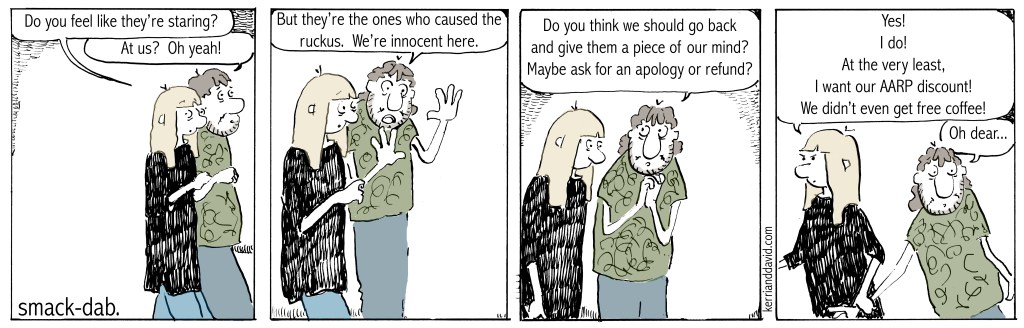
Our code phrase for product/service-discontent is, “Write a letter!” (It’s necessary, when speaking the phrase, to use a thick Long Island accent, “Write-ah-lettah!”). Beaky taught Kerri to express her discontent when a service, product or experience is substandard. And, Beaky taught Kerri this lesson in a thick Long Island accent. So. There you go!
I can see it coming. I can see it in her eyes. The first time I saw my darling dainty duck turn into Nurse Ratchet was at a hotel. I was terrified at the transformation and ran across the lobby. I feared for the person receiving the complaint. It’s become my standard practice: run! Put vast distance between me and the expression of discontent with undertones of Long Island. Pretend to be someone else. If only we’d leave and, later, write-ah-lettah!
The most horrifying cartoon panel I have ever drawn is the last panel in this strip. She grabs his arm. There’s no escape. Oh dear…
“Yes, I’m being followed by a moonshadow/Moonshadow, moonshadow/Leaping and hopping on a moonshadow/Moonshadow, moonshadow” ~ Cat Stevens, Moonshadow
An appreciation of life, no matter what comes. It is the meaning of this lyric, this song – or so I’ve read. It seems obvious. I’m having many, many conversations about loss these days. This has been an era of loss and, so the cliche’ goes, with loss new opportunity arrives. It’s true though one must move through the loss in order to arrive at the new. On the way, there is weeping and fear and anger and disorientation. Chrysalis. The trick, we are told, is about focus placement. One day we shift our eyes and see what we have instead of what we no longer possess. We move toward rather than look back.
Kerri has, for years, surrounded herself with symbols of peace. They are on our walls, on rings that she wears, on chains draped on the corner of our bathroom mirror. She draws them in the sand on the trail. A prayer for the world she desires to create. Inside and out. Since she fell, my solo-piano-playing wife has lost more than mobility in her wrists. Strange stuff is happening. Fingers that sometimes refuse to respond. Pain that shoots, seemingly from nowhere. After a photograph – a wish for the world, a peace sign in shadow – she said, “Come look at this. Look how much my finger is bending!” Strange stuff.
What is most remarkable about this shadow is, a year ago, it would have been cause for frustration. A reminder of loss. Full of fear. Today, it was a curiosity. She looks back, she looks forward. Each day she writes lyrics and poetry and wisdoms. She hums the music running through her mind and heart and, sometimes, she dances. Standing at the crossroads of what was and what is to become. Peace replaces pain. All in good time. Good time. Wings readying to unfurl.
[peace. this is one of my favorite pieces of Kerri’s]
Kerri’s albums are available on iTunes and streaming on Pandora
“There are more things in heaven and earth, Horatio, than are dreamt of in you philosophy.” William Shakespeare, Hamlet
We opened the oat milk ice cream container and read the message printed on the protective cover. It made me laugh. I appreciate marketing messages with a sense of humor. The best news, beyond the giggle-inducing package, is that the ice cream was delicious. Coffee. The woman in the store recommended Salted Caramel but we were on a mission to find some coffee ice cream.
We watched some of the events at the recent winter Olympics. I always appreciate watching the athletes, prior to their competition, imagine their path down the mountain or performing on the ice. They quietly dance the future they envision. They “see” themselves perform. Actors do it, too. Jim taught me, rather than push my voice so I might be heard by the people sitting in the back of the hall, to walk to the edge of the stage and imagine that every person in every seat is included in the embrace of my voice. Not push or reach. Include. Draw in.
Have you ever said, “I just knew it was going to happen!” Or, “My gut told me…” Or, “I knew in my heart.” Even the most hardened scientist follows their intuition. Happy accident, good luck, serendipity, right-place-right-time. Where preparation meets opportunity. Luck of the draw.
Hamlet saw a ghost. His pal from the university had doubts. Reason draws a wide circle but, despite what it thinks of itself, does not encompass all things. Accidents happen. “It’s as if it was meant to be.” Kismet. Follow your heart.
Kerri and I talk of our meeting as destiny. “What are the odds?” we ask. I’m filled with stories of “knowing.” Aren’t we all? And, isn’t it also true, the most oft used phrase following, “I knew it,” is “I can’t explain it.”
And, isn’t that where the wonder lives? In the land beyond explanation?
It seems like such a simple concept. Tom taught it. So did Paul. And, since I was one of their students, I taught it, too. How you treat your space is a reflection of what you think of your art. The concept is universal. Replace the word “art” with “work” or “life.” You and your space are not separate. We worked hard at the theatre to become better artists and produce better plays and a significant part of that work was bettering and maintaining our artistic “home.” We were proud of our work and it showed -everywhere. Our “space” included our community and our art was meant to make it better.
Yesterday it was warm so we took a walk on a favorite loop. As we returned to the car we watched a man clean out his truck. He’d come to the park, not to walk or appreciate the quiet. His purpose was to dump his trash onto the paved lot. In an earlier time, pre-gun-gun-everywhere, we might have said something. Instead, we stared in disbelief. His space,I thought, does not extend beyond his truck. Neither does his community.
Yesterday, after the walk I received a text from Mike. He was a big part of my long-ago theatre. He’s realizing a dream and opening his own theatre. He’s led a company for a few decades but they didn’t have their own space. Now, they do. He – the artistic director – was mopping the floor and paused to send me a text. It’s the other part of the lesson from Tom and Paul. And Demarcus. And Quinn. There’s no hierarchy. There’s no above and below. Loving the space, loving the art that happens in the space: no separation. One and the same for everyone involved and everyone needs to be involved.
You and your space are not separate. The care you take of your outer space is equal to the care you give to your inner space. And, vice-versa.
[visit Justin’s to see how a company can make a better world]










 The Direction of Intention