Make It Visible [on Two Artists Tuesday]

“I believe that the very process of looking can make a thing beautiful.” ~ David Hockney

Sometimes I look at a blank canvas and see a composition. My job is to follow the image. To make it visible.

Sometimes I have an idea and I bring it to the canvas. My job is to explore the idea. To make it visible.

It’s a chicken-and-the-egg conundrum. What comes first? When I look at the peony do I see beauty or do I bring beauty to what I see? Is beauty a decision?

“Good-God!” I hear Kerri’s inner monologue-commentary on my too-ponderous questions. “Get out of your head! Smell the peonies!”

I wish I could. What happens when it’s not a peony that I see but my neighbor? Or someone whose worship is strange to me? Or someone with a different opinion?

Sometimes I look at a blank canvas. Sometimes I have an idea that I bring to it. Sometimes my job is to follow the image. Sometimes my job is to explore the idea.

The tricky part of language is that the biases are unseen. For instance, in English, the emphasis falls on the noun: me. Canvas. It implies the two are separate. Distinct. It obscures the relationship between. Connectivity is relegated to the basement, a lower status or obscured to the point of nonexistence. It fosters a philosophical orientation of…”it happens to me.”

Connectivity, once seen, once understood, requires us to recognize our responsibility for what we see. Our participation in the dance of creating what we see. In what we bring to “it”. What, exactly, do we wish to make visible?

read Kerri’s blogpost about the PEONY

Join The Receivers [on Two Artists Tuesday]

“…artists take delight in and care for their work, and we are thereby inspired to find delight in our own work.” – Alex Grey, The Mission of Art

Standing in front of the Atmospheric wave wall, an art installation at Willis Tower by Olafur Eliasson, I imagined how much fun he had creating it. Monumental. The colorful waves rolling up the side of a building. I wondered, if on visits to Chicago, he delights in watching the play his wave wall invokes in passers-by. I would. His work is spatial so it invites full-body engagement. I had to touch it and lean in against it. I had to put my face close to a wave and look up. The shock of vibrant red among the blue, purple and green made my eye dance across the vertical water.

It is one of the great joys of my life to be surrounded by artists: people who care for their work and find delight in it. David just completed a year-long project, a rewrite/updating of Six Characters In Search of An Author. He directed the first production of his new script. It was thrilling to witness his delight in the process. It was gratifying to watch how he navigated his doubt and fear. The delight and the fear go hand in hand.

It’s worth noting that caring so deeply for your work comes with a studied courage. There’s a very nice lie about bold artists throwing caution to the wind and creating without caring how their work is received. That, of course, is worthy of a press-release and works for image-branding but fully negates the point of artistry. In order for a work of art to be a work of art, it requires an audience. A giver and receiver. A loop of caring. The armor must come off. Expressing beauty or seeking truth is nothing if not a shared meaning and a shared truth. Artists may reach deep into themselves but the point is to engage and express meaning that comes alive beyond themselves and between others. Vulnerability is the secret sauce that connects the two into one.

I didn’t know about the Atmospheric wave wall until we rounded a corner and I saw people enthusiastically embracing it, standing back and craning their necks to take it in, gently moving forward to run their fingers along the wave ridges. The pull was immediate and I found myself joining the receivers of Olafur’s artistry. Armor down, hands planted firmly on the wall, we snapped a photo and I deeply appreciated his whimsy and moxie. Inspiration ripples to the sky!

read Kerri’s blogpost about THE WALL

If you appreciate this post, share it. Or like it. Or let us know your thoughts. Or buymeacoffee.com. All are appreciated.

Reach Beyond [on Two Artist’s Tuesday]

Red Rocks amphitheater, Colorado, 1979. Tie-dye and flannel, a heavy cloud of pot and patchouli wafts over the crowd. The band begins playing. People stand and cheer. And then they dance. And dance. And dance. Strangers dancing with strangers.

The Riverside Theatre, Milwaukee, 2023. Tie-dye and flannel, a heavy cloud of pot and patchouli wafts over the crowd. The band begins playing. People stand and cheer. And then they dance. And dance. And dance. Strangers dancing with strangers.

United through music. Barriers drop. Inhibitions fall. The revelers are of many ages, grey heads and baby faces. The faces are many glorious colors: shades of black and variations of white and nuances of bronze and rich sienna. I suppose they, too, are wildly varied in belief. Yet, in the dance and through the music, none of it matters. They reach beyond. They are one.

read Kerri’s blogpost about THE CONCERT

If you appreciate this post, pass it on. Or buymeacoffee.com. Or, share your thoughts with us. All are appreciated! Thank you.

Thank Dale [on Two Artists Tuesday]

Dale is back. And he has an attitude. The people in the neighborhood know better than to approach Dale. He wants to be left alone on his daily constitutional and will answer even the friendliest “Hello!” with a harsh retort. Gobble-gobble.

We saw the young couple before we saw Dale. They were frozen, mouths a-gaping. They were pushing a stroller and were caught between curiosity and caution. Spelled. You’d have thought they just spied a Leprechaun strutting down the street. We slowed the car, stopped, and followed their gaze. A turkey was in the hood. Dale was just outside our door. Strutting down the sidewalk. He warned us to mind our own business and crossed the street behind our car just to make his point.

Here’s the weird idea that flashed through my mind as Dale stomped across the street: he reminded me of Scrooge. Suddenly, my imagination was awash in the turkey version of The Christmas Carol. I was particularly taken by the possibilities of the ghosts! How might the turkey Jacob Marley appear to the Scrooge-like Dale? The Ghost of Christmas future? The options were hysterical and inspiring. I wanted to thank Dale for the idea but he was already strutting far down the opposite sidewalk. I wanted to tell Kerri but she’d had enough of me for one day. I kept my idea to myself.

The young couple were suddenly released from their spell and the husband looked at us, child-like, “Turkey!” he pointed and smiled.

“Yes,” Kerri replied in a sing-song affirmation, “We saw it, too.”

I wondered at the final scene in my Turkey Carol. Dale, after a night of ghost-visits, flings open his window to the morning light, unable to fully comprehend what he’d just experienced. He asks a small child on the street, “Boy! You there! What day is it?”

The boy, taken aback by the sudden question coming from a notoriously unfriendly bird, replies, “It’s Christmas, sir!”

Dale, newly made, throws his wings above his head and dances with relief.

read Kerri’s blogpost about DALE

buymeacoffee.com – if you’d like to support our writing and workintheworld

Note The Trail [on Two Artists Tuesday]

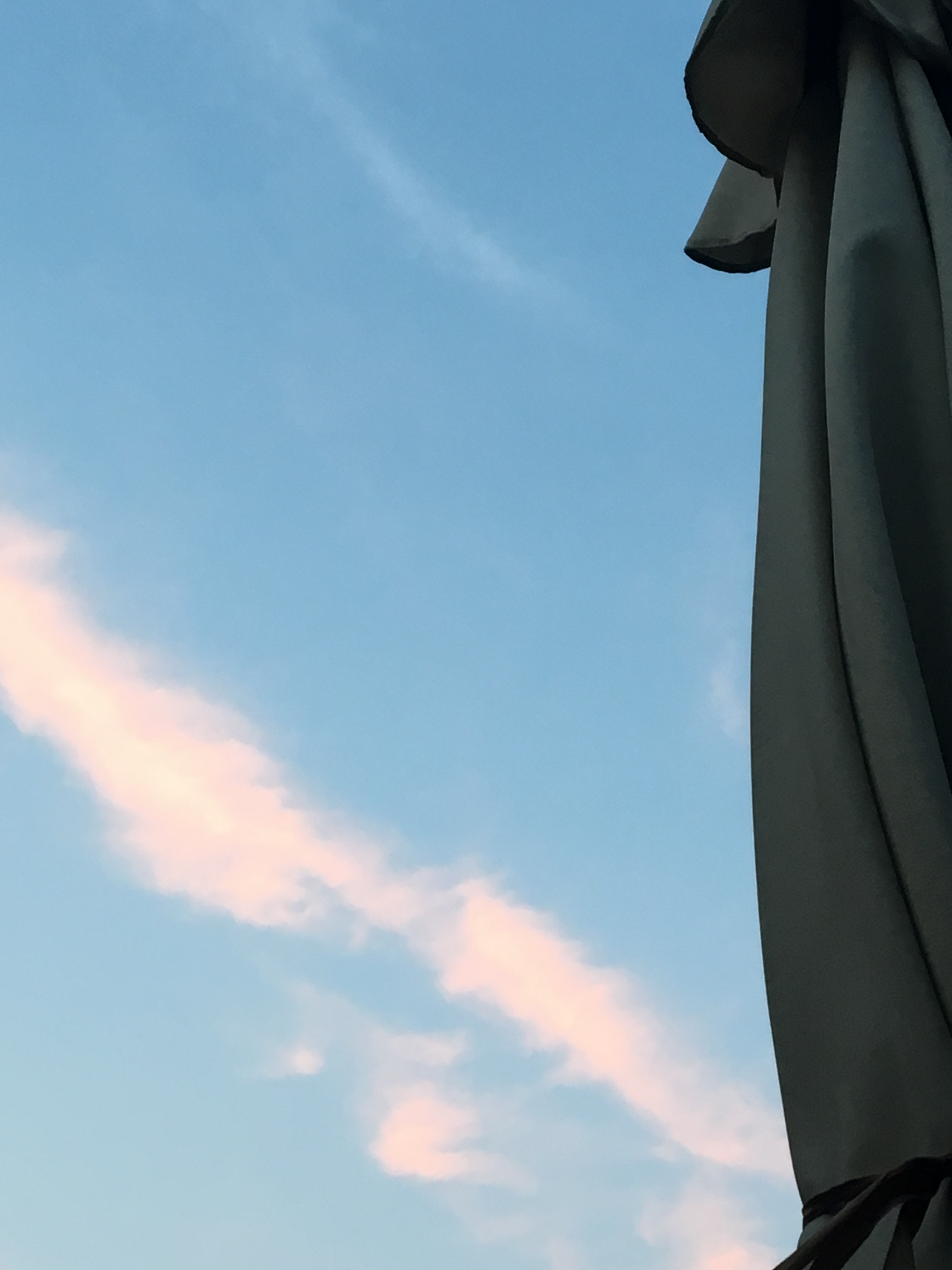
Our pin-on-the-map lands between two airports: O’Hare to the south and Milwaukee’s General Mitchell to the north. On clear summer days, or unseasonably warm days like last week, we recline in our Adirondack chairs and watch the planes Etch-A-Sketch in the sky. According to our recent 5 minute contrail-count-study, at any moment, there are more planes in the sky than one might believe.

It always makes we wonder if Ben Franklin or Leonardo daVinci joined us on the patio would they calmly count contrails from their Adirondack chair or would their heads explode at the wonder of it all. It amuses me to imagine Leonardo hopping around with excitement and pointing to the sky.

In my recent past the phrase “digital exhaust” was relevant to my work in the wild, wild world of software development. Like a contrail, the output of our incessant tapping of keys leaves a trail marking our arc through digital space/time. The particular characteristic that had me hopping out of my chair was the notion that “reading” the digital contrail not only marks our past but is a great way of foreseeing future action. Past patterns are terrific indicators of future behavior. Just ask the FBI.

Kerri keeps a paper calendar where she records the significant and insignificant details of every day. It’s a behavior she inherited from her mother. Beaky was a great recorder of events and maker of lists. If I want to know if we had dinner with 20 in November of 2016, Kerri flips open her 2016 calendar and hits me with the details: yes we did and we had blackened Tilapia, small potatoes, and roasted asparagus. I’ve lost many a debate to the entries in the calendar. Her calendars are our personal analog contrail. Our unique life arc through space/time.

It’s helped me answer one of Tom’s questions about his great-grandmother Isabelle. He found a box with stacks of daily flip-calendars that Isabelle kept, each day had a notation about the weather. A hardworking ranch woman, standing on the porch of the farmhouse, in the days before airplanes, she stared at the sky and made a note in her calendar: hot sun, not a cloud in the sky. Tom looked at me as we went through the stacks in the box, asking, “Why would she do that?”

Contrails.

read Kerri’s blogpost about CONTRAILS

Welcome The Muse [on Two Artists Tuesday]

For many years the “sitting room” was a place we passed through en route to the kitchen or our bedroom on the return trip. It was our staging ground while packing for trips. It was the place we put things when we didn’t know where else to put them. I never sat in the sitting room.

And then, one day, a muse-of-calm possessed Kerri. She wanted a space of peace instead of space of clutter. She wanted to sit in the sitting room. She wanted to hang out in the sitting room. She wanted to read and relax in the sitting room. She became a cleaning dervish. She hung meditative paintings. It was a miracle.

I stopped in my tracks the first time I attempted to pass through the sitting room post-transformation. There was air and light. There were comfy pillows and a throw blanket on the couch. I was filled with an overwhelming desire to sit in the sitting room!

I’d heard rumors of the couch in the corner of sitting room. It was one of BabyCat’s favorite nap spots. Kerri assured me that no creature could sit on that couch without falling into a deep relaxed state. I had my doubts. In my time it was the central repository of clothing overflow. I’d actually never seen the couch. Plus, that BabyCat could sleep anywhere, on any surface. BabyCat was a gifted sleeper.

Kerri appeared behind me. She was holding a book. She, too, had transformed! She was the Siren of the sitting room! I nestled into the couch and cooed, the lap blanket covering my feet. The Siren sat on the other side of the couch. She opened the book and began to read. I was like Dorothy in the poppy field. Eyes drooping. Head bobbing. Incapable of concentration. The last thing I remember was thinking, “So this is what it feels like to be a cat…”

Now, we spend hours in the sitting room, reading on the couch. Falling into a deep relaxed state. Each morning, as I pass through on my way to the kitchen, I slow down and breathe-in the calm.

Sometimes I wonder why we waited so long to create this place of tranquillity. The potential was there all along. The good news? The peace of the sitting room is spilling out into the rest of the house. The sun room is filled with plant-love. The living room is beginning a subtle transformation. We gather around our small table in our tiny kitchen and laugh and tell stories. It’s how change happens. Create the space. Grow the space. It’s how peace happens.

This I know: the muse-of-calm is not yet done with us. I can’t wait to see what happens to the rest of the house and beyond.

read Kerri’s blogpost about THE SITTING ROOM

Celebrate The Symphony [on Two Artists Tuesday]

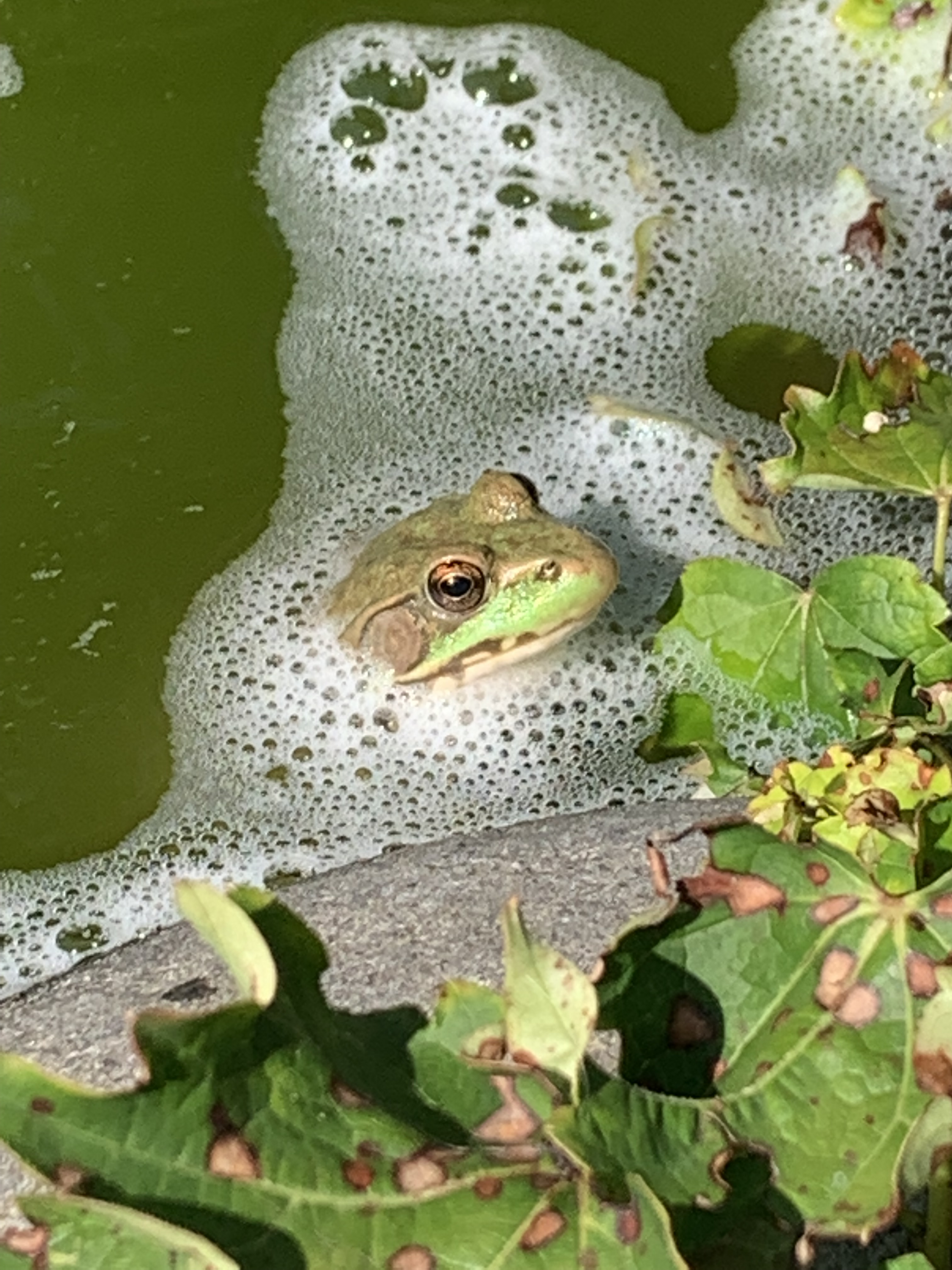
The return of the frogs. No, it’s not the title of a b-grade-horror film. It’s one of our favorite rites of spring. Their chorus is deafening, a sound celebration of the season’s cycle into renewal. We look forward to and celebrate the day of their return.

A short month ago we walked across a snowy field, still a bit in shock at the scrape-clearing of the tall grasses and brush. Broken bits of stick and root poked through the snow. The picture of devastation. In just a few short weeks, the field became a bog – evidently the perfect performance hall for the musician-frogs signaling life’s return with their playing.

They’ve always played in this spot along the trail but this year their symphony is made particularly poignant by the seeming wreckage of their environment. This year, to our ears, they perform a rousing song of perseverance. A composition of resilience.

They’ve also awakened a question in us. We ask it every year but this time it is made more mysterious because the bog is exposed. We can see everything except the frogs. The air is alive with sound while the water is still. We’ve stood, awash in the noisy vibration, yet can see nary a ripple in the surface.

How is it possible to shake the limbs of trees with joyous sound without disturbing the fen? The musicians are invisible.

There can only be one explanation: They are magic, these frogs in their spring renewal, popple-free playing while stirring our hearts and imaginations.

read Kerri’s blogpost about FROG BOG

Drop In [on Two Artists Tuesday]

We stopped on the boardwalk. The sentinel tree stood solitary in the field. Its presence stopped us in our tracks. It was a bone keeping watch over the marshes. It felt forgotten. Unreachable. Made beautiful in its dedication. It inspired quiet. Suddenly, we found ourselves witness to the witness. Look-at-me-look-at-you.

Perhaps it was the boardwalk but I was thrust back in time to a pier. Long Island Sound. It was early morning. The sound and vibration called me to the pier’s end. I stood for a few minutes, eyes closed, and listened. Hundreds of birds, pigeons, chattering beneath the boards, their voices amplified by the wood and soundbox of the structure. I felt them through my feet. Kneeling, I tried to catch a glimpse of the cacophony-makers. They, too inspired quiet.

“Hawk!” Kerri said, pointing and bringing me back to the boardwalk. Beyond the sentinel a hawk threaded masterfully through branches.

I used to think that these magical moments took me out of the real world. Stopping time. Now, I believe the opposite is true. These moments snap me out of my mind-chatter and drop me into the real world. Achingly beautiful. Alive. No story necessary.

pigeon pier. 46x46IN

read Kerri’s blogpost about THE SENTINEL

pigeon pier © 2007 david robinson

React [on Two Artist’s Tuesday]

The answer is herbicide. That blue coloring sprayed on stumps and shards of stumps along our path is meant to prevent the invasive species from sending up new shoots. Eliminating the invasive species so the native plants might someday make a comeback is the point. It only looks like total plant decimation with performance-art-blue dotting the eradicated forest. It is, in actuality, rejuvenation.

We met a couple walking the path. They were bird watchers and thrilled about the rejuvenation project. They explained how the work would allow the river to return to its natural course. The invasive plants were choking the waterway. With the removal of the invasive plants, the wildlife, like the plants, might have a renaissance. They assured us we’d see the difference when spring returned.

When I lived in the pacific northwest, there was deep concern about the salmon. Damming the rivers interrupted the natural cycle of the salmon’s return to spawn and the entire ecosystem was suffering because of it. Salmon are considered a “keystone” species; without the keystone, the ecosystem falls apart.

As we walked our loop I wondered how the invasive plants were introduced and how long had it taken for the invaders to choke the native plants? What prompted the preserve to act now?

Most likely, the invasive plants were introduced unknowingly by people. We cultivate land. We “utilize” nature as a resource. We study. We explore. We develop. We trade. We migrate. We are a force of nature. We walk well tended paths constructed for our ease and enjoyment. Sometimes conscious and sometimes unconscious of our impact.

I had a great conversation with a forest ranger about the re-introduction of wolves into Yellowstone. The thought of “managing” nature has always struck me as paradoxical. We eradicated the wolves and then felt the impact. We re-introduced the wolves to try and correct the mistake before the ecosystem collapsed, and set off another chain reaction of unintended consequences that required further intervention. It’s like prescribing a drug to manage the side effects of a medication.

As we walked I wondered if the concept of natural balance is just too hard for us to grok. We generally don’t realize that interdependence applies to us, too. We believe we are nature’s managers rather than part of the chain. That prevents us from seeing ourselves as invasive, responsible, reactive.

We manage. And sometimes that looks like forest-performance-art-devastation with accents of green-shade-blue.

read Kerri’s blogpost about HERBICIDE

Reach Back To Move Forward [on Two Artists Tuesday]

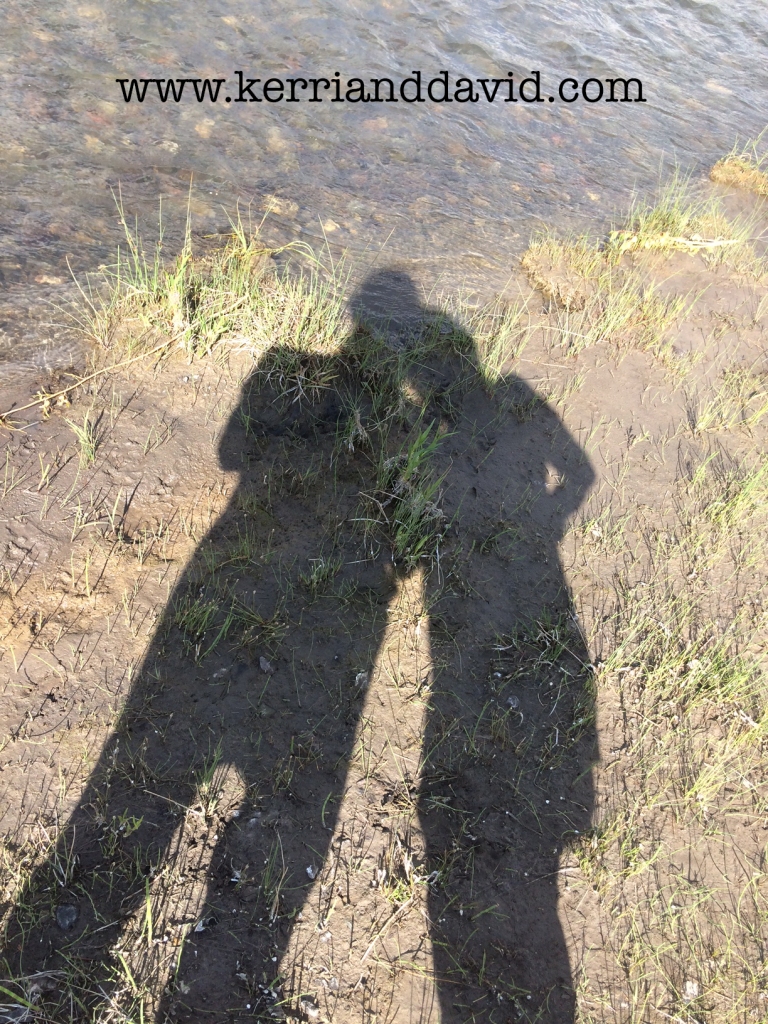
I wrote with great derision of the day I went to the Museum of Modern Art in NYC and watched people line up to take selfies with Van Gogh’s Starry Night. So, more than 15 years later, I howled with laughter at myself when Kerri beckoned me to stand with her so we might take a shadow shot with Diebenkorn’s painting, Ocean Park #68. “We’ll call it ‘Richard and Us!” she smiled.

Kerri recently challenged me to let go of my figurative work, release the image and paint my feelings. The moment before she beckoned me to take the shadow shot, I was having a minor revelation. There’s a reason I have stood in front of this painting for hours. There’s a reason it “talks with me” about simplicity and courage. Early in his life Richard Diebenkorn was a figurative painter. Even earlier, his work was abstract and resembled the paintings of the masters he admired. As his work matured it circled back to abstraction. He didn’t “let go” of his figurative work; he grew through it. He reached through it. In Ocean Park, he fulfilled his unique voice.

I read that his Ocean Park series was greatly influenced by the work of Henri Matisse. I imagined Richard Diebenkorn standing in front of his favorite Matisse, having a quiet conversation about simplicity and the courage to explore. In the gallery light, his shadow cast upon the painting as he moved forward to study the brushstrokes. He leaned in. He reached back to Henri to move forward. Had he lived in the age of cell phones and easy shots, I’m certain he’d have taken a shadow-selfie so he might remember the moment his shadow touched Henri’s.

We were alone in the gallery when Kerri took our shadow-selfie with Richard. We had him all to ourselves. We leaned in. I thought it especially poignant, our shadows cast upon a painting, an artist, who has cast his long shadow upon me. We caught the moment our shadow touched Richard’s. Reaching back to move forward,

read Kerri’s blogpost about RICHARD AND US