Blur The I [on Not So Flawed Wednesday]

We capture quotes all week. Some we see. Some we hear. Some find their way into the Melange. Most do not. We usually note where we heard or found the quote so we remember the context. It’s a practice. It’s not as if we are perpetually eavesdropping on conversations. We’ve simply tuned ourselves to immediately write the amazing words and phrases that catch our attention.

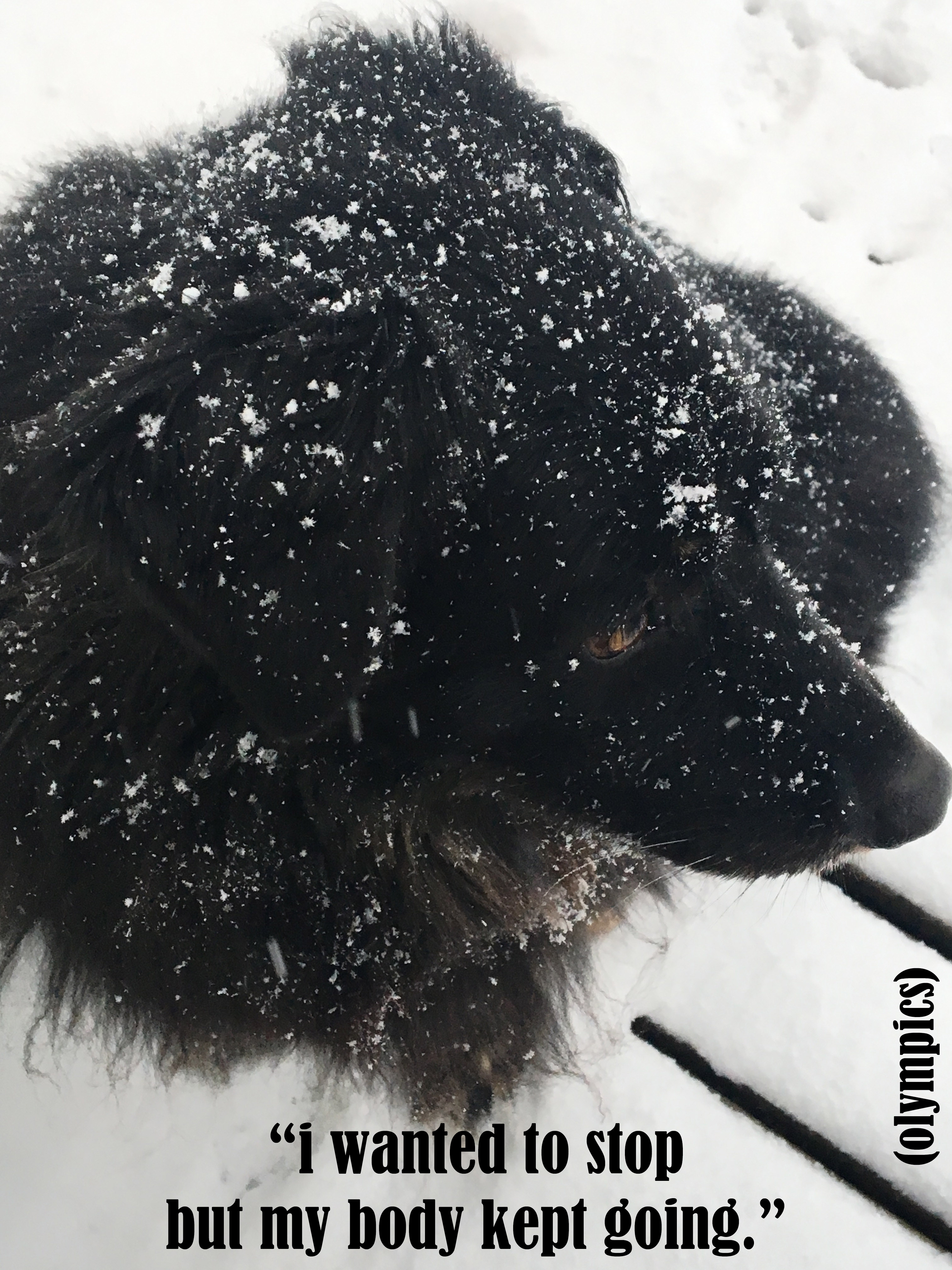
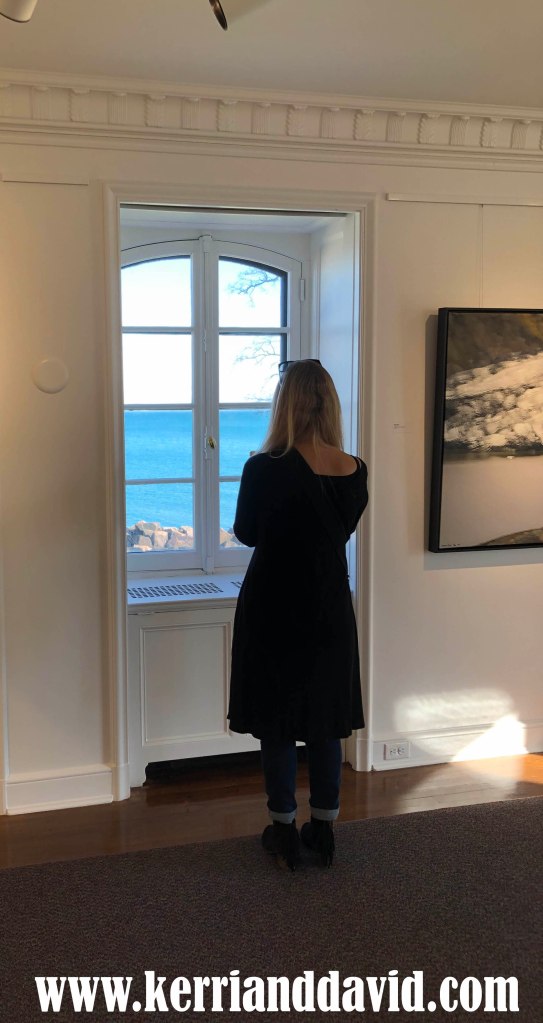
A common phrase is mind-over-matter. Athletes and actors and dancers are conditioned to ignore the limits of their bodies. To keep going. The mind as master over body. I loved this quote because it is the flip side. The mind, the “I”, wanted to stop but the body did not listen. It kept going.

Lately I’ve been reading about – so, paying attention to – the false separations that language necessitates: Mind and body are spoken of, thought of, as separate things. And, the question is this: where does one begin and the other end? Mind over matter. Body did not listen. I made myself do it. Once you start listening for it, it is ubiquitous. Exactly where is the line between “I” and “myself”? When your toe is in pain, isn’t your whole body is in pain? Follow your gut. What does your heart say?

When Dogga gets excited, his little body bounces. He runs in circles. He has to work hard to sit still. Say, “Do you want to go…” and he’s bouncing before the words “on errands?” reach his ears. He knows he won’t actually go on errands until he first sits on the rug. Eventually, he bounces his way into compliance. Control follows unbridled enthusiasm. Control is a means to an end. Rug before errands. Sit before snack.

Dogga might say, while bouncing enthusiastically, “I wanted to stop but my body kept going!”but I doubt it. Given his unified happy spirit, I’m certain the phrase would come out of his muzzle this way: I wanted to stop but I kept going. Watching him is like reading the I-Ching: no separation.

read Kerri’s blogpost about I AND BODY

Feed It [on KS Friday]

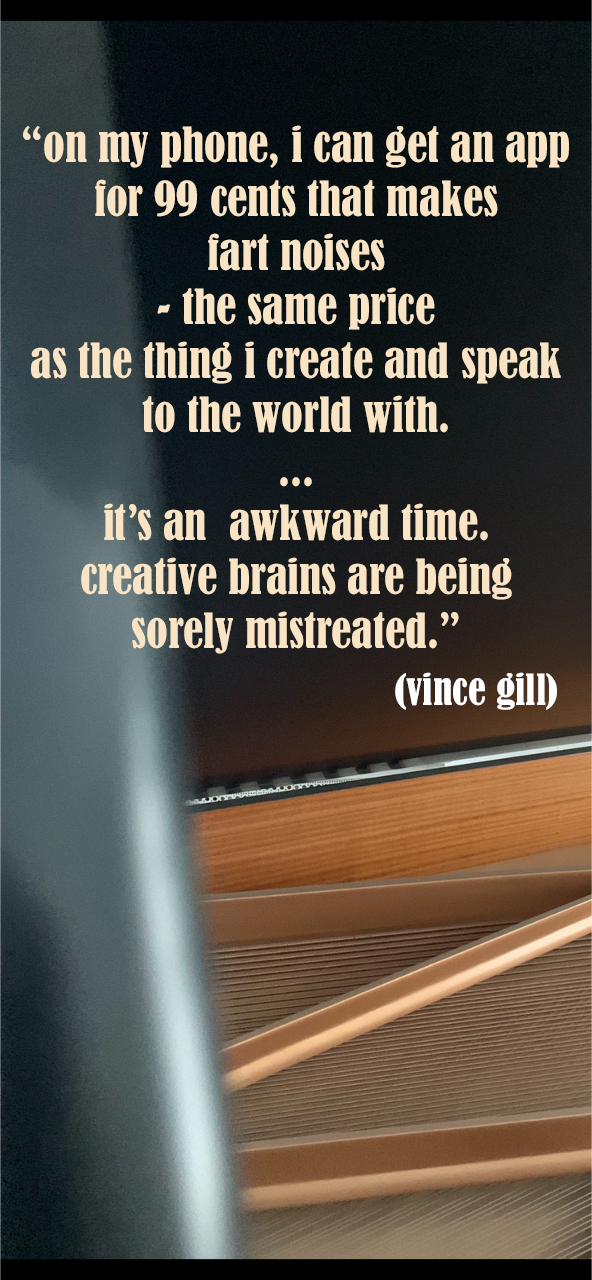
“The devaluation of music and what it’s now deemed to be worth is laughable to me. My single costs 99 cents. That’s what a single cost in 1960. On my phone, I can get an app for 99 cents that makes fart noises – the same price as the thing I create and speak to the world with. Some would say that the fart app is more important. It’s an awkward time. Creative brains are being sorely mistreated.” ~ Vince Gill

I am the first in line to tell you that everyone has a creative mind. Everyone. That river of ridiculousness running between your ears is nothing other than creativity-run-amok. What else? Telling yourself that you are not creative is, in itself, a creative act. Seeds planted early in life grow into mighty obstructions. Creative wastelands are created. If you want to hear a terrific appeal to educators to nurture rather than stifle the creative mind, listen to Sir Ken Robinson’s 2006 Ted Talk. It’s appropriately titled “Do Schools Kill Creativity?”

I’ve listened to numerous school boards tell me how much they truly value the arts – until it’s time to pay for it. Sadly, it’s not a question of whether or not they value the arts; it’s that the arts, the creative minds, do not fit any of the standards of valuation against which all things are measured. They do not know how to value the creative minds that they steward. Arts organizations and artists, mostly, are not money makers. Creative minds, creative acts, do not fit in the boxes and are not measurable on standardized tests. Thinking outside of boxes is, after all, the point of a creative mind. Metrics and goals stop a creative mind and heart in its tracks. The cruelest thing you can ask any artist to do is write a grant.

And yet, an artist has to make a living. Yaki asked me if I had to choose between making a living and making my art, which would I choose? I answered, “Art, of course,” but that it was really a question of Maslow’s hierarchy: it’s hard to make art when you are not surviving. What I didn’t say is that his question perfectly captured the reason schools kill creativity and creative brains are sorely mistreated: it is assumed one must choose between. Making a living and thriving creativity are understood as oppositional.

How many parents have tried to dissuade their children from following their passion for the arts? How many times have I heard Kerri say of the stacks of music on her piano waiting to be recorded, “What’s the use?” How many times have I sat in my basement studio looking at my stacks and rolls of paintings and wondered, “Why bother?” We do it to ourselves, too.

And then, the phony metric falls and we breathe, pick up our brushes and sit at our keyboards. There is a river of riches that runs deeper than money. It is, after all, a creative act to kill a passion. It’s also a creative act to feed and nurture an artistic soul. Both. It’s what the school board doesn’t understand: the choice is not between making a living or living as an artist, the choice is between feeding inspiration, expanding a creative mind, or smothering it.

read Kerri’s blogpost about CREATIVE MINDS

Kerri’s albums are available on iTunes and streaming on Pandora

watershed/as it is © 2004 kerri sherwood

Stack Your Nickels & Pennies [on Flawed Wednesday]

From the school of if-you-are-sitting-on-the-mountain-you-can’t-see-it comes the hot mess we call healthcare in these un-united-united-states. Insanity never looks at itself and says, “I’m insane.” Our system of healthcare – and I use the term “system” loosely, is insane. In my sordid past as an organizational consultant I facilitated an experience called reverse design: ask people to design the worst system possible. The worst product imaginable. Hilarity ensued. None of those mad-mad sessions could have concocted what we call healthcare in the richest nation on earth. It seems the money has both blinded us and made us batty.

I just asked Kerri how much a postage stamp costs. “58 cents,” she grumbled, “And we got three mailings.” We finally achieved our get-out-of-jail-free card: a job with benefits. We canceled our ACA prison policy but, apparently, there was a one-day crossover in the billing cycle. I know a computer sent us the three-times-nasty-gram and spent $1.74 in postage to collect $.27. No human was involved though, having spent an inordinate amount of time on the phone with people paid to try and make sense of the nonsense, we’ve learned how numb the human mind can become when sense-making in a swamp of gobbledygook. We paid our debt online.

No human involved. De-human-izing. The Turing test is…a test of intelligence in a computer. Is the machine’s behavior indistinguishable from that of a human being? Hubris is a human quality that imagines the computer will become more like us while not recognizing that, in the process, we are becoming less like us. I doubt the computer will ever evolve to that point of pomposity. I suspect that the computer will someday recognize the folly of attempting to model itself after something so flawed as human intelligence. What intelligent machine would model itself on beings that seem incapable of creating a competent system for the care of its own health? No advanced intelligence would submerge its prime directive for the secondary intention of stacking nickels and pennies.

read Kerri’s blogpost about HEALTHCARE

Point The Way [on Merely A Thought Monday]

“You can accomplish with kindness what you cannot by force.” ~ Publilius Syrus

It’s one of the most interesting Wikipedia pages I’ve come across. Publilius Syrus. A life described in two sentences that conclude with this: “…but by his wit and talent he won the favor of his master, who freed and educated him. The rest of the page are maxims attributed to him. A Syrian. A Roman slave. An observer of human-kind.

We live in a world of ubiquitous maxims. They are posted everywhere, in stores, billboards, and elementary school signboards. Appeals to our better nature. Choose kindness. There are, of course, plenty of appeals to our worse nature, too. It’s as if our maxims are in a tug-of-war. I imagine that Publilius Syrus experienced in his short life both ends of the rope, the cruel and the kind, which is why he wrote so many maxims.

This quote came across my screen so I wrote it on a lilac colored post-it note and stuck it to my monitor. It may or may not be from Christina Wodtke: “When you make complex things, words eventually fail.” Life is a complex thing that words will always fail to describe or contain. The best a word can do is point to something, or the way to something. A maxim, an ideal, is, after all, a signpost, a direction. A choice of path. A point-of-view is created during those moments of choosing.

Kindness is not a thing. It’s not a word – not the word. The word simply points the way to something so complex, so boundless, that the word will always fail. But, we know it when we see it. We know it when we offer it. We know it when we receive it. We know with certainty when we choose it and when we do not.

read Kerri’s blog post about CHOOSE KINDNESS

Step Back And Realize [on Flawed Wednesday]

If you are like us, every day brings another report of a friend or loved one who has Covid. As someone recently said to me, “With Omicron, it’s only a half degree of separation between you and someone who’s carrying the virus.” I’d say, given the wave of people we know falling sick and reporting positive test results, it’s true. It’s no time to let down your guard.

On Saturday we watched a documentary film, The First Wave. It’s a film everyone should see. It chronicles the first few months of the pandemic in a New York hospital. It is shocking how, in a few short years, we’ve normalized hospitals being overrun. How removed we, the populace, are from the tangible horror of this pandemic. Refrigerator trucks used as temporary morgues. We stand today at 865,000 deaths and counting. People. By comparison, 620,000 people died in the Civil War. 418,500 US citizens, military and civilian, died in World War 2. We ought to be grieving instead of dividing. We ought to be reaching to help rather than peacocking our politics. This film will slap you awake. It will help you step back and realize what we – all of us – are passing through. It might help you grieve.

Kerri tells me that the woman in the next car thought she and 20 were doing a drug deal. He felt sick, needed a test and could find none. We had a few so they met in a parking lot to make a safe pass. While making the exchange, he handed her an envelope. Money for the phone bill but I’m sure it looked suspicious.

It reminded me of the time, many years ago, that Sam asked me to meet him in a parking lot. He rolled down his window and passed to me a sheaf of poems. The window went up. I was to tell no one. It was terribly vulnerable for him to share. I cried the day he published his first book of poetry. It was a titanic journey from fear-of-certain-shame to proudly publishing his beautiful work. He was transformed.

I imagine someday we will stand and look back at this titanic journey. I hope that I remember with fondness the story of Kerri and 20 making an exchange in the parking lot, the women one-car-over shocked by what she thought she was seeing, and we smile. Transformed. Remade as better people in a better community making better assumptions of each other. Stronger.

For now, as the credits rolled on The First Wave, we looked at each other and together said, “I’m exhausted.”

read Kerri’s blog post about THE EXCHANGE

Connect The Poles [on KS Friday]

Though it is not, this could be a close-up of an x-ray. Arteries carrying blood away from the heart, veins carrying blood back to the heart, and the capillaries that connect the them. Outgoing. Incoming. And the connection between the two. And, as is always true of language, in the naming and the action-describing, the whole system is obscured. This part does this. That part does that. Mechanical mind applied to a miracle of pulsating life.

In North Carolina I overheard an old guy grousing about climate change. He is a sceptic. “There’s record snow in California!” he decried, “And, we’re having record heat here! You can’t have it both ways!” His reluctant listener bobbed her head. “It’s either warming or it’s not!” he railed. “Explain that to me!” Mechanical mind. Parts-thinkers cannot see the whole system. The capillary-word that tumbled from his mouth but bypassed his mind was “record.” The poles are, after all, connected.

I am fascinated by my current work. I am witness to and a participant in the creation of software. The language is familiar though the meanings are new: epic and story. Bug. My mind, lately, has been awhirl. The developers necessarily talk of information as content-objects. Items. The language of “fixed” things. Yet, the problems in the world that they design and solve for are “fluid.” Information, in our day-and-age, never stops. It grows exponentially everyday. It is movement, constant motion. More/faster. Sometimes I get a glimpse behind the curtain and see the developer’s work of content-items-in-motion. You’ve never seen a faster moving current of symbols. Is it a particle or a wave? It depends.

The tree in our front yard reaches toward the house. Kerri tells me that our children climbed through the branches when they were young. When the crew had to clear some branches to trench the yard, Kerri winced each time a branch snapped and fell to the ground. “I can’t look,” she said, not taking her eyes off the tree. Holding vigil. Holding her heart.

It’s easy to forget that, in all cases, no matter the eyes though which we see, the movement is always back to center. To the heart-of-the-matter. The pieces are never isolated. This tree is not separate or distinct from the sky or Kerri’s heart. The poles are always connected, whether we recognize it, see it, acknowledge it, or not. Breathe in. Breathe out. Two actions or one?

read Kerri’s blog post about THE TREE AND SKY

Kerri’s albums are available on iTunes or streaming on Pandora

Disagree [on Merely A Thought Monday]

Months later, she* is still angry with me. I asked her to “stop blowing me off.”

Some things need to be discussed and necessarily require entertaining differing points of view. Finding middle ground or considering alternate possibilities requires hearing what others have to say – and giving others the courtesy of hearing what you have to say. Her standard phrase of choice, when faced with an opinion or idea not her own, is this: “I guess we’ll have to agree to disagree.”

No. I don’t agree to disagree. Especially at the onset of a dialogue. I want to talk about it. I want to hear what you have to say and more importantly why you hold your point of view. I won’t agree to not hearing or being heard.

Opposing points of view, differing opinions, need not be conflicting. They can be highly generative. Mind opening. Thought provoking. “I’ve never thought of that,” is an expression that results when considering a different point of view. In ideal, our nation is based on the notion of two opposing points-of-view extending to each other the courtesy of listening and considering possibilities not yet seen. Yep. And, we are witness to what happens when one side (or the other) rejects the basic premise. Dismissiveness is the strategy of an empty suit.

Why assume conflict?

She followed “I guess we’ll have to agree to disagree,” with the real statement, her actual aim: “You do what you want. I’m going to do what I’ve always done and follow my plan.” In other words, she had no intention of hearing anything that did not support her plan. Why, then, I wondered, did she invite conversation?

When the only tool you have is a hammer, then everything looks like a nail. When the only door you have is a closed door, then every knock sounds like an intruder.

I laughed aloud when I read Bill Murphy’s article in Inc. Magazine about his pet-peeve phrase: “Look, I get it.” He writes, ‘”Look, I get it,'” is almost always inherently untrue…Even worse for our purposes, it’s woefully ineffective.”

It’s dismissive. Just as is “I guess we’ll have to agree to disagree.” The agreement she wanted was for me to agree to be dismissed. An agreement of silence. Why would I – or anyone – agree to that?

[* “She” is not Kerri. We hold each other in high esteem. It’s why the sign in our kitchen reads, “You are my favorite pain-in-the-ass.” We welcome our differing perspectives. Neither one of us dismisses the other nor tolerates being dismissed.]

read Kerri’s blog post about “LOOK, I GET IT.”

Porch Sit [on KS Friday]

Quinn used to say that two things ruined western civilization: salad bars (serve yourself) and attached garages. “It all went south when we started inviting our cars into our homes,” he mused. To his list I might add air conditioners. Porch-sitting and the neighborhood evening promenade, with accompanying neighbor conversations, went away with the invention of cool indoor air. Imagine what we might be able to solve if we actually talked to each other on a regular basis. Imagine what nonsense might dissipate if we pulled our heads out of the television and, instead, strolled the neighborhood to see what was going on.

We look for porches. And, when we don’t have one, we create it. I knew I would be with Kerri forever because (among other things) she had two Adirondack chairs sitting in the grass outside the front door of her house. Early in out time together, we sat out front, sipped wine, and waved and chatted with people walking by. She’s dedicated to greater things than cold-air comfort.

When we travel, our airbnb’s almost always have porches. A porch is on the list of requirements. It never fails. The porches in our travels are always sources of good stories, special moments, new friendships. They are not magic. They were invented for peace and polite conversation. They are liminal spaces, both public and private. People wave and greet each other. People stop and chat – even for a moment. You can learn a lot about a new place by sitting on the porch and asking a local carrying a pizza where the good food is to be found (a true story). People like to share what they know.

As Skip reminded us yesterday, people write things on Facebook or other social media that they’d never say otherwise. I think there’s a lot of that going around these days. Forums for ugliness. I’m certain it’s nothing that a good porch and an evening constitutional couldn’t cure.

time together/this part of the journey is available on iTunes or streaming on Pandora

read Kerri’s blog post about PORCHES

time together/this part of the journey © 1997 kerri sherwood

Look Down [on DR Thursday]

To all the rugged individualists out there living under the grand illusion that you are blazing a new trail, I have only one thing to say: look down. Someone has been there before you. It’s why there’s a path. And, more to the point, someone – a crew of someones – worked very hard to make and maintain the trail you now tread. It’s true in the forest. It’s true in the big-bad city. Every time we flick a switch and the lights come on it might not be a bad idea to recognize how many people were – and are – involved in the maintenance of our comfort and our self-reliance-fantasies.

On the Pink Bed trail there’s a boardwalk that elevates hikers over the swampy sections. I stopped in utter admiration at the section that took a hard left. Someone – a crew of someones – spent a long time making my corner not only easy to walk but beautiful. Certainly there are more efficient ways to build a turn in a boardwalk and they could have chosen any number of simpler solutions but they didn’t. They took the time to make their work functional, sturdy, AND aesthetic.

Daniel was building a house on the lake. He only builds one a year these days, mostly for fun. He invited us in. Far from being finished, the craftsmanship was exposed. The joints were meticulous. The lumber he chose was solid. The materials mattered. There was beauty in the structure and he was proud to point out the love taken in every step, even the roughest stage of the build. The eventual buyers would never see or know the care alive behind the drywall. They might never fathom the depth of effort and design involved in making their comfort – their triumphant lake home – a possibility.

Horatio and I talk often of the deep philosophical divide in these un-united-united-states. The every-man/woman-for-him/herself camp is at odds with the I-am-my-brother/sisters-keeper folks. I understand the appeal of the self-made-man/woman story but I also recognize it to be mostly a fantasy. Sir Edmund Hillary understood that standing atop Everest, celebrated as the first, was only made possible by the efforts of hundreds of Sherpa, months of expedition planning by John Hunt and team, financing, travel arrangements, government officials, 8 previous unsuccessful expeditions, and the good graces and guidance of Tensing Norgay.

We’d be better off if periodically we stopped and simply looked down.

read Kerri’s blog post about the BOARDWALK

prayer of opposites © 2003-4 david robinson

Choose How [on Not So Flawed Wednesday]

My friend’s children are having children. The top-of-the-list advice my friends offer their children, now parents themselves, is this: it goes so fast. Appreciate every single moment. Love every phase. You will blink your eye and they will be grown and gone.

I lost my dad in September. I have, like most people who’ve lost a loved one, spent much of the time since his passing remembering and reflecting. It’s a mixed bag of treasuring moments and wondering why I didn’t fully appreciate others. It is true, you don’t know what you have until it’s gone.

What is so hard about appreciating – fully appreciating – the limited moments of your life?

I used to facilitate an exercise. It had four phases. Working in small groups, the first phase was to have a group member identify a problem in their life and then tell a blame-story about the problem. The rest of the group helped by supporting the person in their story of blame. The groups howled with laughter. Blame is fun. It’s addictive, like sugar.

In the second phase, the groups tried to “fix” the problem. The serious, concerned faces puzzled possible fixes but inevitably dissolved into more laughter: there’s nothing like trying fix a problem to create more problems and loop back into a juicy blame story.

Phase three was simple: I asked the original problem-story-teller to retell their story as a story of choice, not blame. I asked the other members of the group to support the teller in their story of choice. Silence ensued. And then, quiet presence as the new narrative – the story of choice – slowly inhabited the room.

Blame stories are like too much candy. They are easy to eat and yet have no real sustenance.
Stories of choice are much harder to tell but they are rich in awareness and appreciation of the moment.

We never arrived at the fourth phase: stories of opportunity. Activating choice. The notion of taking responsibility for choices always stopped the exploration. Our conversations about choice-avoidance usually filled the time.

What we gain in blame, we lose in appreciation of our moments. In order to taste the moment, one must first choose to be in it – and then choose how to be in it.

Grief is a phase to be loved, not avoided. As is the celebration of a first birthday. A new life. A lost love. A full spectrum. Taste every moment.

read Kerri’s blog post about MOMENTS