Chew On It [on Merely A Thought Monday]

The first and most important question of the day is, “What is nougat?” I’ve always been more of a peanut M&M’s guy or, these days, a straight-up almonds, sea salt in dark chocolate lover. I’m currently accepting donations of Chocolove’s Salted Almond Butter in Dark Chocolate. You should be, too.

So, what is nougat? Originally it was honey, nuts, and egg whites but in this era of “it’s-better-not-to-know-what-I-just-put-into-my-mouth-and-called-it-candy,” I wonder what passes for nougat? I only ask because I’d never heard of a Charleston Chew so, to understand the reference, I looked it up. When I read that a Charleston Chew is, “…flavored nougat covered in chocolate flavored coating…” I immediately spotted the word “flavored” twice in the same sentence. If the chocolate isn’t really chocolate then what are the odds that the “flavored” nougat is really honey, nuts and egg whites?

To borrow and bastardize a bit of Hamlet”To eat; perchance to savor: aye, there’s the rub.” Kerri assures me that a Charleston Chew is yummy. Who cares what’s in it if it makes my toes wiggle with satisfaction? It’s the inverse argument of all those nasty foods adults made us swallow as children: who cares if it’s good for me if it makes me gag? Make me go hungry and send me to my room! Please! Caring adults forget that kids squirrel away and hide Charleston Chews beneath the mattress so banishment to the bedroom for not choking down brussel sprouts is tasty a reward.

This is key to understanding why people do what they do: we know what’s in a brussel sprout*. We have no idea what’s in a Charleston Chew. We’ll clamp down our jaws or pitch public fits rather than eat what’s good for us. Yet, we’ll happily binge on mystery snacks that are certainly no good for us but, damn-do-they-taste-good. Insight: humans are not rational beings. We puff up and proudly defend all manner of thought-nougat but can’t be bothered to look up the source or verity of the dreck we’re feeding on.

Of our current dilemmas, there is one thing that is certain: we can’t Charleston Chew our way out of this.

Take heart. There’s always Chocolove.

[*now that I’m rumored to be an adult I love roasted brussel sprouts]

read Kerri’s blogpost about CHARLESTON CHEWS

Taste The Sound [on KS Friday]

Toadshade trillium. Say it out loud and taste the sounds. Toadshade trillium. Yummy words worthy of e.e. cummings.

I am working in a tech space and keep a document on my desktop: Terms in this Unknown Land. Tech folk speak in acronyms, PAI and SMB, SERP and TAM. Although my colleagues are mostly left-brainers, they are remarkably poetic in their language, peppering their acronym-speak with tasty terms like “cluster calculations” and “stemmings.” I admit to losing the sense of the conversation in the sound. They are, despite the stereotype, passionate and creative and unconsciously poetic. “Plots a curve of probability.”

Toadshade trillium. Plots a curve of probability. Forget the meaning and taste the sound! What might Mary Oliver have done with those syllables!

My lesson this week: I cannot stand and work at my computer all day. I can do the standing (I have a stand-up desk) but staring at a screen eventually shuts down my brain. Across from my stand-up desk is my drafting table. I think better with big pieces of paper and a pencil and then translate back to the computer. I need to move to think but that’s only part of the lesson. When at the drafting table I’m more likely to take things less seriously. I free myself. I get snarky and funny and scribble and draw big arrows and make fun of myself and the logjam in my thinking. I play.

And, while I play, I talk aloud, and hear the sounds of the shapes that I draw. Poetry and motion. Taste the movement. One and the same. Free the thinking. It’s enough to scare the dog but it’s liberating to my kinesthetic necessity. I scribble notes in every direction and dance back and forth between word and image. Consequently, I produce better work.

Thank goodness I finally tasted a few word-sounds that sent me tumbling into a productive scribble dance.

read Kerri’s blogpost about TOADSHADE TRILLIUM

kerri’s albums are available on iTunes and streaming on Pandora

pulling weeds/right now © 2010 kerri sherwood

Breathe At Human Pace [on KS Friday]

We live in a time in which cars are capable of parking and braking themselves. I am able to type a message into a little box that I carry in my pocket and my message, through space and time to anywhere in the world, is delivered immediately. I write my thoughts in this device and then publish all over the world. I’ve learned of a software that is able to write my thoughts without me – faster and with fewer grammatical errors at the outset. I think and write in a pattern capable of being recognized. I am, therefore, capable of being approximated. What is amazing today is common tomorrow. So it goes with the pace of change.

I read in The Dream Society, written two decades ago, that the aim of the industrial era was to spare humanity physical toil and the aim of the information age is to relieve us from the exertion of thought. We’re producing data at a staggering rate and, ironically, the explosion is both serving the intention and overwhelming our capacity to keep up. We can’t possibly process the tsunami of information that washes over us everyday. We are human. We have a tough time sussing out truth from belief-fantasy even when not washed down the roaring information streams.

It is why I hang out with Desi. Desi is the little tree sprout that we rescued from the Des Plaines river trail over two years ago. When Desi came home with us, her tiny trunk was needle thin. She is thriving in her pot and has more than doubled in size, yet, by the standards of data, her growth is glacial. And that is precisely why I visit her each day. She is in no rush. Efficiency for Desi has nothing to do with speed. Health is about good soil and light. Like all plants, she could be pushed artificially, but why? Pushing might get her to adulthood faster but would also damage her systems. Efficiency and health, for Desi, are all about natural pace. Slow, slow, slow to human eyes.

Desi reminds me that the pace of my life is artificial. A choice. The pace, the incessant noise vying for my attention, are human-made, unnatural. Don’t get me wrong. I delight that Google maps gets me where I want to go. I appreciate having a phone available while walking a backwoods trail. One of the great joys of my life is watching Kerri photograph – with her phone – the world she sees. I love to write and push a button to share. I am, despite my advertising, not a luddite. I’m also aware that the media – the medium – is the message. We are – we become – what we consume and how we consume it. It is a necessity in our age of rolling miracles to keep both eyes open.

I think it is healthy (although virtually impossible) to occasionally crawl out of the stream and breathe at human pace. To think without the expectation of assistance. Each day, for a few minutes, I hang out with Desi, a reminder that an inch of growth every year is sometimes fast enough.

Kerri’s albums are available on iTunes and streaming on Pandora

read Kerri’s blogpost about DESI

taking stock/right now © 2010 kerri sherwood

Say Uff Da [on Not So Flawed Wednesday]

I never met Kerri’s dad. He passed before I came into the picture. I feel as though I know him. When a nasty bit of home repair is staring me down, I often ask his advice. “What should I do with this one, Pa?” I ask. Generally, he crosses his arms in quiet consideration and mutters, “Uff da.” And soon a solution comes to mind.

Hanging beside our back door is a bamboo wind chime. It was Pa’s. Sometimes when we open the back door it voices and I respond with a hearty, “Good morning, Pa.”

His nickname for Kerri was “brat.” I know exactly why Pa gave her that nickname. Let’s just say she earned it and, to be clear, has never outgrown it. 20 often looks at me in desperation and says, “She’s torturing me!” He wants me to intervene, to come to his rescue. I know better. Kerri laughs. So does Pa. We love the brat even if we are the recipients of her mischief.

Earlier this year I lost my dad. Yesterday while on the trail, I confessed that I was overwhelmed with a wave of missing him. “Cycles of grief,” as the Wander Women say. Growing older is filled with cycles of grief and I had cycled in. I sighed. Kerri squeezed my hand. “I’m sorry,” she said.

“This sucks,” I thought.

“Uff da,” Pa said.

read Kerri’s blogpost about UFF DA

Know The Poem [on KS Friday]

“Spring has returned. The Earth is like a child that knows poems.” ~Rainier Maria Rilke

“First robin!” she said.

“What?”

“First robin. That means spring is here!” she looked at me with “duh” eyes. I was new to Wisconsin so the rituals were not yet known to me. I did not yet understand that in this strange land a water cooler is called a “bubbler” and that cheese curds are sacred food. Before the week was out, I’d heard it three times from strangers. “First robin!”

Years ago, during my first winter in Seattle, after months of gray, the sun came out for an hour and all the people working downtown poured out of the tall buildings and stood facing the sun. They moaned with satisfaction. “What’s this!” I exclaimed. Weird behavior. The next year, after months of dreary gray, the moment the sun peeked from behind the drab curtain, I ran out of my apartment to revel in the return. Leaning against a brick wall, eyes closed, feeling the warmth on my face and the heat reaching my bones, I knew this was my passage to becoming a “local”. I moaned with satisfaction.

Poetry is visceral. It has it roots in the moans of sun drinkers and robin-seers. The green pushing up from dark soil. The smell of spring or the first hint of warmth on the winter wind. Words cannot capture feelings but isn’t it glorious that we try?

We were walking the neighborhood on a cold afternoon. She squeezed my hand and pointed. “First robin,” I said and she smiled. “Spring.”

Now, doesn’t “First robin. Spring!” sound like a grand start to a poem of renewal? Ahhhhhh, yes. A hint of warmth on the wind, harbinger of green shoots reaching. Someday soon, sun will call me out of hiding and color my pale face.

read Kerri’s blogpost about FIRST ROBIN

Kerri’s albums are available on iTunes and streaming on Pandora

baby steps/right now © 2010 kerri sherwood

See The Signs [on Not So Flawed Wednesday]

Religions around the world and across time have personified this moment. The return of the green. From one day to the next buds appear on trees. The signs of life’s vibrant enthusiasm returning (again) from long winter, barren earth, metaphoric death. Persephone’s homecoming from the underworld and Demeter, her mother, goddess of the earth, allows the return of life.

It’s a very, very old story told in many, many different ways. Human beings, storytellers all, making sense of death and life, generalized across the real experience of cycles and seasons, all pressed through the lens of this-causes-that. Reduce us to an essential oil and we are makers of metaphor and seers of pattern.

I told Kerri that I got out of the wrong side of the bed this morning. An idiom. Imagine the power in brains that utilize idioms! The meaning cannot possibly be carried by a literal interpretation of the individual words. We pull the meaning out of or inject it into the collection of words. We know what it means because the meaning has a long history. The Romans, I’ve read, believed there was a correct side of the bed. Arising on the correct side of the bed would ensure good luck. The right side of the bed was positive, the left side was dubious. Jump out of bed on the left side and the day was ruined!

Superstition: making sense of the happenings of a day or a life, pressed through the lens of this-causes-that.

Mostly, I am restless. It snowed all day yesterday. I yearn for the moment when I can, for the first time of the returning (pattern) spring, lean against the wall and feel the warm sun on my face. I will, like I did last spring, enjoy the moment to the point of non-thinking. I will drink it in with no need to wrap a story around it or make sense of what I am feeling. I will appreciate it to my bones and revel in the return of warmth, new growth, and light.

read Kerri’s blog post on GREEN

Step Off [on Two Artists Tuesday]

“A tree is not made of wood, it is wood.” ~ Alan Watts, The Watercourse Way

Language is powerful. It’s a drum I have beat for a long time, the notion that we insist that the narratives we wrap around ourselves are somehow “reality.” We are told that 50% of Russians believe the hell wrought on the Ukraine is merely propaganda. A made-up story. Not true. It is the narrative they are fed and, in order to eat it, they must ignore any evidence to the contrary. Their economy crumbles. The ruble falls. How could they not see it? Don’t laugh. 40% of USAmericans still believe the last presidential election was stolen, a plausible story only if wearing blinders with fingers placed firmly in ears. Burying your head in the sand is not a Russian or American trait, it’s uniquely human. We see what we believe, not the other way around. Our language makes it so.

Years ago I read that the word “wild” could only come from a people who believe all things must be tamed. Wild makes no sense without the concept of tame. Wild, bad. Tamed, good. So, a people afraid of their own “nature” must become tamers. A people who think “nature” not only can be but must be managed. To be “above” it all, in charge and atop the pyramid, giver of names. It is the necessary narrative for such tamers of the wild, those who story their very nature as corrupt. Tamed, good. Above it all. Separate. Is it any wonder the intrinsically conflicted human world rarely embraces peace? Our narrative leads us to believe, amidst so much inner and, therefore, outer conflict, peace is something to be created because we are naturally conflicted. What else?

Where, exactly, does wild end and tame begin? Where’s the line that delineates nature from civilization? What if nature is neither good nor bad? What if your nature was neither good nor bad? Perhaps self-love would be within reach and, as a natural extension, the love of others, too. It’s an alternative narrative though not possible in a belief-story that fears the wild. Wholeness begins with a step off the pedestal.

It’s in the language. Somehow separate from the world in which we live, not “in” nature or “of” nature , we are deluded to believe we are made of different stuff. Above it. Divinely manufactured. Made.

Manufactured. Made. Trees made of wood.

And, just what are we made of? I guess it depends on the story we decide to tell. Wild stuff.

read Kerri’s blogpost about TREES

Stack The Impossible [on Merely A Thought Monday]

We watched the video of Jaxon climbing the ladder of the red plastic slide. His momma said, “Is that your big boy slide?” Jaxon said, “Big boy slide.” Pandemonium. “He said it!” his father exclaimed, “I think he said it!”

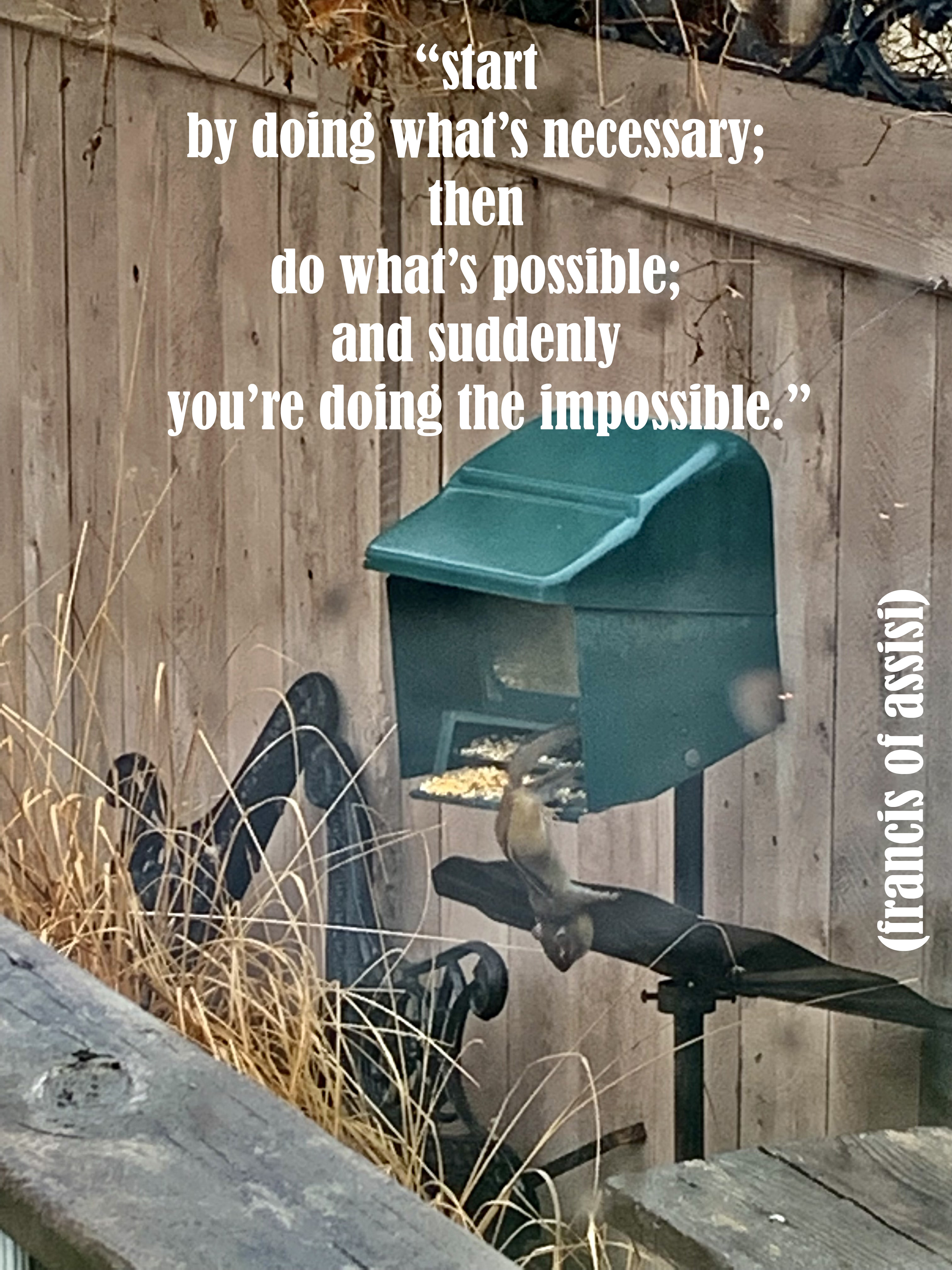
Big boy slide. A first phrase. The moment when what’s necessary becomes what’s possible. It’s something we take for granted every day. The utter impossibility of spoken language. Sounds uttered in sequence that somehow make sense. Of course, we’re also quite capable of stringing together sounds that make nonsense, too. Soon, Jaxon will ask his parents for the keys to the car and a wholly different kind of pandemonium will let loose. From climbing a ladder to driving the Volvo. The impossibilities stack one upon the other.

My mother is adjusting to life without my dad. She says often, “I don’t think I can take it, this loneliness.” She is doing what is necessary. In our last chat, she spoke of playing pickleball, of taking a walk, of meeting a friend for tea. Moving with intention out of the apartment to meet other people. The moment when the necessary becomes what’s possible. She will, I am confident, live her way into the impossible.

The impossible rarely happens in a snap. We live our way into it. Jaxon’s pronouncement and subsequent trip down the big boy slide was a long time coming, a step in the process worthy of celebration. And then, the miracles will keep coming. Full sentences. He’ll learn to write. Someday he’ll write love letters and drive the car to pick up his date. He’ll ask someone to marry him. The art of the impossible. This life.

And, the most amazing of the impossibilities, as we stack our lives with the formerly inconceivable, we grow less and less capable of seeing it. Perhaps that is necessary? How would we exist if we saw each other as keepers of the impossible? Experiencers of the unimaginable?

read Kerri’s blogpost about THE IMPOSSIBLE

Seed The Pocket [on Flawed Wednesday]

I’ve appreciated this sunflower for many years and until a month ago it never made me think of Ukraine. Now, that’s all I see. Thus, the power of a symbol. Sunflower seeds placed into the pockets of Russian soldiers by brave Ukrainian elders. “So, some good may come from your death.”

Walking through the antique mall, Brad spotted an ugly homemade sculpture. Golf balls with multiple screws protruding, spray painted and supported by wire rods. “Look, the coronavirus!” he exclaimed. Three years ago spheres with spiky knobs would have made me wrinkle my brow but never associate the shape with a virus. Now?

And masks? Will we ever see a surgical mask without feeling the divide in our nation? A confederate flag paraded through the Capitol? Members of the Capitol Police beaten with the stars and stripes; symbols matter.

Every year more and more our written communication is reimagined with emojis. Visual symbols. The new Ideogram. A thumbs up. A heart. Laughing face. Saying more with less or at the very least opening up our communication to broader interpretation. I find that I’m symbolically rolling my eyes more and more. Exclamation point. HAHA! Know what I mean? Winky face.

Leonard Shlain wrote some remarkable books about how our brains are wired by how we communicate; he posits that linear language, the introduction of writing drove us into our left brains and away from our holistic right. Perhaps in our movement back toward the ideogram we are rebalancing? A course correction or returning to center? It takes more than a few years for brains to rewire. Our descendants will, no doubt, either write books about it or communicate their thoughts through a combo platter of alphabet and pictograph.

Either way, we can only hope they grasp the meaning of the peace symbol. Or, at the very least, learn how to give it more preference than the dollar sign. Or, better yet, figure out how to make peace profitable. Can you imagine? Certainly there will be a symbol for that.

Until then, sunflowers in the killing fields. Sad face. Broken heart.

read Kerri’s blog post about THE SUNFLOWER

Name Your Wine [on Two Artists Tuesday]

“Ooooh,” I said, reading the bottle, “I want to be untamed and unbound. Plush and jammy!” She rolled her eyes. I won’t tell you what she said. There might be children reading.

As wine bottles often do, it inspired an interval of time paying attention to the phrases I paste on the labels of my life. What if I described my days with wine-label terminology? Last week was definitely earthy and robust. Crusty with hearty notes of calamity.

In my work life, I’m hearing with alarming frequency the word taxonomy. We need to create a taxonomy. We are approaching a taxonomy. The study of naming. The science of definition. With what classification will we identify, and therefore label, our creation? If our product was wine, what would we say of it? Bold and expansive, yet subtle and refined? Are we talking about what it is, what it does, or defining it so it will sell? Those levers are never mutually exclusive. A written language is always an abstraction. Reaching yet never hitting its mark.

Aren’t we living in an age where the world is seeking a new-ish taxonomy? Spin your news channels and hear the same story-wine described in remarkably contradictory terms. What is fruity to one audience is classified as filthy to the other. Two labels, one wine. One team refusing to taste for themselves. We brand ourselves “divided.”

William Shakespeare either created or wrote for the first time in the English language over 1,700 words. I want him on my taxonomy team. I want him to lead my wine-life-labeling committee. Though, I imagine he would be amused to tears at our wild word-world of marketing, our reality-wielding-“news” channels, he wouldn’t be at all surprised that the power of a label pasted on an experience. “Call it what you will,” he might say, “It’s a sorry sight.” No matter. Words, words, words.

Sorry sight! A great name for a wine. A bold red blend for a brave new world. William gives it two thumbs up. Edgy and energetic, nutty and dippy with hints of crackers.

read Kerri’s blog post about WINE LABELS