See Your Choices [on Merely A Thought Monday]

He began with silence. He looked them all over, one fox at a time, and his eyes looked deep into theirs. Lucy wanted to hide when his eyes came to her but instead she fell into his gaze. He seemed to be listening. Then, he made up his mind, and in a voice that was both powerful and quiet, he said, “Words are strong magic, misused they are tragic, but handled with care they bring insight and good cheer. So listen, dear friends, listen with care.” ~ Lucy & The Waterfox

“Choice” is a very powerful word. Perhaps one of the most powerful.

Lucy was a story I told many years ago at a conference of healthcare workers. Actually, it wasn’t the primary story; it was an addition. The organizers asked if I had a second story in my bag o’ tricks and I’d just written Lucy.

After the conference I illustrated and self-published it. It was the early days of self-publishing so the layout is wonky. I’ve never really liked how the book looks. I’d turn Kerri loose on it if we were bored and didn’t have other things to do. We’re not bored.

Lucy makes two choices in the story. The first is to hide her special talent. To conform. The second is to own her special talent. To take flight.

She achieves both choices through the intervention of others. The first choice was made with the help of social pressure; who doesn’t want to belong, to fit in! To conform. This choice nearly kills her. The second is made with the help of a storyteller, a role model. Who doesn’t want to fulfill their passion! Follow their bliss? This choice fills her with life.

I’d write a sequel but it’s already imbedded in the first book. What happens to Lucy when she chooses the left hand path? She becomes, as all artists do, the carrier of the story, the mythologist and mythology of the pack.

Sometimes it doesn’t feel like a choice. To hide your fire. Bend to pressure. To burn brightly. Follow an inner imperative. Yet they are choices, both.

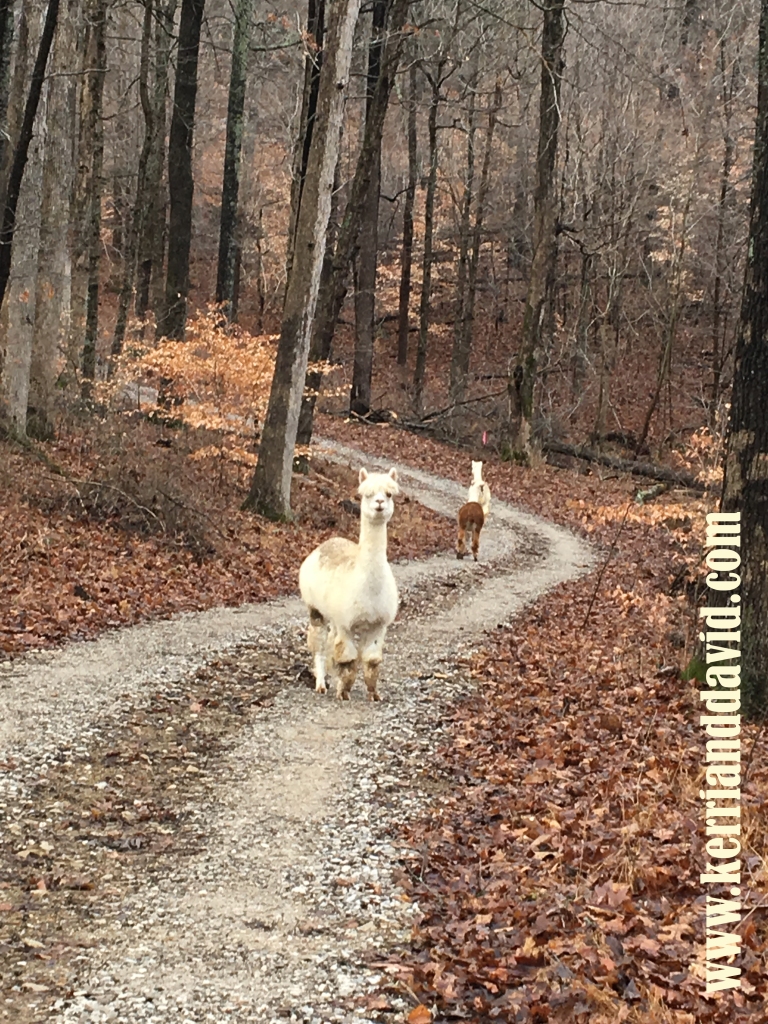
“Lucy was a red fox who lived as other red foxes do, playing in the fields and forests. But Lucy had a secret. She could fly. Not a run-and-jump-to-this-rock kind of fly. No! She could fly like a bird…”

read Kerri’s blogpost about CHOICE

Lucy & The Waterfox © 2004 david robinson

Put It On The Wall [on DR Thursday]

“What you think, you become. What you feel, you attract. What you imagine, you create.” ~ Buddha

I sometimes wonder what the Buddha might think about how words, attributed to him, are now available on Wayfair.com as posters or large decals for every living room wall. Does the ease and ubiquity of the message make it less meaningful? A decoration rather than a wisdom? Or, that we are capable of immersing ourselves in inspiration, a reminder-to-live-well in every room, are we meditating on the messages? Are we incorporating them into our actions and choices?

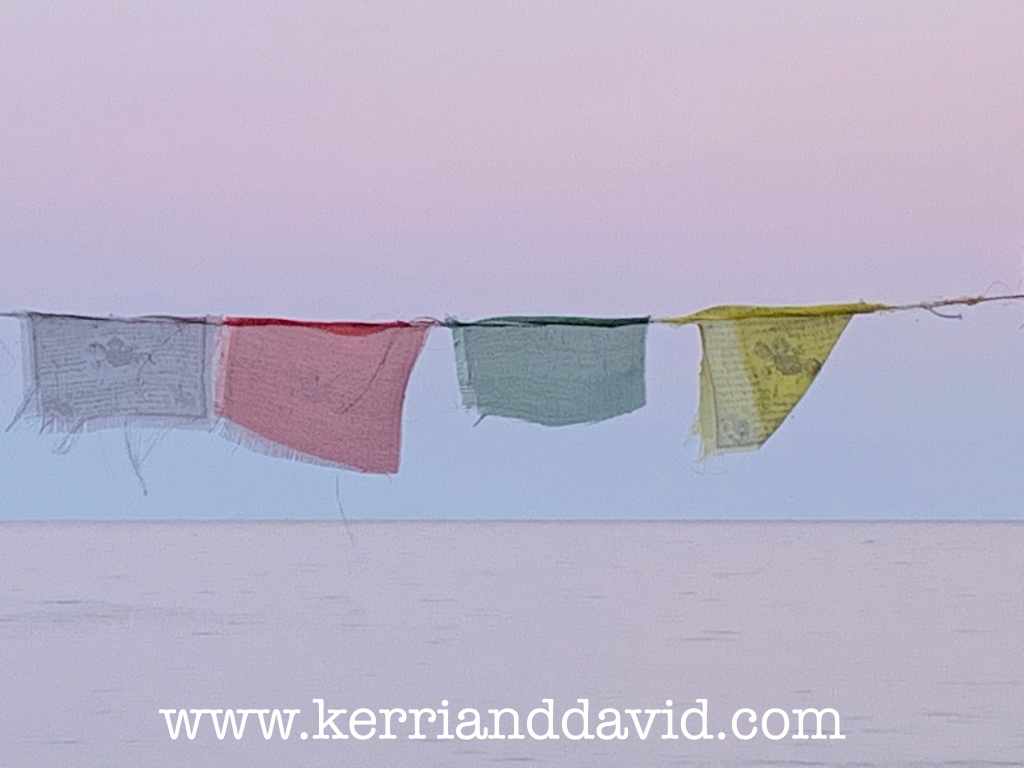
I’ve read that the only requirement when hanging prayer flags is to hold positive thoughts and intentions in the mind. Intend goodness and goodness will spread. That is, after all, the point of the flag. To spread on the wind goodness, peace, kindness,…

Kerri’s philosophy – her religion – is much the same as Dolly Parton: “You just try to be nice to everybody ’cause you know everybody’s got a dream.” Kerri’s version: “If it’s not about kindness it’s not about anything.” It’s simple.

Minds are powerful things. It’s why stories are so impactful; stories are the stuff that fills-the-minds. What you feel. What you think. What you imagine. It’s not passive. Although a trick of the English language, your thoughts, your feelings, your imaginings, are not really separate from “you.” They are you. The story you tell yourself about yourself in the world.

I suppose that’s why we rub the sentiment onto the living room wall. A desire to be better in the world. To tell a better story. Better about each other. Better for each other. What else?

read Kerri’s blogpost about PRAYER FLAGS

in serenity © 2018 david robinson

Connect The Dots [on Two Artists Tuesday]

A curious sentiment painted on the concrete support wall of a busy overpass in a burgeoning city. Crumbling cement sidewalks, hard asphalt, steel cable supports securing a post just outside of the picture frame. A message about bridges painted beneath a bridge.

People hustle by as if there was no time to spare. They drive fast over and around the curious sentiment. The painter-of-the-sentiment placed it adjacent to a stoplight. Perhaps, while revving their engine, awaiting the return of the green light, a motorist might turn and read the thought. Perhaps the motorist might breathe it in. Perhaps the motorist might consider the message as they passed beneath the bridge.

What gets you from here to there? From birth to death? Amidst the hard realities of the road, the steel cables, the thoughtless people whizzing passed, the persevering grasses pushing through the cracks in the cement, the litter at your feet? A thirteenth century Sufi poet thought it important enough to write about it. A twenty-first century painter thought it important enough to paint the poem on a wall.

People across time and cultures have thought it necessary to place significant messages on walls. Aspirations and appeals to our better nature. A compass pointing the way for what might be, what exists but goes largely unseen. The primary thing. Every parent knows this bridge beyond the abstraction of a message on the wall. Every time rings are exchanged, vows spoken, the unseen is understood.

The hawk landed on the fence. Kerri met its eyes and they stared at each other for what seemed a very long time. Divisions disappeared. Forms fell away. Life experienced life.

Just try and place a word on that experience! A Sufi-poet tried. A contemporary street artist thought it necessary to paint the sentiment on a hard wall. What bridge connects the poet and the painter?

read Kerri’s blogpost about THE BRIDGE

Ramble [on DR Thursday]

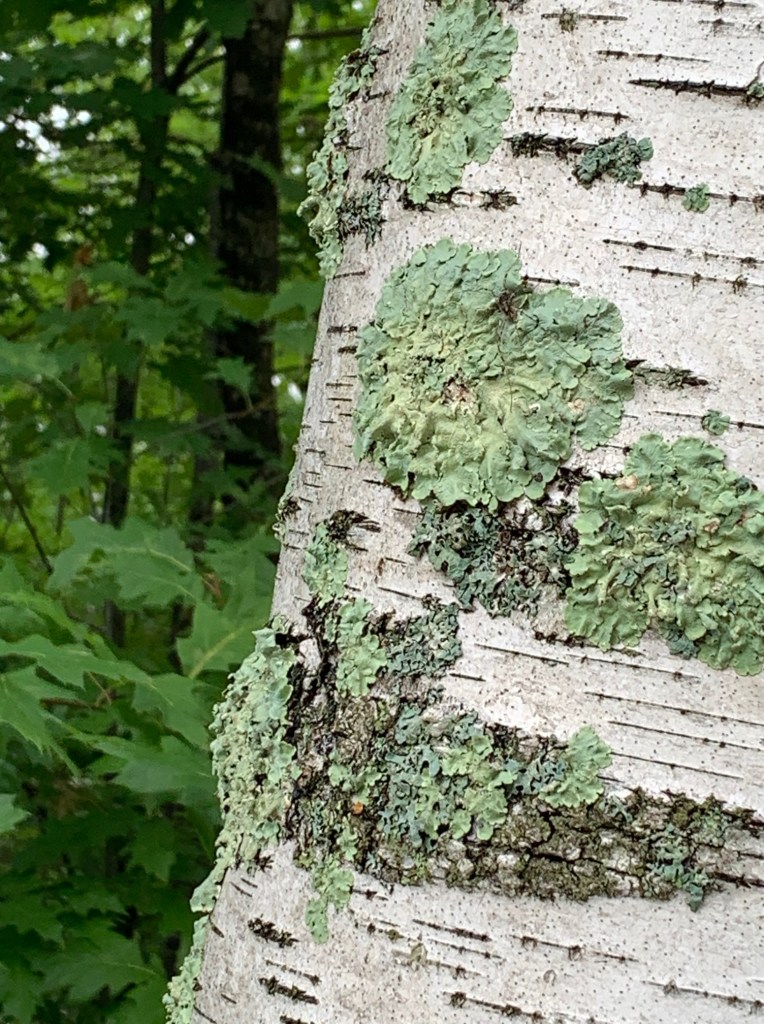
I’m like a two-year old: I want to know “Why?” For instance, the lichen growing on the birch tree is Hypogymnia physodes, but it’s also known as “Monk’s Hood.” Why?

There’s a wildflower also known as Monk’s Hood. I read that the flower gets its name because its petals resemble the cowls once worn by monks. However, the flower is also known as “Wolfsbane.” Why? What does the bane of a wolf have to do with the hood of a monk? I’m capable of inventing a slew of possible connections but they will be just that: inventions.

In an attempt to bore you beyond rescue, I’ve lately been fascinated by how much of our world is a blizzard of unhinged information in search of a context. For instance, conceptual art needs an explanation. Without a curator, it’s nothing more than a banana taped to a wall. Twine with a dirty sponge. Oddity seeking to be taken seriously.

In the 21st century, we measure relevance by the number of followers, not by the substance-of-the-matter-being-followed. It’s a popularity contest. Lots and lots of flowing information, most of it useless. Without use. Without substance. And, scarily for us: without being questioned.

What is empty content pushed through a fabricated context? “Breaking” news. MAGA. Q.

It occurs to me that society needs more two year olds! A healthy practice of asking “Why” would spare us from certain death-by-bloviation.

A cowl, by the way, is both a monk’s hood AND a loose neckline in contemporary women’s clothing. Wouldn’t the monks be surprised if they’d confused their cowls!

Now, get out there and find context for this bit of useless information.

read Kerri’s blogpost about LICHEN

pieta with paparazzi © 2010 david robinson

Beg A Good Question [on Merely A Thought Monday]

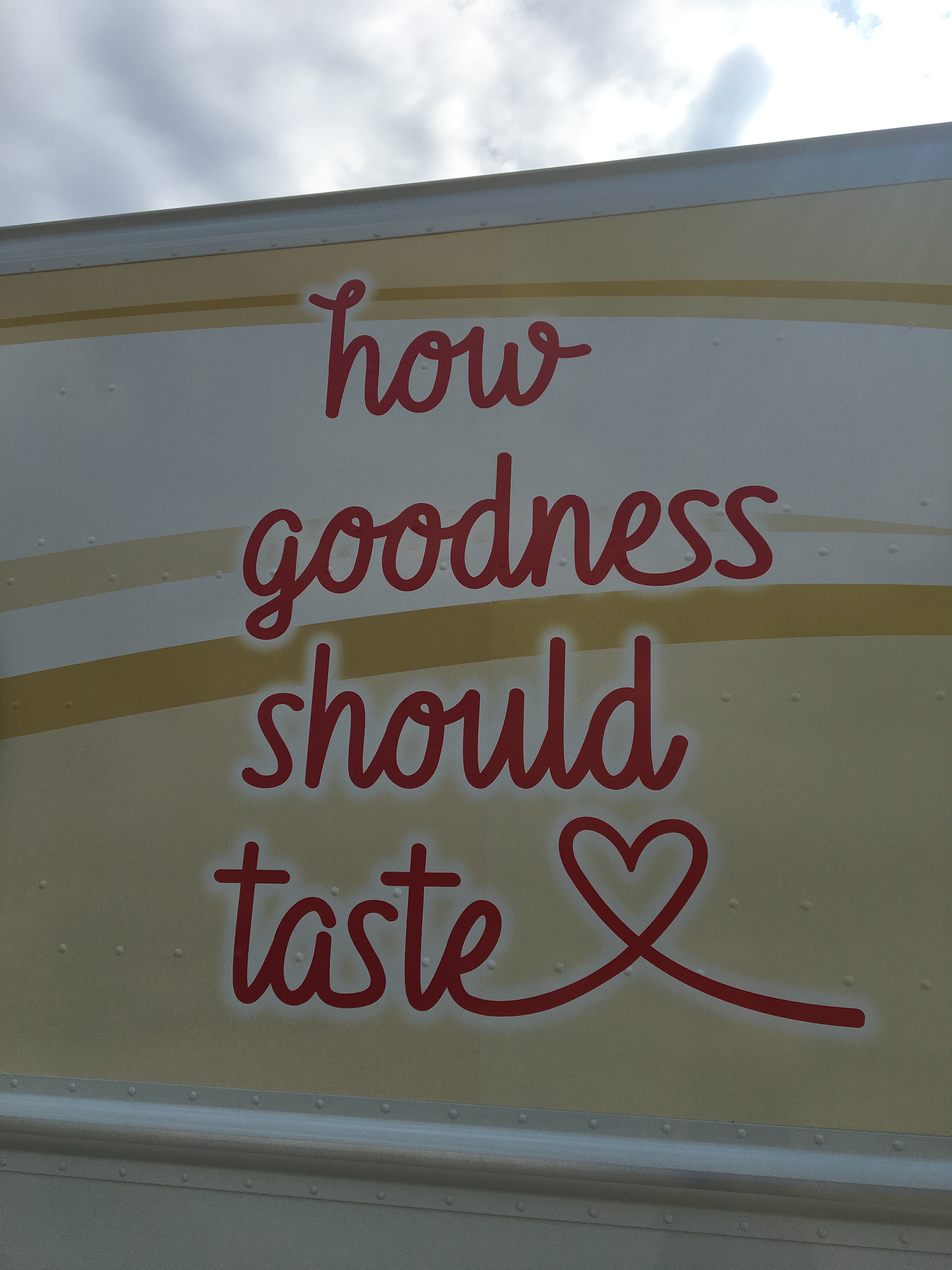
She stopped, turned and went back to the truck. “What are you doing?” I asked. She pulled her camera from her purse and snapped a photo of the Sara Lee truck. She showed me the photo and slid her phone back into her purse.

“I thought this would make a good blog photo,” she said, adding, “If it wasn’t a marketing phrase it would beg a good question.”

How should goodness taste?

How should equality look?

How should community sound?

How should generosity smell?

How should love feel?

We experience the world through our senses. And then we make a story of what we sense. Senses first. Story second. It’s how the brain works. The language capacity, putting words to experience, is essentially a translation function. It does not lead, it follows. It’s why, for the most part, we choose the story we tell.

The word that strikes me the most on the bread truck photo is “should.” How should goodness taste?

How does goodness taste? To you?

How does equality look? To you?

For you, what’s the sound of thriving community?

To me, generosity smells like fresh baked bread and hot dark coffee. You?

And love? There are no words. But you know it when you feel it.

read Kerri’s blogpost about GOODNESS

Sing With Pooh [on KS Friday]

Why does a song suddenly pop-up in your mind and beg you to hum along? Yesterday, for no apparent reason, out of the blue, Loggins and Messina’s song, The House At Pooh Corner, washed over me and forced me to maul the lyrics. At the time I was writing a business blogpost about assembly lines (uff-da). House At Pooh Corner was released in 1971, it’s a bubble from the deep-deep archives.

It changed my day. I made such gumbo of the lyrics that I pulled it up on YouTube. I sang along so I might refresh the muddied words in my mind. In addition to word-recall, it lightened my spirits. Writing about spirit-stripping manufacturing processes, command-and-control structures, had my brows knitted and my brain squeezed. Maybe that’s why Pooh decided to visit. I had a honey jar stuck on my nose. I sang along and laughed.

By the end of the sing-along I was dedicated to taking myself less seriously. I suspect that’s the message and gift A.A. Milne released upon the world with Pooh and Piglet. None of it is as serious as we pretend. Will my knitted brow blogpost about new systems illuminate the world? Yawn. Probably not. Did it feel good to write? Absolutely. I love thinking about a better world. Pooh lives in one – and maybe that’s yet another reason he jumped a bubble and rode to the surface of my thinking. He came as a song. A lovely light-hearted wish. A seed pod of silly presence.

“…So I sent him to ask of the owl, if he’s there, how to loosen a jar from the nose of a bear…Help me if you can I’ve got to get back to the house at Pooh corner by one, you’d be surprised there’s so much to be done….” Kenny Loggins & Jim Messina

Kerri’s albums are available on iTunes & streaming on Pandora

read Kerri’s blogpost about WISHES

i will hold you (forever & ever)/goodnight: a lullaby album © 2005 kerri sherwood

Tally [on KS Friday]

“It’s a haiku day,” I said, feeling empty of anything useful to write. She’s already rapidly clicking away on her keyboard.

The sunflower grows/More beautiful over time/Green vine seeks wisdom.

Counting syllables/ on my fingers, I tally/the word “beautiful.”

Three or four? I ask/She’s deep in thought, can’t hear me/Syllables confound.

Beautiful is three!/”My haiku, my choice,” I quip/Who invents these rules?

Green vine seeks wisdom/Rust has seen many seasons/Green seeks. Rust stands still.

Kerri’s albums are available on iTunes & streaming on Pandora

read Kerri’s blogpost about SUNFLOWER

silent days/blueprint for my soul © 1997 kerri sherwood

Lay It To Your Heart [on Two Artists Tuesday]

“This entire week is about noticing,” Kerri said, looking at the week’s photos we’d just uploaded into our site. Sometimes the melange has an intentional theme and sometimes a theme announces itself. Our lives have become about noticing. I suspect all of our writing is, in one way or another, about noticing.

This is Blue eryngo. Flat Sea Holly to the poet. Eryngium planum to those more interested in species categorization. Shakespeare would know it as a thistle, a cure for love sickness. “And lay it to your heart.”

The evening breeze turned our steps toward the marina. It was a brutally humid day and we were restless in the air’s oppression. Arm in arm we talked of how long it had been since we wandered in this direction. It used to be a daily stroll but more recently we’ve sought trails away from people. The forest quiet rather than the crowds at the shore.

The color of the plant stopped us. I felt as if I was looking at a magical universe of purple-blue planets or something more likely found under water. While Kerri snapped photos I marveled at the color. The shape of the leaves reaching from the thistle center. Little blue suns.

Our chance encounter with the Flat Sea Holly blew some nice air into our sails. We walked on talking about the gift of noticing, taking photographs, how to be better artists, amazing sights all around.

Shakespeare’s thistle cures more than lovesickness. We lay it to our hearts and it lifted our humid-heavy- spirits.

read Kerri’s blogpost about FLAT SEA HOLLY

Wear One Sock [on saturday morning smack-dab]

My elders warned me but I scoffed. It will never happen to me! “Words,” they cautioned, “will become like socks in the dryer. Two sock-words will go into the spinning barrel of your mind. Only one will come out.”

What happens to the other sock? Where is that perfect word match? I open the drawer of my brain only to find half the word-socks have gone missing. Poof.

I should never have scoffed. I wander through my days trying to mask the fact that I’m only wearing a single word-sock.

I imagine the satisfied smiles of all the ancestors getting the last laugh. “Told you so,” they smirk, frown, and ask, suddenly snapping their fingers to stimulate their synapses, “And, what’s your name, again?”

I’d tell them (in my imagination) but think it’s good practice to exercise their brains so I smile and quip, “Who’s asking?”

read Kerri’s blogpost about WORD LOSS

smack-dab. © 2022 kerrianddavid.com

Intend Renewal [on DR Thursday]

Context is everything. When we chose this picture for our Melange, I thought I’d probably write about renewal. Out of devastation, a phoenix rises. Or, perhaps the kind of renewal that doesn’t just happen but requires a bit of scraping, new soil, scattered seed, and hay-net to prevent the birds from feasting on the seed. Intentional renewal.

Context. Between the day we chose this photo and this cool quiet morning that I’m attempting to write about it, the mass shooting at Highland Park happened. I’m finding it nearly impossible to write about renewal.

Highland Park is not far away. We attend the annual art fair on their small-town Main Street. We’ve driven through 4 times in the last two weeks.

We were about to go out the door and walk to our local 4th of July festival when the news arrived. We looked at each other, no words necessary. We kicked off our shoes. We decided to stay home. Going to a place where people congregate – like grocery stores or elementary schools or places of worship or movie theatres or parades meant to celebrate our “independence” – seemed unsafe.

Context.

HIghland Park was one of three locations in the USA that experienced mass shootings on the 4th of July. No, check that. Four locations. Even as I type, Kerri brought news of the mass shooting that happened here – not so many blocks away – on the 4th. Staying home was a good choice. Oops. Check that. More news. There were eight. Oops (again). Check that. Eleven.

I cannot write about renewal but, for the third time this week, I am tapping out thoughts about interconnectivity.

It is a trick of language to say, “I broke my toe” and believe that only the isolated body-part called “toe” is injured while everything else is fine. Except it’s not fine. An injury anywhere to the body is an injury to the whole body. Everything is impacted. Everything adjusts. The pain-impulse you feel in your toe has already completed a round trip to your brain. Your posture adjusts so expect your hip or back to be sore tomorrow. Your spatial awareness goes on high alert: it’s best to avoid toe contact with any immovable object. If you desire to understand interconnectivity, consider how your whole body might respond if you happen to stub your seeming-isolated-and-already-broken-toe. Whole body response. Imagine it.

There have been over 300 mass shootings in the United States this year. So, the single most puzzling comment to come out of HIghland Park? “How could it happen here?” As if “here” is somehow isolated from Uvalde or Buffalo or Boulder or…it’s a long list and growing.

The whole nation-body is injured. It’s the illusion of isolation that underpins the mad-thought that more guns, unrestricted, are a solution to gun violence. Build a fortress? Isolate? Better doors? Arm yourself? It’s only the toe.

Where exactly is the boundary of “here?” And why would it be okay for “it” to happen “there”?

We’re all here. There is no “there” that is “safe.” Context is everything.

Perhaps I am writing about renewal. The intentional kind that requires some leadership scraping, new soil, seed, and a whole-body community united and relentless in their demand for proper protections from the insanity of guns.

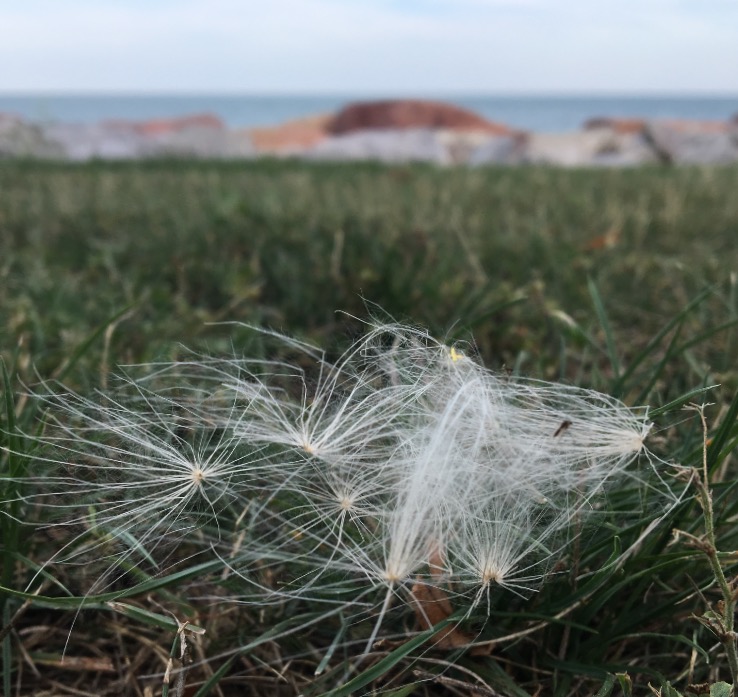
read Kerri’s blogpost bout NEW GRASS

may you © 2015 david robinson