Dump The Suit [on DR Thursday]

“When you are content to be simply yourself and don’t compare or compete, everybody will respect you.” ~ Lao Tzu

Lately, I’m on a Lao Tzu quote kick. Have you noticed? An advocate for a simple life, his words – or those attributed to him – appeal to me at this moment in my walk.

The outstanding characteristic of my working life is that I have mostly been a sore thumb, the person in the collective who doesn’t belong to the collective. That’s been my value: I am the consummate outsider. I do not sit on the mountain so I can more clearly see the mountain. The alternative perspective. I’ve not always found that to be a comfortable role. For instance, alternative perspectives are invited into conversations but the alternative perspective, when voiced, is rarely welcome. The first response to the alternative perspective is almost always an emphatic whisper, “Conform!”

I have, my entire life as the sore thumb, been told that, “Our people will never do that!” or “They don’t think that way, therefore you must conform-modify-edit…” The emphasis is placed squarely on the limit, the notion that “They can’t…” or “They won’t…”

And, I’ve never found that to be true. In fact, that’s precisely the perception that a sore thumb is hired to challenge. “They” can. “They” will. The job of the alternative perspective is to emphasize the possible, to open paths to the not-yet-imagined, to the revelation of, “We didn’t know we could do that.” Or see that. Or feel that.

In order to walk in an alien world, the sore thumb necessarily steps into the unknown. The first step is to listen and learn: to open to the possible within themselves, to challenge the inner-limiter. The alternative perspective lives on a two-way-discomfort-street with their client.

It is never comfortable to “not know.” It’s never comfortable to say, “I have no idea what that means.” However, it’s a great exercise, a necessary practice. And, it’s actually what the alternative perspective is paid to do and to model. “We didn’t know we could do that,” are words that come after a step into discomfort, a step beyond the known limits. “We step together because we both know how this feels.”

The alternative perspective is never right or wrong, it is simply an alternative. “These are the patterns I see. They may be useful or not.” Conformity bristles when the unknown beckons. Conformity is safe, and the emphatic whisper, while meant to maintain comfort for all, is the line that a sore thumb is hired to help the whisperer cross, “The possibilities we seek live beyond this line.”

The first day I put out my consultant shingle, I bought a suit. It’s what I thought I was supposed to wear. I bought my suit because I’d snagged a client, a financial advisor who wanted me to work with his staff. He’d seen my work – he’d seen me work – in another context. After the job, he asked me, “What’s up with the suit?” I’d always been told by well-meaning teachers that I should “dress for the job I wanted,” so I told my client that I’d dressed for the job. He gave me some great advice: dump the suit. “I want you to show up as you are, not as the person you think we want to see.”

His words became my mantra.

Truth: I hated that suit. I felt like an imposter wearing it. My client gave me a great gift. Be content to be yourself. Challenge the inner-limiter. Inner-limiters are very loud, and like outer-limiters, are generally not worth listening to; they will always advise you to conform, say nothing, and put on an ill-fitting suit.

[Happy Thanksgiving]

read Kerri’s blog post about GOURDS

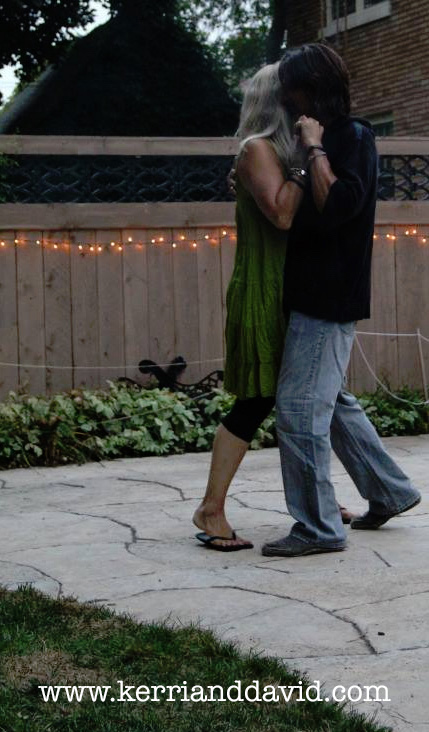
tango with me © 2018 david robinson

Decide To Learn [Flawed Wednesday]

[No image today. My technology is having a rough morning]

I spent my day yesterday thinking about lines of perception. I’ve known for a long time that where a focus is placed will largely determine the dynamic reality, the movement, that is created. For instance, a focus on opposition will always produce a chaotic, explosive pattern. The moving energy locks up, tension builds, explosion. Repeat again and again. Focus on the relationships, the spaces between, and the movement, the energy, will harmonize around a common center. The behavior of a system is visible if you know where to look.

Points. Spaces between. Analytics or Synthesis? Break it into parts or look at the whole. Is it a particle or a wave? Both/And.

Tom used to say, “Teaching is a relationship.” It’s not about the material-to-be-covered. It’s never about the test. It’s always about the spaces between. Learning, at its best, is not about coverage. It’s about incorporation. It’s about meaning made from relevant experience. Experiences made relevant.

Every action has an intention, even if the intention is to stir the pot, to see what happens.

A few blocks from our home, outside the courthouse, protestors face each other across a perceptual dividing line. The energy is locking up. Tension is building. Last year a boy, too young to legally order a beer in a bar, legally brought a big gun to a protest. His mom brought him to the protest, big gun and all. He killed two people and maimed a third just a block or two from where he now stands trial. In the year since, he has been made a symbol, a well-financed icon of those who desire a dividing line. The pressure builds, just as the system demands. We await the explosion. It will be here, a few blocks away, or elsewhere, but it is coming just as the system requires.

There’s a less understood truism when the focus is placed on the points & oppositions: the tension builds and the explosion happens again and again because no one ever learns. It’s a repetitive pattern that perhaps feels like progress but is actually an eddy. Empty movement.

The only way out of the eddy is to attend to the relationships, to turn the focus to the spaces between.

read Kerri’s blog post about DIVIDING LINES

Move Toward Wholeness [on Two Artists Tuesday]

When I look at the bowl of green tomatoes, each plucked from the vine before we pulled the plants from their pots, still moving toward red ripeness, I think of Joe. He was fond of saying, “Life moves in the direction of wholeness.” It’s important to note that his fond phrase included nothing about outcomes. Joe was particular and knew that life is movement and not arrival.

I am revisiting the word ‘rehearsal’ these days only this version of rehearsal is not on the stage with creative minds. It is over Zoom with decidedly analytical minds. Actors in rehearsal halls move through a process of exploration that leads to specific choices. The goal, if there is one, is to embody a state of moving presence within a story. The analytic mind comes with a template overlay that is placed atop the experience before it actually occurs. The language reveals all: content items. Telemetry. The mathematics of movement. Rehearsal is predicated on precision.

As I’ve probably written ad nauseam, these minds are not in opposition. They are complimentary. Freedom of artistic expression comes from years of study of technique. The path to mastery winds through repetition and constraint. Saying more with less comes after a lifetime of saying less with more. The creative mind is one step closer to the senses. The analytic mind applies language, gives voice, to the experience.

Many years ago I participated in a workshop with an actor/director of Noh Theatre. The process was strict, exacting. The movements precise. There was no room for error. We, the participants in the workshop, knew we’d never achieve proficiency since it takes years and years of rehearsal to perform even the simplest of symbolic gestures. No one sings opera in a day. We did our best and failed and failed and failed. That was the point. That is always the point. Each failure is actually an exercise of muscle memory. The body learns. The mind is impatient. Rehearsal is rarely about the mind, despite what the mind insists. At the end of the day, our workshop leader gave a short demonstration of his art form. His ease of movement, born from years of repetition within constraint, was breathtaking. He was free.

Many years later I was helping John in his wood shop. He was a master wood worker. I watched him look over his lumber, preparing to build a cabinet. He ran his hand over the wood, feeling his way into his project. “Ah,” he said, laying his hand on a piece of cherry wood. “This is it.” John was like the Noh actor.

“How did you know?” I asked.

“I don’t know,” he said, “it just feels right.” Then he smiled and added, “Plus, I’ve built a lot of crap.”

Life, moving toward wholeness.

read Kerri’s blog post about TOMATOES

Reach Purely [on Two Artists Tuesday]

“Art, as best practiced and understood over the centuries, is a spiritual as much as technical pursuit.” ~ Kent Nerburn, Dancing With The Gods

It was disconcerting. It still is. The illusion was so distinct that I had to show the book to Kerri and ask if she saw it, too. Each morning I read a few pages from Kent Nerburn’s book. This morning, in a chapter entitled The Divine Thread, I turned the page and a single paragraph, just a few sentences, was printed in a font twice the size as anything else on the page. I read it a few times since the author had given the section such obvious emphasis. After the I finished the chapter, I looked back to reread the oversized section – and it was printed in the same size font as everything else. It wasn’t emphasized at all. The shock of it made me dizzy.

“Art, however, does create this touch. It speaks in different voices, different rhythms, different languages. There is no place in the human heart it cannot reach.”

Paul taught his student-actors that they had an obligation to something greater. “When you choose to get on the stage, you have the power to impact other people’s lives. Do not take that responsibility lightly.” Your art, your creation, if purely intended, will reach the heart of another – purely. Even the loneliest painter knows the transcendence of the expansive energy that comes through in the moment of creation. Transcendence is all inclusive.

I have been humbled by the great artists I’ve known. Teachers, mentors, and others. I’ve been humbled by their humility. Tom, a brilliant director of plays and believer of possibility, influenced more artists than any person I know. He was tortured by the size and scope of his gift. At the end of his life, sitting before a fire in his cabin, he was, for a moment lost in thought. I watched his revelation come to the surface. He looked into his wine and said, “I think I did my best work when I was a just starting, when I was second grade teacher. It was pure imagination. I had no idea what I was doing. I just knew that we could have fun telling stories and going on adventures where our imaginations led us. It was pure.”

I met a few teachers who’d been second grade students in that classroom of long ago. They told me that year changed their lives. They touched his heart and he touched theirs. Shrunken heads and planning expeditions to the Amazon. Maps and budgets and “What do we need to bring to survive?” They spent weeks preparing for “blind day,” an exploration of the world through the full scope of senses. “What could we learn if we didn’t rely on our sight? What would we need to prepare to help each other?” he asked. Pure.

For our wedding, Julia made for us a small box with a Klimt’s ‘The Kiss” decoupaged on the lid. Inside, she placed a few Euros. A metaphor. Great love as a container for great adventure. We placed the box in our sitting room in a spot where we see it everyday.

Kerri knelt on the dock to get this photograph of the water. “The color!” she gasped. Pull up an image of “The Kiss” – or any of Klimt’s paintings for a closer inspection and you’ll see this water pattern. Klimt might have painted it. He studied swirls in water, swimming color on the reflection of the surface. I’m certain of it.

Great love. Great adventure. Tom. Julia. Paul. Art that is pure. My head spins. There is no place in the human heart that art cannot reach.

read Kerri’s blog post about WATER

images of water © kerri sherwood 2021

Meet The Saw [on Merely A Thought Monday]

As the magician saws the woman in half, he tells her that, “Magic is not an exact science.” It is among my favorite Flawed Cartoons.

“There’s nothing sadder than a forty year old production assistant,” she said, sipping her drink, looking across the room at a man she clearly thought was a loser. I was living in Los Angeles and was at a party with movers-and-shakers. The gathering also included a few of the people who carried the cables, loaded the trucks, moved the electrics – the lowest rung on the ladder. The runners. I swallowed hard. At the moment she said it, I was thinking the exact opposite. There is nothing more interesting than a forty year old production assistant. I wanted to be standing with the very man she considered a loser. He’d have stories to tell. Experiences to share. The movers-and-shakers bored me. Dulled by their dedication to security, thoroughly protected from the unknown or surprising experiences, they sneered at the people who’d actually lived. I found my way across the room and spent the rest of the evening sitting in the kitchen talking with a man who traveled the world.

Were I at the party today, she would look across the room at me and whisper, “Sad.”

Life is like magic. It is not an exact science. Ideals collapse. Dreams implode. Yet, the luckiest people I know are the few who have stepped out of their seats and volunteered to climb on to the stage. They’ve taken chances. Built wood buses or put their lifeblood into starting a theatre company or went boarding instead of dying in a cubicle. They’ve stepped beyond traditions and expectation. They’ve been cut in half, opened, challenged, surprised, disappointed, scared, triumphant, awed. They’ve learned. They’ve questioned their beliefs and perceptions. They’ve made titanic mistakes. They’ve stared down their demons. They’ve opted for curiosity rather than being right. They stepped off the edge. They followed, “What if…”

There’s no shortage of people who watch life from the safety of their seats. As Tom used to say, “They paint with a limited palette.” There are those lucky few who, if you see them at the party, most likely the people serving drinks, who’ve been cut in two and know from scary experience that there’s nothing more numbing or illusory than certainty. Follow them into the kitchen and ask about their lives. You’ll be amazed at the full spectrum of colors you find in them.

read Kerri’s blog post about SAWED IN HALF

flawed cartoon ©️ 2016 david robinson

Be Indeterminate [on Two Artists Tuesday]

Through the good graces of our tomato plants, I’ve learned a few new concepts this summer. Determinate and indeterminate. Bush and vine. Determinate tomato plants (bushes) are bred to stop growing. Indeterminate tomato plants (vines) will grow indefinitely or until the weather conditions “are no longer favorable.”

Our plants are indeterminate. Each morning, Kerri visits our planting bench and checks her tomatoes. 20 taught her a few simple tending-rules and now, each morning, there are more and more little indeterminate miracles moving backward along the color spectrum, finally arriving at a brilliant red.

Life is indeterminate.

My new tomato-terms come just in time. My current project has me revisiting my past life as a teacher and facilitator. If I apply my new terminology to people I can’t help but think it is the lucky few who survive so much dedicated energy to stop the learning-mind in the name of education. The natural output of a system designed on manufacturing principles is to truncate the questioning mind by patterning the notion that there is a predetermined answer. It becomes a game of finding the answer that teacher wants – a closed loop – instead of an incitement of curiosity. Children are excellent game players and translate the gaming pattern into their now-dulled-adulthood.

There is a cycle apparent in all genuine learning processes. It begins with discontent. Curiosity is a movement born from some form of discontent. It leads to questioning. Questioning always leads to disturbance (the interruption of the known). And, just like that, out of the disturbance something new is seen, call it a breakthrough, call it an insight, call it new learning…Many classrooms – certainly the systems – are designed and organized to keep disturbances to a minimum. The mantra is ‘control’ rather than ‘inspire curiosity.’ Business has the same dedication.

We’re taught that disturbance is the sign of something wrong rather than the crusty earth breaking to reveal new verdant life.

Discontent leads to questioning, leads to disturbance, which leads to breakthrough. And, an insight will always lead to discontent. It’s a story cycle, where yearning meets obstacle. Learning is by definition uncomfortable and at its best when it is uncontrollable.

Last week I attended a meeting. My two companions and I brought our homework back to the team. One was content. The other two of us were filled with discontent. The leader of the session, at first, was angry. He did not get the result he’d anticipated from his exercise. “So, you two are telling me this process was worthless!” he raged. We’d spent our week questioning instead of answering. Discontent. Questioning.

“No! It was great!” we chimed in chorus. “Look at all the good information we uncovered!” It was a mess. Big disturbance. We cycled through our misalignment a few times, wrangling over perception and usefulness. More rage. And then…an insight. The breakthrough. All of the rage, all of the appeasing, began to flow in a single direction. A possibility took shape. A target materialized that was much better than the prescribed pursuit. Energy filled our zoom-osphere. Laughter. Excitement.

Learning. Indeterminate. Open questions. Hot pursuits.

I am drawn to and surrounded by the dedicated indeterminates; those who refuse to stop learning: David, Mike, Horatio, MM, Bruce, 20, Judy, and yes, Kerri…I am a very fortunate man to be surrounded by so many tomatoes moving their way backward along the color spectrum, not afraid to walk through their discontent toward bigger and bigger questions.

read Kerri’s blog post about TOMATOES

Prove It [on Merely A Thought Monday]

I am about to prove that I am guilty of everything I accuse others of being. I am just as capable of surrounding myself with like-minded people as the next person. Let me explain:

I cheered when I read Marc’s response in the conversation chain. It was an appeal, an attempt to puncture a dedicated delusion, an untethered ideology. But, as is always the case when fantasy is met with fact, the holder of the fantasy vehemently defended and further retreated into their illusion. Confirmation bias.

Among my favorite phrases this week comes from a New Yorker article, Why Facts Don’t Change Our Minds. The phrase: the illusion of explanatory depth. Here are two quotes from the article:

“People believe that they know more than they actually do. What allows us to persist in this belief is other people.” In other words, we ally with people who hold a similar belief rooted in the same lack-of-knowledge. Apparently, as a species, we’d rather be reinforced in our ignorance than consider the possibility that we don’t know what we are talking about. Purple Kool-Aid is easier to drink than wondering if what we’re being told may or may not be truth. It explains the current GOP, Fox News, OAN, Ron Johnson, and the rest of the dangerous-national-clown-car.

Quote number 2: “As a rule, strong feelings about issues do not emerge from deep understanding.”

Strong feelings. Deep understanding.

In the canon of human self-aggrandizement, we delight in the narrative that we are primarily rational, that our reason, like a good border collie, has driven our emotions into safe containment. The opposite seems to be the case. Or, at best, we are a mass of contradictions.

There is a flip-side, a necessity woven into our contradiction that gives me hope. Strong feelings and deep understanding are not natural enemies and need not be pitted against each other. Think of it this way, no firefighter, in his or her right mind, would run into a burning building to save a life, if we were as rational and reasonable as we like to believe. They do, however, study fires beforehand to know how to run in, how to reach. They study the science. For every exploiter there is a matching story of a giver, someone whose strong feelings combines with their deep understanding in an effort to better the world, save a life, make things easier.

That which makes us crazy also makes us compassionate. How’s that for a statement of contradiction? Families fight each other until the forest fire threatens their house. Common cause and education are a great poppers of confirmation bias.

Some fires are manufactured with the sole purpose of exploiting confirmation bias. This kind of exploitation is dependent upon – and feeds upon – strong feelings with shallow roots in understanding. Ignorance. The big lie. Vaccine misinformation. Divide and conquer is always reliant on strong feelings intended to create blindness.

Some fires are real. And, the test of a real fire: divisions fall, eyes open, and people run toward the flames to help other people. It remains to be seen how hot and close the flames need to come before the confirmation bias burns off and we realize that we’re in real trouble, that science is real, and that the big trough of purple (red) kool-aid being proffered is doing the opposite of what it professes to do.

It may be in our nature to believe that we know more than we do, but, it is also in our nature, without concern or thought for our own safety, to reach for the drowning person. Deep understanding allies with strong feelings when people cared enough to learn how to reach, how not to become the person drowned by the drowning person.

Do you see it? I am an idealist. I want to believe in the goodness of humanity and the necessity of shared truth. Yet, despite powerful evidence to the contrary, I hold fast to my dedicated belief that we are capable of tipping toward love rather than falling toward hate, that, when faced with undeniable data, that we are capable of questioning our strong feelings en route to a deeper, shared understanding. We are capable of recognizing that the science that brought us the cell phone, satellites, allergy medicine, and electric light is the same science that brings us the data of climate change, and the best way to beat this pandemic. Cherry picking belief in science is…absurd and currently dangerous. Cherry picking news is equally as absurd and currently dangerous. From my idealistic mind, it is a necessity to ask questions, check sources, doubt belief.

We are certainly capable of knowing the real fires from the those fanned by the thought-arsonists. We are capable of questioning, of suspending our delusions. At least, I like to believe that we are. I, like you, surround myself with like-minded believers.

We’ve proven it again and again and again. When we recognize that the fire is real, our dedicated illusions burn the filters from our eyes, we transcend our little stories, and reach our hands with no thought of political alliance or other exploitative non-sense, to help dig our neighbors from the rubble.

read Kerri’s blog post about BASIC LOGICAL REASONING

Use Your Chalk [on Two Artists Tuesday]

There are two words floating around in my universe these days: structured and unstructured. Structured data. Unstructured data. Structured time. Unstructured time.

The world as seen through the Puritan lens gives great preference to structure. Unstructured anything is suspect. “Idle hands,” we are taught, “are the devil’s workshop.” Yikes. Apparently it’s dangerous to take a stroll, to sit and ponder, to clear the day and do nothing.

I suspect it explains why our notion of business is hyper-focused on the bottom line and often misses the value of relationships. Bottom lines are easy structure. Relationships, not so much. It is the same with test scores in education. Easy structure. However, stepping into the unknown – the very definition of learning – is largely eschewed because it begins in an unstructured pursuit. Creating the structure, making the meaning, discovering the connectivity is what our hearts and brains like to do. When learning isn’t merely a factory, when business is more than a bottom line, people prosper. They come alive.

Unstructured time. There was a time when time had no structure. Monks attempted to “keep” time by monitoring water through a bucket or sift sand through an “hour” glass. Sometimes the water froze in the bucket so the structure of evening prayer was disrupted. The sand clumped in the hour glass and the measure of time clumped with it.

There are moment on the stage when the actor forgets their lines. It’s called “going up” or “drying.” It is always, in the re-telling, the moment when everything becomes real, alive. It is the moment when the structure becomes unstructured. Hearts race. Eyes widen. The stakes are suddenly palpable. The actor breathes, stands in the vast unstructured universe, and the words return like a swinging bar to a high-flying aerialist. The play is infused with aliveness. Presence is mostly unstructured.

As is common in the structured and unstructured use of the English language, oppositions are easily constructed. Unstructured simply means the meaning has yet to be made. Structured data, structured time, are the tip of a largely unknown iceberg. Love, joy, despair, awe…the full spectrum of experiences, bubble in the unstructured spaces. Numbers can describe a moment in time, can orient for a moment, but will never “explain” yearning or desire or our fundamental need to tell stories (put structure on unfathomable experiences). Structure & Unstructure: they are dancing partners, not combatants.

Where do we come from? What are we here to do? I am going to die, what then? It takes a good deal of unstructured time to sit in these unanswerable questions. There are, of course, plenty of people who will gladly provide structure to your unanswerable – and therefore uncomfortable – questions. Perhaps that is why we adore our structure and demonize the empty spaces? Comfort. Ease.

Kerri cannot pass a hopscotch template chalked on the street. It’s almost automatic. Step, hop, hop, step, hop. The little girl in her connects to the child who chalked the squares on the sidewalk. A simple game. Play. It’s one of the things people do with unstructured time. Set challenges. Make up obstacles. Seek puzzles. Invent. Dream. Connect to the deeper places. Where’s the structured bottom line watching the little-girl-in-my-wife hop and skip and turn in the game-chalked-on-the-sidewalk? The laughter of remembering? The giggle and freedom of the woman hopping the scotch, just because she can?

read Kerri’s blog post about HOPSCOTCH

Tether Well [on KS Friday]

It’s official. YouTube has blocked forever our channel for the crime of using Kerri’s music. It’s happened before on other platforms so we’ve actually grown accustomed (sadly) to the loss. She is the composer, the performer. She holds all of the copyrights. We’ve learned that it is impossible to fight with an algorithm. I suspect that our appeal never met human eyes otherwise where is the sense? The algorithm wrote back assuring us that our claim was reviewed thoroughly but their decision stands. Vanish-ment.

Our vanish-ment is only one of the many examples of my latest fascination: what gets between you and your soul? What gets between you and your sense-making? What gets between you and your voice? In other words: what is real and what is not?

On a grand scale, we are alive at a time when deep fakes can put words into the mouths of anyone. We are witness to propaganda tv perpetuating fantastic lies, inserting themselves between people and their common sense. It is important to note that just because you believe it does not make it true. In fact, in today’s day-and-age of easy belief in the outlandish, it is a best practice to check everything you hear. It takes a bit of time – but only a bit – to tether yourself to reality. It takes no time at all to swallow the fables, conspiracies, and cotton-candy-illusions, currently blasting fire-hose-style across the e-waves.

“There is only one good, knowledge, and one evil, ignorance.” ~ Socrates

Anger and hatred are great mind foggers. They are easily-fed-fires-fueled-by-the easily-led. Make no mistake, the purveyors of propaganda see their audience as nothing more than firewood and depend upon dedicated ignorance and unquestioned belief. Those who stoke the fires generally revel in standing between people and their sense, people and their souls. Arsonists always have an agenda.

I’ve always understood that meditation and education share the same intention: remove the noise between your self and your experiences. Discernment. Quiet the mind. Open the mind. Artistry, at its best, does the same thing. It exposes you, opens you, to your greater self, to the fields beyond ‘what you think is true.’ Revelation, reveal-ation. At their very essence, artistry, meditation, education…require a full challenge of belief; belief is the final frontier of white noise, a worthy and necessary din to challenge.

Barney, the piano, grows more beautiful with age. The plants and flowers are again growing around his base. Chipmunks and squirrels sun themselves on his lid. One of Barney’s functions in our life is to remind us of what is real. That’s also true of the rusting sunflower that now lives by Barney’s side. After our YouTube vanish-ment, we sat for a moment on the back porch. “Look at the wild geranium!” Kerri said. She jumped to her feet to take a picture. Have I mentioned that she is also a great photographer?

The artist is intact. More, she is full of energy and ideas. A channel may have closed but the essential remains. Nothing can stand between an artist and her artistry. Not really.

Kerri’s albums are available on iTunes or streaming on Pandora

read Kerri’s blog post about BARNEY

this part of the journey ©️ 1998 kerri sherwood

Make Good Mistakes [on Not So Flawed Wednesday]

At the front desk, we answered a long series of questions about our recent health, had our temperatures scanned and recorded. A ritual of the COVID era. Name tags rolled from a printer and, with masks on, the door clicked open and we entered the memory care facility. It was the first time visiting my dad in his new home.

We found him in his room, number 110. His bed was sharply made, something he’d done all his life. He was sitting in a cranberry colored easy chair and was, in his mind, tending the store. He breathed an audible sigh of relief when we came in. “Finally!” he said, “I’ve been watching the store all day and haven’t had a single customer.”

I learned long ago to jump into his reality rather than try and pull him into mine so we talked about his business. He was especially excited about the television and radio spots promoting the shop. He pointed to the door to the bathroom and told us it was the library and confessed that he’d started to organize it but had been interrupted so it was a fantastic mess. He laughed and the old sparkle, for a moment, returned to his eyes.

I told him I was really good at making messes. He leaned in, adjusted his oxygen tube, and spoke a lovely wisdom, a lesson from the very old that, in my opinion, should be taught to the very young, “I can make as good a mistake as anybody.” We laughed.

He was always a good teacher. Making good mistakes was, and still is, even deep in his dementia journey, the epicenter of his good teaching. Make mistakes freely and learn from what you find in the mess. Remove failure from the equation.

He walked us to the door when it was time to go, and, for a moment, he knew who we were. He looked at Kerri and said of me, “I’m sorry you have to look at that all the time. Damn, is he ugly.” In my clan, to tease is to love. “I get my looks from my father,” I replied. More sparkle.

“Keep making those mistakes,” I said, hugging him goodbye.

“I don’t think I can avoid it,” he smiled and, he turned down the hall. “Guess it’s time to close up the shop.”

read Kerri’s blog post about GOOD MISTAKES