Turn Around And Look [on DR Thursday]

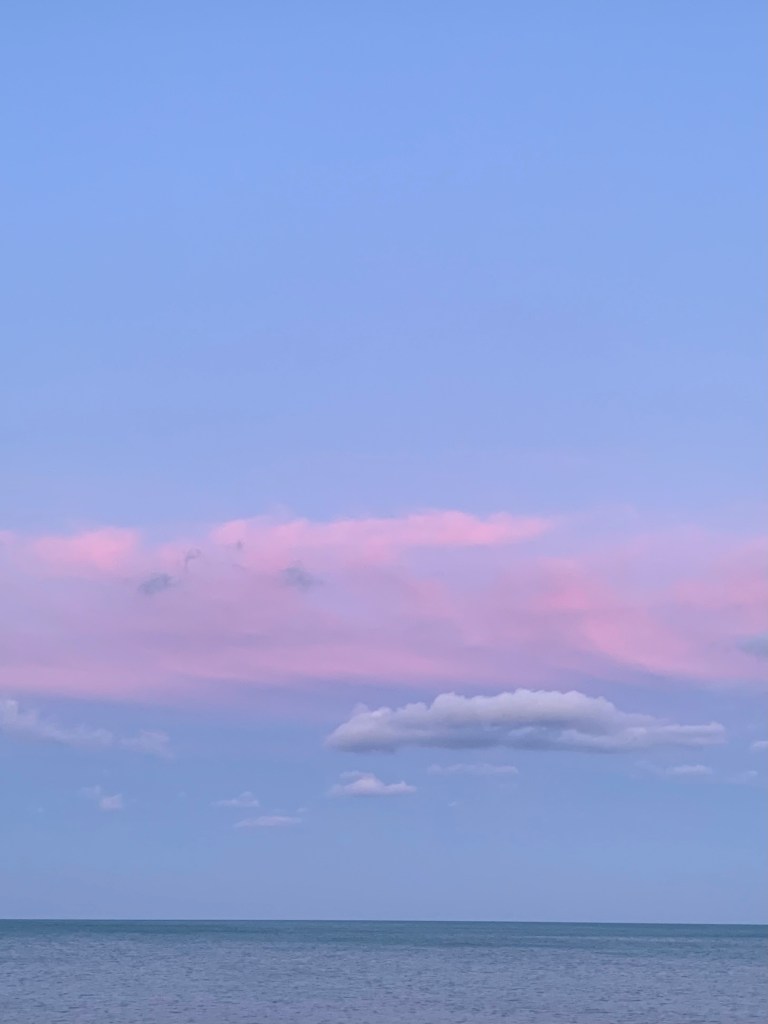
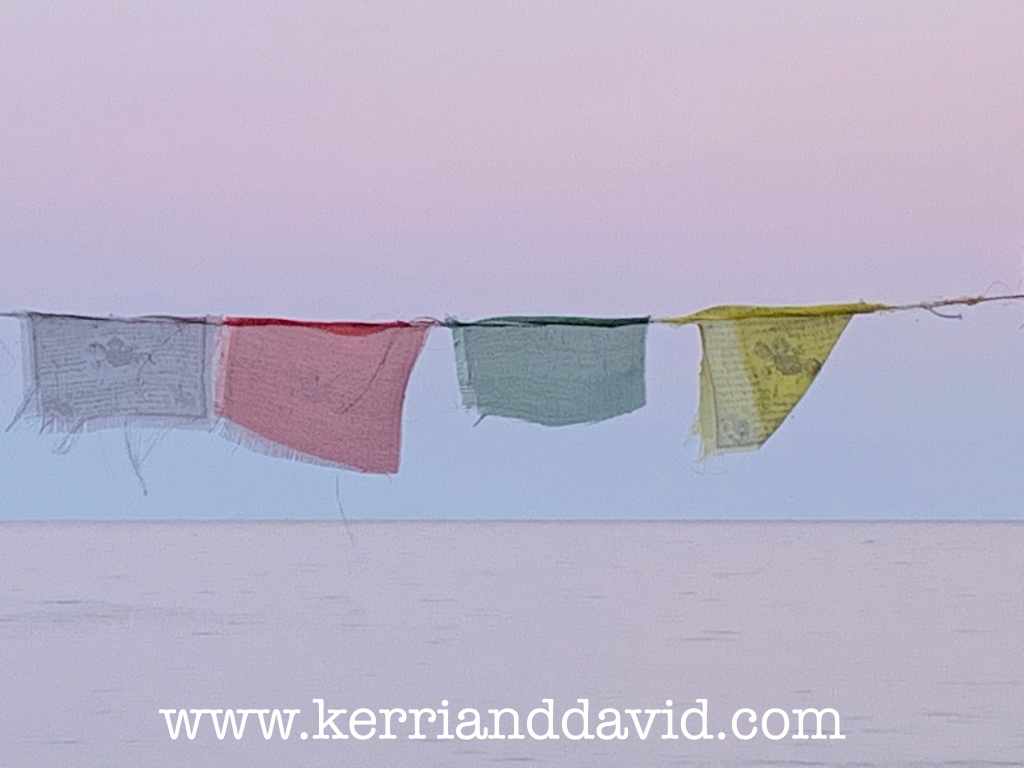
One little line gives reference to the whole. The horizon line. It is how we naturally – visually – orient in space. It is a baseline of perception. It’s the beginning of discernment.

It is a line that disappeared.

Among other things, art is a reflection of its time. In the past century, art leapt into the abstract. We are “post-modern”. Expressions of personal fantasy rule over community truth, a breaking apart of shared ideals, instant doubt of objective theories…we are mirrored in post-modern art. What is art? What is it not? There’s not a whit of agreement to be found.

General distrust is the beating heart of the post-modern ideal. Division, aggression, tribalism, conspiracy…are its blossoms. Our children perform active-shooter-drills in school; a performance we shudder to attend while our leaders smile and look the other way. Post-modernism at its finest. The absence of a baseline.

Shared truth, group trust, community…requires an undeniable horizon line.

What is up? What is down? What has value? What does not? What has merit? What is undeserving? There is a line. Where is it?

Walking through the antique mall, Brad and I discussed chatGPT. I’m playing with it; he’s using it in his work. It’s raising some very big questions. The questions are not new. They are the next step in a series of questions people have been asking for the past 30 years: what is true? A photograph was once proof that something happened. That hasn’t been true for a few decades. A video was once proof an experience occurred. That is no longer true. News – a word that once implied the accurate reporting of an event. No more. No horizon line.

Brad and I turned our discussion to a sorely missing quality in our times: discernment. In the absence of a horizon line, people will – and do – believe anything. We speculated that, with the introduction of chatGPT into our world, perhaps discernment will once again become important. Perhaps the complete absence of a truth-anchor will turn us toward a common center and require us to look at each other, to seek and restore general trust. The post-modern tide will someday turn and we will draw an old/new line in the sand: we’re-all-in-this-together.

I know, I know. Pie-in-the-sky. However, I’d like to point out that shared dreaming brought us here. Shared dreaming is how we stood on the moon. It is how we can talk to someone across the planet using a small device that fits in our pockets. When a dream becomes shared it becomes powerful. Manifest. A shared dream is a form of a horizon line.

If a shared dream isn’t powerful enough to establish trust, try remembering the other one; the original line of discernment. The line that invites curiosity. It need not be debated. Turn around and look. The horizon line is everywhere.

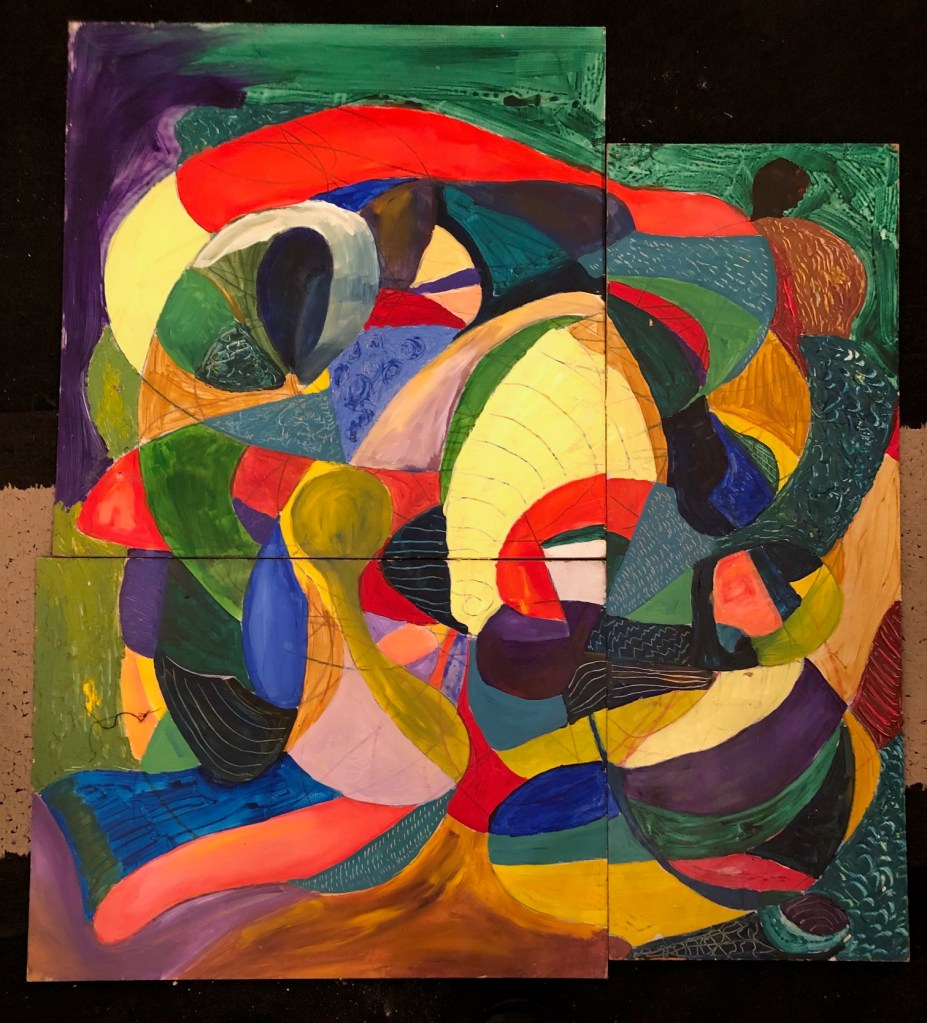
Four-by-Four, 48x48IN, acrylic, (sold)

read Kerri’s blogpost about THE HORIZON

4×4 © 2007 david robinson

Unroll And Renew [on DR Thursday]

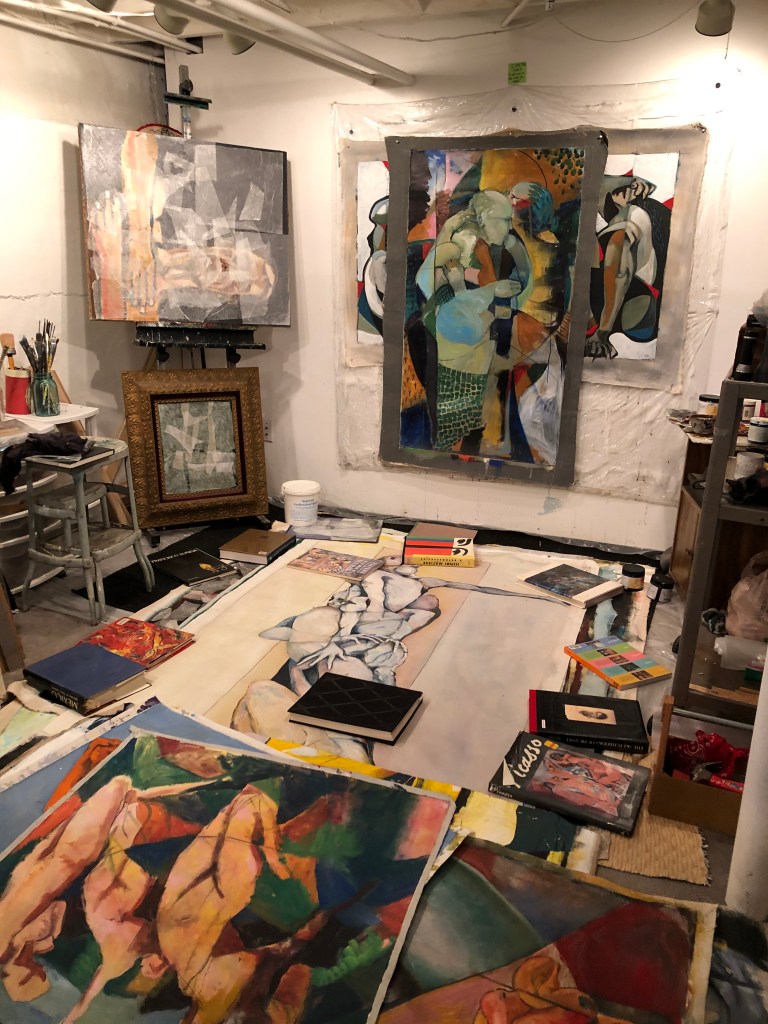
During the past weeks I have rectified a wrong that I did to myself. A few years ago, after several water disruptions in my basement studio, with the space in disarray and too full of stuff, I had a fit of “what-am-I-going-to-do-with-all-of-these-paintings. With no thought to the future, I rolled several of my canvases. There are many, many paintings so I made multiple heavy rolls. And then I stacked them. The stacking was my crime. The weight of the top rolls pressed those on the bottom. Left too long and the canvas warps; the paint cracks.

I feel as if I am emerging from a dream. The past. Dried flowers in springtime.

At breakfast on Monday, Liam asked if I had been painting. I blinked, not ashamed of my reply but mostly shocked at the truth of it. “I just finished a painting,” I said, “the first I’ve completed in three years.” Three years ago I rolled my paintings to keep them out of the water – to get them out of the way. Broken wrists, lost jobs, pandemic, an uncanny series of water issues…A pause. Or, I feared, a finish?

I carefully unrolled the paintings. Flattened the waves in the first canvas roll with books. I built successive layers of flat paintings, using the weight that caused the problem to my advantage. Opening the rolls was like taking a walk back through my life. Two of the rolls were paintings from the early 1990’s. A self portrait in orange on an Oregon beach. I recognized the paintings but had to reach to find the painter. Dried flowers. A dream. The past.

Kerri wrangled carpet tubes from a big box store. We cut them and carefully rerolled the paintings, now with a solid center so they cannot be smashed. We devised a strategy to stand the tubes, protected from any future water problem.

Emerging from the dream. Perfect timing. It is the season of renewal. Spring.

read Kerri’s blogpost about DRIED DAISIES

Learn A New Word [on DR Thursday]

Call it a “happy accident.” Call it an unintended consequence. “I like this photo!” she exclaimed. “It reminds me of a Rothko.” A wrinkled brow and then, “I wonder when I took this?”

Last night we learned a new word that I love: Coddiwomple: to travel in a purposeful manner toward a vague destination. I’ve never heard a more appropriate definition for the life of an artist! My pursuit could not be more clear and the destination could not be any less attainable. It’s impossible to explain. Recently I tried – again – to clarify for a colleague that I know exactly what I want, I do not need career counseling or advice. I’ve always known what is mine to do. I’ve never been able to wrap words around it so it might make sense to others. An artist’s life is hyper intentional. From the outside it makes no sense at all. There is no 401k. There is no safety net. There is no certainty. Sometimes there is no shape. Always, there is no adequate answer to the question, “Why?”

There is a clear calling, an underground river running beneath how it is expressed – whether through paint or musical notes or pirouettes. My career, on paper, looks like a random romp through the woods. Galleries and symphonies and stages and boardrooms and classrooms and consultancy and facilitation and coaching (a word that still makes me wince). DEI and intercultural. Start-ups and SaaS. Canvas, all. Some of the best plays I’ve ever developed happened in cafeterias or a conference room. I knew exactly what I was doing. I was not “using improvisation” in a business setting. I wasn’t using anything. The work of my life has not been about translation or utilizing “the tools of art” in other settings.

Artistry is akin to stepping into a rocket headed into deep space for a journey of discovery. The only honest answer to the those who ask, “What are you doing?” is “I’m journeying.” Creating. Inventing. Innovating. Stepping purposefully toward a vague destination. Coddiwompling.

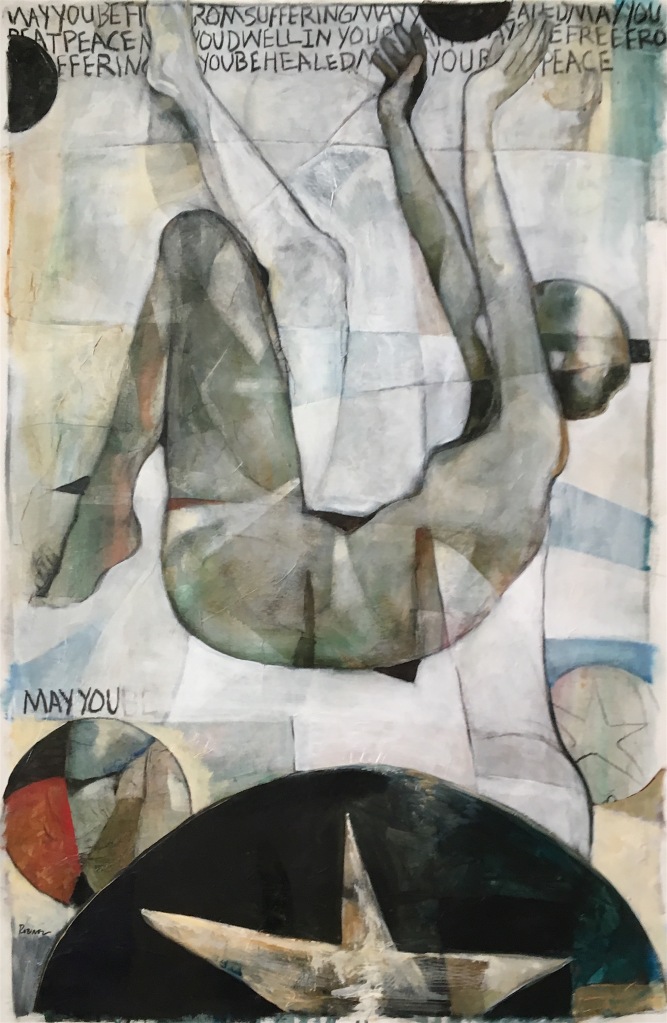
May You, 55x36In, mixed media

read Kerri’s blogpost about ROTHKO PHOTO

may you © 2015 david robinson

Unroll And Tune In [on KS Friday]

I did a stupid thing. A few years ago I rolled several of my canvases and stacked the many heavy rolls. Stacking them was my crime. The weight crushed the bottom rolls, potentially leaving ripples in the paintings. I know better. I’m unrolling each, one roll at a time, weighting the flat canvas so any potential wave is pressed. So far there is no damage.

I have opened three rolls. I have three more rolls to go. The opened rolls remain flat on the ground with the next roll layered on top. A new type of stack. Sedimentary paintings. Each layer provides weight to help flatten the previous roll. It’s slow going. I am being careful. I am treating the canvas – my paintings – with the respect that I should have afforded them long ago.

We took a walk on the road when we were up north. It was snowing and the world became snow-quiet. As without, so within. I became snow-quiet. The gang walked ahead as Kerri took a photo of the silent woods. I turned my face to the snow and felt the sting of each flake. Sometimes, when deep in the snow-quiet, the life-canvas is blank and affords the opportunity to discover the world anew; snow on my face for the first time. This earth is heartbreakingly beautiful.

Unrolling each roll of paintings is like turning my face to the falling snow. It makes me quiet. I am seeing paintings – my paintings – that I have not seen for a few years. I am afforded the opportunity to discover my world anew. I’m finding, as I carefully weight them, hoping the ripples are not permanent, that I have new eyes and new appreciation for my life and work. Unrolling the rolls, caring for the pieces, evokes peace in me.

I painted each of these paintings for the same reason. Standing before my easel quiets my mind and tunes me into something bigger than my tiny frets and future worries. It connects me – and that is whole point of the arts. It connects us. Unites us.

With each roll revealed, just as with each new painting, I become clear, if only for a moment. Like a walk through the woods on a snowy day.

[Peace is one of my favorites of Kerri’s compositions]

Kerri’s albums are available on iTunes and streaming on Pandora

read Kerri’s blogpost about SNOWY WOODS

peace/as it is © 2004 kerri sherwood

Release The Seeds [on KS Friday]

“Creative people are driven to periodic symbolic self-annihilation and rebirth, much like the mythic phoenix.” ~ Alex Grey, The Mission of Art

I loaded my truck with my paintings. I drove to the beach where there were large fire-pits. I burned the paintings, bonfire style. I had so many paintings that it took three days, three truckloads, three successive nights. People helped, strangers who held vigil for me. Only one tried to talk me out of it.

Those nights on the beach were over 20 years ago. All along I’ve understood the conflagration. What I only now understand is the necessity of fire to release the seeds. Not just one seed, but hundreds. Thousands. And not all the seeds found rich soil. Only a few. And, once rooted, most of the seedlings were trampled, overshadowed or eaten. They never made it to the sun.

But the one seed, the single seed, released in fire, without will, intention or knowledge; the fortunate seed, flung into the air by heat and flame, caught the wind at just the right moment and fell to the earth haphazardly in an opportune spot. It took root. It drank in the sun. It survived the hungry deer nibbling close-by. And over decades, through harsh winter and sunny drought, it slowly, ever-so-slowly, grew.

A thousand seeds. One strong tree. New cones, loaded with millions of seeds. Ideas ripe for the wind.

A cycle that cannot be rushed. Each loop, lovingly and faith-full, takes time.

Kerri’s albums are available on iTunes and streaming on Pandora

read Kerri’s blogpost about SEEDS

part of the wind/blueprint for my soul © 1997 kerri sherwood

Spot Her [on KS Friday]

We decided to go off trail. There was a stand of birch trees that she’s always wanted to photograph but getting to them meant crossing the marsh. An untenable task in the warm months, but since it was a cold day, below freezing, the grasses and ice made a step-selective pathway possible.

We zigged and zagged our way toward the birches, my eyes cast down, carefully choosing the next step. I hoped that she was following my path but inevitably the crunching and crackling behind me ceased. I knew I needed to stop and prepare myself for a rescue. Something caught her eye. To get the photo she’d forget about the marsh.

Every artist needs a spotter. The dangers may not be as readily apparent as a gymnast but they are no less real. My friend Albert used to pull me from my studio when I was there too long. He saved my life more than once. Artists are given to self-doubt that congeals into dark despair. I’ve learned to be ready to throw light into the cave just as Albert did for me.

Artists are also myopic when the muse grabs hold of them. Before I met her, Kerri, looking through the lens of her camera, stepped backward off a cliff. Her muse is powerful. Her capacity for instant-hyper-focus is unparalleled. My muse clutches me in safer places like a studio or on a stage. Kerri’s seizes her in marshes and on cliff side. I am her spotter.

“Isn’t this cool!” she giggles as the ice beneath her feet groans.

“Maybe take a step to the left onto the tall grass,” I say. She takes a brief look at her feet, adjusts to slightly safer footing and then returns to the camera. “Maybe one more step?” I suggest.

Later, when we return to the car, she asks in all seriousness, “Are your boots wet? Why are my boots wet and yours are dry?” She studies her soggy boots, indignant.

“I don’t know,” I shrug. “Show me your pictures,” I suggest, deflecting her focus from her wet feet and back toward the muse.

“Oh, you’re going to love this!” she sits next to me, flipping through the many close-up shots of cattails, narrating her experience getting the photographs. Her narration does not include cracking ice, sketchy edges and near missteps into knee deep water holes. “Don’t you just love it!”

“Yes,” I smile. “Yes, I do.”

Kerri’s albums are available on iTunes and streaming on Pandora

read Kerri’s blogpost about CATTAILS

untitled interlude/released from the heart © 1995 kerri sherwood

Study The Studier [on DR Thursday]

I study the studier. She kneels, excited to capture the winter face of plants along the trail. It’s as if they call to her.

Where does it start? An idea. Broad and generic. Spontaneous. Studied.

For months I watched her take photos of the train through the trees. “Here it comes!” she’d laugh and pull her phone from her pocket, running to get the best spot on the trail. Each time as excited as the first. I took photos of her taking photos of the train snaking just beyond the trees.

Mostly she shoots close-up photographs. Spontaneous. She has an eye for detail. She helps me see what I overlook. I have an eye for the big picture, the metaphoric. I study. Pie-in-the-sky.

I think she would have been great pals with Georgia O’Keeffe. They’d have compared notes on the magic world of minutia. The dried flowers, the pattern in the petal. The amazing textures and vibrant winter colors. Some people see only brown. Kerri sees subtle changes, ochre, cream and an array of umber. A universe full of color. Just like Georgia.

This is where my studied painting started:

underpainting: train through trees.

Originally I intended to use a long canvas. The composition-in-my-mind was different, more spatially accommodating of the train. I was going to paint over something I didn’t like but she flung herself between me and the doomed painting, like the angel rescuing Isaac from Abraham’s knife. Needless to say, I shifted my composition. I had another canvas. Large and almost square.

It had been awhile since I attempted a larger painting so I made one rule: I had to have fun. Master Miller sent some cool tools for me to try. They are like large rubber scrappers and brushes. After a hiatus I have a tendency to go to detail too soon so I used his gifts to keep my strokes broad and light hearted.

Okay, I made two rules: I painted in 45 minute sessions. I generally have a 3 hour necessity but the realities of our circumstance make that dedication of time difficult. I start Dan Fogelberg’s album, Captured Angel, and when the last note is sung, I stop. I clean my brushes. It was a great way to stir my process-pot. It was frustrating and liberating at the same time.

This is where it may end. This painting has traveled a long way. Soon, I’ll turn it to the wall. I need to forget about it and will someday see it with fresh eyes. Right now, in a festival of irony, all I can see is the detail so I asked Kerri to come into the studio. Blinded by minutia I needed her wise eyes to tell me what she sees. Globally. The studier becomes the study. A perfect circle.

Train Through Trees, 48x49IN, mixed media

I’m slow-stepping into my new site. The construction continues…

read Kerri’s blogpost about DETAIL

train through trees © 2023 david robinson

Check The Resale [on KS Friday]

“Although Rothko lived modestly for much of his life, the resale value of his paintings grew tremendously in the decades following his suicide.”

The premise of this sentence made my jammies bunch-up. This wiki entry might have been written about Van Gogh. “Lived modestly” is a euphemism for “poor.” My favorite stereotype: the poor artist.

William Blake also lived modestly; he’d be shocked at the “resale value” of his work now. Nothing brings valuation to an artist’s work like the sudden end of the supply. Blake’s life came to a natural conclusion, so at least there’s that.

How do we know something has value? Resale, of course. Commodity. Soul reduced to a bottom line.

.003 percent of the nation’s budget goes to the National Endowment for the Arts. Valuation. If you desire to truly understand the phrase, “lived modestly,” visit your local not-for-profit arts organization. They’ll heap sincere gratitude upon you if you donate a ream of paper.

As an exercise in understanding soul, ask an actor or painter or dancer or composer the most obvious question: why do you do it?

Their answer will have nothing to do with resale value or commodity. Keep in mind, that doesn’t mean that they don’t want to be paid. Imagine Van Gogh’s answer. Or Mark Rothko’s. Emily Dickinson’s. Wouldn’t you love to know what they knew, see what they saw? Attempting to stand in their shoes, to see what they saw, is the reason that their resale value is so high. They connect us to something greater than commodity.

A caution: the next time you ask yourself, “What’s it all about?” be careful to direct your question to your inner Mary Oliver rather than your inner Elon Musk. They serve remarkably different gods.

My favorite quote of late: “And while a hundred civilizations have prospered (sometimes for centuries) without computers or windmills or even the wheel, none have survived a few generations without art.” David Bayles & Ted Orland, Art & Fear

.003%. That equates to an amount far less than Jeff Bezos’ tax bill. As a percentage, that’s much more than Kerri gets paid for a single spin of one of her pieces on your favorite streaming service (.000079 of a cent). Spotify, Pandora, and the rest are making out like bandits while the independent artists continue to “live modestly.”

What’s the real value of a nation that so desperately undervalues its art? I guess we’ll just have to wait for the postmortem resale.

Kerri’s albums are available on iTunes and streaming on Pandora

read Kerri’s blogpost about ROTHKO

every breath/as it is © 2004 kerri sherwood

Ask A Simple Question [on DR Thursday]

It’s existential. What you see changes depending upon where you stand. That’s true when engaging any piece of sculpture. It’s true when engaging anything in life. Point-of-view is fluid and relational. This sculptural reminder is Olafur Eliasson’s Rainbow Bridge.

In another era of my life facilitating diversity and inclusion workshops, the same surprisingly simple concept was usually a revelation to people. What you call “normal” is merely a point-of-view. Most importantly, it’s not everyone’s point-of-view. Your “normal” is unique to you, not universal. Most hopeful: it’s not fixed in stone. It’s changeable. Relational. Capable of growth. A mature point-of-view recognizes that it need not, it cannot, be the center of the universe. A mature point-of-view necessarily asks an all important question: “What do you see?”

It’s not only possible to look at the same sculpture and see a myriad of differences, it’s necessary. It’s human. Sharing what we see is how we, together, create community. A common center is created by a circle of differing points of view. A common experience is borne of sharing disparate points-of-view of the same event. A common center is made functional when everyone in the circle is capable of asking with sincerity a simple question: What do you see? It is made vibrant when everyone in the circle expects the answers to be different than their answer.

Art is one way of responding to the simple question.

Instrument of Peace, 48x91IN, mixed media

read Kerri’s blogpost about RAINBOW BRIDGE

instrument of peace © 2017 david robinson

Welcome Home [on Not So Flawed Wednesday]

I realized on a night dive, 90 feet below the surface in the darkest dark I’d ever experienced, that my consciousness was like the flashlight I held. I saw only what was in the small space illuminated by my light. There was a vast world beyond what I could perceive in my limited view. I understood that the most potent choice I have – or will ever have – is where I decide to aim my light.

“Welcome home!” she said as we stepped into the gallery with three magnificent sculptures by Barbara Hepworth. The soft light, the floor-to-ceiling windows drawing us toward the lake. An open clean space. She was imagining this room was what our future home might feel like. I lapsed into studio fantasies.

I’ve always appreciated this room in the museum but for some reason, on this day, the sculptures were magnetic. While Kerri took photographs, I communed with Barbara Hepworth. The pieces are totems. Sacred symbols. Barbara Hepworth was a woman sculptor in a century that pretended the arts were the province of men. Her life spanned both world wars. She reached beyond the horror of her time to something more elemental. I found hope in her work. Guidance. Perseverance. She was shining her light on what humankind might become. Form and emptiness, perfectly balanced.

“Look,” Kerri said, showing me the photo. “It’s a porthole.” A perfect circle. A horizon. “I could stay here all day,” she closed her eyes and breathed in the space.

“Me, too.” Welcome home.

read Kerri’s blogpost about THE PORTHOLE