Connect [on Merely A Thought Monday]

Last night we watched a documentary on the launch of the James Webb telescope, The Hunt for Planet B. One of the scientists said (I scrambled for a pencil but didn’t get the direct quote), “There’s something deeply human that needs to connect.” True. So true. So, we launch a miraculous telescope into space, far beyond the moon, and aim it at planets that might, just might have life forms capable of looking back at us. Not science fiction. Science. To connect.

There’s a prerequisite to connecting: an intentional step into the unknown. It is as true when shooting telescopes into space as it is when trying to grasp “Who am I?” “Lao Tzu wrote, “When I let go of what I am, I become what I might be.”

Our ancestors painted the walls of caves, not for decoration, but for connection to “something greater”. It is the same reason folks fill up synagogues and mosques and churches and temples. To connect.

Art, science, and religion all serve the same deeply human impulse. To connect. To reach across time, to reach across space, to plumb the depths of inner and outer space, in order to connect. Legacy and imagination. Identity, tradition, progress toward…connection to something bigger, something better. We reach to grasp and breathe life into our best ideas, both future and past.

The first step of the entrepreneur, the artist, the scientist, the explorer, the dreamer…the human, is a step into the unknown, to question the limits of the known. What else? Leeches were once believed to be good medicine until some bright inquiring mind observed and asked, ‘I wonder it that is really true?”

Einstein dreamed a dream and, so, he reached through the math to connect to the inconceivable: light is the only constant. Time and space are malleable. Picasso, initially, hid his first cubist painting, not yet ready risk ridicule. And then, needing to connect to “what might be”, he turned it around, stepped into new unknown territory, and invited the world to see.

read Kerri’s blog post on the UNKNOWN
Coalesce [on Merely A Thought Monday]

Rich used to tell me that, “People don’t change until the pain of the change is less than the pain of staying the same.” At the time, I thought his mantra was cynical; pain either way. Now, I think it is spot-on.

Discord is the essential ingredient for initiating any creative process. Explorers look at the horizon with a deep need to find-out what’s beyond. Their curiosity outstrips their comfort. Curiosity and comfort. Change and stay-the-same. There’s a tug-of-war in every decision that’s worth making.

Creative tension is a dynamic pull between two poles. Do I add a brushstroke or is the painting finished? This morning I came across a well-known quote by Leonardo da Vinci: Art is never finished, only abandoned. Pain either way. Finishing a work of art is akin to dropping the rope in the creative tug-of-war.

When I was wearing my corporate-consultant-hat, almost daily I repeated a lesson relative to Little Red Riding Hood: without the Wolf there is no story. Too often we try to eliminate our Wolf. We are inundated with messages trumpeting the notion that happiness (or good process) arrives in the absence of discord. It does not. Happiness avails itself when the necessity of the Wolf is understood as the fuel of the story.

People thrive when challenged. We create challenges when we don’t have them. Understanding the role of the Wolf transforms Rich’s mantra into something far less pain-full. The heart yearns. The brain fears. The yearning and the fear will coalesce into some action that may or may not be recognized as a choice. Which is the Wolf? The yearning? The fear? Either way, another day is lived. The story is created.

read Kerri’s blog post about UNCOMFORTABLE

Stand In Time [on DR Thursday]

Stephen Hawking asked why we remember the past but not the future. Yesterday, in the middle of a meeting, I received a slack message with a sentiment from Russ Ackoff: entrepreneurs stand in the future and look at the present. I was fascinated by an article by Wade Davis, writing about a culture that experiences time as movement backwards; we row our way into the future.

Declan Donnellan writes that it is impossible to try and be present because we already are present. We live in it. We have to try very hard not to be present. In fact, we have to split ourselves in two halves. One looking backward. The other looking forward. We are, each and every one, Janus.

It is the time of year that time changes. It’s an odd ritual to “fall back” in time. What was 5 o’clock will soon be 4 o’clock, not because of a strange universal movement between planets and stars, but because we say so. A few states in the union don’t participate in the ritual so their time stays the same.

Time on a line. So many different realities, even in the most basic experience. Constructs of time.

I’ve read that old age is a return to childhood. Many, many great thinkers and writers from many disparate cultures tell us that we will journey through life and arrive where we began. The destination is ourself. Have you ever tried to describe your self and found the task impossible? Words simply cannot reach that level of complexity. There is a notion popular in the self-help world to define your life mission, your single life purpose. It’s meant to give you focus-of-action and certain-location on your line of time. It is also nearly impossible to articulate and becomes an exercise in metaphor selection. I’ve smiled knowingly as people in my past have asked, “Is this my mission or am I making it up?” The answer to both is, of course, yes. In a more universal peek, the exercise is meant to take you one more step around the circle that will bring you back to your self.

When I was doubting myself, judgmental because I “didn’t know” what I was doing, Quinn pointed to the tallest building and said, “The person on the top floor is just making it up, too.” He was standing in my future, looking back.

It’s just a matter of time.

Just.

read Kerri’s post about TEA LIGHTS

Greet The World © 2011 david robinson

Exhale [on Two Artists Tuesday]

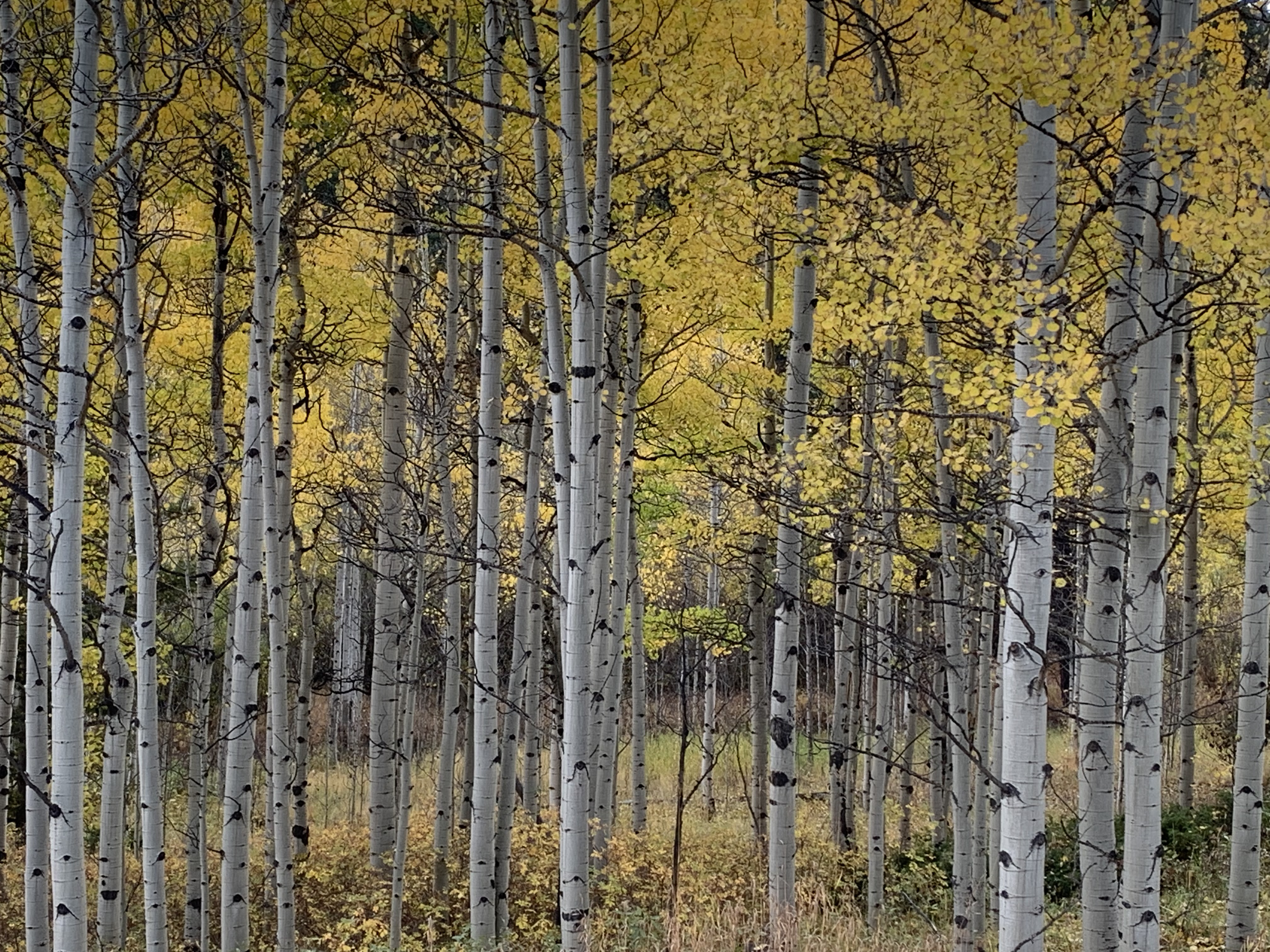
When I was younger I had a dream. I was walking through an aspen forest in autumn. I was not trying to get anywhere. I was not lost nor did I need to know where I was – other than wandering through the forest. The dream was visceral. Real to me. And, I’ve never felt more peaceful or present or quiet.

Because of my dream I equate aspen forests with peace. If I am off balance and need to regain center, I think of aspen forests.

The leaves make a specific sound. It is completely accurate to say they “quake.” Quaking also describes how they move when the breeze catches the leaves on the branches. If the light is right, they shimmer as well as quake. They can be electric in yellow, pale green and orange. Their quaking and shimmering serves as a mind-cleanser. And, not just for me. I dare anyone with a troubled mind to hold onto their troubles when in the presence of an autumn aspen grove.

Before leaving Colorado, we drove into the mountains. People were flocking to see the leaves. We found our destination off the beaten path: the lake, surrounded by stands of brilliant quaking aspen. We thought we’d spend a few minutes there but hours passed before we realized it. That’s the thing about peace, it does not dance with time. We walked. We took pictures. We sat in the resounding, shimmering quiet. And, for the first time in days, we exhaled.

read Kerri’s blog post about ASPEN FORESTS

Hold The Vision Lightly [on Not So Flawed Wednesday]

“Тhe gentle overcomes the rigid.
The slow overcomes the fast.
The weak overcomes the strong.”

“Everyone knows that the yielding overcomes the stiff,
and the soft overcomes the hard.
Yet no one applies this knowledge.” ~
Lao Tzu, Tao Te Ching

If there is a metaphor on this day – or a lesson – it is that a plan or a goal held too firmly is…not useful. Tom Robbins wrote that stability is not rigidity. Stability, like all aspects of balance, is dynamic, constantly adjusting. How’s that for a paradox? Stability is fluid.

My clan is gathering. We are driving a long distance to attend so have plenty of time to talk, to think, to remember. Kerri has lost both of her parents so I have many questions about the river of complex feelings running through me. Joseph Campbell said in an interview with Bill Moyers that “No one lives the life they intend.” I wonder what life my father intended? I think he was more capable of rolling with his circumstance than I, at first, understood.

There are no straight lines in nature and it turns out that we humans, we storytelling animals, are a part of nature and not above it. Our story of dominion is just that, a story. My dad loved to be outdoors. He tried to be a school teacher but there was not enough air in a classroom. He couldn’t breathe so he made a life out in the elements. His skin, at the end, was so sun-baked that it was brittle. He achieved his desire and his desire was simple.

I am, at this point in life, ecstatic that I didn’t achieve what I set out to do when I was 20. I actually thought I was a train on a fixed track and learned through derailing (a few times) that I needed to let go of my notion of the track. I found my artist when I let go of my artist. On this drive, en route to the funeral, I fully appreciate my wanderer heart and my compulsion to step off of edges. I could have done with a bit less chaos but am now of the mind that life has given me a master class in balance. It continues to teach me to open my hand and not hold so firmly to my ideas, my beliefs.

I am currently working with software engineers. They are building a system. It has rules and boundaries and limits. It has a guiding principle. It will do what it is designed to do. And yet, it will never be finished. It grows and changes almost daily. There is a master plan, but the vision does not blind the visionary or the developers to surprises. To changes. They learn as the software emerges. On one hand it is a foreign land to me and on the other, I know intimately how this land works. There are no iron tracks. No straight lines. The movement is in cycles and circles and every time we try to force it into a line, we impede the process, we inhibit the growth.

The lesson is always the same.

We awoke this morning exhausted. And, rather than push our way back onto the road, we sat and sipped coffee. We watched the sunrise. We decided not to put our day on an iron track. We appreciated our moment. So, there is some hope, some small evidence – some – that the lesson is taking root.

read Kerri’s blog post about TRACKS

See The Wonder [on Merely A Thought Monday]

What is this thing called ‘wonder’ and where does it go? Awe. Astonishment. Surprise. The stuff of sunrises and sunsets. The first. The last.

I am of the opinion, like most people I know, that wonder does not go away. We simply stop looking through eyes that see it. Been there, done that. Nothing new. The daily grind. If you’ve seen one, you’ve seen them all. It’s too bad. It’s no way to live.

We moved our chairs to catch the sliver of sun. We sat, closed our eyes, bathed in the warmth, and sighed. Wonder need not be complicated. Tom Mck, his mind already slipping, forgetting why we came to the cemetery, heard the grieving husband across the way wail in pain. “Listen to the wind!” he said to me, eyes wide in amazement.

“We are such stuff/ As dreams are made on and our little life/ Is rounded with a sleep.” ~ William Shakespeare, The Tempest. We are such stuff. It is a very short window, a single moving moment, rounded with a sleep. The real question is: What moment in this brief life is NOT alive with wonder?

read Kerri’s blog post about WONDER

Feel The Rhythm [on Not So Flawed Wednesday]

We lay awake in the night listening to the waves pound the shore. Boom. Rest. Boom. Rest. This lake that is sometimes glassy-in-stillness can rival the Atlantic Ocean in restlessness. It has many moods. It can turn on a dime. I have found great peace walking the shores. I have stood in awe as it blasted those very same shores, hurling boulders with ease.

When we were fortunate to live for a summer in the littlehouse, right on the lake. Kerri had to adjust to the constant sound. Her musician’s ears were caught in the rhythm of sound lapping the shores. Nature’s metronome. We teased about parking a piano on the back deck so she might compose an album of pieces set to the lake’s pulse.

The most striking visceral-revelation that I brought back from Bali is that we function together. Just as I am impacted by the lake, my pace and rhythm are impacted by the people around me. No one is an island. David Abram wrote in The Spell of the Sensuous that it is nearly impossible to meditate in the un-united states. We are an angry frenetic lake, fast moving wave. Changeable. I will always remember pausing at the custom’s gate re-entering the country. It was too much. Finally, I stepped through the doors and felt sucked into a chaotic turbulent whitewater river. It was months before I adjusted, before a walk down the street didn’t feel like a fist fight.

Columbus (my dad) would sit for hours each morning, on the porch. Listening. When I was younger I wondered what he was listening to – or for. He grew up in Iowa and came into adulthood moving to the rhythm of the corn. He lived his adult life in Colorado. It was a different rhythm, the metronome of the mountains. For many years he yearned to live where he understood the rhythm. He was, I think, listening for the corn.

When I return to Colorado I feel an immediate recognition. The mountains are the rhythm I was born into. Alignment. My original dance was a mountain dance.

Kerri and I are both transplants to the lake. Perhaps that is why we hear it so clearly. Jim E. told me that people go to the shore to stare into the infinite. We listen to the lake with the same awareness. The lake was here before me. The lake will be here after I am gone. The mountains, too. We are, of course, delusional to entertain the idea that we control it – nature. That we are somehow separate. Sometimes I think it is the artist’s job to bring proper perspective to the community, to pop the separation-notions – even for a moment – out of ego-brains.

This lake could hurl me like a pebble. It also brings peace to my soul. Stillness. We are not as distinct as we want to believe. That recognition is the single greatest blessing of artistry. It’s a circle dance. Just as my dad is disappearing back into the corn, I, too, will someday rejoin my original rhythm and fold back into the mountain.

read Kerri’s blog post about THE LAKE

Stand In The Narrow Place [on Merely A Thought Monday]

“Western civilization has been a 2,000 year long exercise in robbing people of the present. People are now learning the joys that hide in the narrow place of the hour glass, the eternal moment.” ~ George Leonard, Mastery

The observation has become something of a yearly ritual. Every 9/11, I hear or participate in this conversation: one day, people got out of bed, drank their coffee, brushed their teeth and went to work or boarded an airplane. And then, they never came home.

We are fairly smothered in sentiments about appreciating life, seizing-the-day, living in the present moment, take nothing for granted… “You never know.”

Quinn gave me his copy of Mastery. As was his practice, he underlined significant passages in red pen – and the book was a festival of underlined passages. For years I kept the book on my desk or beside my bed. I’d flip it open and read the red sections. They served as a daily meditation. They gave my busy mind something generative and hopeful to occupy.

George Leonard called presence, “the plateau.” Eckhart Tolle calls it “the now.” In one of the gospels NOT included in the bible, Jesus is reported to have said, “The kingdom of heaven is on earth but men do not see it.” The Way of the Buddha leads to the present moment.

What do we see if we stop thinking long enough to experience the present moment?

2996 people died in the terrorist attacks on 9/11. These people could do nothing about what happened to them on that day. They brushed their teeth. They left for work or got on an airplane.

“You never know.”

This year, there was a new river-of-thought that ran through the annual ritual observation: the daily COVID death toll last week in these un-united states was above 1,000 a day. On January 7th, 2021, 4,147 people died of COVID. In the divided-united states, more than 660,000 people have died of COVID. World-wide 4,550,000 people have perished.

It’s impossible not to look at the numbers and wonder why-and-how we became our own terrorists.

In the past year, with the availability of a vaccine, with the proven effectiveness of masking and social distancing, these people, had they united with the help of their friends and neighbors, had choices. They – we – could have done everything to save their lives. We did not. We divided. 1000 yesterday. 1000 today. 1000 tomorrow. And growing.

Sometimes we know.

Appreciating life is – and always will be, at the narrow place of the hour glass – a community affair. In presence, on the plateau, the line between me and you blurs. It is the reason why all of those firefighters and first-responders ran into the towers that day. My life cannot be precious if I cannot see that yours is also precious. Why – on earth – on any given day – would I not do everything possible – anything possible – to protect your life? Why would you not do the same for me?

read Kerri’s blog post about BLESSINGS ABOVE GROUND

Compose [on DR Thursday]

Many years ago I attended a workshop facilitated by Sam, a brilliant landscape painter. I was delighted and amused when he demonstrated his technique. Rather than paint what he observed, he took great pleasure in rearranging the elements. He moved the trees, altered the hills, relocated the barn. He laughed while mixing up his elements. His eyes sparkled with mischief. Rather than a workshop on painting, the day became an exercise in joy-in-art. Seeing and playing with what we see.

This morning I read that the word ‘composition’ means “putting together.” Definers-of-art-terms associate composition with freedom. “The artist has freedom when choosing the composition of their artwork.” It is a mistake to believe that compositional freedom is the sole province of an artist. If the mind is a canvas then thought is a composition. It is patterned and composed. Arranged and rearranged. We choose where we place our focus. Point-of-view is cultivated, it is not a default setting. We design the story-we-tell-ourselves-about-ourselves. And, then we project it onto the world.

The trick in both art and thought composition is not to wear ruts in the road. Sam was joyful in his art because he was constantly challenging and engaging with what he saw. Art was fun, not morbid tradition. Art was delight-full, not rule-bound or laden with the pressure to capture. Recall that stepping out of the rut was the first lesson in Julia Cameron’s The Artist’s Way. Morning pages and artist’s dates are meant to both see the ruts and open new paths. The same process applies to the thought-canvas. See the rut. Step out of it.

As Sam taught me so many years ago, seeing and playing with what we see begins with letting go of what we think we see. It begins with a blank canvas, an unfettered mind, and the freedom to choose the composition.

read Kerri’s blog post about COMPOSITION

Unfettered ©️ 2018 david robinson

Meet The Saw [on Merely A Thought Monday]

As the magician saws the woman in half, he tells her that, “Magic is not an exact science.” It is among my favorite Flawed Cartoons.

“There’s nothing sadder than a forty year old production assistant,” she said, sipping her drink, looking across the room at a man she clearly thought was a loser. I was living in Los Angeles and was at a party with movers-and-shakers. The gathering also included a few of the people who carried the cables, loaded the trucks, moved the electrics – the lowest rung on the ladder. The runners. I swallowed hard. At the moment she said it, I was thinking the exact opposite. There is nothing more interesting than a forty year old production assistant. I wanted to be standing with the very man she considered a loser. He’d have stories to tell. Experiences to share. The movers-and-shakers bored me. Dulled by their dedication to security, thoroughly protected from the unknown or surprising experiences, they sneered at the people who’d actually lived. I found my way across the room and spent the rest of the evening sitting in the kitchen talking with a man who traveled the world.

Were I at the party today, she would look across the room at me and whisper, “Sad.”

Life is like magic. It is not an exact science. Ideals collapse. Dreams implode. Yet, the luckiest people I know are the few who have stepped out of their seats and volunteered to climb on to the stage. They’ve taken chances. Built wood buses or put their lifeblood into starting a theatre company or went boarding instead of dying in a cubicle. They’ve stepped beyond traditions and expectation. They’ve been cut in half, opened, challenged, surprised, disappointed, scared, triumphant, awed. They’ve learned. They’ve questioned their beliefs and perceptions. They’ve made titanic mistakes. They’ve stared down their demons. They’ve opted for curiosity rather than being right. They stepped off the edge. They followed, “What if…”

There’s no shortage of people who watch life from the safety of their seats. As Tom used to say, “They paint with a limited palette.” There are those lucky few who, if you see them at the party, most likely the people serving drinks, who’ve been cut in two and know from scary experience that there’s nothing more numbing or illusory than certainty. Follow them into the kitchen and ask about their lives. You’ll be amazed at the full spectrum of colors you find in them.

read Kerri’s blog post about SAWED IN HALF

flawed cartoon ©️ 2016 david robinson