Throw Some Light [on KS Friday]

“The principles of true art is not to portray, but to evoke.” ~Jerzi Kosinski

Out of seeming chaos, pattern is found. And, from pattern, chaos is born. It’s a creative cycle. I spent some time this week swimming up the river of systems theory, synthesis instead of analysis. The means of production in an agrarian economy; the means of production in an industrial economy; the means of production in an information economy. The relationship between the methods and materials, the behaviors and the purpose, systems take on a life and energy of their own. The toil to feed more people led to toil to automate to relieve manual toil, led to automation to relieve intellectual toil, will lead to… we can only imagine. And, we do imagine: imagination is the relationship between the present and the future. Stand back and you’ll see, amidst the mess and chaos, we attempt to evoke a better world.

It is not a coincidence that a banana taped to the wall is considered art in an age in which Tucker Carlson is considered a source of truth. Ironically, in the golden age of information, we are befuddled by vapid minds and empty suits. Bananas and duct tape. Shock without substance can only evoke anger and will illuminate nothing. Anger for anger’s sake can only destroy. There’s no nourishment in all of this anger candy but it is certain to lead to national-diabetes and rot our teeth.

Marcel Duchamp, at the beginning of the last century, entered a toilet as sculpture in an art exhibit. He lived and worked in the age of industry at the threshold of mass production. His gesture had purpose and aesthetic framing. What was formerly craft and individual creation was now stamped into being on an assembly line. That’s old news to us but, in his time, it was a shocking revelation. A world war was raging. The collision of old practices meeting new technology was playing out on the battlefield. His exhibit entry evoked questions about loss and gain in the dawn of a new world order.

Sometimes it seems that we are spiraling into chaos. Polynices and Eteocles, brothers who will not compromise, kill each other in a battle for dominance. All lose. A father’s curse fulfilled. In our great art, the work that evokes truth and throws light to our hearts and minds, we have all the guidance we need – if we choose to pay attention. Yesterday I wrote to Mike that it seems we will need to walk the path of Romeo & Juliet: “Two households, both alike in dignity…”will lose their children to violence rather than sit down at a table and earnestly talk. And, when it is too late, when the primary is lost, the formerly indignant will sit and mourn together.

Chaos. Pattern. Sometimes the pattern is chaos. The children die. The mother takes her son across state lines with a big gun and pretends, after he murders people with his big gun, that his crime was self-defense. Bananas taped to a wall. A judge who broadcast to all that a guilty verdict might trigger his decision for a mistrial. He’ll just wait and see if he agrees with the jury. So, here we are. Lady Justice takes off her blindfold and takes sides. Is there a more profound statement of ethical collapse? In the age of information, misinformation gets equal billing; anger-candy.

What might Duchamp put on his pedestal today? What might evoke an honest conversation, throw some light and love, on what is lost and what is gained?

read Kerri’s blog post about FIRE AND SMOKE

Kerri’s music is available on iTunes and streaming on Pandora

Follow The Twine [on DR Thursday]

[Day #2 of no image upload capacity so, for the melange image, see Kerri’s post or visit the Melange]

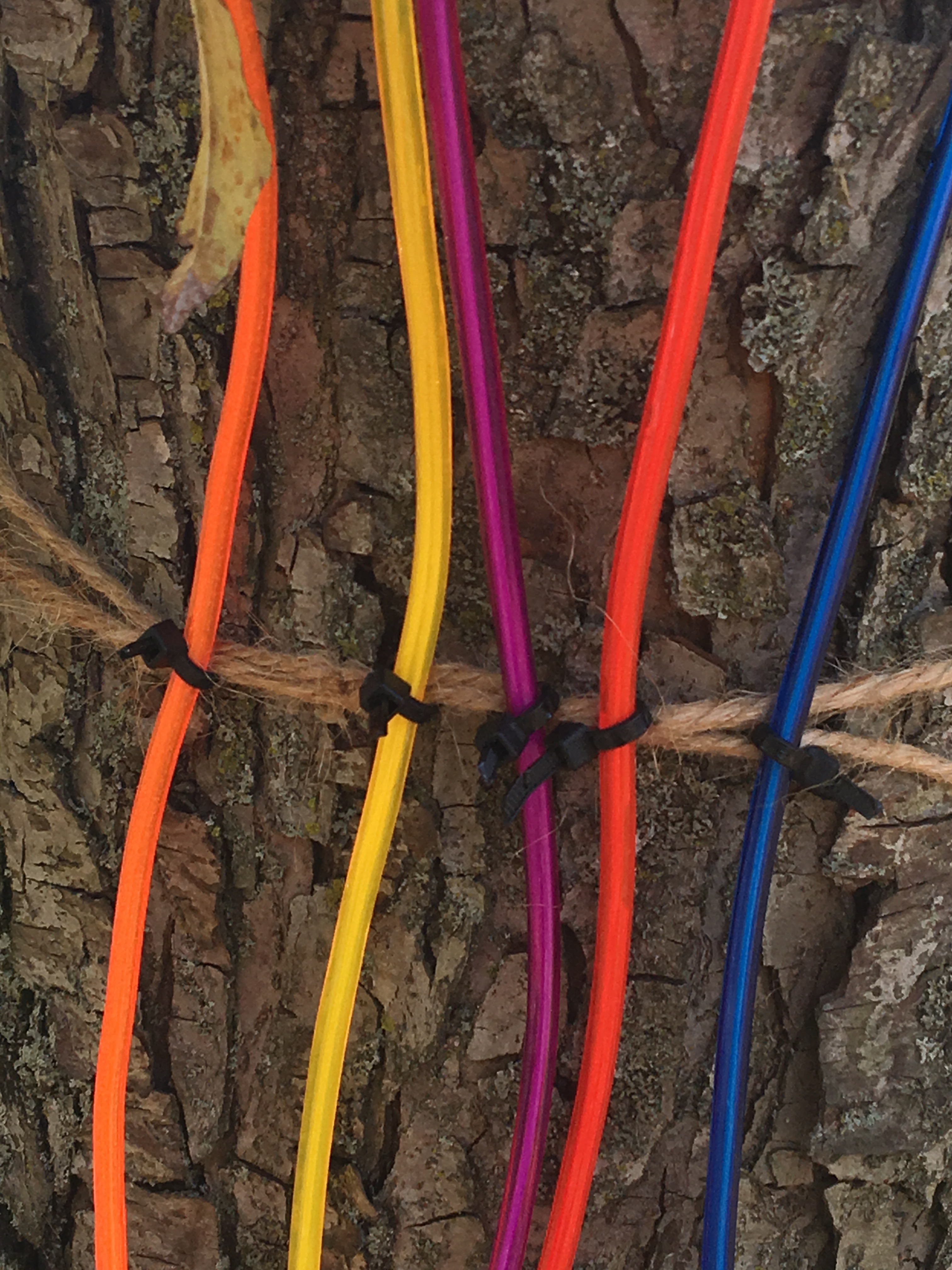
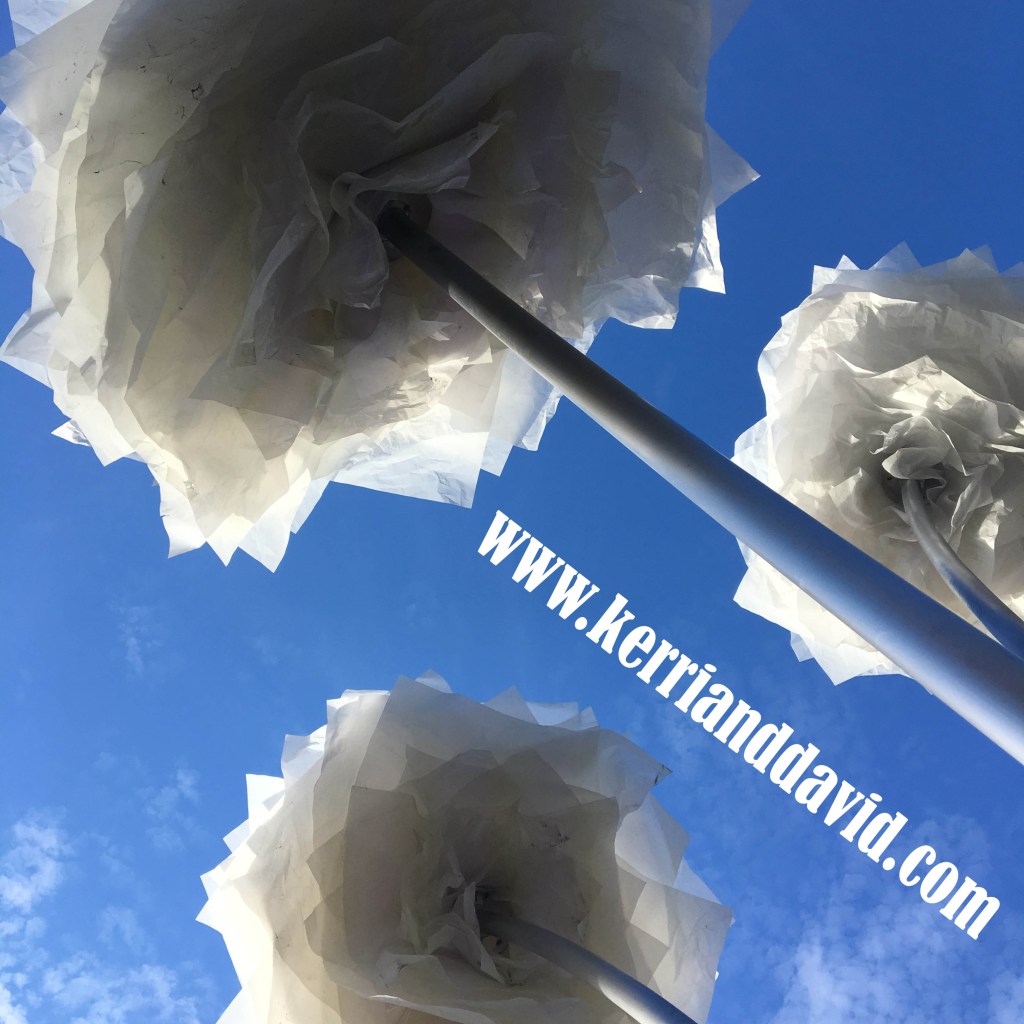
Follow the thick neon pink twine, winding through the park, and you’ll eventually come to a giant ball of string. I delighted in the thought that an enormous barn-sized Kitty, had recently been at play. Across the park giant flowers towered into the blue sky. Strolling beneath the stems and petals gave us an ant’s perspective.

Imagination. It’s working all of the time. And, sometimes it takes a giant ball of pink neon twine to make it visible. When we look forward to an event or dread a meeting, we are in full imagination. What else? When we desire a certain future or run fast from an opportunity, we are deep in our imagination. Kerri’s toes curl every time she drives under the train trestle while a train passes overhead: she imagines disaster.

I wish I had a nickel for every time I’ve heard in my life, from students or clients or friends, who’ve said, “I don’t have a good imagination.” The greatest figment of imagination is the notion that there are greater or lesser degrees of imagination. Sense making, personal story, idea generation, brainstorming, hypothesis checking, retirement planning…are all processes of imagination. We sense the world and then story it and the story always begins with the generation of an image. To be human is to be a wild. imaginer.

I’m privy these days to many thought models and process maps. I’ve spent the past 48 hours in a deep conceptual exercise. Emerging from my office at night I squint at Kerri and say, “My brain is tired.” The lovely paradox about the models and maps and conceptual paths is that they are not real. A map of the city is not the city. A model for product development is not product development, it is a map at best, a place to locate the imagination. The imagination uses itself to discover itself.

And, therein lives the paradox: imagination is as much about “discover” as it is about “invent.” We imagine our future so we can walk toward what we already see. As every artist knows, the canvas tells you where to go, the character tells the writer where the story turns. We discover ourselves in our imagination. Follow the pink twine far enough and you’ll eventually come to a giant ball of string.

read Kerri’s blog post about PINK NEON

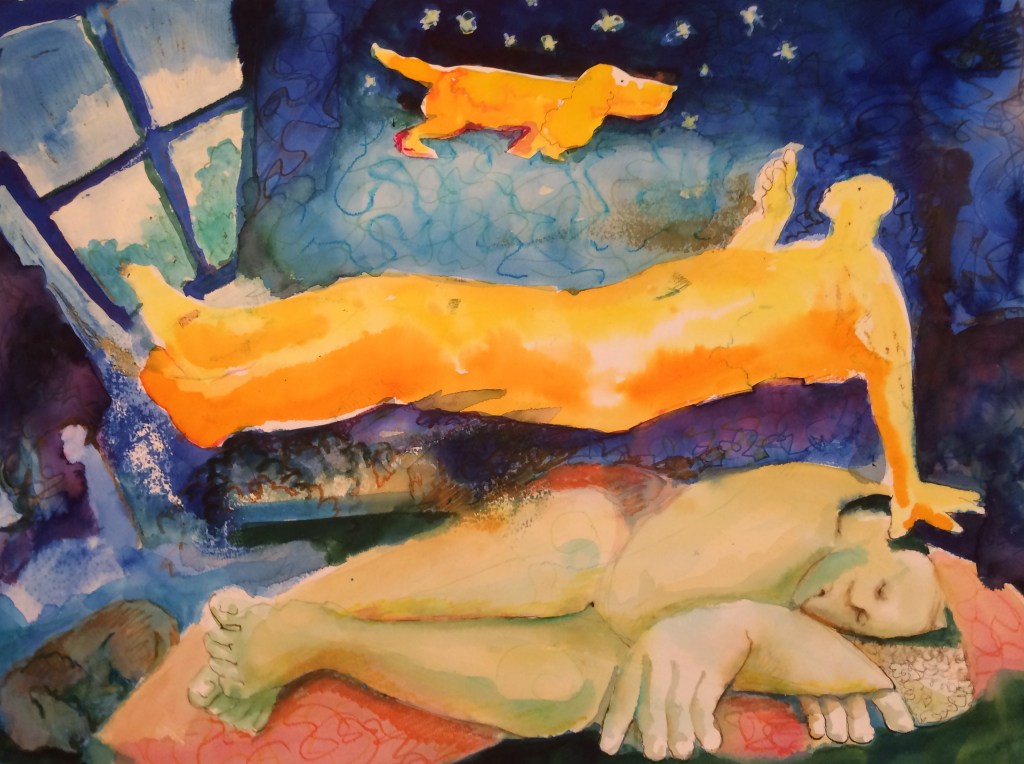
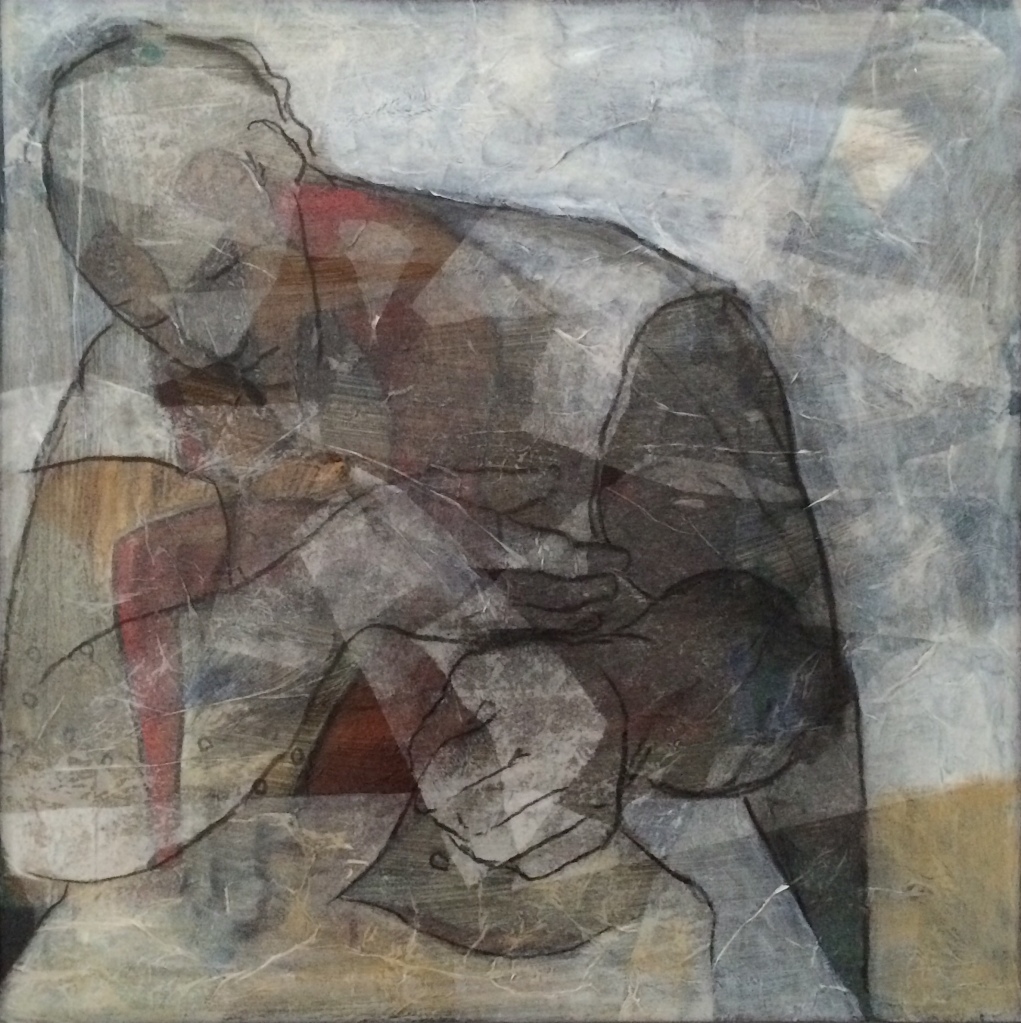
watercolor fun: dog dreaming © 2010 david robinson

Go To The Shoe Room [on Two Artists Tuesday]

When I managed the theatre conservatory at PCPA Theaterfest, I occasionally gave backstage tours. It was great fun because the favorite stop on the tour – on every tour I gave – was the shoe room. Visitors always enjoyed standing on the stage, they were impressed with the scene and costume shop, they delighted to watch the prop master at work, but the moment we entered the shoe room, they were transcendent. Wide-eyed and giggling, pulling period shoes from the shelves to show their companions, it was as if they’d entered a candy store. The magic was released through the shoes.

The shoes, I suspect, harkened back to a time of dress-up. Childhood. The shoes touched their spirit of play. They beckoned to be worn and, as any actor knows, the shoes will inform how a character moves. The sooner you don the shoes, the sooner you will “find” the character. The shoe room was a portal to possible-other-lives.

I am more enamored by sketches than I am by final drafts. I delight in watching master craftsmen and craftswomen work. Theatre artists do not create illusions, they provide access to other worlds, unknown paths. They invite us to the shoe room to try on another life, even for a moment. The process, to me, is more beautiful than the performance.

As we walked the paths of the Botanical Gardens, the technicians were preparing for the festival of lights. Walkie-talkies crackled. Connections were checked. Battery packs were carefully placed. Multi-colored light strands ran like rivers up the trunks of trees. E-candles on armatures floated in the waterways. Magic was in the making. During the daylight, the entire expanse of the Garden is backstage – exposed wires and explicit design. At night, the mechanics will fade behind the light curtain. Backstage will become fore-stage. The light will invite us into another world. The light will touch the spirit of play.

I have always believed that people, lurking behind those serious faces, really just want to play. It’s the reason I kicked off my shoes every time I entered a room to do a facilitation. Lose your shoes and it’s no longer a serious affair. Play threatens. Play is suddenly a real possibility. The spirit of play cracks even the most harden entrenchment. Play necessitates collaboration and sharing. Pirates and Princesses need mates and parrots and knights in order for the world to be complete. Lawyers will take off their ties and wear them as headbands when the shoes come off and the serious topics are approached in socks and bare toes.

I recently – as we all have – been privy to an endless contentious debate about what this nation needs to do to get back on track. I believe it is not so complicated. We can carry on our oh-so-serious-division, but the single rule should be that no one can open their mouth – politician, pundit, and pedestrian alike – before first taking off their shoes.

read Kerri’s blog post about LIGHT STRANDS

Know The Moment [on KS Friday]

“A work needs to relax toward finality. It cannot be pushed, it cannot be worried, it cannot be analyzed to completion. Pushing against the natural rhythms of creation will just churn up the waters. Clarity comes only when the waters settle and the air clears.” ~Kent Nerburn, Dancing With The Gods

Because I tend to speak in metaphors in a world enamored with goals, what I say often, at first, goes unheard. Skip is stewarding an amazing creation and has, from my perspective, just passed a significant milestone. I told him that, in working with many playwrights and painters and actors, there is an initial phase in every creative process in which the creator works for form. It’s like the tide going out, dumping everything down on the page to gather and find the story-form. Then, in a beautifully mysterious moment, the tide turns and finding form is no longer the intention. Clarity becomes the aim. Skip is a listener. Metaphors tossed into an analytic frame generally seem out of place or perhaps arrive too early to the party. But I’ve learned they are seeds that, when planted, begin to work their way up through the crusty soil.

John Guare said that a writer has to write ten bad pages to arrive at a single good page. The ten bad pages are the search for form. Reducing ten into an essence of one is the work of clarity. The phases, the exhale for form and the inhale of clarity, are two different yet interrelated energies.

When I am working on a canvas I might evolve the image for days. Sketching, painting, wiping, adjusting, wiping, sketching, painting. The search for form. Adding and subtracting. Moving the composition, tilting the symmetry. And then, something clicks and I know. The painting is formed and now the pursuit is to hold its hand and bring it into the light. Inhale.

Because my father recently passed, followed hard upon by my dear Ruby, I have been reviewing much of my life. Roger used to say that the first 30 years of life were about trying to become something and then, one day, you realize that you are that thing you were trying to become. The rest is learning how to be it. Searching for form. And then, clarifying. I think Roger was half-right. Becoming and being are cycles, not arrivals.

The cycles of my life are explicit. I enter into worlds that I know nothing about – either by accident or invitation. That I know nothing about the world is precisely why I’m invited in – or bumble in. I see it. I bring it metaphors. It is uncomfortable to not-know so I learn about the world as an outsider. It helps me see more clearly. I know the moment when form turns toward clarity. I see when the process roils into an eddy. I understand how to free stuck energy. I’m a midwife to creative process, a guide across unseen bridges.

We stood in the November sun admiring the giant flowers against the blue sky. I loved the idea that I was experiencing an ant’s view. These past many years I have been looking for the new form. Pushing. What was I? What am I now? And, in a beautifully mysterious moment, I realized that the tide was at long last coming in.

read Kerri’s blog post about GIANT FLOWERS

find Kerri’s music on iTunes or streaming on Pandora

Walk With Samuel [on DR Thursday]

“The end is in the beginning and yet you go on.” ~ Samuel Beckett, Endgame

When is something finished? Beckett wrote Waiting For Godot in 1953; characters waiting for what will never arrive. A finish. A completion. Beckett’s life spanned both wars-to-end-all-wars, Korea, Vietnam. He wrote about humanity’s dedication to nonsense. His work has been called bleak and dark. His work is shelved with the canon of The Theatre of the Absurd. And, yet, given the news of the day, these days, who doesn’t feel as if they are living in a Beckett play?

What is often missed in his absurdist plays is the beautiful human capacity to keep walking, to keep trying. Waiting and walking through tragedy, mostly of our own making, with unwavering hope. We story ourselves with nobility even when wrapping ourselves in a lie. We make rules and laws that apply to some but not to all and then we set about to justify the inequality. Money and morality are not the same thing though there’s plenty of storytelling meant to have us believe that wealth only flows to the worthy.

Art is not supposed to make sense because life doesn’t make sense. We make sense of life through the stories we concoct. Emperor’s buried with thousands of statues to keep them company in the afterlife, an artist painting the ceiling and walls of the Sistine Chapel, gods and angels and saints. How many people died building the great pyramids, tomb for a pharaoh? Who would possibly spend their life in abject poverty smearing color on canvas? Van Gogh. A legion of others not known. Are we better for it? I cried the day the Taliban blew up the Buddhas of Bamiyan, 6th century statues that I had not seen in person and was likely to never see. Were my tears more or less absurd than the Taliban’s animosity toward carved stone?

Matters of the heart. When are they finished? Where do they begin?

It was a gorgeous day, perhaps the last warm day of the season. We met our pals at the Chicago Botanical Gardens. Throughout the gardens, preparations were being made for the annual holiday light exhibit. A tree of shiny stars. Giant flowers. Faux candles floating in the waterway. Strings of colored lights were being placed along the walkways. Even during the light of day it was impressive.

In this time of transition, many of the gardens were being prepped for the winter, the pathways were packed with people cooing at the wave of the grasses, the shape of the trees in the Japanese garden. I was gobsmacked by the color of the moss on trees, the shock of red leaves against vivid green. No matter which direction I looked, someone, some special gardener and designer, had crafted beauty. They knew that their work would stop me in my tracks and allow me to whisper, “Unbelievable.”

Winding our way back to the Visitor’s Center, I told Brad that, seeing so many people out enjoying the gardens, excited to walk in beauty, filled me with hope.

To walk in beauty. Dollars and cents can’t reach the reason. Data can’t touch the impulse. There is so much light in this theatre of the absurd. Beckett knew it, writing about the stories we tell, the relationships we create, waiting for something – a beauty – that by definition, will never arrive because we are surrounded by it each and every day.

read Kerri’s blog post about RED SCULPTURE

www.davidrobinsoncreative.com

Move Toward Wholeness [on Two Artists Tuesday]

When I look at the bowl of green tomatoes, each plucked from the vine before we pulled the plants from their pots, still moving toward red ripeness, I think of Joe. He was fond of saying, “Life moves in the direction of wholeness.” It’s important to note that his fond phrase included nothing about outcomes. Joe was particular and knew that life is movement and not arrival.

I am revisiting the word ‘rehearsal’ these days only this version of rehearsal is not on the stage with creative minds. It is over Zoom with decidedly analytical minds. Actors in rehearsal halls move through a process of exploration that leads to specific choices. The goal, if there is one, is to embody a state of moving presence within a story. The analytic mind comes with a template overlay that is placed atop the experience before it actually occurs. The language reveals all: content items. Telemetry. The mathematics of movement. Rehearsal is predicated on precision.

As I’ve probably written ad nauseam, these minds are not in opposition. They are complimentary. Freedom of artistic expression comes from years of study of technique. The path to mastery winds through repetition and constraint. Saying more with less comes after a lifetime of saying less with more. The creative mind is one step closer to the senses. The analytic mind applies language, gives voice, to the experience.

Many years ago I participated in a workshop with an actor/director of Noh Theatre. The process was strict, exacting. The movements precise. There was no room for error. We, the participants in the workshop, knew we’d never achieve proficiency since it takes years and years of rehearsal to perform even the simplest of symbolic gestures. No one sings opera in a day. We did our best and failed and failed and failed. That was the point. That is always the point. Each failure is actually an exercise of muscle memory. The body learns. The mind is impatient. Rehearsal is rarely about the mind, despite what the mind insists. At the end of the day, our workshop leader gave a short demonstration of his art form. His ease of movement, born from years of repetition within constraint, was breathtaking. He was free.

Many years later I was helping John in his wood shop. He was a master wood worker. I watched him look over his lumber, preparing to build a cabinet. He ran his hand over the wood, feeling his way into his project. “Ah,” he said, laying his hand on a piece of cherry wood. “This is it.” John was like the Noh actor.

“How did you know?” I asked.

“I don’t know,” he said, “it just feels right.” Then he smiled and added, “Plus, I’ve built a lot of crap.”

Life, moving toward wholeness.

read Kerri’s blog post about TOMATOES

Coalesce [on Merely A Thought Monday]

Rich used to tell me that, “People don’t change until the pain of the change is less than the pain of staying the same.” At the time, I thought his mantra was cynical; pain either way. Now, I think it is spot-on.

Discord is the essential ingredient for initiating any creative process. Explorers look at the horizon with a deep need to find-out what’s beyond. Their curiosity outstrips their comfort. Curiosity and comfort. Change and stay-the-same. There’s a tug-of-war in every decision that’s worth making.

Creative tension is a dynamic pull between two poles. Do I add a brushstroke or is the painting finished? This morning I came across a well-known quote by Leonardo da Vinci: Art is never finished, only abandoned. Pain either way. Finishing a work of art is akin to dropping the rope in the creative tug-of-war.

When I was wearing my corporate-consultant-hat, almost daily I repeated a lesson relative to Little Red Riding Hood: without the Wolf there is no story. Too often we try to eliminate our Wolf. We are inundated with messages trumpeting the notion that happiness (or good process) arrives in the absence of discord. It does not. Happiness avails itself when the necessity of the Wolf is understood as the fuel of the story.

People thrive when challenged. We create challenges when we don’t have them. Understanding the role of the Wolf transforms Rich’s mantra into something far less pain-full. The heart yearns. The brain fears. The yearning and the fear will coalesce into some action that may or may not be recognized as a choice. Which is the Wolf? The yearning? The fear? Either way, another day is lived. The story is created.

read Kerri’s blog post about UNCOMFORTABLE

Get Lost [on DR Thursday]

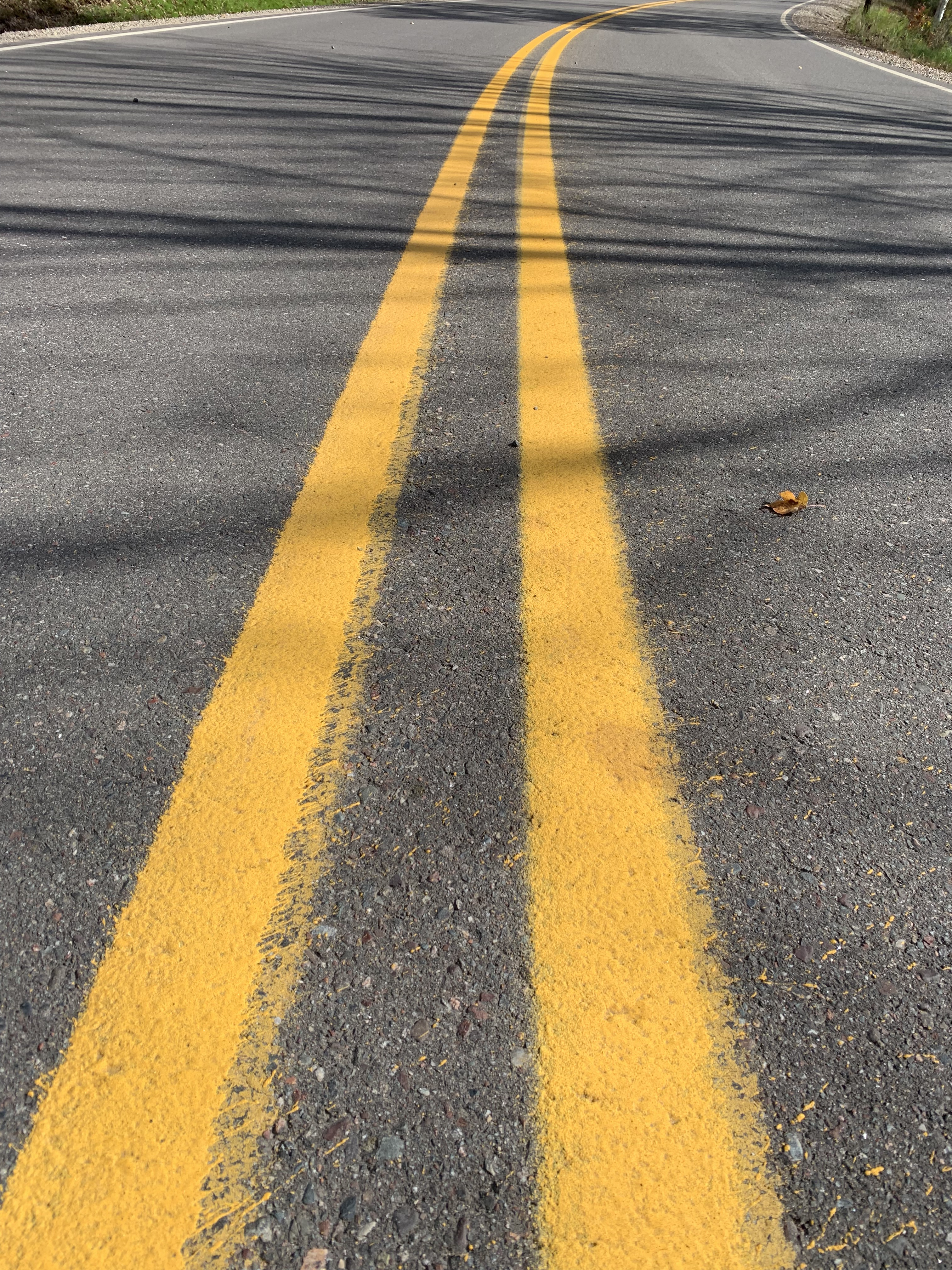
We delight in taking Sunday drives. Sometimes we have a destination but most of the time we have no idea where we are going. We head “out into the county,” the farm land, and with great intention, we get lost. “Left or right?” Kerri asks when we come to a crossroads. “Left.”

The goal is to “not know.” Drive down roads we’ve never experienced. There is a direct correlation between “not knowing” and “clear seeing.” When lost, we open our eyes. It’s something that every artist understands, “always-knowing-where-you’re-going” is a killer of the magic. It is the dividing line between art and craft.

I’m currently working with a team of analytical minds. “Lostness” is often interpreted as failure. It’s not welcome. But, to my great delight, even in the most analytic of creative processes, the engineers and entrepreneurs, shaking their fists at the sky when adrift, find their greatest magic arrives only after time spent wandering the wilderness.

After many twists and turns, rolling country roads and, “Which direction are we headed?”, we pop out of lostness and know exactly where we are. “Hey!” we laugh, “How did we get here?”

The art of getting lost. The art of exploration. The art of having an experience without a predetermined outcome. The art of having an outcome and letting it go, making space for something better. It is the art of cultivating surprise, allowing for the bigger idea to come through. “Left or right?”

It’s a practice. Learning-to-see and letting-go-of-needing “to know.” It’s the same thing. And, a great way to practice, is taking a nice Sunday drive.

read Kerri’s blog post about THE ROAD

pax © 2015 david robinson

Reach Purely [on Two Artists Tuesday]

“Art, as best practiced and understood over the centuries, is a spiritual as much as technical pursuit.” ~ Kent Nerburn, Dancing With The Gods

It was disconcerting. It still is. The illusion was so distinct that I had to show the book to Kerri and ask if she saw it, too. Each morning I read a few pages from Kent Nerburn’s book. This morning, in a chapter entitled The Divine Thread, I turned the page and a single paragraph, just a few sentences, was printed in a font twice the size as anything else on the page. I read it a few times since the author had given the section such obvious emphasis. After the I finished the chapter, I looked back to reread the oversized section – and it was printed in the same size font as everything else. It wasn’t emphasized at all. The shock of it made me dizzy.

“Art, however, does create this touch. It speaks in different voices, different rhythms, different languages. There is no place in the human heart it cannot reach.”

Paul taught his student-actors that they had an obligation to something greater. “When you choose to get on the stage, you have the power to impact other people’s lives. Do not take that responsibility lightly.” Your art, your creation, if purely intended, will reach the heart of another – purely. Even the loneliest painter knows the transcendence of the expansive energy that comes through in the moment of creation. Transcendence is all inclusive.

I have been humbled by the great artists I’ve known. Teachers, mentors, and others. I’ve been humbled by their humility. Tom, a brilliant director of plays and believer of possibility, influenced more artists than any person I know. He was tortured by the size and scope of his gift. At the end of his life, sitting before a fire in his cabin, he was, for a moment lost in thought. I watched his revelation come to the surface. He looked into his wine and said, “I think I did my best work when I was a just starting, when I was second grade teacher. It was pure imagination. I had no idea what I was doing. I just knew that we could have fun telling stories and going on adventures where our imaginations led us. It was pure.”

I met a few teachers who’d been second grade students in that classroom of long ago. They told me that year changed their lives. They touched his heart and he touched theirs. Shrunken heads and planning expeditions to the Amazon. Maps and budgets and “What do we need to bring to survive?” They spent weeks preparing for “blind day,” an exploration of the world through the full scope of senses. “What could we learn if we didn’t rely on our sight? What would we need to prepare to help each other?” he asked. Pure.

For our wedding, Julia made for us a small box with a Klimt’sThe Kiss” decoupaged on the lid. Inside, she placed a few Euros. A metaphor. Great love as a container for great adventure. We placed the box in our sitting room in a spot where we see it everyday.

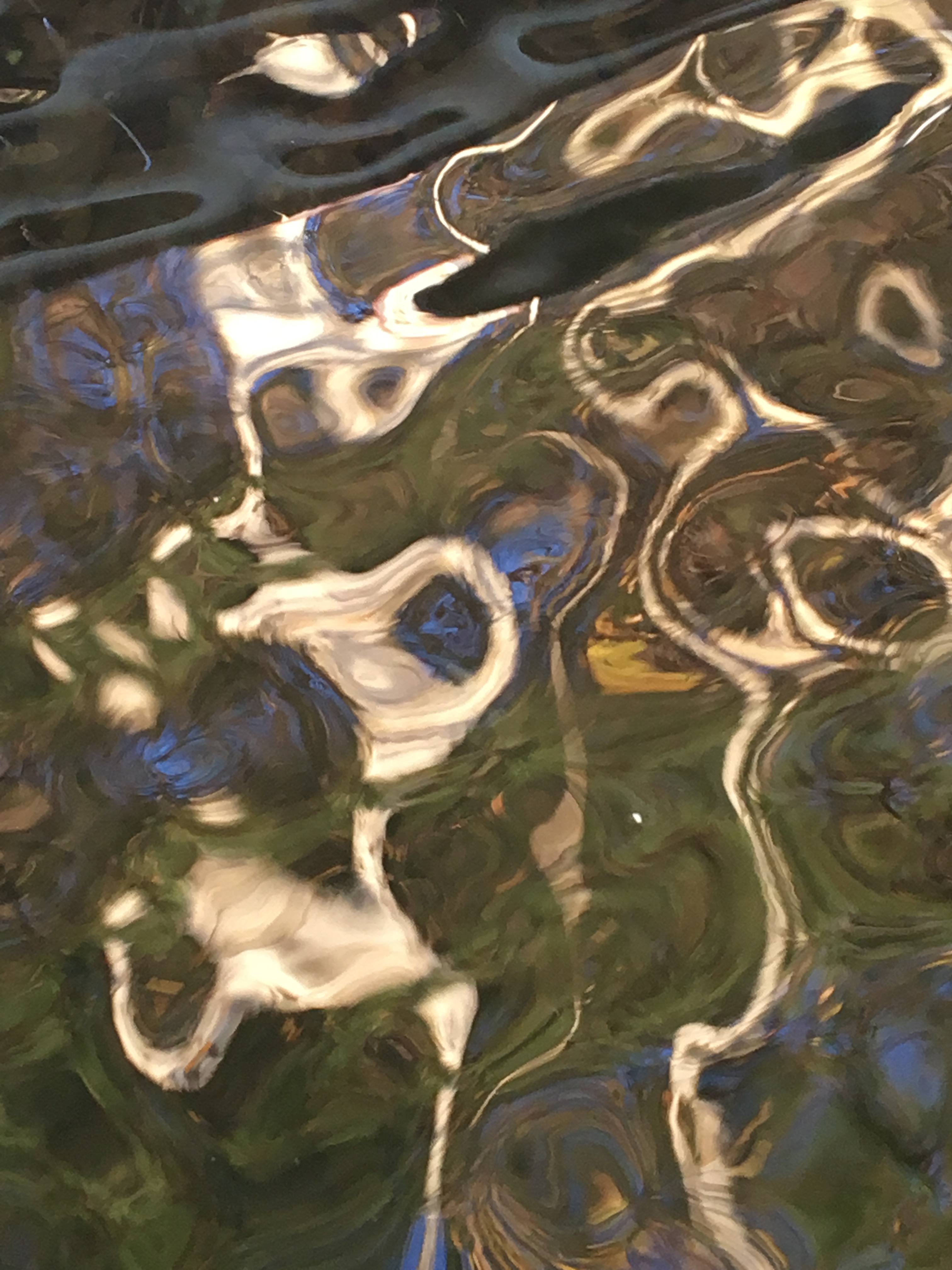
Kerri knelt on the dock to get this photograph of the water. “The color!” she gasped. Pull up an image of “The Kiss” – or any of Klimt’s paintings for a closer inspection and you’ll see this water pattern. Klimt might have painted it. He studied swirls in water, swimming color on the reflection of the surface. I’m certain of it.

Great love. Great adventure. Tom. Julia. Paul. Art that is pure. My head spins. There is no place in the human heart that art cannot reach.

read Kerri’s blog post about WATER

images of water © kerri sherwood 2021

Learn Where To Listen [on KS Friday]

“Her mother told her she could grow up to be anything she wanted to be so she grew up to be the strongest of the strong, the strangest of the strange, the wildest of the wild, the wolf leading wolves.” ~ Nikita Gill

A long time ago I wrote and illustrated a children’s book about a young fox who had extraordinary abilities. Her talents made her an outlier in the pack, something strange, so they hammered her into compliance. She buried her gifts. The story is, of course, how she came to embrace her gifts despite the court of fox-public opinion.

Lao Tzu wrote, “Care about what other people think of you and you will always be their prisoner.” It is a lesson that every artist must learn. Do your work. YOUR work. Some will love it. Some will hate it. Some will walk by without a second glance. You can never determine what another person sees or thinks so waste no energy in that fruitless cause. Do your work.

It’s a tough lesson, a mammoth paradox, since we are, after all, a pack animal, a social being. An artist has no reason to work if there is no audience or community to receive the work. Traditionally, artists live on the edge of the community so they can both see in and express what they see but also serve as a channel to what lies beyond the spiritual perimeter. The tightrope walk is about belonging while marginalized enough to remain clear-sighted. The artist must step back from the painting in order to see it.

I’m enjoying a slow read through Kent Nerburn‘s book, Dancing With The Gods: Reflections On Life And Art. Master Miller recommended it and I’m finding the simple wisdom of an artist-elder a refreshing daily meditation. Were I to write a sequel to my long-ago-children’s-book, it would be about this: coming back to your gift is not a one-and-done affair. It is a cycle. We embrace it and run from it and embrace it and lose it and find it and smother it and resurrect it and step back and look at it. Again and again. To become the strangest of the strange, the wildest of the wild, is not an achievement, an arrival platform, it is a relationship. Yes, with the community, but it is mostly a walk with your self and what lies beyond that spiritual perimeter. It is ongoing. Never static. Somedays you are the strongest of the strong. And, on other days, you are empty and weak. Full spectrum palette. The only way to know and reflect all of the colors of life is to experience them firsthand. And, so, it is imperative to learn where to listen, where to invest your tender care.

The gift grows as more colors enter the paint box.

read Kerri’s blogpost about HER MOTHER TOLD HER

Kerri’s albums are available in iTunes or streaming on Pandora