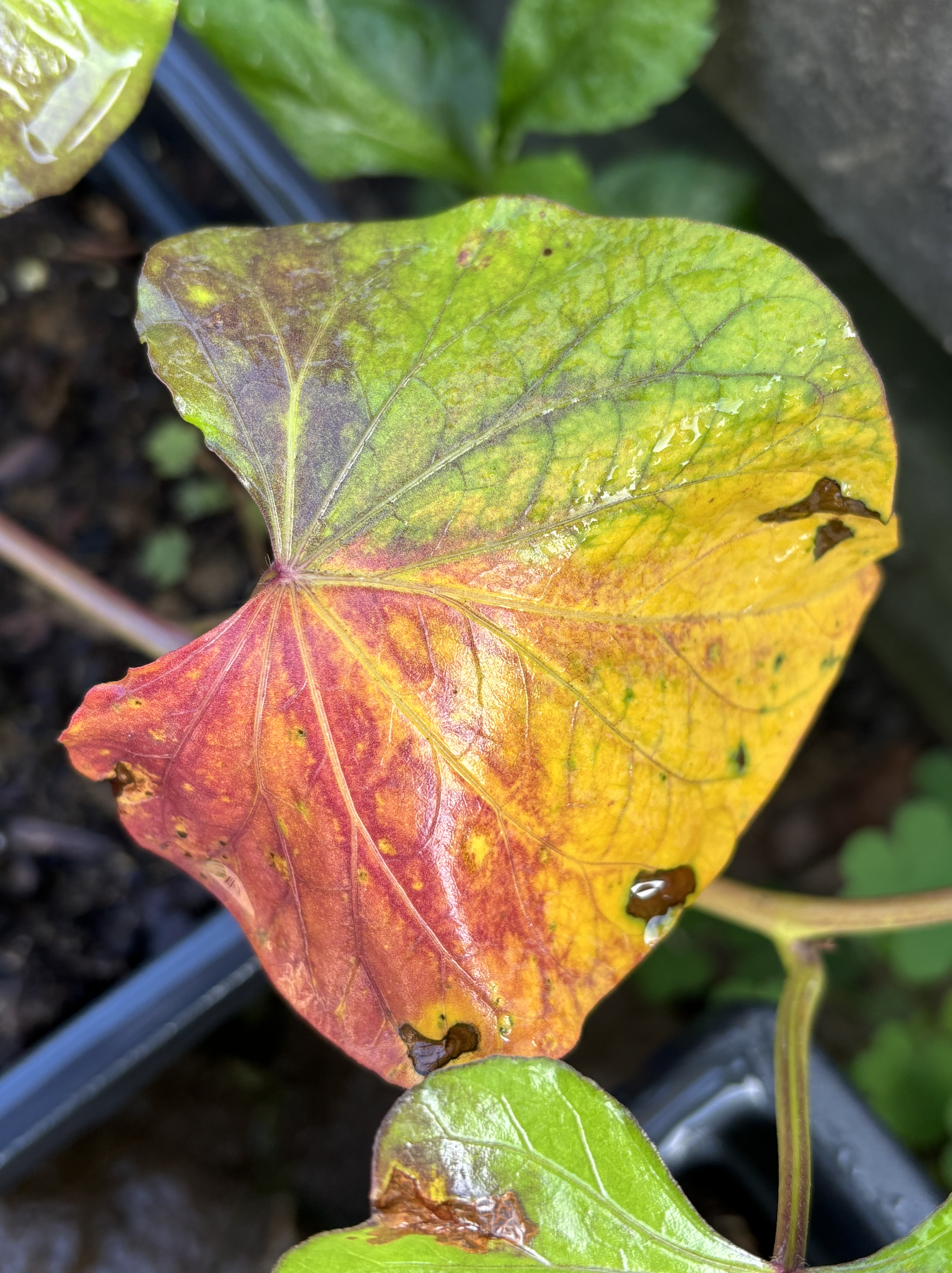
But If I Had [David’s blog on Not So Flawed Wednesday]

I’ve never taught visual art but if I had, I’d have sent my students outside to look at color in nature. I wouldn’t spend a moment having them study an abstract color wheel or match paint swatches indoors. Together we’d look at light, the angle of the sun. We’d play with shadows and discover the changing hue of shadows; they are more full of color than we want to admit.

We’d bring-to-light, uncover, unearth…we’d learn to see, a skill much more valuable to the artist than merely looking. We’d walk through the world as if for the first time. We’d share our color notes. We’d tease and be teased by a full range of morphing value as the sun played with our perception.

We’d remind ourselves that our window on this life is only open for a short while. We’d saturate ourselves in the infinity of shapes and textures, the marvel of pattern and interconnection; the riches of diversity. We’d immerse-in-the-immensity and not pretend that we were in any way separate or better-than.

We’d stave off a world insistent that we live within the narrow strictures of black and white, bland cubicles of dulled minds. I’d have sent my students outside to wander into their thicket of questions and step boldly into a world without answers but alive in rich, vibrant color.

read Kerri’s blogpost about THE LEAF

likesharesupportthankyou

A Different Criteria [David’s blog on Merely A Thought Monday]

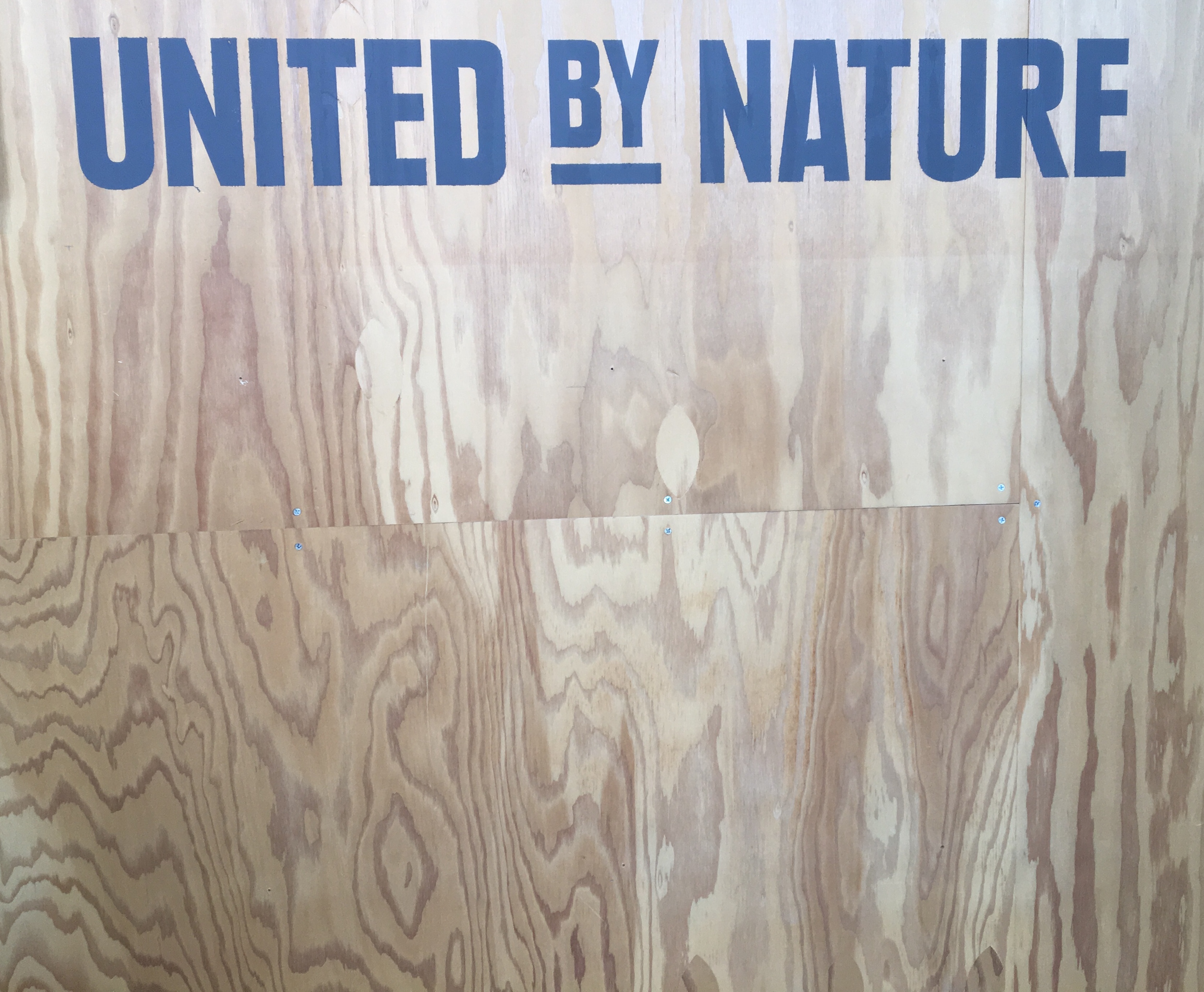
“The clearest way into the Universe is through a forest wilderness.” ~ John Muir

I once read that the word “wild” was only necessary to a people who’ve deluded themselves into thinking that they are somehow separate from or above nature, that wild is something that desperately needs to be tamed.

In a culture where many are predisposed to believe that one’s personal nature is fundamentally corrupt (sin-full) and, therefore, requires serious controlling, all of nature is destined to suffer the same fate. Rivers are dammed. Forests eradicated. Waterways and air polluted. It is inevitable. All of nature is reduced to the word “resource”. It is the ultimate expression of taming. A resource to be used and then discarded.

Human resources. We are not excluded from the reduction since we are the source and executors of the degradation. Is it no wonder that so many are so certain that their lives have little or no purpose, value, or meaning. Used and discarded. The magic and mystery of this enormous universe rendered inaccessible. Subdued. Tamed.

It’s never made sense to me.

There are other systems of belief on this earth that are not built upon separation-from-nature but upon relationship-with-nature. Wild and tame are not oppositional but part of the same whole.

In workshops – teaching what I most needed to learn – I used to tell people that “Nothing is broken and nothing needs to be fixed.” Start with a loving premise. And see what happens. It fosters a different view of the world. It fosters a foundational shift in the understanding of “self”.

Starting with appreciation-of-self leads naturally to appreciation-of-others. Inclusive.

People incessantly trying to fix themselves grow blind to others. It’s the path of self-absorption. Exclusive.

People who fundamentally love their nature…begin with love. In love, they are naturally connected to all of nature, through their nature. Interdependent. Unified. There is nothing to fix. There are expansive experiences. Rather than tame, there is caring for the health of the whole. From a grounding in love, there is an entirely different set of criteria for making choices.

In love, it is easy to see: what we do to nature, we do to ourselves. What we do to others, we do to ourselves.

read Kerri’s blogpost about NATURE

like. support. share. comment. subscribe…thank you.

Right Before Our Eyes [David’s blog on Two Artists Tuesday]

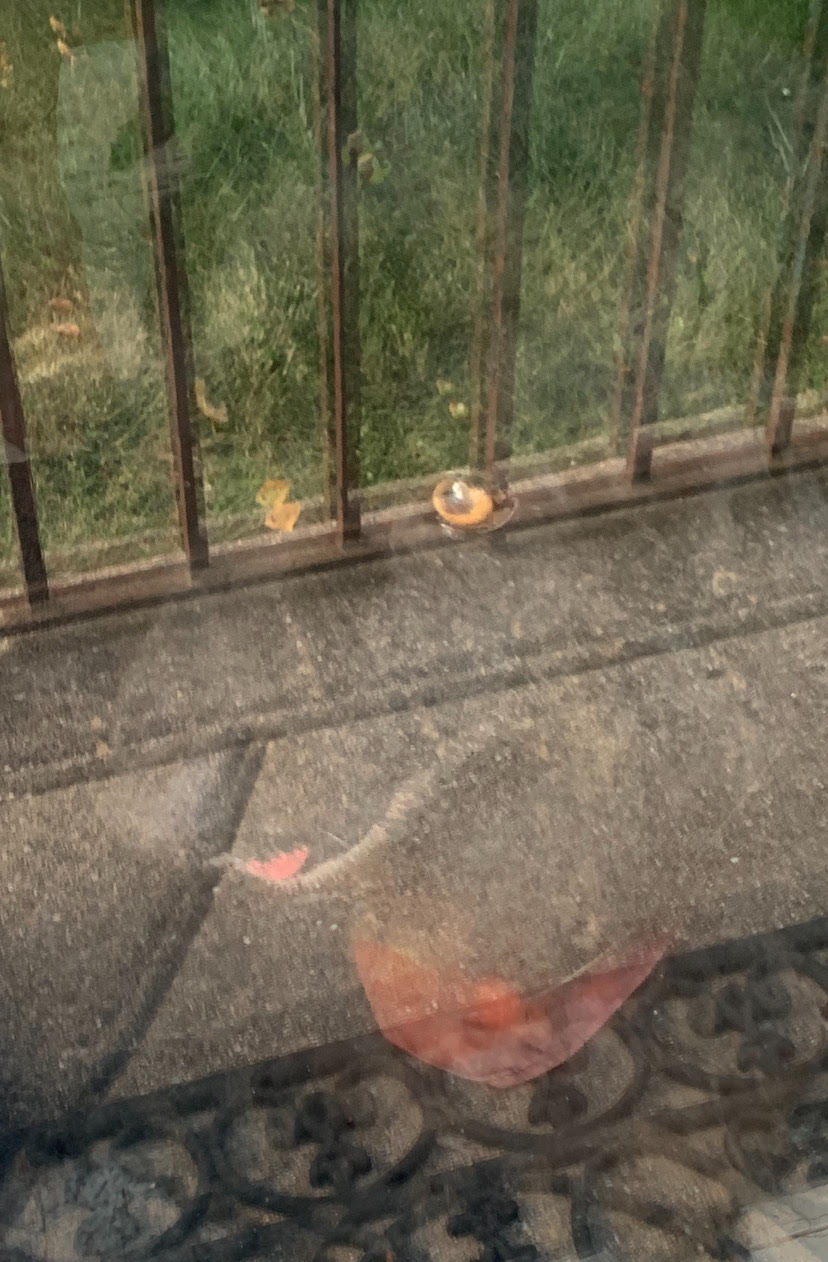
If you are like me, this image took a moment to grok. All the elements are apparent yet, at first, my brain couldn’t pull the pieces together. Kerri, standing outside the front door, took the photo of Dogga on the inside staring out. What is reflection? What is image-through-the glass? It reminds me of those famous drawings that can be seen in completely different ways, the old crone and the young woman. One drawing, two possible images. An optical illusion.

After the image of Dogga-in-the-glass came into focus for me, Kerri exclaimed, “I can’t believe it took you so long to see it!”

MC Escher made a career of creating optical illusions. Stairways to nowhere. Hands drawing hands. The mathematics of art and design. We are rarely aware that our brains assign rather than discover meaning, selecting and assembling pieces in order to sense-make. Like well-worn paths through the woods, our sense-making carves default channels: we see what we expect to see. We see it because we believe it, not the other way around. That is to say, we rarely see beyond what we think. Thinking paths-of-least-resistance render us blind.

The pursuit of truth is to see beyond our well-worn paths. Escher knew that. His images play with our expectations. His images, for a moment, shock us into seeing beyond our expectation.

Factors like age or cultural orientation create biases in the making of meaning, in the assembly of the illusion. For instance, in the drawing of the old/young woman, older people will more often see the old woman while younger people will almost always see the young woman. If you happen to come from a culture that is not inundated with images (there are a few remaining on the planet), it is likely that you would only see scribbles on a page. You would see neither the old or the young woman.

Your normal is not my normal. Your well-worn thought-paths are different than mine.

Given identical experiences, your sense-making will differ from mine. It is the genius behind our system of governance. That two opposing points of view might come together, discuss what they think-they-see and compromise on a best path forward, is the foundation-stone of our democratic system. The genius begins when allowing that one party sees an old woman while the other sees a woman who is young. Both can be valid. Both can exist on the same page.

Allowing for and valuing differences of perspective leads to common ground, shared action.

On the other hand, the same system collapses when what is immediately apparent to both parties is summarily denied by one side of the aisle. It’s another type of illusion altogether: the negation of the obvious. For instance, our last presidential election endured 65 challenges in court and all were summarily thrown out for lack of evidence. Both sides knew – and know – without doubt that the election was valid, free and fair yet the red-hat team continues to fearmonger, pounding the drum of corruption, wearing another kind of thought-path in the minds of their constituents, rendering them blind.

There is a clear distinction between sorting out differences and creating them to exploit fear.

Coming together, in an attempt to see beyond expectations, respecting differing perspectives, valuing the multiple perceptions of a diverse nation in order to stand on common ground is democracy at its best. Creating division, whipping up disunity, negating and devaluing the perspectives and values of others spells the end of democracy. It intentionally pulls the nation apart.

Democracies pursue truth. Autocracies thrive on falsehoods. The choice we face is abundantly clear and right before our eyes. As a nation, all we need do is step off our well-worn thought-paths and open our eyes.

read Kerri’s blog about ILLUSIONS

like. share. comment. subscribe. support…thank you.

A New Day [David’s blog on DR Thursday]

A new day.

Sometimes it takes a storm blowing through to make you realize what has value and what does not. The tornado takes the house, scatters the possessions, but the family is safe. No one is harmed. The wind takes the clutter and leaves a certain clarity.

I once knew an accomplished artist who lost his life’s work in a house fire. What I assumed would be tragic, for him was an opportunity: “I’m alive,” he said, elated. “Now I have a completely clean slate and can discover my work all over again.”

The storm comes. The veil falls. The Great and Powerful Oz is nothing more than a man with levers and illusions of grandeur hiding his real face behind a curtain. Dorothy suddenly knows without doubt what is true and what is fabrication. It’s quietly liberating.

She watches The Great and Powerful drift away in his hot air balloon and clumsy illusion. Dorothy realizes that no one can give her what she already possesses, an integrity of purpose, a vibrant spirit, surrounded by honest people who love her in a place she calls “home.”

A new day.

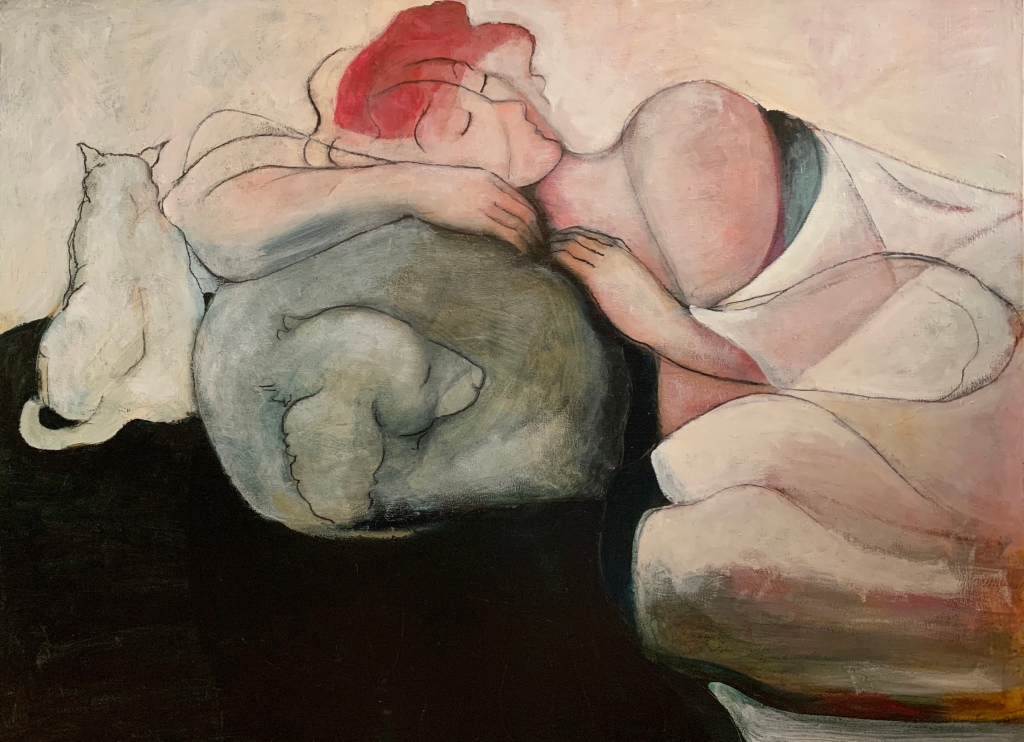
Nap with DogDog & BabyCat, 36″x48″, mixed media

read Kerri’s blogpost about A NEW DAY

share. support. subscribe. like. comment. thank you.

Don’t Wait! [David’s blog on saturday morning smack-dab]

I’ve shared Master Marsh’s insight before: “Customer service…” he said, “…is a firewall against serving the customer.”

This smack-dab is hot off the reality press; it just happened. When she hung up the phone, she immediately reached for the computer. “What are you doing?” I asked.

“You’ll see.” she smirked.

It tickles me that Kerri so readily translates and transforms her real-world experiences into our cartoon land personas. If nothing else, if no one on earth ever reads our weekly comic strip, of this I am certain: smack-dab is good for our mental health.

“As the customer, isn’t the business supposed to be valuing our time above their time?” I asked, knowing I was about to get that special stink-eye saved for my too-idealistic-no-duh-commentary. She didn’t disappoint!

“Where’s the complaint department?” I asked in mock rage.

She smiled, “Your wait time will be three hours and fifteen minutes.”

read Kerri’s blogpost about WAIT TIMES

Bonus cartoon from the Flawed Archive:

share it. like it. support it. comment on it. we thank you for any or all of it.

buymeacoffee is a tip jar dedicated to keeping cartoon characters real.

Grok The Rule [David’s blog on Two Artists Tuesday]

“A good poem looks life straight in the face, unflinching, sincere, equal to revelation through loss or gain.” ~ David Whyte

A good rule of thumb in the visual arts: areas of high contrast, in color-or-value, come forward while areas of low contrast retreat. Landscape painters use this rule to create the illusion of foreground and distance. Abstract painters use this rule to move the eye around a composition.

Storytellers and poets use the same rule. High contrast creates interest. It grabs attention. Low contrast sets the environment, the mood. “Some kind of relaxed and beautiful thing/ kept flickering in with the tide/ and looking around./ Black as a fisherman’s boot, with a white belly…” Dogfish by Mary Oliver.

Misused, it’s the rule-behind-the-reason that most of our news is “Breaking News!” False contrast. Hype. It’s the reason our national portrait is continually painted as divisive. High contrast pulls focus. The money follows the ratings so attention-grabbing is highly prized. Low contrast – like agreement, collaboration, sameness, community…truth – doesn’t generate the same level of interest or income.

Like all rules, there are worthy reasons to wield them. In the arts, the contrast principle is used to illuminate unity. To break an individual through to the experience of something bigger. To open questions. In our news-of-the-day, the rule is used to whistle a song-and-dance of discord and distraction. To separate into tribes. To manufacture the illusion of depth while sitting in shallow water.

The reasons to wield the rule are diametrically opposed.

It was a sad day when the young man, standing in our living room, told me that he would educate his child at home. His reason? He didn’t want his son to be stuffed with ideas. “Just the facts,” he said. “Just the facts.”

“Poor souls,” I thought of this man and his young child. How will they ever stare into the fiery face of democracy – an ongoing idea born of high contrast and wild ideas – the artistic kind, meant to bring people together in one nation under every possible god – like a poem. They won’t recognize democracy’s death when without question it slips like ashes through the fact of their fingers.

As for me, I’ll stick with the high and low contrast of Rumi, MLK, Shakespeare, Kahlil Gibran, Mary Oliver, Maya Angelou…

“Your task is not to seek for love, but merely to seek and find all the barriers within yourself that you have built against it.” ~ Rumi

[another worthy rule of thumb: never read the headlines prior to writing a post. All the icky-mush rushes to the foreground and permeates my brain]

read Kerri’s blogpost about FOG

like. share. support. comment. let us know you are out there.


buymeacoffee is a counterintuitive, highly appreciated, offering of support amidst a high contrast environment that keeps the artists among us hopping and hoping.

See The Unseen [David’s blog on Not So Flawed Wednesday]

20’s collections are surprising and always thought-provoking. For instance, he has a rich collection of images from the world that he calls “It’s good enough.” Jobs done poorly. The least amount of effort necessary to address a big job. Solutions that merely shift the problem. Beneath his series is a potent observation: this is what the world looks like when no one cares. Good enough. He is an artist of subtle yet powerful statements.

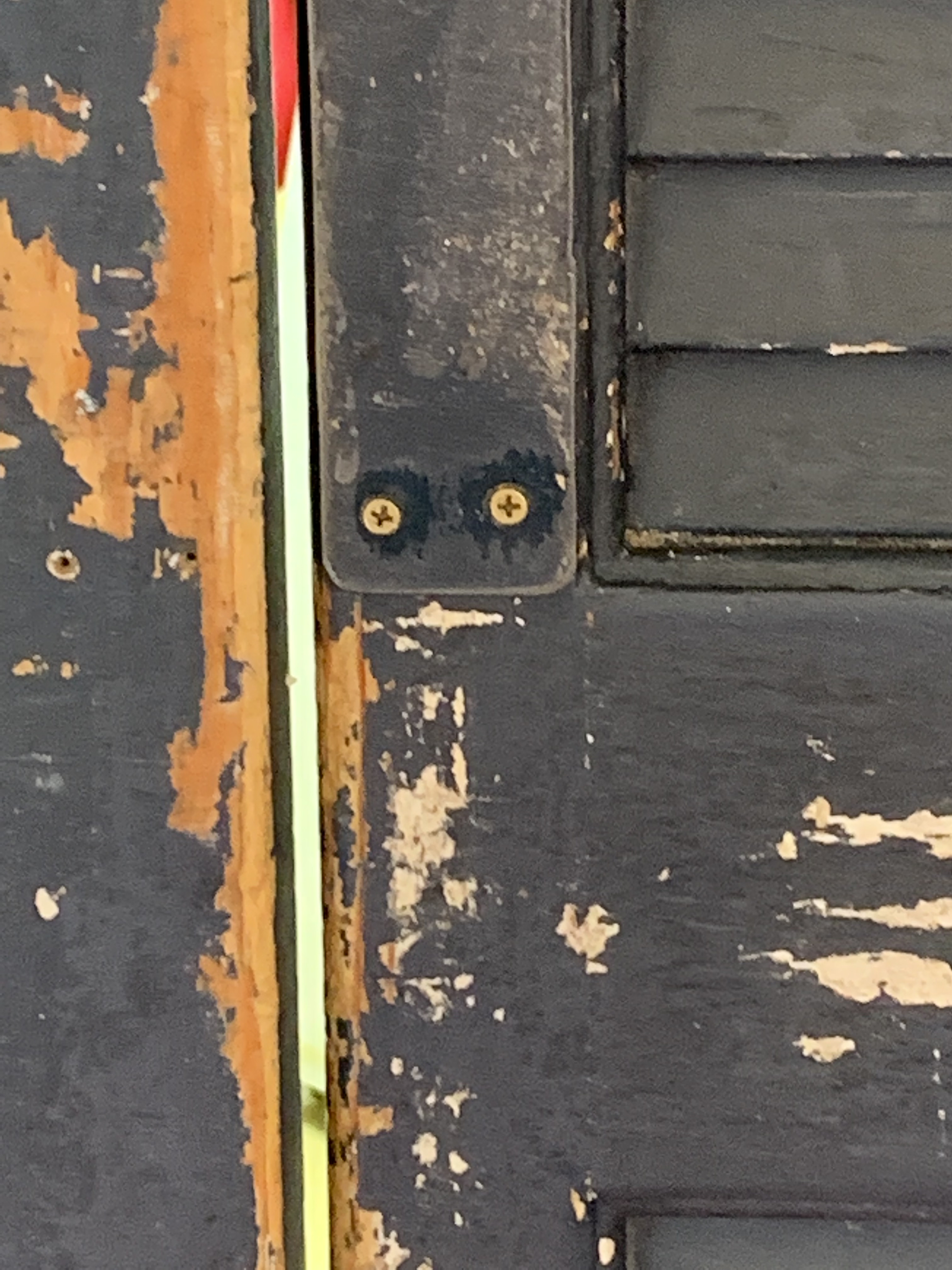
Another series that always makes me laugh is his “found faces” series. Electric outlets, manhole covers, utility plates, door knobs, that, once seen, gaze back at the viewer and can never be unseen. Now, it’s become a group sport. Kerri will stop suddenly, saying, “Oh! A face for 20’s series!” She adds to his collection. He adds to her collections.

It’s what artists are supposed to do for each other and the world. Open each others eyes to the whimsy and worth that surrounds us. To make the unseen seen, the familiar new.

Recently, at a coffeehouse near Madison, I heard the scuffle. Kerri and 20 both saw the face in the door and leapt to capture it. “Did you see it, too?” they simultaneously chimed, snapping away, bobbing around each other to capture the found face.

They are like siblings, a brother and sister competing to get the first photo. Laughing and jabbing ribs. My job is to sit back and appreciate the beauty of being surrounded by so many artists’ eyes – wide open and helping each other – and me – see and fully experience this surprising and mysterious world.

read Kerri’s blogpost about FOUND FACES

like. share. support. comment. many thanks!

buymeacoffee is a “tip jar” where you can support the continued work of the artists you appreciate.

Love Both Ends of the Spectrum [David’s blog on saturday morning smack-dab.]

Training manual for an artist’s life: there are times of plenty. There are times of pain. In the times of plenty it is impossible not to know there will be times of pain. In times of pain, it is impossible not to believe that there will be times of plenty. The tide rolls in. The tide rolls out (just as in every other life).

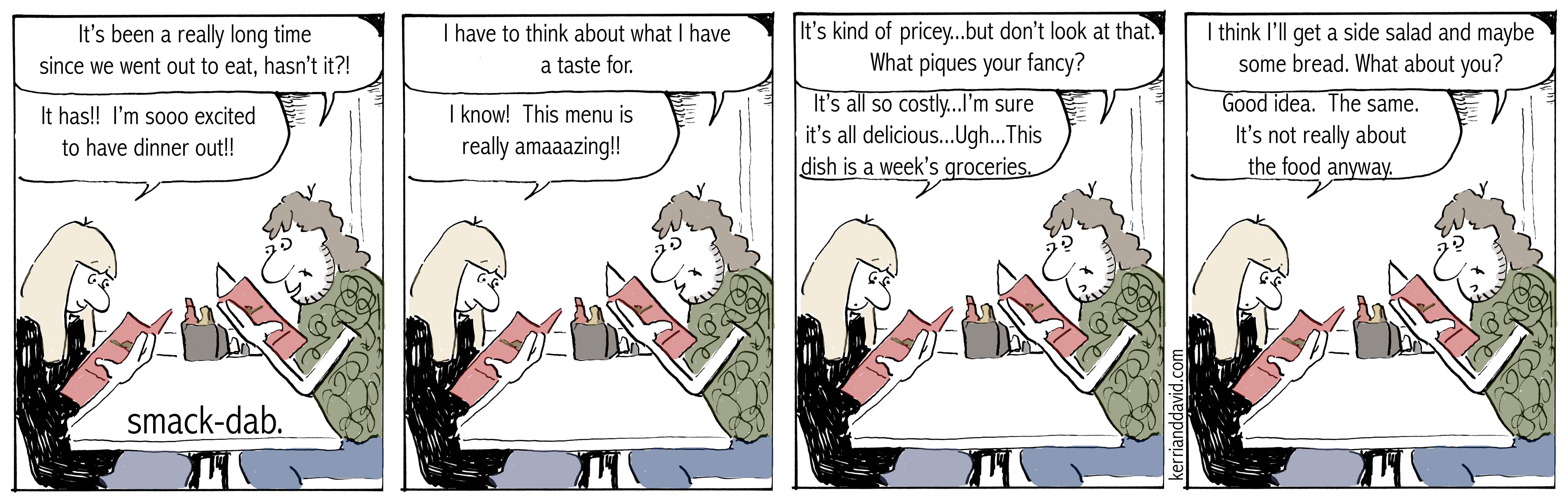
The results? There are two that accompany both times of plenty and times of pain. 1) The ever-present weird comparison. This meal = a week’s groceries. The weird comparison is probably why we love to cook at home. And we do. We love it. 2) The unassailable hope. It’s an exercise in focus-placement. It’s never really about the cost; it’s about focusing on the experience. We regularly split a burger and a glass of wine whether in times of pain or times of plenty. We regularly love every minute.

Pain and plenty are both worthy experiences on the full palette of life. We are capable of savoring a side salad. We laugh all the way home because the tip is often the most expensive portion of our bill (our daughter and my mother did serious time as wait-staff and we know the value of a great tip).

Loving both ends of the spectrum simply means that we are fully loving life. And we are. It’s not really about the food anyway.

read Kerri’s blogpost about SIDE SALADS

share. like. support. comment. thank you.

smack-dab. © 2023 kerrianddavid.com

buymeacoffee is a “tip-jar” site that allows you to support the continued work of the artists you value.

Keep The Connection [on DR Thursday]

A Haiku: Sun bathes the hilltop/Green grass, stones etched, dates with names/Here, we meet again.

Carvings in stone. I’ve read that among the first evidence of human-made-art is associated with funerary rituals. Send the soul on their journey with the proper talismans. There are petroglyphs, too. Scratches in stone. A message? A journal? A reach to the “beyond”? A handprint on the wall of a cave.

The earliest Greek theatre was a religious ceremony. A portal for the gods to come through and speak. Can you imagine the role and responsibility of the playwright?

I watched a Rangda ritual in Bali that shook my world. Priests with knives ran at the Rangda, stabbing and stabbing. The knives bent, the Rangda taunted. One of the priests fell into a trance and began channeling a voice from beyond. The entire community leapt to surround the priest and hear the ancestor’s message. As introduction to the ritual, the only English speaker in the village told us something akin to: “What we have of value to share is our art.”

Can you imagine? An entire community that held their art and artists as sacred. Valuable. As the means to connect to their ancestors. It was so profoundly moving that I couldn’t sleep that night. What I had known and experienced personally was, in this place, alive in the public heart. I mourned the art-poverty of my nation and community. We tape bananas to the wall and lose ourselves in a made-up-maze of the conceptual.

I was taken aback in the pioneer cemetery. Most of the headstones were homemade, a red-brown sandy-cement with shells or rocks pressed in; a name scratched in the surface with a stick. Families doing their best not to lose their kin. Moving forward in time, we found a few stones made of marble and decorated by a stone carver. More substantial, perhaps, but the purpose remained the same. Keeping connected to what has come and gone. Attending to the ancestors. The story of us etched in stone.

shaman. 36x48IN. Oil on canvas. nfs.

read Kerri’s blogpost about THE CARVING

like. share. tip jar if you want to support our creating. pass it on. all are greatly appreciated.

Eat And Wait [on KS Friday]

“Neither the hummingbird nor the flower wonders how beautiful it is.” ~ unknown

Jay, Gay, and Kerri are waiting. They are watching for the return of the hummingbirds. The anticipation is palpable. Each day I come upon Kerri, staring out the kitchen window at the untouched feeder. She turns, and, mimicking a voice-over from a commercial for the television show, Wicked Tuna, she asks “WhehAuhThey?” I shrug. She returns to her watch.

A line from a book flashed into my mind. “I can think. I can wait. I can fast.” Siddhartha replies to the beautiful Kamala when she asks what he can do. Hold on! Waiting is a marketable skill! Of course!

Inside my mind, I practice my answer in an imaginary job interview: “Now, tell me, Mr. Robinson, what are your most valuable skills?”

“I can think. I can wait.” I say to the too-serious-HR manager. Note how I cleverly omitted the part about fasting. As a rule I’m hungry all of the time. I want to create the illusion of value without having to outright lie. If I don’t eat, I can’t think. Period. And, if I can’t think, waiting-to-eat is virtually impossible. Just ask Kerri about that day in Minturn, Colorado. It was almost ugly. I have a long way to go before I add fasting to my short list of valuable skills.

In my mind I don’t get a second interview. “We want someone who can fast,” the too-serious-HR manager smiles thinly.

“I’m certain I can work on my delayed gratification skills,” I say as I’m escorted to the door. Wow. Another lie. I’ve been working on delayed gratification for a lifetime and have made very little progress. “I didn’t want that job anyway!” I declare as I stumble onto the noisy street-in-my-mind.

All of this fantasy lying to myself has made me hungry. “Do you want to eat something?” I ask Kerri who’s keeping her hummingbird vigil. “I’m starving.”

“Yes,” she says. “When do you think they’ll get here?” she asks, suddenly becoming a 5 year old. “How will they find us?”

“They’ll be here soon,” I say, perhaps telling another fib. I have no idea when they will be here. “All we can do is wait,” I offer, quickly adding, “So, what do you want to eat while we wait?”

Kerri’s albums are available on iTunes or streaming on Pandora

read Kerri’s blogpost about HUMMINGBIRDS

waiting/joy! a christmas album © 1998 kerri sherwood

If you like this post, let us know or share it. Or, buymeacoffe.com. Thank you, all-ways.