Eat And Wait [on KS Friday]

“Neither the hummingbird nor the flower wonders how beautiful it is.” ~ unknown

Jay, Gay, and Kerri are waiting. They are watching for the return of the hummingbirds. The anticipation is palpable. Each day I come upon Kerri, staring out the kitchen window at the untouched feeder. She turns, and, mimicking a voice-over from a commercial for the television show, Wicked Tuna, she asks “WhehAuhThey?” I shrug. She returns to her watch.

A line from a book flashed into my mind. “I can think. I can wait. I can fast.” Siddhartha replies to the beautiful Kamala when she asks what he can do. Hold on! Waiting is a marketable skill! Of course!

Inside my mind, I practice my answer in an imaginary job interview: “Now, tell me, Mr. Robinson, what are your most valuable skills?”

“I can think. I can wait.” I say to the too-serious-HR manager. Note how I cleverly omitted the part about fasting. As a rule I’m hungry all of the time. I want to create the illusion of value without having to outright lie. If I don’t eat, I can’t think. Period. And, if I can’t think, waiting-to-eat is virtually impossible. Just ask Kerri about that day in Minturn, Colorado. It was almost ugly. I have a long way to go before I add fasting to my short list of valuable skills.

In my mind I don’t get a second interview. “We want someone who can fast,” the too-serious-HR manager smiles thinly.

“I’m certain I can work on my delayed gratification skills,” I say as I’m escorted to the door. Wow. Another lie. I’ve been working on delayed gratification for a lifetime and have made very little progress. “I didn’t want that job anyway!” I declare as I stumble onto the noisy street-in-my-mind.

All of this fantasy lying to myself has made me hungry. “Do you want to eat something?” I ask Kerri who’s keeping her hummingbird vigil. “I’m starving.”

“Yes,” she says. “When do you think they’ll get here?” she asks, suddenly becoming a 5 year old. “How will they find us?”

“They’ll be here soon,” I say, perhaps telling another fib. I have no idea when they will be here. “All we can do is wait,” I offer, quickly adding, “So, what do you want to eat while we wait?”

Kerri’s albums are available on iTunes or streaming on Pandora

read Kerri’s blogpost about HUMMINGBIRDS

waiting/joy! a christmas album © 1998 kerri sherwood

If you like this post, let us know or share it. Or, buymeacoffe.com. Thank you, all-ways.

Together Thrive [on Merely A Thought Monday]

“Art is an illusion that can convey the truth.” ~ Alex Grey

The little boy who was obsessed with drawing eyes – for hours on end – was not attempting to perfect the drawing; he was trying to reach beyond the visual and touch what was inside. Beyond. To the place of joining.

That motive has never wavered. I have always been at-service. For Kerri and me, art-as-service is the impulse behind our blogs. It’s at the center of our many cartoons. It’s the driving impulse in the plays I have yet to write and the few books that haunt me at night. It’s in the music Kerri amasses in her mind and hums when she’s walking down the trail.

We understand art is essential. That’s not an abstraction. Look into the abyss of your death and tell me where you go to wrap your mind around it? Politics? Business publications? Software? My bet is you read the poets. You listen to Arvo Pärt. You stare at The Sistine Chapel. You walk a labyrinth. You read the words of Anne Frank or ponder a psalm. How do you reach beyond what you can see and touch the essence of what is inside? Infinite? How do you make sense of the big questions? If we do good in the world, what does it inspire you to see? If you do good in the world, what does it help us to see?

It’s hard to put a price on it. It’s impossible to put words around it. And it is our reason for being.

Without you, we cannot thrive.

read Kerri’s blogpost about THRIVE

If you like this post, pass it on. Or, buymeacoffee.com. Or share your thoughts with us. All are appreciated. Thank you.

Appreciate The Glee [on KS Friday]

My “word-of-the-day” is bedight. Adorned. It seems most appropriate that this adverb popped in my box on this day of Forsythia. The trail was bedight in Forsythia. A sudden explosion of vibrant yellow.

I always look forward to the first Forsythia sighting. It’s the day Kerri dances in delight, chanting, “They’re back! They’re back!” Her relationship with Forsythia reaches into her childhood and has deep love-roots. My association is more recent: it’s the flower that makes Kerri dance. She runs to the vibrant petals to take a close-up. I stand back and appreciate the glee.

Dogga acts as if we are Forsythia. When we return home from errands – even if we’ve only been gone a few minutes – he jumps vertically at the backdoor, so excited is he to see us. Sometimes I like to go on errands just so I can come home to such a glorious welcome. Who doesn’t want to be greeted with out-of-control enthusiasm!

Yesterday, after a particularly arduous slog through the day, Kerri sat on my lap and declared, “We are successful at nothing!” We burst into laughter. Zero. Nil. Nada. Zip. Bupkis. Nought. Naught. And Zilch. And, into that vast nothing, we pour our good laughter and heart until our nada-cup runneth over.

She did not say that we are unsuccessful. Our particular form of success, apparently, is no-thing. Like Glee. Or enthusiasm. Or music. Or beauty. They are hard to wrap your fingers around. They are even harder to assign concrete monetary value. What is our work worth? What – exactly – is our work? Beyond no-thing?

Yesterday I asked Arnie the to ponder the same question I’ve asked many of my wise-eyes pals: why would people support us? Financially? Beyond caring for us or liking us (trust me, we are wildly abundant in love and friendship), why would someone – anyone who doesn’t know us – support our work? What do we bring of value to the community? For us it’s confusing. Approximately 1,500,000 people listen to Kerri’s music every year through streaming services and she receives nearly-nada. Our blogs and cartoon have reached people in over 80 countries. We love to write together. We love to share what we create. Is there concrete value to what we offer? No-thing? If so, what is it called? What could it be? What shape is graspable? We are sitting on the mountain so we cannot see it. What are we missing?

Mostly, we hope to bedight the life-trail – yours and ours – with the vibrant yellow that lives beyond words and evokes spontaneous dancing. Mostly, if it doesn’t make you dance, we hope it helps you stand back and, like me, appreciate the glee.

Kerri’s albums are available on iTunes or streaming on Pandora

read Kerri’s blogpost about FORSYTHIA

the way home/this part of the journey © 1998 kerri sherwood

If you appreciate this post, share it. Or, buymeacoffee.com. Or share your thoughts with us. Thank you.

Turn Around And Look [on DR Thursday]

One little line gives reference to the whole. The horizon line. It is how we naturally – visually – orient in space. It is a baseline of perception. It’s the beginning of discernment.

It is a line that disappeared.

Among other things, art is a reflection of its time. In the past century, art leapt into the abstract. We are “post-modern”. Expressions of personal fantasy rule over community truth, a breaking apart of shared ideals, instant doubt of objective theories…we are mirrored in post-modern art. What is art? What is it not? There’s not a whit of agreement to be found.

General distrust is the beating heart of the post-modern ideal. Division, aggression, tribalism, conspiracy…are its blossoms. Our children perform active-shooter-drills in school; a performance we shudder to attend while our leaders smile and look the other way. Post-modernism at its finest. The absence of a baseline.

Shared truth, group trust, community…requires an undeniable horizon line.

What is up? What is down? What has value? What does not? What has merit? What is undeserving? There is a line. Where is it?

Walking through the antique mall, Brad and I discussed chatGPT. I’m playing with it; he’s using it in his work. It’s raising some very big questions. The questions are not new. They are the next step in a series of questions people have been asking for the past 30 years: what is true? A photograph was once proof that something happened. That hasn’t been true for a few decades. A video was once proof an experience occurred. That is no longer true. News – a word that once implied the accurate reporting of an event. No more. No horizon line.

Brad and I turned our discussion to a sorely missing quality in our times: discernment. In the absence of a horizon line, people will – and do – believe anything. We speculated that, with the introduction of chatGPT into our world, perhaps discernment will once again become important. Perhaps the complete absence of a truth-anchor will turn us toward a common center and require us to look at each other, to seek and restore general trust. The post-modern tide will someday turn and we will draw an old/new line in the sand: we’re-all-in-this-together.

I know, I know. Pie-in-the-sky. However, I’d like to point out that shared dreaming brought us here. Shared dreaming is how we stood on the moon. It is how we can talk to someone across the planet using a small device that fits in our pockets. When a dream becomes shared it becomes powerful. Manifest. A shared dream is a form of a horizon line.

If a shared dream isn’t powerful enough to establish trust, try remembering the other one; the original line of discernment. The line that invites curiosity. It need not be debated. Turn around and look. The horizon line is everywhere.

Four-by-Four, 48x48IN, acrylic, (sold)

read Kerri’s blogpost about THE HORIZON

4×4 © 2007 david robinson

Dance [on DR Thursday]

“The human race has spent several millennia developing a huge and robust set of observations about the world, in forms as varied as language, art and religion. Those observations in turn have withstood many – enormously many – tests. We stand heir to an unstatably large set of meanings.” ~ David Bayles & Ted Orland, Art & Fear

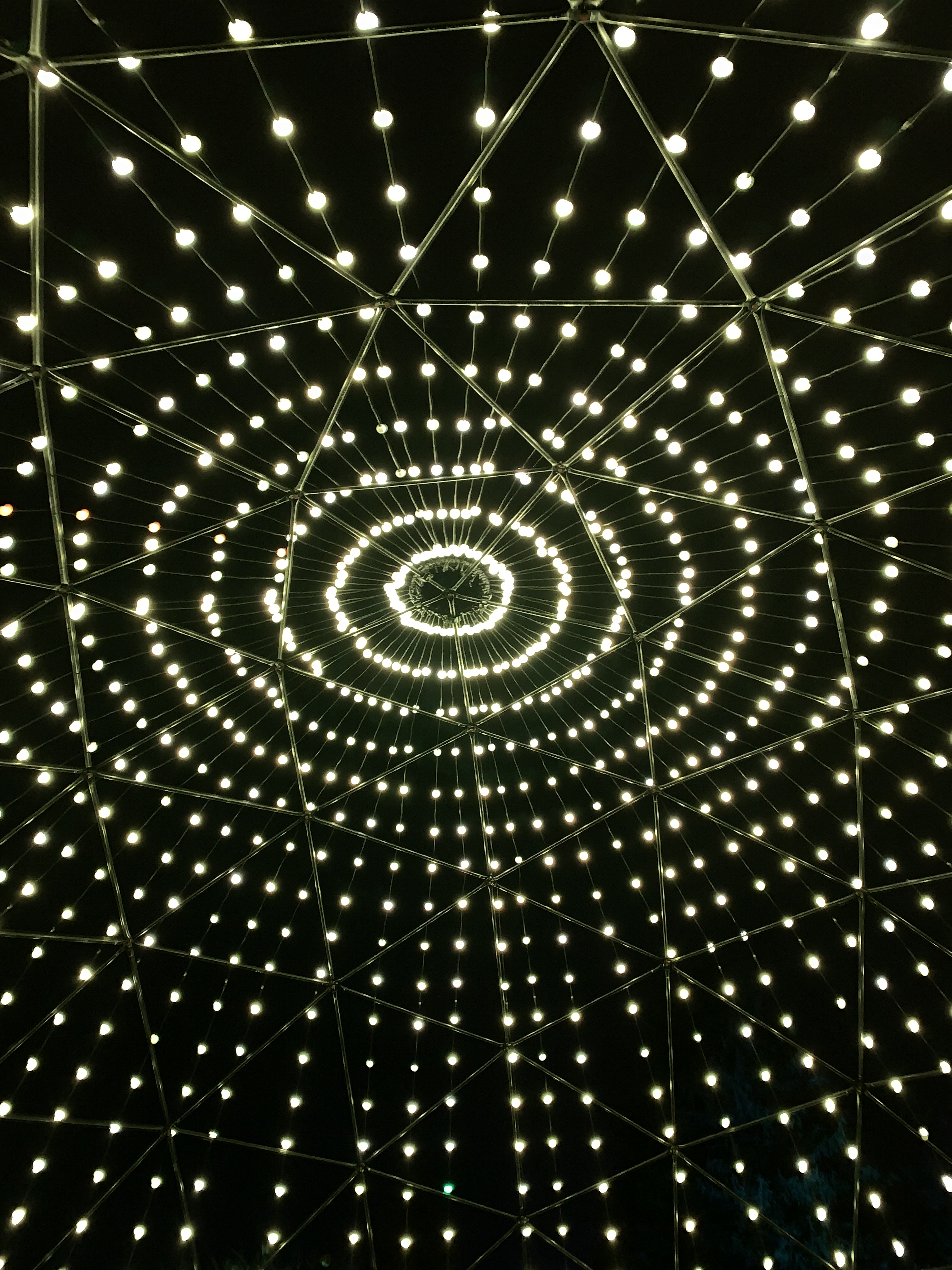
The little girl shrieked with delight, “You can stand in it!” She raced inside the dome, her little body so teeming with enthusiasm that she danced. The crowd burst into laughter.

Joy is contagious.

She reminded me of the children I saw dancing at the base of Christo’s Umbrellas. She transported me back to the very first time Kerri and I stepped off the stage after our performance of THE LOST BOY. We were euphoric, so overrun with relief and triumph that we jumped up and down in the backstage hallway, laughing and hugging. Dancing. We couldn’t help it.

I remember that moment when people ask me why I make art since art makes no money. I’ve learned to answer the question, not with words but with a smile.

Value is perceived.

I stepped into the dome repeating to myself, “You can stand in it.” A dome of light. A constellation of thought. The earth rotates around the sun. Joyful participation in the sorrows of the world. Do unto others. There is not one way, there are many paths up the mountain. Discovery is better than invention.

Meaning is made. It’s an ongoing relationship.

Sometime you know that you enter it. Sometimes you don’t know and the dome you discover evokes a joyous dance.

read Kerri’s blogpost about DOMES OF LIGHT

Iconic, 54x54IN, mixed media

[my site is down. A new site is in the works. New works are also in the works. Good things]

iconic © 2010 david robinson

See The Glue [on Not So Flawed Wednesday]

It’s a new phrase to me but I liked it immediately. I liked it because I have known some amazing people, those rare birds who keep the runaway-egos focused on the project, who naturally and seemingly without effort coalesce disparate talents into a cohesive creative team. The ‘glue people’ is a perfect description.

Glue people intuitively understand power as something that is created between people, not something wielded over people. I suspect that is the epicenter of their glue-gift: they see beyond the parts to the sweeping possibility of the whole. They know that “every man/woman for themself” is a recipe for disaster.

Despite our dedicated cowboy mythos, innovation is never the province of a single person. There may be a single visionary but the vision is never accomplished in a vacuum. Inventions, like organizations or nations, come to fruition through the efforts and skills of the many-working-as-one. Glue people generate “the-working-as-one.”

Stage managers, production managers, executive assistants, contractors…those highly overlooked people at the center of the information, who quietly make sure the work of creation happens without collision while also making certain all the parts and pieces know how much they are valued.

Meaning makers. Making value explicit. Glue people. Just try to get an idea off the runway without them.

read Kerri’s blogpost about GLUE PEOPLE

Look Back [on Not So Flawed Wednesday]

Our 3am conversation was about the horrible clothes we once wore. We both lived through the 70’s and 80’s so there was plenty of fodder for shudders and laughter. I couldn’t be more delighted that cameras in that era used film that was expensive to process, and were not ubiquitous, so there’s limited visual proof of the alarming garments of my past.

Looking back. My favorite aspect of our horrible-clothes-conversation is how much we loved the offending items when we wore them. I had a Huckapoo shirt that was only worn on special occasions. I’d scream and run from that shirt if I opened my closet and found it there today. Kerri described a favorite periwinkle blue dress with black polka dots that had me crying with laughter. The woman I know would faint in fright if she awoke wearing that dress. “Get it off! Get it off,” she’d scream, as if it was a spider.

For two people who spend most of their lives wearing black thermal shirts and blue jeans, it was delicious to trace our past lives through the costumes we’ve worn. The people we were. The investments we made. The colors we donned.

What was sacred is now profoundly silly. What was serious is now grin-worthy. What seemed so important turned out to be so-much-powder.

“Time just rolls. It just keeps rolling,” she said. The hard times and the good times. Hang on long enough and what-is will become what-was and a new-thing will have replaced the previous thing. “It just rolls on through.” At 3am, what matters in life could not be more clear. It’s the conversation. The laughter at our foibles, the sweet, “Shall we try and get some sleep?” It’s what we will see of this age when time rolls on and, late one sleepless night, we look back.

read Kerri’s blogpost about LOOKING BACK

Feed It [on KS Friday]

“The devaluation of music and what it’s now deemed to be worth is laughable to me. My single costs 99 cents. That’s what a single cost in 1960. On my phone, I can get an app for 99 cents that makes fart noises – the same price as the thing I create and speak to the world with. Some would say that the fart app is more important. It’s an awkward time. Creative brains are being sorely mistreated.” ~ Vince Gill

I am the first in line to tell you that everyone has a creative mind. Everyone. That river of ridiculousness running between your ears is nothing other than creativity-run-amok. What else? Telling yourself that you are not creative is, in itself, a creative act. Seeds planted early in life grow into mighty obstructions. Creative wastelands are created. If you want to hear a terrific appeal to educators to nurture rather than stifle the creative mind, listen to Sir Ken Robinson’s 2006 Ted Talk. It’s appropriately titled “Do Schools Kill Creativity?”

I’ve listened to numerous school boards tell me how much they truly value the arts – until it’s time to pay for it. Sadly, it’s not a question of whether or not they value the arts; it’s that the arts, the creative minds, do not fit any of the standards of valuation against which all things are measured. They do not know how to value the creative minds that they steward. Arts organizations and artists, mostly, are not money makers. Creative minds, creative acts, do not fit in the boxes and are not measurable on standardized tests. Thinking outside of boxes is, after all, the point of a creative mind. Metrics and goals stop a creative mind and heart in its tracks. The cruelest thing you can ask any artist to do is write a grant.

And yet, an artist has to make a living. Yaki asked me if I had to choose between making a living and making my art, which would I choose? I answered, “Art, of course,” but that it was really a question of Maslow’s hierarchy: it’s hard to make art when you are not surviving. What I didn’t say is that his question perfectly captured the reason schools kill creativity and creative brains are sorely mistreated: it is assumed one must choose between. Making a living and thriving creativity are understood as oppositional.

How many parents have tried to dissuade their children from following their passion for the arts? How many times have I heard Kerri say of the stacks of music on her piano waiting to be recorded, “What’s the use?” How many times have I sat in my basement studio looking at my stacks and rolls of paintings and wondered, “Why bother?” We do it to ourselves, too.

And then, the phony metric falls and we breathe, pick up our brushes and sit at our keyboards. There is a river of riches that runs deeper than money. It is, after all, a creative act to kill a passion. It’s also a creative act to feed and nurture an artistic soul. Both. It’s what the school board doesn’t understand: the choice is not between making a living or living as an artist, the choice is between feeding inspiration, expanding a creative mind, or smothering it.

read Kerri’s blogpost about CREATIVE MINDS

Kerri’s albums are available on iTunes and streaming on Pandora

watershed/as it is © 2004 kerri sherwood

Draw A Chalk Circle [on Merely A Thought Monday]

There are charts for everything. Definitions and distinctions of value meant to clarify but, in the end, make life seem more and more farcical. For instance, we recently were directed to a worker’s compensation website and learned that losing your hand in an accident is worth 400 weeks of [minimal] compensation. The dominant hand is worth more than the non-dominant hand. Fingers have less value-in-weeks than a thumb. Just imagine the guys-and-gals-in-suits sitting around a conference table discussing the value of a human hand as expressed in weeks. Sometimes I’m certain that we live inside the mind of Gary Larson.

Is it no wonder that we are confused about the value of a human life? We have actuaries calculating human-life-value and making smart looking tables with support graphs to answer this most fundamental question. I’m certain that those guys-and-gals-in-suits sitting around the conference table would come up with a different answer if it was their hand or fingers or toes or life on the chopping block. If it was their child’s eye or foot. Charts, like all data points, are not personal.

We awoke this morning to the news that the latest mass shooting (if 4 or more people are shot it is, according to the FBI, considered “mass”) was in our town. We are number 47 since March 16. March 16 is the date of the mass shooting in Atlanta; 8 people were killed. Here are some nifty and comprehensive charts on gun violence in America.

When I was in elementary school we did safety drills, crawling under our desks, in the event of an atomic bomb drop. Although I was certain that my desk was not going to protect me in the event of an atomic explosion, I was comforted by the knowledge that the enemy was far away, external. Now, our children in elementary school do active shooter drills and they, too, know that their desks offer little protection. But their predicament is dire: the enemy they face is right here. It is everywhere, internal. Sitting under my desk I knew there was an entire military machine between me and the potential dropper of atom bombs. Sitting under their desks, our children know with certainty that there is nothing, not even legislative will, standing between them and the ubiquitous shooter.

I once listened to an author speak about the difficulty of writing a farce about the USA. He said, “Before you can a publish the book, the fictional farce that you’d written will have actually happened.” Our scary farce: the only answer we can muster to daily mass killing in schools, grocery stores, work places, concerts, houses of worship…the only idea that the markets will support in an out-of-control gun culture, is more guns. Sales charts and political donation data drive policy to dedicated inaction. [For some lightheartedness in the midst of this dark-and-dismal post, go here. I laughed aloud when I heard comic Steve Hofstetter riff on gun control.]

What is the value of a human life?

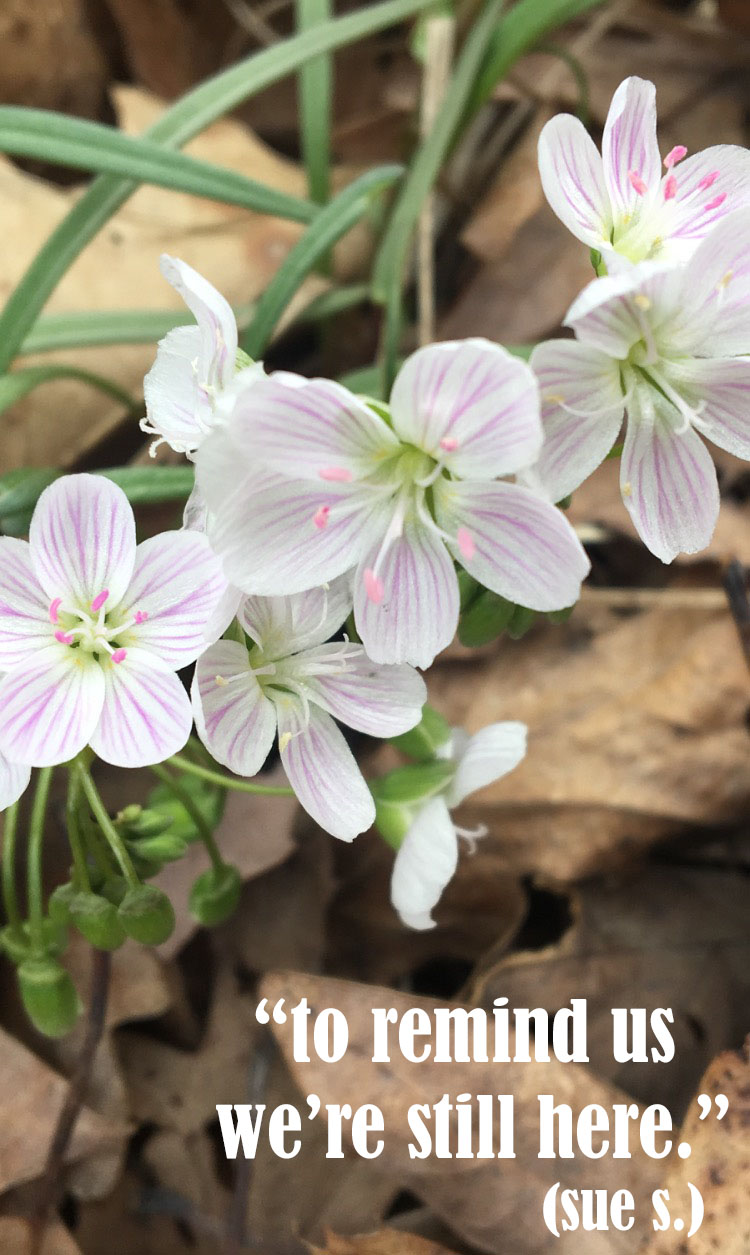
We had a lovely conversation in the grocery store. An accidental path crossing with friends. Sue remarked, as we compared life experiences, that our personal challenges are meant to remind us that we are still here.

What is the value of a human life as determined by those of us who are still here?

Bertold Brecht wrote a play called The Caucasian Chalk Circle. Two women claim to be the mother of a small child. A judge has to settle the case. He has a small circle drawn on the ground. The child is placed in the circle. The judge instructs the women to stand on opposite sides of the circle, each taking one of the child’s hands. The woman that successfully pulls the child from the circle will be declared the mother. One woman quickly yanks the child from the circle. The other will not pull. She refuses. She cannot do harm to her child. She proves herself to be the true mother.

I wonder what we might value if we could put down our charts and data points and amendments-as-seen-in-isolation-from-all-the-other-amendments, step beyond our abstractions, and draw a simple circle in the dirt. What might we discuss if we placed a small child in the circle, and considered the value of that one precious life? My bet is that none of us would yank that child out of the circle of life. We’d do everything imaginable to protect the child from harm. To keep it safe. Sales graphs and actuary tables and every other dehumanizing analytic would drop away. We would, in considering the beating heart of our public dangers, make the safety of the child, of every child, our personal challenge. It would slap us awake and remind us that we are still here. Alive. And, as custodians of the circle of each and every actual life, we are responsible to and for each other.

read Kerri’s blog post about STILL HERE

Walk With Joey [on Not So Flawed Wednesday]

We owe Joey Coconato a debt of gratitude. He has unwittingly made our journey through the pandemic-year-of-isolation, not only bearable, but expansive. We’ve hiked with him through the canyons of Utah, the back country of Yellowstone, off trail in Glacier National Park. We’ve crossed glaciers with him, forded multiple rivers, traversed gorgeous rock benches, dodged thunderstorms, quivered at some serious exposure, shivered and sweated. We’ve cracked a beer with him in celebration of standing on a high pass. We’ve enjoyed some box wine and dubious meals while staring into a crackling fire.

His YouTube channel, My Own Frontier, is the chronicle of a man who is more John Muir than Steve Jobs. He’s pretty much left the mania of this society for the majesty of the outdoors. His early backpacking films betray a man on the cusp of jumping into the life he wants to live; his look more urban than rustic, a man preparing to find his voice. Within a year, he robustly unzips his tent and in a spirit free and playful announces in a voice undivided, “Well good morning! We’ve made it to day #2!” His enthusiasm for the new day makes us smile. The jump is complete, his hair is long, his equipment is in full disarray from overuse.

Joey walks the earth. He is living the kind of life that most people desire but fear. He’s tossed away his safety net. He stands face to face with the great unknown. He makes a plan but adjusts according to the forces of nature. He places himself squarely within those powerful forces with no shield or 401K. Rather, he invests in a deep respect for the lightning and proper relationship with the bears. Finding a beautiful meadow, enjoying the color of the aspen trees or the rock formations in a canyon, is his gold. He establishes his camp so that he might enjoy the views and spend time with the stars.

He’s quick to tell us that he is not a guide. He enjoys making his films and hopes that we enjoy them, too, but we are not to plan our back country trips according to his story or route. It is the very thing that we find compelling about him. He is clear. He is not invested in any way in what others do or think. He is creating his way. Your way is entirely up to you.

But he is wrong about one thing: he is, without trying, a guide. He is a master of simple appreciation. He’s stripped away the Walmart stampede and cuts through the luxury car illusion. With the wind gently blowing through his mic, standing on the shore of a mountain lake, and lets slip his quiet awe: “Sometimes I’m struck that this has been here every single day of my life. It was here before I was born. It will be here long after I’m gone.” He is a guide of perspective, a teacher of value, one of those rare beings that doesn’t get lost in the glitter and the noise.

read Kerri’s blog post about JOEY