Posted on February 5, 2022 by davidrobinsoncreative
Once, after sleeping through the sunrise at a rest area, we drove through a Starbucks without stopping at the order kiosk. The kind young woman at the window, after politely telling us that we hadn’t yet ordered, brought us vats of coffee for free. She said we looked like we needed it. And, we did. We needed it.
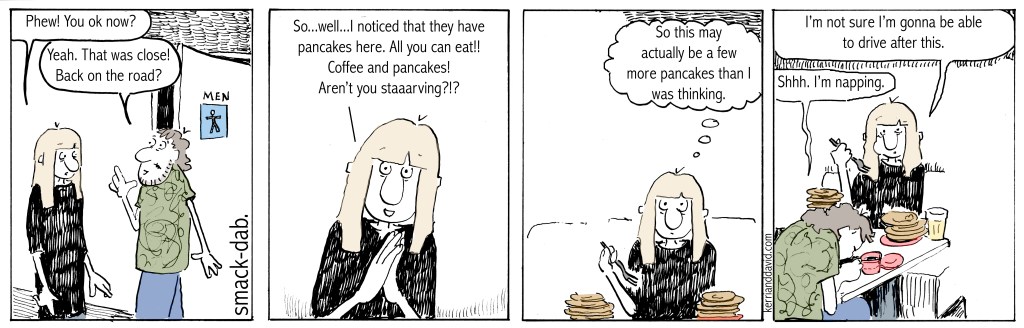
I suppose we don’t really know what is good for us. That might be the reason we regularly step into the ridiculous and only recognize that it is ridiculous after-the-fact. My favorite part of our folly is the paradox that makes it all possible: we have the spirit of feral cats but were raised to be polite and clean our plates. It’s this inner collision that makes possible each and every attempt at scaling Mt. Pancake.
We’ve yet to summit. But, never fear, the next time all-you-can-eat crosses our fancy, we’ll get out the ropes and pitons, the special forks and belts that loosen-a-notch or two, and we’ll climb that mountain until I collapse in the booth and Kerri glazes over in a pancake-coma. Some nice serving person will gently take our plates and tell us to take our time. “No rush,” they will say, “You look like you need to sit for a while.” It’s a wonder they don’t take our car keys.
Posted on February 4, 2022 by davidrobinsoncreative
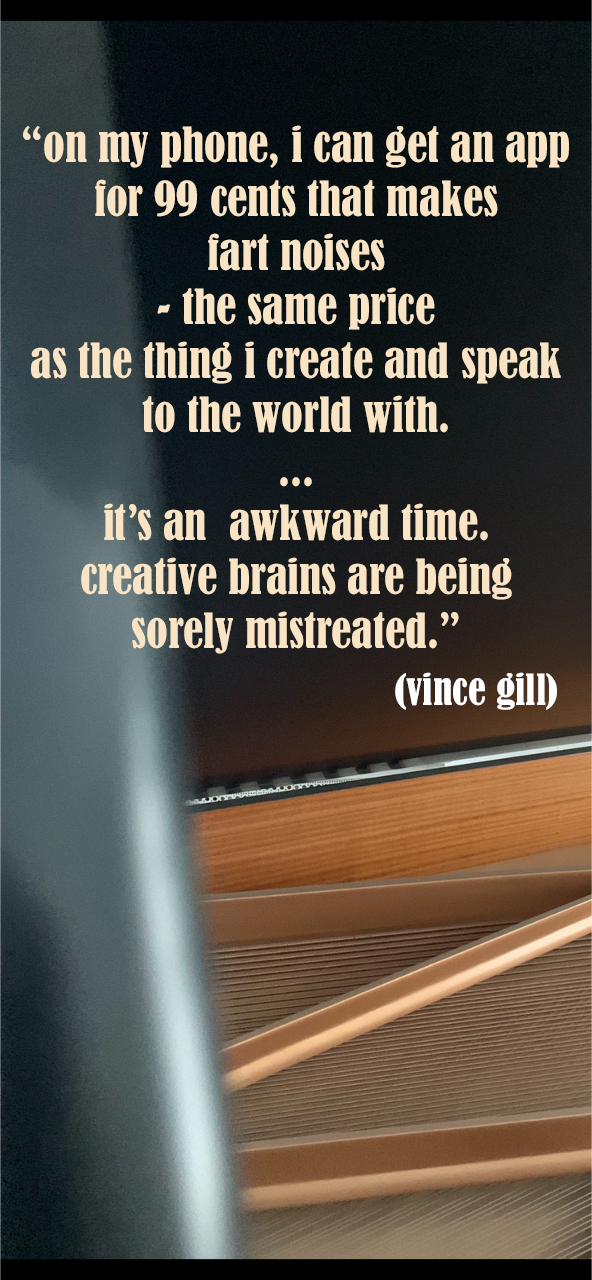
“The devaluation of music and what it’s now deemed to be worth is laughable to me. My single costs 99 cents. That’s what a single cost in 1960. On my phone, I can get an app for 99 cents that makes fart noises – the same price as the thing I create and speak to the world with. Some would say that the fart app is more important. It’s an awkward time. Creative brains are being sorely mistreated.” ~ Vince Gill
I am the first in line to tell you that everyone has a creative mind. Everyone. That river of ridiculousness running between your ears is nothing other than creativity-run-amok. What else? Telling yourself that you are not creative is, in itself, a creative act. Seeds planted early in life grow into mighty obstructions. Creative wastelands are created. If you want to hear a terrific appeal to educators to nurture rather than stifle the creative mind, listen to Sir Ken Robinson’s 2006 Ted Talk. It’s appropriately titled “Do Schools Kill Creativity?”
I’ve listened to numerous school boards tell me how much they truly value the arts – until it’s time to pay for it. Sadly, it’s not a question of whether or not they value the arts; it’s that the arts, the creative minds, do not fit any of the standards of valuation against which all things are measured. They do not know how to value the creative minds that they steward. Arts organizations and artists, mostly, are not money makers. Creative minds, creative acts, do not fit in the boxes and are not measurable on standardized tests. Thinking outside of boxes is, after all, the point of a creative mind. Metrics and goals stop a creative mind and heart in its tracks. The cruelest thing you can ask any artist to do is write a grant.
And yet, an artist has to make a living. Yaki asked me if I had to choose between making a living and making my art, which would I choose? I answered, “Art, of course,” but that it was really a question of Maslow’s hierarchy: it’s hard to make art when you are not surviving. What I didn’t say is that his question perfectly captured the reason schools kill creativity and creative brains are sorely mistreated: it is assumed one must choose between. Making a living and thriving creativity are understood as oppositional.
How many parents have tried to dissuade their children from following their passion for the arts? How many times have I heard Kerri say of the stacks of music on her piano waiting to be recorded, “What’s the use?” How many times have I sat in my basement studio looking at my stacks and rolls of paintings and wondered, “Why bother?” We do it to ourselves, too.
And then, the phony metric falls and we breathe, pick up our brushes and sit at our keyboards. There is a river of riches that runs deeper than money. It is, after all, a creative act to kill a passion. It’s also a creative act to feed and nurture an artistic soul. Both. It’s what the school board doesn’t understand: the choice is not between making a living or living as an artist, the choice is between feeding inspiration, expanding a creative mind, or smothering it.
Posted on February 3, 2022 by davidrobinsoncreative
I memorized Sonnet 30 for an acting class when I was in school. “When to the sessions of sweet silent thought…” For reasons I can’t explain, I still remember it. I can barely remember my zip code but Sonnet 30 has stuck around. “…I summon up remembrance of things past.”
I watched Dogga this morning. Standing in the middle of the yard, barking for friendship’s call. He’s not been the same since BabyCat passed. He’s still trying to find his place. Each morning after breakfast, he returns to the kitchen and lays on the floor. It was his ritual with BabyCat. They’d mooch some bites and when there was no more hope of food, they’d jump down and snooze together in the kitchen. Now, he assumes his usual spot but only for a few minutes. It’s not the same so he moves to the backdoor or the rug in the living room.
He’s always been a snow dog. When we think it’s too cold to go out, he thinks it’s balmy and perfect. After his daily unsuccessful bark-and-response, he finds a good pile of snow and lays in it. I tell Kerri that he is surveying his vast territory. He’s an Aussie so he likes having a job. Surveying the territory, watching for marauding squirrels, provides purpose. There is no more joyful moment in our house than when it’s time to take out the trash. He loves being the advance team. He leaps vertically at the back door, his joy is too great for his little body to contain. Clearing the yard of danger, I have safe and secure passage to the cans and back to the house.
This morning, as I watched him snuggle into his snow pile, Sonnet 30 rushed to the fore of my mind. “But if the while I think on thee, dear friend, All losses are restor’d, and sorrows end.”
Posted on February 2, 2022 by davidrobinsoncreative
From the school of if-you-are-sitting-on-the-mountain-you-can’t-see-it comes the hot mess we call healthcare in these un-united-united-states. Insanity never looks at itself and says, “I’m insane.” Our system of healthcare – and I use the term “system” loosely, is insane. In my sordid past as an organizational consultant I facilitated an experience called reverse design: ask people to design the worst system possible. The worst product imaginable. Hilarity ensued. None of those mad-mad sessions could have concocted what we call healthcare in the richest nation on earth. It seems the money has both blinded us and made us batty.
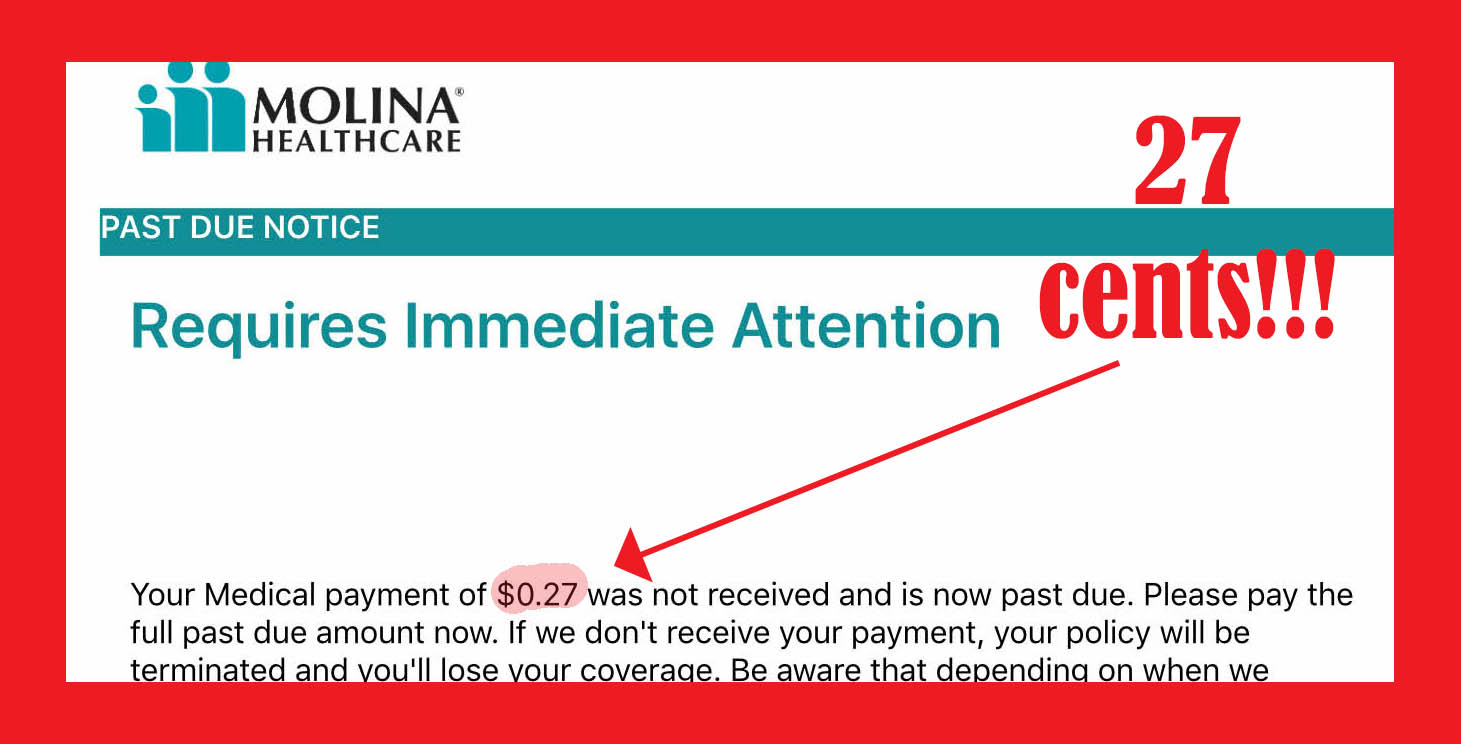
I just asked Kerri how much a postage stamp costs. “58 cents,” she grumbled, “And we got three mailings.” We finally achieved our get-out-of-jail-free card: a job with benefits. We canceled our ACA prison policy but, apparently, there was a one-day crossover in the billing cycle. I know a computer sent us the three-times-nasty-gram and spent $1.74 in postage to collect $.27. No human was involved though, having spent an inordinate amount of time on the phone with people paid to try and make sense of the nonsense, we’ve learned how numb the human mind can become when sense-making in a swamp of gobbledygook. We paid our debt online.
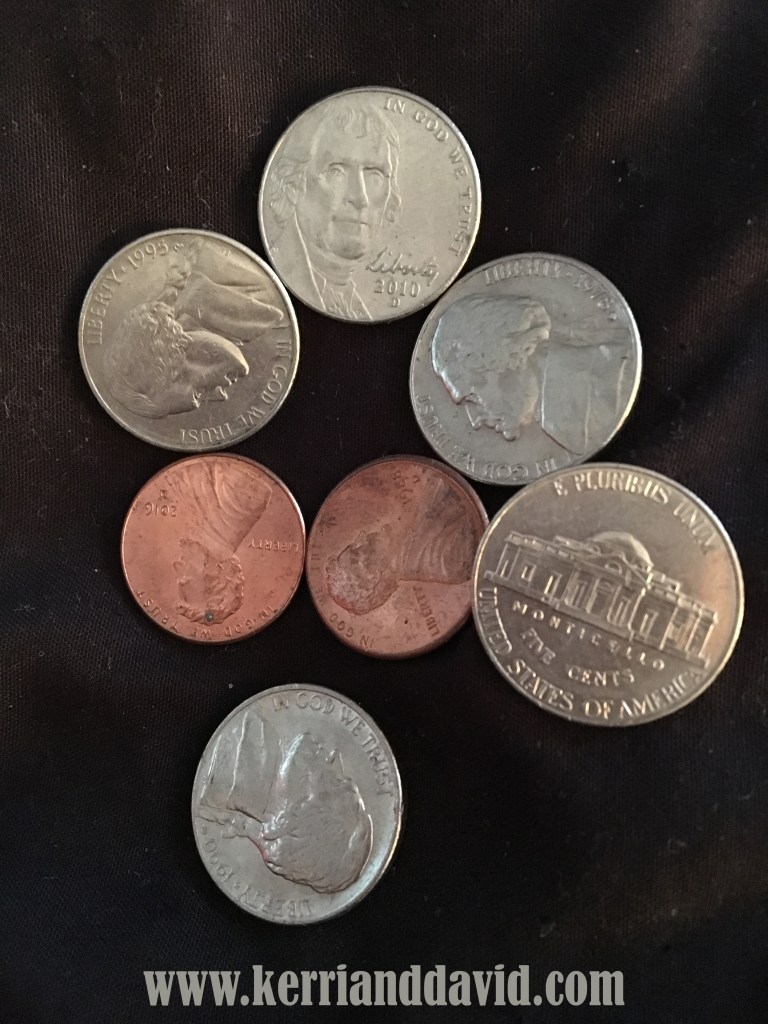
No human involved. De-human-izing. The Turing test is…a test of intelligence in a computer. Is the machine’s behavior indistinguishable from that of a human being? Hubris is a human quality that imagines the computer will become more like us while not recognizing that, in the process, we are becoming less like us. I doubt the computer will ever evolve to that point of pomposity. I suspect that the computer will someday recognize the folly of attempting to model itself after something so flawed as human intelligence. What intelligent machine would model itself on beings that seem incapable of creating a competent system for the care of its own health? No advanced intelligence would submerge its prime directive for the secondary intention of stacking nickels and pennies.
Posted on February 1, 2022 by davidrobinsoncreative
I’ve re-read his email several times. Skip’s explanation of the development of the computer. Subject/Object. Noun/Verb. Items/Action. It’s a story of cause and effect. This causes that. I’ve learned more from this single email than from my very expensive graduate degree. And, it’s sent me down the rabbit hole and I am currently in a world easily as miraculous as Alice’s Wonderland.
Does the moon cause the tides? It does if you are an English-speaker. Causation is the foundation structure of the English language. An action needs an initiator. The noun is king. He kicked. The sea rocked the boat. The moon causes tides. If you speak Mandarin, the moon and the tides are inseparable, not perceived or described as separate events but as interconnected. The same dance, differentiated forms.
Where does an action begin? A consequence end? I warned you. A rabbit hole.
Our perception of the world has everything to do with the language we use to describe it. Our creating of the world has everything to do with the language we use to imagine it. In a world where actions are separate from items, verbs from nouns, this causes that, it’s easy to believe that order is separate from disorder, cosmos is separate from earth, humans are separate from nature. Death is separate from life. Is it?
Each year that passes I’ve noticed the world of written communication includes more emojis and fewer words. Attention spans are shorter – mine, too. Tweet and text. Images carries the bulk of the message. If you could see the analytics on my blog you’d note that if I use more than 600 words, you are less likely to read what I write. We are slowly moving toward ideograms and slowly away from alphabets. Whatever will we do, what might we see, when nouns and verbs blend into image? When the eyes of dedicated separation begin to see through the eyes of interconnectivity – or, as Skip says, “When actions become central.”
It’s called a Wolf Moon, I read, because wolves are particularly loud and vocal during the first months of the year. One questioner asked if the moon causes the wolves to howl. Noun/Verb. Subject/Object.
Posted on January 31, 2022 by davidrobinsoncreative
“You can accomplish with kindness what you cannot by force.” ~ Publilius Syrus
It’s one of the most interesting Wikipedia pages I’ve come across. Publilius Syrus. A life described in two sentences that conclude with this: “…but by his wit and talent he won the favor of his master, who freed and educated him. The rest of the page are maxims attributed to him. A Syrian. A Roman slave. An observer of human-kind.
We live in a world of ubiquitous maxims. They are posted everywhere, in stores, billboards, and elementary school signboards. Appeals to our better nature. Choose kindness. There are, of course, plenty of appeals to our worse nature, too. It’s as if our maxims are in a tug-of-war. I imagine that Publilius Syrus experienced in his short life both ends of the rope, the cruel and the kind, which is why he wrote so many maxims.
This quote came across my screen so I wrote it on a lilac colored post-it note and stuck it to my monitor. It may or may not be from Christina Wodtke: “When you make complex things, words eventually fail.” Life is a complex thing that words will always fail to describe or contain. The best a word can do is point to something, or the way to something. A maxim, an ideal, is, after all, a signpost, a direction. A choice of path. A point-of-view is created during those moments of choosing.
Kindness is not a thing. It’s not a word – not the word. The word simply points the way to something so complex, so boundless, that the word will always fail. But, we know it when we see it. We know it when we offer it. We know it when we receive it. We know with certainty when we choose it and when we do not.
Posted on January 29, 2022 by davidrobinsoncreative
One of the cruelties of multiple daily zoom meetings is that, in addition to seeing other faces, you also stare at your own. “OMG!” I think to myself (of course- who else would I think to), “I look old!” The picture that I see on the screen does not match the picture in my mind. In my mind, I am much younger. “Some old guy stole my voice!” I shout to myself.
Here’s a strange bit of phraseology: I did not know our kids when they were kids. I came into their lives when they were already adults so I don’t have the memories of footie pajamas, bath time or back yard swing sets. During a recent visit with Craig, I realized that Kerri measures her time on earth relative to her children. She’s constantly reconciling the adult son/daughter sitting across the table with the infant son/daughter that she remembers like it was yesterday. “Where did the time go?” she asks, looking at her hands.
We’re all adults now. Well, even staring into the eyes of that dude who stole my voice, I’m cautious about claiming adulthood. I feel as if I stepped into a time machine that thrust me forward in time. I remember myself in footie pajamas as if it was yesterday. It’s ironic, isn’t it, that it’s in the last few laps that you understand the race is all in your mind and the real juice of life is in enjoying a body that can run. Or feel. Or sense. Or love. Or dance. Or hold the hand of the one you adore.
The advice I’d give to our children is the same advice I’d give to myself (and I’d do it, too, if that rat-bastard hadn’t stolen my voice!), “There’s no hurry. This race is not run on a line. It’s a circle. You’re not really getting anywhere more important than where you already are.” It’s a time machine to now.
Posted on January 28, 2022 by davidrobinsoncreative
We lit this candle for Linda. Her service was last Friday and out of our reach so we honored her in our way, fire and stone. And, we told stories.
“Find the people who are exactly who they say they are.” Wise advice from a long ago friend. “They are rare and worth more than gold.” With Linda, what you saw was what you got. She was genuine and unmasked. If she told you that she liked your work, you knew it wasn’t merely a feel-good compliment. She meant it. They same rule followed if she didn’t like something. She meant it. No games. No power plays. No illusions. No wasted time. She never left you pondering what she might have intended or wanted to say. With Linda, no shovel was required to mine for her meaning. You knew.
That kind of unvarnished communication was polished by her optimism, her unshakable belief in the goodness of people. If she left you no doubt about what she meant, she also left no doubt that her intention was to help. She was a lifter of spirits, an elevator of souls.
She was the kind of leader that people write about but very rarely encounter. As Tom Mck would say, “She led from the back of the pack.” If there was work to be done or meals to be made, she was in the kitchen chopping or carrying boxes or bags or trash to the dumpster. She’d cook it. She’d clean it. She’d organize it. She’d make it happen.
The ship was so steady while in her charge that we mistakenly thought the ship was solidly built. It was not. It was steady because she was steering. No illusions, no games, no power plays. Calm seas or rough waters, a ship fares well when the guidance, the guider, is authentic and unencumbered.
Linda has passed. No wasted time. Lots of people fed, literally and metaphorically. An example to emulate. Stone and fire.
Long ago Linda asked Kerri to sing at her funeral. That was not possible. So, this is for Linda.
Posted on January 27, 2022 by davidrobinsoncreative
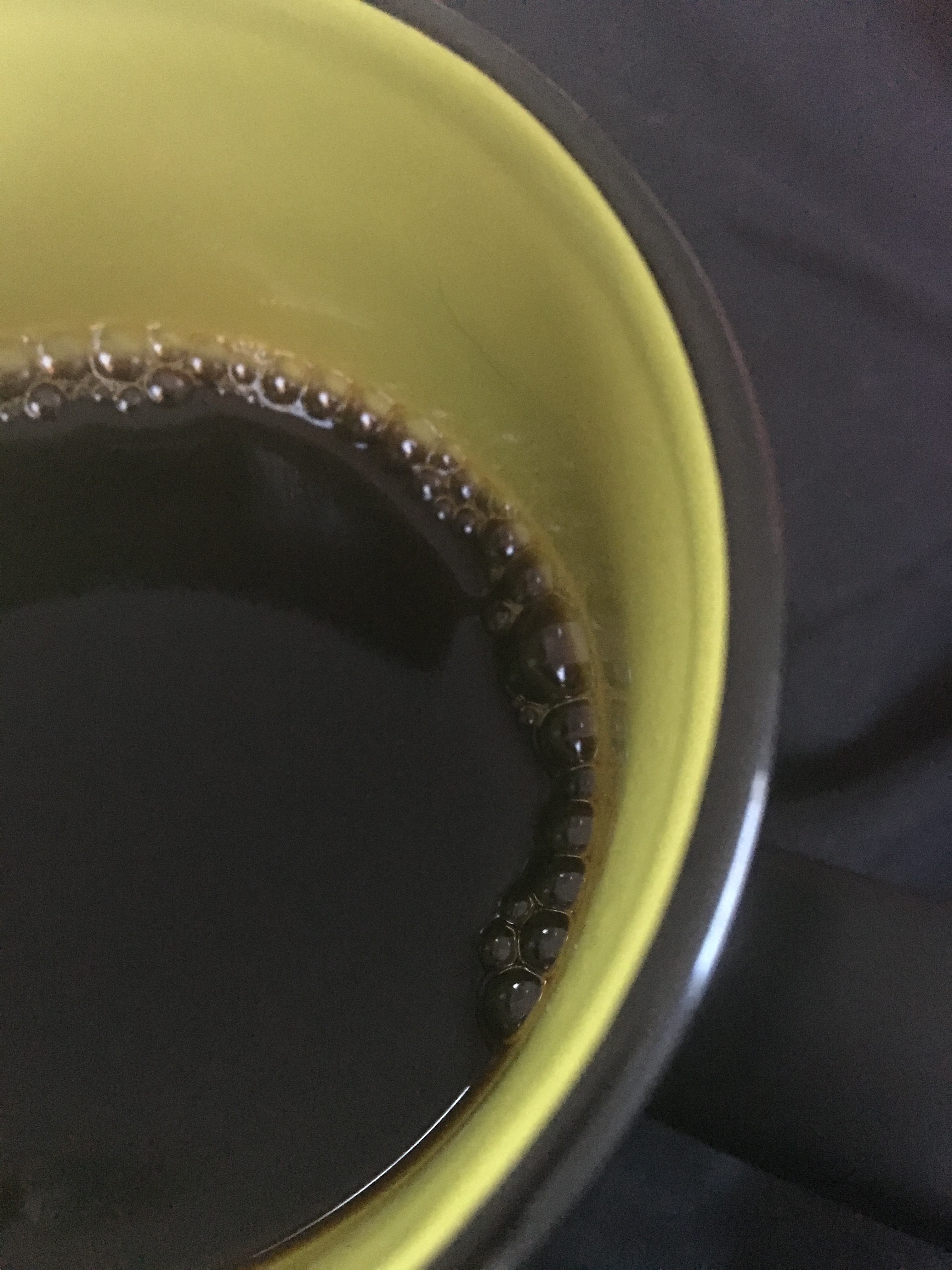
The snowplow just scraped down the street. They keep the streets clear of snow but create great heaping snow-walls at the end of every driveway. Some people grumble, especially the early morning shovelers. I’m sure it’s disconcerting to clear the driveway only to have the snowplow block the egress. I’ve seen people shake their fists and curse at the plow drivers. We work from home so have the luxury to sip coffee and wait until the snow stops and the plows finish their great-wall-creation. Only then do I venture out with my big green shovel and clear the way.
Dogga is getting older. While the coffee brews in the early morning he goes outside. He used to race out the door, excited to chase away the squirrels. Now, he lopes. Lately, he locates the geographic center of the backyard, plants all four paws, and barks-and-listens. He is desperate for a return bark. It’s a pooch call-and-response. We’re up early enough that the other dogs are not yet out so he listens and barks in vain. After several disappointing attempts at rousing the troops, he lopes to the back door and barks at me to let him inside. It’s uncanny; his morning ritual takes the exact amount of time for the coffee maker to complete the brew. Sometimes I think he hears the final whoosh of steam. Back inside, he leads the way as I bring my-errand-of-mercy-first-cup-of-coffee to Kerri.
Although I drink less coffee than I once did, it remains the thread that weaves together the fabric of our day. We start our day with it. The last thing I do before retiring at night is to set up the coffee. “I love that smell,” Kerri says, as she turns out the lights.
During a recent visit, my doctor insisted that coffee is an irritant. His timing was curious because I was, in that moment, thinking the same thing about him. However, in that moment I was certain that, given the choice of spending 15 minutes with him or with a cup of coffee, I’d choose the coffee. One must be picky about the irritants they choose to embrace.
It’s still snowing. There’s no sense shoveling for a while. I guess it’s time for a second cup.
Posted on January 26, 2022 by davidrobinsoncreative
If you are like us, every day brings another report of a friend or loved one who has Covid. As someone recently said to me, “With Omicron, it’s only a half degree of separation between you and someone who’s carrying the virus.” I’d say, given the wave of people we know falling sick and reporting positive test results, it’s true. It’s no time to let down your guard.
On Saturday we watched a documentary film, The First Wave. It’s a film everyone should see. It chronicles the first few months of the pandemic in a New York hospital. It is shocking how, in a few short years, we’ve normalized hospitals being overrun. How removed we, the populace, are from the tangible horror of this pandemic. Refrigerator trucks used as temporary morgues. We stand today at 865,000 deaths and counting. People. By comparison, 620,000 people died in the Civil War. 418,500 US citizens, military and civilian, died in World War 2. We ought to be grieving instead of dividing. We ought to be reaching to help rather than peacocking our politics. This film will slap you awake. It will help you step back and realize what we – all of us – are passing through. It might help you grieve.
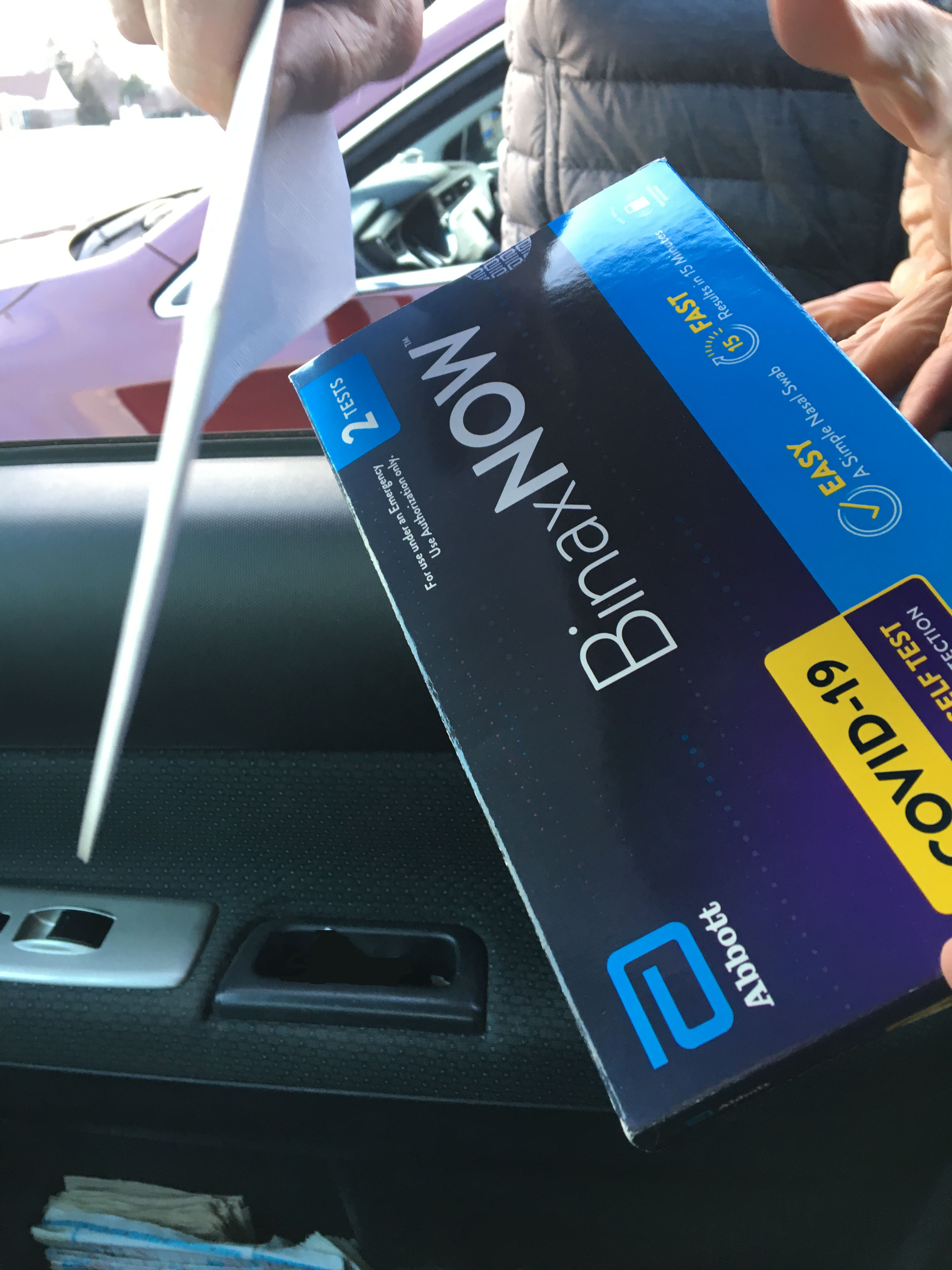
Kerri tells me that the woman in the next car thought she and 20 were doing a drug deal. He felt sick, needed a test and could find none. We had a few so they met in a parking lot to make a safe pass. While making the exchange, he handed her an envelope. Money for the phone bill but I’m sure it looked suspicious.
It reminded me of the time, many years ago, that Sam asked me to meet him in a parking lot. He rolled down his window and passed to me a sheaf of poems. The window went up. I was to tell no one. It was terribly vulnerable for him to share. I cried the day he published his first book of poetry. It was a titanic journey from fear-of-certain-shame to proudly publishing his beautiful work. He was transformed.
I imagine someday we will stand and look back at this titanic journey. I hope that I remember with fondness the story of Kerri and 20 making an exchange in the parking lot, the women one-car-over shocked by what she thought she was seeing, and we smile. Transformed. Remade as better people in a better community making better assumptions of each other. Stronger.
For now, as the credits rolled on The First Wave, we looked at each other and together said, “I’m exhausted.”