Dine With Jonathan [on Not So Flawed Wednesday]

I lost my copy of On Reflection by Jonathan Miller in one of my moves. He gave it to me. I treasured it both for the generosity of his gift but also a reminder of a night I had a casual dinner with an artistic giant. He was kind. And funny. And shared his ideas, thoughts and new work like an enthusiastic child. He listened intently to my ideas and thoughts like a fascinated friend. It is the mark of a great artist: humility. Healthy doubt. He loved his work and loved to share the exploration. He was brimming with questions.

I left that evening thinking, “I want that!”

That. Secure in my work. The playfulness of a child. The love of the exploration. The fearlessness to my bones knowing that each painting and every play is not an end in itself – not an achievement – but part of the dance of life on the playground called artist. Dedicated to asking questions. Dedicated to surfacing shared truth.

To Mary Oliver’s question, “What will you do with your one wild and precious life?” I say, I want that. Wild and precious.

That. It’s not an achievement; rather, it is a way of being. A practice. It alters Mary Oliver’s question: How will you be within your one wild and precious life?

Safe. Steady. Unshakable through dedicated practice. Arrived at through a lifetime of grace and humility. Or, perhaps, grace and humility arrived at through a lifetime of questioning. The certainty of doubt. That’s what I saw in Jonathan Miller that night. The paradox of the artist: security in vulnerability. To feel so safe as to play without inhibition. To express sans trepidation. To share and receive with equal enthusiasm.

It is a practice available when the artistry is no longer about the “I” but about the “we”. The bigger energy, call it what you will. It’s humbling. That.

read Kerri’s blogpost about REFLECTION

like it. share it. comment on it. buyusacoffee. thank you for reading what we write.

Let Go And Breathe [on KS Friday]

We have been slow to reenter life at home. We were only gone for a few days but it feels like months. There is life before the farmhouse and life after. The time away serves as a hard line of distinction. And, because there is now a before, we are finding our reentry a bit disorienting. Nothing is the same yet everything is the same. Unrecognizable because it is familiar.

We are moving slow. We are noise averse. We are reticent to go to the store or drive on a busy road. Too much stimulus fries our wires. It’s as if we are walking through the life we know – we knew – as witnesses. There is a silent accounting: what stays, what we will let go.

Transformation is like that. Snakes shed old skin. Trees drop their leaves. People clean their closets. Letting go creates necessary space for a new rhythm and new rhythms emerge slowly over time.

Sitting on the back deck this morning, the air was still and warm. The birds were singing, the chippies foraged beneath the feeder for discarded seed, Kerri said, “This is the level of sound that I can tolerate right now.” I nodded.

Long ago, when I facilitated retreats, on the last day someone would usually ask, “How do we take what we’ve learned back into our normal lives?” They were changed by their experiences at the retreat but the circumstance of their daily lives remained unaltered. The real question was “How do I bring this feeling of openness and expansion from the protection of the retreat center to the squeeze and turmoil of the realities of life?” There isn’t a single answer to the question. In fact, there isn’t an answer. There’s a practice. There are decisions. What might fall off the list of to-dos? Spaciousness is not magic. Openness is often the result of generosity-to-self. One must slow down to see and hear and taste. Touch takes time. Positive thought takes intention and letting go of grudges. Forgiveness is a choice made again and again and again.

The first day back we walked our trail. We talked of the changes we want to make. The clearing of old baggage. Making space. Kerri stopped to photograph the honeysuckle. I took a deep breath of the sweet fragrance. Nothing more. Nothing less.

old friends revisited © 1995 kerri sherwood

Kerri’s albums are available on iTunes and streaming on Pandora or iHeart Radio

read Kerri’s blogpost about HONEYSUCKLE

if you’d like to support our blogging, writing, cartooning, composing, painting… the QR code below or the link will bring you to our online tip jar;-)

Ask A Better Question [on Merely A Thought Monday]

I just erased the post I’d written for today. We often write a few days ahead so we have time to reflect on or edit what we’ve written. We’ve learned that it’s a good practice to consider what you are about to spill into the world.

It’s a good practice because it affords us the opportunity to ask, “Is this what I mean to say? Is this what I really want to say?” The post that I’d initially written was bothering me. A lot. Sipping coffee, I confessed my discomfort to my chief editor and life-collaborator (Kerri) and we followed the trail until we found the source of my chagrin.

There is a question, a much more important question, behind and beyond clarifying what I really want to say. It is this: “Is this who I want to be?” My post was making me uncomfortable because it was the opposite of what I profess to be. It was the opposite of who I understand myself to be. Of who I want to be.

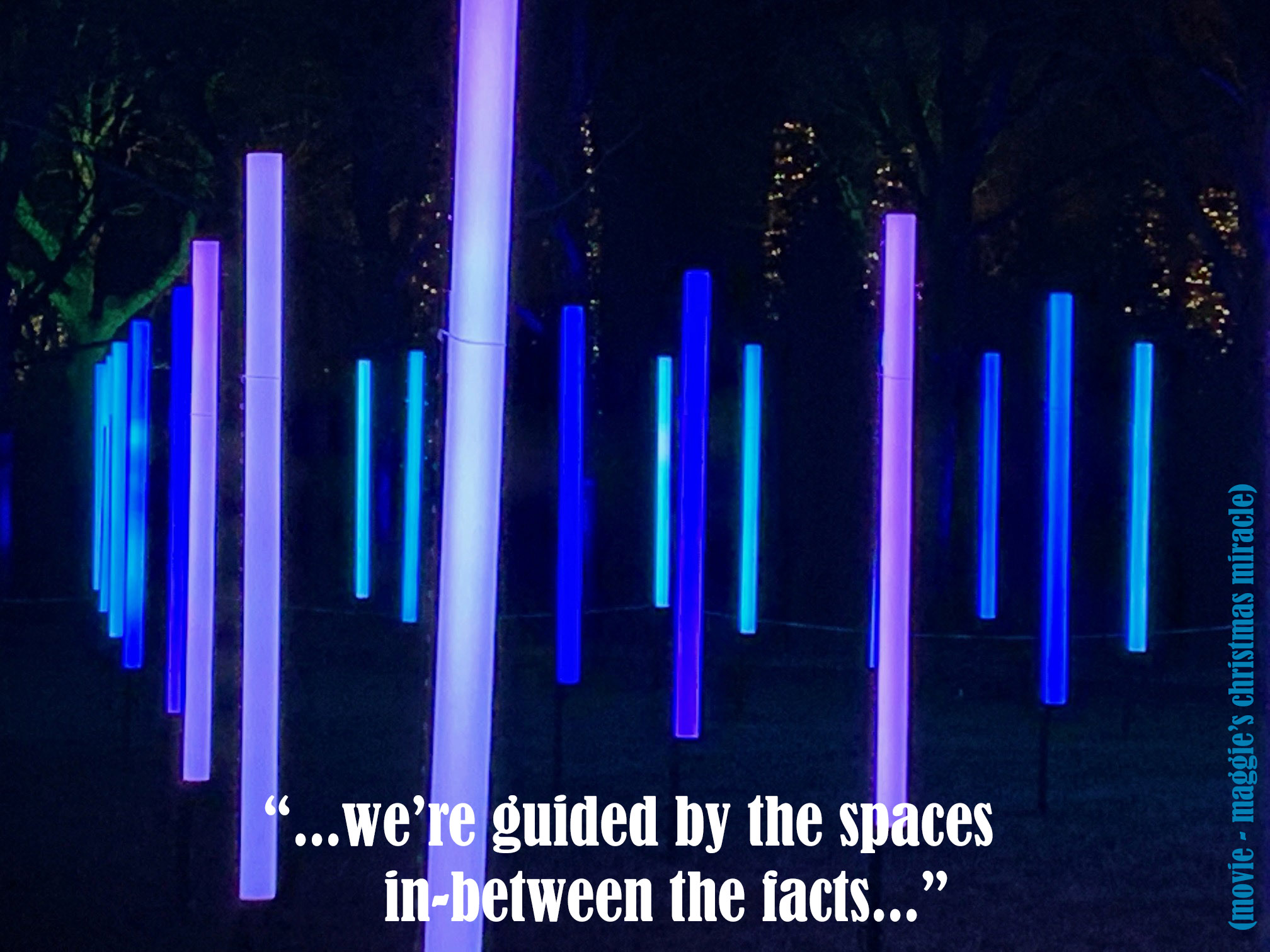
I’ve often written and taught about “the spaces between.” Relationship. Intuition. Heart. Facts and data require interpretation and live on the spectrum at the farthest point away from wisdom. Focus on the spaces between, the movement rather than the noun, and an entirely different life opens. Wisdom is more like water than stone.

Most cliches touch a truth-root and today that is the case for me: We teach what we most need to learn. Thank goodness my editor was around to gently slap open my eyes and help me ask myself a better question.

read Kerri’s blogpost about THE SPACES

Connect [on Merely A Thought Monday]

When I think of Sam I am flooded with fond memories of a man dedicated to bringing people together around heaps of fine food. Thanksgiving with friends. Apple crush. A “bad art” party that was a thin veneer for assembling those he loved around a table of abundance. Sam envisioned himself as a connector of people, both to others and to deeper connections within. Two paths to the same destination.

Yesterday on the trail we talked about what was and what is. The pandemic years have proven to be a hot crucible for change. Life passages. There is a hard line: before and after. When I first moved to Wisconsin, Kerri and I hosted large gatherings almost every week. Ukulele band. Slow dance party. Cantata Frittata Regatta. Bringing people together. We held five progressively larger dinner parties on the week before our wedding. There was always boisterous conversation, plenty of food and wine. Now, we are delighted each week when 20 comes over to share a meal. We laugh. We spin tales. We enjoy quiet and simplicity. Intimate conversations.

As Sam knew, food and stories are both connection creators. Together, they are an unbeatable team, the pulsing heart of breaking bread. And, he knew as we do, that connection is not an achievement or arrival platform. It is like a good fire and must be tended, fed. Both between others and within the self.

When the sun sets on these cool fall evenings, we bring dinner outside and eat beside a fire. Dogga finds a comfortable place to rest. The pond gurgles. Each night I am overwhelmed with waves and waves of gratitude. We coo over the meal we’ve made. Our conversation is made quiet by the fire. Reflective. We savor the passing moment, no thought of stopping time. All in. Connected.

read Kerri’s blogpost about EAT

Reflect [on DR Thursday]

This reflection spiraled me into a fond memory. A long ago chance dinner in London with Jonathan Miller. He was kind and funny and took me upstairs to his studio to show me photographs he was readying for a gallery show. I could have talked with him all night. As I left he gave me a copy of his most recent book, On Reflection. Questions of reality and identity in the arts and beyond, explored through reflections. I had the book for years and lost it in a loan.

Reflections. I have crossed paths with many brilliant artists. Some, like Jonathan Miller, a single evening, a passing glance. Others, I had the good fortune to spend many years assisting and watching and learning from their work. James Edmondson. If I ever delude myself into the notion that my artistry is unique and truly individual, I only need stop for a moment and track the people who shaped me, who inspired me, who challenged me, who passed to me their traditions, who gave me an hour of their time to share their work and thoughts with me. I am a reflection of those many, many people.

My work in the world is made better by the reflections of Horatio and David and Master Marsh, people who give me their time by reading my work and sharing their thoughts. People who have jumped into my mad projects and made me and my work better.

I am the luckiest man alive. Each morning I get up early and sit next to my wife. We drink coffee and write. She edits my posts. We read to each other and offer advice or talk about word choices. I take her hand and bring her into my studio and ask, “Will you tell me what you see?” Lately, as I draw in pencil cartoons for work, she digitizes them, dumps them in Photoshop, cleans up my messes and makes them better. She makes suggestions. She offers reflections. She formats them for publication. They are transformed from my work to our work.

And, that is the secret I learned from my many master teachers. A unique perspective, an artist’s eye, is the blossom of many, many wise eyes coming together, expressing through a single moment, an opportunity. It’s all collaboration. Artistry is nothing more than a hologram of reflection.

read Kerri’s blogpost about REFLECTIONS

pax © 2015 david robinson

Call It Realism [on Not So Flawed Wednesday]

This garlic could have been painted by Jan Vermeer. To my eye it looks like the work of a Dutch master, an artist more concerned with realism than the ideal.

Art that reveals the beauty in the ordinary. For a few weeks in my surly youth I studied with a realist painter. I was wowed by his technique but could not yet grasp his dedication to capturing the everyday. Only later did I come to understand that his art was not about the technique but about bringing attention to the experience of the everyday. He rejected the aloof and desired to pull art down from the pedestal so it might reflect the lives of the “common people.” He believed that people needed to literally see themselves in the paintings to have access to the painting. They needed to see their hardship and toil as well as the objects that surrounded them.

Bertolt Brecht believed the opposite. In order for people to have access to the deeper messages of a play, they needed to be removed from their circumstance. So, in his way of thinking, people are more capable of seeing themselves in a piece of science fiction than in a reality-mirror.

David is working on a re-imagining of Pirandello’s play, Six Characters In Search of an Author. One of the questions of the play is, “Who is telling your story?” And, how are they telling it. I reread the play and was struck by how relevant it is to our times.

The beauty in the ordinary. The turmoils and struggles of the everyday. Ours is a time of tumultuous story tug-of-war. I wonder, in a hundred years, what historians will write about our time. I wonder what aspect of artistry – if any – will be considered “realism.” As defined by Vermeer and Pirandello, it’s to reach across a social line, from the privileged to the working class. For Brecht it is spatial: step out to look in.

One thing is constant, while reaching across time and artificial boundary, it is always the role of the artist to help their community ask the questions: Who is telling my story? Whose story am I telling? What is the story that we are telling?

I imagine those someday-historians will write tomes on our messy struggle to sort out what is “real” and what is not.

read Kerri’s blogpost about GARLIC

What’s Now? [on Two Artists Tuesday]

After a fairly contentious conference I co-facilitated in The Netherlands, Kerri and I took the bullet train to Paris. It was early in our relationship and our first time abroad together. We couldn’t afford to get to Paris otherwise, so tagging a small vacation onto a work trip seemed foolish not to do. It was the perfect place at the perfect time. I released the conference friction the moment we stepped off the train. I didn’t know it at the time but on the streets of Paris I left behind a skin that I’d badly needed to shed.

We had limited funds so we bought baguettes and Camembert cheese, fruit, tarts from vendors and bottles of wine. We ate in parks. We wandered the streets. Climbed the hill to Sacre’- Coeur, visited Rodin, and tried to get lost. We fell exhausted into bed each night, full of art and sound and color and delicious wandering. One night we sauntered to the Arc de Triomphe and barely escaped a riot. Bus loads of police in riot gear appeared on the street and, wide-eyed, we slipped out of the crowd and hustled to find more peaceful rues. Paris now serves as a marker. There was before Paris. And after.

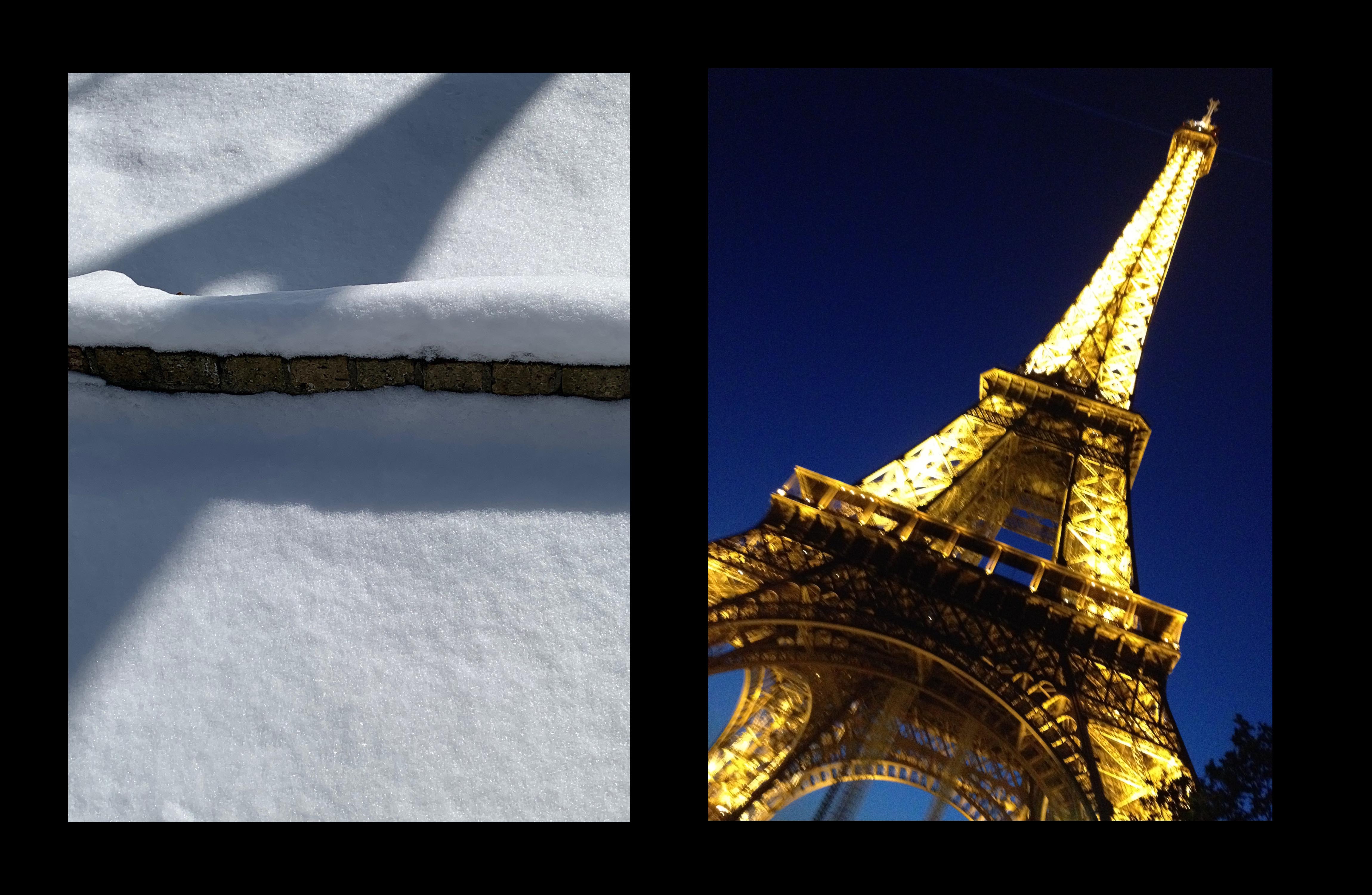
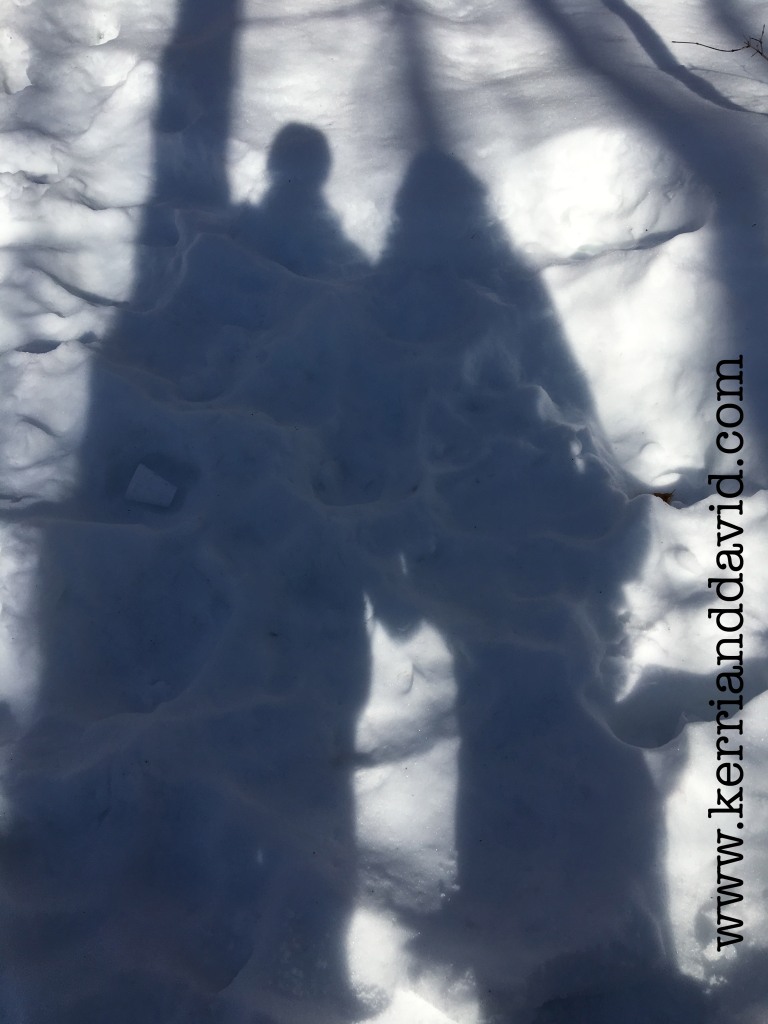
“This shadow looks like that picture I took of the Eiffel Tower,” she said, showing me the photo of the shadow. The angle is perfect. The shadow is appropriate. Shadows. What was. An outline of the people we were, reflected on the snow. And, the series of photos, shadows along the way, the surprising people we have lived-into since we wandered those streets, shedding old skin, and boarded a plane home with a a question, “What’s next?” What’s now?

read Kerri’s blog post about SHADOWS

Choose How [on Not So Flawed Wednesday]

My friend’s children are having children. The top-of-the-list advice my friends offer their children, now parents themselves, is this: it goes so fast. Appreciate every single moment. Love every phase. You will blink your eye and they will be grown and gone.

I lost my dad in September. I have, like most people who’ve lost a loved one, spent much of the time since his passing remembering and reflecting. It’s a mixed bag of treasuring moments and wondering why I didn’t fully appreciate others. It is true, you don’t know what you have until it’s gone.

What is so hard about appreciating – fully appreciating – the limited moments of your life?

I used to facilitate an exercise. It had four phases. Working in small groups, the first phase was to have a group member identify a problem in their life and then tell a blame-story about the problem. The rest of the group helped by supporting the person in their story of blame. The groups howled with laughter. Blame is fun. It’s addictive, like sugar.

In the second phase, the groups tried to “fix” the problem. The serious, concerned faces puzzled possible fixes but inevitably dissolved into more laughter: there’s nothing like trying fix a problem to create more problems and loop back into a juicy blame story.

Phase three was simple: I asked the original problem-story-teller to retell their story as a story of choice, not blame. I asked the other members of the group to support the teller in their story of choice. Silence ensued. And then, quiet presence as the new narrative – the story of choice – slowly inhabited the room.

Blame stories are like too much candy. They are easy to eat and yet have no real sustenance.
Stories of choice are much harder to tell but they are rich in awareness and appreciation of the moment.

We never arrived at the fourth phase: stories of opportunity. Activating choice. The notion of taking responsibility for choices always stopped the exploration. Our conversations about choice-avoidance usually filled the time.

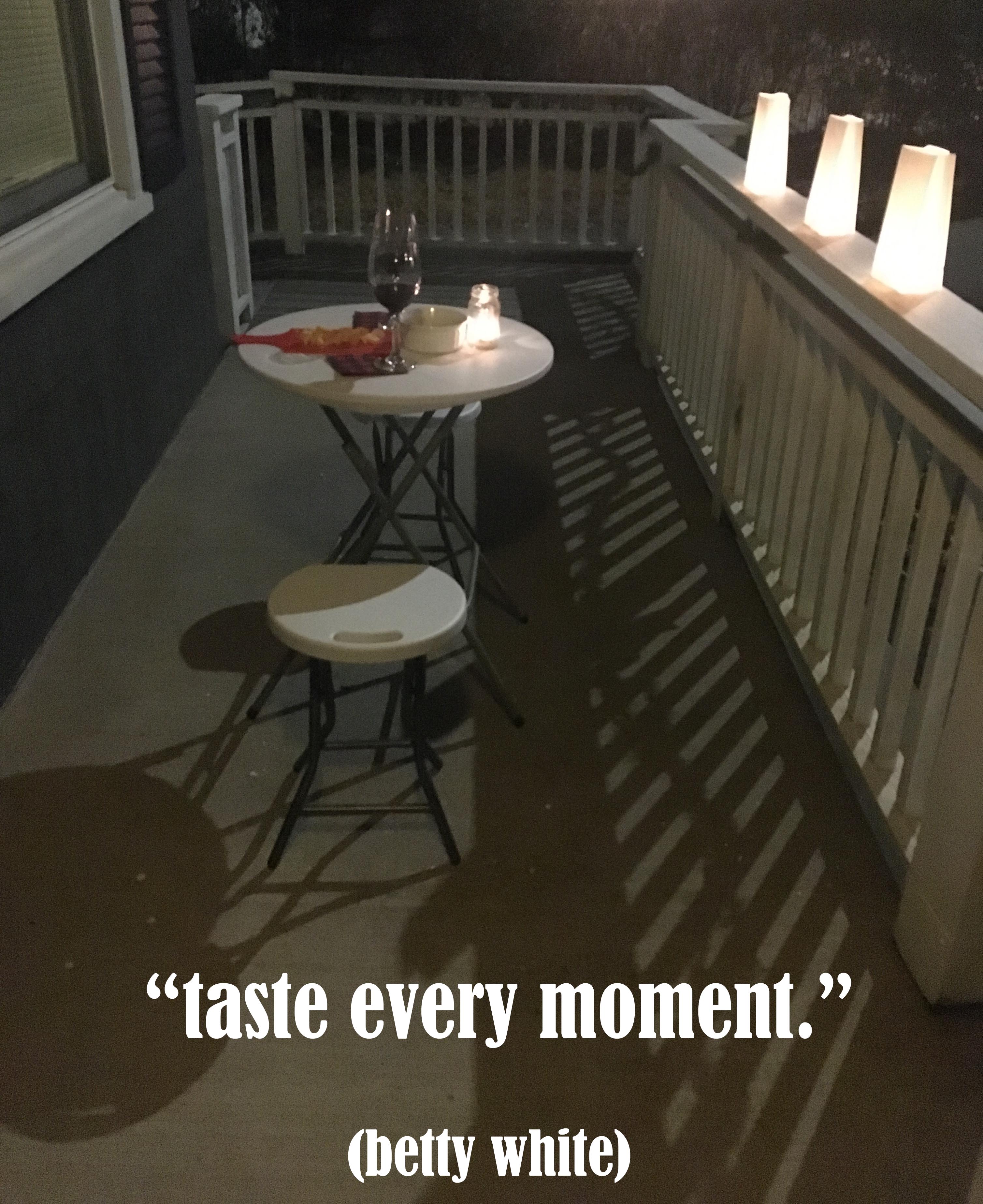
What we gain in blame, we lose in appreciation of our moments. In order to taste the moment, one must first choose to be in it – and then choose how to be in it.

Grief is a phase to be loved, not avoided. As is the celebration of a first birthday. A new life. A lost love. A full spectrum. Taste every moment.

read Kerri’s blog post about MOMENTS

Await The Return [on KS Friday]

This time of year I do a lot of staring into the night sky, pondering vastness. Reflecting on the year. It’s what we’re hard-wired to do as we approach the darkest night of the year. And, along with the darkest night of the year, comes the turning point. The return of light. This fact of earth’s orbit has spawned ritual, religious metaphor, and all manner of contemplation, letting go, setting new intentions, since humans first started, as I did last night, looking into the sky. We feel our smallness looking into the face of starry infinity.

This year there’s a delightful serendipity associated with the solstice. We cross the line from darkest night to return of the light on December 21. On December 22nd, as we creep our way back into light, the James Webb telescope will be launched into space and, when it unfurls and points its lens into other star systems, it will be looking for life on other planets. It will be looking for other beings staring into the night sky who might also be pondering their relationship with the universe. I look at you, you look at me.

We are candle people. We light them all the time for various reasons, marking auspicious occasions or simply to lift our spirits. We bought a menorah this fall. Kerri’s clan is religiously complex and we wanted to celebrate Hanukkah with her cousins. I read a bit since I am fond of finding the roots of rituals. I learned that the menorahs with seven branches, among other things, represent the five visible planets plus the sun and the moon. The rounded shape of the branches represents their trajectories across the sky. We lit the candles each night, singing poorly but with love and conviction the prayers. Connecting with her cousins, connecting with the light and pondering our place in a spinning universe.

Sitting at my desk, upstairs, too long staring at a computer screen, I heard her at the piano. I crept halfway down the stairs not wanting to break the spell. She played a carol, quietly. It’s rare these days that she plays. Broken wrists. Resistant fingers. Bruised heart. Yet, the piano calls. The lighting of the candles, the quiet pondering of “what’s it all about”, has made a crack in the darkness. There is a vast inner universe, too. We shoot telescopes into our selves. I look at you, you look at me. Smiling on the steps, I realized that I am anxiously awaiting the return of the light.

read Kerri’s blog post about LIGHT

Know The Moment [on KS Friday]

“A work needs to relax toward finality. It cannot be pushed, it cannot be worried, it cannot be analyzed to completion. Pushing against the natural rhythms of creation will just churn up the waters. Clarity comes only when the waters settle and the air clears.” ~Kent Nerburn, Dancing With The Gods

Because I tend to speak in metaphors in a world enamored with goals, what I say often, at first, goes unheard. Skip is stewarding an amazing creation and has, from my perspective, just passed a significant milestone. I told him that, in working with many playwrights and painters and actors, there is an initial phase in every creative process in which the creator works for form. It’s like the tide going out, dumping everything down on the page to gather and find the story-form. Then, in a beautifully mysterious moment, the tide turns and finding form is no longer the intention. Clarity becomes the aim. Skip is a listener. Metaphors tossed into an analytic frame generally seem out of place or perhaps arrive too early to the party. But I’ve learned they are seeds that, when planted, begin to work their way up through the crusty soil.

John Guare said that a writer has to write ten bad pages to arrive at a single good page. The ten bad pages are the search for form. Reducing ten into an essence of one is the work of clarity. The phases, the exhale for form and the inhale of clarity, are two different yet interrelated energies.

When I am working on a canvas I might evolve the image for days. Sketching, painting, wiping, adjusting, wiping, sketching, painting. The search for form. Adding and subtracting. Moving the composition, tilting the symmetry. And then, something clicks and I know. The painting is formed and now the pursuit is to hold its hand and bring it into the light. Inhale.

Because my father recently passed, followed hard upon by my dear Ruby, I have been reviewing much of my life. Roger used to say that the first 30 years of life were about trying to become something and then, one day, you realize that you are that thing you were trying to become. The rest is learning how to be it. Searching for form. And then, clarifying. I think Roger was half-right. Becoming and being are cycles, not arrivals.

The cycles of my life are explicit. I enter into worlds that I know nothing about – either by accident or invitation. That I know nothing about the world is precisely why I’m invited in – or bumble in. I see it. I bring it metaphors. It is uncomfortable to not-know so I learn about the world as an outsider. It helps me see more clearly. I know the moment when form turns toward clarity. I see when the process roils into an eddy. I understand how to free stuck energy. I’m a midwife to creative process, a guide across unseen bridges.

We stood in the November sun admiring the giant flowers against the blue sky. I loved the idea that I was experiencing an ant’s view. These past many years I have been looking for the new form. Pushing. What was I? What am I now? And, in a beautifully mysterious moment, I realized that the tide was at long last coming in.

read Kerri’s blog post about GIANT FLOWERS

find Kerri’s music on iTunes or streaming on Pandora