Feel The Stir [on DR Thursday]

“It has bothered me all my life that I do not paint like everybody else.” ~Henri Matisse

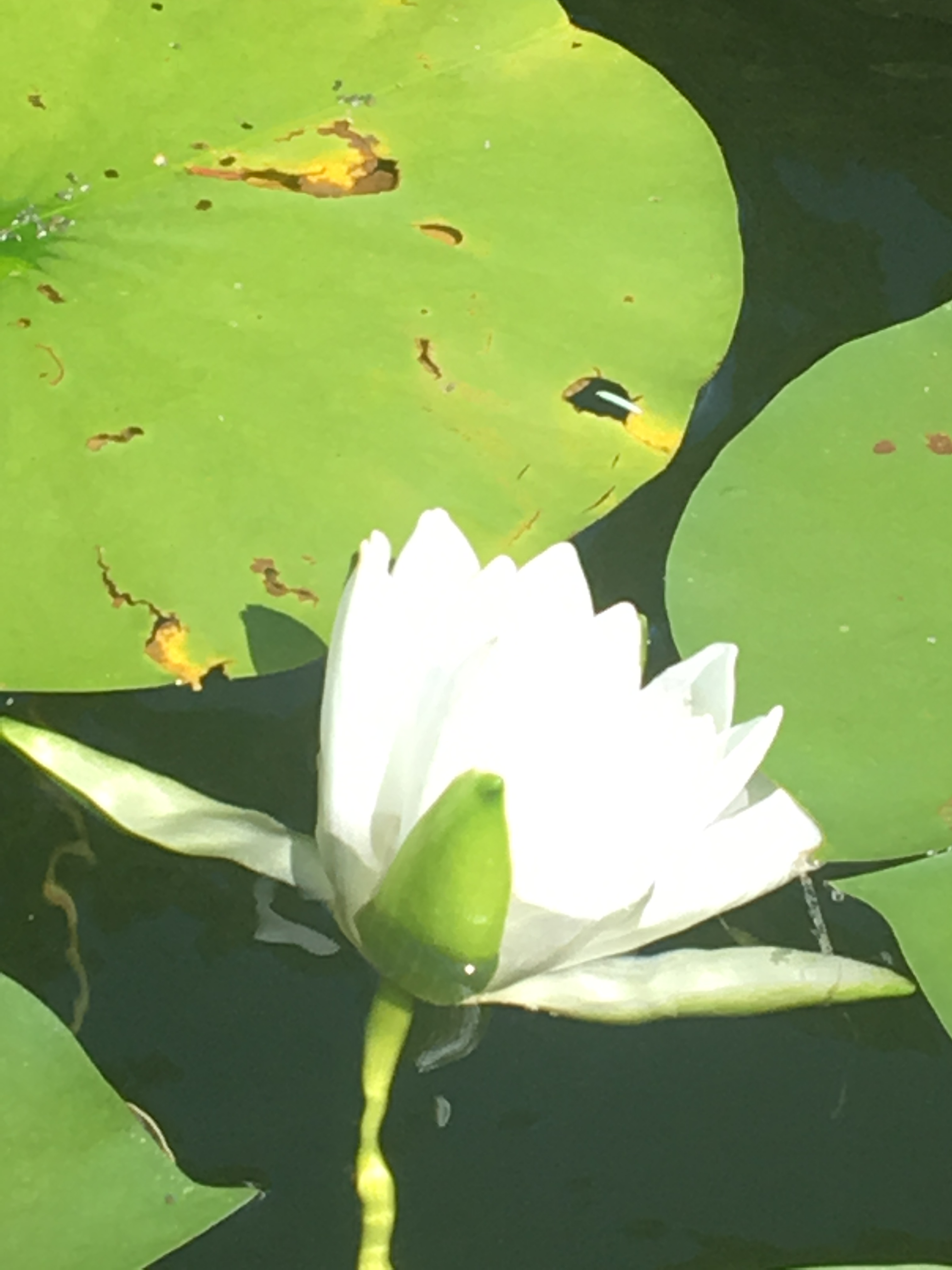
The canoe glided silently through the lily leaves. I counterbalanced the canoe as she stretched over the side to take a photograph. Leaning, I stared down at the leaves. Vibrant color and pattern, Matisse might have painted them. They stirred within me the deep desire to paint, something I haven’t heeded for too long. Nature is a great artist.

The trees surrounding the lake signaled autumn’s imminent arrival. Crimson reds and yellows dotted the shore. Fall paints me melancholy and I felt the first whispers of the coming-sweet-sorrow. Deep quiet. Still water reflection. Hearing rhythms beyond sound. Nature, I am told, is a great healer.

Although I’ve painted all my life I’ve never thought of myself as a painter. For me, painting is not about the image I produce. It is about walking into the dark cave or soaring into the blinding light. Icarus. Nature’s call.

My sister remains confounded that I have not given myself over to the wealth and riches of pet portraiture. Early in my life I was paid-not-well to copy masterworks, alter the colors so they might match a client’s couch. I can paint anything. I can paint like anyone. I left that behind. It was soul draining. I paint to answer Nature’s call, to discover how to paint like myself.

Counterbalancing the canoe, staring at the Matisse leaves, the brilliant white lily, I acknowledged the stir. I promised myself, my easel, like autumn’s imminent arrival, “Soon.”

read Kerri’s blogpost about LILY

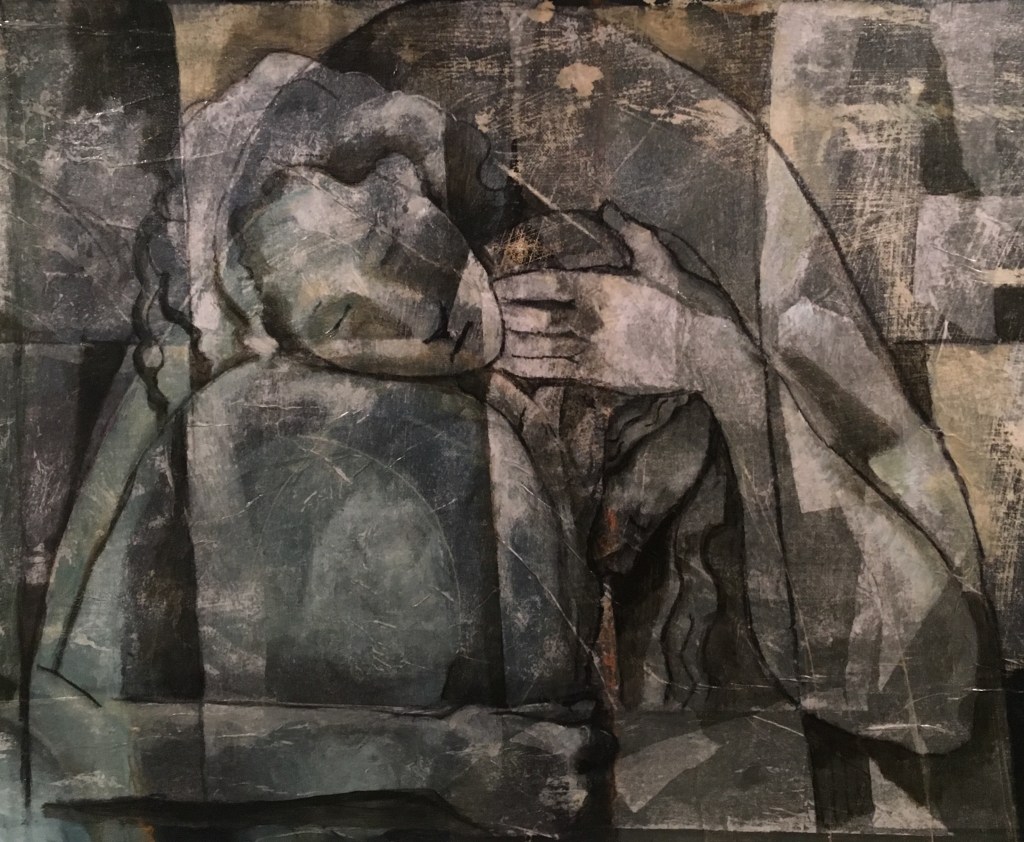
icarus © 2008 david robinson

Interpret The Impression [on DR Thursday]

“Art, to me, is the interpretation of the impression which nature makes upon the eye and brain.” ~ Childe Hassam

The eye of the mind. Interpretation of the impression. Imagination. Nature.

This morning Kerri told me that she’s having a stand-off with her piano.

This morning I picked up a box to clear my studio space. I asked myself, “What are you doing?” I set down the box where I found it.

Lately, I’ve been working with an overabundance of business models. Not surprisingly, each addresses the same contemporary challenge: people are having trouble discerning between what is actionable and what is not, what has relevance and what does not. A variation on the theme: focus is hard to come by. Models, I remind myself, are interpretations.

I’ve read that the first evidence of humans making art is found in the funeral rites of our distant ancestors. Decoration? Talisman? Fuel for the trip? An interpretation of life, making peace with the unknowable. Nature makes an impression. Humans respond.

The interpretation-of-the-impression-that-nature-makes points to something essential about art and life: it needs to be shared. It is nothing if not witnessed. We stand in the art gallery and drink it in. We stand at the graveside supplying our fellow traveler for the long journey ahead. We place the crayon drawing on the refrigerator.

Nature makes an impression.We are nature’s impression. Interpreting what that means.

read Kerri’s blog post about IMPRESSIONS

motherdaughter © 2019 david robinson

Give It Perspective [on Not So Flawed Wednesday]

“Awe” is one of those complex words that contains its opposite. Wonder and dread. Astonishment and fear. Respect for the power of nature. Reverence. It’s a full-spectrum word.

Awe is what you feel standing at the ocean shore, knowing the waves will rush in long after you are gone. Water pulling at your ankles. Toes in the sand. Staring into eternity.

Awe is a perspective-giving word. It makes us both tiny-in-the-universe and fortunate-beyond-words, all in the same moment.

Once, I stood on a mountaintop in the bitter cold of dawn. The sun broke over the horizon and washed over me with a wave of warmth. Life-giving. Literally. I stopped shivering when the sun touched my bones. Filled with awe, I started to laugh and cry. Beautiful, magnificent and painful.

We stood on the deck and watched the cloud tower above us. Threatening and astonishing. She showed me the photo. “The wire makes it,” she said holding the screen so I could see it, “It gives it perspective.”

Perspective. Correct regard for the truly awesome power of nature.

read Kerri’s blogpost about TOWERING CLOUD

Live The Words [on Merely A Thought Monday]

We awake each morning to birdsong. I imagine the birds’ song raises the spirit of the sun. Or, the birds sing because the sun raises their spirits. Both are good stories.

When I was in college I had a professor who seemed a bit radical. Now I recognize that he was not radical. He was a scientist and his data was prophetic. He was sounding an alarm for his students, knowing that his students could not yet hear him. He was the first person to introduce me to the notion of climate change. At the time, the world was still smarting from the oil crisis of the 1970’s. One day in class he said, ‘If you think the oil wars are bad, just wait until the water wars.” I heard his voice this morning while looking at photographs of Lake Mead and the river Po. Dwindling water meets rising population. Panic is in the air. In the meantime, Australia is drowning. Desperation is on the rise.

I like to imagine the birds raising the sun while the sun raises the song in the birds. It’s a story of interconnectivity. It’s to understand the question, ‘what causes what?’ – as a two way street. You impact your environment and your environment impacts you. Or, better stated, you and your environment are not separate events. (“The love you take is equal to the love you make.” ~ The Beatles)

Though he never used the word, “interconnectivity” was the construct my seeming-radical professor was asking us to consider. He understood that his students were products of a long tradition of disconnection. A dedicated delusion of dominance over nature ruled our construct and he was attempting to puncture that absurdity bubble. Pour toxins into your river and your water will poison you. Pour carbon into your air and your air will eventually pour carbon into you.

The same applies to governance and society in general. What we pour into it is what we will experience as it. H wrote that, “Politics is simply the exercise of being a good neighbor for the sake of the neighborhood.” Interconnectivity. For the sake of the neighborhood. Demonize your neighbor and they will, in turn, demonize you. Refuse to listen to your neighbors and they will refuse to listen to you. Pour guns into your community and your community will inevitably aim its guns at you. Lie to gain power and the lie will gain power over you.

Pour support, service, acceptance, consideration…into your community and it will respond in kind. “Do unto others as you would have them do unto you,” is not so complicated a concept when seen through the lens of interconnectivity. Kindness begets kindness. Acceptance begets acceptance. Honesty begets honesty. Intend it. Practice it.

These are easy words to say. Living the words is quite another story. Unless you happen to be a bird, singing the sun awake as the sun pours its rejuvenating warmth over your song.

read Kerri’s blogpost about THIS DAY AND AGE

Sit In The Quiet [on DR Thursday]

Years ago I directed a production of Into The Woods and I wanted a set design alive with David Hockney colors. The production was gorgeous. The set the designer created was a vibrant fantasyland with the dark undertones wrought by dinosaur-size-too-big foliage. Tiny people in an oversized children’s pop-up book.

If I were going to direct the musical again today, I’d approach it through a different lens. I wouldn’t place it in the vivid palette of fantasyland; this world we journey through is fantastic just as it is. When Kerri and I walk, I am sometimes stunned to silence by the shapes and patterns and pops of color. Ominous and serene. Alive.

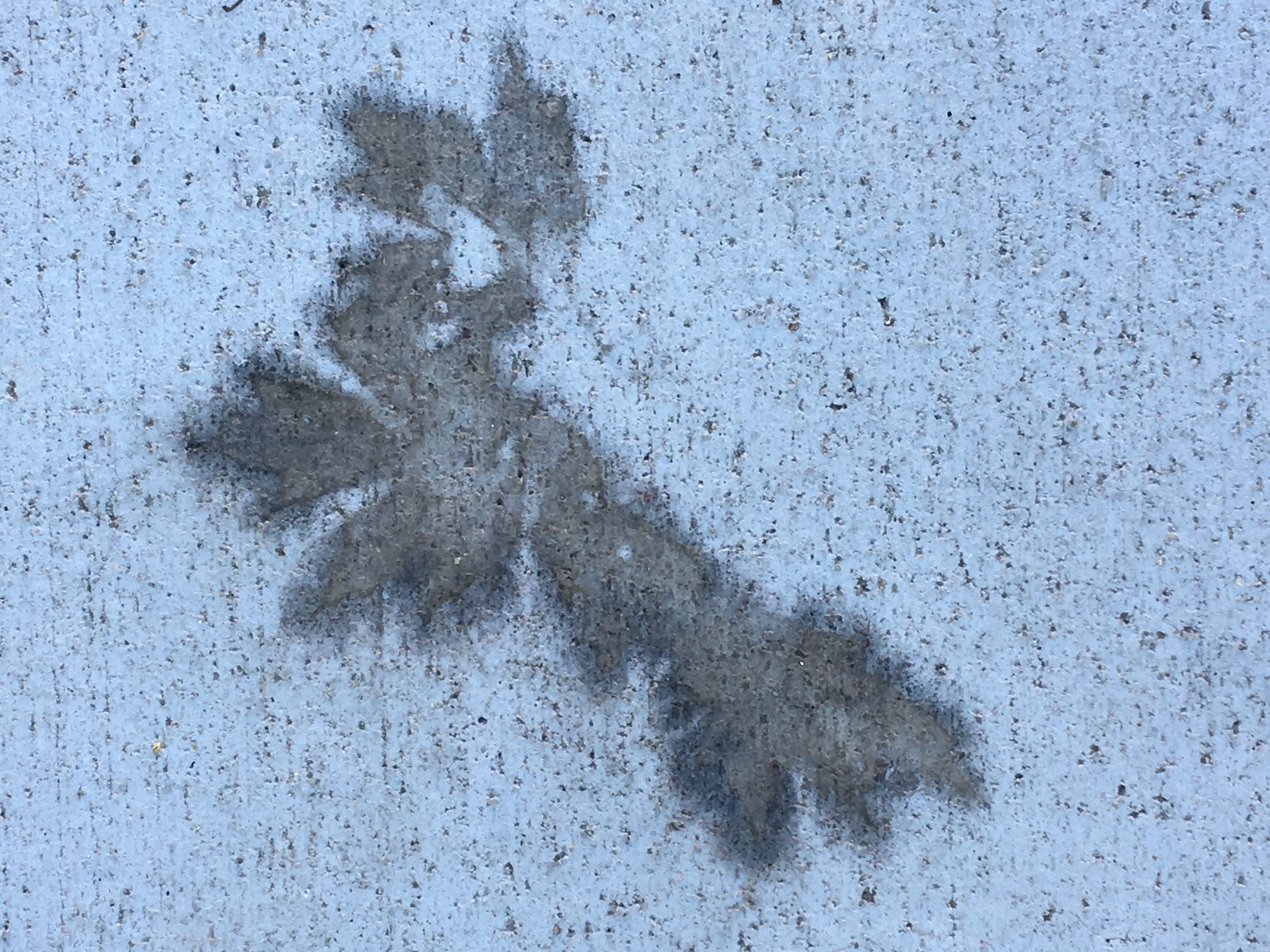
For reasons that have nothing to do with reason, I started using imagined leaf shapes, plant-symbols in my paintings. I know when I someday return to my easel, the plant shapes will be present – perhaps even dominant. There is no end to the eye-popping variations. Our walks in nature have me “seeing” again.

A few years ago, Brad and I talked about the deep backstory of why an artist creates. Of course, there’s not a single driving reason – it changes over time as we change over time. I know many artists who’ve set down their brushes, singers who stopped singing. They satisfied their backstory. They channel their creative juices into other forms. Based on the evidence, these days I am a writer. Lately, I spend more time drawing cartoons than painting paintings. And yet, I still think of myself as a painter.

In the past, a step away from the easel was acknowledging a fallow season, letting my batteries recharge. This time, the step away is different. My reasons are spinning, changing. The younger me-artist was finding a place to transform pain into presence. The middle-age-artist-me entered the studio because it was the only place on earth that made sense. It was a sanctuary. A quiet place.

Each day I walk down the stairs and stand for a few moments with the canvas on my easel. It’s a stranger. I hear my easel whisper, “Not yet. Soon.” I am content with soon. I feel as if I am in an extended meditation, borrowing a tradition from Japanese masters, sitting in the quiet until there is no space between me and the brush, no space between me and the motion. No space between me and the shape, the pop of color, the infinite variance of pattern. No space between me and the surprise-of-what-will-happen. No space between me and the story.

read Kerri’s blogpost about TRILLIUM

joy © 2014 david robinson

Fail At The Box [on Merely A Thought Monday]

Among Don Miguel Ruiz’s Four Agreements is this gem: do the best that you can.

Through the lens of the Occident, those folks on earth oriented to the idea that their nature is bad and needs taming, the Agreement is a statement of self-forgiveness. Do the best that you can. It’s a good bit of advice when everything on earth seems to come with a measuring stick.

Don Miguel is Toltec so his Four Agreements are rooted in an entirely different understanding of nature. To do the best that you can has little to do with performance or achievement. There’s no judge sitting on the high bench scrutinizing goodness or badness. There’s no book with black marks next to your name. This Agreement is about setting an intention. The other Agreements are about speaking with impeccability, making no assumptions, taking nothing personally. In other words, it’s never about you; you can’t possibly know the reasons why; your words matter. So, do the best that you can.

Circumstances are uncontrollable. Sometimes people are mean. Sometimes the tornado comes through and blows your house away. It’s not personal. You probably can’t do anything to change the tornado and even less to change other people. So, change yourself. Or, better, be yourself. Attend to your story and free yourself from the illusion of living under grand judgment or any of a number of other control fantasies. Do the best that you can.

Lately, I’m pondering the too-tight-image-boxes we squeeze into and try, but can never quite, fulfill. The impossible image; a too tight expectation. The Pleaser. The One Who Knows What Is Right. The Peacekeeper. The Strong One. A step away from the box-expectation, the-role-I-think-I-must-fulfill, is a giant leap into happiness. Inside the box it is virtually impossible to do the best that you can. Boxes are alive with assumptions (what I must do, who I must be); buzzing hives of judgment, and, when in a box, speaking truth is frowned upon, so editing and/or silence rules the day. Just try doing your best when living in a too tight box!

Fear and anger fill boxes. That is, after all, the purpose of the box, the fruit of the impossible mission.

Here’s my advice to myself: fail at the box. Cut it up and put it into the recycle bin. Then, free of the too-tight judgments, it’s possible to set mistake-free intentions. Life as finger painting: do the best that you can.

read Kerri’s blogpost about SOME DAYS

Let The Chips Fall [on saturday morning smack-dab.]

If I left Kerri to her own devices, we’d have a kennel full of once-stray-dogs, a menagerie of rescued kitties, birds in rehab, chipmunks recuperating in the upstairs bedroom and a host of other critters who crossed our path on their day of distress.

It’s not that I am heartless. I have a heart. My capacity to stand upright is proof-positive that it works. No, the real impediment to my save-the-animal-kingdom-resistance is practicality: we have a tiny backyard and it’s my job to scoop the poop. I can barely keep up with Dogga.

I’d love a St. Francis existence, birds alight on my shoulders and raccoons following at my feet. The realities of poop always pops my fantasy. “Let them run wild,” I insist. “Let nature take its proper course!”

She looks at me with those pleading, doe eyes.

“Let the chips fall where they will,” I say with conviction, “just not in our backyard.”

read Kerri’s blogpost about ANIMAL RESCUE

smack-dab. © 2021-2 kerrianddavid.com

Take Note [on DR Thursday]

Although it may not be at first apparent, this is a map for product development. A single stout stalk that supports shoots of replication that explode in support features. One clear central intention. Multiple expressions that return nutrient to the stalk.

Although it may not be at first apparent, this is a map for healthy community. A single stout story stalk that supports shoots of replication, diverse paths that explode in seeming individual expression. One clear central narrative. Multiple expressions sending sunlight back to the root.

Who hasn’t seen the time-lapse films of plants growing, forms expressing and then retreating, the accelerated motion of people commuting on a city street, what seems like chaos is, at speed, cooperation. Those people on the street in real time, walking to work, a to-do list on their mind, are mostly unaware of their symphony of togetherness.

It’s easy to forget the stout stalk when standing at the individual expression point. I have been witness to the demise of many organizations who turn against the stalk in favor of the feature. For instance, the fastest way to kill a non-profit organization is to attempt make it run like a for-profit business. It will forget its story-stalk and lose its heart and mind in a spreadsheet.

The quickest way to destroy a community is for its branches to forget that they are individual expressions of a single stout story. They are not separate as much as extensions. To focus on the multiple tiny expressions as if each small branch is a stand-alone truth is absurdity-creation. Chaos masked as convention. Inverted, the plant dies.

In our literature we are riddled with advice to turn toward nature. Existential crisis? Lost? Go to the meadow, find the woods, take a hike. Get quiet. We go there because…we are there. Alan Watts wrote,”We don’t come into the world, we come out of it.” We are not separate from the stalk; we are expressions of it. Occasionally, the map to sanity that we seek is hiding in plain sight dressed as a platitude. Go to nature. You cannot do otherwise. Realize it.

When I’m running abstract questions of design in my dreams, I know it’s time to take a walk. It’s time to stop, look around, take note of nature’s design, the perfection of a plant. A perfect yoga, branch-fingers reaching for the sun, root-fingers reaching deep into soil.

read Kerri’s blogpost about PARSNIPS

sam the poet, 48×48 (painted and sold a long time ago)

sam the poet © 2004 david robinson

Breathe At Human Pace [on KS Friday]

We live in a time in which cars are capable of parking and braking themselves. I am able to type a message into a little box that I carry in my pocket and my message, through space and time to anywhere in the world, is delivered immediately. I write my thoughts in this device and then publish all over the world. I’ve learned of a software that is able to write my thoughts without me – faster and with fewer grammatical errors at the outset. I think and write in a pattern capable of being recognized. I am, therefore, capable of being approximated. What is amazing today is common tomorrow. So it goes with the pace of change.

I read in The Dream Society, written two decades ago, that the aim of the industrial era was to spare humanity physical toil and the aim of the information age is to relieve us from the exertion of thought. We’re producing data at a staggering rate and, ironically, the explosion is both serving the intention and overwhelming our capacity to keep up. We can’t possibly process the tsunami of information that washes over us everyday. We are human. We have a tough time sussing out truth from belief-fantasy even when not washed down the roaring information streams.

It is why I hang out with Desi. Desi is the little tree sprout that we rescued from the Des Plaines river trail over two years ago. When Desi came home with us, her tiny trunk was needle thin. She is thriving in her pot and has more than doubled in size, yet, by the standards of data, her growth is glacial. And that is precisely why I visit her each day. She is in no rush. Efficiency for Desi has nothing to do with speed. Health is about good soil and light. Like all plants, she could be pushed artificially, but why? Pushing might get her to adulthood faster but would also damage her systems. Efficiency and health, for Desi, are all about natural pace. Slow, slow, slow to human eyes.

Desi reminds me that the pace of my life is artificial. A choice. The pace, the incessant noise vying for my attention, are human-made, unnatural. Don’t get me wrong. I delight that Google maps gets me where I want to go. I appreciate having a phone available while walking a backwoods trail. One of the great joys of my life is watching Kerri photograph – with her phone – the world she sees. I love to write and push a button to share. I am, despite my advertising, not a luddite. I’m also aware that the media – the medium – is the message. We are – we become – what we consume and how we consume it. It is a necessity in our age of rolling miracles to keep both eyes open.

I think it is healthy (although virtually impossible) to occasionally crawl out of the stream and breathe at human pace. To think without the expectation of assistance. Each day, for a few minutes, I hang out with Desi, a reminder that an inch of growth every year is sometimes fast enough.

Kerri’s albums are available on iTunes and streaming on Pandora

read Kerri’s blogpost about DESI

taking stock/right now © 2010 kerri sherwood

Look Out The Window [on Two Artists Tuesday]

I came down the stairs, having just finished work for the day, and found her staring out of the bedroom window. “You have to come see this!” she said.

Atop John and Michele’s house, hundreds of birds, starlings, jockeying on the roof, taking turns diving into the gutters. And then, in heartbeat, the entire murmuration whirled as one into the sky. The visual impact of their singular launch nearly knocked us over.

And then, they were in the trees and swooping down to the pond. We ran to the sunroom where we could see the backyard. Dozens and dozens of birds and, we realized, not just starlings, great-tailed grackles were in the mix. The starlings, apparently late for a date or not willing to wrestle the grackles, swirled into the sky and disappeared, leaving the great-tails to enjoy the pond.

For a few moments it was like watching a bird ballet. The pulse of bird dancers, rising and falling in groups to the water, according to a symphony that we could not hear but could see in their choreography. And then, like the starlings, in a heartbeat, they were gone.

We looked at each other to confirm that we actually saw what we just saw. No dream or hallucination. It happened and we were lucky enough to look in the right direction at the right moment.

It’s not that it’s rare. This ballet happens all day, everyday. It’s rare that we are privy to the performance or are captured by the play happening around us.

“What if I hadn’t looked out the window?” Kerri asked.

read Kerri’s blogpost about STARLINGS AND GRACKLES