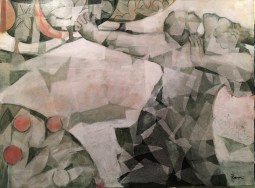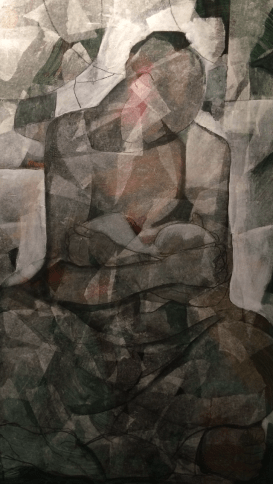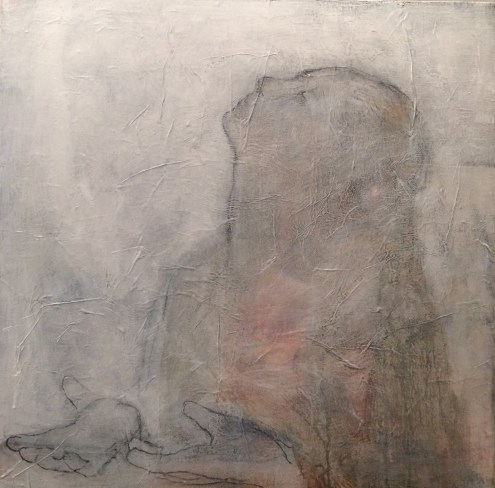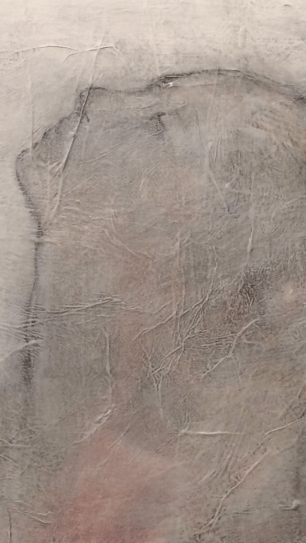
Listen Well [on Not So Flawed Wednesday]

act well 2 copy

When I wore my life/business coaching hat, many of my clients secretly wanted to be painters or writers. After wading around in the depths of their dissatisfaction, they’d finally say something like, “What I really want to do is write a book.” And then, they’d divert their eyes and say, “I just don’t know how to get there.”

The path was always simple to say but difficult to execute. Write. Write everyday. There is no magic path. As Tom would say, “A writer writes. A painter paints.” The action is rarely difficult to do; the story wrapped around it is…well, another story altogether.

The difficulty comes in the form of a many headed monster called vulnerability. “If I write (paint, dance, act…) people will judge what I write (paint, dance, act…).” It’s a heavy cloak to wrap around the creative heart. Yes. They will judge. Some will diminish you and some will praise you to the sky. However, that has little or nothing to do with being a writer or painter, with becoming a better writer or painter. Neither the praise nor the derision is truth or accurate or meaningful.

Both accolades and critiques can pull an artist off-center. To listen to either is to ignore  the quiet prompting of the muse. The essential will be lost in the chatter.

My mind is a tumble of truism. “A journey of a thousand miles begins with a single step,” etc. There is no other way to be a writer than to sit down and write. There is no way to become a better painter than to stand at the easel and paint. And, while writing and painting and acting, there is a necessary skill for an artist to develop: learn to let the opinions and judgments of others pass through. They have nothing to do with creating and everything to do with what others are seeing. The artist’s job is not to determine what others see. The job is to write and paint, to create what the muse whispers in your ear.

There is no other way. Artistry is not an achievement. It is an action, a relationship.

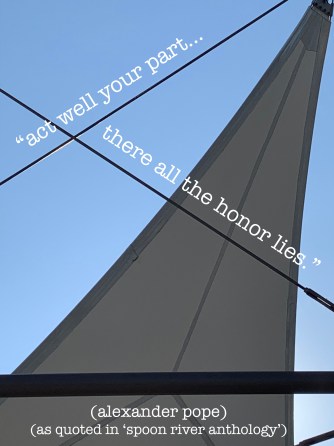
Act well your part. Paint well your painting. Write well your novel. Listen well to your muse.


read Kerri’s blog post about ACT WELL YOUR PART…


roadtrip reading website box copy

Turn And Open [on Two Artists Tuesday]

canoe and dock copy

Real education is understanding the significance of life, not just cramming to pass examinations. ~ Krishnamurti

Tom used to call it The Little Green Bottle theory. The illusion of learning at the expense of real learning. It is the worst fate for a curious mind to confuse active pursuit with passing the test.

The worst fate for an artist is to be revered. Artists who are revered regardless of what they do, stop growing – or worse – they twist. They confuse themselves with their art. And, because they are lauded for any and everything thing they do, they lose their muse. They no longer need to listen or seek or try.  They insulate and turn in on themselves. Knowing that their feedback loop – called an audience – will give them a perfect score no matter what they do, oddly makes their work not matter at all. They – and their work – and their audience – become an energy eddy, an empty bottle with no substance. The circle closes.

Long ago, I guest-directed a play at a college. There was a student, an extraordinarily talented young man, who was coddled by his professor. She heaped praise on him. He was cast as the lead in all productions. In fact, I was (hush-hush-nod-nod) required to cast him. He was protected from the rules and rigors his peers were required to follow. He simply needed to show up.  I crossed his path again a few years later and he was a very sad and empty young man. He left his small pond and didn’t have the skills or work ethic to swim in the ocean. He wondered why no casting director would work with him, why no masters program would admit him. He expected reverence. His talent collapsed on itself. Many of his peers, those who had to work, to grapple, to reach, to struggle, had solid and thriving careers. Rather than helping him grow, his professor, his college community, stunted his artistry. His circle closed.

The waters are so calm this morning. Hog Island seems to float in the air. Sitting on the dock, I feel perplexed. Lately, the world so often feels upside-down, in service to the opposite of what it professes. Islands feigning connection. Closed circles working hard to stay closed even awash in the knowing that they can only breathe when opened. They can only grow when challenged, when they open the gates. They can only thrive when they turn, open the circle, paddle toward the limitless horizon and face the unknown.

The muse is out there, waiting.


read Kerri’s blog post about THE DOCK


sunrisewebsite copy


photograph: on the dock of the bay ©️ 2019 kerri sherwood


Play Again Please [on KS Friday]

nurture me songbox copy

I just broke the first rule of the melange. I peeked over Kerri’s shoulder to see what she was writing. It’s true, she misses her piano. It’s true, last night, as we were closing the theatre, after a day of high anxiety, she walked onto the dark stage, opened the 9 foot grand piano delivered for the chamber music festival currently performing from our TPAC, and began to play. I sat in the dark and listened. Her anxiety and frustration transformed. She nurtured herself into artistry. And, once again, as I always do in these moments, I thought what a pity it is that I am the only person on this planet privy to the full breadth and depth of her artistry.

Streaming services, although great and free for listeners worldwide, have filled artists like my wife with a gigantic Why Bother. The streaming services are making a great living off of her music. More than a million people each year listen to Kerri’s compositions. She profits not at all. The streaming services stand between her and the money her music produces. They toss her less than a bone.

She just wrote that she misses her piano but I think it is more than that. I think she misses the vitality, the good heart that grows inside an artist when they produce, when they challenge themselves, when they explore new territory and bring what they find back for the rest of us to hear. It nurtures the artist. It nurtures the audience. Left unexplored, an artist’s heart fills with anxiety and depression, it closes against the pain.

Last night, after the chamber music had died, in a dark theatre, I listened to a second concert. It was more powerful than the first because it was pure. It was an artist talking to herself, reaching through the Why Bother door and touching, even for a moment, the answer: because it nurtures you to play. It nurtures you to create. I know it nurtures me to listen.


NURTURE ME on the album RELEASED FROM THE HEART  is available on iTunes & CDBaby


read Kerri’s blog post about NURTURE ME (and don’t tell her I peeked)


cropped head kiss website copy


nurture me/released from the heart ©️ 1995 kerri sherwood


Continue To Learn [on DR Thursday]

Studio Shot copy

Last week we helped our dear 20 pack his late father’s paintings. His dad, Duke Kruse, was an exceptional and prolific artist. As we wrapped the pieces, preparing them for storage, I couldn’t help but study them. Duke was free and bold. His color palette was precise. His technique was impeccable. And, a few years after his death, his work has nowhere to go. No gallery. No museum. After the estate sale, we will catalogue it. 20 will store it.

It was bittersweet. I got to spend time with the work of an extraordinary painter. It was inspiring and thrilling. I learned. I also got a glimpse of what will most likely happen to my work after I am gone. It will be catalogued. It will be stored.

My work is similar to Duke’s: I have fine technique and my subject matter is not widely accessible. Like Duke, I have individual buyers. My paintings are in collections across the nation. But, also like Duke, no collectors seek my work. At this late stage, like Duke, I have no greater gallery representation. No one, besides me, is actively promoting my work. I paint. I take a photograph of the new piece, catalogue it, and then throw it onto the stack. It begs the question, ” Why do it?”

Horatio is a gifted artist. During his recent visit, we descended into my studio and we waded into the stacks. I was delighted to pull out and show him my paintings. I value his thoughts and opinions. He rarely shows his work. He doesn’t paint to show. He paints for himself. He paints, like Duke and like me, because he has to. He paints because the paintings work on him, too. They paint him. They challenge and change him.

This afternoon we will move the final load of Duke’s work. I doubt if Duke would care much that his paintings will disappear into storage. He did his work and the paintings served him well. They made him soul-rich and laughter-filled.

And, so, from Duke, – and Horatio – I learn. From my paintings I also continue to learn. It begs the question, “Why not?”


read Kerri’s blog post about THE STACKS


wineglassesthreehands61 website box copy


Feel The Mountains [on Two Artists Tuesday]


mountains in the distance CO copy

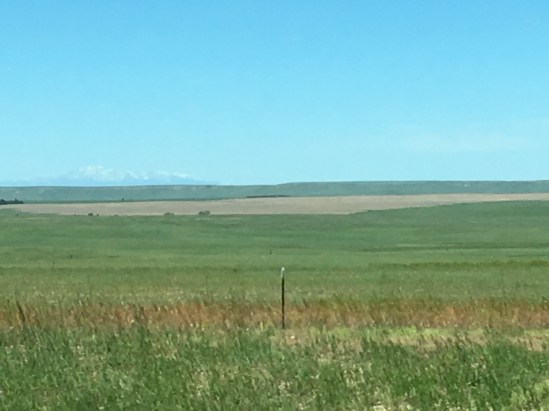
Look carefully. In the distance you will see the mountains. “It kills me, “Kerri said, staring out the window as we drove east out of Colorado. She craned her neck and watched as the mountains faded into the distance. She took a picture more to reach than record them.

The mountains make her weep. Seriously. Driving up the canyon, leaving the flats of Denver behind, she catches her breath and then the tears roll down her cheeks. “It’s so beautiful.” she utters, wide-eyed, incapable of taking it all in.

Leaving them is harder still. I watch her writhe in her seat, growing more agitated the further away that we get. “Damn it,” she fumes. These mountains are her holy land. They inspire songs and poems and musing. Leaving is not a geographic equation. She feels the separation.

In every corner of our home you will find a pile of rocks, mementos from our travels. And, in each pile, among all the other treasures, there is always a special rock, a mountain rock. She surrounds herself with mountains, even living on this great plain, a block away from a great lake. An artist knows where her power comes from.

She sits at her piano. She opens her computer to write. Surrounded by mountains, she composes. She feels the connection and it fills her with inspiration. Going home is not a geographic equation.


read Kerri’s blog post about MOUNTAIN IN THE DISTANCE


roadtrip website box copy


See [on DR Thursday]

HH sketches copy

These days, I draw to sort out a composition. That’s it. I open my sketchbook if I need help seeing beyond what I am thinking.

I used to draw everyday. It was a rule. It was an essential part of my daily life and artistic development. I now know that, during that phase, I was teaching myself to see.

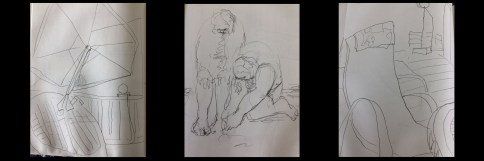
Nowadays, I take my sketchbook when I go on vacation. For a few moments every morning, I open it and do a series of quick gesture drawings. 10 seconds max. I rarely look at the page. Quick gestural lines of what’s right in front of me. Quick capture of a memory I want to record. Eating watermelon on the deck. Picking up a shell to see if it’s occupied. Seeing the moment. Seeing the memory. I close my sketchbook and later in the day take a peek at what I drew.

Once, long ago, I was jammed up. A blocked artist. Liz had me do 100 paintings in an hour. Ink and a brush and no time to think. No separation between the seeing and the movement of the brush. It was fun and fast. No thought means no judgment means no blockage. It bears repeating: seeing = no separation. My block disappeared in a single night. My artistic well sometimes goes dry but since Liz’s lesson I have never again been blocked. She reminded me that artistry is about seeing and not about showing.

I sat on the deck overlooking the ocean. The morning sun, hot coffee and a few pencils. I opened my sketchbook and my eyes. As my hand moved quickly across the page, the world sparkled, and I knew that I was the luckiest man alive.


read Kerri’s blog post about HILTON HEAD SKETCHES


juiceglassesonHH website box copy

Pace And Shed [on DR Thursday]

underpainting copy

underpainting

Like all artists I pass through periods of discontent with my paintings. They become like ill-fitting clothes. I want to shed them. I’m embarrassed to claim them. I start poking around for something new. Something that fits.

It took me more than a few cycles of discomfort to realize that discontent was actually a gift. It is the leading edge of curiosity, the fire storm that makes way for rejuvenation. Artists are not immune to holding on tightly to the safety and comfort of what they know and need a good dose of discontent to loosen their grip. At least I do.

Discontent makes me range around. Try stuff. Tear things up. Scribble furiously. Wonder if my muse has abandoned me (feel sorry for myself). Make really bad art (not on purpose). Make really bad art (on purpose). Take walks.

Discontent allows my empty well to refill. It pops any illusion I might carry of perfection. It turns my ship and hoists full-sail toward the edge of the world. And, it is always when I sail into uncharted waters that I find my muse waiting. She drums her fingers and says, “I thought you’d never get here.”

Ten years ago, when becalmed in the middle of my artistic ocean, I saw a pile of tissue paper in the corner of my studio. In a fit of why-not-nothing-else-is-working, I tore pieces of tissue and slapped them onto the painting-of-my-discontent. There sat my long missing muse, fingers drumming. “Texture,” she yawned. “You might want to see where this takes you.”

It’s taken me a long way. And, to my surprise, just a few weeks ago, I woke up and my paintings, like ill-fitting clothes, no longer fit me. I look at them as if someone else painted them. “Yikes,” I thought, “I hope no one saw these…” My muse packed her bags. She is nowhere in sight. I paced a little. Discontent like fog descended.


read Kerri’s blog post about UNDERPAINTING


buffalo adirondack chair website box copy

mother&childprocessshot copy

sometimes the underpainting becomes the painting…this is a slice of Newborn


newborn ©️ 2019 david robinson


Drink It In [on DR Thursday]

I wrote to Master Miller. He is one of my favorite artist confidantes. I told him that I was in a dry spell and so I was taking advantage of my artistic empty well by playing with sketches and revisiting old themes. Drawing memories.

He was (as always) enthusiastic. He regularly bubbles with love of art and artists. He often sends me photos of his young son painting. They have become a source of great joy and inspiration for me. Curiosity and freedom. A father and son, both artists, at play.

I remember a spring day in Colorado. A mountain trail. It was hot and then the afternoon rains came. A short burst, a downpour. There was nothing to be done but turn and face it, open and drink it in.

facetherain morsel

a close up


read Kerri’s blog post about FACE THE RAIN


vailKdotDdot website box copy


face the rain ©️ 2019 david robinson


Reach Back [on DR Thursday]

prometheus resurrection morsel copy

Artists are constantly reaching backward and forward through time. They daily pay visits to the work of the masters. They periodically revisit their own past creations. Their work sends ripples of inspiration and opportunity far into the future.

When Beethoven was young he wrote a ballet called The Creatures of Prometheus. It calls for a legion of dancers and is way too big for most contemporary ballet companies to attempt. Contemporary symphonies, on the other hand, desire to play the music because Beethoven, for the rest of his life, reached back into his ballet, mining for musical phrases, developing some of the phrases into his most famous work.

How to play the music from a ballet written in 1801 as a symphonic piece in 2009?

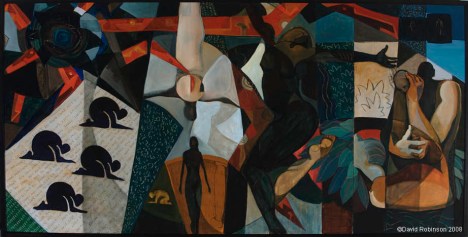
Yaacov Bergman, the visionary and laughter-filled director of the Portland Chamber Orchestra had an idea. Why not tell the story of the ballet. A storytelling would provide the connective tissue, weaving the music together into a cohesive symphonic performance. Because Beethoven wrote a ballet, 207 years later, I had the great good fortune to write and perform the story of The Creatures of Prometheus with the PCO.

And, since we were crossing time boundaries, why not cross a few artistic genres, too.  Yaki hired artist Liz Gil-Neilson to paint and produce a visual storytelling that was projected during the performance. Music, storytelling, contemporary visual art. Ripples, ripples, everywhere.

But, that was not enough. Since I am also a visual artist, Yaki asked that I translate my story into a visual statement. So, I painted three large canvases (Creation, Garden, Resurrection), one for each movement of the symphony, that hung with Liz’s original images during run of the symphony at the George Broderick Gallery in Portland.

Reaching forward. Reaching back. Today, more than a decade after our collaboration, I mine my experiences and paintings for inspiration. As new collaborations arise, as I stand at the base of a new series of seemingly impossible tasks, I’m fortunate to have my Creatures of Prometheus to remind me of the possibilities. They nudge me forward.  Like Beethoven, I reach back into my past work to find a path forward.

It makes me smile to know that in 1801 Beethoven, with a quill pen and ink, scribbled notes at his desk and those scribbles turned into dances and symphonies that inspired stories and paintings and a wacky multi-media collaboration (a phrase that did not exist during his lifetime). And more: a morsel image digitally altered for a blog post written on a computer keyboard. Pen and ink are hard to come by. Reaching backward. Reaching forward.


read Kerri’s blog post about Prometheus morsel


arches shadows k&d website box copy


prometheus resurrection ©️ 2008 david robinson

Bend It [on DR Thursday]

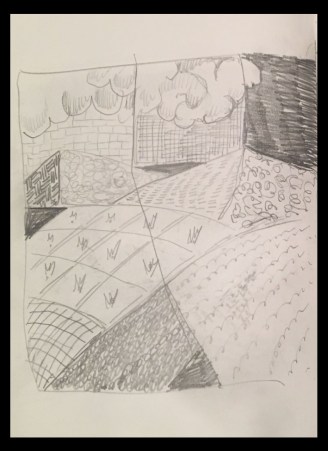
county sketch copy

The terminology in art reads like so much poetry. Zero point perspective. Chiaroscuro. Foreshortening. Rococo. Image plane. Vanishing point. Oblique projection. Intaglio. It goes on and on, these tasty and magical words.

They should be poetry. They describe fields of possibility. They attempt to codify the making of illusion or the impulse of an explorer. Bending space. Deconstructing and reconstituting. Perceptual distinctions. The visual language of cultural norms.

There has been for centuries a mathematics of art. Optics and relativity, movements in science that have their conjoined artistic twins. Rebellions. The maintenance of form. Rules and rule breakers.

I sat in on a class taught by a master artist. He was a lover of landscape (another yummy word) and taught his students an earth-shattering lesson: reality, like time, cannot be caught. It’s a fools errand to try. Painting is a conversation. It is an infinite game. Bend space. Move the tree. Color is fluid, moving, never fixed.  Be like color. Play. Discover. Transform.

I do not consider myself a landscape painter. And then I remember the master teacher and I remove the word ‘landscape’ from my vernacular. And then, suddenly, there is a universe of movement, color, light, and shapes to bend.


read Kerri’s blog post about a LANDSCAPE SKETCH


Newborn copy

newborn. deconstruction. reconstitution.


coffee cups in scion website box copy


newborn /landscape sketch ©️ 2019 david robinson