Make Quiet

A sanctuary

A sanctuary

It is Thursday night. Kerri is attending a meeting at the church and I have tagged along so I might sit alone in the sanctuary. I’ve always loved entering the quiet spaces. Once, a lifetime ago in Sedona, John called me “guru dude” because I sat for hours nestled in the quiet of a vortex. It felt like minutes to me. I think it unsettled him that I was so completely settled. I know it unsettled him that I would rather seek quiet than make noise.

Sanctuaries, I’ve learned, are everywhere.

My task, my mantra, and my delight of a few years ago was to realize that all the world is my studio. I had some amazing help and more than one universal dope slap before that realization sank in. I used to believe that in order to create I had to escape the world to find the refuge and quiet of my studio. I felt like I had to go to my studio to find my creative place just like I felt like I needed to go to a vortex to experience deep quiet. I had it upside-down. A studio, like a meditation practice, is meant to bring us into communion-with, not reinforce our isolation-from. It is not a place of escape. It is a place of joining. Quiet is not something we find as much as something we allow.

To me, the word “studio” and the word “sanctuary” are now equivalents. They are the places that creating happens and creation is a quiet process: the inner chatter stops, channels open, and something comes through. A few weeks ago, in the second performance of The Lost Boy, we stepped onto the stage and everything was quiet inside. There was no past and no future; there was only the moment – and it joined us, audience and performers, in a single, shared story. Something came through us; together we created. There was no effort, there was no striving; there was, as Jim Edmondson used to say, “a dance of giving and receiving.”

This “joining” is the dirty little secret and great power of the arts. It is something that school boards will never understand but something that dictators across the ages have feared. Artists are the vortex of joining, of shared identity, of explosive quiet, of laughter that crosses lifetimes. The arts do not separate; when at their most potent they unite. They clarify. They delineate substance from chatter en route to a powerful common center that is as holy, as quiet, as it is creative.

Study Your Practice

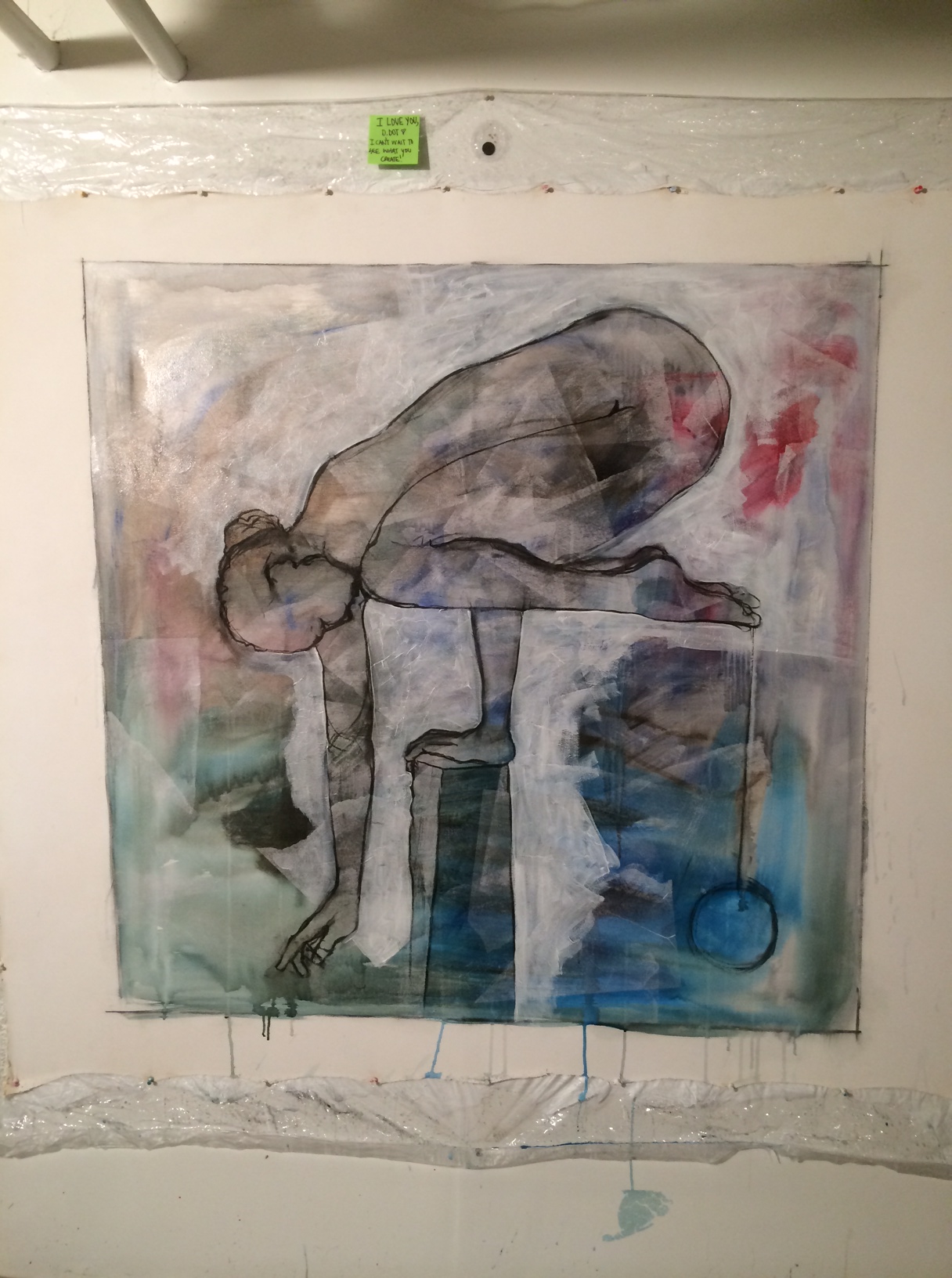
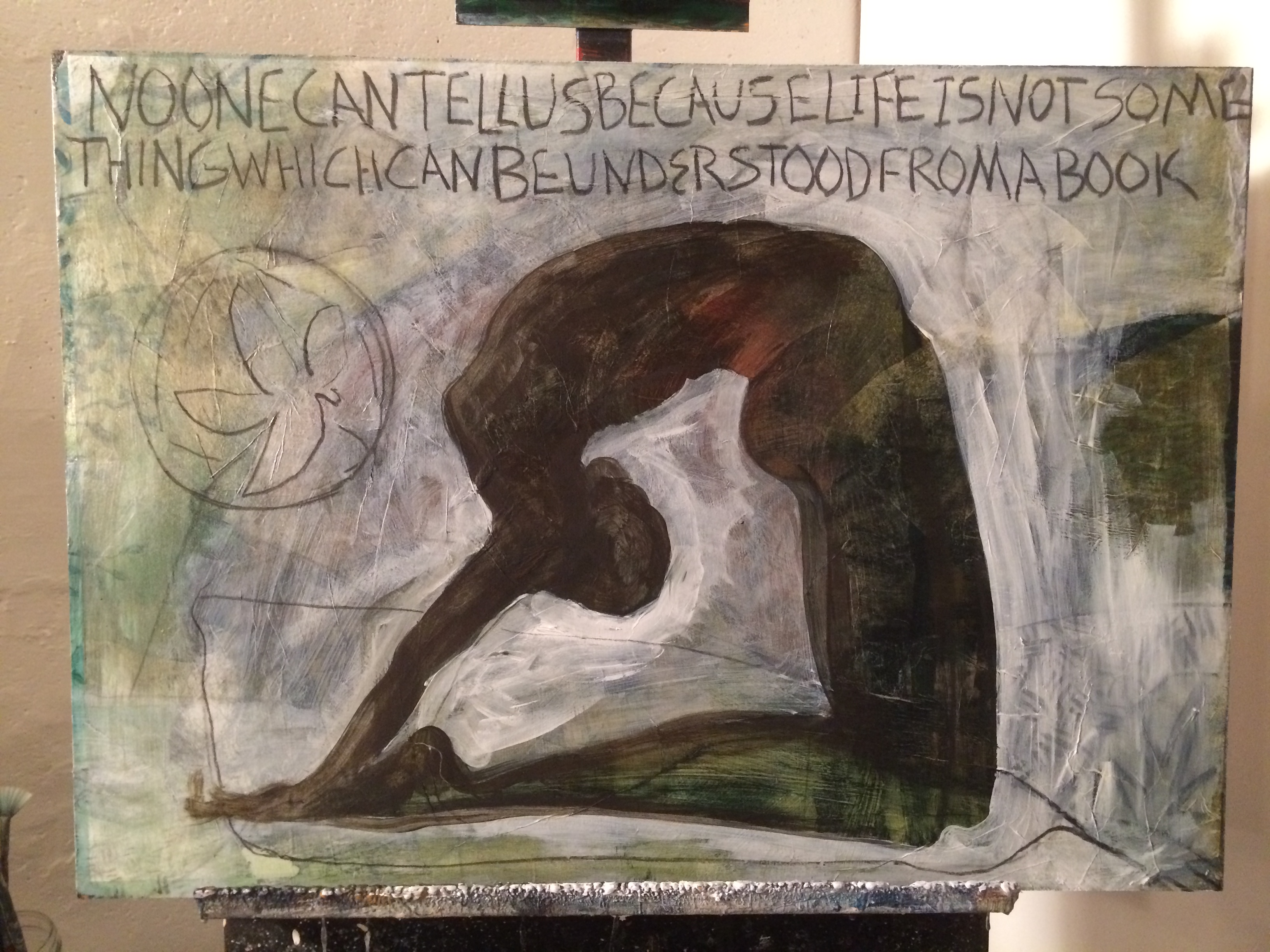
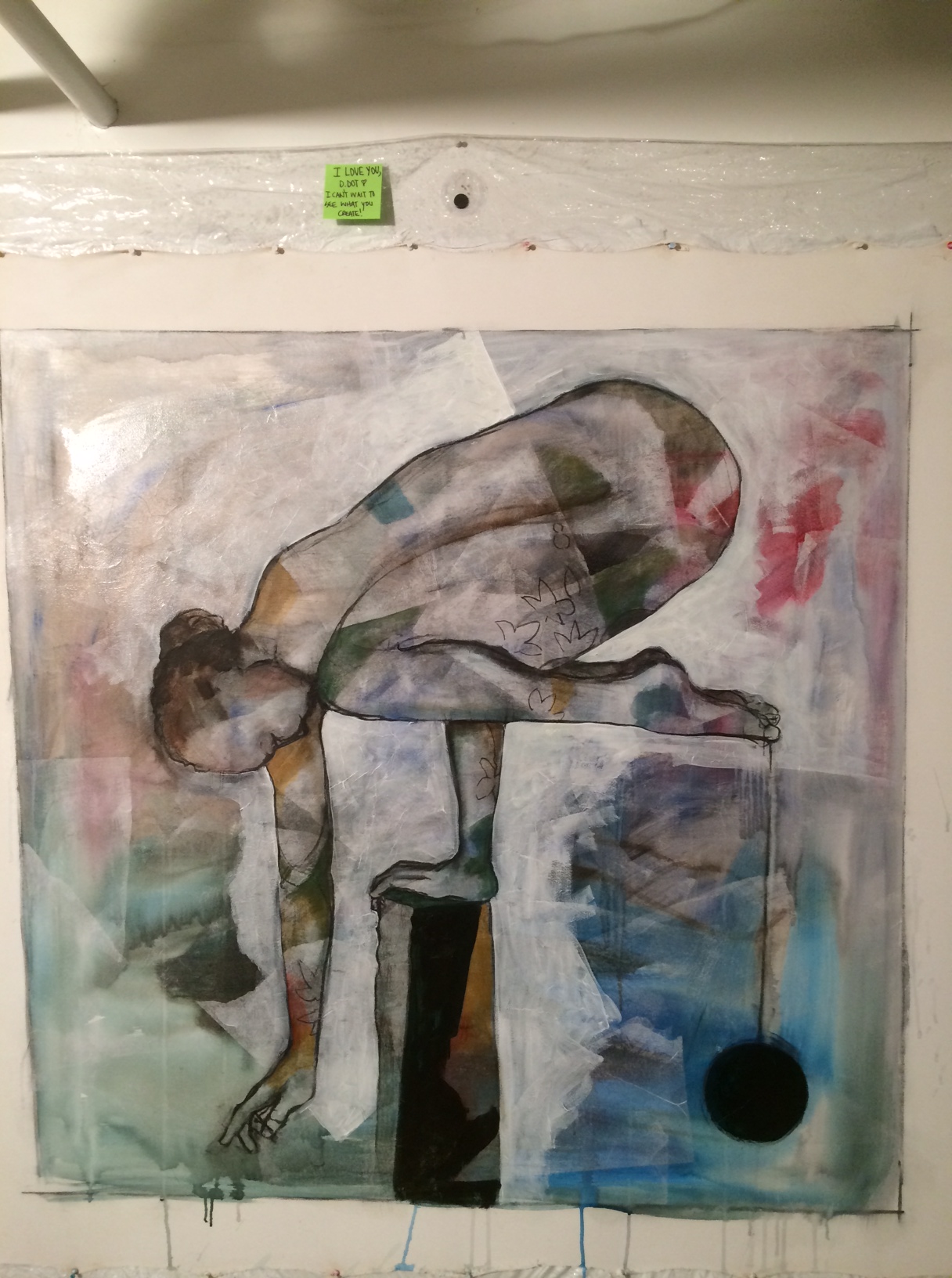
During his recent visit, Skip wanted to see my latest paintings so we went down to the studio. He is a great studier of people and processes and while flipping through my work he asked if I’d ever taken process shots or filmed my process of painting. Occasionally I take photographs of a painting in process – not to record the stages of development but so I can see what’s there. I’ve learned that a photograph can sometimes help me see what I’ve grown blind to seeing. I agreed to take and share some process shots. Yesterday, I started a new piece and here is the day’s progress:

#1

#1


#2

#2

This is the next in my “Yoga series” of paintings. A “yoga” is a practice and I started this series because I was curious about my practices: I was meditating on this question:what is the difference between what I actually do and what I think I do? For most of us the gap is vast between those two points. This series is my ongoing meditation/inquiry into the gap.

#3

#3

A study of your practices will surprise you. What you do and think each day is a practice – it is your yoga; your actions and thoughts constitute the rituals of your life. So, for instance, when I was younger (lots younger) I believed my paintings were “not good enough.” Each day I’d approach the easel and practice “not good enough.” It’s amazing the transformation that becomes possible when you simply change your practice. Practice dropping the judge from your menu. Why not?

Last night I had a conversation with someone who asked, “Why don’t people care?” I suggested that people do care but you have to practice seeing it. It’s all around us if we refocus our eyes. And, in cultivating the practice of seeing the acts of kindness and caring, we become kind and caring (because that is the object of our focus).

photo-5

#4

My yoga series has brought me to this (so far): The world does not need changing; we need, as Doug used to say, to close the gap between what we think we do and what we actually practice doing.

Reach

photo-6In these few weeks post Lost Boy I’ve been writing thank you letters and sending Kickstarter rewards to the many people who donated to the campaign. I am humbled by the number of people who stepped forward to lend a hand, offer resources (financial and otherwise), and/or heap us with the moral support necessary to produce the play.

The Reminder: no one does anything alone. All creative acts, all things that are useful in this world, all triumphs that seem on the surface to be an individual achievement, are, in truth, a group effort. Life is a team sport. Quarterbacks are nothing without a front line, a coaching staff, a back office, a marketing machine spinning the tale. They also had mothers that for years drove them to practice, families that stood in the cold to watch them play little league, and a host of friends who told them that they could do it if the only kept going. Artists are no different. Even the loneliest painter has a rolling lifetime team whether they recognize it or not. Consider this simple basic: a painting is never complete until someone other than the artist engages with it. A play is never complete until an audience arrives. The whole point is to make or accept an offer to/from an other.

We, the people of these United States, place the accent of our existence on the achievement of the individual and that sometimes makes us blind to the obvious truth of our existence. We do nothing of worth on this earth without the support and participation of others; relationship is at the core of anything worth doing.

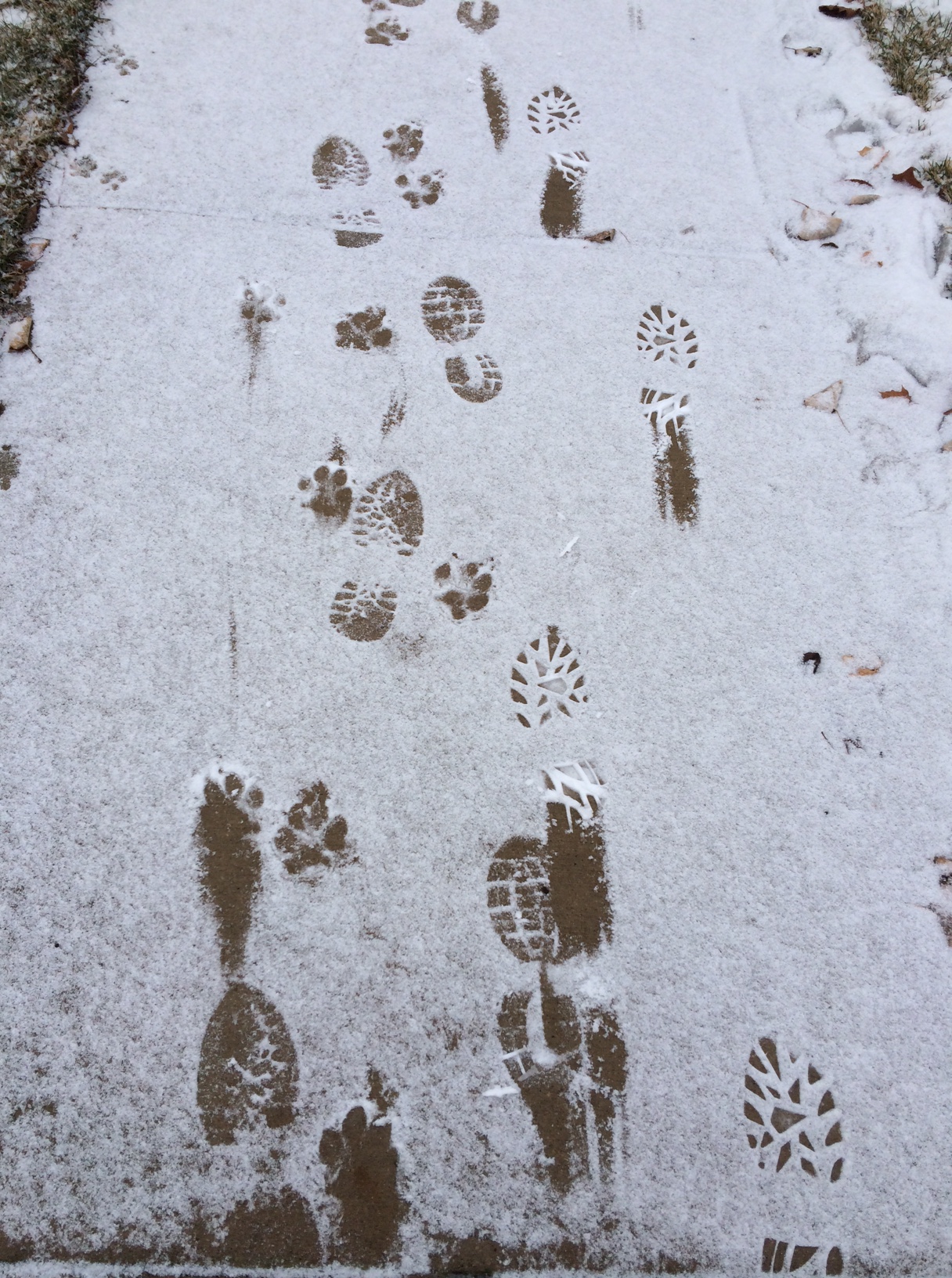
from the 2015 Racine snow carving contest. I'm sorry I did not capture the artists names!

from the 2015 Racine snow carving contest. I’m sorry I did not capture the artists names!

Once, many years ago, I lived in Los Angeles. I did not know my neighbors. I had no idea or desire to know who was living in the houses next to me. One night the earthquake came and our illusion of independence was stripped bare. With no power, no water, no heat, and compromised housing, the first thing we did was to reach to each other. When the illusions of comfort and security are stripped, our real need (each other) becomes glaringly apparent.

I wrote this play, The Lost Boy, because someone dear to me, over a decade ago, asked me for help. I was grateful that he asked – it meant I got to spend time with him and return some of the attention and love that he had invested in me. When the metaphoric earthquake hit – when Tom died – I had no recourse but to reach out to others; I produced this play when I realized that I was not alone and all I need do was ask for help. Legacy, like story or life, is an infinite loop of relationships.

Delight In The Question

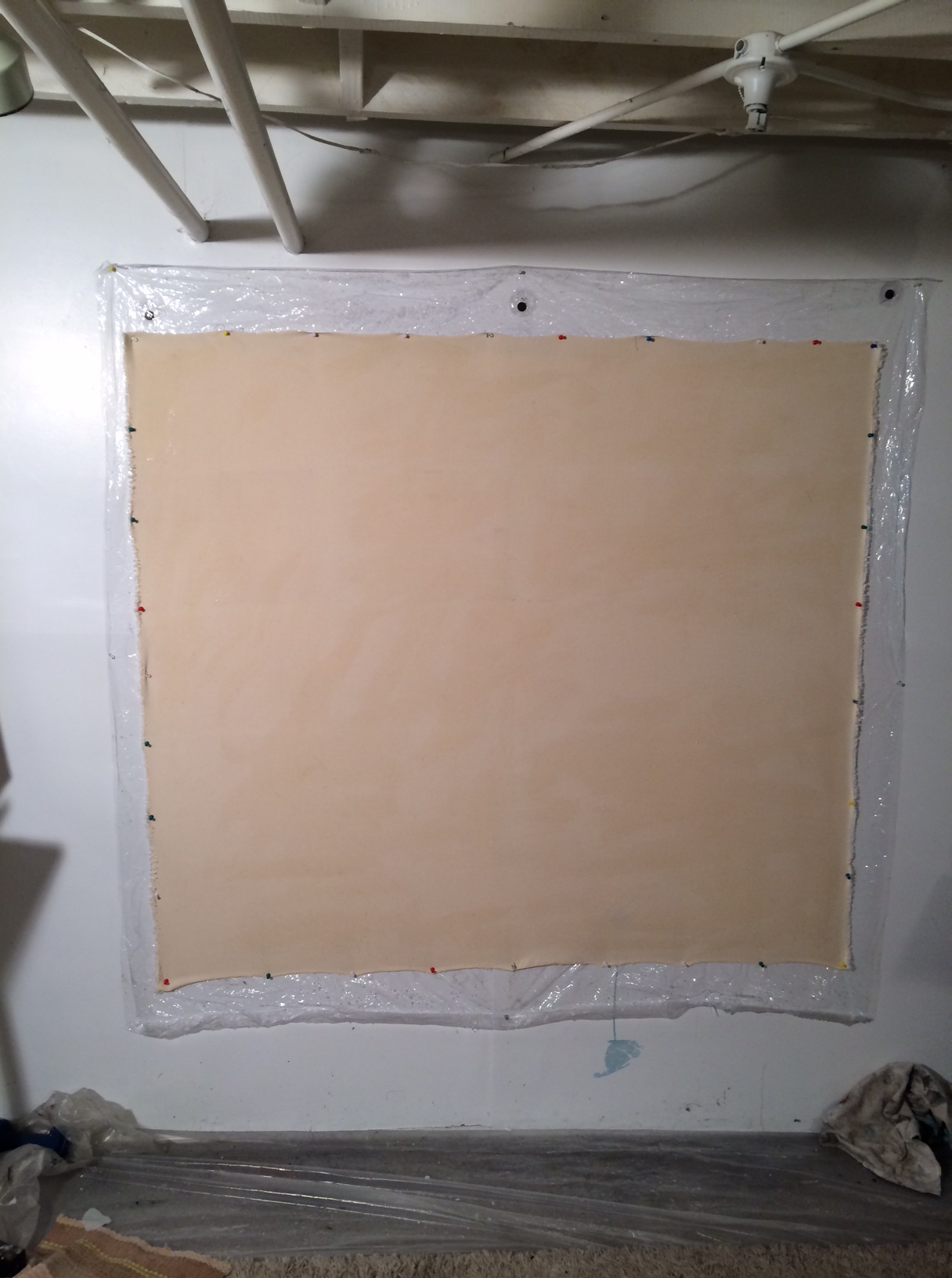
a new canvas, stretched and ready for gesso.

a new canvas, stretched and ready for gesso.

So what is next?

There is a sweet void that follows in the wake of every project and this particular void is vaster than most (don’t you love the phrase, “particular void?”). This project, The Lost Boy, was and continues to be more layered than any other. It pulls on emotional and spiritual roots that have not been available in other performances and so the post-show disorientation is mighty.

I’ve come to appreciate my time in the void. It is the time of reflection. It is the time of rest. It is the time of long walks. It is the time of questions finally answered that invite bigger questions. I’ve learned that disorientation is necessary for reorientation and reorientation never comes as an answer but always comes in the form of a question: so, what’s next?

Yesterday I tacked a large canvas to the wall. It is now covered with layers of Gesso and is ready for paint. I delight in this phase of preparation. It is akin to the anticipation of meeting with an old friend; the conversation will be rich and far reaching. I also bought a new sketchbook and have set myself the task of filling it within the month. Many years ago, while sitting in another void, I was staying with my pals Duncan and Liz while directing a play. Liz, familiar with voids, insisted that, after rehearsals, I do a hundred paintings before I sleep. Each night, tired from a long day of rehearsal, Liz sat with me as I did one hundred paintings, quick gestures with brush and ink, paper fluttering to the floor. We laughed and I felt renewed. After ten paintings en route to a hundred, the notion of judgment and too-much-thinking goes out the window. The joy of the action takes precedence over the illusion of a finished product.

I’ve written often of the lessons Saul-the-tai-chi master taught me. Focus on the field of possibility and not on the opponent. In other words, offer no resistance to those things that appear as obstacles. Sit with gratitude in the void. Paint a hundred paintings before you sleep. Delight in the question.

Mix Beautiful Color

photo-6This magnet-sentiment was on Jim’s refrigerator:

It’s never too late to become what you might have been.

It is particularly poignant because both Jim and I are surprised, dare I admit, disoriented, after finally producing The Lost Boy. It was over a decade in coming. I’d stopped believing that it would ever find a path to the stage and, instead, would remain a good story for dinner conversation. Now that it’s out of the box and rolling around in the world of possible-next-productions, I hear Tom’s voice ringing in my ears, “Readiness is all.” It couldn’t happen until it was ready, until I was ready.

For the past decade, coincident with the development of The Lost Boy, I have been telling stories at conferences, with symphonies, during organizational trainings, and other random stage performances. I have inadvertently learned to tell a good story (or better stated while slaughtering all grammar: to tell a story good). 5 years ago I couldn’t have performed the play as I did last week. I didn’t have the chops for it. I do now.

Years ago, after being wowed by Jim Edmondson’s performance of King Lear, I asked him what he’d learned from doing the role. He replied, “I don’t have enough colors in my paint box to do it justice. Not yet.” This giant of American theatre blew my socks off with his performance, but felt that he fell short. He couldn’t yet fulfill the demands of the role. He knew there was more to grasp and his artistic arms were not long enough. He knew he was not yet ready. No amount of accolade or sock-less fans would change what he knew: there was more to the role than he could reach. More age, more life, more skill was needed. He taught me in that moment what it meant to be an artist. The compass is internal. The capacity is ever expanding if you work at it.

I now believe that, to produce The Lost Boy, I also needed to find the right reason before readiness was available. For years I thought I had an obligation to Tom. I thought I had to finish it for him and tell his story. That was only partially true. The real obligation was to myself. I had to finish it for me – and it took a good deal of readiness for me to see that. It had to become my play. And, in becoming my play, I can now see that I have a world of color in my paint box – and a world of color that I still need to develop. That is the name of this game of mastery. There is never an end. There are just more and more beautiful colors to find and mix and share.


Step Into The Field

photo-5[continued from “Jump!]

I wrote this phrase: “The one facilitates the journey for the many.” And, today, I would add: the one facilitates the journey for the many so that the many can experience the one. This little phrase is the point and the purpose of the theatre.

I’ve come to believe, at this stage in my artist life, that all processes of art-making are actually exercises in presence. And, presence, for me, has come to mean transcending any experience of separation. For instance, when I am fully engaged with painting a painting, “I” am nowhere to be found. Time disappears. There is only rolling creation. To use a cliché: something comes through me. Language is incapable of grasping what really happens and all we are left with is “something comes through” – a statement of separation.

A week ago today we were preparing to perform the closing of The Lost Boy. This play is unique in my experience for many reasons (it would require a book or two to explain the many layers of this cake), one of which was that we only had two performances: an opening and a closing. We hit our stride on the closing – and by that I mean we let go of thinking, preparing, adjusting…, and entered presence. We stepped onto the stage with no thought of “what’s first” and “what’s next.” The play happened with no effort. The Chili Boys played like never before. We were, to use another cliché, in the flow. I have never felt more alive, more connected, more present. It was fun!

50 minutes before stepping onto the stage

50 minutes before stepping onto the stage

Years ago, I had the opportunity to assist Jim Edmondson in a series of plays and I riddled him with questions. He introduced me to the notion that the art of acting was the art of presence (though he used a different language). He taught me that words like “focus” and “intention” are merely tools for cultivating the capacity to be present. Presence is the portal and the actors’ (artists’) job is to step into presence so the audience can join them. Literally, join with them in the field of the present, the place of common story. To be. Together, in a single story. And, although he did not say it this way, he taught me that “to be” is infinitely more powerful than “to become.” “To be” is not an arrival platform; it is an experience of the many recognizing itself as the one [could you ask for a better definition of art!].

Mike, our stage manager extraordinaire, came down from the booth and told us that our performances were different than the first night. We were more potent; we found nuance and greater depth. He was right. We were finally able to surrender to the work, get out of our own way, and step into the field of shared story.

See Again and Again

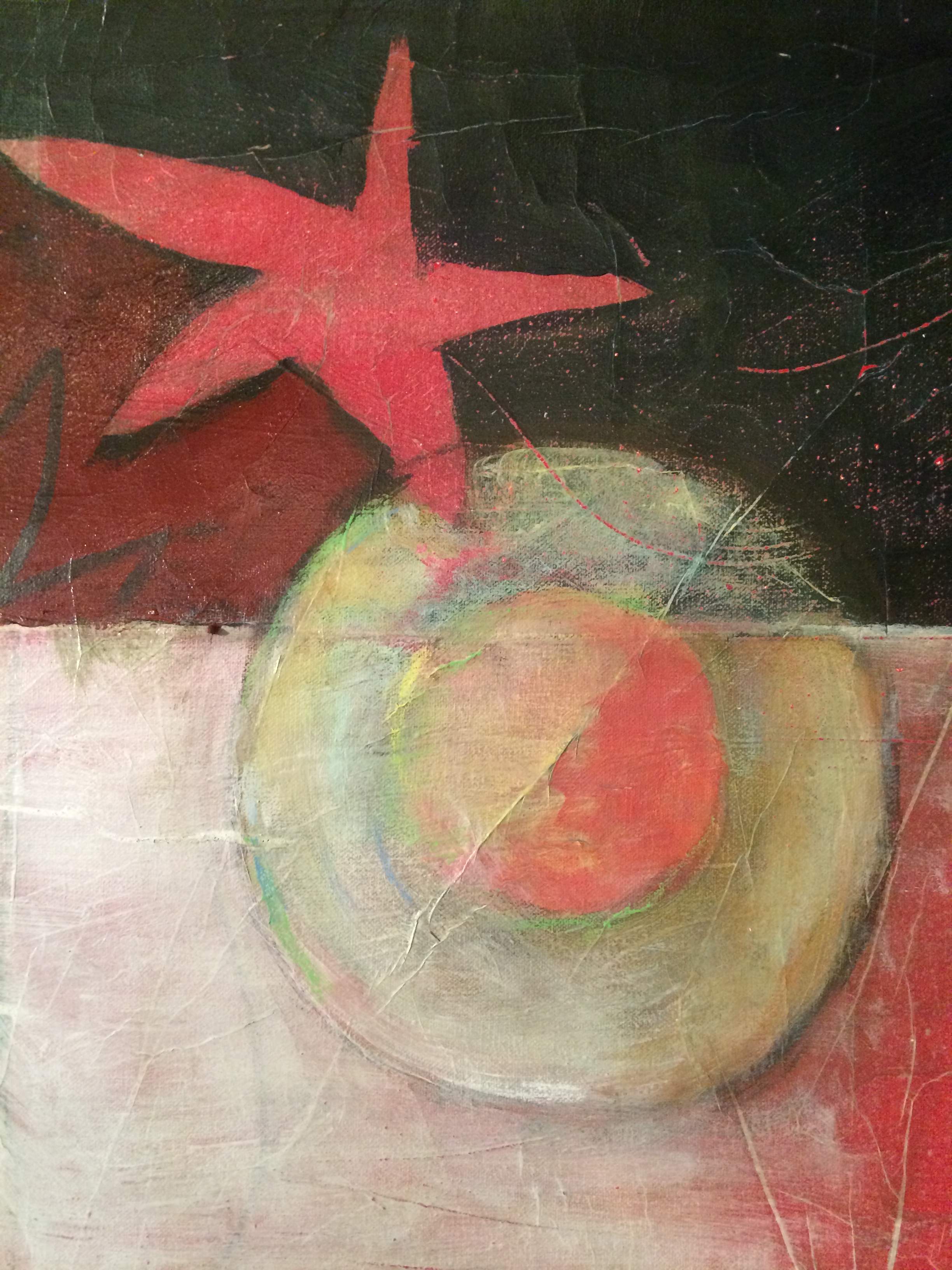
A detail from my painting, An Instrument of Peace

A detail from my painting, An Instrument of Peace

It has become my habit, when I finish a painting, to take photographs of sections of the piece. It helps me see it again. Often, I like these detail photographs as well or better than the painting. There are always discoveries in the details.

My paintings always surprise me. Years ago, I was showing my paintings to Jim Edmondson and he asked why all of my pieces had three spheres in the composition. I didn’t know what he was talking about. He laughed, our roles reversed, and he began showing me my paintings; each piece included three distinct spheres. I literally did not see them. They were apparent only after he made me look at sections of the paintings. I was both shocked and delighted. Perception is not universal.

Another detail from An Instrument of Peace

Another detail from An Instrument of Peace

The mastery of art (the mastery of life – same thing) is to transcend the notion that you “know” and that what you know is “right.” Krishnamurti wrote that, the moment you judge something, you cease to experience it. The fullness of life is in the experience and not the translation of the experience. All of us assume that we see the whole picture. We assume that we see is reality (truth) – and that reality (truth) for me must be reality for you. It is not. To have an “open mind” and “clear vision” is to release the notion that there is one truth, one way of seeing.

Once, I directed a production of God’s County by Steven Dietz and I knew it was a good production because half of the audience left angry and the other half left inspired. One play, many interpretations and the interpretations were, like all things we name as reality, rooted in each individual’s personal experience. What matters is not that our interpretations need to be the same, but a recognition that what you see is just as valid as what I see. As my friend Joe once said, “We come to know ourselves through other people’s eyes.”


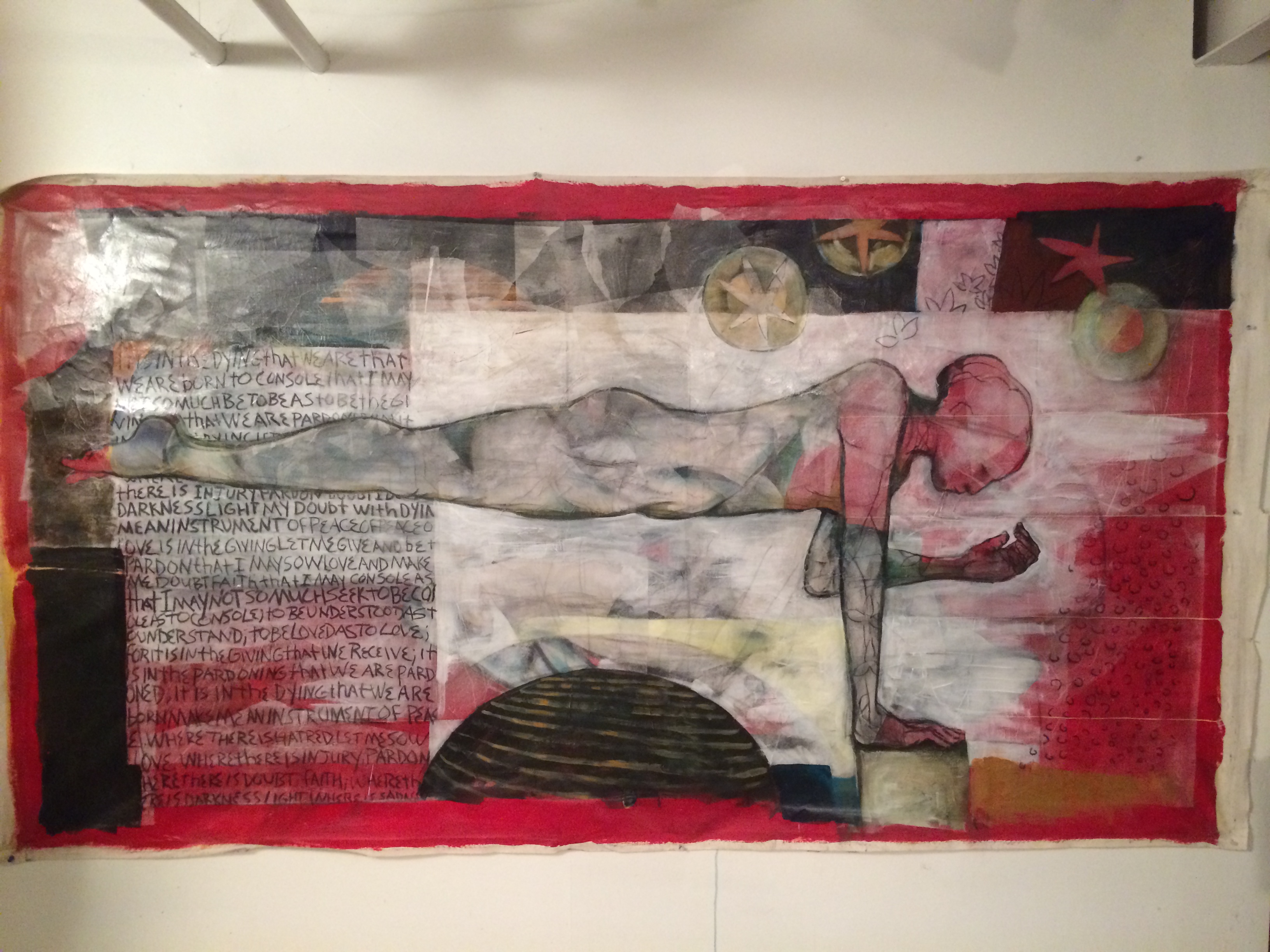
An Instrument of Peace

A rough shot on the studio wall of An Instrument of Peace

title_pageGo here to buy hard copies (and Kindle) of my latest book: The Seer: The Mind of the Entrepreneur, Artist, Visionary, Innovator, Seeker, Learner, Leader, Creator,…You.

For all digital forms, go here (Leanpub)

Look To Each Other

my latest work-in-progress

my latest work-in-progress

Josh laughed from the back seat of the car. He read aloud the text that made him laugh: I’m in MoMA (the museum of modern art) and someone dropped a glove. Now, people are walking around it because they don’t know whether it is art or not!

I’ve spent a goodly amount of my time on the planet in museums of contemporary art and know that most folks passing through the museum have the same confusion about the pieces on the walls. What makes something art and something else not-art?

Almost a century ago Marcel Duchamp entered a urinal in an exhibition and gave it the title, “Fountain.” At the time it was scandalous and now represents a major milestone in art history. Today, a urinal in a museum exhibition would get the same treatment as the glove on the floor: confused consideration. Is it or is it not art? The beauty of the glove moment, the thing that binds it to the urinal moment, is that, in both cases, the gallery goers looked to others, perfect strangers, to ascertain a proper response: it is art if they say it is. Art, in this case, is an agreement.

This agreement, looking for approval about how to behave when confronted with the art-or-not-art question may seem superficial until you consider that recently people in Paris lost their lives over a disagreement of what was art and what was not. In recent history (2001), the Taliban destroyed centuries old giant statues of the Buddha in the Bamiyan Valley. They considered the statues idols (not art) and dynamited them off of the face of the earth (I will leave you to discover and ponder the irony between my Paris and Bamiyan Valley examples).

the words written into my work-in-progress

a close-up: the words written into my work-in-progress

Art is meant to open our perspective, to make us question, to help us see. A society that is capable of seeing is also a society that is capable of questioning; they go hand-in-hand. Questioning is always present when people are growing – so is art. Questioning also begets tolerance – it requires us to doubt our perspective and consider the view from someone else’s shoes. In these times when I hear someone bemoan the end of civility and the horrors in the world, I wonder if they’ve argued to cut art from the schools or  recently attended a concert to hear music to move their soul. Art is dangerous to leaders who like their people blind. Art is offensive to people who want their community thought-less. I delighted that somewhere in the world, in a museum of modern art, a group of people walked around a lost glove and looked to each other for guidance.

title_pageGo here to buy hard copies (and Kindle) of my latest book: The Seer: The Mind of the Entrepreneur, Artist, Visionary, Innovator, Seeker, Learner, Leader, Creator,…You.

For all manner of digital SEER copies, go here

Yoga.ForwardFoldFor posters and prints of my paintings, go here.

Begin Here

photo-6

Begin Anywhere

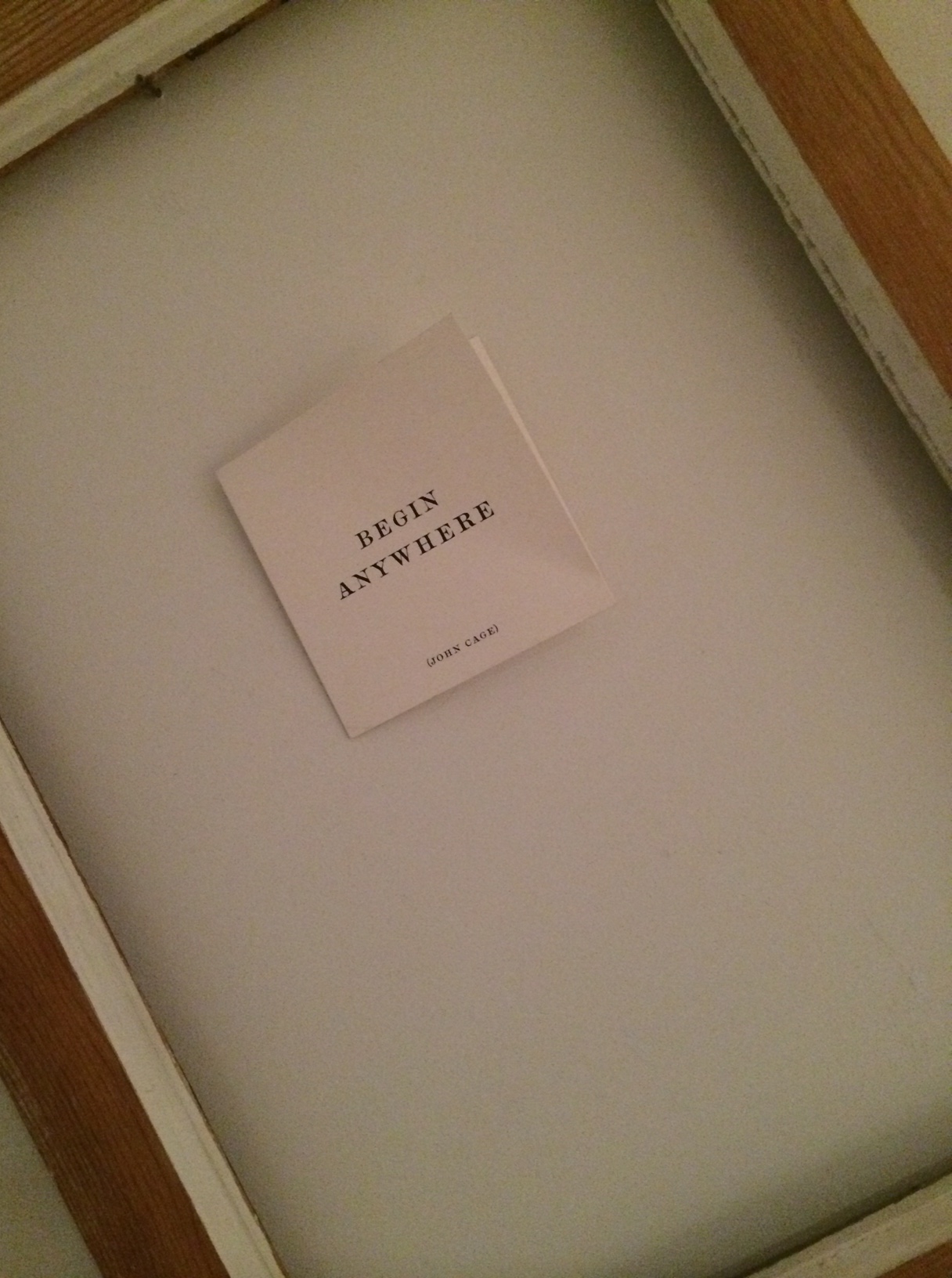
In our house, hanging on the wall like a painting, is an old window frame. In the top pane is a card that reads, “Begin Anywhere.”

Earlier this week I had a great conversation with Diane. She laughed and said, “In my meditations I was whining to God because I wanted to see the plan of my life. I got the clear message that I was never going to see the plan but I could always see the next step. The next step is always right in front of me.” Dancing with what’s right in front of you is sometimes called faith. Sometimes it is called play. Sometimes it is called art.

Diane and I are good reflectors for each other; we are usually on parallel paths. For both of us, the past year or two has been a process of letting things go and stripping things back: paths, patterns, and presuppositions. It has been the mother of all house-cleanings (she had a literal flood!) and, like all good house cleaning it took some elbow grease and few hard decisions about what to keep and what to throw. After the job is done, nothing feels better than a clean house and along with the good feeling, new space, and wide-open possibilities, comes the question, “What’s next?”

Diane told me her story because my next step is so clear that I can focus on nothing else. With such a myopic focus I can see nothing else and that’s why I called her. I must do this play. I must. I cannot see beyond this dance. It is my first thought in the morning. It is my last thought falling into sleep. This step, my dance with The Lost Boy, makes no sense and Diane’s point was well taken: the next step rarely makes sense. Sense-making requires context. Sense-making is a skill of relativity – and since we can never know the plan (if, indeed, there is one), we can only make sense based on old information. That is good news for plumbers but is dubious at best for leaders, explorers, seekers, and artists.

After our call I realized that dancing with what’s right in front of me is how I paint. It’s also the key to a good conversation – and painting, for me, is a good conversation. After my good conversation with Diane, she sent me an email of affirmation and concluded her thoughts with this: “Stay focused on what is before you now and let the creations show you how and when they are ready to play.”

title_pageGo here to buy hard copies (and Kindle) of my latest book: The Seer: The Mind of the Entrepreneur, Artist, Visionary, Innovator, Seeker, Learner, Leader, Creator,…You.

For all digital forms of The Seer, go here

Yoga.ForwardFoldFor posters and prints of my paintings, go here


Hear The Voices

photo-2This is the most unusual rehearsal process I’ve ever navigated.

First, I wrote the play and in preparing to perform it, I’m discovering it anew as if someone else wrote it. There have been brilliant and funny moments when I ask myself, I wonder why he wrote that? The good news is that I remember whom to ask.

Second, the play was originally meant for Tom to perform and since the story is Tom’s family narrative, I wanted the language and syntax to be Tom’s. In development, I recorded hours of conversation with him. Much of the first draft was a transcription so that I might capture word-for-word his language choices and speech patterns. Those structures survived the several rewrites that happened after Tom’s death. In preparing to perform the play I’m wrestling with the language. I’m wrestling with his language. It is almost as if I am discovering my own speech patterns and syntax – in telling Tom’s story I’m finding it necessary to tell it my way, not his. Essentially, as is true in all good storytelling, I am finding myself, my voice, through his story.

Tom and me a long time ago.

Tom and me a long time ago.

Finally, the music is a character in the play and the musicians, Mom’s Chili Boys, are madly rehearsing in California while the actors (Kerri and I) are rehearsing in Wisconsin. The internet is a beautiful thing as, each day, we pass notes, record voices, email questions; we will only be together in the same room 3 days before the first performance. We’re essentially workshopping the play from two locations. It is akin to rehearsing a symphony in parts and the parts only come together in the final day. They get to experience the whole symphony, the fullness of their music as played through all of the voices, only in the final hour. And that will be true of this play.

Each day I rehearse and I hear Tom’s voice in my head, telling me the stories that comprise the play. I am reminded that, whether artist or audience, art is a living thing. It is a relationship and ultimately that relationship is with your self.

title_pageGo here to buy hard copies (and Kindle) of my latest book: The Seer: The Mind of the Entrepreneur, Artist, Visionary, Innovator, Seeker, Learner, Leader, Creator,…You.

For all digital versions, go here (Leanpub)

Untitled by David Robinson

Untitled by David Robinson

Go here for fine art prints of my paintings.