Call It Realism [on Not So Flawed Wednesday]

This garlic could have been painted by Jan Vermeer. To my eye it looks like the work of a Dutch master, an artist more concerned with realism than the ideal.

Art that reveals the beauty in the ordinary. For a few weeks in my surly youth I studied with a realist painter. I was wowed by his technique but could not yet grasp his dedication to capturing the everyday. Only later did I come to understand that his art was not about the technique but about bringing attention to the experience of the everyday. He rejected the aloof and desired to pull art down from the pedestal so it might reflect the lives of the “common people.” He believed that people needed to literally see themselves in the paintings to have access to the painting. They needed to see their hardship and toil as well as the objects that surrounded them.

Bertolt Brecht believed the opposite. In order for people to have access to the deeper messages of a play, they needed to be removed from their circumstance. So, in his way of thinking, people are more capable of seeing themselves in a piece of science fiction than in a reality-mirror.

David is working on a re-imagining of Pirandello’s play, Six Characters In Search of an Author. One of the questions of the play is, “Who is telling your story?” And, how are they telling it. I reread the play and was struck by how relevant it is to our times.

The beauty in the ordinary. The turmoils and struggles of the everyday. Ours is a time of tumultuous story tug-of-war. I wonder, in a hundred years, what historians will write about our time. I wonder what aspect of artistry – if any – will be considered “realism.” As defined by Vermeer and Pirandello, it’s to reach across a social line, from the privileged to the working class. For Brecht it is spatial: step out to look in.

One thing is constant, while reaching across time and artificial boundary, it is always the role of the artist to help their community ask the questions: Who is telling my story? Whose story am I telling? What is the story that we are telling?

I imagine those someday-historians will write tomes on our messy struggle to sort out what is “real” and what is not.

read Kerri’s blogpost about GARLIC

Marvel The Resilience [on Two Artists Tuesday]

The guys at the water utility told us not to bother replacing our yard until the fall. “The dirt needs to settle,” they said. After trenching from the street to the house, tearing up great chunks of the sidewalk and curb, blowing a hole in the foundation, throwing dirt into the moat and covering it with straw, ripping up the street and quickly tossing temporary asphalt over the hole, our front yard is a hot mess of destruction.

Our neighbor owns a landscape design business; he scowls every time he looks our way. It pains him that his pristine yard sits next to our ruin. “The dirt needs to settle,” I say and shrug as he looks in horror at his worst nightmare. To add insult to injury, I’ve threatened to park the truck on our ruin but Kerri gives me THAT look. If I want to stay above ground, the truck stays in the driveway.

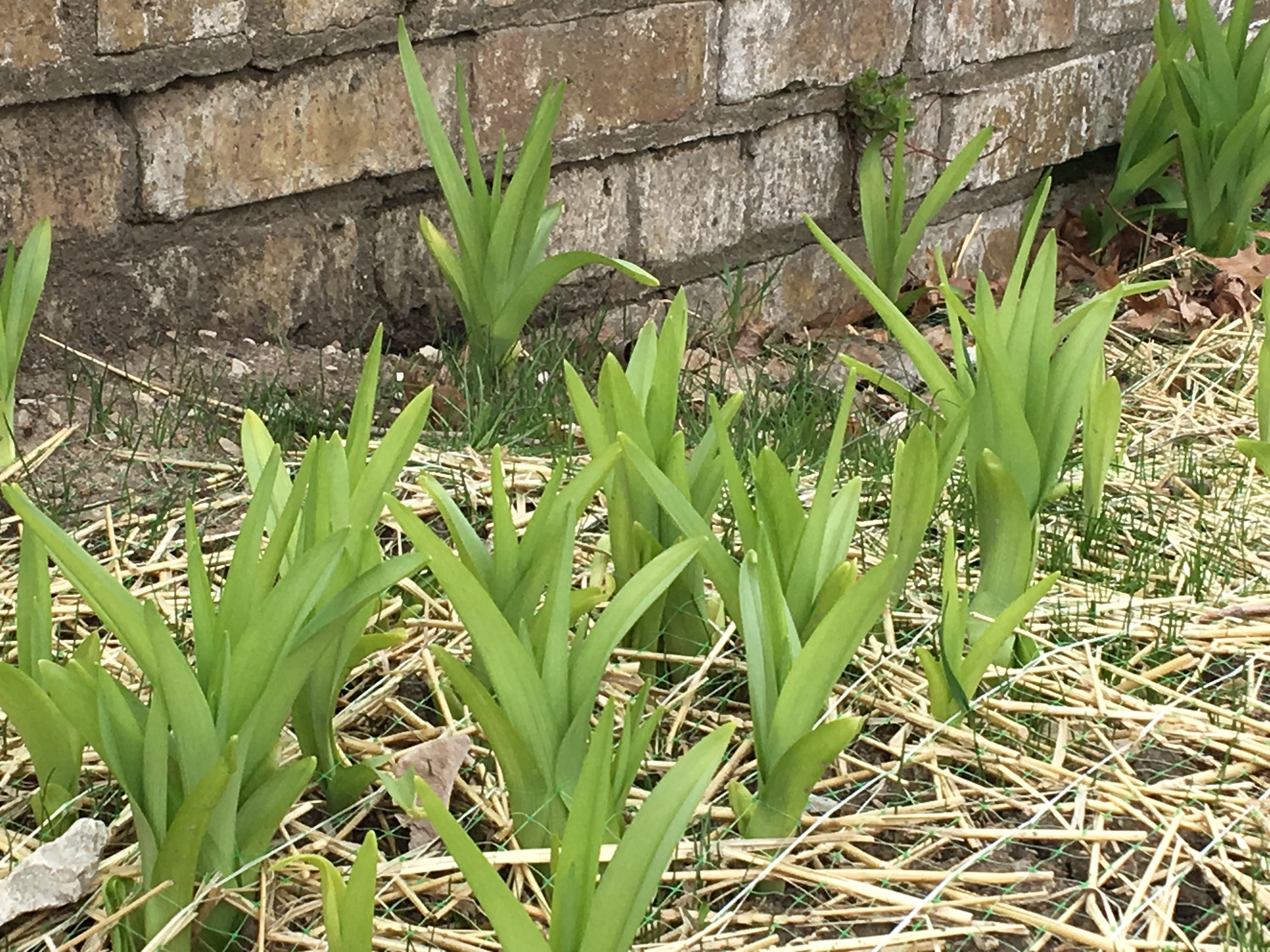
Standing on the front porch, amazed at the hardy green shoots reaching up through the devastation, straw and lawn netting, I thought of Tom. He marveled at the resilience of young people, students in the schools that he stewarded. Some of the children lived in extreme circumstances or had suffered terrific injury, and yet, they consistently transcended their situation. Pushing through the wreckage and reaching for the sun. “The human spirit,” he’d say and shake his head in amazement. “Marvelous.”

Despite being trenched, torn, mixed with concrete and rock, thrown about, turned over and over again, covered with straw and netting, the Day Lilies have not only survived, they are thriving. Just as a fire brings renewal to the forest, it seems the destruction served to energize the plants. More than a comeback, this is a riot of Lily return. A reunion.

“The impulse to life,” I whispered to Tom. “Unbelievable.”

“Yep,” he smiled.

read Kerri’s blog post about RESILIENCE

Know Their Name [on Merely A Thought Monday]

As I let Dogga out each morning, I stand for a few moments and listen to the birdsong. Our particular spot on the earth is alive with birds: starlings, finches, sparrows, robins, hawks, crows, owls… The Mourning Doves always stop my motion. Their song is hypnotic.

The pandemic changed – and continues to change – many things. Our world became significantly smaller. The table in the sunroom. The backyard. Our trails. As someone with his head in the clouds I am a dedicated generalist. I have always appreciated bird song yet never, not once, thought of identifying the specific birds and their song. “Sparrow? Finch? Who cares! They are beautiful and that’s enough for me! I spend too much time in my left brain as it is! The last thing I want to do is categorize the birds!”

COVID changed that. Sitting on the back deck or at the COVID table staring out the window for hours on end, our relationship with the birds grew. From general appreciation to specific experience. From passive appreciation to personal connection. We began to see nuance. Pattern. We wanted – and want to know more about these beings that sing us awake each morning, that alert us to changes in the weather, that signal alarm in the neighborhood.

While visiting the Botanical Gardens, Kerri found a small book, coded by color, that identifies the birds in our region. In a flash we can open the book and identify the bird. “Hey! Look! That’s Paul!” I say.

“Stop!” Kerri scowls. “It’s Martha. Paul’s on the fence.”

Just kidding. House Sparrow. Carolina Wren. My favorite to pronounce is Grackle. Great-tailed Grackle to be exact. I’ve decided that, were I to somehow achieve tough-guy status and ride a Harley to breakfast, my motorcycle-dude name will be Grackle. “Hey, Grackle,” the waiter will say, as I come through the door en route to my usual stool. “Hey,” I respond. Motorcycle-dudes named Grackle are birds of few words.

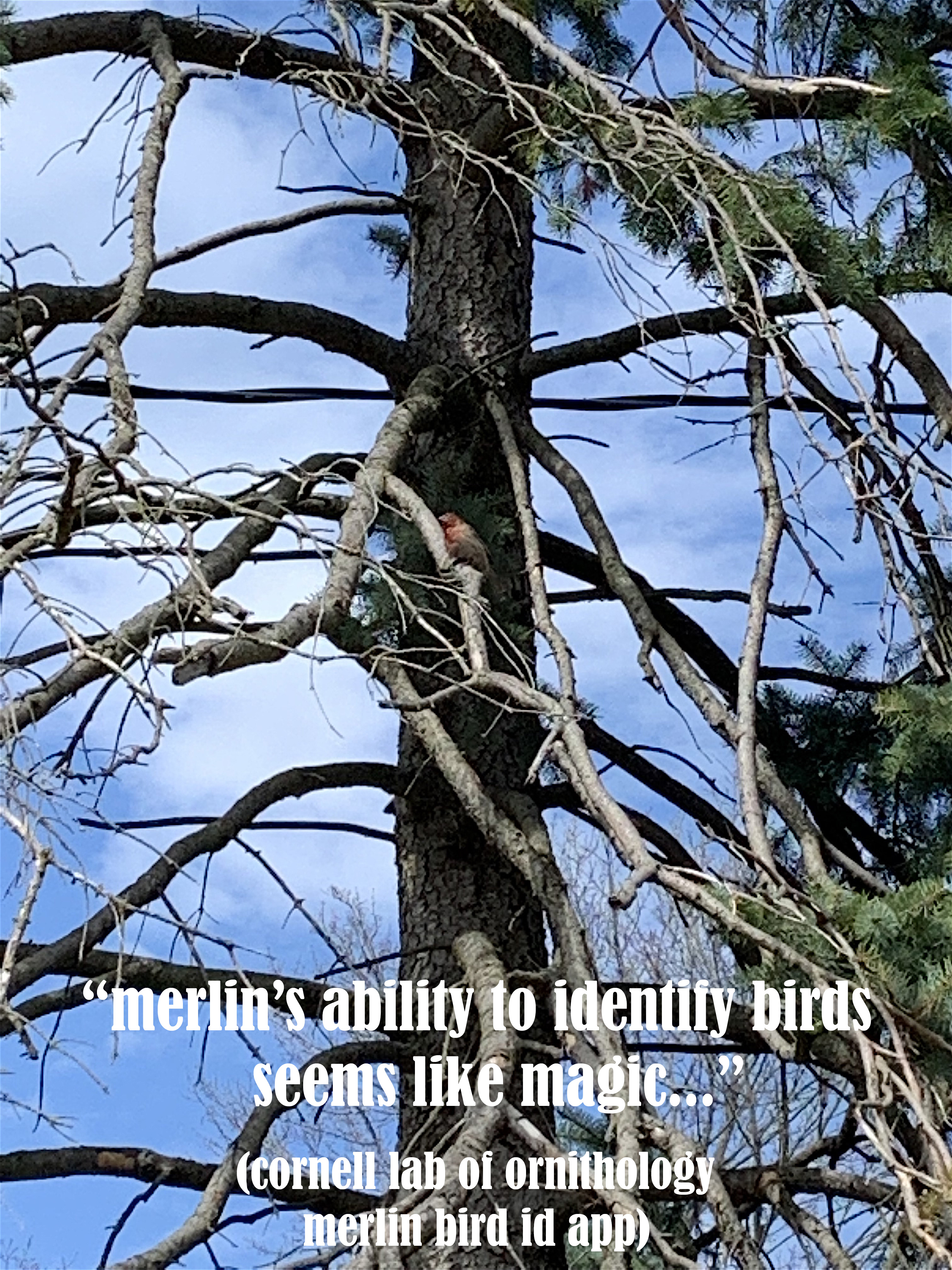
Deb showed us an app. Merlin. It identifies birds by their song. Now, armed with our book from the Botanical Garden and our Merlin app, when I ask, “What’s that?” Kerri – who is always alarmingly way ahead of me – has the answer. “Eastern Towhee,” she says.

“You’re making that up!” I cry, knowing she can’t stand to be challenged so will immediately jump to prove to me that she is right (it’s my secret fast-track to knowledge).

“Look it up!” she insists, showing me both the book and the Merlin return.

“Wow,” I say. “Towhee. Who knew. Maybe my pen name should be Grackle Towhee!”

She yanks the book from my hands. “Oh, Look!” she exclaims. “Merlin has identified you: Midwest DoDo.”

read Kerri’s blog post about BIRDS!

Try To Disappear [on saturday morning smack-dab.]

“There will be days that you know you simply cannot win. The best thing to do when you find that you are standing in a no-win situation, is to vigorously wave your white flag and surrender to your fate as gracefully as possible.” ~ Quinn (not an exact quote)

“To keep your mouth closed and say nothing is trouble for sure. To say anything in this moment – anything at all – is the road to tribulation. There is only one thing to do. Feign a slipped disk. Crumple to the ground in desperate pain. Seek theatrical escape!” ~ the only advice my inner Confucius offered in my moment of need.

“This world is crazy. It makes no sense.” ~ Sterling Brown, This Is Us.

read Kerri’s blogpost on this Saturday Morning Smack-Dab.

smack-dab. © 2021-2 kerrianddavid.com

Call It A Life [on KS Friday]

Seven years ago today, Beaky passed. The last time we saw her she was clutching a blue notebook to her heart. “You found it!” she exclaimed, rocking back and forth in glee. The journal she kept of a special trip to Europe. A memory, a connection to Erling she thought was lost. We searched the house high and low. We stayed an extra day knowing that meant a 24 hour drive/sprint home. In the last bin, truly , the very last, tucked in the far recesses of the garage, we discovered the notebook.

What I recall about that search is how many times we stopped, dust coated and tired. We sat in the middle of boxes, stacked papers and bins and said, “We’re never going to find it.” Or, “It’s not here.” And then we’d go to the next room of the house, open closets, pull out boxes, the search resumed.

As you might imagine we found more than the blue notebook. That night Kerri told me many stories of family and events sparked by something we’d unearthed. “Oh, my god!” she’d exclaim. “Look at this!” The vet papers for the dog named Shayne. A photo of the family at the house on Long Island. Good times. Stories. Our search became a connection for Kerri to times that she thought were lost.

Memories. Legacy. Doing what is yours to do, looking back and calling that a life.

Eric recently wrote in our Slack channel about my play, The Lost Boy: Your introduction — chronicled on Skips blog — stuck with me, and comes to mind frequently in daily interactions. “This is a memory, after all. It all happened. Though because it’s memory, it probably isn’t factual. So, if I contradict myself, if you catch me saying the opposite of what I just swore was true, if you find me standing smack in the middle of a paradox, it’s not that I’m lying to you. It’s a memory.” The Lost Boy was a story told to me by Tom. Originally, it was meant for him to perform, the story of doing what was his to do. It only became possible to produce after he had slipped into the land of memory. It became mine to do.

And isn’t that the magic of life. What is mine and what is yours to do is never separate. 50 years ago Beaky and Pa took a trip to Europe and she kept a journal of the trip in a blue spiral notebook. 7 years ago Kerri and I spent a long day and night scouring a house to find it. I am now part of the memory of her journal. Her journal is now part of the story of Kerri and my past.

“Never underestimate your power to impact or influence another person’s life,” Paul said to his actors. Doing what is yours to do. Never really understanding or knowing the impact of the simplest action. Calling it a memory. Calling it a life.

Kerri’s albums are available on iTunes and streaming on Pandora

read Kerri’s blogpost about BARNEY

legacy/released from the heart © 1995 kerri sherwood

Take Note [on DR Thursday]

Although it may not be at first apparent, this is a map for product development. A single stout stalk that supports shoots of replication that explode in support features. One clear central intention. Multiple expressions that return nutrient to the stalk.

Although it may not be at first apparent, this is a map for healthy community. A single stout story stalk that supports shoots of replication, diverse paths that explode in seeming individual expression. One clear central narrative. Multiple expressions sending sunlight back to the root.

Who hasn’t seen the time-lapse films of plants growing, forms expressing and then retreating, the accelerated motion of people commuting on a city street, what seems like chaos is, at speed, cooperation. Those people on the street in real time, walking to work, a to-do list on their mind, are mostly unaware of their symphony of togetherness.

It’s easy to forget the stout stalk when standing at the individual expression point. I have been witness to the demise of many organizations who turn against the stalk in favor of the feature. For instance, the fastest way to kill a non-profit organization is to attempt make it run like a for-profit business. It will forget its story-stalk and lose its heart and mind in a spreadsheet.

The quickest way to destroy a community is for its branches to forget that they are individual expressions of a single stout story. They are not separate as much as extensions. To focus on the multiple tiny expressions as if each small branch is a stand-alone truth is absurdity-creation. Chaos masked as convention. Inverted, the plant dies.

In our literature we are riddled with advice to turn toward nature. Existential crisis? Lost? Go to the meadow, find the woods, take a hike. Get quiet. We go there because…we are there. Alan Watts wrote,”We don’t come into the world, we come out of it.” We are not separate from the stalk; we are expressions of it. Occasionally, the map to sanity that we seek is hiding in plain sight dressed as a platitude. Go to nature. You cannot do otherwise. Realize it.

When I’m running abstract questions of design in my dreams, I know it’s time to take a walk. It’s time to stop, look around, take note of nature’s design, the perfection of a plant. A perfect yoga, branch-fingers reaching for the sun, root-fingers reaching deep into soil.

read Kerri’s blogpost about PARSNIPS

sam the poet, 48×48 (painted and sold a long time ago)

sam the poet © 2004 david robinson

Ode The Basement Floor [on Not So Flawed Wednesday]

Ode to the basement floor.

Though little acknowledged and less appreciated, you carry without comment the brunt of the load. When water runs where it ought not run, you, master of the Tao, let it flow, knowing the drains in your design will surely win the day. Or not. No matter. What happens will happen and we will make stories with either result, never once mentioning your stalwart participation, unseen support in every storm.

The washer jumps, the dryer rolls, the boxes stack, the shelves stand guard, you accommodate and hold space for all.

Sometimes I stand on you, toes a-wriggling, lost in thought, or wrinkle-brow-perplexed, all the while missing the wise message of patience you proffer. “Stand long enough,” you suggest but do not say, “and everything will look different. Or the same.” Were I to ask – and you to answer – you might imply that my paint and carpet solutions are surface remedies merely. Perhaps I should consider lasting and deeper alternatives?

We rearrange. We are cleaning out. We see more of you than before! Yet increasingly exposed and in full reveal you do not attempt to hide your age as we might. As we do. Your pocks and chips and scratches galore the proud chronicle of your era.

“Tread on me” your flag must wave, as we step and stride and dance and tramp and plod and stomp, fulfilling your purpose with our every footfall. I wonder, as I carry a load to the stairs, do you mind or even note that I am lost in the cause of singing your praises?

[this post comes to you without the assistance of mind altering drugs of any kind. Just sayin’]

See The Exact Center [on Two Artists Tuesday]

Kerri took this photograph a week ago. We’d set up our pop-up table in the middle of the woods. We had a small cooler with cheese and crackers, tabouli and chips and wine. It was cold. We needed to take off our gloves to eat a bit of our snack and then put them on again, fingertips stinging. Since she is a photography maven, I knew to stand back after setting up so she might take shots of our snack-laden table. She finished, sat, and then pointed her camera to the sky.

Despite what you see in the photo, the trees did not reach to a common center. That is an illusion. Perspective as taught in art school. The point of view of a lens. “Lookit!” she said, red fingertips holding the camera so I could see the image. “We must have found the exact center of the forest,” I thought and smiled.

I often feel like that these days. We must have found the center.

Last night, on an all-too-rare warm evening, we sat with friends on their deck. The Up North Gang. We ate dinner. We laughed. I had my first ever sip of salted caramel whiskey. Dessert as a drink. Time stood still for me and I studied the moment. I wondered if anyone on earth was as fortunate as Kerri and me.

Perspective as taught in art school. Points converge creating the illusion of distance. At one time in history, a crossroads of art and mathematics, this simple recognition was a revolution. Linear perspective. A unique point of view. The accurate portrayal of three dimensions on a two-dimensional surface was powerful – the creation of illusion, shape and distance, produced new intentions and mathematical rules.

It also changed forever the viewer. To see the illusion one must occupy the illusion of a unique center. A new psychology. It’s possible to draw a direct line of descendancy from the hard perspective of the Renaissance to our abstract expressionism. The artist’s point of view, unconscious expression without limit or rule, is all that matters. Two ends of the same pole.

I told Horatio that I am, at long last, learning to keep quiet. To share what I see when asked, and not before (he says as he writes a blogpost about what he sees). I have made a career out of too adamantly trying to get people to see what I see. My adamancy might be traced to the Renaissance and the notion that I occupy a unique center, a specific point of view that makes my illusion of shape and distance somehow privileged and necessary.

Age is helping me challenge and release my investments. It is also a grand teacher of movement and moments. Nothing stands still, especially time. The best we can do is savor the spaces between, always shifting and moving. Children become parents become grandparents. A warm night. A cold day on the trail. It matters less and less what I see and sense-make with my unique hard lines and more and more that I taste the tastes and see the colors, my lens aimed at a common center, sharing the passing moments with others.

read Kerri’s blogpost about THE WOODS

Tell The Full Story [on Merely A Thought Monday]

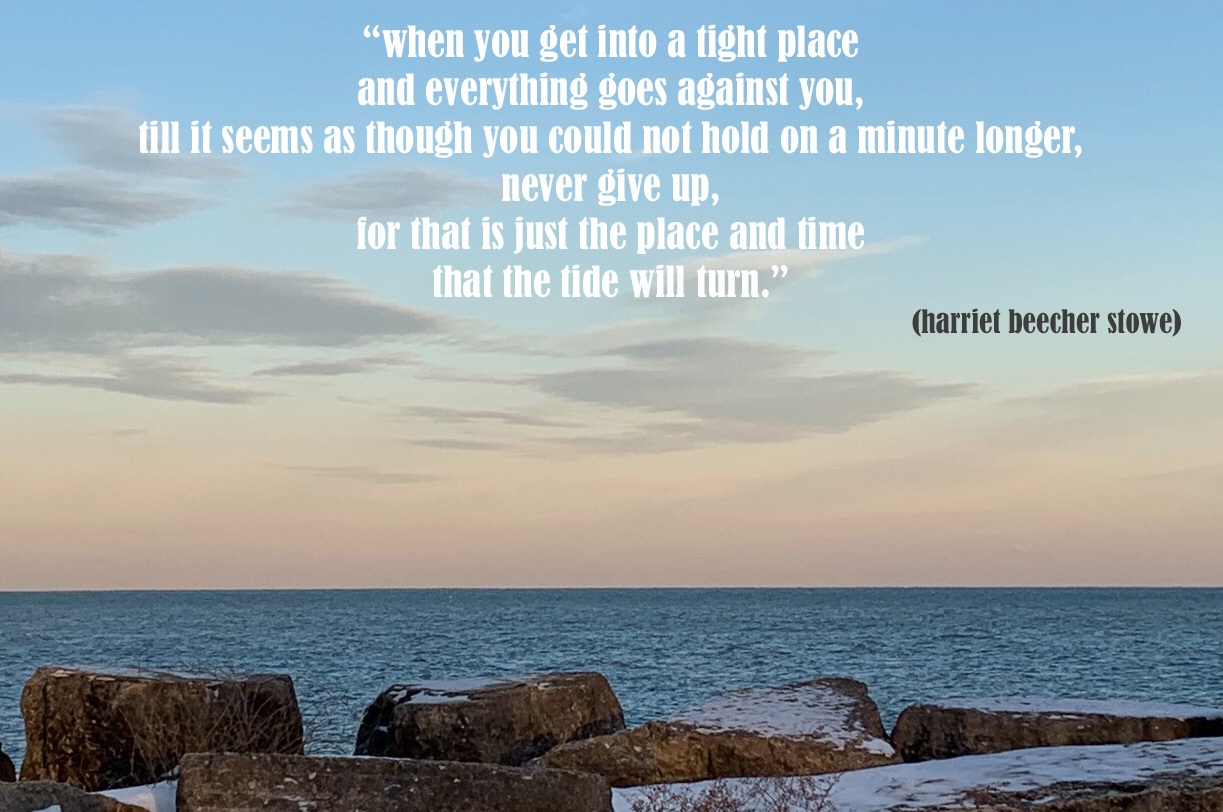
If you Google Harriet Beecher Stowe you’ll come across a confounding question: Did Harriet Beecher Stowe cause the Civil War?

Think about it. Tease it apart. If the question doesn’t make you shudder ever so slightly, you’re not paying attention to the happenings in our day.

A woman in 1851, a full seventy years before women in our nation had the right to vote, wrote a book depicting “the harsh conditions experienced by enslaved African Americans.” She did not write a fantasy. She wasn’t concocting a circumstance. She wrote a book “which highlighted the evils of slavery.” She called attention to a moral horror story.

The question jumps the long and legislated history of slavery in the land of all-men-are-created-equal. It ignores the economic engine that made enslavement of human beings an institution in our nation. It suggests that shining the light, calling attention to the immorality, not the immorality itself, caused the war. The slavery wasn’t the cause, the industry and economics and political drivers had nothing to do with the war. Looking at slavery, calling attention to it, was.

If we close our eyes it doesn’t exist. If we ban the books it will not be part of our history. It’s a game we play with infants. It’s the puerile mentality of Fox news.

“Since January of 2021, 42 states have introduced bills or taken other steps that would restrict teaching critical race theory or limit how teachers can discuss racism or sexism, according to an Education Weekly analysis.”

To be clear: “Critical race theory is an academic concept that is more than 40 years old. The core idea is that race is a social construct, and that racism is not merely the product of individual bias or prejudice, but also something embedded in legal systems and policies.”

Why do we work so hard to cover our eyes and plug our ears? The path to health begins with admitting and taking a good hard look at the disease. Slavery is a part of our history. As is Jim Crow. The Civil Rights Movement. Red lining,…Black Lives Matter. A clear narrative path.

Isn’t the frenzy to introduce bills restricting discussion about our history yet another example of racial bias embedded into our policies? We are watching critical race theory in action.

Talking about what ails us isn’t the cause of our division. Our inability to fully look ourselves in the mirror and acknowledge all aspects of our story – perpetuates our dis-ease. We would do well to revisit the Serenity Prayer and muster our courage.

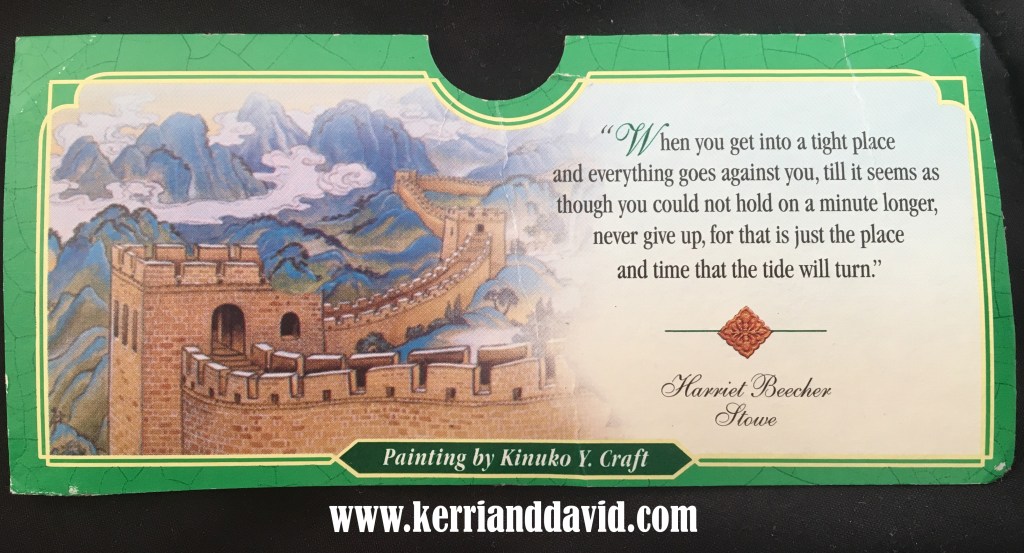
According to Harriet, there is hope. There will someday come a place and time that our tide turns, a time when we can without fear or shame or legislation, look at each other and tell our full story.

read Kerri’s blogpost about THE TIDE TURNING

Drop And Roll [on saturday morning smack-dab.]

If you want to see me go primal, all you need do is hang out with me when there’s lightning. One hot flash of light ripping across the sky and I wince, drop, and roll. I enjoy thunder. Lightning, not so much.

The first time Kerri saw my lightning-behavior, we were on a walk when a storm blew in. There was no time between the violent white flash and cannon-style-boom. “It’s just lightning,” she said as I attempted to make myself a smaller target. We ran home. Well, in truth, I grabbed her arm and pulled so hard she had no choice but to fly along (giggling) with her manly-man bobbing and weaving to avoid imminent electrocution.

Even within the safety of the house, I will wax poetic about the beauty and wonders of thunder but add a dash of lightning and I lose all artistry. I dip into my animal brain. I’m happy to admit that, when there’s lightning and you want to find pants in our family, go find Kerri. You’ll find me under the bed with Dogga.

read Kerri’s blogpost about LIGHTNING

smack-dab. © 2022 kerrianddavid.com