Choose A Better Story [on Two Artists Tuesday]

Watching an early episode of the Millennial Farmer I was astounded to learn how computerized farming has become. Driving the tractor was far more digital-than-donkey. Even the word “driving” is mostly misplaced, just as the word “telephone” is loosely applied to the magic box in our pockets that searches the internet, takes photographs, measures our step, our heart rate, acts as a calendar, a compass, a flashlight, a newspaper…

Farmers can do more, faster, with greater precision. The seeds are planted to exact depths and meticulously spaced. The temperature of the earth and the minerals in the soil are collected and measured as data points. The farmer monitors the technology and engages the steering only when making a turn. Keeping the machinery in good running order requires an entirely different set of skills than it did twenty – even ten years ago. I wonder what farming will mean to the grandchildren of the people I watched mowing their fields. Like a modern car mechanic, in addition to wrenches and oil, farming demands computer diagnostic skills and a continuous upgrade of software. While the process is different, the basics remain the same. Plant. Nurture. Grow. Harvest. Feed.

To feed. Hands in the soil. Eyes to the horizon gauging the weather. Eyes on the advanced weather forecast technology. Praying for rain. But not too much.

There’s an old black-and-white photograph on the wall of the farmhouse we rented for our family gathering. People assembled on the porch, wearing high collars and long prairie dresses. Horses and wagons populate the foreground. I marveled, standing on the same porch in the old photograph, how close-in-time I am to the people in that picture. Two headstones away. Tom once told a story, when he was a boy, of sitting in the lap of an elderly woman who, as a small child, sat in the lap of Abraham Lincoln. That makes me a mere three headstones from the 16th President. “He smelled of saddle soap and lavender,” she reported.

I hear abundant chatter about rural America being all red and urban America mostly blue. Both colors have to eat. Both are made better by technology. The food is grown in the red while the computers are imagined and made manifest in the blue. A single step back from the chatter reveals how truly interdependent we really are. I am grateful for the easy availability of food at my local grocery store. I imagine the farmer is grateful for the advanced technology that takes some of the guesswork and toil from their lives.

We are, all of us, a single headstone away from passing on a better or lesser world. Both are possible. The choice is ours. Where do we desire to place our focus? What world do we desire to create?

Farmer’s take great pride in feeding the world. Entrepreneurs and software engineers take great pride in making tasks easier for others. Generally, gratitude is not only a much better story than division, it’s also more productive. It’s also more honest. I find that people are highly motivated when helping others. The question is, “Why can’t we see how we are helping and being helped?” Our interdependence is right in front of our faces.

The noisy trappings of our time may seem complicated but the basics remain the same: Plant. Nurture. Grow. Harvest. Feed. We eat what we sow. We choose the thought-seed that we plant. Technology can help us be more effective and efficient. It cannot help us gain wisdom or sort what we lose in our dedicated color-crayon-divide. It cannot help us choose or pass on a better story. Only we can do that.

read Kerri’s blogpost about HAY RAKES IN THE SKY

like it. share it. online tip jar (link or qr). talk to us. all are appreciated.

Accept The Gift [on Not So Flawed Wednesday]

Years ago Tom gave me a bit of career-advice that I’m still trying to take: “Unlike most people,” he ominously said, “your path will never be about plugging into life. Rather, you must find how life can best plug into you.”

Joyce, a healer and mystic, got that look in her eyes, and told me that I was never going to pursue a single profession. Mine-to-do was to see into hearts; mine was to guide people to their truths.

These days, their words ring loudly in my ears. In the past 24 weeks, since the start-up collapsed, I’ve applied to over 100 positions. Each morning I open my email and find the latest thanks-but-no-thanks. And, each morning I ask myself the same question: How do I – this time – once again – at this stage in my life – find how life might plug into me? I’ve received plenty of ideas-for-jobs and more than a heaping spoonful of advice. “Seeing into hearts” and “Guiding people to their truths” is not stellar resume fodder, even when it includes owning businesses and fixing businesses and coaching people all over the world and painting paintings and directing plays and repairing broken theatre companies. Those “ways” feel finished.

I’m working very hard to find ways to plug into life.

It was a great relief to unplug from the fruitless pursuit for a few days. To gather with my family, to say good-bye to my dad, to eat and drink and play at a farmhouse that will forever represent the time and place an era ended and a new age began. Sitting on the porch in the morning sun I felt spacious for the first time in many months. Standing in the yard watching the sunset, I was quiet inside. Rooted. Easy.

I hadn’t realized how compressed I’d become. How air-less. The farmhouse served as a gift from my father: take a deep breath. Nothing more. Nothing less. This life is quickly passing. Relax. It will find you.

I stepped into the morning sun and practiced my tai-chi. These words from the Buddha came to mind: “Joyful participation with the sorrows of the world,” The accent is on the word “joyful.”

read Kerri’s blogpost about FARM SUNSET

A few ways you can support our writing: like-the-post. share the post. buyusacoffee.com. comment or question. It feeds when you complete the loop.

Embrace The Accident [on Two Artists Tuesday]

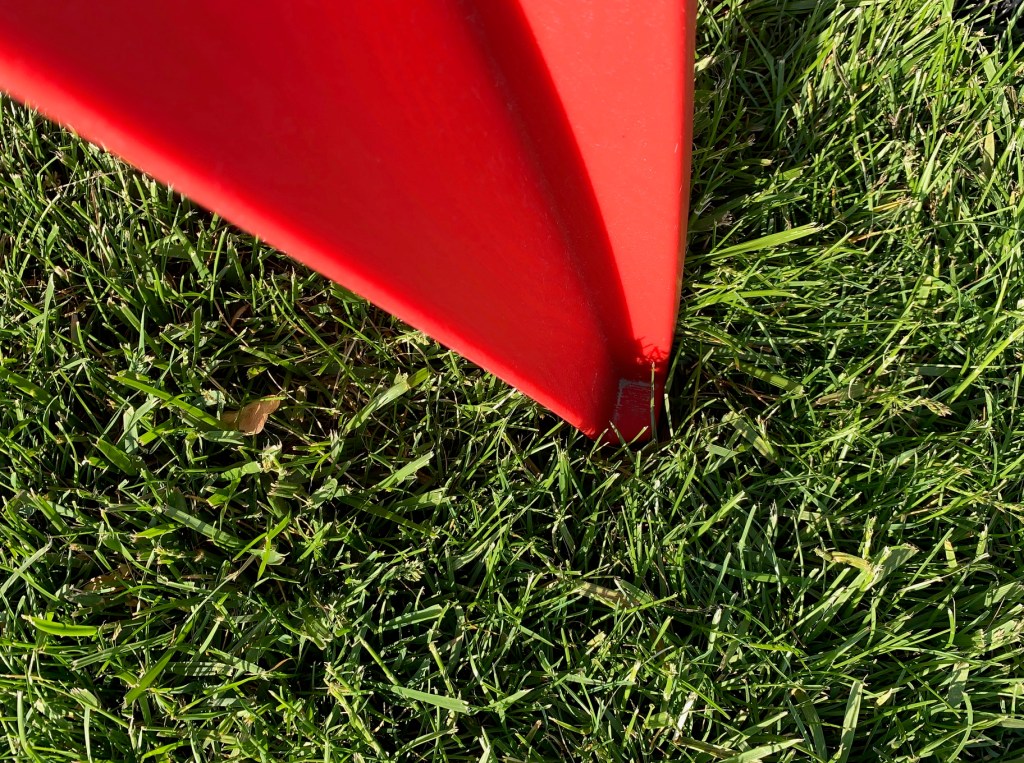
I am a big believer in happy accidents. Kerri didn’t intend to take this photo. A vibrant shock of red thrust into a field of green. I’m tempted to slap a title on it and enter it into a contemporary photography exhibition.

I’ve read that serendipity, an “unplanned fortunate discovery,…is a common occurrence throughout the history of product invention and scientific discovery.” It’s also a common occurrence throughout the history of art. It’s also a common occurrence throughout the history of…history. We have experiences and then we make meaning of them. Not the other way around.

I suppose we pride ourselves on our capacity “to know” so we forget that all knowledge is the result of a stumble, a discovery found at the far end of curiosity, exploration or an outright mistake. The point of a hypothesis (to borrow a term from Quinn) is to cultivate serendipity. Try it and see what happens.

I’ve been following the conversation in the tech-o-sphere about the sudden blossom of the very lucrative job “phrase engineer.” Human beings attempting through trial and error to learn how best to converse with the technology we’ve created. AI. ChatGpt. The unspoken goals are (not surprisingly) efficient and effective communication. There are now several sites with useful phrases, conversational hints, Youtubes abound with guidance for best ways to ask better questions, quickly eliciting the best result: an answer. It’s glorious and reminds me of old 3rd grade language primers or my high school foreign language class – only more enthusiastic.

I am among the millions who hope beyond hope that someone-out-there bumbles into the secret of effective communication. Perhaps if we discover how to communicate with artificial intelligence there will be a profound blowback and we will, serendipitously, discover the secret of easy communication with each other. Generosity. Empathy. Kindness. How-you-say-what-you-say matters.

“AI, tell me what you see and I will listen with an open mind and heart.” I know, I know. More pie-in-the-sky. But as a dedicated believer in happy accidents, I’m given to think that anything is possible.

read Kerri’s blogpost about RED ON GREEN

like it. share it. buyusacoffee. tell us your thoughts. all are appreciated.

Make It Visible [on Two Artists Tuesday]

“I believe that the very process of looking can make a thing beautiful.” ~ David Hockney

Sometimes I look at a blank canvas and see a composition. My job is to follow the image. To make it visible.

Sometimes I have an idea and I bring it to the canvas. My job is to explore the idea. To make it visible.

It’s a chicken-and-the-egg conundrum. What comes first? When I look at the peony do I see beauty or do I bring beauty to what I see? Is beauty a decision?

“Good-God!” I hear Kerri’s inner monologue-commentary on my too-ponderous questions. “Get out of your head! Smell the peonies!”

I wish I could. What happens when it’s not a peony that I see but my neighbor? Or someone whose worship is strange to me? Or someone with a different opinion?

Sometimes I look at a blank canvas. Sometimes I have an idea that I bring to it. Sometimes my job is to follow the image. Sometimes my job is to explore the idea.

The tricky part of language is that the biases are unseen. For instance, in English, the emphasis falls on the noun: me. Canvas. It implies the two are separate. Distinct. It obscures the relationship between. Connectivity is relegated to the basement, a lower status or obscured to the point of nonexistence. It fosters a philosophical orientation of…”it happens to me.”

Connectivity, once seen, once understood, requires us to recognize our responsibility for what we see. Our participation in the dance of creating what we see. In what we bring to “it”. What, exactly, do we wish to make visible?

read Kerri’s blogpost about the PEONY

Join The Receivers [on Two Artists Tuesday]

“…artists take delight in and care for their work, and we are thereby inspired to find delight in our own work.” – Alex Grey, The Mission of Art

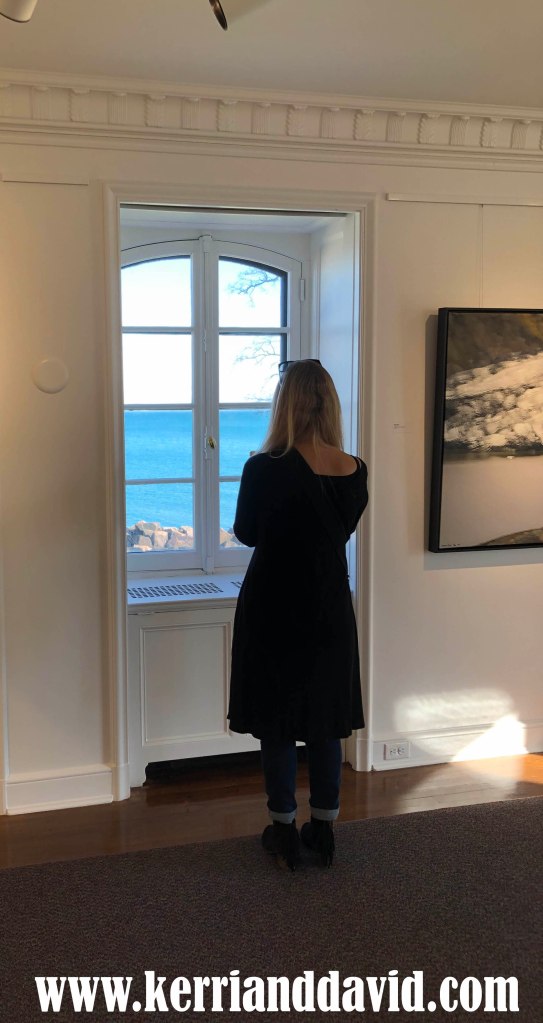
Standing in front of the Atmospheric wave wall, an art installation at Willis Tower by Olafur Eliasson, I imagined how much fun he had creating it. Monumental. The colorful waves rolling up the side of a building. I wondered, if on visits to Chicago, he delights in watching the play his wave wall invokes in passers-by. I would. His work is spatial so it invites full-body engagement. I had to touch it and lean in against it. I had to put my face close to a wave and look up. The shock of vibrant red among the blue, purple and green made my eye dance across the vertical water.

It is one of the great joys of my life to be surrounded by artists: people who care for their work and find delight in it. David just completed a year-long project, a rewrite/updating of Six Characters In Search of An Author. He directed the first production of his new script. It was thrilling to witness his delight in the process. It was gratifying to watch how he navigated his doubt and fear. The delight and the fear go hand in hand.

It’s worth noting that caring so deeply for your work comes with a studied courage. There’s a very nice lie about bold artists throwing caution to the wind and creating without caring how their work is received. That, of course, is worthy of a press-release and works for image-branding but fully negates the point of artistry. In order for a work of art to be a work of art, it requires an audience. A giver and receiver. A loop of caring. The armor must come off. Expressing beauty or seeking truth is nothing if not a shared meaning and a shared truth. Artists may reach deep into themselves but the point is to engage and express meaning that comes alive beyond themselves and between others. Vulnerability is the secret sauce that connects the two into one.

I didn’t know about the Atmospheric wave wall until we rounded a corner and I saw people enthusiastically embracing it, standing back and craning their necks to take it in, gently moving forward to run their fingers along the wave ridges. The pull was immediate and I found myself joining the receivers of Olafur’s artistry. Armor down, hands planted firmly on the wall, we snapped a photo and I deeply appreciated his whimsy and moxie. Inspiration ripples to the sky!

read Kerri’s blogpost about THE WALL

If you appreciate this post, share it. Or like it. Or let us know your thoughts. Or buymeacoffee.com. All are appreciated.

Reach Beyond [on Two Artist’s Tuesday]

Red Rocks amphitheater, Colorado, 1979. Tie-dye and flannel, a heavy cloud of pot and patchouli wafts over the crowd. The band begins playing. People stand and cheer. And then they dance. And dance. And dance. Strangers dancing with strangers.

The Riverside Theatre, Milwaukee, 2023. Tie-dye and flannel, a heavy cloud of pot and patchouli wafts over the crowd. The band begins playing. People stand and cheer. And then they dance. And dance. And dance. Strangers dancing with strangers.

United through music. Barriers drop. Inhibitions fall. The revelers are of many ages, grey heads and baby faces. The faces are many glorious colors: shades of black and variations of white and nuances of bronze and rich sienna. I suppose they, too, are wildly varied in belief. Yet, in the dance and through the music, none of it matters. They reach beyond. They are one.

read Kerri’s blogpost about THE CONCERT

If you appreciate this post, pass it on. Or buymeacoffee.com. Or, share your thoughts with us. All are appreciated! Thank you.

Thank Dale [on Two Artists Tuesday]

Dale is back. And he has an attitude. The people in the neighborhood know better than to approach Dale. He wants to be left alone on his daily constitutional and will answer even the friendliest “Hello!” with a harsh retort. Gobble-gobble.

We saw the young couple before we saw Dale. They were frozen, mouths a-gaping. They were pushing a stroller and were caught between curiosity and caution. Spelled. You’d have thought they just spied a Leprechaun strutting down the street. We slowed the car, stopped, and followed their gaze. A turkey was in the hood. Dale was just outside our door. Strutting down the sidewalk. He warned us to mind our own business and crossed the street behind our car just to make his point.

Here’s the weird idea that flashed through my mind as Dale stomped across the street: he reminded me of Scrooge. Suddenly, my imagination was awash in the turkey version of The Christmas Carol. I was particularly taken by the possibilities of the ghosts! How might the turkey Jacob Marley appear to the Scrooge-like Dale? The Ghost of Christmas future? The options were hysterical and inspiring. I wanted to thank Dale for the idea but he was already strutting far down the opposite sidewalk. I wanted to tell Kerri but she’d had enough of me for one day. I kept my idea to myself.

The young couple were suddenly released from their spell and the husband looked at us, child-like, “Turkey!” he pointed and smiled.

“Yes,” Kerri replied in a sing-song affirmation, “We saw it, too.”

I wondered at the final scene in my Turkey Carol. Dale, after a night of ghost-visits, flings open his window to the morning light, unable to fully comprehend what he’d just experienced. He asks a small child on the street, “Boy! You there! What day is it?”

The boy, taken aback by the sudden question coming from a notoriously unfriendly bird, replies, “It’s Christmas, sir!”

Dale, newly made, throws his wings above his head and dances with relief.

read Kerri’s blogpost about DALE

buymeacoffee.com – if you’d like to support our writing and workintheworld

Note The Trail [on Two Artists Tuesday]

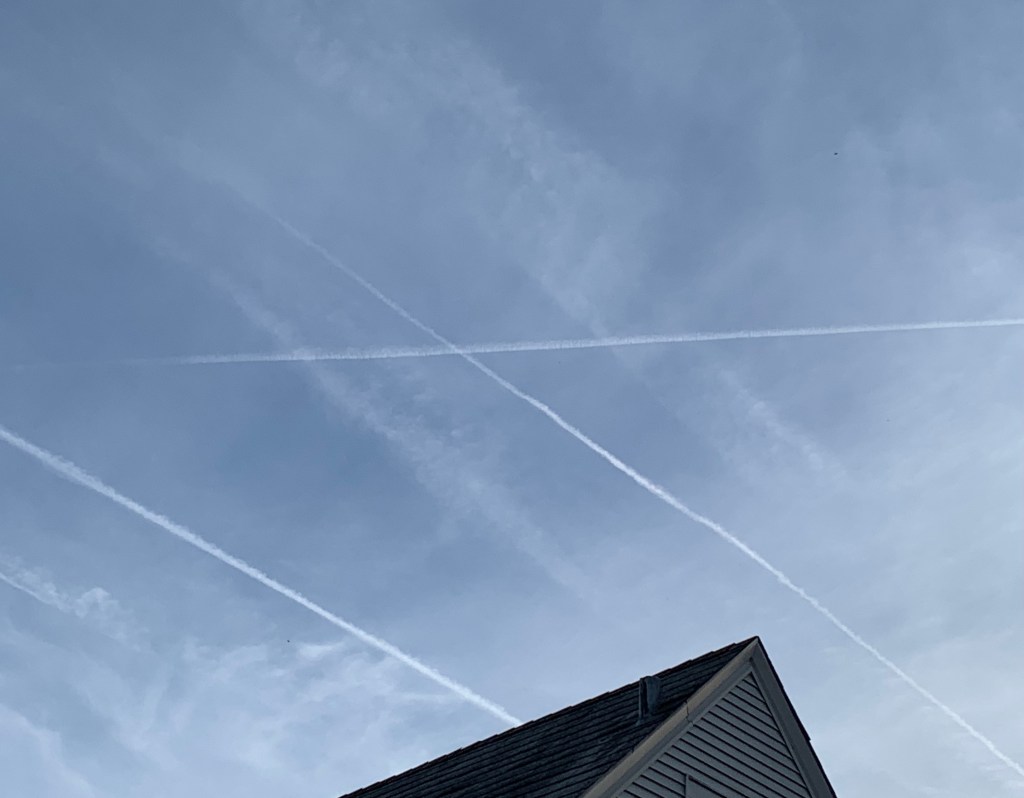
Our pin-on-the-map lands between two airports: O’Hare to the south and Milwaukee’s General Mitchell to the north. On clear summer days, or unseasonably warm days like last week, we recline in our Adirondack chairs and watch the planes Etch-A-Sketch in the sky. According to our recent 5 minute contrail-count-study, at any moment, there are more planes in the sky than one might believe.

It always makes we wonder if Ben Franklin or Leonardo daVinci joined us on the patio would they calmly count contrails from their Adirondack chair or would their heads explode at the wonder of it all. It amuses me to imagine Leonardo hopping around with excitement and pointing to the sky.

In my recent past the phrase “digital exhaust” was relevant to my work in the wild, wild world of software development. Like a contrail, the output of our incessant tapping of keys leaves a trail marking our arc through digital space/time. The particular characteristic that had me hopping out of my chair was the notion that “reading” the digital contrail not only marks our past but is a great way of foreseeing future action. Past patterns are terrific indicators of future behavior. Just ask the FBI.

Kerri keeps a paper calendar where she records the significant and insignificant details of every day. It’s a behavior she inherited from her mother. Beaky was a great recorder of events and maker of lists. If I want to know if we had dinner with 20 in November of 2016, Kerri flips open her 2016 calendar and hits me with the details: yes we did and we had blackened Tilapia, small potatoes, and roasted asparagus. I’ve lost many a debate to the entries in the calendar. Her calendars are our personal analog contrail. Our unique life arc through space/time.

It’s helped me answer one of Tom’s questions about his great-grandmother Isabelle. He found a box with stacks of daily flip-calendars that Isabelle kept, each day had a notation about the weather. A hardworking ranch woman, standing on the porch of the farmhouse, in the days before airplanes, she stared at the sky and made a note in her calendar: hot sun, not a cloud in the sky. Tom looked at me as we went through the stacks in the box, asking, “Why would she do that?”

Contrails.

read Kerri’s blogpost about CONTRAILS

Welcome The Muse [on Two Artists Tuesday]

For many years the “sitting room” was a place we passed through en route to the kitchen or our bedroom on the return trip. It was our staging ground while packing for trips. It was the place we put things when we didn’t know where else to put them. I never sat in the sitting room.

And then, one day, a muse-of-calm possessed Kerri. She wanted a space of peace instead of space of clutter. She wanted to sit in the sitting room. She wanted to hang out in the sitting room. She wanted to read and relax in the sitting room. She became a cleaning dervish. She hung meditative paintings. It was a miracle.

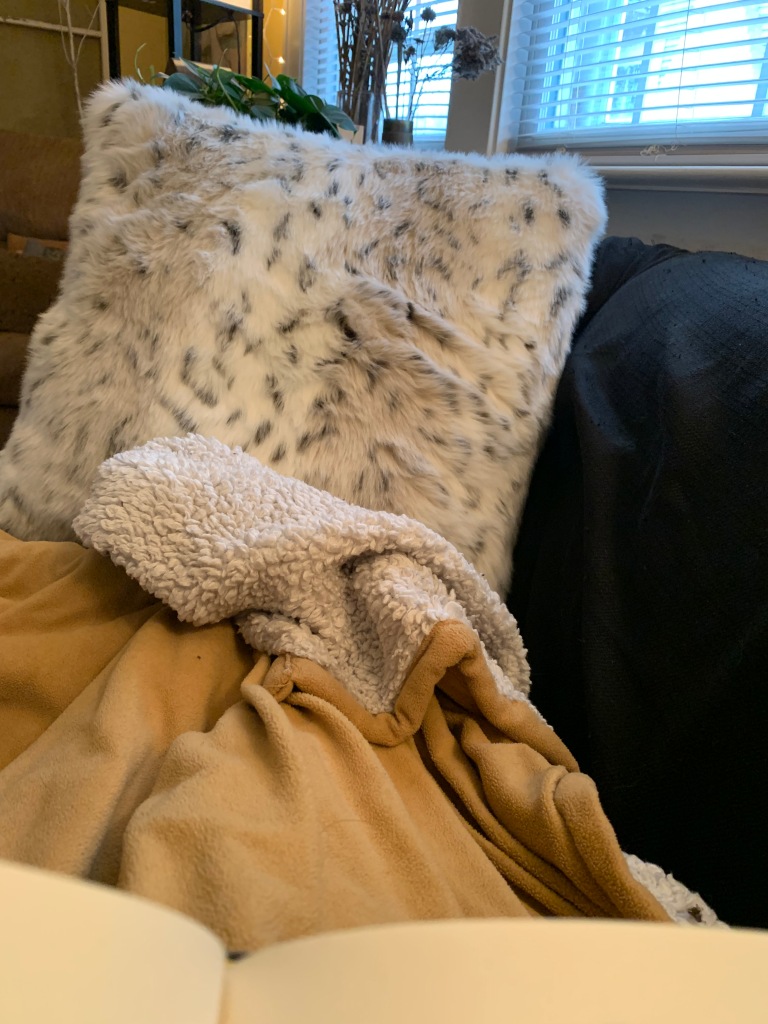
I stopped in my tracks the first time I attempted to pass through the sitting room post-transformation. There was air and light. There were comfy pillows and a throw blanket on the couch. I was filled with an overwhelming desire to sit in the sitting room!

I’d heard rumors of the couch in the corner of sitting room. It was one of BabyCat’s favorite nap spots. Kerri assured me that no creature could sit on that couch without falling into a deep relaxed state. I had my doubts. In my time it was the central repository of clothing overflow. I’d actually never seen the couch. Plus, that BabyCat could sleep anywhere, on any surface. BabyCat was a gifted sleeper.

Kerri appeared behind me. She was holding a book. She, too, had transformed! She was the Siren of the sitting room! I nestled into the couch and cooed, the lap blanket covering my feet. The Siren sat on the other side of the couch. She opened the book and began to read. I was like Dorothy in the poppy field. Eyes drooping. Head bobbing. Incapable of concentration. The last thing I remember was thinking, “So this is what it feels like to be a cat…”

Now, we spend hours in the sitting room, reading on the couch. Falling into a deep relaxed state. Each morning, as I pass through on my way to the kitchen, I slow down and breathe-in the calm.

Sometimes I wonder why we waited so long to create this place of tranquillity. The potential was there all along. The good news? The peace of the sitting room is spilling out into the rest of the house. The sun room is filled with plant-love. The living room is beginning a subtle transformation. We gather around our small table in our tiny kitchen and laugh and tell stories. It’s how change happens. Create the space. Grow the space. It’s how peace happens.

This I know: the muse-of-calm is not yet done with us. I can’t wait to see what happens to the rest of the house and beyond.

read Kerri’s blogpost about THE SITTING ROOM

Celebrate The Symphony [on Two Artists Tuesday]

The return of the frogs. No, it’s not the title of a b-grade-horror film. It’s one of our favorite rites of spring. Their chorus is deafening, a sound celebration of the season’s cycle into renewal. We look forward to and celebrate the day of their return.

A short month ago we walked across a snowy field, still a bit in shock at the scrape-clearing of the tall grasses and brush. Broken bits of stick and root poked through the snow. The picture of devastation. In just a few short weeks, the field became a bog – evidently the perfect performance hall for the musician-frogs signaling life’s return with their playing.

They’ve always played in this spot along the trail but this year their symphony is made particularly poignant by the seeming wreckage of their environment. This year, to our ears, they perform a rousing song of perseverance. A composition of resilience.

They’ve also awakened a question in us. We ask it every year but this time it is made more mysterious because the bog is exposed. We can see everything except the frogs. The air is alive with sound while the water is still. We’ve stood, awash in the noisy vibration, yet can see nary a ripple in the surface.

How is it possible to shake the limbs of trees with joyous sound without disturbing the fen? The musicians are invisible.

There can only be one explanation: They are magic, these frogs in their spring renewal, popple-free playing while stirring our hearts and imaginations.

read Kerri’s blogpost about FROG BOG