Breathe and Make Choices [on Two Artists Tuesday]

“The greatest weapon against stress is our ability to choose one thought over another.” ~ William James

A note from the Rejuvenation Fairy: the relief we seek may depend upon the phrase we choose. For instance, consider this phrase: coping mechanisms. What ease might become available if we viewed ourselves as something other than machines? Turn this dial. Adjust this screw. Add a little oil. Check the battery. Do this, then that will happen. Turn down the pressure gauge. Talk to others. Take a break. Cause and effect.

Breathe. Sentient beings are much more complex and subtle than apparatus made from iron and steel.

We story ourselves. For reasons no one will ever fully comprehend, we sort to the tragic. We imagine the worst. Ask any good storyteller and they will confirm that conflict is the driver. Yearnings meet obstacles and stories ensue. Everyone, without exception, is telling themselves a story. Everyone, without exception, is starring in their own movie, complete with impossible mountains to climb, monsters to face, dreams that remain just out of reach. Robert Sapolsky has it right: zebras don’t hold onto their tale of stress while human beings are reticent to let it go. We like to tell it again and again and again.

If we cast ourselves as victims in our movie, our stories will be filled with ogres to blame. If we reduce ourselves to the mechanical, our stories will be endless attempts at fixing what’s broken, looking for the right hose to replace. How to recharge the battery. The fortunate few recognize that their movie might be a story of choice. Choices made within given circumstances. The storm, like time, passes. How do we stand in it?

There’s little doubt that we are living in stressful times. There’s nothing like a deadly pandemic to turn up those mechanical pressure gauges. Add another notch or two of pressure with extreme national ideological division, cowards at the switches of government, mix in some economic stress…there are plenty of choices on the angst-menu. All are visceral. All are circumstances to the story we choose to tell, the story I choose to tell.

I came across a few universal coping strategies. Eat healthy. Exercise. Give yourself a break. Get plenty of sleep. Talk to others. Recognize when you need help and ask for it. I wondered why these good choices are reserved for times of stress. Why not give yourself a break as an everyday expectation. Talk to others. Eat healthy. Weave a calm center it into the fibers of daily life. Make choices. Especially in the story you tell yourself about yourself. The thought upon which you choose to fixate, to play over and over again in your movie-mind.

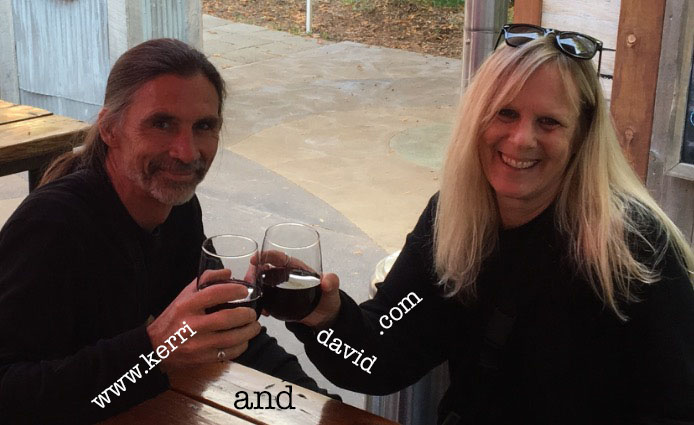
When Kerri and I fall off the pony and run around like our hair is on fire, we make chicken soup. I am the sous chef. She is the master mind. The recipe comes from her mother so the making of the soup is more than food prep, it’s a love-touch to her anchor. We touch love. And, of course, defying the advice of experts to avoid alcohol, we enjoy a glass of red wine. We choose the glasses: Jamie’s? Or Skip’s? Or Joan’s? For our wedding, we were gifted with many special wine glasses from many special people. Recently, Jay and Carol and Rob sent us wine. When we clink our glasses, we touch the depth of our support and reach of our friendships. We call 20 and laugh. As the soup simmers and the wine disappears, we realize that our hair is not on fire, that, although we are not zebras, we are infinitely capable of releasing our tale of woe. We need not cope or distract. We can grasp hold of the full tale of the enormity of our lives. We need only refocus our eyes, see the depth and expanse of our story and choices, enjoy the warming soup. Appreciate the story of the wine.

read Kerri’s blog post about CHICKEN SOUP & WINE
Start Here [on Flawed Wednesday]

Let’s start here: a strange attractor. “Chaos has its own pattern, a peculiar kind of order.” This magical definition pairing chaos and order is from the good folks at Merriam-Webster. They provide definitions of words. Words are a collection of symbols, called “letters,” assigned to specific sounds which, when placed in a sequence, carry meaning. For instance, D-O-G points to something unique and different than, say C-A-T. A collection of words placed in a sequence carries even more complex meaning. Dogs chase cats.

Thought. Expression. It’s nothing short of miraculous if you think about it. And, if you are thinking about it, you, too, are a carrier of meaning. The symbols and their sequence are useless without me and you, reaching to each other, agreeing on the general meaning of the sequence of sounds. And, more to the point, we not only carry but we create meaning. With our magical sounds-in-sequence we are capable of generating the high art of story, the supreme gift of understanding each other. We can reach each other, touch each other, move each other. We can find each other with our words. We shape each other with our words.

From the chaos of all-possible-sound, to the pattern of word and alphabet, to the order of sentence, to the power of story. Anyone who tells you that they are not creative is missing the point of their existence.

I suspect the power of story is infinitely more powerful than we might realize. We take it for granted, this extraordinary capacity, this glorious gift. You’d think we’d have more appreciation for our high art of language, our transcendent ability of speech. You’d think we might honor and protect truth and fact. They are the compass, the map through the forest of all possible tales. You’d think we might use our most powerful accomplishment to find, or better yet, to create shared ground. Common good is an intention, a creation.

You’d think.

There’s a vast difference between disagreement, conflicting points of view, and lie.

The point of a disagreement is to find agreement. After all, single-point-perspective begins from two disparate points of view. It is a “coming together.”

The point of a lie is to mislead. To deceive. To create false impression. False ideals. To foster disagreement. It is a tool for exploitation. It is meant to render apart.

Because we so easily sequence our words, pattern our thoughts, we are capable of using our magic, our ordered language to create…order. We are also capable of using it to create chaos. Disorder.

To help. To hurt. To accomplish. To disrupt. It’s a matter of intention. The direction of intention. How do you intend to use your precious gift?

The real power comes when we learn to think beyond our belief. To question. To ask.

The first rule of education, an essential rule in shaping precious words into thoughts, into actions, is simple: check your sources. Make sure the story you’re embracing, the piper you are following, arises from a well spring of good intention. That it has an ethical center. Check that it seeks to clarify and reach rather than obscure and demonize. Check that your thought-house is not built on a lie.

Check your sources. Of information. You, too, are a source of information, so…check your sources.

With our most powerful capacity to pattern, to create, to think in words and sentences and stories, we can be a carrier of the lie-virus or we can be part of the cure. Reach or reject. It is our choice, through how we use our miracle words and language, what we agree to create together.

Let’s start here.

read Kerri’s blog post on AGREE

Conceal To Reveal [on Two Artists Tuesday]

When I was tilting at windmills, one of my favorite things to facilitate was mask work. I brought masks to lawyers, to CEOs, to teacher’s, government workers, elementary school students, corporate trainers, business coaches and sometimes to actors. There’s nothing better than a mask to pop open possibilities and challenge petrified thinking.

Masks conceal and reveal. They serve the paradox and, therefore, are tapped into the root of truth.

It’s impossible to work with masks for long before realizing that the faces we wear everyday are also masks. We “put on” a smile. We attempt to hide what we feel by the mask we manufacture. Some faces freeze in masks of indifference or masks of disdain. We perform ourselves, and craft our masks accordingly.

Many cultures around this world believe the mask opens a communication with the gods. Don a mask and something bigger-than-you speaks through you. When I paint I often have that feeling. Artistry sometimes means getting out of the way so the creation can flow.

It’s why I brought masks to lawyers and CEOs and corporate folks and teachers. To introduce them to the fields that bloom beyond their need to control. So much of their lives, so many of their problems and challenges were wrestling matches of control. They were actively creating the obstacles that they desired to remove.

What do we actually control when we harden our faces over what we feel? What do we gain by attempting to control what others see or think or feel? We are makers of our own prisons. We are deluded by our fantasy that we have the capacity to determine what others see. The only control we exert is upon ourselves.

The mask work makes abundantly clear that control is not power. Power – creativity – flows. It is the dance of the artist to master technique, to learn control, and then transcend it. To get out of the way.

My favorite moment, with every group, in every circumstance, came when the masks released the people and they slowly, respectfully said goodbye and removed them. Their faces was also mask-less. It was like seeing infant’s faces. Bright. Open. They would, for a few brief moments, look at each other, unmasked and unprotected. Simply astonished at being alive, together, in the world.

read Kerri’s blog post about MASK

See It For What It Is [on DR Thursday]

In the aftermath of my calls with Horatio I often feel as if I’m descending the mountain, as if I’ve just spent a few precious moments with the wise being sitting at the top. He will no doubt frown at my assertion because, as he says, he puts his pants on one leg at a time just like everyone else. Pants or no pants, Horatio is clear-seeing. He is in-sight-full.

This morning he interrupted my diatribe about the insurmountable dangers of competing information bubbles. “We have to stop the narrative of polar-opposites,” he said, “We’re not a polarized nation. We’ve been invaded by opportunists.”

His point was simple and distinct: It’s not a two-way street. PBS is not the polar opposite of FOX. CNN is not in an apples-to-apples comparison with the likes of OAN. “PBS has a virtuous intention. CNN has a virtuous intention,” he said, “The same cannot be said of FOX or NewsMax or Limbaugh and all the rest. They are opportunistic predators.”

Waging war on truth for profit is not the same as attempting to report the truth.

Horatio continued, “PBS or CNN might be feckless or inconsistent, they may get things wrong, but they are not predatory. They serve a decent intention and the same cannot be said of FOX.”

“The incentive for hucksterism is vibrant in the United States. Apply game theory,” he quipped. “The incentive for waging war on us and our institutions for personal power, personal gain and financial benefit is great. It’s been with us for a long, long time and is now perfected to a fine art. We are living in a confluence of hucksters.”

Josh Hawley. Lindsey Graham. Marco Rubio. Ted Cruz. And all of those who voted not to certify a legitimate election, even after a violent insurrection on the Capitol driven by their willing support of fabrications. Opportunistic predators all. Yes, a confluence of hucksters.

He paused. “We are not radicals,” he sighed. “We’re not being radicalized. PBS and CNN – the NY Times – are not the ideological polar equivalent of FOX or Limbaugh. They are not attempting to radicalize us or disseminate lies for power, profit or position. We have to stop it. We have to say it differently. The press needs to say it differently. Call it out. The press, the real press, not the hucksters, are keeping the world alive. They’re doing the work and the work is often dangerous. It’s inspiring.” he said. “We are living in a golden age of the press. The real press as distinct from the opportunists, the predators.”

They are not the same. Horatio is right.

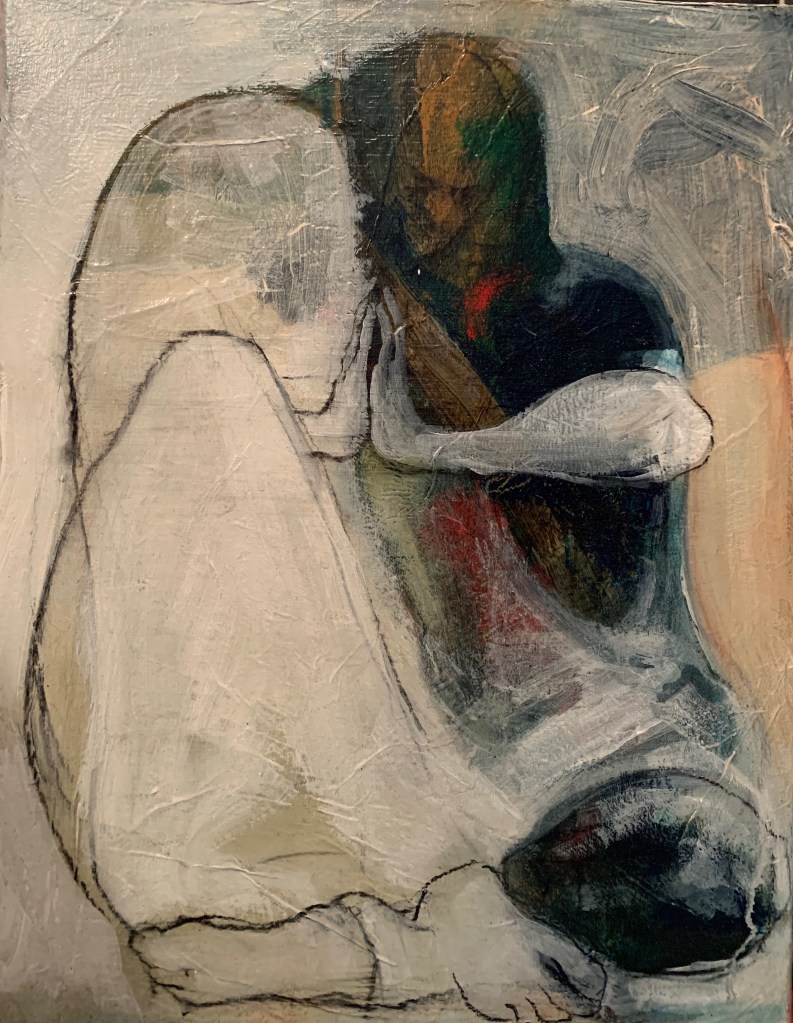
After our call I went into the studio to find a painting to use in the Melange, something I’ve not used before. “Use this one,” Kerri recommended. It’s one of many I painted of the same theme. “It’s timely,” she said.

Yes. Timely.

read Kerri’s blog post on the UNTITLED PAINTING

untitled ©️ 2019 david robinson

Stop The Chase [on Two Artists Tuesday]

It’s difficult, seemingly Pollyanna-ish, to write about love when our nation is now officially divided and living in two combating realities. When Kerri took this photo on our back deck, I knew it was going to make an appearance in the Melange. “It will be tough to write about given the events of this week, the realities of our divided nation,” I said to no one listening.

I was wrong. The more I pondered this heart in the snow, the more I saw a simple theme, the thing we always miss. It is at the core of almost all spiritual teaching and personal revelation: stop the chase.

Krishnamurti wrote that “Love is a fact, not an emotion.” It cannot be found precisely because it is omnipresent. It is everywhere. It is everything. However, it can be easily missed, especially when covered in a blanket of righteousness. Love will sit patiently and wait for those who believe love to be a separate thing, something to be earned or discovered in the eyes of an other. We recently, through Zoom, sat Shivah for someone dear who had passed. The Rabbi read these words from a poem, “Love doesn’t die, people do. So when all that’s left of me is Love, give me away.”

Viktor Frankel wrote that “Happiness ensues.” It follows. It cannot be pursued or attained.

I can’t tell you how many countless hours I’ve spent with groups who desire to attain presence. To achieve mindfulness. It is nigh-on impossible to convey to achievers that presence cannot be pursued. It’s simple if you think about it: presence comes when ambition disappears. Presence and love. The desire to be anywhere else, to achieve anything, to become something other than what you are in this moment, precludes presence, interrupts love. Allow it; it’s already there.

It is anathema to suggest to modern seekers that they will find what they seek by ceasing to seek. Ha! It is the ultimate collision, in a culture steeped in achievement-as-a-central-tenet, that love, happiness, presence, mindfulness are unachievable – but infinitely available when standing still.

“You can love me most by letting me live in your eyes, And not on your mind,” the Rabbi read. See beyond what you think.

Division lives in the mind. What we seek, what we most need in this historic moment, cannot be found there. What we seek will become apparent – readily available – when we stop the chase, drop the destructive delusion of manifest destiny and its many separation-shadows – and, even for a moment – stand still.

read Kerri’s blog post about HEART

Do It For Yourself [on Merely A Thought Monday]

I have been writing long enough to know that there are sedimentary layers to my themes. The top layer, the most superficial, is the political layer, current events. I am not above shouting into the storm. When I run to the keyboard and ring the alarm or presume that my point of view is relevant enough to roundly criticize others, I know that, above all, I’m breaking the first rule of happiness: I can never determine what another person thinks or does or feels. On my superficial days, in my ranting, I write for myself.

When I was at my saddest, I set about looking for goodness. I walked the streets of Seattle with the single intention of counting acts of kindness. As you might suspect there were more than I could count. In this world where we story ourselves as aggressive, unthinking and unkind, we are remarkably compassionate. Good will is simply more difficult to see. It is not the focus. The deeper layers of my writing-archaeology emerge when I direct my attention, when I exercise the artist in me and attempt to see beyond what I think. Since these are the layers where I desire to live and work, I suppose it is also true that on those days I also write for myself.

It is a looping life-lesson for me: I have the capacity to choose where I place my focus. I will see in the dark ocean where I decide to shine my light. I will author myself according to what/where I decide to give my focus. It is, among other things, why the film ABOUT TIME is among my favorite movies.

Lately, as one of our get-through-the-pandemic-winter-strategies, we’ve taken to assembling jigsaw puzzles. Entire evenings disappear into our intense pursuit of pieces. Our puzzle sessions require absolute focus – all of the other nonsense and monsters that vie to plague our brains are banished. Our focus is so thorough that we rarely speak. We do, however, listen to the soundtrack of ABOUT TIME. Again and again. When it finishes, one of us walks to the CD player (yes…we play CDs) and play it again. Sometimes we don’t make it past the first track, Ben Fold’s THE LUCKIEST. “Do you mind?” one of us asks. It’s a rhetorical question. It warms us so a repeat is always welcome.

Sitting at the dining room table, hunting for bits of colored cardboard, with the soundtrack playing, all things come into focus. While the surface-layer is on fire with a circus of instability, a pandemic, a climate that is changing, all jobs gone, a broken wrist that is not mending,…the deeper layer beckons: DogDog sits under the table, BabyCat is asleep on the chair, 20 just called and made us laugh, a postcard from Jen made us cry, my phone dinged with a text from a dear friend. I look across the table at my wife, pursing her lips as she plucks a piece of the puzzle from the table and attempts to make it fit, and I know to my bones that I am the luckiest.

To see it or not to see it; it’s my choice.

read Kerri’s blog post about REPEAT

Sort [on Flawed Wednesday]

As I type this morning, concrete barriers are being set to block off the streets downtown, fencing is going up around the courthouse, plywood panels are once again screwed into place, covering the windows of businesses. We are hunkering down for an announcement about whether or not the officer, who shot Jacob Blake in the back seven times, will be charged. Also, the little kid with the big, big gun who murdered two people blocks from our home is being arraigned. His bail was posted by the My Pillow Guy. Truly, you can’t make this stuff up.

Also as I type this morning, the party wrapped in red on Capitol Hill is choosing personal gain over principle. Despite placing their hand on a holy book and swearing to serve the Constitution above all else, they’ve chosen – they are choosing – to serve their ambition above all else. Apparently, the holy book and the Constitution are useful props for photo ops but any real dedication ran away with the fox.

As I write this I’m suddenly flush with a revelation that I blame on Horatio. He once told me that every challenge we face in these supposed-united-states is a tension between dueling philosophies: Every-Man-For-Himself vs. I-Am-My-Brother’s-Keeper. My revelation: To believe, again and again, that leaders-wrapped-in-red who are committed above all else to personal gain should honor an oath to something larger than themselves, like their holy book or The Constitution, makes us the fools. It is the natural end, the path of least resistance, for adherents of the philosophy of selfishness, to believe in nothing greater than themselves.

And, after today, why should we expect them to represent with integrity our best interests? They are demonstrating just how incapable they are at leading. Leadership, by definition, requires a concern about something other, something greater, than your self.

Why should we expect more? Red is the new yellow. To twist a bit from Forrest Gump, “Cowardice is as cowardice does.” It is nigh-on impossible to write a farce of these conflicted-united-states. Such is our dedication to the ridiculous, the mad-fantastical.

2020 was the blue ribbon winner of miserable years. Our picture was blown to bits. So, as part of our new years invocation, we did a jigsaw puzzle. 1000 pieces. We brought order and sense and, finally, a completed picture together from so much disarray. It is what we hope to do for ourselves in 2021.

The first step was to sort, to turn over the pieces and see what was really there. Find the edges. Colors. And, so it is. Today we sort.

We’ll again pack a “go bag” in case the expected violence spills into our street. We’ll witness the antics of a failed state as performed by the privileged, sacrificing the greater for the lesser. Seeing what is really there. Accepting what is really there. “The problem with you, Robinson,” Doug delighted in saying, “is that you want it all to make sense. None of it makes sense.”

Red is the new yellow. Where, oh where, will we ever find our edges?

read Kerri’s blog post about the PUZZLE

Balance The Opposites [on Two Artists Tuesday]

Skip told me that the only problem Kerri and I would face is that we are both CEO personalities but come at it from entirely different directions. Truer words were never spoken! For instance, when we walk, my eyes are generally in the sky pondering the greater meaning of the universe while Kerri’s eyes are on the ground looking for a cool photo op. I see big pictures and she is a master of detail. I am easily lost in thought and she is snagged in nuance. Most of our wranglings are hysterical arguments for the same thing but from diametrically opposed points of view; we are quite capable of making agreement sound like dissent. Word magic.

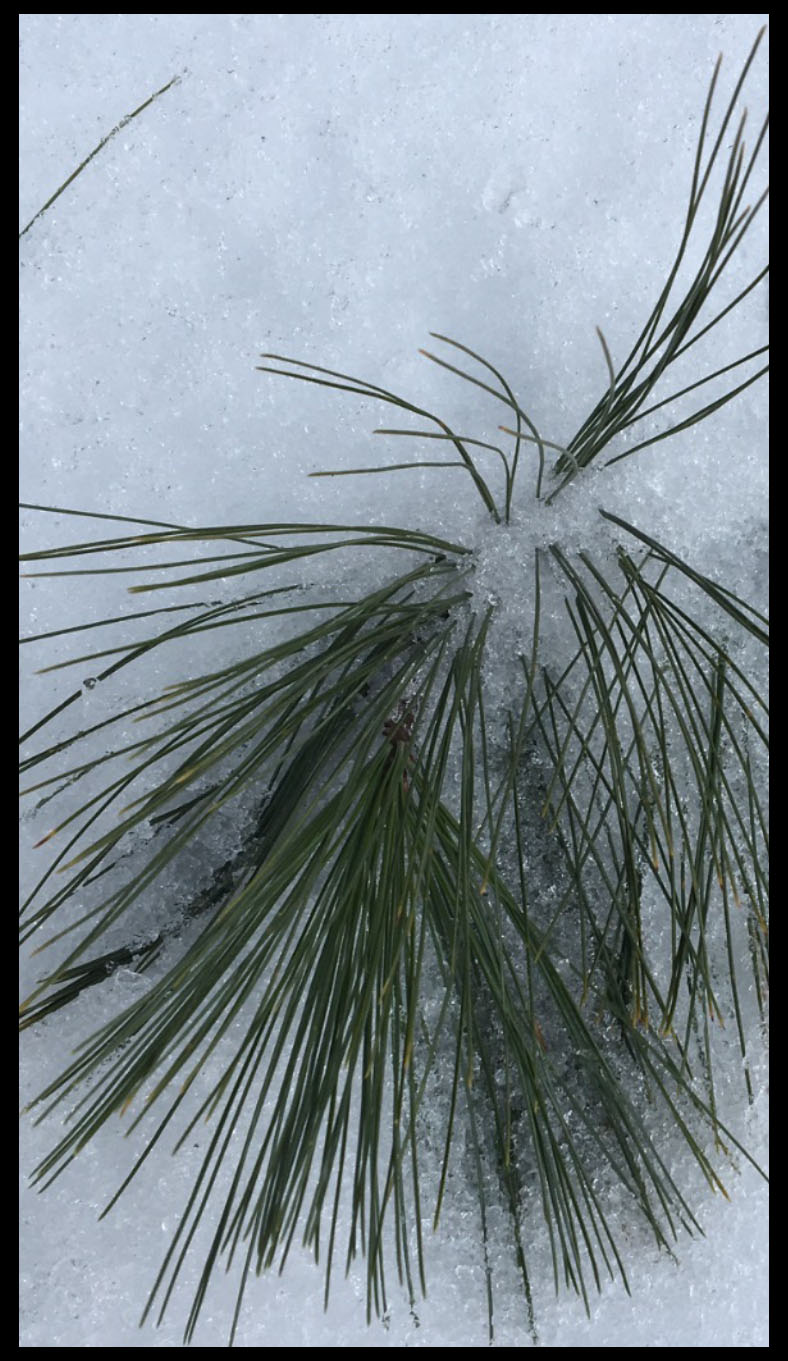
Our walks, with my eyes in the sky and hers on the ground, have become a metaphor for why we are so good for each other. She pulls my eyes to the ground. I pull her eyes into the sky. I’ve recently been awed by a nurse log covered in ice crystals, the lines running through a tiny rock, the composition of a fallen pine branch in undisturbed snow. She helps me see in life what I easily miss. It’s a paradox – from my view at 30,000 feet – pulling my eyes to the ground is expansive. I see more. I appreciate more. I stop and look. It is my favorite paradox that, in our house, I’m considered the visual artist but she is teaching me to see.

Balance. It comes from opposition. Like a yoga pose, energy sent in opposite directions creates stable grounding. It creates space, creative tension. Center.

When Terry was teaching me to scuba dive he often instructed me to “get neutral.” He was Buddhist and his teaching was as much spiritual as it was practical. “Getting neutral” meant not to struggle. Maintain or change depth with breathing. Inhale or exhale. “Getting neutral” meant not to swim through the dive like a tourist but to be in it. Be in the enormous power of the ocean. Balance the opposites. Begin with your breathing.

On the trail, Kerri often stops, kneels close to the ground, focusing her camera. “I love this,” she whispers. “This is beautiful.” She carefully frames her shot. “Do you want to see?” she asks, standing after taking a few shots.

“Yes.” I say. “Yes, I do.”

read Kerri’s blog post about UNDISTURBED

Be Like BabyCat [on Not So Flawed Wednesday]

We had a difficult time choosing our Melange this week. The final week of the year is overwrought with reflection and, let’s face it, 2020 is not like any other year. There is too much. For the first time in our 151 consecutive weeks of writing, on Sunday night we published an almost empty slate; one solid decision and four placeholders. We knew our prompt for Monday because, well, it was Monday. The curtain was rising.

It is tempting in a year like no other to write about the tragedies, disgruntle-ments, mountains to climb and we’ve certainly done our share of that. The pandemic has merely served as a baseline to the other palette of poo that populated our 2020 experiences. As we rounded the trail on Monday we decided that filling-out the Melange week with DogDog and BabyCat might be the respite that we needed. Our boys keep us laughing. They bring us back to the moment, to the real stuff of life. More than once this year, lost in the stormy sea of my mind, I’ve joined the boys on the rug, ruffled ears and stroked chins – and in a matter of seconds I’ve been awash in the thought, “It doesn’t get any better than this.” They are wizards of transformation.

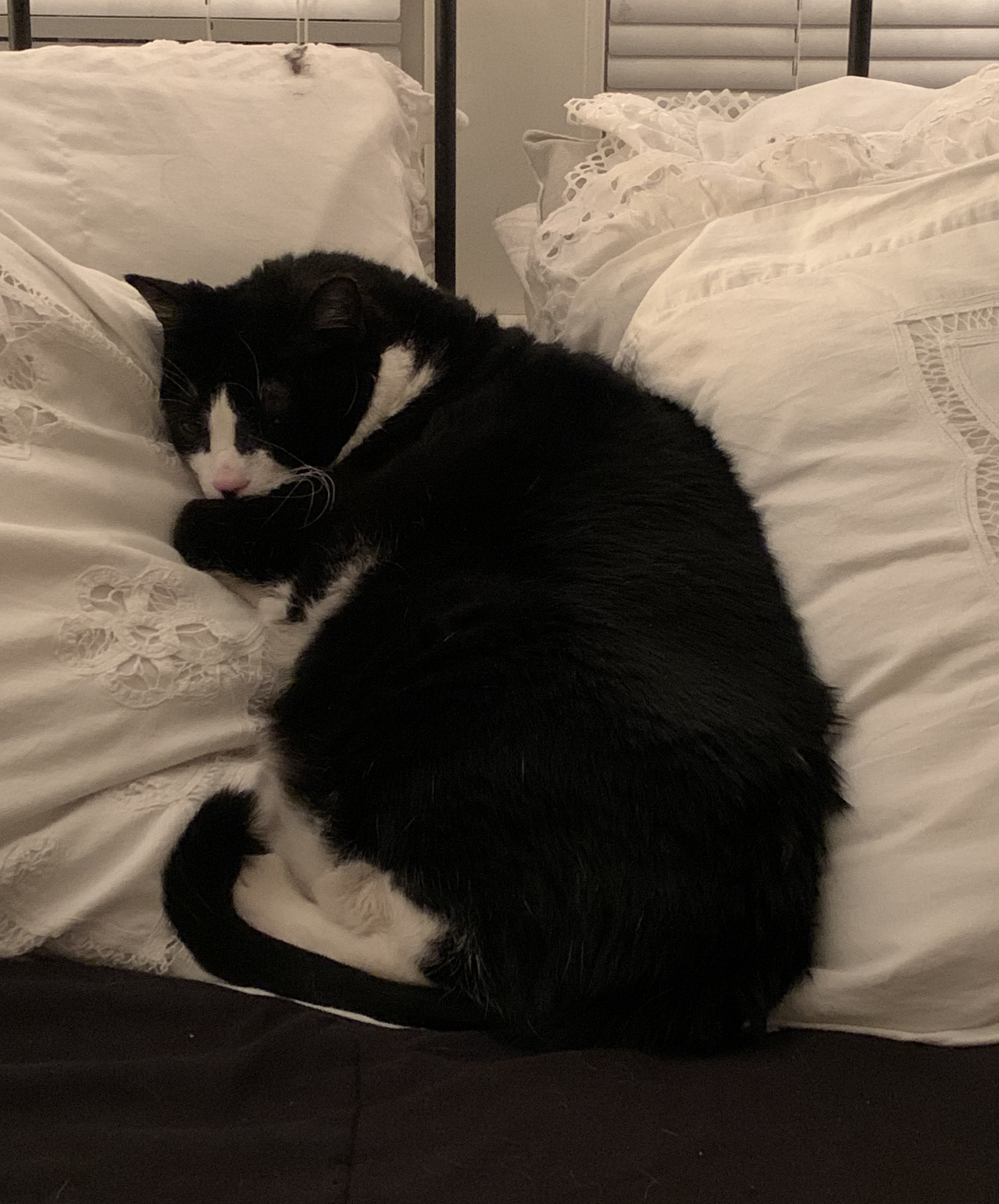
BabyCat is a study in contentment. Scratch that. He is a master of contentment. While DogDog runs circles through the rooms of the house or barks at imagined intruders, BabyCats seeks stillness and sleeps. While we wrestle with fears of the future or sort through the wreckage of our stability, BabyCat finds the most comfortable place in the house and occupies it. He is not ashamed of his inactivity. He revels in it.

I watch him. He is my first cat, an alien being, a mystery that I can’t help but study. Yesterday, as he moved from one nap into the next, I thought that, if BabyCat was an artist, he would be in a constant state of conception. He sleeps on his ideas with no imperative to actually make them happen. He loves an idea for its own sake. In that deep-state-of-fulfillment, he specifically and successfully rejects all forms of self-criticism. He is a hedonist, shameless in his love of pleasure, his ease of enjoyment.

There were days in 2020 that pounded us into mush. If Kerri or I found ourselves in a fit of despair, without fail, in a matter of moments, BabyCat would crawl into our lap. He’d plop his hulking contentment in the center of our darkness, stop all movement, and purr himself to sleep, taking our despair with him into that netherworld. There are few more effective soul-balms than a contented cat on your lap.

Wizards of transformation. Contentment in a storm. No words necessary.

read Kerri’s blog post about BABYCAT

Look Into Their Eyes [on Merely A Thought Monday]

I joke that my experience of moving to Wisconsin was akin to a brake-less semi-truck hitting a runaway truck ramp. I plowed into the sand and pieces of me flew off in all directions. My work, my artistry, my orientation to life. Also lost in the rapid deceleration were my defense mechanisms, my armor, my “status” and “role” as I understood it. Full stop. Bumpers, bolts and bits of me strewn all over the place. It seemed that I was no longer useful.

I recently read a story about African porters, after days of hurrying to keep up with the team of explorers racing to get through the jungle, the porters refused to go another step. They simply sat down. The exasperated explorers appealed to the porters to no avail. “We have been moving so fast, ” the porters said, “we must now wait for our souls to catch up to our bodies.”

I have learned that, amid my wreckage, I am like the porters. Although my abrupt stop was largely unconscious, my soul needed some time to catch up. Wonderment takes time. Depth of experience (otherwise known as relationship) requires a good bit of standing still.

It’s a lesson I have learned more than once. During my time in Bali, if I wanted to walk with Budi, I had to slow way down. It’s actually possible to walk-in-presence rather than walk-in-purpose. In slow walking I learned I could breathe. My mind slowed. Direct experience (also known as relationship) and imagination filled-to-the-brim my new found space.

In our world, so addicted to speed and achievement and possessing and lists and “getting there,” we flatten our experiences to the mechanical. In nuts-and-bolts there is very little meaning to be found. Worse, there is no inter-connectivity. There is no experience of togetherness in an expectation of quotas and cubicles.

When I was consulting with organizations, the most profound experience I could provide my clients was simply to have them stand and face each other. No words. Presence is utterly terrifying to people who are dedicated to never being present. Once through the terror, however, there is no better balm to the horrors of a “business-is-business” wound.

Flat world phrases like “bottom line,” “human resources,” and “business-is-business” are ultimately the language of abdication of responsibility. It is the language of separation. It is the language of cowardice. As we know, it is possible to do all manner of violence on people and the planet when they are reduced to a “resource” or considered an obstacle to business.

We can forgive ourselves anything when we refuse to stand still and look each other in the eye.

The eyes are, after all, the window to the soul.

Stand still. facing another human being, and you will at first pull up the drawbridge and man the parapets. Guards will rush to the towers. But, after a few moments of eye-to-eye-looking, the castle falls apart. The pieces come down. It’s like laying in a hammock on a dark starry night, gazing into the Milky Way. You will either clap your hands and laugh with wonder or you will weep with the profound recognition of belonging.

read Kerri’s blog post about TRAVELING TOGETHER