See The Awesome [on KS Friday]

Our favorite Wander Women posted the next installment of their through-hike on the Arizona trail. They are 300 miles in and passed through a burn zone that impacted a Saguaro cactus forest. Some of the giant cactus had perished. Many were burned yet somehow, survived. New growth pushed through the top of the blackened resilient plants. I was awestruck.

A decade or so ago, when life was hard, when I least believed in human kindness, I set out each day on my walk across the city determined to count acts of generosity. The acts of benevolence were everywhere and by far outnumbered the aggressive honkers and the impatience of frustrated commuters. By the time I reached my studio I wondered how there could be so much kindness, so much benevolence in the world, unseen. I wondered why our shared story was of a scary-angry-world rather than a world of munificence. The evidence did not support the narrative.

Looking for kindness in others inspired acts of kindness in me. Sometimes, after I witnessed a generosity, I approached the person who gave of themselves and acknowledged their act. I essentially said, ‘I saw that and it was awesome.” You may or may not be surprised to learn how impactful a simple acknowledgement can be. People smiled and blushed. People waved it off as if it was nothing.

Kindness is everything.

My walks across the city were more than a decade ago. The shared narrative of scary-angry-world is louder now than ever yet I wonder if I took a walk across my city-of-yore would I see a different result or the same? Kindness flies mostly under the radar, people wave it off as small gestures; it doesn’t pull high ratings like bullying or blood or scandal. We live within the narrative we feed.

I suspect kindness is as pervasive as fear-mongering but kindness doesn’t care if it gets the headline.

A sentinel stands on our trail. A tall stump, long ago burned by fire, perhaps a lightning strike. Perhaps its blackened scars are from a controlled burn. It reminds me of Shel Silverstein’s The Giving Tree. The birds use it for perching. The squirrels burrow at its base. Life teems around and because of the blackened stump. It always captures our attention. I imagine it is kind since so many creatures and living things find support in its watchful presence. New growth will never push through the top of this stump. It is no longer self-generating. It is, however, like a standing nurse log, new life teems around, on top of, and through it. A silent giver. I am always tempted to step off the path and whisper, “I saw that and it was awesome.”

Kerri’s albums are available on iTunes and streaming on Pandora

read Kerri’s blogpost about THE STUMP

transience/right now © 2010 kerri sherwood

Ask The Same Questions [on DR Thursday]

Their call is ancient and beautiful. I imagine their unique voice reaches back to the pterodactyl. Sandhill cranes. We live on their migration path. Each spring they stop for a rest, passing through, heading north. The Des Plaines river, surrounded by abundant farm fields, provide ample road snacks and safe places for respite.

Last fall, during the southern migration, a crane couple took up residence in a cornfield we pass en route to our trail. They stayed so long that they became a fixture. We expected to see them. Statuesque, always together, I wondered if they were as excited to see us as we were of seeing them. “There they are!” the cranes point to our little black toaster car. “Those two are always together,” they observe. “I wonder where they are headed?”

We make the same observations and ask the same questions of them.

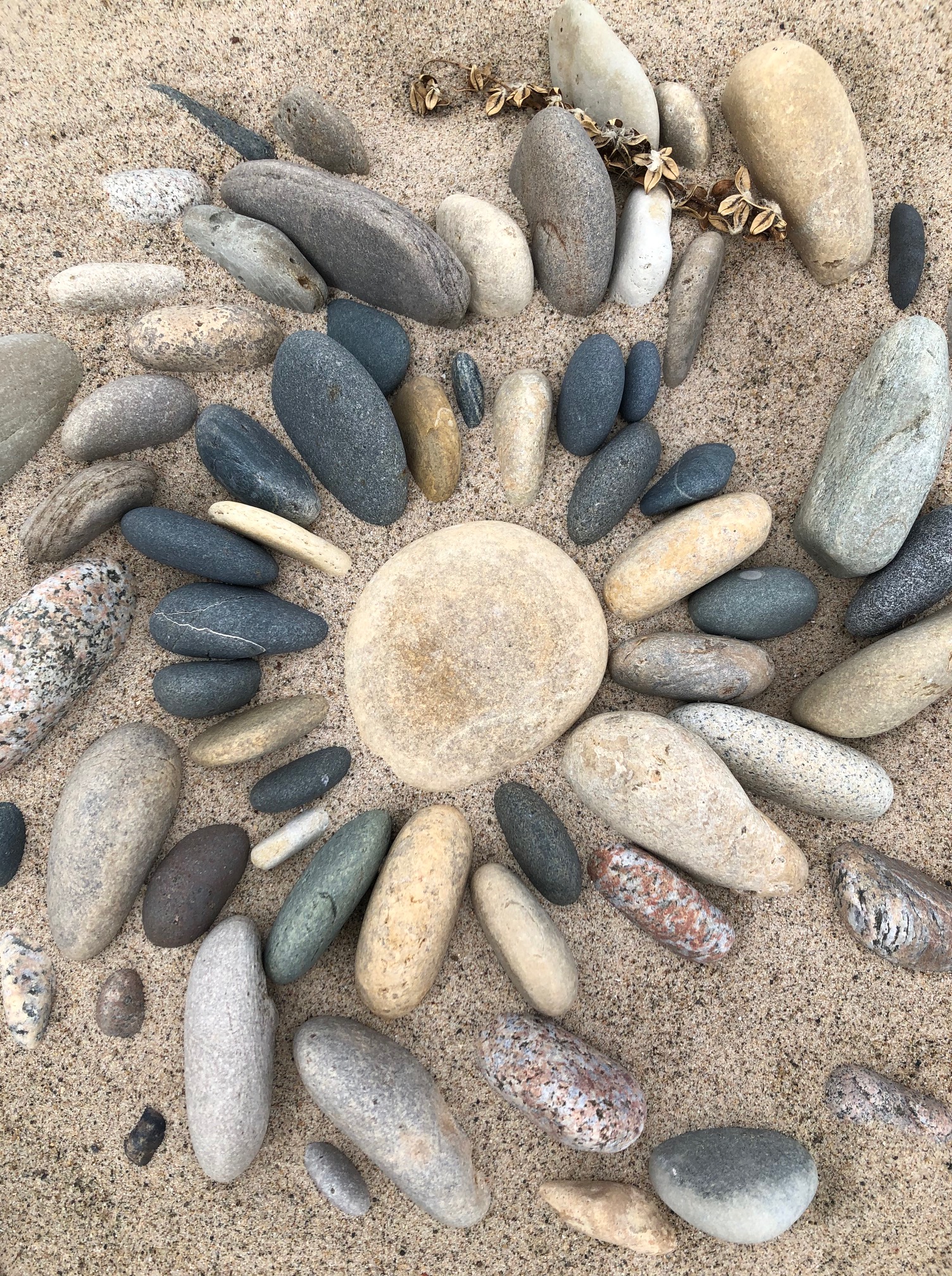
When we first saw their tracks in the snow it felt like a gift, like seeing two hawks circling or several deer peeking from the willows. Their prints were huge, almost too big to be real. They were so distinct that they reminded me of something Andy Goldsworthy might create. Patterns in the snow. Marks mysteriously etched across the landscape.

Were it stone instead of snow, white quartzite, these amazing marks would be petroglyphs. Abraded to leave us a message, a symbol whose meaning was lost in time but inspire speculation none-the-less. “Where did they come from,” we ask, knowing there is no answer but we have to ask anyway.

Our footprints cross theirs on the path. Brad does a masterful crane-walk-imitation. We laugh as man becomes bird, eyes intense. The original theatrical impulse. I look back at the our prints crossing the crane’s and marvel at the image. This startling canvas will certainly melt. Another reminder of Andy Goldsworthy. The power of impermanence, like a sacred sand painting, a spirit captured for a brief moment, witnessed, evoking power, and then disappearing into sun and wind and time.

Canopy, 48x48IN, acrylic

read Kerri’s blogpost about CRANES

Canopy © 2008 David Robinson

Look In [on Not So Flawed Wednesday]

“I want to stand as close to the edge as I can without going over. Out on the edge you can see all kinds of things you can’t see from the center.” ~Kurt Vonnegut

Yesterday I applied for a job that is all about narratives told from the edges of society. I’m not sure why it surprised me to find such a cool-to-me job; our community seems addicted to shattering so there are plenty of small edges to be found. Small edges are fallacious and serve a myriad of false centers. Our survival will depend upon whether or not we can awaken from the shatter-narrative and make the decision to direct our broken focus toward a common center. No small feat.

It is the role of the shaman, the explorer, the artist, the researcher to stand on the edge and report back to the community what is seen and unseen. The voice from the edge is rarely welcome since the report is capable of popping delusions or pulling the sheep’s clothing from the wolf. Page one of the autocrats’ handbook instructs the elimination of artists and educators. Making an enemy of the eyes-that-see, demonizing educators and thinkers – the people who recognize pattern and metaphor. The game of Us-and-Them necessitates silencing the voices capable of calling out the wolf. Autocrats require blind sheep that follow without question.

Some famous edge sitters: Galileo. Cesar Chavez. Rosa Parks. Nelson Mandela. Susan B. Anthony. Albert Einstein. Frederick Douglass, a former slave and leader of the abolitionist movement, wrote extensively about what we call Critical Race Theory; it was clear in his view from the edge. It’s not a new theory. It’s an old pattern with a new name. I think he might denounce his Republican party affiliation were he alive today; they would certainly silence his voice. He would be fired were he a professor in Florida today. As would Martin Luther King, another famous voice from the edge.

Voices of reason are often voices from the edges. Voices of the future are always voices from the edges. Galileo was silenced for suggesting that the earth circled the sun and not the other way around. Over time, the voices from the edge, when authentic, always make the center better, the community stronger. Susan B. Anthony spent her life on the edge, lobbying the center, to secure for women the right to vote.

Progress. Growth. They are rarely inspired from the tight grip at the center. Silence the edges and the community atrophies. Stop the movement and the body dies. That page was left out of the autocrats’ handbook for obvious reasons.

read Kerri’s blogpost about EDGES

Study The Studier [on DR Thursday]

I study the studier. She kneels, excited to capture the winter face of plants along the trail. It’s as if they call to her.

Where does it start? An idea. Broad and generic. Spontaneous. Studied.

For months I watched her take photos of the train through the trees. “Here it comes!” she’d laugh and pull her phone from her pocket, running to get the best spot on the trail. Each time as excited as the first. I took photos of her taking photos of the train snaking just beyond the trees.

Mostly she shoots close-up photographs. Spontaneous. She has an eye for detail. She helps me see what I overlook. I have an eye for the big picture, the metaphoric. I study. Pie-in-the-sky.

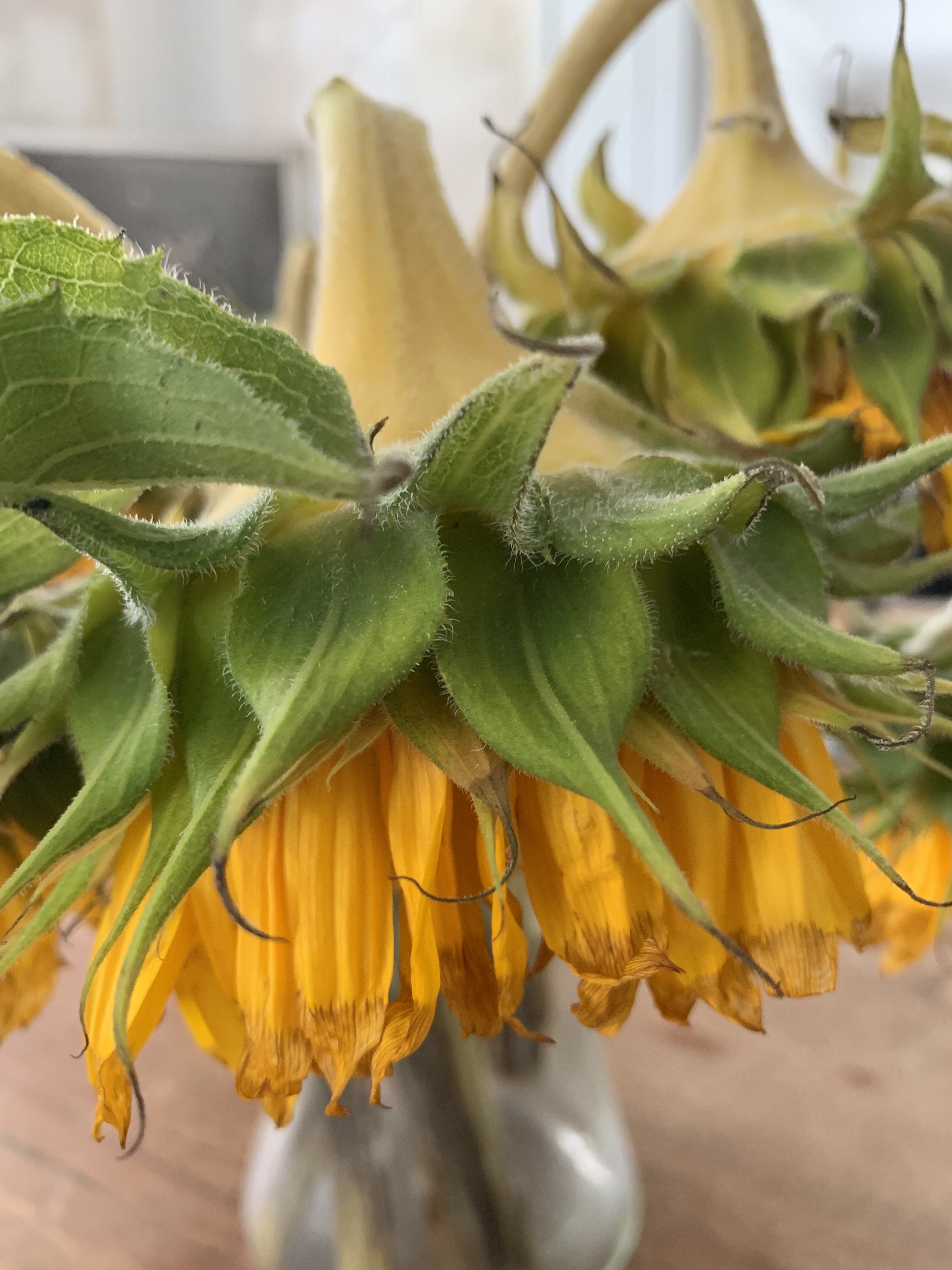
I think she would have been great pals with Georgia O’Keeffe. They’d have compared notes on the magic world of minutia. The dried flowers, the pattern in the petal. The amazing textures and vibrant winter colors. Some people see only brown. Kerri sees subtle changes, ochre, cream and an array of umber. A universe full of color. Just like Georgia.

This is where my studied painting started:

underpainting: train through trees.

Originally I intended to use a long canvas. The composition-in-my-mind was different, more spatially accommodating of the train. I was going to paint over something I didn’t like but she flung herself between me and the doomed painting, like the angel rescuing Isaac from Abraham’s knife. Needless to say, I shifted my composition. I had another canvas. Large and almost square.

It had been awhile since I attempted a larger painting so I made one rule: I had to have fun. Master Miller sent some cool tools for me to try. They are like large rubber scrappers and brushes. After a hiatus I have a tendency to go to detail too soon so I used his gifts to keep my strokes broad and light hearted.

Okay, I made two rules: I painted in 45 minute sessions. I generally have a 3 hour necessity but the realities of our circumstance make that dedication of time difficult. I start Dan Fogelberg’s album, Captured Angel, and when the last note is sung, I stop. I clean my brushes. It was a great way to stir my process-pot. It was frustrating and liberating at the same time.

This is where it may end. This painting has traveled a long way. Soon, I’ll turn it to the wall. I need to forget about it and will someday see it with fresh eyes. Right now, in a festival of irony, all I can see is the detail so I asked Kerri to come into the studio. Blinded by minutia I needed her wise eyes to tell me what she sees. Globally. The studier becomes the study. A perfect circle.

Train Through Trees, 48x49IN, mixed media

I’m slow-stepping into my new site. The construction continues…

read Kerri’s blogpost about DETAIL

train through trees © 2023 david robinson

Visit An Old Friend [on saturday morning smack-dab.]

We often walk the same trail. You’d think we’d get bored but we like to see how it changes through different seasons and at different times of the day. It’s never the same. It’s like an old friend.

In the same way, on our way home, we stop and visit a tree in a farmer’s field. It stands in isolation, alluring on the horizon. It is both the same and never the same. A guardian in the fog. The geese land in the surrounding field and gather close to its protective arms. It is an ancient beacon in the cold icy snow. It’s silhouette at sunset has moved me to tears. We have a relationship with it. It’s like an old friend.

Our old friends remind us to open our eyes. To pay attention. To make no assumptions. They are never the same and, I suppose, the same is true of us, too. A different season. A different time of day. Through cold and sun, fog and rain, if we stop to see or slow down enough to notice, time reveals us as we are. Ever-changing. Beautiful.

read Kerri’s blogpost about THE TREE

smack-dab. © 2023 kerrianddavid.com

Ask A Simple Question [on DR Thursday]

It’s existential. What you see changes depending upon where you stand. That’s true when engaging any piece of sculpture. It’s true when engaging anything in life. Point-of-view is fluid and relational. This sculptural reminder is Olafur Eliasson’s Rainbow Bridge.

In another era of my life facilitating diversity and inclusion workshops, the same surprisingly simple concept was usually a revelation to people. What you call “normal” is merely a point-of-view. Most importantly, it’s not everyone’s point-of-view. Your “normal” is unique to you, not universal. Most hopeful: it’s not fixed in stone. It’s changeable. Relational. Capable of growth. A mature point-of-view recognizes that it need not, it cannot, be the center of the universe. A mature point-of-view necessarily asks an all important question: “What do you see?”

It’s not only possible to look at the same sculpture and see a myriad of differences, it’s necessary. It’s human. Sharing what we see is how we, together, create community. A common center is created by a circle of differing points of view. A common experience is borne of sharing disparate points-of-view of the same event. A common center is made functional when everyone in the circle is capable of asking with sincerity a simple question: What do you see? It is made vibrant when everyone in the circle expects the answers to be different than their answer.

Art is one way of responding to the simple question.

Instrument of Peace, 48x91IN, mixed media

read Kerri’s blogpost about RAINBOW BRIDGE

instrument of peace © 2017 david robinson

See The Frame [on DR Thursday]

The lake was angry. Had you dropped me in from outer space I’d have sworn I was standing on a beach of the stormy Atlantic Ocean. “I just can’t capture it,” she said, after snapping several photographs. The roiling waves hit the shore with thunderous power and intensity. I felt it in my chest. Distilling the energy within the frame of a photo sublimated the dramatic waves to an everyday image. The frame successfully abolished the fear and eliminated the awe.

On the trail this past Sunday, he quipped that the world as we knew it began its decline when CNN invented the 24 hour news cycle. It’s a lot of time to fill and, to keep people hooked (ratings), the importance has to be exaggerated. When everything becomes ‘Breaking News,’ the really important stories are lost amidst the manufactured dross. Scrolling through our news app this morning I felt as I once did while waiting in line at the grocery store check-out surrounded by the screaming headlines from The National Enquirer. Sorting to the grotesque. Manufactured awe has successfully amped up our fear. A very strange frame, indeed.

The real power of a frame-of-reference is that it is mostly invisible yet it determines the potency of the composition. Focus is largely a function of frame. I’m in the habit of taking “snippet” shots of my paintings. Altering the frame of what I see helps me…see. It promotes inquiry.

A fluid frame is like an open question. It facilitates engagement. A fixed frame does the opposite. It closes the question options: yes or no. A 24 hour news cycle necessarily defaults to a fixed frame. It pretends to be inquiry while promoting dogma. If you wonder why we are at each other’s throats, why we’ve reduced ourselves so severely to a community defined by two primary colors instead of the full palette available in our color-full nation, do an experiment: pay attention to the story-frame you are being fed.

Ice crystals formed on our kitchen window during the latest storm. Kerri rarely takes a single close-up. She takes many shots of the same subject. In a digital age, she is also able to pull a single photo into several different focuses and takes screenshots of the possibilities. A fluid focus. She composes. She questions. She asks. It’s a pure artist’s action. Turning to me she never asks, “Which is better?” Instead, knowing the power of a frame and with full respect for the difference that I might perceive, she asks, “Which do you like and why?”

joy. 50x56IN mixed media

Two frames. Can you see them? [the new site is like a good wine…taking its time to mature]

read Kerri’s blogpost about ICE

joy © 2014 david robinson

Attend [on Not So Flawed Wednesday]

She thinks I’m kidding. If we someday walk the 2,650 mile Pacific Crest Trail I will require an emotional support donkey. This is no joke! She does not do well when she’s hungry and I’m not sure I can heft the amount of snacks necessary to keep her from daily H-anger. Hiker hunger is a real thing and without an emotional support donkey to carry sufficient snacks I’d walk all 2,650 miles with low-grade anxiety.

For our seventh anniversary she gave me a plant, a heart-shaped-leaf Philodendron. It was meant to keep me company in my office. I was spending most of my life alone upstairs noodling away at software-start-up conundrums. She thought I might need an ally. We cleverly named the Philodendron “Seven”. I’m not ashamed to admit that my life improved dramatically when Seven greeted me each morning. I surprised myself the day I asked Seven a question and an answer popped into my brain. “Did you just answer me?’ I asked, squinting my eyes at those mischievous heart leaves. Here’s a good Zen koan for you: What is the sound of a heart-leaf Philodendron chuckling?

When the pandemic closed the world we transformed our sunroom into a plant sanctuary. A ponytail palm arrived. A snake plant. Succulents. Our sweet Desi, who dreams of someday being a pine tree. The finicky KC. We sat in the sunroom surrounded by our plants every day. They lifted our spirits. We tended them and they, in turn, tended us. Eventually the plants spilled out of the sunroom into the living room and now our sitting room and bedroom are plant-ed.

When we saw this little plant stake in a shop in Cedarburg, I laughed. We’d need a thousand of the little stakes. The tall grasses in the yard. Breck, the little-aspen-tree-that-could. Kerri’s tomatoes. The basil. I’d consider withholding a stake from the crabgrass but it gives me a mission-impossible that keeps me busy and self-important, so I suppose it’s also an emotional support plant in disguise.

I wonder if the birds might wear tiny bracelets? Emotional Support Bird. Between the green things and the feathers-that-fly – not to mention our bevy of two-legged friends – we’re pretty well emotionally supported. Well, everywhere but on the trail. Do not doubt I’m keeping my eyes peeled for that donkey.

read Kerri’s blogpost about EMOTIONAL SUPPORT

“LookIt!” [on Two Artists Tuesday]

Two Artists Haiku

What is in a chip?

Form and meaning see a heart,

Loving reminder.

Kerri sees them everywhere. It’s a seeing-sense that I appreciate: moving through the world finding hearts. Another trait that I appreciate? When she see’s the heart, she stops. She takes time with it. Sometimes she takes a photograph. Sometimes she simply attends to the uncanny heart, taking it into her being. A message or affirmation. “LookIt!” she exclaims as if this heart-find is the first time.

It happens often. Daily.

Sometimes I wonder: is she finding the hearts or are the hearts finding her? “LookIt!” the heart exclaims.

Either way, it’s not a bad way of moving through the world.

read Kerri’s blogpost about HEART

Open The Binder [on Merely A Thought Monday]

He was referred to me because he was failing. His English teacher told me that he was impossible, that he rarely came to class and he “just wasn’t interested in writing.” At the time I was working at the “alternative school” running an independent study program. My job was “to catch the students that were falling through the cracks” or “to retrieve the students who’d already fallen.” To this day, the language kills me.

We talked. We laughed. The assignments I gave him were about fun and breathing space. After three sessions, when he trusted me not to judge him, he came to our appointment with a thick black binder. It was very old. The seams were ripping. It was a sacred object. He tapped his fingers on the cover, still deciding whether or not to share it with me. He wriggled in his chair, vulnerable.

I will always remember the moment he asked, “Can I show you something?” I felt honored. It is what I always feel when an artist comes out of hiding and shares their work with me.

He gingerly opened the binder. It was literally bursting with stories that he’d written and alive with illustrations that he’d drawn. This young man was ditching English class so he could hide in the football stadium and write stories.

I asked him to read to me. As he read, he made marks on the page. “What are you doing?” I asked.

“Making changes.”

After a few sessions I asked questions about the characters. He shared his illustrations. One day, he came to our session with a new story complete with sketches that we placed in sequence across the floor. As he read, we stepped to the next drawing. And the next. He made more marks on his pages. He made notes on his sketches.

One day I asked if I could read one of his stories to him. As he listened to me read, he began to coach my reading. “Whoa! Did I write that?” he said, grabbing the pages from my hand. And then he asked, “How can I write that in a better way?”

“I don’t know,” I smiled. “What does it mean to be better?”

read Kerri’s blogpost about BE YOU