Look Out [on Two Artists Tuesday]

Perhaps the most useful and profound lesson I’ve learned happened under the water. I was doing my first night dive. I was scared. I was not yet a confident diver. As we descended the world became inky black. All I could see was where I pointed my light.

It was that simple. I can see where I point my light. That’s it. And, more to the point, I choose where I point my light. I have the capacity to choose what I see. I can…and have…chosen to focus on hardship and lack. I can…and have…chosen to focus on what I love. On any given day my focus bounces full spectrum between complaint and appreciation. And then I remember: it’s my light, where do I want to aim it?

There’s a second aspect of the lesson. My focus is a beam. My light is not all encompassing. Each of us looks at life through a soda straw. None of us has the big picture. That’s why the commons is so important. In order to know what to do, we need to bring our many perspectives together to approximate something close to a full picture. Rather than fight about disparate points of view – who is right – it’s more useful to try and assemble all of those differing views, like the pieces of a jigsaw puzzle, into a bigger picture. No one wins when the pieces refuse to interlink.

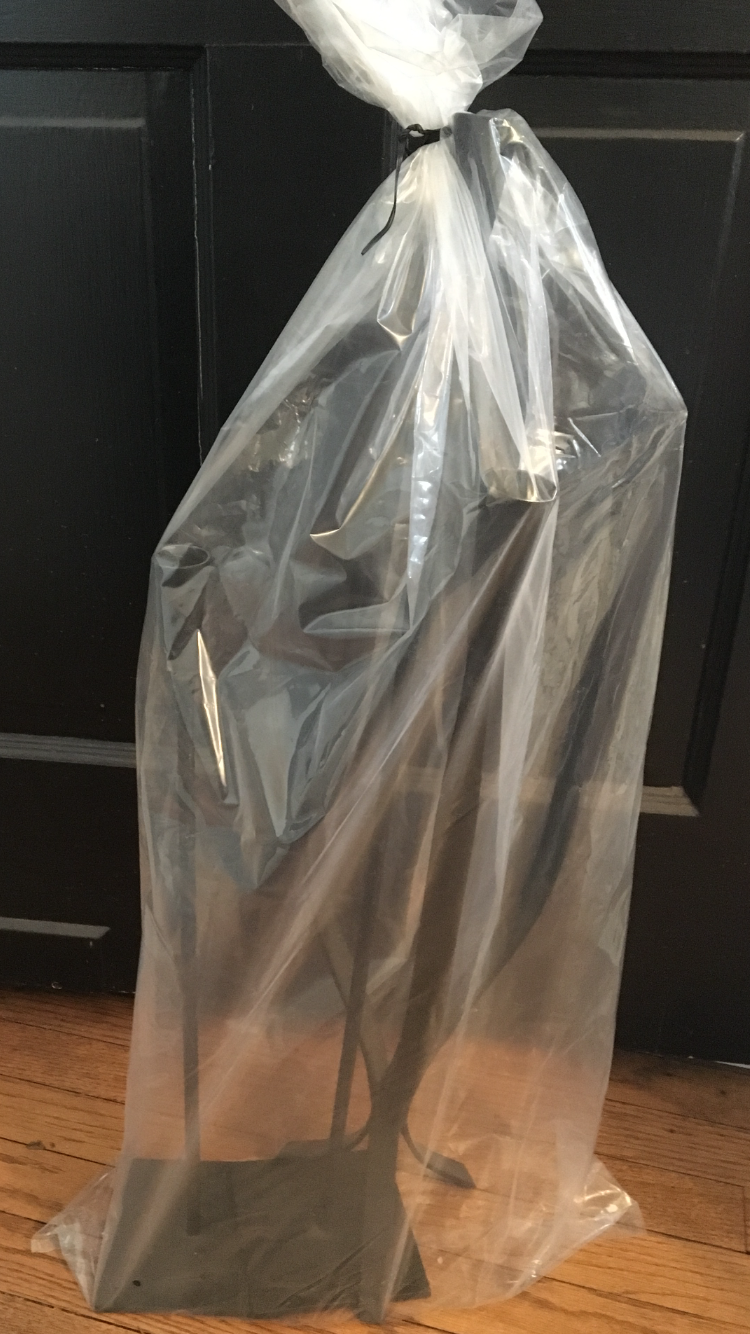
With two broken wrists the cello became impossible to play. It has sat in her studio, the case unopened, since her fall over two years ago. I remember the day we bought it. We were early in our relationship, not yet married. I knew she was having cello dreams. We went to the music store for some other purpose, I can’t remember. The cello was sitting in the corner. She sat. She began to play. It was a perfect fit. And, although we could not afford it, we also could not leave it behind. It was a perfect fit.

Our lives these past two years have been a descent into dark water. We’ve worked hard to shine our light at our good fortune in a dark and inky landscape. As we make our way back to the surface, we are cleaning out. Taking stock. “The cello needs to be played,” she said, deciding to sell it. “I’ll never be able to play it, now.” She took photographs of her cello. Sent out a message through the network.

At the end of the day she showed me the photo. Edges. The view from inside the empty cello case, looking out. A slice of the world visible outside the case.

What’s “out there” is rarely clear. We see a small slice. It tickles our curiosity. The cello dream moves on making space for…? Who knows? We can’t see that far. In the meantime, we keep our eyes and hearts uplifted as we slowly kick our way back to the surface.

read Kerri’s blogpost about EDGES

Reseed [on Merely A Thought Monday]

We pulled everything off the walls of the office. The photographs and posters of plays I’ve directed, Kerri’s first album, framed, a gift. Our poster announcing Beaky’s Books. “I don’t think the office should be about the past,” she said. “It’s time to make this space about our current work and the future.”

She chose a painting, Nap On The Beach, one of many created from our experiences together. She’s making a poster of Smack-Dab, our cartoon. Turning our eyes from what we’ve done, where we’ve been, who we were. We’ve changed. We want different things now. We work in different ways now.

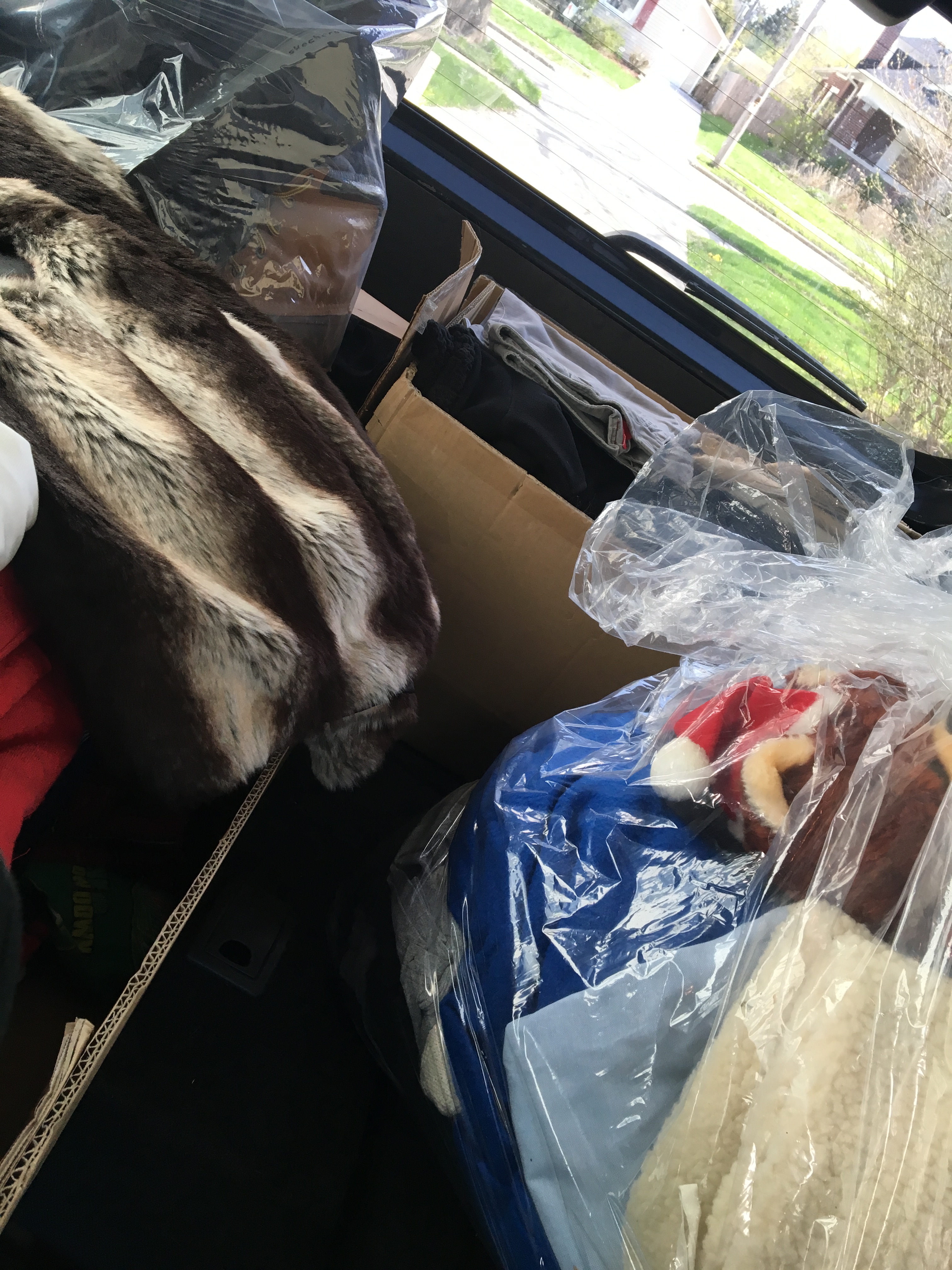
She’s slowly cleaning out the house. I can’t help. This is something she must do by herself. Purging closets, the laundry room, the storage and work rooms. The year of water upended our house. Several times. It continues in the front yard, all the way to the street. When the ground settles, we’ll reseed the lawn. How’s that for a metaphor? When the ground settles, we will reseed.

It takes time for the ground to settle. It can’t be rushed. It should not be rushed. The same is true for cleaning out. We have new piles forming: what goes, what stays. I climb the stairs to the office each morning. When I come down again, she shows me the new space that she’s created from the day’s purge. It’s true on many levels. She’s creating space. Old baggage and burdens are going out with the old clothes and broken appliances. I can see it in her eyes. Space. Light. Like the house, she is beginning to breathe again.

She told me about the dream, her father was setting up microphones. “What are you doing?” she asked.

“Working for tomorrow,” he said.

I had to work hard not to weep. She’s had a rough few years. “Your daddy’s talking to you,” I said. “Sage advice.”

She nodded. Her eyes turning from the pain and constraints of the injuries. Letting go of the past. “Work for tomorrow,” she smiled.

read Kerri’s blog post about WORK FOR TOMORROW

Stack The Impossible [on Merely A Thought Monday]

We watched the video of Jaxon climbing the ladder of the red plastic slide. His momma said, “Is that your big boy slide?” Jaxon said, “Big boy slide.” Pandemonium. “He said it!” his father exclaimed, “I think he said it!”

Big boy slide. A first phrase. The moment when what’s necessary becomes what’s possible. It’s something we take for granted every day. The utter impossibility of spoken language. Sounds uttered in sequence that somehow make sense. Of course, we’re also quite capable of stringing together sounds that make nonsense, too. Soon, Jaxon will ask his parents for the keys to the car and a wholly different kind of pandemonium will let loose. From climbing a ladder to driving the Volvo. The impossibilities stack one upon the other.

My mother is adjusting to life without my dad. She says often, “I don’t think I can take it, this loneliness.” She is doing what is necessary. In our last chat, she spoke of playing pickleball, of taking a walk, of meeting a friend for tea. Moving with intention out of the apartment to meet other people. The moment when the necessary becomes what’s possible. She will, I am confident, live her way into the impossible.

The impossible rarely happens in a snap. We live our way into it. Jaxon’s pronouncement and subsequent trip down the big boy slide was a long time coming, a step in the process worthy of celebration. And then, the miracles will keep coming. Full sentences. He’ll learn to write. Someday he’ll write love letters and drive the car to pick up his date. He’ll ask someone to marry him. The art of the impossible. This life.

And, the most amazing of the impossibilities, as we stack our lives with the formerly inconceivable, we grow less and less capable of seeing it. Perhaps that is necessary? How would we exist if we saw each other as keepers of the impossible? Experiencers of the unimaginable?

read Kerri’s blogpost about THE IMPOSSIBLE

Gaze At The Seam (on KS Friday)

Some things are hard to grasp. When that’s the case, it’s a good time to look at the sky. You’ll not find many explanations up there but gazing at the seam between us and the infinite-universe can, in moments of clenched fists, bring some perspective. As Kerri says, “It just keeps rolling.” No problem can remain large when measured against the seam, that fragile ozone layer that makes breathing and every current dilemma possible.

Sometimes when I look at the sky I wonder how many people across the ages have engaged in seam-gazing.

I imagine, one day in Kansas, 1932, as his fields turned to dust, a farmer looked to the sky. All his appeals for rain exhausted.

I can’t imagine how many women looked to the sky over the 100 years of protests and parades before being afforded the right to vote.

Can you imagine how many African-Americans looked to the sky as slaves in a nation that boasted to the world about its freedom and equality?

I look to the sky every time another state in the union passes legislation prohibiting discussions about our history, so fearful are we of critical race theory and the equality that we profess.

I find nothing in the seam that explains anything, but the clouds remind me that it just keeps rolling and, since I believe we tend toward wholeness, I catch a whiff of hope in all the blue and moving puffy white.

Someday, somewhere down the historic road, someone will look to the sky, in a post-nonsense era, and will, perhaps, imagine me staring back. To them, from their perspective, my unanswerable questions will have found resolve. They will have questions of their own, no doubt, but won’t it be nice to have a new set of questions to thrust at the seam?

read Kerri’s blogpost about THE SKY

Little By Little (©2022 Kerri Sherwood featuring Dogga)

Use A Bag [on DR Thursday]

To Chris Crites, grocery shopping day is a feast. To Chris, these sacks are more than functional. They are more than ordinary shopping bags. These bags are canvas. They are opportunities for art. They are surfaces meant for brilliant mugshots. The underbelly of society made beautiful on brown paper sacks.

I’m not sure if it was Chris or the other artists in my Seattle pod that prompted me to experiment. One of my forays into “where will this take me” required paper sacks. Lots of paper sacks, torn to bits and pasted on a canvas. I drew and painted on top of the bits.

I forgot about my experiment until I met Kerri and one day unrolled all the canvas to show her what was in the pile. She cooed at my paper bag experiment. “This should be a series,” she said. “It should be called Earth Interrupted.” And, so it was.

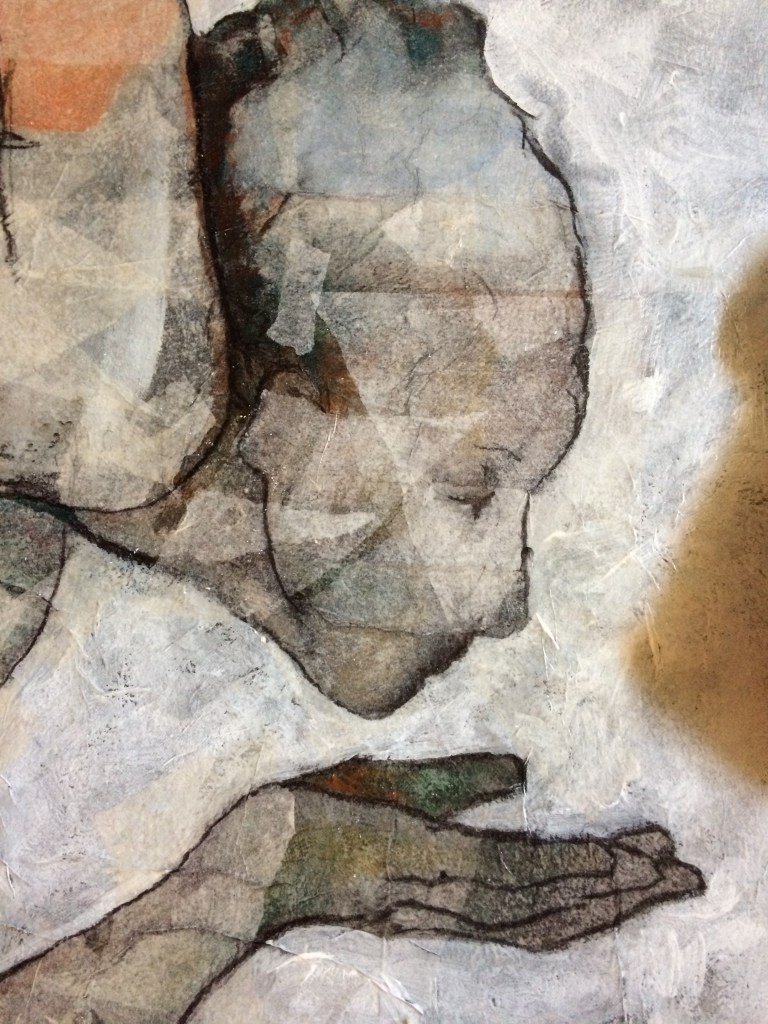
I have (mostly) been a painter of people. I’ve learned that art – and theatre – for me are a means and not an end. In other words, I don’t paint because I want to master the craft of painting or make brilliant paintings. I paint to study people. I paint because it is a meditative space. I paint because I lose myself and enter someplace bigger. I paint because it helps me “to see.”

I completed six additions to the Earth Interrupted series and then stopped. I lost my way. That’s always been my experience when I abstract- when I leave the figure and mess with texture and shape. I know I’m not finished with it. Getting lost is part of the process.

Unloading the groceries last week brought me up short. I felt like Chris Crites. So much possibility sitting on the counter. So much material begging to be transformed.

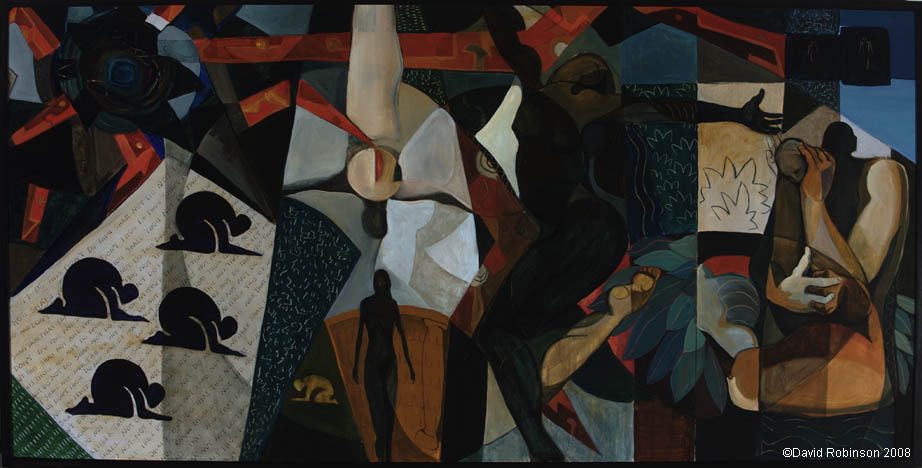
Earth Interrupted I, mixed media, 48x53IN

read Kerri’s blog post about BAGS

earth interrupted I © 2012 david robinson

Step Out Of Line [on Merely A Thought Monday]

“…the fountain of creative work is an intelligent questioning of the rules.” ~Alan Watts, Tao: The Watercourse Way

“If someone tells you they know, they most certainly do not.” It’s not a direct quote from Quinn but it’s close enough. Art school almost snuffed the art in me; there were so many rules and nary a hint of curiosity allowed in the studio. I fled into the theatre after a single year for fear of losing my heart to a book of rules. My theatre professors were explorers of nature. Their refreshing mantra was, “Well, let’s find out!”

What if…? What happens if…?

Nature is boundless expression. Boundless expression is human nature, too, until it is taught otherwise. Boys don’t cry. Be a good girl. Sit in your desk. Follow the rules. There’s a right way. My way or the highway…So much effort to force nature – your nature, your curiosity, to stand on a line.

Einstein revolutionized our world because he dared to posit that Newton had it upside-down. Thank goodness, as Alan Watts observed, “The scientist and the mystic both make experiments in which what has been written is subordinate to the observation of what is.” In other words, they look beyond established belief, expectation and entrenched norms into what is.

What is? Curiosity. A desire to know what’s over that hill. No child begins their life-walk by desiring to color within the lines. Lines are a learned thing. The word “wild” was invented by people whose ancestors emerged from the woods and who have forgotten that they, too, are part of nature – so have become afraid of stepping into the woods. What might they – we – find there?

“It’s not an idea problem,” David Burkus wrote in the HBR, “It’s a recognition problem.” Stepping beyond the known – a great definition of curiosity – is too often seen as an aberration or an assault upon authority. Nip it in the bud. Forcing flow into a fixed state invariably causes idea-blindness and the imperative to think-outside-of-the-box. Innovations are too often smothered in the crib by “What we know,” or “We don’t do it that way.” Coloring in the lines, once ingrained, is a life-long-book-to-follow.

I wish I had a nickel for every time I’ve been invited into an organization or hired by a client to help them “see what they cannot see,” and then subtly or not-so-subtly, been rebuked for opening their eyes to what is in plain sight…or the availability of alternative paths. “We want a vital arts program but we only want art that entertains,” said the school board after the student play asked a serious question of their audience. “…the scholastic theologians would not look through Galileo’s telescope because they considered that they already knew, from Scripture, the order of the heavens.” (Alan Watts)

Think outside the box – as long as you stay within the model or the expectation or the rules. So many models. So many lines. So in love with the struggle and afraid of the simple, natural joy of curiosity. Bend your will to the line. See what you are supposed to see and look no further. What, exactly, are we trying to control?

read Kerri’s blog post about CURIOSITY

Step Back And Realize [on Flawed Wednesday]

If you are like us, every day brings another report of a friend or loved one who has Covid. As someone recently said to me, “With Omicron, it’s only a half degree of separation between you and someone who’s carrying the virus.” I’d say, given the wave of people we know falling sick and reporting positive test results, it’s true. It’s no time to let down your guard.

On Saturday we watched a documentary film, The First Wave. It’s a film everyone should see. It chronicles the first few months of the pandemic in a New York hospital. It is shocking how, in a few short years, we’ve normalized hospitals being overrun. How removed we, the populace, are from the tangible horror of this pandemic. Refrigerator trucks used as temporary morgues. We stand today at 865,000 deaths and counting. People. By comparison, 620,000 people died in the Civil War. 418,500 US citizens, military and civilian, died in World War 2. We ought to be grieving instead of dividing. We ought to be reaching to help rather than peacocking our politics. This film will slap you awake. It will help you step back and realize what we – all of us – are passing through. It might help you grieve.

Kerri tells me that the woman in the next car thought she and 20 were doing a drug deal. He felt sick, needed a test and could find none. We had a few so they met in a parking lot to make a safe pass. While making the exchange, he handed her an envelope. Money for the phone bill but I’m sure it looked suspicious.

It reminded me of the time, many years ago, that Sam asked me to meet him in a parking lot. He rolled down his window and passed to me a sheaf of poems. The window went up. I was to tell no one. It was terribly vulnerable for him to share. I cried the day he published his first book of poetry. It was a titanic journey from fear-of-certain-shame to proudly publishing his beautiful work. He was transformed.

I imagine someday we will stand and look back at this titanic journey. I hope that I remember with fondness the story of Kerri and 20 making an exchange in the parking lot, the women one-car-over shocked by what she thought she was seeing, and we smile. Transformed. Remade as better people in a better community making better assumptions of each other. Stronger.

For now, as the credits rolled on The First Wave, we looked at each other and together said, “I’m exhausted.”

read Kerri’s blog post about THE EXCHANGE

Find A Way [on Two Artists Tuesday]

In the age of Covid, the rules are different. We keep our distance from friends and loved ones. We make rules for engagement. Vaccinations, boosters and negative tests are the requirement for a visit. What was once connective tissue – like an airplane – is now a barrier. A cost/benefit analysis is required before stepping into a terminal. And then, spin the world of rules and boundaries on its axis and this is also true: we find a way. It’s what I appreciate most about people. Will finds way.

A species ends when it can no longer adapt to changes in circumstance.

For weeks we searched for a way to see Craig. To give him his xmas presents. A restaurant that required masks, proof of vaccination, and had a protected outdoor patio provided the necessary ingredients. On a January night, with temperatures dipping into the low 20’s we sat at a table nested between heaters and shared a meal. We exchanged gifts. And, we weren’t the only guests dining on the patio. Other patrons also searched for and found a way.

We loved our meal and our time together. We laughed at the absurdity of the situation. We acknowledged and embraced the necessity of outdoor dining in sub-zero temperatures. We made a story that we’ll tell in years to come. Do you remember when…?

Zoom has become a way. To a point. We’ve learned in this time of pandemic that seeing someone on a screen doesn’t replace seeing them in person. At work we’ve learned that many things can be done through a screen but many generative experiences are slower or inhibited without presence.

Presence.

Energy begets energy; the fire of enthusiastic idea generation is dampened through an app. As Skip said at our end of year meeting, “Nothing replaces breaking bread together. Someday we’ll share a meal.” I look forward to that time, to meeting the incredible people that I see each day through my screen.

We are racking up stories as we adapt to an ever-changing circumstance. To drive rather than fly takes time so we’re learning to take more time. To not rush to arrive. We feel the limits on the distance of our reach. We’re learning the depth of yearning to be-with as opposed to merely-look-at. We’re learning the necessity of boundaries and the health-considerations that come with saying “No.” Mostly, we’re learning the hard line between what’s do-able through a screen, and when we need to consider the ridiculous – and find a way.

read Kerri’s blog post about HEATERS

Make A Small Choice [on Merely A Thought Monday]

When we saw the sign planted on the side of the road – and then another, and another – we wondered what inspired the message and the movement. We were not surprised to learn that the community had recently experienced a cluster of teen suicides. The signs were a message to their young people, a love letter to their children.

The WHO reports that more than 700,000 people die by suicide every year. That’s more people than die by homicide or war combined. Even as I write this I am startled at how antiseptic a statistic can make hopelessness. The data of despair.

The signs appeared on the roadside because the violence-of-hopelessness had faces and names and addresses. And parents. And teachers. And friends. People moved, they pulled together. The threat transcended the numb data and became personal. They needed to talk. They needed to grieve together. They had no idea what to do so they made signs: you matter.

I thought a lot about those signs during our long drive home. Campaigns for change most often fail. They lose steam. They dissolve into abstraction. Behavior cannot be legislated. The messages we receive in the media are mostly violent. Ask most people about a blow to their self-esteem and you’ll hear a specific story. A moment of bullying, a glancing blow that altered the trajectory of their life one degree but, over time and distance, that small degree of violence made a huge difference.

In the same fashion, tiny acts of kindness, one small gestures of support, can send titanic ripples throughout a lifetime.

On the road, there was a distinct message sent to us by the people that roared up behind us, flashing their lights, riding our bumper. There was an entirely different message sent to us by the people who slowed their speed to let us in the lane of traffic. Small choices. Tiny moments. We are humans and learn to respond in kind.

Each day an opportunity. Each moment a choice. When we truly believe what the signs say, we will make certain that in small ways and large, it will be a priority to instill in each and every heart the message that they are worth more than they know. No one arrives at despair by themselves. No one arrives at hope by themselves.

I believe we actually do know what to do. It might begin with a sign or a curriculum but real hope – the intentional creation of worth – will shine through millions of small choices, communities dedicated to filling each and every day with tiny moments of support.

read Kerri’s blog post about WORTH

Gain The Force [on KS Friday]

It seemed appropriate, in order to conclude our year of water, that we travel to visit a region of the country with 250 waterfalls. Of course, we didn’t know about the waterfalls until we arrived. Water, water everywhere. I howled with laughter and secretly affirmed that our unintentional pilgrimage to the waterfalls might appease the great WHATEVER and finally release us from water-resistance into the watercourse way.

I will someday look back at our journey to the falls and realize the extent to which we “let go.” It already serves as a marker, a breaking through the resistance and fight of the last chapter and into the next. The new chapter.

Yesterday, at work, I had the opportunity to tease apart a question en route to asking a better question. I am fortunate to have a team of collaborators that, instead of rejecting my alternate perspective outright, even amidst the frustration of my challenge of the norm, ask me to lean into it. My assignment was to return next week with a better question. I am a firm believer that the form of a question – the way that it is asked – determines the answers that are seen or – more importantly – not seen.

Better questions are like the watercourse way. They show up when, instead of swimming against the current, against “what is,” the swimmer/questioner turns and allows the current to carry them. Wu-wei. Natural action. Every creator knows the moment of frustration when trying to force something into being. More force can only produce more frustration. Or, it breaks something. The best thing to do, when force can only produce an eddy, is put down the brushes, step back, and look at what-is. Force never produces a better question. Stepping off the mountain so it becomes visible – or acknowledging the direction of the river’s flow and giving into it, always reveals new possibility.

It is what I remembered for myself at the waterfall. It made me chuckle, then, when my first moment back at work, I was doing for my team what I’ve done all my life: attempting to flip or free a perspective by lobbying for flow; acknowledge what exists-in-the-moment versus what we want to exist. The better question – for me – and others – is always found when we turn and gain the full force of the river.

[I can’t imagine a better piece of music to carry us into 2022. Give yourself a treat – truly – and listen to Riverstone]

read Kerri’s blog post about THE WATERFALL

riverstone/as it is is available on iTunes or streaming on Pandora

riverstone/as it is © 2004 kerri sherwood