Enter The Sanctuary [on Not So Flawed Wednesday]

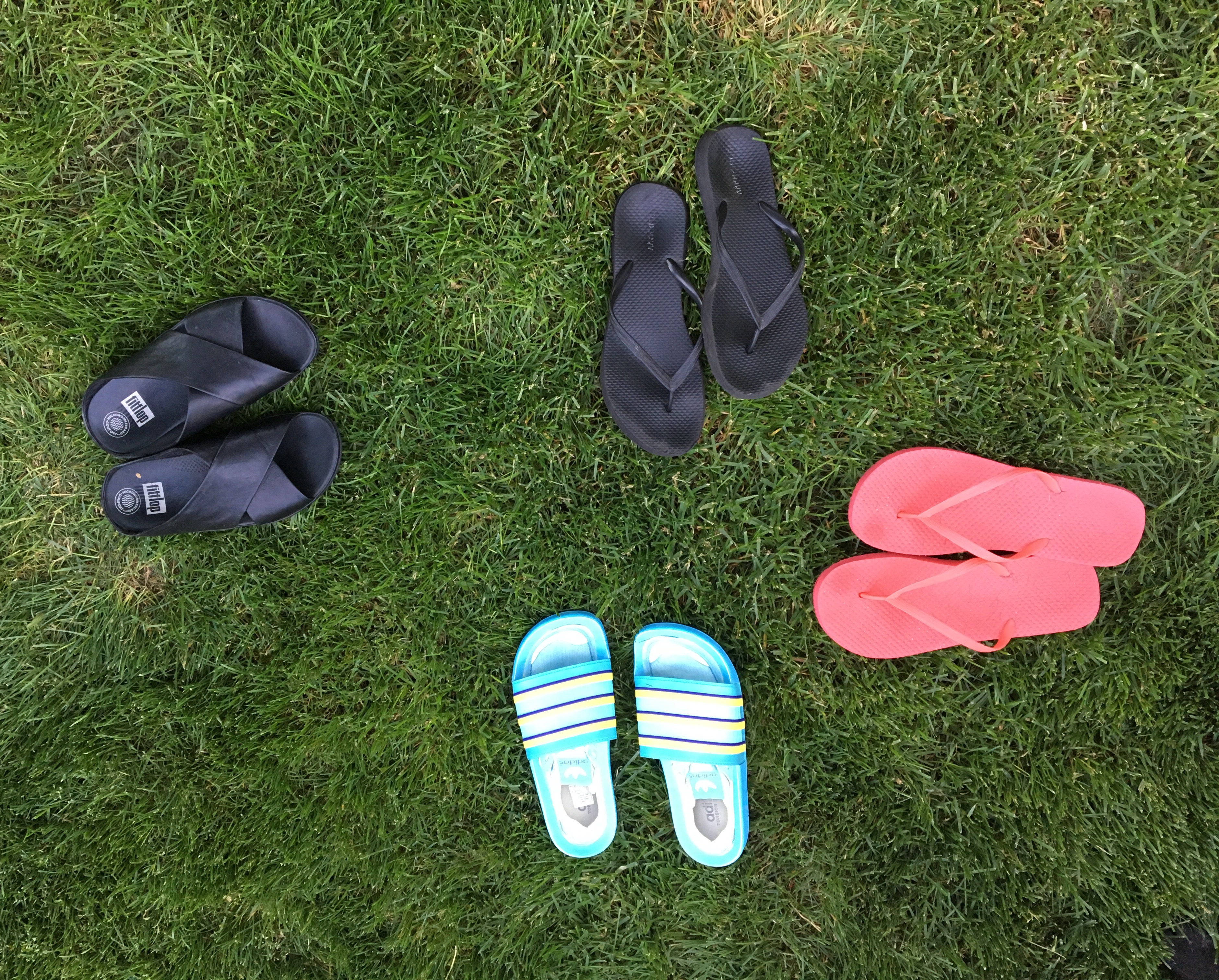
This is an image of sanctuary. The back yard of dear friends, time spent together, taking precautions to be safe in a time of pandemic.

There’s more than one compromised immune system represented in this photograph. It is why we continue to meet outdoors. It is why, until we were vaccinated, we were careful to keep distance between us. How odd to honor the love of dear friends by inserting space between us. Our flip flops and sandals are stand-ins for a group selfie.

When our postal carrier came to the door to deliver a certified letter, she groused about the process for capturing the required signature, “We have to do this because of COVID,” she sneered, “even though there is no COVID.” We’ve learned not to push back on ignore-ance. I was reading about Brazil eclipsing the the over 500,000 deaths-mark when the doorbell rang. Kerri signed for the letter. She closed the door and we simply stared at each other. No words.

I delight in this photograph because, to me, it is slightly disorienting. If you had to guess which direction the photo was taken, you’d most likely guess blue. You’d be wrong. Perspective is just that – perspective. From my perspective, the photograph is upside-down. The photographer wears black flip flops.

We constantly locate ourselves in our stories. The location we choose is not passive or general. It is unique, dynamic. It gives us a point of view but does not afford us a lock on truth. Learning to question your unique perspective, to challenge your story-as-central, is an important growth step. It is maturation. Learning to question what you are told is an invaluable skill to develop.

As a lover of story, as a student of perspective, I am fascinated by the story-war raging in my nation. Politicians drape themselves in the flag, defending a violent insurrection on democracy, while demonizing and fearmongering BLM. Propaganda, hate-mongering and conspiracy theory is run amok and fueled by entertainment posing as news. Voter suppression laws, gerrymandering, stuffing the courts, all in the name of…what? The story of division. The dedicated maintenance of a half-story. A national story increasingly exposed as redacted. Why should a democracy work so hard to prevent a portion of its population from voting? To prevent its full history from being told? As we ask in the coaching world, “What’s underneath?”

Nations, like people, cannot grow until they look at the whole of their story, until all perspectives are voiced.

I’ve wandered back into the world of entrepreneurs and business. Each day I read or am shown the data on teamwork or the power of collaboration. The software-as-a-service world is dedicated to facilitating better communication, efficiency in sharing and collaborating, crossing disjointed platforms, and reaching into clouds where all are stronger as one than when in silos. I’m finding it intensely hopeful. Progress is calling us together. The economy is global as is the pandemic. We are in this together.

No one is healthy if all are not healthy. It’s the rule of the backyard, the honoring of dedicated friendship. My job is to protect you and yours is to protect me. It’s the story of the sandals and flip flops, the image of sanctuary, and, if not the yearning of this nation, it is the reality of this interconnected world.

read Kerri’s blog post about SANDALS

Use Your Chalk [on Two Artists Tuesday]

There are two words floating around in my universe these days: structured and unstructured. Structured data. Unstructured data. Structured time. Unstructured time.

The world as seen through the Puritan lens gives great preference to structure. Unstructured anything is suspect. “Idle hands,” we are taught, “are the devil’s workshop.” Yikes. Apparently it’s dangerous to take a stroll, to sit and ponder, to clear the day and do nothing.

I suspect it explains why our notion of business is hyper-focused on the bottom line and often misses the value of relationships. Bottom lines are easy structure. Relationships, not so much. It is the same with test scores in education. Easy structure. However, stepping into the unknown – the very definition of learning – is largely eschewed because it begins in an unstructured pursuit. Creating the structure, making the meaning, discovering the connectivity is what our hearts and brains like to do. When learning isn’t merely a factory, when business is more than a bottom line, people prosper. They come alive.

Unstructured time. There was a time when time had no structure. Monks attempted to “keep” time by monitoring water through a bucket or sift sand through an “hour” glass. Sometimes the water froze in the bucket so the structure of evening prayer was disrupted. The sand clumped in the hour glass and the measure of time clumped with it.

There are moment on the stage when the actor forgets their lines. It’s called “going up” or “drying.” It is always, in the re-telling, the moment when everything becomes real, alive. It is the moment when the structure becomes unstructured. Hearts race. Eyes widen. The stakes are suddenly palpable. The actor breathes, stands in the vast unstructured universe, and the words return like a swinging bar to a high-flying aerialist. The play is infused with aliveness. Presence is mostly unstructured.

As is common in the structured and unstructured use of the English language, oppositions are easily constructed. Unstructured simply means the meaning has yet to be made. Structured data, structured time, are the tip of a largely unknown iceberg. Love, joy, despair, awe…the full spectrum of experiences, bubble in the unstructured spaces. Numbers can describe a moment in time, can orient for a moment, but will never “explain” yearning or desire or our fundamental need to tell stories (put structure on unfathomable experiences). Structure & Unstructure: they are dancing partners, not combatants.

Where do we come from? What are we here to do? I am going to die, what then? It takes a good deal of unstructured time to sit in these unanswerable questions. There are, of course, plenty of people who will gladly provide structure to your unanswerable – and therefore uncomfortable – questions. Perhaps that is why we adore our structure and demonize the empty spaces? Comfort. Ease.

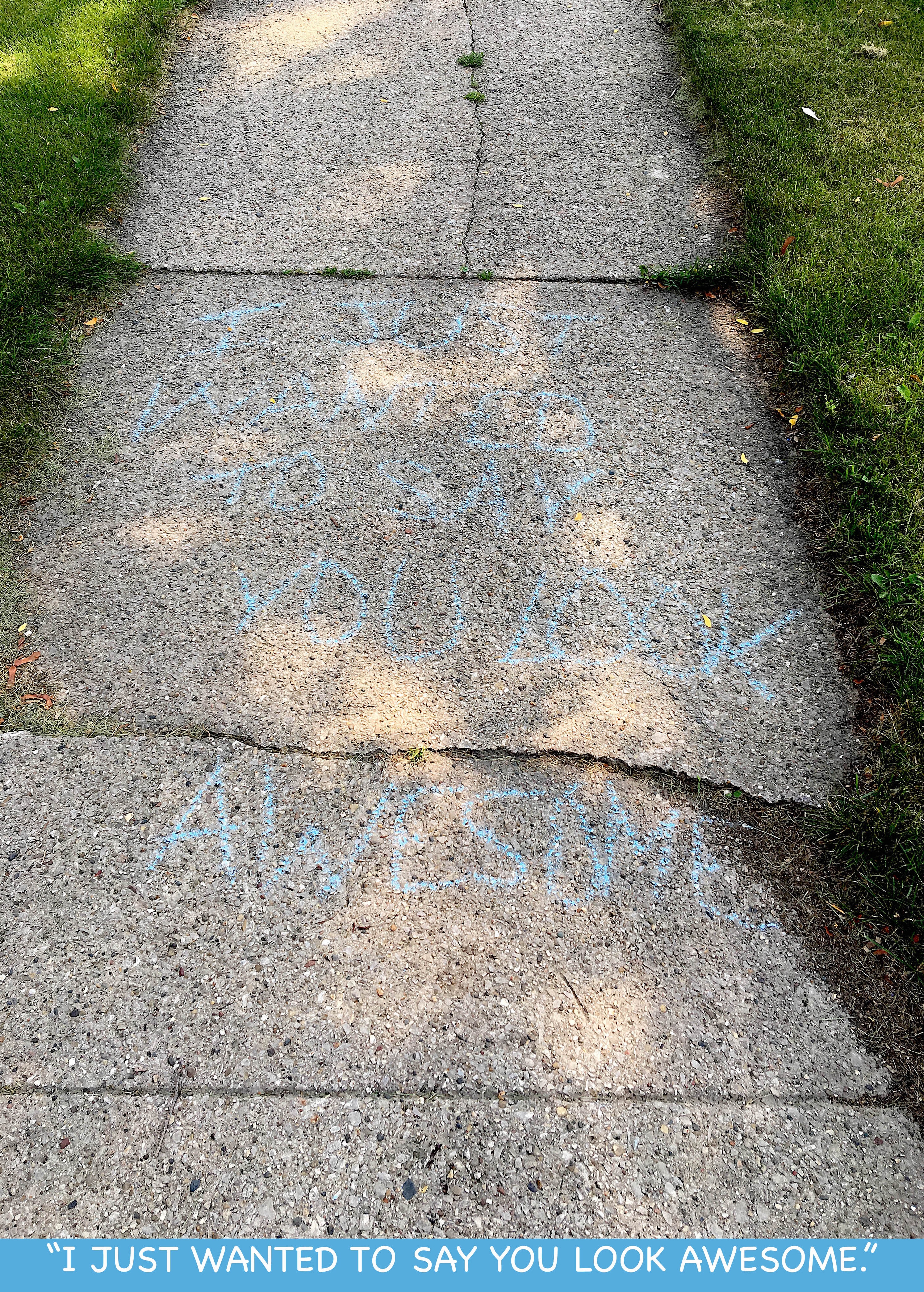
Kerri cannot pass a hopscotch template chalked on the street. It’s almost automatic. Step, hop, hop, step, hop. The little girl in her connects to the child who chalked the squares on the sidewalk. A simple game. Play. It’s one of the things people do with unstructured time. Set challenges. Make up obstacles. Seek puzzles. Invent. Dream. Connect to the deeper places. Where’s the structured bottom line watching the little-girl-in-my-wife hop and skip and turn in the game-chalked-on-the-sidewalk? The laughter of remembering? The giggle and freedom of the woman hopping the scotch, just because she can?

read Kerri’s blog post about HOPSCOTCH

Look With Honest Eyes [on Not So Flawed Wednesday]

We were sharing pandemic survival stories, the worlds that we explored in our isolation that we otherwise might never have entered. We told Keith of Joey Coconato and how his back country backpacking trips were a nightly fascination. I’m particularly drawn to his hikes through the canyon lands. Keith became animated, saying, “You have to check out the Millennial Farmer!”

I know nothing about farming. Once, sitting on the back porch of a farmhouse Air-B-N-B in Iowa with my dad, I listened intently to his stories from childhood working on the various farms in the community. Had he been able to script his life differently, I think he might have written a farmer’s story. He loved the outdoors. He loved growing things. He always kept a garden and tended flowers. He knew what he was doing! Somehow, I gleaned nothing from his green-thumb-knowledge. I am a plant killer.

In the first short installment of The Millennial Farmer, Zach Johnson tells his audience that he’s making his videos because people know so little about farming and what farmers actually do. He’s a fifth generation farmer in Minnesota. I was, as he predicted, completely gobsmacked watching The First Day Of Planting 2016. I pushed play expecting dirt clods and the rumpled pages of the Farmer’s Almanac and, instead, entered the space age. His tractor was akin to the deck of the Starship Enterprise. His nuanced explanation of the monitors in his cab was enlightening. He’s driving a computer (actually, it mostly drives itself).

My stereotype was completely shattered. I had no idea. And, isn’t that the point of taking a peek into the lives of others? Recognizing that we have no idea about the realities of others lives? Isn’t that the opportunity?

This morning I pondered aloud about how we’ve changed in the months since COVID began. “I don’t know anyone who hasn’t changed.” One of the most profoundly sad awakenings for me during this time of division and dedicated ignorance is how resistant we are – and I believe always have been – of taking a peek into the lives of others in our nation. We simply don’t want to know, so great is the fear of what we will find there.

John Lewis famously said, “We are one people, we are one family, we are one house. And we must keep this house together.” By “keep” he meant to tend. We might become one family when we are willing and able to look with honest eyes into the lives of those who share this house. Our stereotypes, our almanac ideas, keep us fragmented.

Joey and Zach. Both live lives immersed in nature but from diametrically opposed intentions. Both have popped open my eyes to new experiences and bodies of wisdom that I might otherwise never have encountered. Both are following their personal star and sharing what they find on their paths.

As part of our summer planting and backyard oasis, we bought two tomato plants and some basil. Our Boomer farm is not extensive but it is well loved. “Do you think, if we tagged The Millennial Farmer, our tomatoes would stand a better chance?” I asked.

Kerri considered it for a moment, her hands busily potting the basil plants. “It couldn’t hurt.”

read Kerri’s blog post about BOOMER FARMERS

Tether Well [on KS Friday]

It’s official. YouTube has blocked forever our channel for the crime of using Kerri’s music. It’s happened before on other platforms so we’ve actually grown accustomed (sadly) to the loss. She is the composer, the performer. She holds all of the copyrights. We’ve learned that it is impossible to fight with an algorithm. I suspect that our appeal never met human eyes otherwise where is the sense? The algorithm wrote back assuring us that our claim was reviewed thoroughly but their decision stands. Vanish-ment.

Our vanish-ment is only one of the many examples of my latest fascination: what gets between you and your soul? What gets between you and your sense-making? What gets between you and your voice? In other words: what is real and what is not?

On a grand scale, we are alive at a time when deep fakes can put words into the mouths of anyone. We are witness to propaganda tv perpetuating fantastic lies, inserting themselves between people and their common sense. It is important to note that just because you believe it does not make it true. In fact, in today’s day-and-age of easy belief in the outlandish, it is a best practice to check everything you hear. It takes a bit of time – but only a bit – to tether yourself to reality. It takes no time at all to swallow the fables, conspiracies, and cotton-candy-illusions, currently blasting fire-hose-style across the e-waves.

“There is only one good, knowledge, and one evil, ignorance.” ~ Socrates

Anger and hatred are great mind foggers. They are easily-fed-fires-fueled-by-the easily-led. Make no mistake, the purveyors of propaganda see their audience as nothing more than firewood and depend upon dedicated ignorance and unquestioned belief. Those who stoke the fires generally revel in standing between people and their sense, people and their souls. Arsonists always have an agenda.

I’ve always understood that meditation and education share the same intention: remove the noise between your self and your experiences. Discernment. Quiet the mind. Open the mind. Artistry, at its best, does the same thing. It exposes you, opens you, to your greater self, to the fields beyond ‘what you think is true.’ Revelation, reveal-ation. At their very essence, artistry, meditation, education…require a full challenge of belief; belief is the final frontier of white noise, a worthy and necessary din to challenge.

Barney, the piano, grows more beautiful with age. The plants and flowers are again growing around his base. Chipmunks and squirrels sun themselves on his lid. One of Barney’s functions in our life is to remind us of what is real. That’s also true of the rusting sunflower that now lives by Barney’s side. After our YouTube vanish-ment, we sat for a moment on the back porch. “Look at the wild geranium!” Kerri said. She jumped to her feet to take a picture. Have I mentioned that she is also a great photographer?

The artist is intact. More, she is full of energy and ideas. A channel may have closed but the essential remains. Nothing can stand between an artist and her artistry. Not really.

Kerri’s albums are available on iTunes or streaming on Pandora

read Kerri’s blog post about BARNEY

this part of the journey ©️ 1998 kerri sherwood

Sing It Into Existence [on Two Artists Tuesday]

Lately I am awake for the sunrise. I know it is coming because, very slowly, the birds begin to sing. At first there is one voice, then a few more and then more. By the time the light through the window glows soft purple and gray, the full bird chorus is in session. They sing the sun into rising.

Although I didn’t recognize it at the time, these lawn-art-birds would come to represent to me threshold guardians. Harbingers of the test that my move to Wisconsin would bring. In story terms, threshold guardians are not friendly; they serve as the test of readiness: are you willing and able to greet the challenges that come with change. Or will you run away? Sometimes they are monsters. Sometimes they require the answer to a riddle or solving a puzzle. The new world will open after the obstacle is met. In facing and overcoming the challenge, the guardians often become allies. In truth, they are allies all along. They help you find your self by testing every idea that you have of your self.

Driving the Budget truck on my move from Seattle, filled with the artifacts of my life, Kerri and I stopped in a little village, Stockholm, just as we crossed the Mississippi River into Wisconsin. We wandered down the street and into a gallery. We were drawn to these simple bird-sculptures. They are the first thing we bought together. They represented our step into relationship. Us. They would stand together in our yard.

My first few years in Kenosha were akin to being lost in the woods. My livelihood disappeared. My networks disappeared. Art opportunities vanished. Many of my friendships faded. Every project I tried to pitch or create stalled, every path I attempted to plow broke the plow. I felt stripped. Of little or no value. Even in arenas where I was once appreciated, I was invisible. I’ve done extraordinary consulting work in organizations but learned in my new life that my experience and observations were not welcome. So, silent as well as invisible.

More than once I went out back and sat with the sculptures. They remained silent when I asked of them my questions. Who am I now that I have no useful purpose? What do I do now? In the absence of an answer, the sculptures and I listened to the birdsong.

Often the test brought by the threshold guardians is one of letting go. You cannot become a butterfly if you insist on remaining a caterpillar. The armor must fall. The known shape must go to mush. The what-the-hell-is-happening-to-me necessarily falls unanswered into the void. What’s happening is not complex: you are changing. The old stuff isn’t working because it is too small for the new shape. Let go.

It is not complex but it is uncomfortable. Dark night is cold when you’ve shed your skin. The sun will rise. The birds will sing it into existence. Warmth will return in the moments beyond the soft purples and greys.

We recently moved the bird sculptures from their spot by the pond to a new home by the fence. I hadn’t realized how invisible they were when standing over the pond. By they fence, they are glorious! They are also a metaphor, standing tall, made more vibrant and dynamic by their incorporated shadows. They are transformed. They are present, standing together in the yard. They are signaling the path to the new world, singing into existence the new day.

read Kerri’s blog post about THE BIRDS

Choose Your Way [on DR Thursday]

“Everything can be taken from a man but one thing: the last of human freedoms – to choose one’s attitude in any given set of circumstances, to choose one’s own way.” ~ Viktor Frankel

I always feel a bit disappointed in myself after writing a post like the post I wrote yesterday. It was a near-rant, an ugly system becoming more ugly as it fights to protect its ugliness.

It’s been a battle all of my life, wrestling with what to do or say when my desire to focus on the life-giving runs headlong into the harsh realities of the life-denying. To shine a light on the life-denying is sometimes the most life affirming thing to do, it just doesn’t feel very good. “Look at the ugly. No, really look.” Last night, I listened to a conversation – in all seriousness – about the collapse of our democracy. It’s been a minor fascination of mine to witness how self-destructive people and organizations – and nations – will become before they admit that they need to change. Before they turn and say, “I’ve been lying to myself and to you.” Sometimes they destroy themselves rather than turn and face their truth. That was the crux of the conversation. It seems more and more likely that we’ll set ourselves on fire before we embrace the truth of our dysfunction.

One of Kerri and my greatest losses during the time of pandemic was our weekly ritual dinners with 20. Thursday night we’d cook at his condo. Sunday night we’d cook at our house. We’d cook for each other. Sometimes we’d cook with each other. Always we’d drink wine, laugh, and reaffirm what is most important about life. Each other.

Post-vaccination, after a long year of isolation, we recently, gratefully, returned to our ritual. We cook. We talk about our days. We laugh. 20 and I tease Kerri. She feigns indignance and loves every moment. We talk about art. We share the curiosities that have crossed our paths and screens. Sometimes we talk about the nation’s self-immolation but only briefly as we very quickly realize that it pulls us from what is really important. Each other.

Tonight is dinner with 20. We can’t wait and are making our menu, designing our day around what will be the most important thing to happen all day. Time with each other.

As a nation, “We have the wolf by the ears, and we can neither hold him, nor safely let him go. Justice is in one scale, and self-preservation in the other.” ~Thomas Jefferson, in a letter discussing slavery.

How a question is framed determines the answers/paths-forward one sees or does not see. It could be said of our national trauma that we’ve framed our dilemma with justice pitted squarely against self-preservation, or, to be clear, self-preservation will be at the cost of justice-for-all. It’s too bad. As the bottom of Maslow’s hierarchy, self-preservation will always negate a reach toward justice. You’d think that we’d someday recognize that the wolf we have by the ears is of our own creation and that justice-for-all is the only path to self-preservation, national self-actualization. You’d think that it might occur to us, rather than do the same old thing in the same old way, to ask a different question.

If I had a magic wand I’d ding the noggin of this nation with the one strength we share, the one thing that 20 and Kerri and I know without doubt, the only real path to laughter and support and all the other good things we can offer: time with each other. A good meal made with heaps of love. A ritual born of a simple desire to each week make the world a bit better for each other.

read kerri’s blog post about DINNER WITH 20

Imagine It [on Flawed Wednesday]

Malidoma Somé wrote that a society with locks on its doors is a sick society. Something has broken down when a home needs protection from the other members of the community. Acquiring stuff takes precedence over honoring your neighbor. Can you imagine living in a community built upon mutual respect and trust, that valued and protected its members over its acquisition of stuff? Pie-in-the-sky? That might be the problem: we can’t imagine it.

Societies betray themselves. Despite the values inscribed in library cornices, despite the commandments we hold up as sacred ideals, we lock our houses against each other. We turn away when we see a person in need, their cardboard sign an appeal for help. The gap between the espoused and lived value-set is wide. In a society that claims greatness but practices mediocrity, is it no wonder that so much energy is dedicated to perpetuating a big lie? The lie is not the exception, it is the norm. The lock on the door.

Apparently, there is so much road rage on a particularly beautiful stretch of road rolling into Aspen, Colorado, that signs are posted giving travelers the number to call when the need for help is dire. Societies betray themselves. Why would a road through so much beauty, a road that dead ends in to some of the world’s great ski areas, a place where the elite retreat for some peace and quiet, why would there be so much rage on the road to such a place?

It must be a metaphor.

We tell a good story, that all are created equal, but we fight like hell to keep the full story untold. It’s happening now. Again. Still. Why are we so afraid to tell the whole story of a nation touting equality but built upon slavery and a rolling metamorphic racism? Like an individual, a society can’t address its problem until it admits it has one.

Gaps between espoused and lived values usually fill up with rage. Our gap is textbook. So many guns, so many locks on the door, so many patterns of violence and suppression that repeat over and over again.

Can you imagine living in a society that was proud of its story and need not dunk it in a lie? Or feast on an orgy of guns in order to feel potent and protected? Or post signs warning of the ubiquity of rage? That just might be the problem: we either can’t or won’t imagine it.

read Kerri’s blog post on ROAD RAGE

Consider The Intention [on Merely A Thought Monday]

My least favorite character in Romeo and Juliet is Capulet, Juliet’s father. A few years back I thought it would be a good exercise to tell the story from his point of view. In his world of privilege and order, he has an out of control daughter, a teenager no less, ignoring the rules of the house and society, having sex with the son of a sworn enemy. He imagines a better future for her (and himself) and has worked hard to protect her and match her with royalty. Like every parent I know, he just wants his daughter to behave and thrive.

Every story has an agenda. That’s true of the stories we tell of ourselves at parties, it’s true of the stories we shout at each other when we are having fights, it’s true of the stories we tell when we are falling in love, it’s true of the stories we tell when breaking up. Every story has at least two sides and each side has an intention.

Stories are never neutral or passive. It’s precisely why Blind Justice is so important to the health and well being of a society: between two opposing/competing stories there is a point of equilibrium that we call “fact” or “truth.” Blind Justice carries a scale to symbolize that place of story-equilibrium, ideally free of status, privilege, sway…weighing the stories to arrive at fairness and equity.

Health is the capacity to consider the other side of the story.

It is the truly despicable character that steps with intention into the gap between competing narratives solely to create discord. To lie for gain. Iago is just such a character. He creates an illusion with no greater intention than to hurt, to destroy. Desdemona dies. Othello murders because he cannot see through the lie Iago is telling. Othello’s love turns to hate. He cannot or will not hear the other side, the love story, the truth of Desdemona.

Hatred is a territorial flag planted in a one-sided story.

The modern GOP is Iago. Othello is a cautionary tale relevant in our times. What or who will be murdered before the lie is laid bare?

I have always been a lover of myth and parable, stories that reach with intention to deeper truths. It is why I stepped into the theatre in the first place. Art, like Blind Justice, uses story to reach deeper truths, truths that can rarely be captured in words. It’s the paradox of art and truth is always found there.

No story has a single point of view. No truth is singular – that is the hallmark of the truly important challenges that every society faces. It is why successful governments tell their story with truth as their intention. It is why successful relationships sail through stormy seas. The intention is pure. The desire to stand in the shoes of the other-side-of-the-story is genuine and necessary in order for the relationship, the community, the country to thrive.

Capulet is not a bad man. He has good intention. The play ends when he becomes capable of standing in and considering the other side of the story. Hope and equity is the promise rising from the pain.

Iago, on the other hand, is a wholly different story. His play ends in a cage with a nasty celebration of the pain, death and havoc he’s wreaked, gloating about his capacity to snare others in his big lie. All are made fools.

read Kerri’s blog post about THE OTHER SIDE OF THE STORY

Appreciate The Marks [on DR Thursday]

Life leaves marks. When I look in the mirror these days, I see my grandfather staring back at me. Or, to be more accurate, I see aspects of both of them, all akimbo in a variation that I now recognize as “me.” The topography of DNA, crafted by my unique life, now sketched into my mask.

Quinn left marks in me. So did Tom. And Doug. And Kathy. I could go on. The list of amazing humans who had a hand in shaping my perception, molding my thinking, in informing my walk through this world, is lengthy. They are my fortune, the gold in my pocket. Their marks serve as my credo, define my intentions. Their marks have become the scale upon which I weigh value and importance. Laughter, according to their marks, carries enormous weight.

As we carried boxes out of the house, I couldn’t help but notice marks on the walls, scuffs on the floor. Each marked a memory. When the movers lifted the couch, its impression in the carpet was deep. It had sat in the same spot for years. In its absence, the entire space reeled. Soon it would find a new equilibrium as another family sculpted the now empty space. They will, no doubt, remove the carpet. The impression is too deep, the placement and accompanying memories are not theirs. Erasure is the necessary first act of new inhabitants. Eliminate the marks. Paint. Sand. Demo. And freshen. Clean the palette.

Leigh is an authority on rock art. Cave painting. The marks left by humans. Prophesy and map. Ritual and graffiti. Not all cultures are obsessed with leaving marks. Many try not to. My relationship to my marks, my paintings, changed the day I helped carry Duke’s brilliant paintings out of his basement. He’d passed and now the question was, “What do we do with all of his paintings?” I knew, someday, someone would ask the same question of my paintings. Carrying his paintings up the stairs and stacking them in the truck, I became less invested in the notion that my paintings, my marks, need matter. They no longer need to transcend me. They are immediate, fulfilling for me and perhaps me alone. That is enough. Bits of ego easily fall off when the perspective of age comes calling, when the marks are undeniable.

Marks fade. Life is what is happening now. A cliche’ that could not be more relevant. The couch, seemingly so permanent, will someday be hauled out. The marks will remain for a while. Only a while. And new life will move in and fill the old space, as it should.

read Kerri’s beautiful blog post on IMPRESSIONS

Exercise Choice [on Not So Flawed Wednesday]

I know what it is to be kind. I see acts of kindness everyday. Humans helping humans. Humans helping animals. Humans mindful of and taking care of their planet. Synonyms include friendly, generous, considerate. All of these are other-focused. To be kind is to consider the needs and lives of others. Beaky used to say in parting, “Be kind to each other.” Kindness was her wish for this world.

I’m not sure that I know with the same clarity what it is to be human. Philosophers have answers that generally trace back to our capacity to reason, to make meaning from our senses. To think consciously. To question. To be aware.

My quick pass through the news of the day betrays how non-human we humans can be. What is the sense of perpetuating a lie? What is gained by lobbing bombs at neighbors? Cyber attacks? We read that there were, from sea to shining sea, 9 mass shootings over the weekend. I’m having a hard time making meaning of it all. I can rationalize it, explain it away, assign blame…but, at the end of the day, I know my rationalizations are nonsensical. Non-sense. No sense. Which, according to the battalion of philosophers scribbling across the ages, attempting to define what it is to be human, we are, because of our non-sense, not human.

There are so many questions and thoughts bursting from this simple bumper sticker!

Arriving home at 10pm, after two consecutive days of 13 hour drives, 20 had a hot meal waiting for us. I called for help and my neighbor John came running. Jen prepared a travel bag of snacks for us and left it on our doorstep. The family that lived next door to my parents made sure, after every snowfall, that the walks and driveways of their elder neighbors were shoveled and safe. Kind.

Somewhere in Kansas it occurred to me that to be human was a choice. Kindness is a choice. Yes, we make meaning from our senses and experiences and the line that defines us as human is our capacity to choose the sense, the meaning that we make. We witness and then we choose. The choice makes all the difference.

The angry man weaving in and out of traffic in his truck, flying the confederate flag, was making a choice. The man who shoveled my parent’s driveway, never having met them, was making a choice. To focus on division is a choice. To reach across the aisle is a choice. To wear a mask to protect others is a choice. To point a gun is a choice. To lie is a choice. To stand firm in your conviction is a choice. To open a door for others is a choice.

To be human is not just to exercise choice but to choose actions that support others. And, among the greatest available choices, the choice that most advances humankind, as Beaky knew, is kindness. To think of others, choose, and act accordingly.

read Kerri’s blog post about HUMANKIND