Break The Rules [on Not So Flawed Wednesday]

When the tornado sirens sound, we have to carry Dogga to the basement. He doesn’t do stairs. It confuses him since he is hard-wired to take care of us. That we snatch him up and hurry into the basement leaves him discombobulated. In the basement, the essential borders to protect become unclear. He paces. The behavior of his humans signals a wolf is approaching but where’s the necessary line of defense? The rules are different in the basement.

Brad and Jen have a new puppy. They are diligent in their training. We confessed that during the pandemic, we’ve “ruined” Dogga. We never allowed him to beg or fed him scraps from the table. During the long dark days of isolation, we tossed all the rules. We breached every training boundary. He’s a smart boy so he knows the difference between snack time and dinner. Dinner remains off limits (mostly) but snack time is open season for begging. And, who am I kidding, he doesn’t need to beg. He sits between us at the table and waits for a steady stream of cracker bits to find his open muzzle. The metaphoric tornado came, we retreated to our safe place. Different rules.

This pandemic tornado is in no hurry to leave. And, haven’t we all been changed by it? Whether we acknowledge it or not, we are in the basement now. New rules apply. New realities are in play. The essential boundaries are unclear.

Just as was true before the tornado arrived, Dogga gives world-class eye contact. He reads our eyes to suss-out where we are going or how we are feeling. Sometimes I think he knows how I am feeling before I do. And, although we are in a hunkered-down world of new rules, the most important relationships remain the same. If he wants out, he establishes eye contact; the intensity of his stare and his nod-hint-to-the-door educates his too-slow-humans that the squirrels have breached the boundary. Action is required! I am captivated by those amber eyes and comply with his wishes every time. In-out-in-out. Kerri is made of stronger metal and responds with authority to his intense stare, “You can wait,” she says. The intensity drains from his face and he retreats to the comfort of his bone. I count to twenty and ask, “Do you want to go out?” Kerri shakes her head. Some old stories transcend the new basement reality and are, and have always been, about the complete absence of boundaries. A boy and his dog.

read Kerri’s blogpost about DOGGA EYES

Say The Word [on Two Artists Tuesday]

“In the realm of ideas, everything depends upon enthusiasm…in the real world all rests on perseverance.” ~ Goethe

To outside eyes it looks like a small stack of plastic Adirondack chairs. To our eyes, it is a marker of something almost unimaginable to us during these past few years: stable ground.

If you want to know what these semi-cheap plastic chairs represent to us, look no further than the movie Gravity. Sandra Bullock in space in a story of “if it can go wrong, it will go wrong.” Through a rolling series of disasters peppered with just-in-the-knick-of-time hand-holds, against all odds, she splashes down to earth, safe. She stands on a beach, shaky legs. For the first time in a seeming eternity: stable ground.

Perseverance is a word used after the fact. During the free fall to earth, nothing feels even remotely like tenacity. Survival-mode does not allow for meaningful reflection or personal congratulations. Look for anything to grab to stop the fall. Believe that the ghost of George Clooney will crawl into the space capsule with a kick-in-the-butt speech at the very moment when giving up seems like the only option.

“There’s always another option,” we told ourselves. There’s always another step to take. Any step. There must be…

During our free fall we sat on our back deck in our broken white, cracking-and-en-route-to-collapsing plastic Adirondack chairs. We felt the sun on our faces. We talked of appreciating our moments. We encouraged and affirmed each other when “hope” was a word that made us roll our eyes and laugh-out-loud.

Last week, in a daring gesture of new times, we bought (on sale!) six black Adirondack chairs. Six! For friends to sit in when they come to visit. A statement of “hope” during a season of pandemic.

Yesterday we sat for the first time in two of our new chairs, faces in the sun, appreciating our moment. And, for the first time in three years, we dared utter the word “perseverance.” Shaky legs. Stable ground.

read Kerri’s blogpost about NEW CHAIRS

Chew On It [on Merely A Thought Monday]

The first and most important question of the day is, “What is nougat?” I’ve always been more of a peanut M&M’s guy or, these days, a straight-up almonds, sea salt in dark chocolate lover. I’m currently accepting donations of Chocolove’s Salted Almond Butter in Dark Chocolate. You should be, too.

So, what is nougat? Originally it was honey, nuts, and egg whites but in this era of “it’s-better-not-to-know-what-I-just-put-into-my-mouth-and-called-it-candy,” I wonder what passes for nougat? I only ask because I’d never heard of a Charleston Chew so, to understand the reference, I looked it up. When I read that a Charleston Chew is, “…flavored nougat covered in chocolate flavored coating…” I immediately spotted the word “flavored” twice in the same sentence. If the chocolate isn’t really chocolate then what are the odds that the “flavored” nougat is really honey, nuts and egg whites?

To borrow and bastardize a bit of Hamlet”To eat; perchance to savor: aye, there’s the rub.” Kerri assures me that a Charleston Chew is yummy. Who cares what’s in it if it makes my toes wiggle with satisfaction? It’s the inverse argument of all those nasty foods adults made us swallow as children: who cares if it’s good for me if it makes me gag? Make me go hungry and send me to my room! Please! Caring adults forget that kids squirrel away and hide Charleston Chews beneath the mattress so banishment to the bedroom for not choking down brussel sprouts is tasty a reward.

This is key to understanding why people do what they do: we know what’s in a brussel sprout*. We have no idea what’s in a Charleston Chew. We’ll clamp down our jaws or pitch public fits rather than eat what’s good for us. Yet, we’ll happily binge on mystery snacks that are certainly no good for us but, damn-do-they-taste-good. Insight: humans are not rational beings. We puff up and proudly defend all manner of thought-nougat but can’t be bothered to look up the source or verity of the dreck we’re feeding on.

Of our current dilemmas, there is one thing that is certain: we can’t Charleston Chew our way out of this.

Take heart. There’s always Chocolove.

[*now that I’m rumored to be an adult I love roasted brussel sprouts]

read Kerri’s blogpost about CHARLESTON CHEWS

Marvel The Resilience [on Two Artists Tuesday]

The guys at the water utility told us not to bother replacing our yard until the fall. “The dirt needs to settle,” they said. After trenching from the street to the house, tearing up great chunks of the sidewalk and curb, blowing a hole in the foundation, throwing dirt into the moat and covering it with straw, ripping up the street and quickly tossing temporary asphalt over the hole, our front yard is a hot mess of destruction.

Our neighbor owns a landscape design business; he scowls every time he looks our way. It pains him that his pristine yard sits next to our ruin. “The dirt needs to settle,” I say and shrug as he looks in horror at his worst nightmare. To add insult to injury, I’ve threatened to park the truck on our ruin but Kerri gives me THAT look. If I want to stay above ground, the truck stays in the driveway.

Standing on the front porch, amazed at the hardy green shoots reaching up through the devastation, straw and lawn netting, I thought of Tom. He marveled at the resilience of young people, students in the schools that he stewarded. Some of the children lived in extreme circumstances or had suffered terrific injury, and yet, they consistently transcended their situation. Pushing through the wreckage and reaching for the sun. “The human spirit,” he’d say and shake his head in amazement. “Marvelous.”

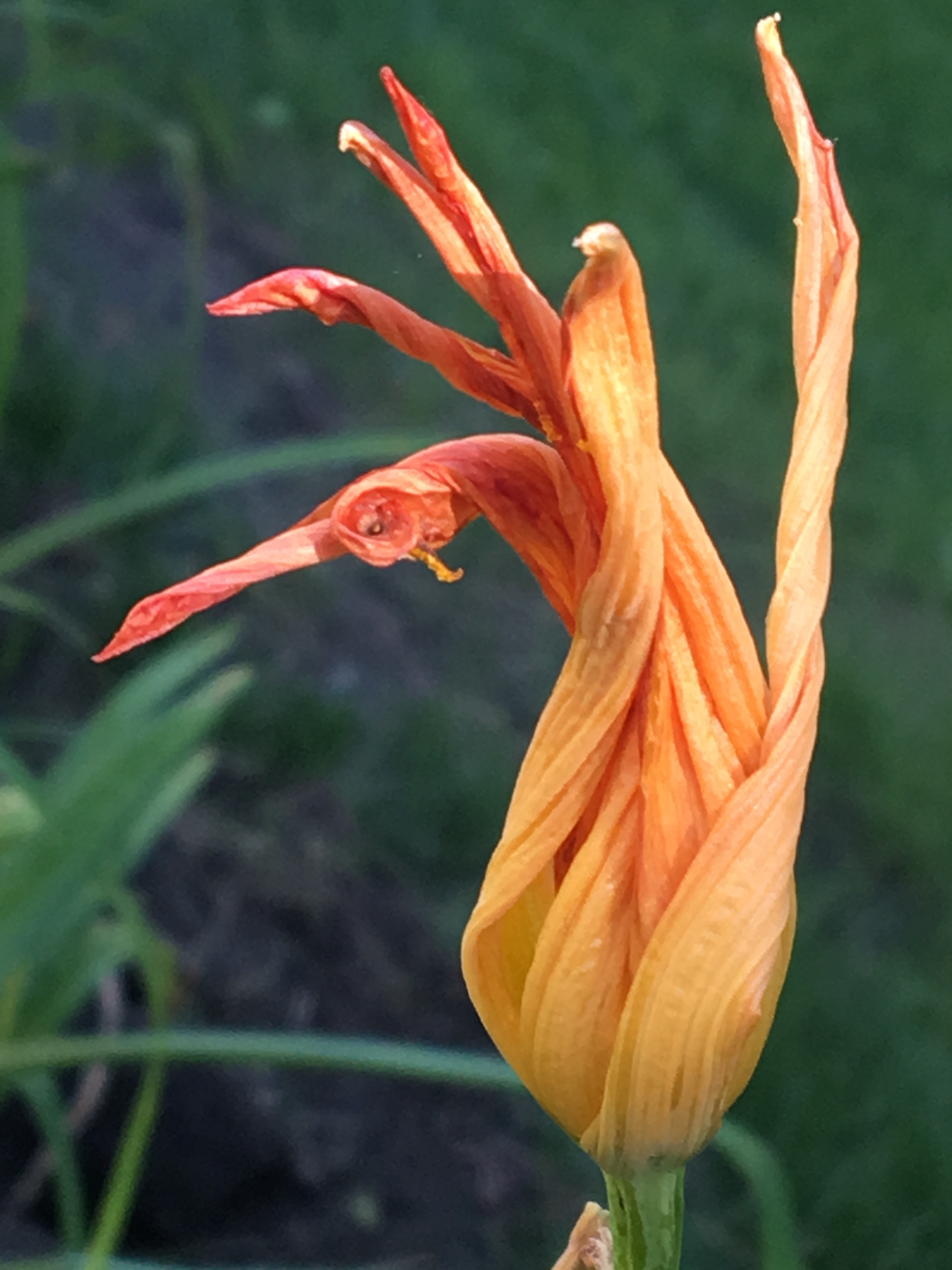
Despite being trenched, torn, mixed with concrete and rock, thrown about, turned over and over again, covered with straw and netting, the Day Lilies have not only survived, they are thriving. Just as a fire brings renewal to the forest, it seems the destruction served to energize the plants. More than a comeback, this is a riot of Lily return. A reunion.

“The impulse to life,” I whispered to Tom. “Unbelievable.”

“Yep,” he smiled.

read Kerri’s blog post about RESILIENCE

Take Note [on DR Thursday]

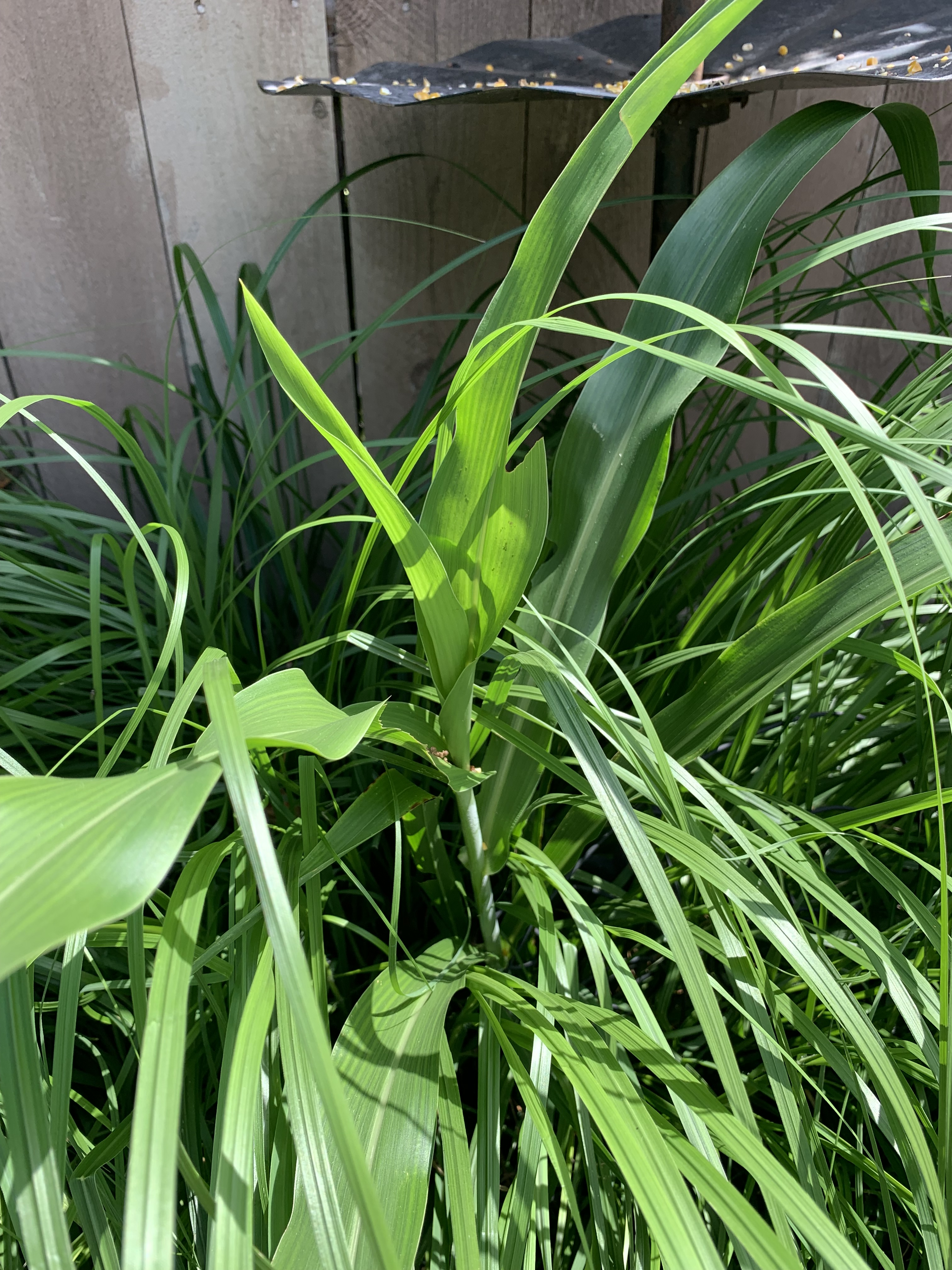
Although it may not be at first apparent, this is a map for product development. A single stout stalk that supports shoots of replication that explode in support features. One clear central intention. Multiple expressions that return nutrient to the stalk.

Although it may not be at first apparent, this is a map for healthy community. A single stout story stalk that supports shoots of replication, diverse paths that explode in seeming individual expression. One clear central narrative. Multiple expressions sending sunlight back to the root.

Who hasn’t seen the time-lapse films of plants growing, forms expressing and then retreating, the accelerated motion of people commuting on a city street, what seems like chaos is, at speed, cooperation. Those people on the street in real time, walking to work, a to-do list on their mind, are mostly unaware of their symphony of togetherness.

It’s easy to forget the stout stalk when standing at the individual expression point. I have been witness to the demise of many organizations who turn against the stalk in favor of the feature. For instance, the fastest way to kill a non-profit organization is to attempt make it run like a for-profit business. It will forget its story-stalk and lose its heart and mind in a spreadsheet.

The quickest way to destroy a community is for its branches to forget that they are individual expressions of a single stout story. They are not separate as much as extensions. To focus on the multiple tiny expressions as if each small branch is a stand-alone truth is absurdity-creation. Chaos masked as convention. Inverted, the plant dies.

In our literature we are riddled with advice to turn toward nature. Existential crisis? Lost? Go to the meadow, find the woods, take a hike. Get quiet. We go there because…we are there. Alan Watts wrote,”We don’t come into the world, we come out of it.” We are not separate from the stalk; we are expressions of it. Occasionally, the map to sanity that we seek is hiding in plain sight dressed as a platitude. Go to nature. You cannot do otherwise. Realize it.

When I’m running abstract questions of design in my dreams, I know it’s time to take a walk. It’s time to stop, look around, take note of nature’s design, the perfection of a plant. A perfect yoga, branch-fingers reaching for the sun, root-fingers reaching deep into soil.

read Kerri’s blogpost about PARSNIPS

sam the poet, 48×48 (painted and sold a long time ago)

sam the poet © 2004 david robinson

Breathe At Human Pace [on KS Friday]

We live in a time in which cars are capable of parking and braking themselves. I am able to type a message into a little box that I carry in my pocket and my message, through space and time to anywhere in the world, is delivered immediately. I write my thoughts in this device and then publish all over the world. I’ve learned of a software that is able to write my thoughts without me – faster and with fewer grammatical errors at the outset. I think and write in a pattern capable of being recognized. I am, therefore, capable of being approximated. What is amazing today is common tomorrow. So it goes with the pace of change.

I read in The Dream Society, written two decades ago, that the aim of the industrial era was to spare humanity physical toil and the aim of the information age is to relieve us from the exertion of thought. We’re producing data at a staggering rate and, ironically, the explosion is both serving the intention and overwhelming our capacity to keep up. We can’t possibly process the tsunami of information that washes over us everyday. We are human. We have a tough time sussing out truth from belief-fantasy even when not washed down the roaring information streams.

It is why I hang out with Desi. Desi is the little tree sprout that we rescued from the Des Plaines river trail over two years ago. When Desi came home with us, her tiny trunk was needle thin. She is thriving in her pot and has more than doubled in size, yet, by the standards of data, her growth is glacial. And that is precisely why I visit her each day. She is in no rush. Efficiency for Desi has nothing to do with speed. Health is about good soil and light. Like all plants, she could be pushed artificially, but why? Pushing might get her to adulthood faster but would also damage her systems. Efficiency and health, for Desi, are all about natural pace. Slow, slow, slow to human eyes.

Desi reminds me that the pace of my life is artificial. A choice. The pace, the incessant noise vying for my attention, are human-made, unnatural. Don’t get me wrong. I delight that Google maps gets me where I want to go. I appreciate having a phone available while walking a backwoods trail. One of the great joys of my life is watching Kerri photograph – with her phone – the world she sees. I love to write and push a button to share. I am, despite my advertising, not a luddite. I’m also aware that the media – the medium – is the message. We are – we become – what we consume and how we consume it. It is a necessity in our age of rolling miracles to keep both eyes open.

I think it is healthy (although virtually impossible) to occasionally crawl out of the stream and breathe at human pace. To think without the expectation of assistance. Each day, for a few minutes, I hang out with Desi, a reminder that an inch of growth every year is sometimes fast enough.

Kerri’s albums are available on iTunes and streaming on Pandora

read Kerri’s blogpost about DESI

taking stock/right now © 2010 kerri sherwood

Pass The Cheer [on DR Thursday]

We do some quirky things. Driving an aspen tree halfway across America in the back of our car is certainly on the list of quirky.

It’s from a place special to us. We honeymooned at Linda and Bill’s condo in Breckenridge, Colorado. I am from Colorado and our honeymoon trip felt like coming home – for both of us. We return to that special place when we can, though not often enough. There is a trail we like to hike. It’s become an old friend that we need to visit when in the area. If we do nothing else, we strap on our boots and begin the climb. It follows a brook up the side of the mountain. We’ve never made it to the top but one day…

On our mantel is a piece of driftwood from Long Island, Kerri’s home. In our dining room is a log – literally a log – we carried from our trail in Breckenridge. Elemental. We have stones from our respective birthplaces, too. Our house is filled with confused cairns, pointing both east and west.

We named the little aspen tree Breck. It traveled in a pot with its tippy top branches bent against the car ceiling for the ride. It survived the journey. For the first few years it lived in a pot on the deck in the warm months and was wrapped and protected in the winter. Breck’s quaking leaves make us smile and instantly transport us to the special town in the high mountains.

Breck did not like its first spot where we planted it in the yard. The top branches died. When we moved it last fall, we were afraid that Breck would not make it through the winter. We talked to it. We cheered for it. “You can do it!” we chirped. Imagine our relief and celebration a few weeks ago when we went out back and found Breck budding. Lots of buds. More sun. Better soil. New Growth!

A reminder of a special place. A symbol of resilience and a hearty can-do. This spring it feels as if Breck is speaking to us, too. More sun! Better soil! You can do it. New growth. Art-life budding.

read Kerri’s blogpost about BRECK

Imagine The Possibilities! [on Two Artists Tuesday]

Mastering others is strength. Mastering yourself is true power.” ~ Lao Tzu

I’ve had this quote sitting on my desktop for months. I’ve been on a Lao Tzu kick, a Kurt Vonnegut kick, a Rainier Maria Rilke kick…all at the same time. They are, not surprisingly, in alignment on many topics, among them self-mastery. “The secret?” they whisper. “Stop trying to control what other people think or see or feel and, instead, take care of what you think and see and feel.” Their metaphoric trains may approach the self-mastery station from different directions but the arrival platform is the same.

It’s a universal recognition: take the log out of your own eye.

Sometimes a penny drops more than once and so it is with Saul’s advice to me. “Look beyond the opponent to the field of possibilities.” “And, just what does that mean?” you may shout at your screen. It sounds like new-age hoo-haw.

Ghandi said, “Nonviolence is the weapon of the strong.” It is the height of self-mastery to bring ideas to the table rather than a gun. It is the height of self-mastery to bring to the commons good intention and an honest desire to work with others to make life better for all. Power is never self-generated but is something created between people. Power is distinctly different than control. Power endures since it does not reside within a single individual. Power lives, as Saul reminded me again and again, not in throwing an opponent but in helping the opponent throw themself. “Focus on the possibilities,” he said again and again. Throw yourself to the ground often enough and, one day, it occurs that there may be another way.

Work with and not against. It seems so simple. The bulb hovering over my cartoon head lights-up. Work with yourself, too, and not against. Place your eyes in the field of all possibilities. Obstacles are great makers of resistance, energy eddies and division. Possibilities are expansive, dissolvers of divisiveness.

I am writing this on the Sunday that Christians celebrate their resurrection. The day that “every man/woman for him/herself” might possibly and-at-last-transform into “I am my brothers/sisters keeper.” All that is required for this rebirth is a simple change of focus; a decision to master one’s self instead of the never ending violent attempt to exercise control over others.

It’s the single message, the popcorn trail left for us by all the great teachers. Instead of fighting with others, master yourself. Imagine the possibilities!

read Kerri’s blogpost about THE CEILING LIGHT

Know The Poem [on KS Friday]

“Spring has returned. The Earth is like a child that knows poems.” ~Rainier Maria Rilke

“First robin!” she said.

“What?”

“First robin. That means spring is here!” she looked at me with “duh” eyes. I was new to Wisconsin so the rituals were not yet known to me. I did not yet understand that in this strange land a water cooler is called a “bubbler” and that cheese curds are sacred food. Before the week was out, I’d heard it three times from strangers. “First robin!”

Years ago, during my first winter in Seattle, after months of gray, the sun came out for an hour and all the people working downtown poured out of the tall buildings and stood facing the sun. They moaned with satisfaction. “What’s this!” I exclaimed. Weird behavior. The next year, after months of dreary gray, the moment the sun peeked from behind the drab curtain, I ran out of my apartment to revel in the return. Leaning against a brick wall, eyes closed, feeling the warmth on my face and the heat reaching my bones, I knew this was my passage to becoming a “local”. I moaned with satisfaction.

Poetry is visceral. It has it roots in the moans of sun drinkers and robin-seers. The green pushing up from dark soil. The smell of spring or the first hint of warmth on the winter wind. Words cannot capture feelings but isn’t it glorious that we try?

We were walking the neighborhood on a cold afternoon. She squeezed my hand and pointed. “First robin,” I said and she smiled. “Spring.”

Now, doesn’t “First robin. Spring!” sound like a grand start to a poem of renewal? Ahhhhhh, yes. A hint of warmth on the wind, harbinger of green shoots reaching. Someday soon, sun will call me out of hiding and color my pale face.

read Kerri’s blogpost about FIRST ROBIN

Kerri’s albums are available on iTunes and streaming on Pandora

baby steps/right now © 2010 kerri sherwood

View The World [on DR Thursday]

Dogga is a wrecker of backyards. He’s a destroyer of pristine spaces. His joyful enthusiasm propels him in rapid circles and his circles have become etchings in our smallish yard. Initially, we tried to cover his etching path in stone. Were you to visit you’d find flat stones covering a wide spiral around the pond, his first velodrome. To no avail. He is a living Spirograph, a dervish of delightful circles. Viewed from the air, I’m certain our backyard smacks of alien visitation, mysterious crop circles.

We’ve learned. Rather than resist nature, attempt to control it or cover it up, it’s a much better plan to work with it. I knew we’d crossed a thought-bridge the day Kerri suggested we install a round-about sign. We had to be direction-correct so we bought one for right-sided drivers. The details matter. If Dogga was to suddenly switch and run in the opposite direction we’d have to issue a citation or get a new sign.

If there is a devil in the details there must also be an angel. As I’ve previously noted, I am not naturally a detail-guy; my head is at home in the clouds. I’m conceptual and can see great distances. It’s why metaphors are my currency, movement and pattern my friends. Please do not ask me to write a grant or make sense of the world through a spreadsheet. I can. I have, mostly out of necessity. But the cost to my soul is mighty. Luckily, as this great world spins, and the draw to a comfortable center is the force-at-play, I’m currently surrounded by teachers-of-detail, Kerri and Dogga are my favorite two but there are many in my circle. Angels, all.

Kerri runs to show me the photo she’s just taken. A close-in shot. A texture. A bud. An entire world in minutiae. See the beauty in the detail. For me, that’s the passage to the center. There’s entire universes to be found in the smallest detail. The up-in-the-clouds and close-in are relative terms. There’s a whole other worldview available from the grasses.

Lay on the ground and the Dogga will run circles of joy around you, his center point. There’s nothing better and that’s the kind of detail that’s not to be missed.

read Kerri’s blogpost about FROM THE GROUND UP

face the rain © 2019 david robinson